Exhibition | The Grand Tour: Destination Italy

Pompeo Batoni, Portrait of Thomas William Coke, 1774, installed at Holkham Hall.
◊ ◊ ◊ ◊ ◊
From the press release (3 July) for the exhibition:
The Grand Tour: Destination Italy
Mauritshuis, The Hague, 18 September 2025 — 4 January 2026
The Grand Tour: Destination Italy features masterpieces from three of the UK’s most esteemed stately homes: Burghley House, Holkham Hall, and Woburn Abbey. The art in this exhibition was collected on tours in the 17th and 18th centuries, when young British aristocrats finished their education by spending several years travelling in continental Europe. The highlights will include an impressive portrait of Thomas William Coke by Pompeo Batoni (Holkham Hall), work by Angelica Kauffman (Burghley House), and two grand Venetian cityscapes by Canaletto (Woburn Abbey), all of them on display in the Netherlands for the first time.
Burghley House: Great Collectors
Visitors will encounter two extraordinary travellers from the Cecil family: John Cecil, the 5th Earl of Exeter, and Brownlow Cecil, the 9th Earl. In the 17th century John and his wife made four tours of Europe, collecting pieces for their stately home, Burghley House. They purchased all kinds of things, including furniture and tapestries, but above all they purchased lots of paintings for their grand house. Their trips were far from easy. The couple travelled with their children, servants, and dozens of horses. Grand Tours were not without their challenges. Sick servants would have to be left behind, horses died in the heat, and carriages broke down.

Nathaniel Dance, Portrait of Angelica Kauffman, 1764 (Burghley House).
Angelica Kauffman: Beloved, Talented, and in Demand
In the 18th century their great grandson Brownlow left for Italy after the death of his wife. He had a particular favourite, Angelica Kauffman, a Swiss-Austrian painter who worked in Italy for many years and was the star of her age beloved, talented, and in demand. The exhibition will include a magnificent portrait of her by Nathaniel Dance that shows her looking straight at the viewer. For many, meeting Kauffman was the highlight of their Grand Tour. Vesuvius can be seen in the background of her portrait of Brownlow. No visit to Naples was complete without a climb to the top of this volcano, which was a popular destination in the 18th century—the earliest example of ‘disaster tourism’. Pietro Fabris painted a detailed image of the eruption of Vesuvius in 1767, with a crowd in the foreground watching the awesome power of nature.
Holkham Hall: Home of Art
Thomas Coke, the 1st Earl of Leicester, was just fifteen when he embarked on his six-year Grand Tour (1712–1718). He travelled with a clear goal in mind: to collect art for the future Holkham Hall, which he had built after his return, in Palladian style, with Roman columns, façades resembling temples and strict symmetry. His artworks were displayed to their best advantage in his palatial country home. During his travels, he collected paintings, drawings, sculptures, books, and manuscripts. Coke was regarded as one of the most important 18th-century collectors of the work of Claude Lorrain, the French master of Italian landscapes, including the fabulous View of a Seaport and Amphitheatre. The top item in the exhibition is an impressive portrait of his great nephew Thomas William Coke, painted by Pompeo Batoni, a typical Grand Tour portrait with a Roman statue from the Vatican in the background.
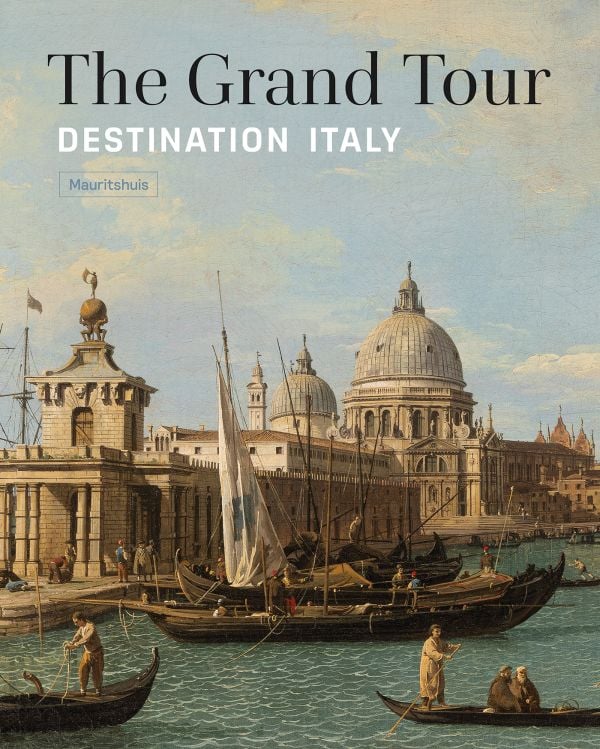
The cover of the catalogue includes a detail of Canaletto’s View of the Grand Canal in Venice, Looking West, with the Dogana di Mare and the Santa Maria della Salute, ca.1730–40 (Woburn Abbey).
Woburn Abbey: Obsession with Venice
The Grand Tour is synonymous not only with Rome, but also with Venice. John Russell, who became the 4th Duke of Bedford in 1735, visited the city on his Grand Tour (1730–31). Like many young aristocrats, he wanted a permanent memento to take home with him, and what could be more appropriate than a cityscape by Canaletto, the leading painter of 18th-century Venice? Eventually, John Russell commissioned an entire series comprising more than 24 paintings, the largest series of Canalettos still in existence. The paintings normally hang in the dining room at Woburn Abbey, the ancient family seat of the Russells.
The Grand Tour
These days many youngsters take a ‘gap year’ after high school, but a Grand Tour could easily last several years. Italy was the ultimate destination, with Rome, Florence, Naples, and Venice as the absolute highlights. En route, travellers would learn about art, architecture and culture, and collect artworks for their stately homes in England, just as we take back souvenirs nowadays. Yet these trips were not always innocent and high-minded. They are also known for their less salubrious distractions, including gambling and lustful pleasures. To keep the young men on the straight and narrow, they would be accompanied by chaperones. Such a ‘private tutor’ would mockingly be known as a ‘bear leader’. From the 18th century onwards, women also increasingly did the Grand Tour, sometimes with their entire family. The Napoleonic Wars (1803–15) brought the tradition of the Grand Tour to an end. In the 19th century, the advent of the steam train changed travel for good.
The catalogue is distributed by ACC Art Books:
Ariane van Suchtelen, The Grand Tour: Destination Italy (Waanders & de Kunst Publishers, 2025), 112 pages, ISBN: 978-9462626461, $45.
New Book | Travel Stories and the Eastern Adriatic
From The Institute of Art History at Zagreb:
Katrina O’Loughlin, Ana Šverko, and Elke Katharina Wittich, eds., Travel Stories and the Eastern Adriatic with a Section about the Travels of Thomas Graham Jackson (Zagreb: The Institute of Art History, 2025), 296 pages, ISBN: 978-9537875466, €20.
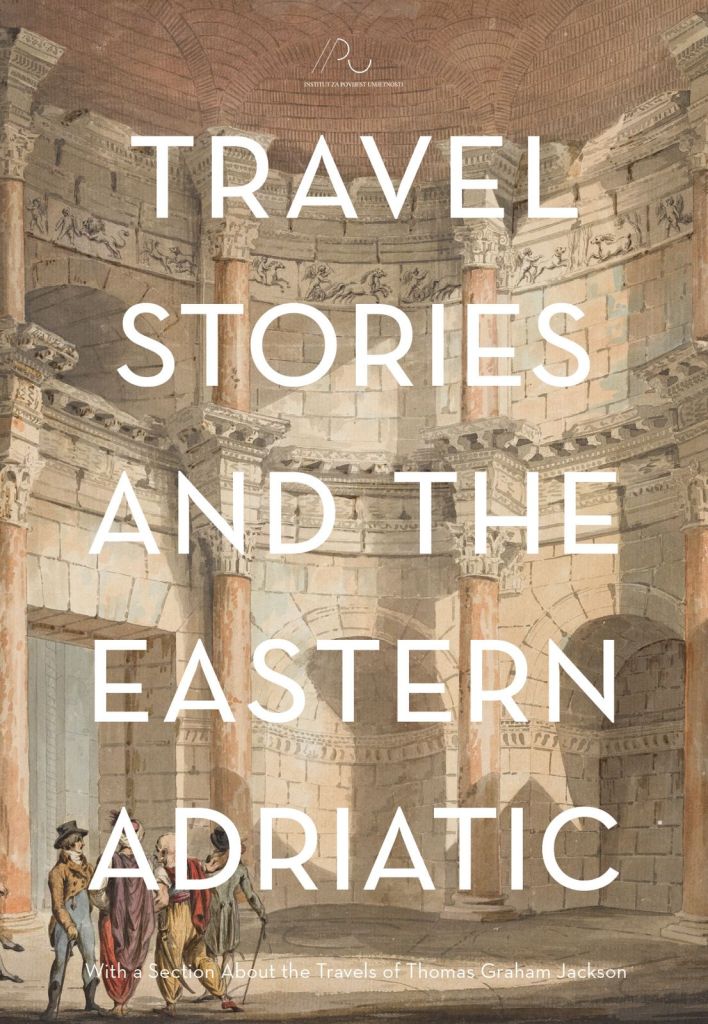 Travel Stories is the fourth collection of selected papers from a series of annual academic conferences held at the Institute of Art History – Cvito Fisković Centre in Split, which began in 2014. The current volume is a direct continuation of the book Discovering Dalmatia: Dalmatia in Travelogues, Images, and Photographs, published in 2019. The same editorial team and volume reviewers have this time grouped the selected papers from the Split conferences into two sections.
The first section, “Travellers and Travel Narratives,” brings together five papers related to travel narratives and the Eastern Adriatic over a broad timeline. These papers are authored by individuals from various backgrounds and discuss sources that include a variety of different media (lectures, drawings, books, photographs, diaries, letters), contributing to the exploration of the range of media used in travel narratives within this multimedia genre. The second section follows the Victorian architect Thomas Graham Jackson (1835–1924) on his journey along the eastern Adriatic coast, focusing on selected episodes from this trip, as described in his renowned three-volume work Dalmatia, the Quarnero, and Istria with Cettigne in Montenegro and the Island of Grado (Oxford, 1887), which is dedicated to the architectural and artistic heritage of this region.
The editorial process and publication of this book coincides with the first year of a new project funded by the Croatian Science Foundation, dedicated to Dalmatia and travel writing, ‘Where East Meets West’: Travel Narratives and the Fashioning of a Dalmatian Artistic Heritage in Modern Europe (c. 1675–1941), (Travelogues Dalmatia 2024–27).
c o n t e n t s
Acknowledgments
Ana Sverko — Preface: Exploring Genre, Place, and Travellers within the Travel Narrative
Section 1 | Travellers and Travel Narratives
• Frances Sands — Sir John Soane’s Lecture Drawings: A Virtual Grand Tour
• David McCallam — Carlo Bobba, Souvenirs d’un voyage en Dalmatie (1810): Travel, Empire, and Hospitality in the Early Nineteenth-Century Adriatic
• Ante Orlović — A Photographic Album with a Description of His Majesty the Emperor and King Franz Joseph I’s Tour through Dalmatia in 1875
• Boris Dundović and Eszter Baldavári — The Balkan Letters by Ernő Foerk: A Travelogue Mapping the Architectural Trajectories of Ottoman and Orthodox Heritage
• Dalibor Prančević and Barbara Vujanović — Ivan Meštrović’s Reflections from His Travels to the Middle East
Section 2 | Thomas Graham Jackson and the Eastern Adriatic
• Mateo Bratanić — Travellers, Historians, and Antiquaries: How Thomas Graham Jackson Wrote History in Dalmatia, the Quarnero, and Istria
• Krasanka Majer Jurišić and Petar Puhmajer — Thomas Graham Jackson and the Island of Rab
• Ana Torlak — Thomas Graham Jackson and Salona
• Sanja Žaja Vrbica — The Portrait of Dubrovnik by Thomas Graham Jackson
• Mateja Jerman — The Church Treasuries of Dalmatia and the Bay of Kotor through the Eyes of Thomas Graham Jackson
List of Illustrations
List of Contributors
Cover image: Soane office hand: Detail of a Royal Academy Lecture Drawing Showing an Interior View of the Temple of Jupiter at Diocletian’s Palace, Spalatro (Split), after Robert Adam, Ruins of the Palace of the Emperor Diocletian at Spalatro in Dalmatia (London 1764, plate 33), 1806–19 (London: Sir John Soane’s Museum, SM 19/11/1; Ardon Bar-Hama).
Call for Articles | Fall 2026 Issue of J18: Archipelago
From the Call for Papers:
Journal18, Issue #22 (Fall 2026) — Archipelago
Issue edited by Demetra Vogiatzaki and Catherine Doucette
Proposals due by 1 September 2025; finished articles will be due by 1 February 2026
“Antillean art,” remarked St. Lucian poet Derek Walcott upon receiving the Nobel Prize for Literature in 1992, “is this restoration of our shattered histories, our shards of vocabulary, our archipelago becoming a synonym for pieces broken off from the original continent.” Walcott’s Nobel lecture, “The Antilles: Fragments of Epic Memory”, offers a compelling meditation on the interplay between art, history, and the archipelago as a space of fragmentation, multiplicity, and interconnectedness. In dialogue with Walcott’s reflections, Italian philosopher and politician Massimo Cacciari has framed the rise of early Cycladic culture in the Aegean Sea as the archetype of sociocultural relationality in Europe, inviting a reconsideration of the Archipelago as a model of geographical, as well as political negotiations.
 As the eighteenth century witnessed the expansion of the trans-Atlantic slave trade and the anchoring of European empires across Atlantic, African, Indian, and Mediterranean archipelagic complexes, the insights of Walcott and Cacciari challenge us to rethink how eighteenth-century art and architectural practices in archipelagic spaces were shaped by tensions between isolation, connection, empire, displacement, autonomy, and exchange. While offering an opportunity to reconsider the intertwined histories of colonialism, slavery, and territorialism, focusing on archipelagic structures can help “decenter” Western narratives. An archipelagic perspective is also critical to understanding how island societies navigated and negotiated their cultural identities and agency outside, or in spite of, colonial structures.
This issue of Journal18 explores how archipelagic thinking informs the study of eighteenth-century art, architecture, and material culture. How might concepts of creolization, diaspora, and tidalectics, in the words of Kamau Brathwaite, reshape our understanding of artistic production and circulation? In the fragmentation of archival repositories, what can eighteenth-century objects and built environments made within archipelagic spaces reveal about the experiences of the people who lived there? How did eighteenth-century objects negotiate relationships between islands, oceans, and continents? How did artistic and architectural practices in the archipelago both reflect/reinforce and resist colonial power?
We encourage contributions that explore the metaphorical and material implications of the archipelago in artistic practices, cartography, and networks of exchange and use. We welcome interdisciplinary and innovative approaches to object study in the form of full-length articles or shorter pieces focused on single objects, interviews, or other formats.
To submit a proposal, send an abstract (250 words) and a brief biography to the following email addresses: editor@journal18.org, cd2bv@virginia.edu, and vogiatzaki@arch.ethz.ch. Articles should not exceed 6000 words (including footnotes) and will be due for submission by 1 February 2026. For further details on submission and Journal18 house style, see Information for Authors.
Issue Editors
Demetra Vogiatzaki, gta/ETH Zurich
Catherine Doucette, University of Virginia
Call for Papers | Character in Global Encounters with Architecture
This session is part of next year’s EAHN conference; the full Call for Papers is available here:
‘Character’ in Global Encounters with Architecture, 1700–1900
Session at the Conference of the European Architectural History Network, Aarhus, 17–21 June 2026
Chairs: Sigrid de Jong, Dominik Müller and Nikos Magouliotis
Proposals due by 19 September 2025
The eighteenth century was at once the period when Classical architecture was canonized in the Western world and beyond, and the moment when its supposedly universal ideal came into crisis. The study of competing practices and traditions of various medieval (Romanesque, Gothic, Byzantine) and vernacular architectures in Europe, and the allure of ‘Oriental’ styles (filtered through Turquerie and Chinoiserie) challenged the claims of Classicism, as did the encounters with different extra-European building traditions through travel and colonialism. These encounters prompted an avid preoccupation with cultural difference, as evidenced in Voltaire’s Essai sur les moeurs et l’esprit des nations (1756), Vico’s Principi di una scienza nuova d’intorno alla natura delle nazioni (1725–44), and Hume’s Of National Characters (1748).
Before the systematic global histories of architecture of the nineteenth century, and previous to the notion of style, Western authors employed a particular term to describe cultural specificity and difference: character. Stemming originally from the Greek word χαρακτήρ, its meaning evolved from the tool with which one carved signs on a wax or stone surface, over denoting these signs themselves, to the imprint these had on a reader or viewer. The distinctiveness of that impact, and the marks of identity of a whole culture in its environment and material culture, was encapsulated by its character. As such, from 1750 onwards the notion of character became ubiquitous in a variety of languages and was used in reference to people, buildings and landscapes, and shared across different genres of writing and scientific disciplines: from travel literature, political theory and ethnography, over treatises of art and architecture, to gardening manuals.
This session interrogates the architectural category of character in the globalizing world of the long eighteenth century, by zooming in on its meanings, implications, and complexities in moments of encounter between Western and non-Western cultures and architectures. We draw on recent inquiries into how Western travellers conceptualized non-Western architectures (Brouwer, Bressani, and Armstrong, Narrating the Globe, 2023), but also on works aiming to show how indigenous thinking conceptualized and criticized Western political and aesthetic norms (Graeber and Wengrow, The Dawn of Everything, 2021).
We are interested in instances of encounter addressing the following questions:
• How have Western accounts used the notion of character to describe non-Western architectures, building traditions, cultures, landscapes and places?
• How was the notion of character employed for architectures that challenged Western taxonomies and categorizations of architectural style?
• Which are the analogous notions in native languages that have been used to respond to encounters with Western architectures? How were these employed to process cultural specificity and otherness, and to describe, translate, acculturate or criticize Western cultural expressions (including mores and manners) from an indigenous perspective?
We welcome papers dealing with one or more of these questions in the period c. 1700–1900, across geographies. We are eager to discuss a variety of written, visual, and material sources, drawn from various disciplines, to expand the critical history of the term character beyond its well-established place in the history of European architectural theory.
Abstracts of no more than 300 words should be submitted by 19 September 2025 to sigrid.dejong@gta.arch.ethz.ch, nikolaos.magouliotis@gta.arch.ethz.ch, and mueller@arch.ethz.ch, along with the applicant’s name, email address, professional affiliation, address, telephone number, and a short curriculum vitae (maximum one page). Abstracts should define the subject and summarize the argument to be presented in the proposed paper. The content of that paper should be the product of well-documented original research that is primarily analytical and interpretative rather than descriptive in nature.
New Book | London: A History of 300 Years in 25 Buildings
Published last year by Yale UP, with a paperback edition due in September:
Paul Knox, London: A History of 300 Years in 25 Buildings (New Haven: Yale University Press, 2024), 448 pages, ISBN: 978-0300269208, $35.

A lively new history of London told through twenty-five buildings, from iconic Georgian townhouses to the Shard
A walk along any London street takes you past a wealth of seemingly ordinary buildings: an Edwardian church, modernist postwar council housing, stuccoed Italianate terraces, a Bauhaus-inspired library. But these buildings are not just functional. They are evidence of London’s rich and diverse history and have shaped people’s experiences, identities, and relationships. Paul L. Knox traces the history of London from the Georgian era to the present day through twenty-five surviving buildings. He explores where people lived and worked, from grand Regency squares to Victorian workshops, and highlights the impact of migration, gentrification, and inequality. We see famous buildings, like Harrods and Abbey Road Studios, and everyday places like Rochelle Street School and Thamesmead. Each historical period has introduced new buildings, and old ones have been repurposed. As Knox shows, it is the living history of these buildings that makes up the vibrant, but exceptionally unequal, city of today.
Paul Knox is an expert in the social and architectural history of London. Originally from the UK, he is now University Distinguished Professor at Virginia Tech. He is the author of Metroburbia: The Anatomy of Greater London; London: Architecture, Building, and Social Change; and Cities and Design.
New Book | The London Club: Architecture, Interiors, Art
Coming September from ACC Art Books:
Andrew Jones, with photographs by Laura Hodgson, The London Club: Architecture, Interiors, Art (New York: ACC Art Books, 2025), 288 pages, ISBN: 978-1788843294, $75.
 A stunning exploration of London’s most beautiful, interesting, and unusual members’ club architecture and interiors
London has more private members’ clubs than any other city, with new locations opening every year. The UK capital has exclusive clubs for everyone from plutocrats and bishops to jockeys and spies. Written by Andrew Jones, travel writer for the Financial Times and author of The Buildings of Green Park, this large-format picture book is richly illustrated with newly commissioned photographs by Laura Hodgson, covering 300 years of the capital’s architecture and interior design. The London Club: Architecture, Interiors, Art offers a fascinating take on the structures and decorations inside some of the most niche spots in London, giving readers a one-off glimpse into the hidden corners of the city’s social infrastructure.
Andrew Jones has lived in the heart of London clubland, on the border of Mayfair and St James’s, for almost 20 years. He is the author of The Buildings of Green Park, a tour of certain buildings, monuments and other structures in Mayfair and St. James’s, and a contributor to Seeing Things: The Small Wonders of the World according to Writers, Artists, and Others. He writes about cities for the Financial Times, and has also written on architecture for Blueprint, Drawing Matter, and The London Gardener, as well as pieces on London for The World of Interiors and the Londonist.
New Book | Castle Howard
Coming this fall, from Rizzoli:
Christopher Ridgway, with photographs by Mattia Aquila and Nicholas Howard, Castle Howard: A Grand Tour of England’s Finest Country (Paris: Flammarion, 2025), 364 pages, ISBN: 978-2080445865, £100 / $130.
 An exclusive tour of a famous English historic house—featured in period dramas including Bridgerton and Brideshead Revisited—set on acres of beautiful parkland and gardens.
The iconic architectural marvel Castle Howard is the epitome of English baroque magnificence. Nestled in the rolling hills of North Yorkshire, this grand estate was commissioned by Charles Howard, 3rd Earl of Carlisle, and masterfully crafted by Sir John Vanbrugh and Nicholas Hawksmoor in the early eighteenth century. The residence’s facades reveal Vanbrugh’s signature flair for the dramatic, while inside, extravagant frescoes, intricately carved stonework, and antique furnishings tell the captivating story of centuries of aristocratic elegance. Recent renovations, undertaken by American designer Remy Renzullo, have rejuvenated the castle’s bedrooms, merging history with contemporary opulence.
The domain’s sprawling parkland features meticulously landscaped gardens, a tranquil lake, a monumental neoclassical mausoleum and pyramids, and the breathtaking Atlas fountain. This comprehensive monograph explores the history of Castle Howard, its architecture, its gardens, and the generations of the Howard family who have lived there for more than three hundred years. Featuring previously unpublished archival documents, as well as photographs of the sumptuous interiors and art collections, this book is a celebration of a British national treasure, whose timeless beauty has captured the imagination of filmmakers for decades.
Christopher Ridgway, curator at Castle Howard since 1984, has lectured extensively on the history of country houses. He coauthored The Irish Country House: A New Vision (yeartk). Mattia Aquila is an interior design and architecture photographer. His photographs have appeared in Venice: A Private Invitation (2022) and Pierre Frey: A Family Legacy of Passion and Creativity (2023). Nicholas Howard manages Castle Howard with his wife, Victoria.
Call for Papers | Architecture and the Literary Imagination, 1350–1750
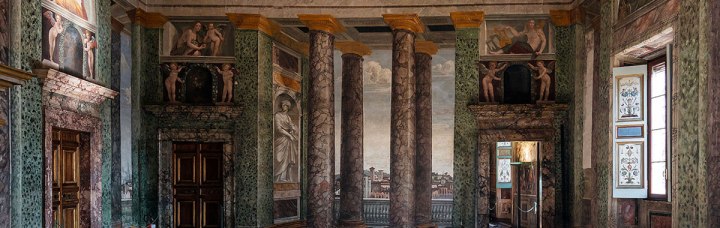
Hall of Perspectives, Villa Farnesina, frescoes painted by Baldassare Peruzzi, ca. 1510–16. Built for Agostino Chigi, the villa was acquired by the Farnese family in 1577.
◊ ◊ ◊ ◊ ◊
From ArtHist.net and the American University of Rome:
Architecture and the Literary Imagination, 1350–1750
American University of Rome, 6–8 November 2025
Organized by Fabio Barry and Paul Gwynne
Proposals due by 1 October 2025
Architecture and the Literary Imagination solicits conference papers that will broaden the repertoire of literary sources for understanding European architecture from around 1350 to 1750 and foster dialogue across disciplines. Architectural historians typically rely on histories for facts, and treatises for theories. A much wider range of texts records the reception of real buildings, the capacity to imagine fantastic ones, and the reciprocity between architecture and literature: poetry, dramaturgy, the picaresque novel, inauguration or consecration speeches, travelogues, epigraphy, and so on.
‘Architecture’ includes cities, civic buildings, palaces, villas, housing, individual rooms, gardens, grottoes, the constructions of nature itself, fountains, monuments, engineering, and decorations from vault painting to topiary. Our focus is largely Europe, but encompasses the Ottoman Empire, all territories ringing the Mediterranean basin, and descriptions of architecture transmitted by the global missions of the Church or travellers.
The source language may be in any vernacular, and we are also interested in Neo-Latin, Neo-Greek, and Classical Arabic as legacy languages of cultural transmission across history and borders. A particular theoretical concern is the intermedial relationship between immaterial words and solid buildings—however that may be defined.
A collection of essays from the conference will be published, subject to peer review, in an edited volume of the new book series, Architecture & the Literary Imagination (Harvey Miller Publishers, series editors, Fabio Barry and Paul Gwynne).
Papers will be 30 minutes in length and preferably in either English or Italian. Please send an abstract of 200 words by 1 October to Fabio Barry (rabirius@cantab.net) and Paul Gwynne (p.gwynne@aur.edu).
Call for Papers | Animals Inside
From ArtHist.net:
Animals Inside: A History of Objects and Furniture for Pets in Domestic Interiors
HEAD – Genève, Geneva, 17 November 2025
Organized by Javier Fernández Contreras and Youri Kravtchenko
Proposals due by 15 September 2025
The Master of Arts in Interior Architecture (MAIA) at HEAD – Genève studies the role of interior spaces in shaping contemporaneity, paying particular attention to human–non-human entanglements. This includes the dynamic relationships between humans and animals within the domestic sphere, a relationship that has transformed radically across time and geography.
This conference invites designers, architects, historians, researchers, artists, and theorists to explore the history of objects and furniture designed for pets in domestic interiors, from antiquity to today. We aim to investigate when and how animals entered the home, and more crucially, when their presence began to transform its design through specific furniture and objects created for their use.
From the ornately crafted birdcages of imperial courts to Victorian aquariums, and from today’s wall-mounted cat gyms to AI-powered talking buttons for dogs—these objects offer a unique lens through which to examine changes in domestic space, material culture, design, and our understanding of interspecies cohabitation.
We welcome contributions that
• Offer a 30-minute presentation based on original research or practice-based investigation
• Clearly specify the geographic and historical context of the case study
• Examine any type of non-human animal (birds, dogs, cats, fish, reptiles, etc.)
• Investigate any historical period, from ancient civilizations to contemporary design
• Address a range of objects and furnishings, such as aquariums, terrariums, bird cages, pet beds, perches, feeders, cat trees, wall gyms, litter furniture, wearables, communication devices, or smart pet furnishings
Please submit a proposal to javier.fernandez-contreras@hesge.ch and youri.kravtchenko@hesge.ch by 15 September 2025 with the following items:
• Title of your presentation
• Abstract (300–500 words)
• Biographical note (150 words)
• Affiliation and contact details
Call for Submissions | Metropolitan Museum Journal
Metropolitan Museum Journal 61 (2026)
Submissions due by 15 September 2025
The Editorial Board of the peer-reviewed Metropolitan Museum Journal invites submissions of original research on works of art in the Museum’s collection. The Journal publishes Articles and Research Notes. Works of art from The Met collection should be central to the discussion. Articles contribute extensive and thoroughly argued scholarship—art historical, technical, and scientific—whereas Research Notes are narrower in scope, focusing on a specific aspect of new research or presenting a significant finding from technical analysis, for example. The maximum length for articles is 8,000 words (including endnotes) and 10–12 images, and for research notes 4,000 words (including endnotes) and 4–6 images. Articles and Research Notes in the Journal appear in print and online, and are accessible in JStor on the University of Chicago Press website.
The process of peer review is double-anonymous. Manuscripts are reviewed by the Journal Editorial Board, composed of members of the curatorial, conservation, and scientific departments, as well as scholars from the broader academic community. Submission guidelines are available here. Please send materials to journalsubmissions@metmuseum.org. The deadline for submissions for Volume 61 (2026) is 15 September 2025.










 Enfilade
leave a comment