Thomas Campbell to Direct the Fine Arts Museums of San Francisco
From the FAMSF press release (30 October 2018). . .

Photo by Scott Rudd; courtesy Fine Arts Museums of San Francisco.
The Board of Trustees of the Fine Arts Museums of San Francisco (FAMSF) and the Corporation of the Fine Arts Museums (COFAM) today appointed Thomas P. Campbell as the new director and CEO of the largest public arts institution in Northern California, effective 1 November 2018. As head of FAMSF, which comprise the de Young museum in Golden Gate Park and the Legion of Honor in Lincoln Park, Mr. Campbell will oversee a wide-ranging curatorial program and education programs and will manage a staff of more than 500.
“I am deeply gratified to take up the responsibility of leading the Fine Arts Museums of San Francisco,” Campbell said. “It is a great privilege to become part of an institution with such outstanding curatorial expertise and famously loyal audiences and supporters, and I am especially pleased to have the opportunity to continue the great work done by my friend and predecessor Max Hollein. I am eager to begin collaborating with the Trustees, the staff, and the entire cultural network of San Francisco.”
Mr. Campbell served as Director and CEO of The Metropolitan Museum of Art from 2009 to 2017, having joined the Met as a curator in 1995. During his tenure at the Met, he led a revitalization and modernization achieved through award-winning exhibitions and publications, major capital projects, and historic donations of works of art. Attendance grew by more than 50 percent to a record seven million visitors a year, with audiences that are now more diverse than ever before.
Most recently, from November 2017 through October 2018, he was a Getty/Rothschild Fellow with residencies at the Getty Research Institute in Los Angeles and at Waddesdon Manor in the UK, undertaking independent study of the impact of global changes on museums and cultural life in general. . . .
Over his thirty-year career, Mr. Campbell has dedicated his life to the preservation, study and promotion of art as a gateway to human understanding. A distinguished art historian who was educated at Oxford and the Courtauld Institute, University of London, he joined the Metropolitan Museum of Art in 1995 as an assistant curator in the Department of European Sculpture and Decorative Arts and supervising curator of the Antonio Ratti Textile Center. As curator, he conceived and organized the acclaimed exhibitions Tapestry in the Renaissance: Art and Magnificence (2002) and Tapestry in the Baroque: Threads of Splendor (New York, 2007; Madrid, 2008). The 2002 exhibition was named ‘Exhibition of the Year’ by Apollo Magazine, and its catalogue won the Alfred H. Barr, Jr. Award (College Art Association) for distinguished exhibition catalogue in the history of art (2003). His book, Henry VIII and the Art of Majesty: Tapestries at the Tudor Court, a reappraisal of the art and patronage of the era, was published in 2007.
During his tenure as Director, he elevated the Met’s national and international profile through conservation exchanges in the Middle East and India, ambitious loan exhibitions in China, Japan and Brazil, the launching of a biannual global museum directors’ colloquium, and a new international donor council.
Exhibition | Sidesaddle, 1690–1935

Johan Zoffany, The Drummond Family, detail, ca. 1769, oil on canvas, 41 × 63 inches
(New Haven: Yale Center for British Art, Paul Mellon Collection)
◊ ◊ ◊ ◊ ◊
On view at the National Sporting Library & Museum:
Sidesaddle, 1690–1935
National Sporting Library & Museum, Middleburg, VA, 8 September 2018 — 24 March 2019
Curated by Ulrike Weiss and Claudia Pfeiffer
In art and sport, the poised equestrian riding aside embodies the essence of elegance, power, and grace. Hidden beneath the flowing skirts of the rider is the sidesaddle, the design of which has evolved dramatically in response to the physical demands of sporting women (and sometimes men) requiring a firm seat as they began to meet the challenges of jumping and galloping across the countryside.
Sidesaddle, 1690–1935 presents a revealing perspective on the history and culture of women as equestrians, their depictions in sporting art, and the evolution of sidesaddle tack and attire represented in British, Continental, and American art from the 17th to the 20th centuries. The exhibition showcases over sixty paintings, works on paper, and sculptures on loan from museums and private collections. Co-curators Dr. Ulrike Weiss, Lecturer at the University of St. Andrews in Scotland, and Claudia Pfeiffer, the George L. Ohrstrom, Jr. Curator of Art at NSLM, are contributing essays to the accompanying catalog.
Ulrike Weiss and Claudia Pfeiffer, Sidesaddle, 1690–1935 (Middleburg: National Sporting Library & Museum, 2018), ISBN: 978-0996890540, $25.
OpEd | HECAA at 25 Conference Recap
Back home from the HECAA at 25 Conference in Dallas, I feel my mind still whirling from what was perhaps the best conference I’ve ever attended. As strange as it may sound, a previous contender for me had been CSECS 2001 in Saskatoon, which included an extraordinary panel on ‘Post-Mortem Investigations: Then and Now’, organized around Samuel Johnson’s autopsy, a session that included not only Anita Guerrini, Helen Deutsch, and John Bender but also medical doctors and a dissected corpse(!), all with an eye toward anatomical similarities and differences across the eighteenth and twenty-first centuries. The HECAA at 25 Conference brought the past and present into conversation in no less compelling ways, even with no cadaver. Indeed, I’m left with a clear distillation of something like pure vitality.
Having edited Enfilade since 2009, I’m aware of how irregular it is for me to chime in with anything more than a few words introducing a posting. From the start, I was keen to build a platform for the sharing of news related to the long eighteenth century with a very light editorial voice. In 2009 blogs were often derided as self-indulgent means for sharing breakfast and shampoo preferences, and I was set on staying out of the way. If it was clear to me that there were lots of exciting things happening in the field of eighteenth-century art, architecture, and visual studies, it was equally true that we as scholars were doing a particularly bad job of telling others (even ourselves) about those exciting things. Building out that communication piece seemed like a useful service to HECAA.
Rather stupidly, I hadn’t grasped that the nature of the web would very quickly transform a communication mechanism built for a small organization into one with a world-wide audience. And yet, if HECAA members constitute only a small minority of Enfilade readers, the connection between the platform and the organization remains important. And that’s why I feel compelled to report back about the conference. The views shared here are entirely my own as I am in no way speaking for the organization. And crucial, I think, for everyone reading—even if you aren’t a HECAA member—the successes of the conference readily pertain to other academic events.
Three things stand out for me: coherence of the program, communicative opportunities thoughtfully embedded into the schedule, and connections with extraordinary works of art and artifacts added not simply as incidental after-thoughts. First, the very simple decision to include no concurrent sessions meant that participants had a shared experience over the course of the three or four days. It meant that sessions unfolded as part of an ongoing conversation. It meant that the usual conference chaos resulting from choices (where am I trying to go? What did you just hear? You should have been in that session!) was entirely abrogated. Revelatory plenary addresses by Melissa Hyde and Daniela Bleichmar weren’t exceptional events that brought everyone together but extended versions of the kinds of talks others gave (amazing talks actually), with all of us engaged together. Second, time for good conversations, in a variety of settings, was carefully planned. Along with the usual coffee and lunch breaks, there were lively receptions, a boisterous evening of food and drink (with the restaurant all to ourselves and dinner served family style), and as an experiment of sorts, structured break-out sessions with preassigned groups. The efficacy of the group discussions presumably varied, but the activity stands out for me as hugely successful. Some of the most interesting ideas I heard discussed all weekend came out there (thanks goes not only to my group’s facilitators Amber Ludwig and Susanna Caviglia but also Aaron Wile for asking an opening question that couldn’t have been more effective). Third, time for looking at art was built into the schedule, with opportunities for exploring the strong holdings of the Meadows Museum, the Dallas Museum of Art, and the Kimbell Art Museum. How many art historical conferences have I attended where actual art was absent from the schedule? Too many.
All three qualities are widely applicable, and organizers should consider them. But there’s another crucial point to all of this, and it’s central to why I’m writing: the conference worked because HECAA is an amazing community of scholars. The final session on Saturday was aimed at thinking about the future of the field of eighteenth-century art studies. It was thought-provoking and (interestingly) the point at which some of the most significant points of difference emerged. To that conversation, I would like to add a modest addendum. For any discussion of what the ‘field’ might best do in the next five, ten, or twenty-five years is necessarily premised on there being a community to do that work. And here, I’m careful not to conflate HECAA with the whole study of eighteenth-century art and architecture (readers of Enfilade prove the point). But it’s no small matter to build a vibrant academic society characterized by goodwill, intellectual hospitality, and the nurturing of scholars along all stages of a career.
That should be celebrated, even as it also bestows responsibilities, obligations to both the present and the future. Organized by Amy Freund—brilliant and indefatigable—the conference underscores the impact an individual can have for a community (with thanks to all who served on the organizing committee). Taking a long view, HECAA has benefited tremendously from founding members who have remained committed to the organization for decades. The impact of Mary Sheriff was profound. I also can’t help mentioning Michael Yonan, who deserves the lion’s share of credit for what the organization has become; he was an enormously effective president at a time when things could have taken a rather different turn. Other officers—treasurers Jennifer Germann and Christina Lindeman and our current president Amelia Rauser—have been adept and sagacious. J18, an online journal affiliated with HECAA, launched by Noémie Etienne, Meredith Martin, and Hannah Williams offers another example of a few people making a huge contribution.
My point is that scholarship—whether conducted by the university professor, the museum curator, or the independent scholar—is a communal activity. My plea as we think forward to the future of HECAA is how to further cultivate that conviviality. I want to say very clearly that HECAA’s health didn’t just happen; examples of numerous academic organizations, big and small, in decline reinforce the point. As conversations happen around delineating future goals and projects, I would here note just one priority that resonates for me (admittedly one among several): widening the membership base with an egalitarian eye toward inclusion. The future of higher education will depend not only on tenured-track positions but ever growing numbers of affiliated faculty and adjuncts. I deeply want HECAA to be an intellectual home for independent scholars, for instructors at community colleges, a welcome place not only for curators at large museums but also directors of small house museums and members of the heritage community, for scholars who will have limited travel budgets for conferences. The goal is perfectly aligned with the core values of the organization. Conversations, for example, about how or why everyday museum visitors may feel comfortable or uncomfortable, at home or alienated by eighteenth-century exhibitions go directly to questions of higher education and the museum landscape broadly conceived. I want the field to matter not only for students at a prestigious liberal arts college or an R1 university, and part of that project means building out a wider community of scholars and museum professionals. Addressing how the eighteenth century matters today requires us to attend to questions of audience, constituency, and sociability.
The HECAA at 25 Conference manifestly demonstrated the organization’s capacity to be a profoundly supportive, stimulating community. Thanks to all of you who have helped forge that community. Thanks to all of you who were there in Dallas for such an extraordinary conference.
–Craig Hanson
Journal18, #6 Albums (Fall 2018)
The sixth issue of J18 is now available:
Journal18, Issue #6: Albums (Fall 2018)
The Culture of Albums in the Long 18th Century
Issue Editor: Nebahat Avcıoğlu
 Selecting, collecting, classifying, curating, displaying, narrating, disseminating, transporting, entertaining, educating, subverting: what other single object does all of that at once? Ordering knowledge through the rationale of a sequenced and empirical display of data (visual, textual, material), the album became an archetypical site of the eighteenth century’s way of thinking about and representing the world. Neither a treatise implementing a master-hypothesis nor a random gathering of material, albums can be described as both hybrid and structured objects. They have the physical structure of a book and the appearance of a narrative but are also sheer displays, a rhetorical organization of iconic discourses and a virtual folding or unfolding of larger ideas with specific agendas. They simultaneously contain pictorial imagery (paintings, drawings, pressed flowers, cut-ups, etc.) and are themselves artistic creations. They provide microcosmic and portable representations of a polity, a culture, or an individual. Unexpected mixtures of media and topics also invite us to think through hybrid regimes of readability, visibility and seriality. Often studied for their contents rather than as creations in their own right, albums raise many important questions regarding their status as archival or museum objects. Their contrived nature makes them ideal objects to be studied in terms of social practice, identity politics and interconnectedness as they invoke relationships, compositions and collectivity.
As the contributors to this issue of Journal18 amply demonstrate, albums offer a very fertile ground for probing the material and intellectual productivity of cultures. Marta Becherini brings to our attention a bewildering universe of Deccani effigies, bound into albums, and their European clientele, while Gwendolyn Collaço introduces us to an elusive Ottoman consumer of local (and thus more affordable) albums. Louise Voll Box delves into the mind and hands of an album-maker to show how the album becomes a site for the material experience of collecting. In a different vein, Freya Gowrley explores the emotional charge of British and American albums through the use of sentimental imagery. Both Kee Il Choi Jr and Anastassiia Alexandra Botchkareva, one focusing on albums of Chinese vases, the other on Persianate albums, discuss how albums work iconographically and as an editing table of sorts for the eighteenth-century connoisseur.
Along with the six articles, the issue features two shorter pieces in “Notes & Queries.” Madeleine Pelling looks at the role of albums in women’s relationships in “Crafting Friendship: Mary Delany’s Album and Queen Charlotte’s Pocketbook,” and Natalia Di Pietrantonio examines the global mobility of albums in “Circuits of Exchange: Albums and the Art Market in 18th-Century Avadh.”
I N T R O D U C T I O N
The Culture of Albums in the Long 18th Century
Nebahat Avcıoğlu
A R T I C L E S
Ancien vs Antique: Henri-Léonard Bertin’s Albums of the Qianlong Emperor’s ‘Vases Chinois’
Kee Il Choi Jr
Albums of Conspicuous Consumption: A Composite Mirror of an 18th-Century Collector’s World
Gwendolyn Collaço
Reflective and Reflexive Forms: Intimacy and Medium Specificity in British and American Sentimental Albums, 1800-1860
Freya Gowrley
Effigies in Transit: Deccan Portraits in Europe at the Turn of the 18th Century
Marta Becherini
Marks and Meanings: Revealing the Hand of the Collector and ‘the Moment of Making’ in Two 18th-Century Print Albums
Louise Voll Box
Topographies of Taste: Aesthetic Practice in 18th-Century Persianate Albums
Anastassiia Alexandra Botchkareva
N O T E S & Q U E R I E S
Circuits of Exchange: Albums and the Art Market in 18th-Century Avadh
Natalia Di Pietrantonio
Crafting Friendship: Mary Delany’s Album and Queen Charlotte’s Pocketbook
Madeleine Pelling
Cover image: Raynal, Figures Naturelles de Turquie, 1688, red leather, in 4º (Paris, Bibliothèque nationale de France, gallica.bnf.fr / BnF).
New Book | Chinese Porcelain in Colonial Mexico
From Palgrave Macmillan:
Meha Priyadarshini, Chinese Porcelain in Colonial Mexico: The Material Worlds of an Early Modern Trade (London: Palgrave Macmillan, 2018), 198 pages, ISBN: 978-3319665467, £79 / $99.
 This book follows Chinese porcelain through the commodity chain, from its production in China to trade with Spanish Merchants in Manila, and to its eventual adoption by colonial society in Mexico. As trade connections increased in the early modern period, porcelain became an immensely popular and global product. This study focuses on one of the most exported objects, the guan. It shows how this porcelain jar was produced, made accessible across vast distances and how designs were borrowed and transformed into new creations within different artistic cultures. While people had increased access to global markets and products, this book argues that this new connectivity could engender more local outlooks and even heightened isolation in some places. It looks beyond the guan to the broader context of transpacific trade during this period, highlighting the importance and impact of Asian commodities in Spanish America.
Meha Priyadarshini is Fellow at the Sciences Po Europe-Asia Programme in Le Havre, France. Her research and teaching interests include global history, material culture studies, colonial Latin American history, and art history. She earned her PhD from Columbia University and has held fellowships at the Getty Research Institute, the European University Institute, and the Kunsthistorisches Institut in Florence.
C O N T E N T S
Introduction
Crafting a Global Brand: Jingdezhen and Its Artisans in the Early Modern World
From Junk to Galleon: Commercial Activity in Manila
A Parián in the Plaza Mayor: Making Space for Asia in Colonial Mexico
Blue-and-white Chocolateros: Crafting a Local Aesthetic in a Colonial Context
Conclusion: Themes from a Connected World
Vanessa Alayrac-Fielding’s review of the book for J18 (October 2018) is available here.
New Acquisitions at the McNay Art Museum
Press release (30 October 2018) from the McNay Art Museum in San Antonio:
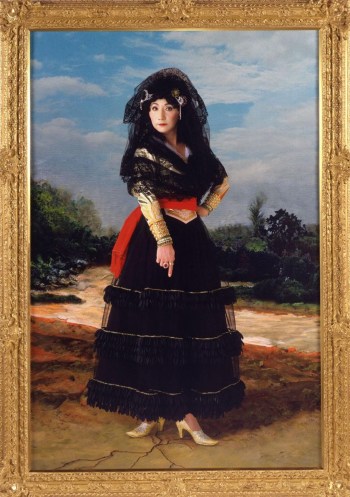
Yasumasa Morimura, ‘Dedicated to La Duquesa de Alba/Black Alba’, 2004, chromogenic print, mounted on canvas (San Antonio: Collection of the McNay Art Museum, 2018.33, ©Yasumasa Morimura).
Richard Aste, Director of the McNay Art Museum, announced today the acquisition of two major works that broaden the McNay’s permanent collection of contemporary art: Dedicated to La Duquesa de Alba/Black Alba by Yasumasa Morimura and Robert by James Gobel.
Funds for these newly acquired works of art were generated by the McNay Contemporary Collectors Forum. The McNay Contemporary Collectors Forum (MCCF) supports contemporary art at the McNay and builds bridges between the Museum and San Antonio’s vibrant art community. In addition to other programs, MCCF initiated the Artists Looking at Art series, which features four artists each year and displays their work in the Museum for three months. MCCF also hosts an annual fundraising event each fall that directly supports the McNay’s art acquisition fund.
“We are thrilled to include the vision of Morimura and Gobel in the collection of the first modern art museum in Texas,” said Aste. “Their works expand the canon of art history and new ideals of beauty and truth in the 21st century.”
“These particular acquisitions enhance two expanding priorities of the McNay’s contemporary holdings—an increasing global presence and greater emphasis on under-recognized communities,” said Head of Curatorial Affairs René Paul Barilleaux. “Together with other judicious purchases made by MCCF since 2003, these artworks demonstrate the ever-expanding ways in which artists communicate their vision through content, subject, materials, and presentation.”
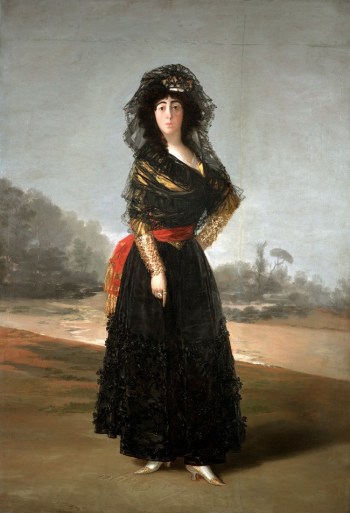
Francisco de Goya, ‘Mourning Portrait of the Duchess of Alba’ (‘The Black Duchess’), 1797, oil on canvas, 77 × 51 inches (New York Hispanic Society).
Both newly acquired works of art will be featured in the McNay’s major summer 2019 exhibition, Transamerica/n: Gender, Identity, Appearance Today. Presented in tandem with Andy Warhol: Portraits and following Warhol’s lead, Transamerica/n is a broad survey of works by visual artists, performers, and self-identified artists who explore gender identity as manifest in outward appearance, individual presentation, and societal perception.
Yasumasa Morimura was born in Osaka, Japan in 1951, and received a BA from Kyoto University of Art in 1978. Morimura is featured in the collections of Carnegie Museum of Art, Pittsburgh; The Museum of Contemporary Art, Los Angeles; The Museum of Fine Arts, Boston; The Museum of Fine Arts, Houston; The San Francisco Museum of Modern Art; and Whitney Museum of American Art, New York. Morimura has composed works of art by referencing seminal paintings by Frida Kahlo, Vincent Van Gogh, Diego Velázquez, and Francisco de Goya, as well as images culled from historical materials, mass media, and popular culture. The artist’s first solo-exhibition at the Japan Society, New York, Yasumasa Morimura: Ego Obscura, is on view through January 13, 2019.
Through extensive use of props, costumes, makeup, and digital manipulation, Morimura masterfully transforms himself into recognizable subjects, often from the Western cultural canon. In Dedicated to La Duquesa de Alba/Black Alba, a self-portrait, Morimura draws reference from Francisco de Goya’s 1797 painting of María Cayetana de Silva, 13th Duchess of Alba. Painted the year after the Duke’s death, this portrait of the Duchess depicts her in mourning black, wearing the traditional costume of a maja. The artist’s reinvention of art historical masterpieces and iconic photographs challenges associations the viewer has with the subjects, while also commenting on Japan’s complex absorption of Western culture.
James Gobel received his BFA in Photography from the University of Nevada, Las Vegas in 1996 and his MFA in Painting from the University of California, Santa Barbara in 1999. Gobel’s work has been featured in Artforum, Art in America, Flash Art, the New York Times, the Los Angeles Times, as well as the Leslie-Lohman Museum of Gay and Lesbian Art, New York (2014); Las Vegas Art Museum (2008); New Museum, New York (2005); and Hammer Museum, Los Angeles (2000).
Gobel begins his process with photographs, either posed or found, and proceeds to make drawings in pencil and yarn, then composes a mosaic of felt pieces. When viewed from a distance, the McNay’s newly acquired work, Robert, could be mistaken for an oil painting, but upon further inspection reveals a fuzzy, warm texture of delicately placed felt. Robert references Giovanni Battista Moroni’s The Tailor (‘Il Tagliapanni’), 1565–70. Although inspired by traditional portraiture, the artist’s interpretation questions the lack of visibility given to heavyset, homosexual bodies. Gobel’s portraits of zaftig male figures blend references to art history with gay culture and break down boundaries between masculine and feminine.
Rijksmuseum Fellowship Programme, 2019–20
Rijksmuseum Fellowship Programme, 2019–20
Applications due by 20 January 2019
The Rijksmuseum welcomes international, independent research proposals that open new perspectives on the museum’s collection, its history, and activities. The purpose of the Rijkmuseum Fellowship Programme is to encourage and support scholarly investigation, and to contribute to academic discourses while strengthening bonds between the museum and universities. The programme enables highly talented candidates to base part of their research at the Rijksmuseum, and offers access to the museum’s expertise, collections, library and laboratories. Furthermore, the programme facilitates opportunities for Fellows to engage in workshops and excursions to encourage exchange of knowledge—both among themselves and the broader museum audience.
Please review the eligibility, funding, and application requirements by visiting the Rijksmuseum website. For the 2019–20 academic year, candidates can apply for
• Andrew W. Mellon Fellowship for art historical research – apply here
• Johan Huizinga Fellowship for historical research – apply here
• Migelien Gerritzen Fellowship for conservation research – apply here
• Anton C.R. Dreesmann Fellowship for art historical research – apply here
The closing date for all applications is 20 January 2019, at 6:00pm (Amsterdam time/CET). No applications will be accepted after this deadline. All applications must be submitted online and in English. Applications or related materials delivered via email, postal mail, or in person will not be accepted. Selection will be made by an international committee in February 2019. The committee consists of eminent scholars in the relevant fields of study from European universities and institutions, and members of the curatorial and conservation staff of the Rijksmuseum. Applicants will be notified by 15 March 2019. All Fellowships will start in September 2019.
Further information and application forms are available here. For questions concerning the application procedure, contact Roos Staats, Coordinator of the Fellowship Programme (r.staats@rijksmuseum.nl).
Conference | HECAA at 25
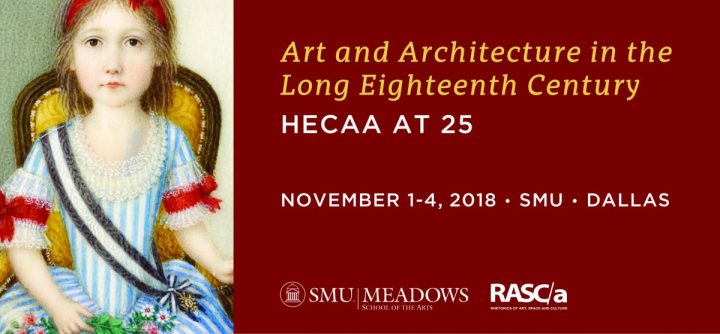
Francisca Efigenia Meléndez y Durazzo, Portrait of a Girl, ca. 1795, tempera on ivory, 5 × 5 cm (Dallas: Meadows Museum, SMU, Museum Purchase with funds from The Meadows Foundation, MM.08.01.20)
Happening now at SMU!
Art and Architecture in the Long Eighteenth Century: HECAA at 25
Southern Methodist University, Dallas, 1–4 November 201
Organized by Amy Freund
The Art History Department, its graduate program in the Rhetorics of Art, Space, and Culture (RASC/a), and the Meadows School of the Arts at Southern Methodist University are proud to announce the program for Art and Architecture in the Long Eighteenth Century: HECAA at 25, a conference to be held 1–4 November 2018 in celebration of the twenty-fifth anniversary of the founding of the Historians of Eighteenth-Century Art and Architecture.
T H U R S D A Y , 1 N O V E M B E R 2 0 1 8
9:00 Welcome and HECAA Business Meeting
10:15 Roundtable: The History of Studying Eighteenth-Century Art, the Belgium of Art History
Chair: Michael Yonan, (University of Missouri)
• Wendy Wassyng Roworth (University of Rhode Island)
• Malcolm Baker (University of California, Riverside)
• Heather McPherson (University of Alabama at Birmingham)
• Meredith Gamer (Columbia University)
• Kevin Chua (Texas Tech University)
• Sarah Betzer (University of Virginia)
1:15 Research Session: Apprehending the Spatial: Methods and Approaches
Chair: Christopher Drew Armstrong (University of Pittsburgh)
• Lauren Cannady (Clark Art Institute), The Garden in a Curiosity Cabinet
• Laurel O. Peterson (The Morgan Library & Museum), Making Spaces: Immersive Politics and the Murals at Chatsworth
• Stacey Sloboda (University of Massachusetts, Boston), St. Martin’s Lane: Neighborhood as Art World in Eighteenth-Century London
2:45 Coffee Break
3:00 Research Session: Carte Blanche
Chair: Denise Baxter (University of North Texas)
• Nina Dubin (University of Illinois at Chicago), Master of the World: Love and Other Inconstancies in Eighteenth-Century French Art
• Jessica Priebe (University of Sydney), Assembling Ambition: Leroy de Barde and the Reimagining of the Artist’s Museum in the Long Eighteenth Century
• Andrew Graciano (University of South Carolina), An Eighteenth-Century Electrical Machine and the Re-Identification of a Portrait Subject in the National Portrait Gallery, London
4:45 Buses Depart to Dallas Museum of Art
5:30 Cocktail Reception
Hosted by the Edith O’Donnell Institute of Art History, University of Texas at Dallas
7:00 Keynote Address / Michael L. Rosenberg Lecture
Horchow Auditorium, DMA
• Melissa Hyde (University of Florida), Knowing Their Place? Women Artists in Eighteenth-Century France
F R I D A Y , 2 N O V E M B E R 2 0 1 8
9:00 Research Session: People, Places, and Things in the Global Eighteenth Century
Chair: Nancy Um (Binghamton University)
• Elisabeth Fraser (University of South Florida), The Ottoman Costume Album as Agent of Contact in the Global Eighteenth Century
• Irene Choi (University of British Columbia), ‘The Principle of Things’: Materiality and Morality from Dutch Still Life to Korean Chaekgeori
• Dipti Khera (New York University), Connected, Yet Dispersed: Pictures, Places and Histories of Art, ca. 1700
• Dawn Odell (Lewis and Clark College), Chinese Art and a South Carolina Rice Plantation
10:45 Coffee Break
11:00 Roundtable: Innovation in Teaching, Advising, Exhibiting, and Curating
Chair: Amelia Rauser (Franklin & Marshall College)
• Lilit Sadoyan (J. Paul Getty Museum)
• Kelsey Brosnan (New Orleans Museum of Art)
• Wendy Bellion (University of Delaware)
• David Pullins (Frick Collection) )
• Amelia Rauser (Franklin & Marshall College)
12:30 Lunch
2:00 Research Session: Emerging Scholars 1
Chair: Christopher Johns (Vanderbilt University)
• Danielle Ezor (Southern Methodist University), A Restaurant at the Salon: Consuming Chardin’s Still Lifes
• Ashley Bruckbauer (University of North Carolina, Chapel Hill), Dangerous Liaisons: Ambassadors and Embassies in Eighteenth-Century French Art
• Delanie Linden (Massachusetts Institute of Technology), Silver, Flesh, and Holy Water: Colonial Conversions in the French Enlightenment
• Thea Goldring (Harvard University), The Imagined Machine of the Encyclopédie Planches
3:15 Coffee Break
3:30 Research Session: Emerging Scholars 2
Chair: Christopher Johns (Vanderbilt University)
• Katherine Calvin (University of North Carolina, Chapel Hill), Merchants, Markets, and Cultural Contact in Early Modern Aleppo
• Vincent Pham (University of California, San Diego), Self-Made Men: Lord Chesterfield and His Library Portraits
• Ji Eun You (University of North Carolina, Chapel Hill), Interpretation of Neoclassical Designs in Decorative Art through Winckelmann
• Hyejin Lee (University of North Carolina, Chapel Hill), Perfumed Flights of Imagination: Reverie, Ornaments, and Elite Female Identity in Late Eighteenth-Century Boudoirs
4:45 Meadows Gallery Visit
5:15 Research Session: Things Change
Chairs: Wendy Bellion (University of Delaware) and Kristel Smentek (Massachusetts Institute of Technology)
• Jeffrey Collins (Bard Graduate Center), Repair or Reinvention? Recreating the Red Faun
• Tara Zanardi (Hunter College), Artful Nature and Material Splendor: The Dauphin’s Collection at the Royal Cabinet of Natural History
• Susan Wager (University of New Hampshire, Durham), The Sweet Hereafter: The Multiple Lives of Boucher’s Biscuit Porcelain Figures
• Jennifer Chuong (Harvard University), Wood in Transition: Veneer Furniture in the Early American Republic
7:15 Buses depart Meadows Museum for Bolsa
7:30 Dinner at Bolsa, 614 West Davis Street, 75208
S A T U R D A Y , 3 N O V E M B E R 2 0 1 8
9:00 Keynote Address
• Daniela Bleichmar (University of Southern California), Painting and the Time and Place of History
10:30 Recent Acquisitions in Eighteenth-Century Menswear from the Texas Fashion Collection
• Annette Becker (Director, Texas Fashion Collection at University of North Texas)
11:00 Breakout Sessions
Participants will convene in small pre-assigned groups for discussion.
12:30 Roundtable: How to Art History: A Workshop for Emerging Scholars
Chair: Elizabeth Bacon Eager (Southern Methodist University)
• Michael Yonan (University of Missouri)
• Nicole Myers (Dallas Museum of Art)
• Kimberly Chrisman-Campbell (Independent Scholar)
Come with questions about job hunting, professional networking, publishing, and balancing life and work. Boxed lunches provided for preregistered guests.
2:00 Research Session: Art and Political Authority in the Long Eighteenth Century
• Meredith Martin (New York University) and Aaron Wile (University of Southern California)
• Sarah Grandin (Harvard University), Font Fit for a King: The Romain du Roi, Print, and the Mechanical Arts under Louis XIV
• Douglas Fordham (University of Virginia), Free Market Patriotism
• Ünver Rüstem (Johns Hopkins University), Ottoman Baroque Architecture and the Aesthetics of Power
• Jennifer Van Horn (University of Delaware), Slavery and Portraiture in a New Nation
3:45 Coffee Break
4:00 Roundtable: The Future of Studying Eighteenth-Century Art: HECAA at 50
Chair: Amy Freund (Southern Methodist University)
• Ewa Lajer-Burcharth (Harvard University)
• Cassie Mansfield (Penn State University)
• Catherine Girard (Eastern Washington University)
• Paris Spies-Gans (Harvard Society of Fellows)
• Andrei Pop (University of Chicago)
5:45 Closing Cocktail Reception
S U N D A Y , 4 N O V E M B E R 2 0 1 8
Afternoon at the Kimbell Art Museum, Fort Worth.
Organizing Committee
Denise Baxter (University of North Texas)
Kelly Donahue-Wallace (University of North Texas)
Lindsay Dunn (Texas Christian University)
Elizabeth Bacon Eager (Southern Methodist University)
Daniella Ezor (Southern Methodist University)
Amy Freund (Southern Methodist University)
Jessica Fripp (Texas Christian University)
Nicole Myers (Dallas Museum of Art)
Alexandra Perez (Southern Methodist University)
Beth S. Wright (University of Texas at Arlington)
Exhibition | Piqué at the Court of Naples

Giuseppe Sarao, Piqué Table, ca. 1730s
(Saint Petersburg: The Hermitage)
◊ ◊ ◊ ◊ ◊
From Galerie Kugel:
Piqué: Gold, Tortoiseshell, and Mother-of-Pearl at the Court of Naples
Complètement Piqué! Le fol art de l’écaille à la Cour de Naples
Galerie Kugel, Paris, 12 September — 8 December 2018
Galerie J. Kugel presents the first exhibition devoted to the art of piqué, which flourished in Naples during the first half of the 18th century. The technique combines lavish inventiveness, virtuoso skill, and astonishing opulence. These extraordinary objects bring together three precious materials: tortoiseshell, gold, and mother-of-pearl. According to Nicolas Kugel: “This fascinating combination is sublimated by light, which makes the gold shimmer, reveals the iridescence of the mother-of-pearl, and penetrates even the diaphanous darkness of the tortoiseshell.”

Piqué chest with chinoiserie details and four turtle-shaped feet, eighteenth century.
The exhibition includes over 50 objects created between 1720 and 1760 for connoisseurs and the court, particularly for Charles of Bourbon, who became king of Naples in 1734 and made his court one of the most splendid and cosmopolitan in all Europe. The artisans who created these masterpieces were known as Tartarugari. Giuseppe Sarao, the most famous among them, had a workshop adjoining the walls of the royal palace. Several of the pieces in the exhibition were made by Sarao, including a table—the ultimate piqué masterpiece—here lent, for the first time, by the Hermitage Museum in Saint Petersburg.
These talented artists were able not only to join and mold the tortoiseshell using boiling water and olive oil, but also inlaid gold and mother-of-pearl into the still-soft tortoiseshell. They created the most extravagant shapes, which they adorned with fashionable piqué decors such as singeries (scenes where monkeys engage in human activities), chinoiseries, and grotesques.
Alexis Kugel explains: “The exhibition will allow visitors to discover both the incredible inventiveness of the artists and the extraordinarily keen interest this art sparked among 19th-century collectors, including several members of the Rothschild family. Many pieces boasting that prestigious provenance will be presented.”
The extraordinary table from the Hermitage Museum is the greatest masterpiece to have been created using the pique technique. It is also the only table to have retained its original legs. The triangular shape of the legs is also present in the cabinet from the Royal British Collections. The extraordinarily inventive and elaborate tabletop is adorned with over a hundred chinoiserie figures, while countless animals, monkeys, insects, birds, and dragons also inhabit the space. The six main medallions depict Chinese couples in gold and mother-of-pearl, two of which are also found on the turtle casket. The compartments are decorated with small Chinese figures made of cut out and engraved gold. In the centre, four gold vases symbolise the seasons; the figures between refer to the same theme. The centre is adorned with a small cartouche in which two figures rock back and forth on a seesaw. The Chinese theme continues on the legs and stretcher. Underneath the medallion with the Chinese couple there is the monogram SfN (Sarao fecit Napoli). In 1886 Baron Stieglitz purchased the table from the Frankfort antique dealer Goldschmidt, one of the main suppliers to Mayer Carl de Rothschild, also a great connoisseur of tortoiseshell piqué. It was no doubt the death of Mayer Carl that same year (1886) that allowed Stieglitz to acquire the table. It stood in the Stieglitz Museum of Applied Arts and was transferred to the Hermitage after 1924.
The exhibition is accompanied by an illustrated catalogue, offering the first complete study of the subject. The French version will be published by Monelle Hayot and the English version by Rizzoli.
Nazanin Lankarani wrote about the exhibition for The New York Times (7 September 2018).
◊ ◊ ◊ ◊ ◊
From Rizzoli:
Alexis Kugel, Piqué: Gold, Tortoiseshell, and Mother-of-Pearl at the Court of Naples (New York: Rizzoli, 2018), 256 pages, ISBN: 978-8891820617, $60.
 The first volume dedicated to the most complete and outstanding collection of piqué objects ever assembled, a number of which have never been published before. The volume is dedicated to the art of piqué, created in Naples during the first half of the eighteenth century, a technique that combines remarkable inventiveness, virtuoso skill, and astonishing opulence. These extraordinary objects are made of three precious materials: tortoiseshell, gold, and mother-of-pearl. These pieces were made between 1720 and 1760 for the public and the court, especially for Charles de Bourbon, King of Naples. The authors of these creations were known as tartarugari. Among the most famous tartarugari was Giuseppe Sarao, whose studio was next to the walls of the Royal Palace and who created some of the pieces presented in this book. Also included is an extraordinary table from the Hermitage Museum, considered to be the greatest masterpiece created using the piqué technique, and still retaining its original legs. The catalogue will allow readers to discover both the incredible inventiveness of the artists and the extraordinarily keen interest this art sparked among nineteenth-century collectors, including several members of the Rothschild family. The volume presents more than fifty objects, representing the masterpieces of this technique. The objects are introduced by a study of the subject and a text explaining the historical context.
Alexis Kugel is a member of the fifth generation of a family of antiques dealers whose company was founded in Russia at the end of the eighteenth century. Based in Paris since 1924, they expanded the business of silver and jewelry to deal in fine furniture, works of art and sculpture, Kunstkammer objects, ivories, Renaissance jewelry, and scientific instruments.
Symposium | Art, History, and Sinology
From the University of Michigan:
Art, History, and Sinology
University of Michigan, Ann Arbor, 9–10 October 2018
Martin J. Powers, Sally Michelson Davidson Professor of Chinese Arts and Cultures at the University of Michigan, has been a towering beacon in the field, trailblazing fresh methodologies and breaking down academic stereotypes on Chinese culture. In celebration of his well-deserved retirement from teaching, Professor Powers’s graduate advisees and colleagues from around the world will convene an international conference on Chinese art and history on November 9 and 10, 2018 at the University of Michigan. This academic gathering will reflect upon ways the field of sinology has changed over the course of Powers’s long academic career and the new directions it is developing, or should develop, in the future. Tenth Floor at Weiser Hall, University of Michigan, Ann Arbor.
This event is sponsored by Lieberthal-Rogel Center for Chinese Studies at the University of Michigan, Ann Arbor. Additional support is provided by the Department of the History Art, University of Michigan and the University of Michigan Museum of Art (UMMA) as well as by Liu Jiuzhou and Qian Ying.
F R I D A Y , 9 N O V E M B E R 2 0 1 8
10:30 Painting Viewing Session
With Natsu Oyobe (Curator of Asian Art, UMMA) in the Ernestine and Herbert Ruben Study Center for Works on Paper and the Object Study Room, University of Michigan Museum of Art
1:00 Welcome and Opening Remarks
J.P. Park (University of California, Riverside) and Mary Gallagher (Director, LRCCS)
1:15 Panel 1 | Art, Trade, and Early Modern Cultural Contact
Moderator: David Porter (University of Michigan, Ann Arbor)
• Tamara Bentley (Colorado College), Tribute and Tropes of Foreignness in Some Chinese Qing-Dynasty Lacquer Screens Picturing Europeans
• Richard Vinograd (Stanford University), Global Gardens: Descriptions, Views, Collections
• Katharine Burnett (University of California, Davis), Art History without the Art: The Curious Case of Sino-Vietnamese Teapots before 1700
3:00 Coffee Break
3:15 Panel 2 | Of and By the Women
Moderator: Wang Zheng (University of Michigan, Ann Arbor)
• Wen-Chien Cheng (Royal Ontario Museum), Boundary Crossing: Portraiture or Paintings of Beautiful Women?
• Liu Bo (John Carroll University), Images of Women in Northern Song Tomb Murals
• Lara C. W. Blanchard (Hobart and William Smith Colleges), Women as Collators in Chinese Art History: Some Notes on Reading Tang Shuyu’s Jade Terrace History of Painting
5:15 Public Reception
S A T U R D A Y , 1 0 N O V E M B E R 2 0 1 8
9:00 Panel 3 | Painting as Political Maneuvering
Moderator: Li Min (UCLA)
• Roslyn Hammers (University of Hong Kong), Multiple Personalities at Work: Wang Meng’s Spring Tilling at the Mouth of a Valley
• Gerui Wang (University of Michigan, Ann Arbor), Round Fans in Markets: From Personal Item to Public Expression
• Olivia Mendelson (University of Michigan, Ann Arbor), A Pictorial Commentary on Rural Conditions in Imperial China
10:45 Coffee Break
11:00 Panel 4 | Fakery, Fiction, and History
Moderator: Christian de Pee (University of Michigan, Ann Arbor)
• J. P. Park (University of California, Riverside), Re-inventing Art History: Forgeries and Counter-Forgeries in Early Modern Chinese Art
• Timothy Brook (University of British Columbia), State Power as Consensual Hallucination: Emperor Yongle’s Tooth Relic
12:15 Lunch Break
1:30 Panel 5 | State of the Field
Moderator: Alex Potts (University of Michigan, Ann Arbor)
• Lothar von Falkenhausen (University of California, Los Angeles), How East Asian Art History Grew into an Academic Discipline
• John Onians (University of East Anglia), Towards a Neuroarthistory of Chinese Art
• Wu Hung (University of Chicago), A Short History of ‘Black Painting’ (hei hua), A Counter Tradition in Chinese Art
3:30 Coffee Break
3:45 Panel 6 | China Studies beyond Borders: Connective and Comparative Histories
Moderator: Tamara Bentley (Colorado College)
Participants: Martin Powers, Lydia H. Liu (Columbia University), David Porter, Katharine Burnett, Richard Vinograd, and Timothy Brook
5:00 Keynote Speech
• Martin Powers, Privacy in Song China and Georgian England










 Enfilade
leave a comment