New Book | St Paul’s outside the Walls
From Cambridge UP:
Nicola Camerlenghi, St Paul’s outside the Walls: A Roman Basilica, from Antiquity to the Modern Era (Cambridge: Cambridge University Press, 2018), 350 pages, ISBN: 9781108429511, $125.
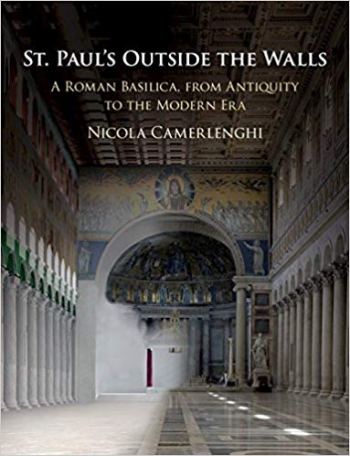 This volume examines one of Rome’s most influential churches: the principal basilica dedicated to St Paul. Nicola Camerlenghi traces nearly two thousand years of physical transformations to the church, from before its construction in the fourth century, to its reconstruction following a fire in 1823. By recounting this long history, he restores the building to its rightful place as a central, active participant in epochal political and religious shifts in Rome and across Christendom, as well as a protagonist in western art and architectural history. Camerlenghi also examines how buildings in general trigger memories and anchor meaning, and how and why buildings endure, evolve and remain relevant in cultural contexts far removed from the moment of their inception. At its core, Saint Paul exemplifies the concept of building as process, not product: a process deeply interlinked with religion, institutions, history, cultural memory and the arts. This study also includes state-of-the-art digital reconstructions synthesizing a wealth of historical evidence to visualize and analyze the earlier (now lost) stages of the building’s history, offering glimpses into heretofore unexamined parts of its long, rich life.
Nicola Camerlenghi is Assistant Professor of Art History at Dartmouth College, New Hampshire. A native of Italy and Switzerland, he has been a fellow at the Bibliotheca Hertziana and the Swiss Institute in Rome. His collaborative projects in the Digital Humanities have been awarded grants from the Kress Foundation.
C O N T E N T S
1 Paul’s Place in Rome: Tomb, Trophy, and the Basilica of the Constantinian Dynasty, ca. 67–386
2 The Basilica of the Theodosian Dynasty, 386–410
3 The Early Transformations, 410–700
4 A Fortress of Faith during the Heart of the Middle Ages, 700–1050
5 The Advent, Apogee, and End of St Paul’s Golden Age, 1050–1423
6 Rebirth and Modernization, 1423–1655
7 Restoring and Reconstructing St Paul’s during the Long Eighteenth Century, 1655–1823
Epilogue: The Basilica Is Dead, Long Live the Basilica!
Appendix A Reconciling the Evidence and Making the Model
Appendix B Carolingian-era Patronage
Exhibition | Herculaneum and Pompeii: Visions of a Discovery
Exhibition formerly in Chiasso, now on view at the National Archaeological Museum in Naples (MANN):
Herculaneum and Pompeii: Visions of a Discovery
m.a.x. Museum, Chiasso, Switzerland, 25 February — 6 May 2018
Museo Archeologico Nazionale di Napoli, 28 June — 30 September 2018
Curated by Pietro Giovanni Guzzo, Maria Rosaria Esposito, and Nicoletta Ossanna Cavadini
 The 280th anniversary of the discovery of Herculaneum and the 270th anniversary of that of Pompeii are here celebrated with a completely original approach, by exploring the media and the methods with which the discoveries of the two sites were communicated through the visionary expressions of those who immediately intuited the implications of the discoveries and sought to promote the progress of the excavations and research into them. From the late eighteenth century to the early twentieth, from Goethe to Stendhal, William Gell, Giovanni Battista and Francesco Piranesi, and many drafters, engravers, and lovers of antiquity down to the Alinari brothers, this is an account of the passion for the excavations and precious archaeological finds and the desire to make known the discoveries through letters, hand-coloured sketchbooks, engravings, lithographs, drawings, reliefs, copperplates and gouaches, the first postcards, and daguerreotype photographs.
Pietro Giovanni Guzzo, et al., Ercolano e Pompei: Visioni di una scoperta / Herculaneum and Pompeii: Visions of a Discovery (Milan: Skira, 2018), 392 pages, ISBN: 978-8857238630 (Italian-English text), €38 / $68.
Exhibition | Montepulciano and the Eternal City
Now on view in Montepulciano:
Montepulciano and the Eternal City: Landscapes and Views from the Aesthetics of the Grand Tour to the Mid-Twentieth Century
Museo Civico – Pinacoteca Crociani di Montepulciano, 15 June — 7 October 2018
Curated by Roberto Longi
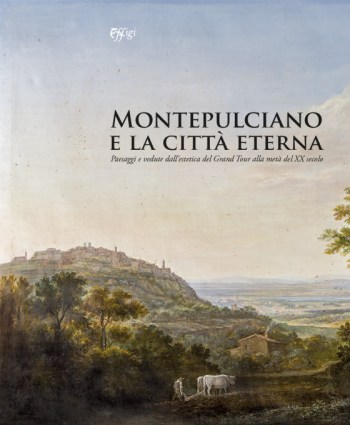 The exhibition, on view in the Crociani Civic Museum and Picture Gallery of Montepulciano from July 14th to October 7th, compares Rome and the Roman countryside with Montepulciano and its rural outskirts, through more than one hundred oil paintings, drawings, watercolours, and engravings by artists such as Labruzzi, Pacetti, Sartorio, Petrassi, Ranieri Rossi, and Ettore Roesler Franz. Of particular interest are works depicting the views of Rome and the Montepulciano countryside by foreign artists who saw the Grand Tour as a paradigm shift—the Spanish Juan Gimenez Martin, the English Samuel Prout, the Bavarian Karl Lindemann-Frommel, and the Swiss watercolourist Salomon Corrodi, who painted several views for Tsar Nicholas I and Queen Victoria.
In addition to the paintings, the exhibition includes a selection of materials which, carried by a servant, accompanied tourists on their long journeys, providing records of a time and a lifestyle: a travel writing desk, portable inkwells, medicine chests—essential in times of malaria—and tools used to prepare snacks for the journey. The noble traveller had to be perfect on all occasions; hence an iron for ties, a jewelry box, and a fragrance holder, as well as a scale for weighing coins and a travel chessboard to enliven any boring evenings at inns. A walking stick could serve as a good defense weapon or preserve a secret reserve of fine liqueur. The final section of the exhibition presents the working tools of the travelling artists: oil colours and watercolours boxes, palettes and materials for graphic techniques, travel sketchbooks, and folders. The exhibition relies on two important Roman collections and several private collections from Montepulciano.
Roberto Longi, Montepulciano e la Città Eterna: Paesaggi e vedute dall’estetica del Grand Tour alla metà del XX secolo (Rome: C&P Adver Effigi, 2018), 160 pages, ISBN: 978-8864339054, $43.
New Book | Giacomo Raffaelli (1753–1836)
From ArtBooks.com:
Anna Maria Massinelli, ed., with contributions by Massimo Alfieri, Laura Bianchini, and Ekaterina Yakovleva, Giacomo Raffaelli (1753–1836): Maestro di stile e di mosaico (Florence: Aska, 2018), 376 pages, ISBN: 978-8875422943, €110 / $150.
 È un’opera monografica dedicata a un mosaicista romano: Giacomo Raffaelli, erede di una tradizione familiare nella produzione di paste vitree risalente alla metà del XVII secolo. Negli ultimi tre decenni del Settecento il suo studio in San Sebastianello, angolo Piazza di Spagna a Roma, divenne una meta obbligata per i sofisticati tourists d’Oltralpe e per la nobiltà europea che non mancava di acquistare placche, tavoli o gioielli ideati dal caposcuola del mosaico minuto romano. La fama raggiunta gli procurò riconoscimenti prestigiosi e nel 1804, su incarico del governo napoleonico, fondò una scuola di mosaico a Milano. Qui si trattenne fino al 1820 portando a compimento uno dei capolavori nel genere del mosaico minuto: la replica a grandezza naturale dell’ ‘Ultima cena’ di Leonardo da Vinci (Vienna, Minoritenkirche). I testi, corredati da ampi apparati documentari e iconografici esaminano l’intera produzione, a oggi nota. La vasta selezione di immagini a colori illustra mosaici e opere lapidee appartenenti a musei e collezioni private in Europa e negli Stati Uniti.
Exhibition | Precious Instruments, Distinguished Figures

Antonio Berti, Psaltery made for Maria Teresa Strozzi (1682–1748).
◊ ◊ ◊ ◊ ◊
Now on view at the Palace Venaria, near Turin:
Precious Instruments, Distinguished Figures: Music and Luthiery between the 17th and 20th Centuries in Europe
Venaria Reale, Torino, 31 May — 30 September 2018
Curated by Giovanni Accornero
The exhibition illustrates and compares four centuries of luthiery and collections, music and musicians, nobility and patronage.
Violins, violas, cellos, 5-course guitars, mandolins, lyre-guitar and psalteries made by master luthiers who were recognized and appreciated worldwide: Stradivari, Guarneri ‘del Gesù’, Amati, Guadagnini, Vinaccia, Fabricatore, Berti and Battaglia, Nadermann, Torres e Hauser—these were the fundamental Italian and European luthiers, an artistic craft that is inextricably connected the world over to the culture of ‘music making’. Precious musical instruments that on this ambitious stage move beyond craftsmanship to become genuine works of art.
It is a stimulating display that outlines a socio-cultural and artistic framework through a historical overview of around thirty musical instruments, most of which are exhibited for the first time since they are part of private collections. The instruments once belonged to famous figures: from exceptional musicians like Gaetano Pugnani, Niccolò Paganini, Charles Dancla, Yehudy Menuhin, Mauro Giuliani, Ramon Montoya, Andrés Segovia, Ida Presti, to major historical figures like the Emperor Leopold I of Habsburg, the Empress Maria Theresa of Naples and Sicily, princess Maria Teresa Strozzi, count Cozio di Salabue, countess Maria Beatrice Barbiano di Belgioioso Dal Pozzo della Cisterna, duchess Marie-Thérèse Charlotte of France, and queen Margherita of Savoy.
The exhibition is also an opportunity to familiarize the general public with the luthiery tradition of Turin that starting in the late 18th century, gained momentum (as the production in Cremona started to wane), and established itself on the European scene, a preeminence that remained unchanged for more than a century. It is a chance to rediscover the primacy of this region in yet another cultural sector.
Exhibition organized by: Consorzio Residenze Reali Sabaude in collaboration with the publishing house Edizioni Il Salabue
Exhibition | Furniture and Cabinetmakers at the Savoy Court
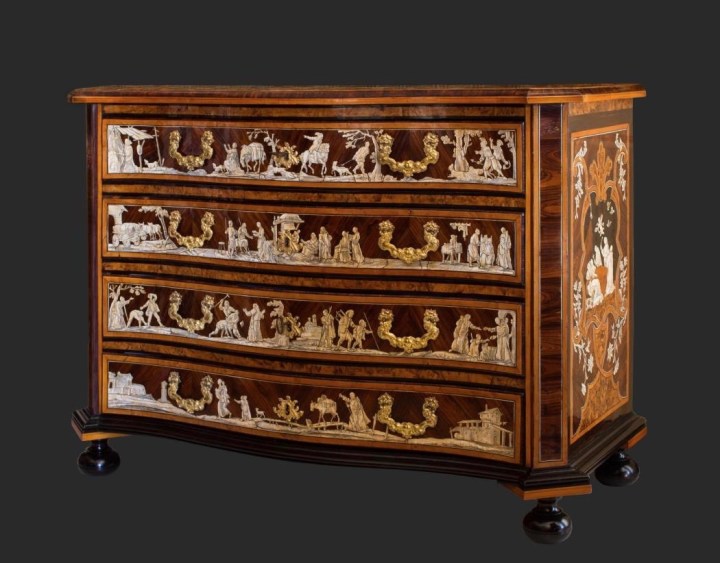
Luigi Prinotto, Chest with four drawers, depicting stories of Saint Bruno and the foundation of the Carthusian Order, 1736
(Private Collection)
◊ ◊ ◊ ◊ ◊
The exhibition at the Palace Venaria, near Turin, closed in June, but the catalogue is available from ArtBooks.com:
Genius and Skill: Furniture and Cabinetmakers at the Court of Savoy
Venaria Reale, Torino, 17 March — 15 June 2018
The exhibition aims to better define the history of furniture making in Piedmont between the 18th and 19th centuries through a display of 130 exceptional pieces crafted by the finest cabinet-makers and sculptors of the time—Luigi Prinotto, Pietro Piffetti, Giuseppe Maria Bonzanigo, and Gabriele Capello known as ‘Il Moncalvo’—some of which will be presented for the first time thanks to loans from important Piedmontese and international museums and collections.
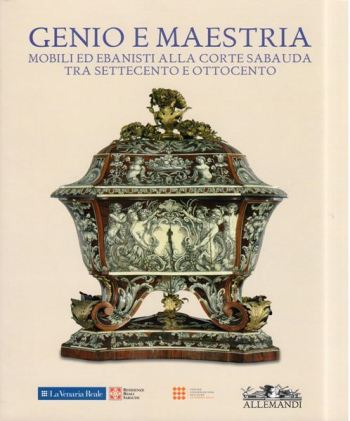 The purpose of the exhibition is to familiarize the public with precious cabinetmaking and inlay works, emphasizing their significance, use, and transformations with technical and scientific insights and multimedia installations. The exhibition tells the story of an elegant, cultivated, and complex craft that developed in Turin to cater to the needs of important royal and aristocratic patrons, in conjunction with other arts.
Special care has been adopted to design a display that is accessible to disabled visitors, including scale models, touch tablets, olfactory islands, and an Italian Sign Language video-guide. Moreover, description panels and labels are written in the EasyReading font, which is highly readable and facilitates reading for dyslexic persons.
Organizing and Scientific committee: Cesare Annibaldi, Roberto Antonetto, Clelia Arnaldi di Balme, Elisabetta Ballaira, Enrico Colle, Stefania De Blasi, Silvia Ghisotti, Luisa Papotti, Carla Enrica Spantigati
Coordinated by Carlo Callieri
Cesare Annibaldi, Roberto Antonetto, et al, Genio e Maestria: Mobili ed Ebanisti alla Corte Sabauda tra Settecento ed Ottocento (Turin: Allemandi, 2018), 304 pages, ISBN: 978-8842224594, $70.
AWA and Art Restoration in Florence
“The Lady Who Paints,” an 11-minute video produced by Bunker Films, addresses the work of Advancing Women Artists Foundation, focusing on the Virgin Mary Presents the Christ Child to Santa Maria Maddalena de’ Pazzi by Violante Siries Cerroti, located in the sacristy of the church of Santa Maria Maddalena de’ Pazzi in Florence. Severely damaged in the 1966 flood, the painting was restored by Nicoletta Fontani and Elizabeth Wicks in 2016. More information is available in this book available from the AWA Foundation: I. Ciseri, J. Fortune, P. Masse, and E. Wicks, The Lady Who Paints: Violante Siriès Cerroti (1709–1783) (Pisa: Pacini Editore, 2016), 106 pages, ISBN: 978-8869951145 (English and Italian), €20.
◊ ◊ ◊ ◊ ◊
CAA’s listserv newsletter from yesterday noted this ArtNet News article:
Kate Brown, “How a Female-Led Art Restoration Movement in Florence Is Reshaping the Canon,” ArtNet News (12 July 2018).
Sometimes, all it takes is for someone to ask the right question.
That is exactly what Jane Fortune did on a visit to Florence 12 years ago. While touring the Renaissance city’s exquisite museums and fresco-covered churches, the American philanthropist began to wonder, “Where are the women?” Her search for an answer set Fortune on a passionate quest to restore the lost legacies and artworks of Florence’s forgotten female artists, digging into museums’ archives and dusty deposits with her organization, Advancing Women Artists (AWA). . .
Since the foundation launched more than 10 years ago, AWA has restored some 53 artworks. By September, that number will jump to 58. The nonprofit has become the go-to for Florentine curators who want to research their own collections, which house many works by women (AWA has inventoried 2,000 so far) that have been unseen for centuries. “That’s half the population that’s not being heard,” Fortune says. “I want to give them a voice.”
AWA has some ground rules for museums that engage them for help: If the work in question comes out of storage, it doesn’t go back into storage. It goes on the wall. And if a work needs to be restored, the vast majority of projects are carried out by female conservators.
Linda Falcone, the director of AWA, explains that the majority of restorers in Florence are in fact women, but that it was not always this way. The shift was caused by a devastating flood that struck in 1966, which led to the loss or damage of millions of artworks and books, including many masterpieces. A group of scholars, art students, and other art experts dubbed the “Mud Angels” flocked to the city to help with the restoration effort, as did the so-called “Flood Ladies”—female artists who donated art to replace lost masterworks.
Art historians like Kirsten Aschengreen Piacenti, who came from Denmark, were eager to help. In turn, they established a female-led network of experts, many of whom are still active today. Piacenti went on to become the head of Florence’s Museum Stibbert until 2012, and she is among an impressive number of female curators who work in the city’s institutions.
“It was the first time women began wearing trousers in Florence,” Falcone says. “Women’s liberation in Florence is deeply linked to the art restoration effort.” . . .
The full article is available here»
New Book | Visual Typologies
From Routledge (and now on sale for $120) . . .
Tara Zanardi and Lynda Klich, eds., Visual Typologies from the Early Modern to the Contemporary: Local Contexts and Global Practices (New York: Routledge, 2019), 298 pages, ISBN: 978-1138200135, $150.
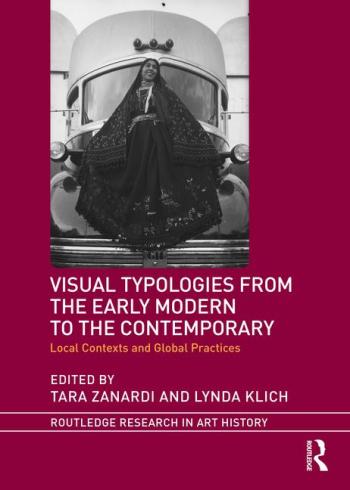 Visual Typologies from the Early Modern to the Contemporary investigates the pictorial representation of types from the sixteenth to the twenty-first century. Originating in longstanding visual traditions, including street crier prints and costume albums, these images share certain conventions as they seek to convey knowledge about different peoples. The genre of the type became widespread in the early modern period, developing into a global language of identity. The chapters explore diverse pictorial representations of types, customs, and dress in numerous media, including paintings, prints, postcards, photographs, and garments. Together, they reveal that the activation of typological strategies, including seriality, repetition, appropriation, and subversion has produced a universal and dynamic pictorial language. Typological images highlight the tensions between the local and the international, the specific and the communal, and similarity and difference inherent in the construction of identity. The first full- length study to treat these images as a broader genre, Visual Typologies gives voice to a marginalized form of representation. Together, the chapters debunk the classification of such images as unmediated and authentic representations, offering fresh methodological frameworks to consider their meanings locally and globally, and establishing common ground about the operations of objects that sought to shape, embody, or challenge individual and collective identities.
Tara Zanardi is Associate Professor of Art History, Hunter College, CUNY. Lynda Klich is Assistant Professor of Art History, Hunter College, CUNY.
C O N T E N T S
Contributors
Acknowledgements
Tara Zanardi and Lynda Klich, Introduction to Visual Typologies from the Early Modern to the Contemporary: Local Contexts and Global Practices
Repeating, Borrowing, and Serializing
• Heather A. Hughes, Fashion, Nation, and Morality in English Allegorical Costume Prints, ca. 1620–40
• Sarah E. Buck, Bodies of Work in the Ancien Régime: The Costumes Grotesques by Nicolas I de Larmessin
• Elisabeth Fraser, The Color of the Orient: On Ottoman Costume Albums, European Print Culture, and Cross-Cultural Exchange
• Vanesa Rodríguez-Galindo, On and off the Tram: Contemporary Types and Customs in Madrid’s Illustrated and Satirical Press, 1874–98
Staging Place
• Eugenia Paulicelli, Venice: City of Fashion and Power in Giacomo Franco’s Habiti d’huomini et donne venetiane, ca. 1610
• Yu-chih Lai, Costuming the Empire: A Study on the Production of Tributary Paintings at the Qianlong Court in Eighteenth-Century China
• Denise Birkhofer, Enrique Díaz’s Parade of Progress: Toward a Streamlined Mexican Future
Performing the Documentary
• Emily Kathryn Morgan, ‘True Types of the London Poor’: Street Life in London’s Transitional Typology
• Maya Jiménez, The Myth of the Baiana in Nineteenth-Century Portrait Photography
• Lynda Klich, Circulating lo mexicano in Mauricio Yáñez’s Postcards
• Deborah Dorotinsky, It Is Written in Their Faces: Seri Women and Facial Painting in Photography
Materials of Typologies
• Natalia Majluf, Fashioning a Nation: Military Dress in Peruvian Independence, 1821–22
• Tara Zanardi, From Global Traveler to Costumbrista Motif: The Mantón de Manila and the Appropriation of the Exotic
• Victoria L. Rovine, Cloth, Clothing, and Colonial Power: France and West Africa at the Expositions
• Charlene K. Lau, Against ‘Fashion-Time’: Bernhard Willhelm, Regional Folk Dress, and the Contemporary
Unmasking Stereotypes
• Ashley Bruckbauer, Ambassadors à la turc: Assimilation and Dissimulation in Eighteenth-Century Images of French-Ottoman Diplomacy
• Leyla Belkaïd-Neri, The Transmediterranean Routes of Fashion: Between Material Expression and Artistic Representation
• Teresa Eckmann, Julio Galán and the Type: Fashioning a ‘Border’ Aesthetic
New Book | The Enchanted Clock
From Columbia UP:
Julia Kristeva, The Enchanted Clock: A Novel, translated by Armine Kotin Mortimer (New York: Columbia University Press, 2018), 336 pages, ISBN: 978-0231180467, $30 / £24.
 In the Palace of Versailles there is a fabulous golden clock, made for Louis XV by the king’s engineer, Claude-Siméon Passemant. The astronomical clock shows the phases of the moon and the movements of the planets, and it will tell time—hours, minutes, seconds, and even sixtieths of seconds—until the year 9999. Passemant’s clock brings the nature of time into sharp focus in Julia Kristeva’s intricate, poetic novel The Enchanted Clock.
Nivi Delisle, a psychoanalyst and magazine editor, nearly drowns while swimming off the Île de Ré; the astrophysicist Theo Passemant fishes her out of the water. They become lovers. While Theo wonders if he is descended from the clockmaker Passemant, Nivi’s son Stan, who suffers from occasional comas, develops a passion for the remarkable clock at Versailles. Soon Nivi is fixated on its maker. But then the clock is stolen, and when a young writer for Nivi’s magazine mysteriously dies, the clock is found near his body. The Enchanted Clock combines past and present, jumping back and forth between points of view and across eras from eighteenth-century Versailles to the present day. Its stylistically inventive narrative voices bring both immediacy and depth to our understanding of consciousness. Nivi’s life resembles her creator’s in many respects, coloring Kristeva’s customary erudition with autobiographical poignancy. Part detective mystery, part historical fiction, The Enchanted Clock is a philosophically and linguistically multifaceted novel, full of poetic ruminations on memory, love, and the transcendence of linear time. It is one of the most illuminating works of one of France’s great writers and thinkers.
Julia Kristeva is professor emerita of linguistics at the Université de Paris VII and author of many acclaimed works and novels. Her Columbia University Press books include Murder in Byzantium: A Novel (2005); Teresa, My Love: An Imagined Life of the Saint of Avila (2014); and, with Philippe Sollers, Marriage as a Fine Art (2016).
Armine Kotin Mortimer is professor emerita of French literature at the University of Illinois at Urbana-Champaign. Her contributions to French culture were recognized with the Palmes académiques distinction in 2009. She is the translator of two books by Philippe Sollers.
New Book | China’s Philological Turn
From Columbia UP:
Ori Sela, China’s Philological Turn: Scholars, Textualism, and the Dao in the Eighteenth Century (Columbia University Press, 2018), 328 pages, ISBN: 978-0231183826, $65 / £50.
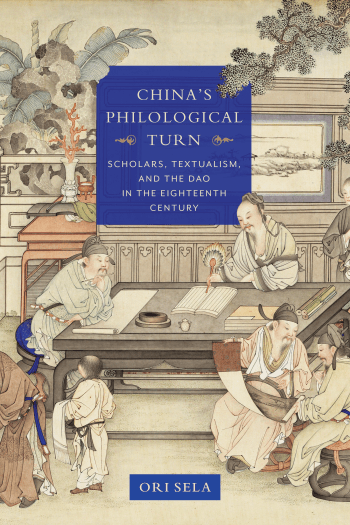 In eighteenth-century China, a remarkable intellectual transformation took place, centered on the ascendance of philology. Its practitioners were preoccupied with the reliability of sources as evidence for restoring ancient texts and meanings and with the centrality of facts and truth to their scholarship and identity. With the power to construct the textual past, philology has the potential to shape both individual and collective identities, and its rise to prominence consequently deeply affected contemporaneous political, social, and cultural agendas.
Ori Sela foregrounds the polymath Qian Daxin (1728–1804), one of the most distinguished scholars of the Qing dynasty, to tell this story. China’s Philological Turn traces scholars’ social networks and the production of knowledge, considering the texts they studied along with their reading practices and the assumptions about knowledge, facts, and truth that came with them. The book considers fundamental issues of eighteenth-century intellectual life: the tension between antiquity’s elevated status and the question of what antiquity actually was; the status of scientific knowledge, especially astronomy, mathematics, and calendrical studies; and the relationship between learned debates and cultural anxieties, especially scholars’ self-characterization and collective identity. Sela brings to light manuscripts, biographies, letters, handwritten notes, epitaphs, and more to highlight the creativity and openness of his subjects. A pioneering book in the cultural history of intellectuals across disciplinary boundaries, China’s Philological Turn reconstructs the history of eighteenth-century Chinese learning and its long-lasting consequences.
Ori Sela is an associate professor in the Department of East Asian Studies at Tel Aviv University.
C O N T E N T S
Preface and Acknowledgments
Introduction: The Way and Its Crossroads
Part I | The Way of Man: Scholarly Networks and the Social History of Scholarship
1 Learning to Be a Scholar
2 Official Scholars and the Growing Philologists’ Networks
3 Private Scholars, Private Academies, and the Community of Knowledge
Part II | The Way of Antiquity: Searching for the True Way in the Past
4 The Way of Ancient Learning: Philology, Antiquity, and Ru Identity
5 Philology and the Message of the Sages: The Classics and the Four Books
6 Historical Philology: Navigating the Sources
Part III | The Way of Heaven and Earth: The Mandate of Scholarship and the Search for Order
7 Astronomy, Mathematics, and Calendar: Historical Perspective
8 Ancient Learning Encounters Western Learning: Scientific Knowledge and Its Cultural Baggage
9 Fate, Ritual, and Ordering All Under Heaven
Conclusion: The Consequences of the Eighteenth-Century Intellectual Turns
Appendix A: Selections from Qian Daxin’s 1754 Palace Examination Answer
Appendix B: Major Shuowen and Erya Studies of the Qian-Jia Period (and Related Works)
Appendix C: Qian Daxin’s Letter to Dai Zhen
Appendix D: Questions and Answers About Astronomy
Appendix E: Essay on the Value of Pi Π
Appendix F: Qian Daxin’s Writings on Mathematics, Astronomy, and Divination
Appendix G: On Saṃsāra
Appendix H: Sources for the Works of Qian Daxin
Note on Abbreviations and Citations
Notes
Selected Bibliography of Chinese and Japanese Titles
Index










 Enfilade
leave a comment