New Book | Americana Insights, Pennsylvania German Redware
From Penn Press:
Lisa Minardi, ed., Americana Insights 2025 (Philadelphia: University of Pennsylvania Press, 2025), 300 pages, ISBN: 979-8988533122, $65. With contributions by Johanna Brown, Laini Farrare, R. Erich Hess, Christopher Malone, Lisa Minardi, Karl Pass, Candace Perry, Jeffrey Pressman, Jean Renshaw, Justin Thomas, and Adam Zayas.
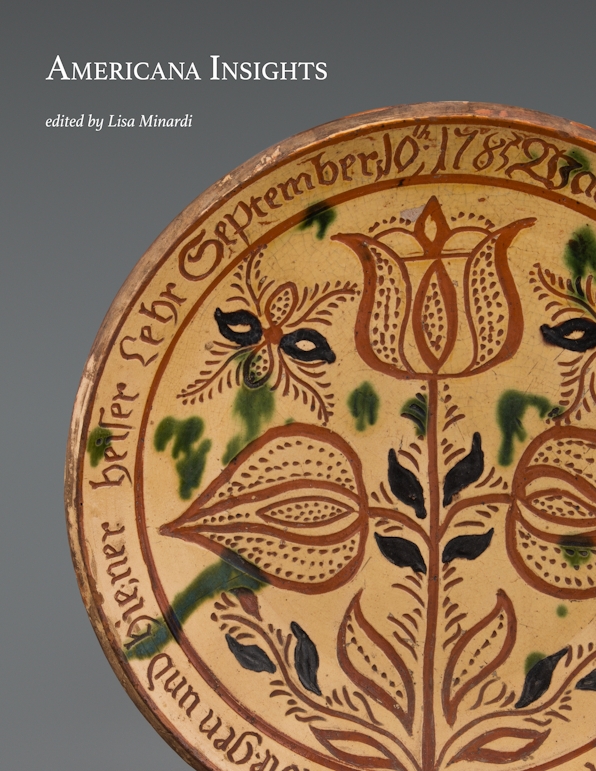 A comprehensive study of Pennsylvania German redware and a celebration of this vibrant folk art tradition
Americana Insights 2025 is the third volume in an annual series that presents the latest research and discoveries on traditional Americana, folk art, and material culture. In this volume the authors explore a beloved aspect of American folk art—Pennsylvania German redware. Focusing on redware’s production, use, and collecting in southeastern Pennsylvania from the mid-eighteenth to early twentieth century, the authors provide fresh insights into renowned potters such as Georg Hubener and Samuel Troxel as well as lesser-known figures. Other essays delve into the work of twentieth-century potters like Jacob Medinger, considered the last of the traditional Pennsylvania German potters, and Mildred Keyser, a pioneering revivalist potter. The authors also explore broader themes, including the use of political imagery and hunting iconography, and redware’s role in cultural exchange between Anglo-Americans and Pennsylvania Germans. A celebration of this vibrant folk art tradition and a vital scholarly contribution, Americana Insights 2025 represents the most comprehensive study of Pennsylvania German redware in more than a century.
Lisa Minardi is a curator and scholar of Pennsylvania German art and culture. She has organized numerous exhibitions and published extensively and was assistant curator at Winterthur Museum from 2006 to 2016. Minardi currently serves as executive director of Historic Trappe and the Center for Pennsylvania German Studies. She is a PhD candidate in the History of American Civilization Program at the University of Delaware, where she is researching the German-speaking community of early Philadelphia for her dissertation. She holds an MA from the Winterthur Program in Early American Culture and a BA in history and museum studies from Ursinus College.
Turner’s ‘Battle of Trafalgar’ Back on Display at Greenwich
◊ ◊ ◊ ◊ ◊
From the press release (via Art Daily) . . .
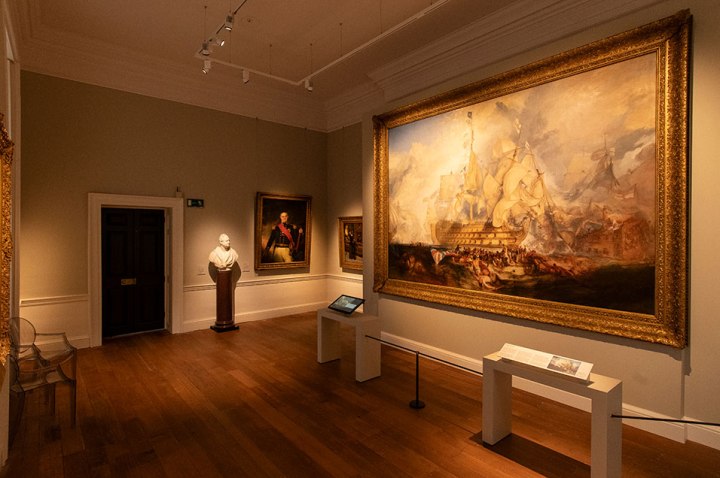
2025 marks the 250th anniversary of the birth of Joseph Mallord William Turner (1775–1851), one of Britain’s most admired Romantic painters. To commemorate this landmark anniversary, the National Maritime Museum is returning one of Turner’s most important masterpieces to display in the Queen’s House. The Battle of Trafalgar will be on public display from 21 October 2025, 220 years to the day since the Battle of Trafalgar.
Measuring more than three metres across, The Battle of Trafalgar is the largest painting that Turner ever completed. It commemorates the most decisive naval action of the Napoleonic Wars, the victory of the British Royal Navy over a combined French and Spanish fleet off Cape Trafalgar on 21 October 1805. The painting was made for King George IV in 1824—Turner’s only royal commission. It initially attracted criticism from naval officials, who complained about factual inaccuracies, but it was later acclaimed as a highlight of the Naval Gallery—a popular public art gallery set within the grounds of the Royal Hospital for Seamen at Greenwich.
In The Battle of Trafalgar, Turner captures the human drama of the action, from the struggles of the ordinary sailors to the fatal wounding of their commander, Vice-Admiral Horatio Nelson. The finished composition is a symbolic amalgamation of different moments in the battle. Nelson’s flagship, Victory, is depicted on an exaggerated scale, an artistic decision intended to emphasise the might of British naval power. The ship’s falling foremast, bearing the vice-admiral’s flag, symbolises Nelson’s demise. The signal flags spell the final three letters of ‘duty’, referencing both Nelson’s famous order, “England expects every man to do his duty,” and some of his dying words, “Thank God I have done my duty.”
The French ship Redoubtable, from which the fatal shot came, foundered in a storm after the battle but is depicted sinking in the thick of the action. In compressing the timeline, Turner emphasised the defeat of the Franco-Spanish fleet. However, while celebrating Britain’s triumph, Turner did not shy away from the brutal realities of naval warfare and encouraged respect and sympathy for sailors manning the ships on both sides of the conflict. In the centre of the image, at what would have been eye level when the painting was first displayed in St James’s Palace, the lifeless eyes of a dead seafarer gaze out. The Latin word ‘ferat’ appears in the water beside him, recalling Nelson’s motto, Palam qui meruit ferat (‘Let him who has earned it bear the Palm’). The palm referenced in the motto was a traditional symbol of victory, but the sailor’s suffering undermines this noble ideal of glory.
 In 1829, George IV had Turner’s The Battle of Trafalgar transferred from St James’s Palace to the Naval Gallery. Greenwich Hospital, where the gallery was situated, provided accommodation for elderly and disabled naval veterans, many of whom had served at Trafalgar. This made it a fitting home for Turner’s painting, given its emphasis on the labour and suffering of common sailors.
The painting was taken off display in March 2024 to protect it during a capital project at the National Maritime Museum. Its new home places it within the heart of the Museum’s fine art collection in the Queen’s House art gallery. It will be displayed alongside artworks from the Museum’s collection that tell the story of its journey from St James’s Palace to the Naval Gallery at Greenwich.
A new book has also been published celebrating this exceptional artwork. J.M.W. Turner’s The Battle of Trafalgar: Commemoration and Controversy is part of Royal Museums Greenwich’s new Spotlight series. Curator Katherine Gazzard considers the challenges that Turner faced during the creation of the painting, the public response to it and the fascinating history that led to its place at the centre of a national art collection.
Katherine Gazzard, J.M.W. The Battle of Trafalgar: Commemoration and Controversy (Greenwich: Royal Museums Greenwich, 2025), 96 pages, ISBN: 978-1068765995, £13.
Prado Acquires Pendant Paintings by François Boucher
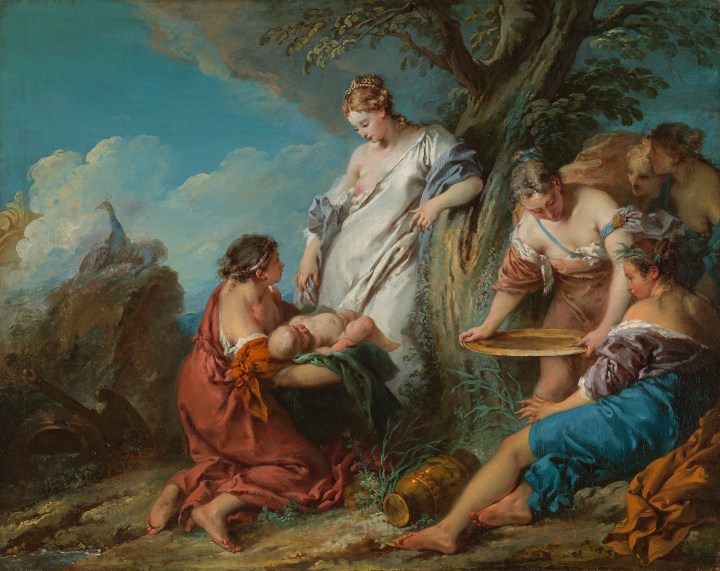
François Boucher, The Birth of Adonis, early 1730s, oil on canvas
(Prado: Museo Nacional del Prado)
◊ ◊ ◊ ◊ ◊
From the press release, via Art Daily:
The lavish, sensual world of French Rococo just got brighter in Madrid. The Museo Nacional del Prado has announced a major acquisition that cements its standing as a premier destination for 18th-century art: two exceptional mythological paintings by François Boucher, the undisputed star of the era. The newly acquired works, The Birth of Adonis and The Death of Adonis, offer a crucial glimpse into the early genius of Boucher (1703–1770), who would later become the court decorator par excellence for Louis XV and the favorite painter of Madame de Pompadour.
The two canvases, which cost €2.2 million, were purchased using funds generated by the generous bequest of Juan José Luna Fernández, a beloved former Prado curator and a pivotal scholar of French painting who passed away in 2020. His legacy—a Madrid home auctioned for €3.2 million—now beautifully bridges a research past with the museum’s artistic future.
Boucher’s interpretation of the Adonis myth—which blends love, tragedy, and eroticism in delicate pastoral settings—was perfectly suited to the refined taste of the Rococo. With the acquisition, the Prado can now tell a richer, more complete story of the artist. In The Birth of Adonis, Boucher captures the myth’s genesis, showing the sorrowful transformation of Myrrha into a tree, from which Adonis is born. The Death of Adonis, conversely, develops the tragic farewell scene between the goddess Venus and her lover after he is fatally wounded by a wild boar.
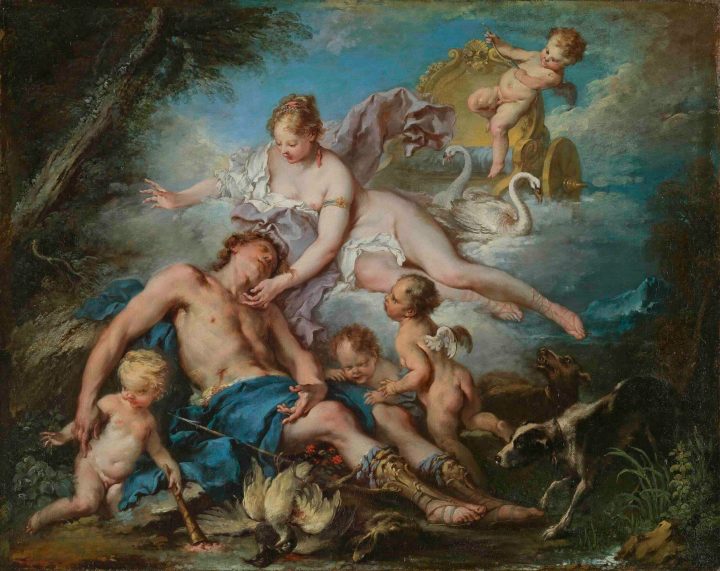
François Boucher, The Death of Adonis, early 1730s, oil on canvas
(Prado: Museo Nacional del Prado)
◊ ◊ ◊ ◊ ◊
These pieces were painted on the same bolt of canvas early in Boucher’s career, shortly after his return from Italy in 1731. They display a technical fluidity influenced by his predecessors Antoine Watteau and Sebastiano Ricci. The recent restoration not only brightened the luminous colors characteristic of Boucher but also revealed visible changes and the artist’s signature, confirming the works’ authenticity and offering a window into his creative process. The new paintings join another important Boucher work in the collection, Pan and Syrinx, which Luna was instrumental in acquiring in 1985. The newest additions powerfully expand the Prado’s representation of the Rococo master, complementing his mature style with a view of his formative years.
While Boucher’s glamorous, optimistic style—characterized by graceful lines and light color—was the height of courtly fashion across Europe, his works are comparatively scarce in Spanish collections. Historically, the Spanish Bourbon court favored Italian art or the stricter Neoclassicism championed by artists like Mengs. Boucher’s focus on gallant and mythological themes simply contrasted with the predominantly religious and historical tastes of the Spanish monarchy, meaning his major works largely remained tied to French aristocratic commissions. This acquisition, therefore, is not just a triumph of taste but an important historical correction. It gives the Spanish public access to the visual language of the 18th century’s great narrator and pays a final, fitting tribute to the curator who tirelessly championed his work.
To mark the occasion, Françoise Joulie, the world’s leading specialist on Boucher, will deliver a conference on November 12th at the Prado auditorium, inviting the public to delve deeper into the seductive genius of the artist who truly defined the spirit of the Ancien Régime.
Society of Antiquaries of London Launches Fundraising Series
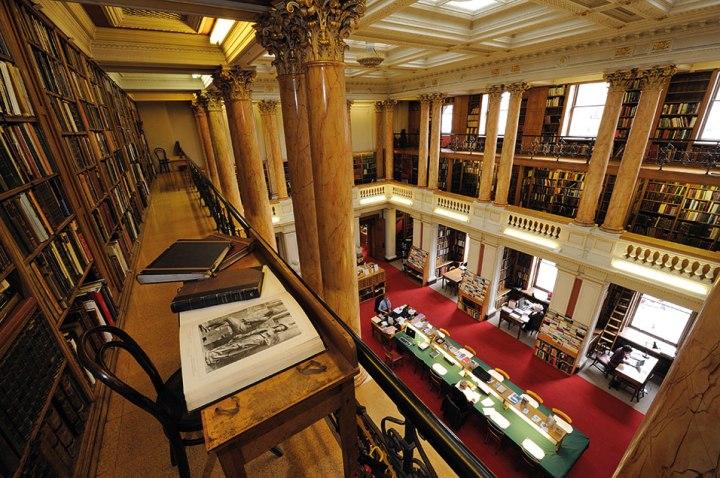
Library of the Society of Antiquaries of London, Burlington House.
◊ ◊ ◊ ◊ ◊
From the press release, via Art Daily:
The Society of Antiquaries has launched a series of fundraising events Past Matters: Shaping Our Future at Burlington House in support of the Society’s bold vision to transform its historic home into a world-leading centre for the study of heritage. The talks series will take place from 28 October to 19 November 2025 with tickets now available to buy online. These autumn events will enable the Society to commission architectural plans to shape the Society’s future at Burlington House and increase access to the vast collections, expand the Society’s research and education programmes, and create dynamic new spaces for exhibitions, seminars, and events. This will ensure that Burlington House remains a place of inspiration, scholarship, and discovery for generations to come.

George Vertue, Lady Jane Grey, 1748, engraving.
Alongside the talks, Abbott & Holder (30 Museum Street, opposite the British Museum) will sell some early engravings by George Vertue for the Society of Antiquaries from 21 October until December 2025. Seven prints of the 18th-century engravings made from plates by the Society’s first official engraver, George Vertue (1684–1756), all duplicates with copies still part of the Society’s Collection, will be for sale with 65% of the sale price going to the Society. The enterprising Vertue combined his work for the Society with illustrious private commissions and the production of independent engravings, which he sold from his shop in Drury Lane. His ‘tablatures’ of historical royal portraits were ‘collected, drawn, and engraved from ancient original pictures’.
Natasha McEnroe FSA, General Secretary and CEO of the Society of Antiquaries of London, says: “Thanks to our kind sponsors so far we have raised £1.3 million (27%) of the £4.8m cost of the Society’s 999-Year Lease. We invite supporters to sponsor our home in square feet:£500 cover a square foot of Burlington House, while ‘Foundation 1707 Sponsors’ will sponsor four square feet of Burlington House with £2,000 (costs can be spread with monthly Direct Debits). Our supporters will all get a special ‘Bond of Support’ designed by British artist Adam Dant.”
All events cost £30 per person, with tickets available on the Society’s website. Geoffrey Munn’s Halloween talk can also be followed online at a cost of £6. The Society is collaborating with the St. James’s Hotel & Club for the Past Matters season and supporters are able to enjoy a special three-course lunch offer of £30 including a glass of bubbly and event attendees can exclusively enjoy a 20% discount on the exquisite art-inspired afternoon tea by showing their ticket confirmation. The hotel is just across the road in St James’s; pre-booking is essential and the offers are available until 30 November; they can be booked here.
Sale of Early Engravings of the Society of Antiquaries at Abbot & Holder
October — December
From 21 October we are offering seven prints of engravings made from plates by the Society’s first official engraver, George Vertue (1684–1756) for sale with the gallery Abbott & Holder.
Royal Patrons and Collectors in the 20th Century, from King Edward VII to Queen Elizabeth II
Tuesday, 28 October, 6pm
Join Tim Knox FSA, Director of the Royal Collection, for a lively exploration of royal taste and patronage from Edward VII to Queen Elizabeth II.
Myth and Magic: A 16th-Century Charmstone and Its Links to the Society of Antiquaries
Friday, 31 October, 6pm
On Halloween night, join Geoffrey Munn OBE FSA, as he unveils the extraordinary tale of a mysterious 16th-century rock crystal charmstone.
Drawn to Discovery at the Antiquaries
Thursday, 6 November, 5pm
An evening reception with Abbott & Holder at the Antiquaries for a curated selection of highlights from the Society’s remarkable collection of over 55,000 prints and drawings from the 17th to 20th centuries.
Hats off to Tradition: Tales from The Cocked Hat Club
Wednesday, 19 November, 6pm
Roll up! Roll up! Join us for a unique evening that lifts the lid on one of the most curious—and least known—aspects of the ‘Old Lady’, as the Society of Antiquaries is affectionately known.
Call for Articles | Queerness in 18th- and 19th-C. European Art
From ArtHist.net and Arts:
Queerness in 18th- and 19th-Century European Art and Visual Culture, 2nd Edition
Special issue of the journal Arts, guest edited by Andrew Shelton
Abstracts due by 15 January 2025; final manuscripts will be due by 1 July 2026
Essays regarding a wide variety of topics that subvert or disrupt heteronormative interpretations of the art and visual culture of this period are welcome, including the works of art produced by or under the auspices of personages who can plausibly be identified as attracted to members of the same sex; works or creative situations that can be construed as expressing or eliciting same-sex sexual desire or attraction; works or creative situations in which the heteronormative polarity of the processes of identification and desire can be perceived as having been collapsed or scrambled; works or creative situations that involve gender-bending or gender fluidity; works or creative situations that either deepen or complicate our understanding of sexuality and/or sexual identity during the 18th and 19th centuries; and works that eroticize individuals or situations that are normally regarded as lying outside the realm of the erotic.
Arts is an international, peer-reviewed, open access journal promoting significant research on all aspects of the visual and performing arts, published bimonthly online by MDPI.
Submission Planning
• Abstracts due by 15 January 2025, submission link for abstracts.
• Final manuscripts due by 1 July 2026, submission link for full articles.
Submission Criteria
• Abstract and a short biography should be sent to Andrew Shelton (shelton.85@osu.edu) and Sylvia Hao (sylvia.hao@mdpi.com).
• Final articles, in English only, should be at least 4000 words long; a 150-word abstract and 5 keywords should also be submitted.
• Authors can include image files (tables, maps, graphs, photographs …) in ..jpg; they should ensure that images are free of rights (or that rights have been obtained).
• Each article will be peer-reviewed by at least two anonymous referees.
For inquiries, please contact: Sylvia Hao (sylvia.hao@mdpi.com) and Editorial Office of Arts (arts@mdpi.com).
Symposium | Vanbrugh from Stage to Stone
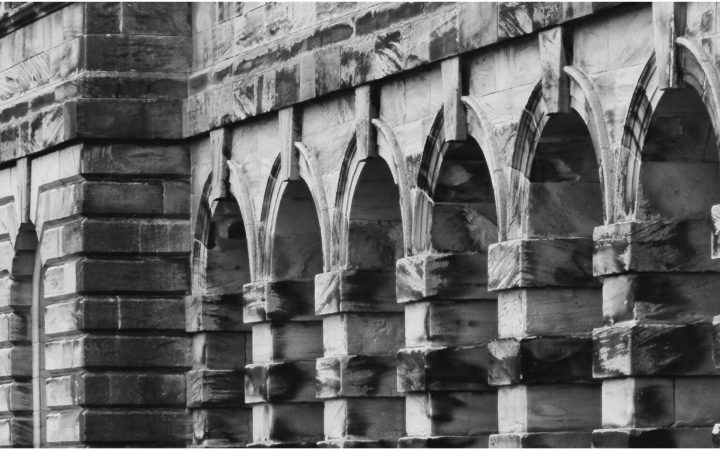
Sir John Vanbrugh, Seaton Delaval Hall, Northumberland, near Newcastle, 1718–28. Ravaged by fire in 1822, it is now owned by the National Trust.
◊ ◊ ◊ ◊ ◊
Next spring at the University of Cambridge:
Vanbrugh from Stage to Stone
Howard Theatre, Downing College, Cambridge, 27 March 2026
This international academic conference will explore the impact and legacy of Sir John Vanbrugh. The event marks the tercentenary of Vanbrugh’s death in March 1726 and forms part of the Vanbrugh300 festival for 2026, organised by The Georgian Group, the conservation organisation founded in 1937 to protect and promote Georgian buildings.
For those requiring hotel accommodations, there are two options nearby: the Regency Guesthouse, an independent boutique hotel, and the University Arms, a luxury hotel located directly across Regent Street from Downing College.
This conference is organised by the Ax:son Johnson Centre for the Study of Classical Architecture (CSCA) at the University of Cambridge in partnership with The Georgian Group.
Registration is now open via The Georgian Group website.
p r o g r a m m e
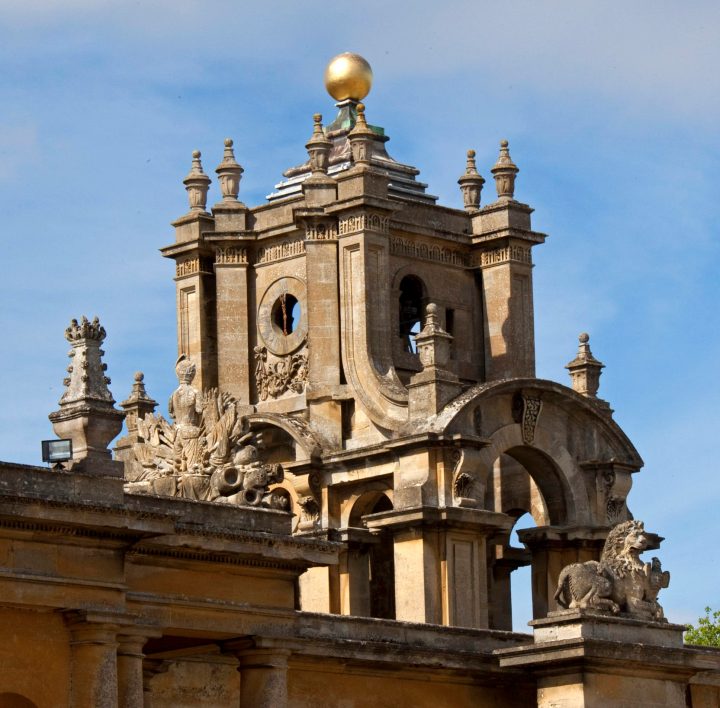
Detail of Blenheim Palace (Photo by Tony Hisgett CC BY-SA 2.0).
9.00 Registration breakfast with tea and coffee
9.45 Introductory Remarks — Frank Salmon (CSCA) and Anya Lucas (The Georgian Group)
10.00 Session 1 | Vanbrugh: The Writer and Herald
Chair: Charles Saumarez Smith
• Christopher Ridgway — Sir John Vanbrugh: The Letters of a ‘Great and Versatile Character’
• Annette Rubery — ‘I confess I have not at all stuck to the original’: John Vanbrugh as Translator and Adaptor
• David Roberts — The Playwright in Print
• James Peill — Vanbrugh as Herald
11.15 Coffee and tea
11.45 Session 2 | Vanbrugh: The Architect and Politician
Chair: Charlotte Davis
• Matthew Wood — Weighing Scales of Power? The State Apartments at Castle Howard
• Susie West — Vanbrugh and the Country House Plan
• Rory Fraser — John Vanbrugh: The Politician behind the Polymath
13.00 Lunch
14.00 Session 3 | Vanbrugh’s Network
Chair: Elizabeth Deans
• Melanie Hayes and Andrew Tierney — Building Relations: Collaboration, Achievement, and Artisanal Agency in Vanbrugh’s Architectural Practice
• Helen Lawrence-Beaton — Parallel Careers and Building Neighbours: The Relationship between Vanbrugh and Thomas Archer
• James Legard — Vanbrugh/Hawksmoor: The Graphic Anatomy of an Architectural Partnership
15.00 Tea and cake
15.30 Session 4 | Vanbrugh at Stowe
Chair: Frank Salmon
• Tom Nancollas — Vanbrugh’s Sleeping Parlour: Anatomy of a Lost Folly
• Michael Bevington — Vanbrugh’s Innovative Architectural Reconstructions at Stowe
• Francis Terry — Vanbrugh’s Design for Stowe
16.30 Break
16.45 Panel Discussion | Vanbrugh’s Influence
Chair: Matthew Walker
• Jeremy Musson, Frances Sands, and Owen Hopkins
17.30 Champagne reception
Talk | Christine Stevenson on Vanbrugh and His Clients
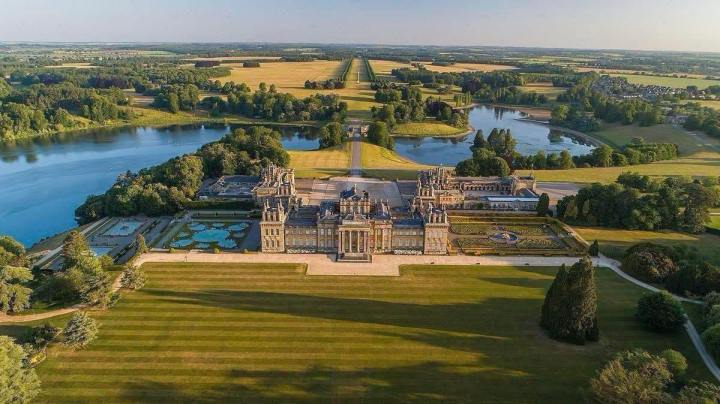
Sir John Vanbrugh, Blenheim Palace, Oxfordshire, 1705–22. Seat of the Dukes of Marlborough.
◊ ◊ ◊ ◊ ◊
From The Georgian Group, in anticipation of Vanbrugh300 in 2026:
Christine Stevenson | John Vanbrugh and the Art of Client Management
The Georgian Group, 6 Fitzroy Square, London, 21 October 2025, 6.30pm
The early eighteenth-country houses designed by John Vanbrugh (1664–1726), including Blenheim in Oxfordshire and the now-lost Claremont in Surrey and Eastbury in Dorset are, or were, remarkable for their bold forms and unorthodox ornament. Yet in one respect Sir John’s work was supremely delicate: the ways in which he persuaded clients that boldness and unorthodoxy were the most economical routes to displays appropriate to their status. His arguments are gossipy, funny, and often suspect. They present the architect less as a designer than as a hedge against financial and reputational risk. At the same time, they offer us a fascinating insight into the sometimes-fraught social and familial relationships in play when it came to spending money on a house. Georgian Group members, £15 / non-members, £18; tickets include a glass of wine.
Booking is available here»
Exhibition | Vanbrugh: The Drama of Architecture
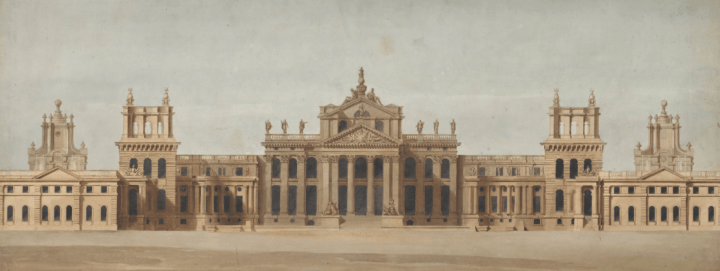
Soane office, Royal Academy Lecture Drawings of the work of Sir John Vanbrugh, Blenheim Palace, elevation
(London: Sir John Soane’s Museum, SM 74/4/8)
◊ ◊ ◊ ◊ ◊
The exhibition opens in the spring; the book launches this fall:
Vanbrugh: The Drama of Architecture
Sir John Soane’s Museum, London, 4 March — 28 June 2026
Curated by Charles Saumarez Smith
300 years after his death, a major new exhibition exploring one of the UK’s greatest architects—Sir John Vanbrugh (1664–1726)—will open in the spring at Sir John Soane’s Museum. Some of the UK’s most admired and loved country houses like Blenheim Palace and Castle Howard were the result of Vanbrugh’s genius, becoming cornerstones of English Baroque. Soane cited him as one of his great influences, saying Vanbrugh had “all the fire and power of Michelangelo and Bernini.”
Curated by Sir Charles Saumarez Smith CBE and architect Roz Barr, the exhibition will feature never-before-exhibited drawings from the collections of the V&A, the Royal Institute of British Architects, the National Portrait Gallery, and Sir John Soane’s Museum, including many in Vanbrugh’s own hand. Perhaps overshadowed by contemporaries Nicholas Hawksmoor and Sir Christopher Wren, the emotional impact and imagination of Vanbrugh has continued to be admired, particularly by architects, in the centuries since. The exhibition will highlight Vanbrugh’s enduring architectural ideas and influence, including on two of the most influential architects of the 20th century, Robert Venturi (1925–2018) and Denise Scott Brown (b.1931). A new short film by filmmaker Jim Venturi, their son, will explore this connection and will be shown on loop in the Museum’s Foyle Space. Vanbrugh: The Drama of Architecture will introduce new audiences to the work of an English Baroque architect, adventurer, playwright, and spy 300 years after his death.
Charles Saumarez Smith, John Vanbrugh: The Drama of Architecture (London: Lund Humphries, 2025), 272 pages, ISBN: 978-1848227316, £30.
◊ ◊ ◊ ◊ ◊
Book tickets at Wigmore Hall:
Book launch | John Vanbrugh: The Drama of Architecture
The Wigmore Hall, London, 20 November 2025, 12.30pm
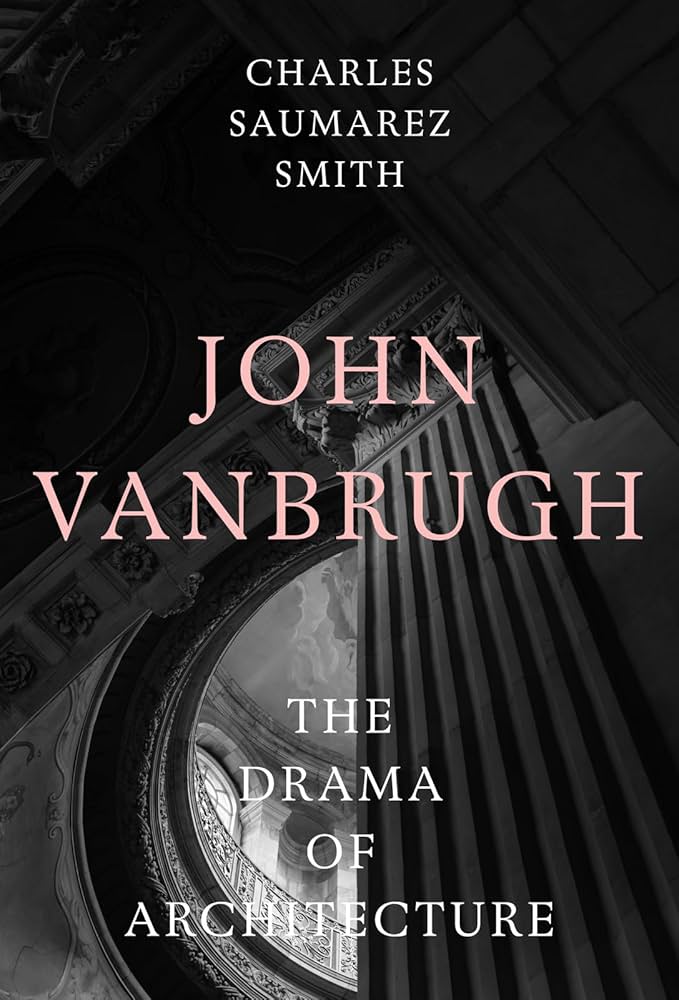 Charles Saumarez Smith will give a lunchtime talk on Vanbrugh’s extraordinary life: his upbringing; why he spent so much time in a French gaol; the writing of The Relapse and The Provoked Wife; and how he came to design Castle Howard with no previous experience of architecture. Saumarez Smith will give particular attention to Vanbrugh’s work as a theatrical impresario and the designer of the Queen’s Theatre, Haymarket, so disastrous as a venue for plays, but where all of Handel’s early operas were performed. He will then describe Vanbrugh’s quarrel with the Duchess of Marlborough and his later work as an architect, at King’s Weston, Claremont, Grimsthorpe, Seaton Delaval, and Stowe. In recent years, Vanbrugh’s reputation as an architect has been eclipsed by his subordinate, Nicholas Hawksmoor. This talk and the accompanying book will explain Vanbrugh’s originality and influence on later architects from Robert Adam to Robert Venturi and Denise Scott Brown.
Exhibition | Egypt: Influencing British Design, 1775–2025

George Dance, Front Elevation of a Library Chimney-piece for the 1st Marquess of Lansdowne, Lansdowne House, Berkeley Square, Westminster, ca. 1788–94; pen, sepia, raw umber, and crimson washes, shaded on laid paper laid down on (old) board with double-ruled border (London: Sir John Soane’s Museum, SM D3/3/3).
◊ ◊ ◊ ◊ ◊
Now on view at The Soane:
Egypt: Influencing British Design, 1775–2025
Sir John Soane’s Museum, London, 8 October 2025 — 18 January 2026
The mystery, romance, and aesthetic appeal of ancient Egypt has informed richly decorated Regency homes, Victorian factories and cemeteries, Art Deco cinemas, and twentieth-century houses, shops, and offices. This exhibition explores the British fascination with all things Egyptian through evocative drawings and books owned by Soane. Decorative objects including Wedgwood ceramics, Liberty Fabrics, and an Egyptian-style Singer sewing machine demonstrate the range of ways people have brought Egypt into their homes from Soane’s time to today.
This exhibition is accompanied by new work by Cairo-born artist Sara Sallam. As part of this exhibition, Sallam has produced A Tourist Handbook for Egypt outside of Egypt, Vol. II, London. Displayed in the Foyle Space in large scale, Sallam’s collages juxtapose photographs of London’s commemorative statues and imperial architecture with nineteenth-century paintings of correlating events in Egypt. Copies are available for purchase from the museum shop. Sallam’s second work, Eyes that Weep, Eyes that Pierce, is an audio tour, available exclusively on Bloomberg Connects, inspired by the sarcophagus of Seti I. Sallam invites you to listen closely to the Egyptian sky goddess Nut (seen inside the sarcophagus), her voice tracing the many eyes that have peered into Seti I’s sarcophagus across time.
Exhibition | Mary Linwood: Art, Stitch and Life
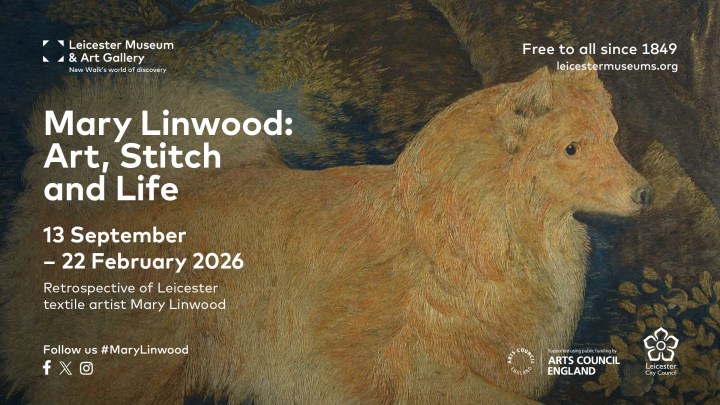
Mary Linwood, Pomeranian Dog, detail, needlework, 68 × 86 cm
(Leicester Museum & Art Gallery)
◊ ◊ ◊ ◊ ◊
Now on view, as noted by Adam Busiakiewicz for the Art History News blog:
Mary Linwood: Art, Stitch, and Life
Leicester Museum & Art Gallery, 13 September 2025 — 22 February 2026
A retrospective of the Leicester textile artist Mary Linwood (1755–1845)
Leicester’s Mary Linwood was a celebrity artist in the early 1800s but has since been largely forgotten. She created detailed embroidered versions of famous British paintings using a technique known as needle painting. Linwood was not only a talented artist but also an innovator and entrepreneur. Alongside running a successful school for young ladies in Leicester, she exhibited her embroidered works in touring exhibitions and established the first gallery in London to be run by a woman. In her lifetime, Linwood was supported by the wealthy and powerful, and was widely respected and well known. Since her death, however, she has been overlooked and undervalued. This exhibition is the first retrospective of Mary Linwood’s work since 1945, featuring 14 embroidered works from the Leicester Museums collections. Alongside these historic pieces are new textile artworks by Ruth Singer, reflecting on Linwood’s life and legacy.
Ruth Singer, Lost Threads: Mary Linwood’s Legacy (2025), 60 pages, £15. Available for purchase here.
◊ ◊ ◊ ◊ ◊
It’s also a fine opportunity to remind readers of Heidi Strobel’s recent book, The Art of Mary Linwood: Embroidery, Installation, and Entrepreneurship in Britain, 1787–1845. –CH










 Enfilade
leave a comment