Exhibition | Travels: Artists on the Move

Jakob Philipp Hackert, Cestius Pyramid with German Artists at the Grave of a Companion, 1777, pen and watercolor on paper, 35 × 46 cm
(Vienna: Albertina)
◊ ◊ ◊ ◊ ◊
From the press release:
Travels: Artists on the Move / Fernweh — Künstler:innen auf Reisen
Albertina, Vienna, 27 June — 24 August 2025
Ancient buildings, sunny southern landscapes, or local mountain worlds: travel has inspired numerous artists to create new perspectives and pictorial worlds. The Albertina Museum’s summer exhibition is dedicated to this artistic wanderlust with a selection of 18th- and 19th-century masterpieces from its own collection—from Johann Wolfgang von Goethe to Caspar David Friedrich and Tina Blau.
Travels: Artists on the Move spans an arc from the ‘Grand Tour’—an educational journey through Europe lasting several years with Rome as its destination—to voyages of discovery to distant continents. What was reserved for the sons of the nobility during the Renaissance increasingly became an educational ritual for the aspiring bourgeoisie from the 18th century onwards. Important destinations included Paris, Lyon, Marseille, Florence, Pisa, and the Eternal City. Johann Wolfgang von Goethe was drawn even further south on his Italian journey, and the museum presents four views from his trip to Italy from its own collection. The exhibition draws attention to landscapes that are as diverse as they are special, the intensity of the personal experience of nature and the conditions of travel in the 18th and 19th centuries. The finest drawings and luminous watercolors bring the longing for distant places and new horizons to life.
Introduction
Traveling—indulging the longing for the unknown and for faraway lands—is a notion dating to Romanticism, but as a phenomenon it was by no means limited to this era. The desire to leave one’s familiar surroundings, to get to know new scenery and distant destinations, and capturing them in drawings and paintings for those who had stayed behind also prompted numerous artists of Neoclassicism, Biedermeier, and Realism in the 18th and 19th centuries to set off for places near and far. They did so either on their own initiative as an educational journey in order to gain inspiration for their own artistic work, or on behalf of ruling dynasties and art publishers editing compilations of the most stunning views of a particular region. Countless picturesque impressions could be gained, whether near ancient buildings in Rome, in landscapes under the southern sun and in alpine mountains, on picturesque lakes, along the Danube and the Rhine, or on journeys to foreign countries.
The Albertina’s exhibition sheds light on this artistic love of travel by presenting 18th- and 19th-century masterpieces from its own collection while illustrating the various travel routes that existed. The show ranges from the Grand Tour and the study of antiquity and the Italian landscape to the beauty of the Austrian countryside, the fascination of the mountains and romantic journeys along the Rhine, and the discovery of other continents. The focus is on the various landscapes and motifs studied, as well as the exploration of nature in the works of Johann Wolfgang von Goethe, Caspar David Friedrich, Jakob Alt, Thomas Ender, and Rudolf von Alt. Women landscapists have also conquered nature, as is proven by works by Tina Blau, Olga Wisinger-Florian, Marie Lippert-Hoerner, and Emilie Mediz-Pelikan. Precious drawings and colorful watercolors allow us to sense the hunger for new horizons and witness not only individual experiences of nature but also the travel conditions in those days. In this way, travel becomes art and art becomes a mirror of travel.
Grand Tour
While since the Renaissance the traditional educational tour of Continental Europe had been exclusively reserved for the sons of aristocratic families, from the 18th century onward it also became popular among the upper middle classes as the so called Grand Tour. With Rome as its destination, it lasted several years and was the culmination of any higher education. Time and again, the travelers were accompanied by artists who were supposed to capture the beauties of nature. Over time, routes developed that led to must-see cities. The English voyaged from London to the Channel Coast, with Paris as their first important stop. They traveled via Burgundy and Lyon to Marseille and on to Italy, where Florence was most important as a first station. Visiting Pisa and Lucca, they moved on to the much-longed-for destination of the Eternal City, where they usually spent several months. It was almost obligatory to have one’s portrait painted by a local artist. Naples was also on the itinerary, and some were even drawn as far as Sicily, including Johann Wolfgang von Goethe. The return journey was then via Verona, Padua, and Venice. However, there were also many individual routes depending on the personal interests and networks of the travelers, leading through Germany, Austria, Switzerland, and the Netherlands on the way back home.
Goethe’s Italian Journey

Johann Wolfgang von Goethe, Lakescape, 1787, brush on paper 19.5 × 31 cm (Vienna: Albertina, permanent loan of Österreichische Goethe-Gesellschaft).
Johann Wolfgang von Goethe’s account of his Italian Journey (1813–1817) makes him one of the most famous Grand Tour homecomers. During the trip he made around 850 drawings. The writer, who was already well known at the time, traveled incognito in order to be able to move around more freely. He set off for Italy in September 1786, visiting Trento and Verona and stayed in Venice for a first extended stay of a fortnight. Goethe then visited the cities of Bologna and Florence in rapid succession before finally arriving in Rome, the place he had always longed for as a child. After four months he moved on to Naples. Goethe, following in the footsteps of his father on his own Grand Tour, ventured a little further than the latter had done in 1740. In the spring of 1787, he set sail for Sicily. For his exploration of the island he also hired a travel sketch artist, Christoph Heinrich Kniep, to capture the most beautiful vistas. For over a month, the two of them drew side by side. The four views of Sicily by Goethe shown in this exhibition bear witness to this journey and to his passion for drawing. Goethe eventually returned home via Naples and Rome in the spring of 1788.
Rome and the Study of Antiquity
Once Grand Tourists had arrived in Rome after months of traveling and numerous stopovers, they stayed for a few months to familiarize themselves with the city’s art treasures as profoundly as possible. Johann Joachim Winckelmann’s History of Ancient Art (1764) played a decisive role in the emergence and spread of the enthusiasm for antiquity. The tour comprised museums, old churches, ancient monuments, and such sites as the excavations on the Palatine, one of Rome’s seven hills. The Roman Forum, the ancient marketplace, offered ample opportunity to study the architecture and sculpture of antiquity through the temples, official buildings, market and assembly halls (basilicas), and the two triumphal arches from the first centuries AD. Magnificent villas and their exquisitely landscaped gardens, among them the 17th-century Villa Ludovisi, likewise attracted visitors to Rome.
According to the rules of the Académie française, the study of antiquity was the most important element in a painter’s education and training, alongside instruction in drawing and copying models. Many artists, thus encouraged by their art academies, traveled to Rome to study the city’s ancient heritage and the way the High Renaissance revisited it as to content and form.
The Italian Landscape
The artists visiting Rome not only discovered the city’s ancient monuments but also undertook excursions to the countryside and familiarized themselves with the unique scenery of the Campagna, the impressive coast near Naples, and the enchanting island of Capri. With its outstanding light, the Southern Italian landscape made a lasting impression on countless artists that prevailed even after their return home. Artists such as father and son Alt and Thomas Ender, whose origins lay in the Austrian Biedermeier period, painted topographically meticulous landscapes effectively staging light, water, and sky in the colors of nature.
Some artists imaginatively assembled different parts of a region, adding fictitious ancient ruins and random staffage figures. They created ideal Arcadian landscapes that were modeled on antiquity and evoked a nostalgic mood for past beauty. This ideal landscape painting style harked back to the 17th-century tradition of Claude Lorrain.
Fascination of the Mountains
Until well into the 19th century, the nature of high mountains was perceived as threatening. Crossing the Alps, as some people did on their Grand Tours, was fraught with danger. There were no well-maintained paths, rivers were not regulated, and one was rather defenseless in the face of rapid weather changes. Many a traveler fell victim to avalanches or rockslides, and some even died.
In the 18th century, a genuine enthusiasm for the Alps prevailed. Literature played a quite significant role in this. Publications dealing with the Alps and Switzerland in particular enticed many travelers. Improved transportation conditions had made traveling more comfortable. The golden age of alpinism began in the middle of the 19th century, with many first ascents. Artists captured the beauty of the mountains and catered to the newly awakened interest in mountain peaks, glaciers, and wild, pristine nature.
In the Service of Archduke John
As many as about 1,400 watercolors and drawings were executed by artists in the service of Archduke John. The works of his so-called ‘chamber painters’, who were on an equal footing with court painters, were originally created in the context of his efforts to produce a systematic description of Styria, for which the artists were to provide a pictorial documentation. Ferdinand Runk was employed by Archduke John from 1795 on and later also worked for the Princes Schwarzenberg and Johann I of Liechtenstein. The commissions that went to Matthäus Loder were still connected with the purpose of documentation, but more and more often motifs from the archduke’s immediate personal life and experiences were added. Loder’s task was taken over by Thomas Ender in 1828. He traveled as far as the glacier regions for Archduke John and also accompanied him on journeys to more distant destinations. The chamber painters came from several generations of artists. Their works were created over a period of almost fifty years and represent an important contribution to the development of 19th-century Austrian landscape painting.
In the Service of Emperor Ferdinand I

Rudolf von Alt, The Dachstein in the Salzkammergut as Seen from the Vorderer Gosausee, 1840, watercolor on paper, 42 × 52.5 cm (Vienna: Albertina).
Archduke Ferdinand (from 1835 Emperor Ferdinand I of Austria) commissioned the most highly renowned artists of his time to paint the most beautiful places throughout the Austrian monarchy. It was the heyday of Austrian watercolor painting. Initially, Eduard Gurk became the archduke’s companion and chronicler. In 1830 he created the first drawings for the imperial peep box series, which could be viewed by means of an optical device, offering the illusion of a deceptively real perspective expanse. Soon, Jakob Alt was also employed by Archduke Ferdinand. He had already made a name for himself with his work as a landscape painter for the art publisher Artaria. On the peep box series he collaborated particularly closely with his son Rudolf, yet the works were all signed by Jakob Alt as principal contractor. His son Franz Alt too was a talented landscapist. The painter Leander Russ worked for Emperor Ferdinand I’s peep box series starting in 1841.
Women Landscapists
In the 19th century few women were able to pursue an artist’s career. They were not allowed to study at the Vienna Academy of Fine Arts, as women were generally assumed to lack a creative spirit in the domain of high art. It was not until 1920 that women were admitted. Before that, they had to rely on private art schools, private teachers and, above all, family support, or their father or a close relative was a painter himself. Nevertheless, there were women landscape painters who traveled with their sketchbooks or painted directly in the great outdoors. The most important practitioners in Austria were Olga Wisinger-Florian and Tina Blau, who were already successful during their lifetimes, and who were permitted to take part in exhibitions. However, as Olga Wisinger-Florian complained, the works of women were poorly hung, and the women artists were not invited to exhibition openings. There were hardly any commissions from financially strong rulers or aristocrats for whom they could travel and paint.
Romantic Rhine Journey
Towards the end of the 18th century—based on the writings of Johann Wolfgang von Goethe, Friedrich Hölderlin, and Heinrich von Kleist—a rapturous interest in the Rhine landscape developed, which was in stark contrast to the wild alpine valleys of Switzerland. The rocky Upper Middle Rhine Valley, now a UNESCO World Heritage Site, became a popular tourist destination due to its fascinating river landscape and large number of castle ruins. The classic Rhine Romanticism route essentially stretched from Cologne to Mainz, although there were also variants and extensions similar to the Grand Tour, which led to the Upper Rhine between Basel and Bingen or to the sources of the Rhine. Many artists either traveled on their own initiative or were commissioned to capture the romantic views of the Rhine in painting. The Swiss artist Johann Ludwig Bleuler, who also owned a publishing house, and the Austrian landscape painter and etcher Laurenz Janscha created important series of vedute and views of the Rhine region.
On the Move
Until the 19th century, voyaging had mainly been reserved for the nobility. It was only then, in the course of industrialization, that a wealthy middle class discovered travel as well. From 1825 on, when the first train line was put into operation in England, the railroad rapidly developed into a widely networked transport system over the decades to come, making traveling much easier, more convenient, and safer. Until then, people had traveled in horse-drawn carriages. Artists could only go on such journeys if they had sufficient funds of their own or if they were financed by wealthy patrons. However, they often also traveled on foot to sketch in nature. In 1835, an English company brought out a paint box that was easy to transport and ideal for painting en plein air. The new pocket-sized travel guides published by Baedeker and Hartleben became useful companions. Many of the places that artists wished to capture were difficult to reach. They thus carried sketchbooks with them or had a light travel easel that could easily be set up anywhere.
Traveling to Faraway Countries
The longing for endless expanses and an unbridled spirit of discovery were the driving forces behind travel in the 19th century. In most cases, however, it was solid monetary and territorial reasons that led to numerous journeys of exploration and discovery. Artists often accompanied these voyages in order to capture romanticizing impressions of the various stations in paintings and drawings. One of the most ambitious expeditions in the name of science was the circumnavigation of the world with the frigate Novara between 1857 and 1859, which was also not without economic interests. Archduke Ferdinand Maximilian, commander-in-chief of the Austrian navy, made the converted frigate Novara available to the Academy of Sciences and the Geographical Society. On board was the landscape painter Josef Selleny, who documented the journey. He produced around 2,000 watercolors, sketches, and studies, thus making a significant contribution to the success of the expedition. Another example was Leander Russ, who had already been the artistic companion of a diplomat on a trip to the Orient when he was commissioned by Emperor Ferdinand I in 1841 to produce peep box paintings with motifs from Egypt, Bethlehem, Jerusalem, Beirut, and India.
New Book | Old Age in Art
From Reaktion Books, with distribution by The University of Chicago Press:
Larry Silver, Old Age in Art (London: Reaktion, 2025), 208 pages, ISBN: 978-1836390527, £20 / $30.
 Old Age in Art shows how elders have been depicted from ancient Greece and Rome to the present century. The book explores portraits, including self-portraits, and stories of older figures in religion, myth, and history, focusing on the theme of wisdom versus folly. Larry Silver also discusses the concept of old age within the Middle Ages and early modern periods. The final chapter examines how renowned artists like Michelangelo, Titian, and Monet turned to experimental forms and new subjects in their later years. This book provides a comprehensive overview of old age in European art history.
Larry Silver is the Farquhar Professor Emeritus of History of Art at the University of Pennsylvania and a specialist in Dutch and Flemish paintings. He has published numerous monographs and exhibition catalogues, including Rembrandt’s Holland (Reaktion, 2018).
c o n t e n t s
Preface: Ars longa, vita brevis
1 Old Age Is Relative: Age and Stage as Concepts from Antiquity to the Renaissance
2 Wisdom and Folly
3 Old Age Stories
4 Portraits – Self and Others
5 Old-Age Style
References
Bibliography
Acknowledgements
Photo Acknowledgements
Index
Print Quarterly, June 2025
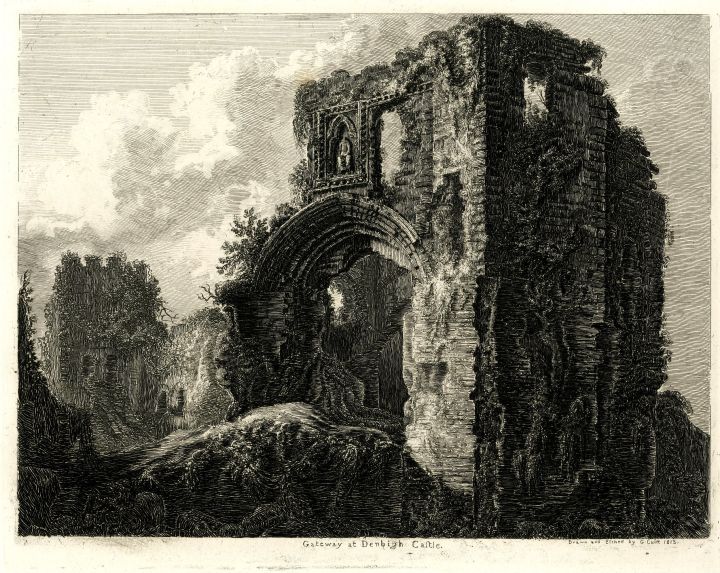
George Cuitt, Gateway at Denbigh Castle, 1813, etching, 252 × 315 mm
(London, British Museum), reproduced on p. 200.
◊ ◊ ◊ ◊ ◊
The long eighteenth century in the latest issue of Print Quarterly:
Print Quarterly 42.2 (June 2025)
a r t i c l e s
• Jane Eade, “A Mezzotint by Jacob Christoff Le Blon (1667–1741) at Oxburgh Hall,” pp. 143–53. This article examines a newly discovered impression of Jacob Christoff Le Blon’s colour mezzotint after Sir Anthony van Dyck’s (1599–1641) portrait of The Three Eldest Children of Charles I at Windsor Castle. The author discusses Le Blon’s invention of his revolutionary printing technique, the print’s distribution history, the operations of Le Blon’s workshop known as the ‘Picture Office’, as well as the circumstances surrounding the Oxburgh Hall impression, including its recent conservation treatment.
• Stephen Bann, “Abraham Raimbach and the Reception of Prints after Sir David Wilkie in France,” pp. 154–67. This article establishes the premise that Sir David Wilkie (1785–1841) introduced a new style of narrative painting in England that would prove influential for painting throughout Europe. It was previously thought that Paul Delaroche (1797–1856) popularized this new narrative style a couple of decades later in France. Since the French public had no local access to Wilkie’s paintings, it is here shown that it was the reproductive engravings of Abraham Raimbach that brought Wilkie to their attention. In doing so, this idea challenges the centrality of Delaroche’s sole influence on European painting.
• Paul Joannides, “John Linnell, Leonardo Cungi and the Vault of the Sistine Chapel,” pp. 168–84. This article discusses John Linnell’s (1792–1882) mezzotints after the Sistine Chapel ceiling and the recently discovered drawings on which the prints were based. The drawings, once a single sheet, are here attributed to Leonardo Cungi (1500/25–69); in its entirety, it is the earliest known copy to show the complete ceiling in full detail.
n o t e s a n d r e v i e w s
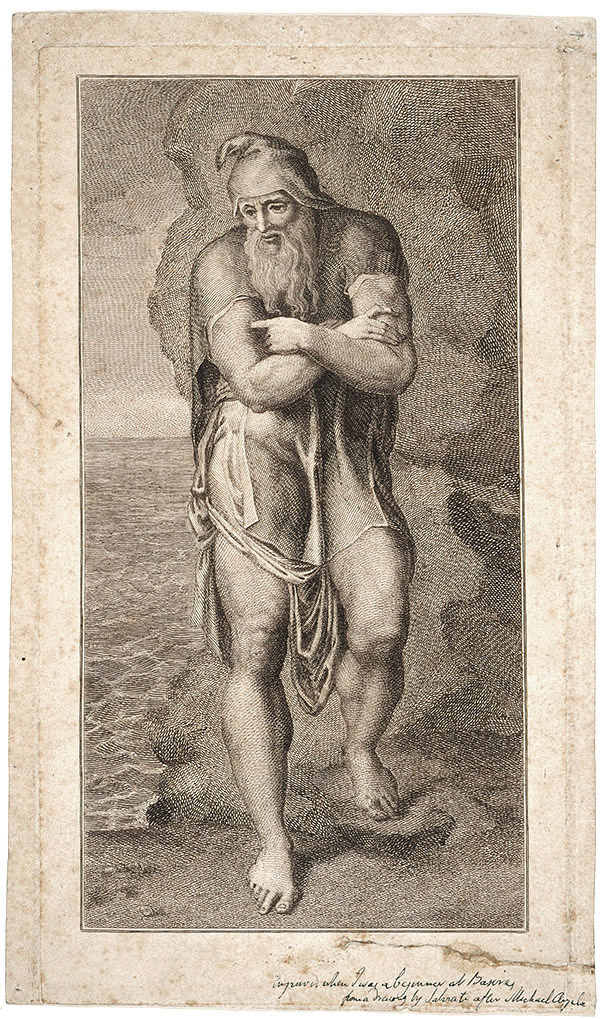
William Blake, Joseph of Arimathea among the Rocks of Albion, ca. 1773, engraving, 254 × 138 mm (Cambridge, Fitzwilliam Museum), reproduced on p. 192.
• Ulrike Eydinger, Review of Jürgen Müller, Lea Hagedorn, Giuseppe Peterlini and Frank Schmidt, eds., Gegenbilder. Bildparodistische Verfahren in der Frühen Neuzeit (Deutscher Kunstverlag, 2021), pp. 185–87.
• Nigel Ip, Review of Owen Davies, Art of the Grimoire (Yale University Press, 2023), pp. 187–89.
• Antony Griffiths, Review of Mario Bevilacqua, ed., Edizione Nazionale dei Testi delle Opere di Giovanni Battista Piranesi. I. Opere giovanili, ‘Vedute di Roma’, ‘Pianta di Roma e Campo marzo’ (De Luca Editori d’Arte, 2023), pp. 191–92.
• Mark Crosby, John Barrett and Adam Lowe, Note on William Blake as an apprentice engraver, pp. 192–93.
• Ersy Contogouris, Review of Pascal Dupuy, ed. De la création à la confrontation. Diffusion et politique des images (1750–1848) (Presses Universitaires de Rouen et du Havre, 2023), pp. 194–95.
• Cynthia Roman, Review of David Atkinson and Steve Roud, Cheap Print and Street Literature of the Long Eighteenth Century (Open Book Publishers, 2023), pp. 197–98.
• Sarah Grant, Review of Peter Boughton and Ian Dunn, George Cuitt (1779–1854), ‘England’s Piranesi’: His Life and Work and a Catalogue Raisonné of His Etchings (University of Chester Press, 2022), pp. 199–201.
• Timon Screech, Review of Akiko Yano, ed., Salon Culture in Japan: Making Art, 1750–1900 (British Museum Press, 2024), pp. 201–03.
• Bethan Stevens, Review of Evanghelia Stead, Goethe’s Faust I Outlined: Moritz Retzsch’s Prints in Circulation (Brill, 2023), pp. 240–43.
LACMA Acquires Manuel de Arellano’s Precursors of Casta Painting
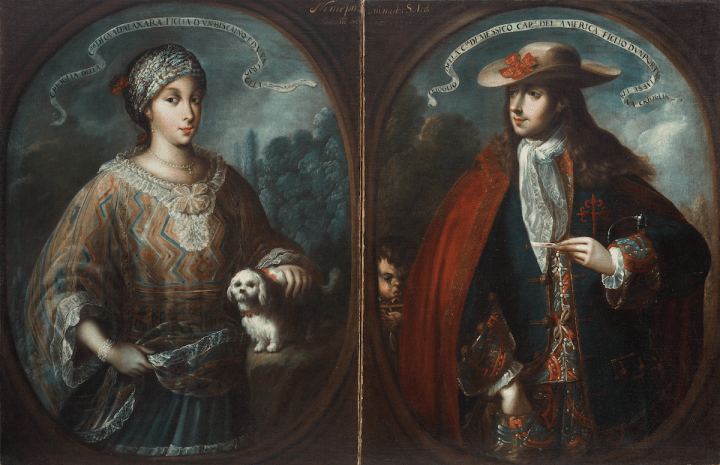
Manuel de Arellano, Creole Woman from the City of Guadalajara and Creole Man from Mexico City, ca. 1710, oil on canvas, each 109 × 84.5 cm (Los Angeles County Museum of Art, gift of the 2025 Collectors Committee with additional funds from an anonymous donor, photo courtesy of Colnaghi, Madrid).
◊ ◊ ◊ ◊ ◊
As noted at the Art History News blog; from the LACMA essay (30 April 2025) by Ilona Katzew, who leads the museum’s Latin American department:
This week we added a unique pair of paintings by Manuel de Arellano (1662–1722) to the collection. The works are remarkable in terms of their execution, subject, and pivotal place in the history of 18th-century Mexican painting. Conceived as a pair, they depict a man and a woman within a fictive oval frame, a format traditionally reserved for distinguished figures. Yet, they are not portraits of actual individuals but of different racial types. In fact, these two paintings are groundbreaking precursors of the famous casta (caste) paintings, a distinctive pictorial genre invented in Mexico to depict multiracial families that spanned the entire 18th century.
Manuel de Arellano came from a prominent dynasty of artists active in Mexico City. He trained with his father, Antonio de Arellano (1638–1714), and by 1690 he was working independently and creating paintings marked by a great deal of experimentation. These works developed during a period of political shifts and mounting social and racial tensions in Mexico City. In 1692, just a few years before the ascent of the Bourbons to the Spanish throne (1700), a major riot erupted in the main square, when the Indigenous population and mixed-raced working-class, outraged over the scarcity of basic food staples and the mishandling of power, set fire to the viceregal palace, threatening to overthrow the colonial government.
Spaniards born in the Americas—known as Criollos (Creoles)—grew equally frustrated with imperial authorities, who treated them as second-class citizens and often passed them over for important civil and ecclesiastical posts. Added to this, the common misconception in Europe that everyone in the Americas was a degraded hybrid further tarnished the reputation of Creoles, casting into question their ability to rule. Arellano’s works responded to these concerns by constructing a view of a mixed yet orderly and prosperous society. His monumental view of the transfer of the original image of the Virgin of Guadalupe to her new shrine is a tour de force that captures Mexico City’s complex social hierarchy in minute detail.
LACMA’s new acquisitions are the first paintings to single out Mexico’s diverse population, setting forth the path for the development of casta painting across the 18th century. The inscriptions on the works identify the racial types and situate them geographically. They read: “Creole Woman from the City of Guadalajara, Daughter of a Basque Man and a Creole Woman” and “Creole Man from Mexico City, Capital of America, the Son of a Portuguese Man and a Creole Woman.” The unusual scrolling banderoles in Italian may be related to the original commission and their intended use, a subject that requires further study. . . .
The full essay (with reading suggestions) is available here»
Exhibition | George Dance the Younger

George Dance, Bank of England: Record Drawing of the Wall from Lothbury Street, 1794–97
(London: Sir John Soane’s Museum, SM 12/1/2).
◊ ◊ ◊ ◊ ◊
From The Soane:
George Dance the Younger: A Bicentennial Celebration
Sir John Soane’s Museum, London, 14 January — 31 December 2025
Curated by Frances Sands
On 14 January 2025, we mark the bicentenary of the death of the architect George Dance the Younger (1741–1825). Dance is not a household name, and relatively few of his buildings survive, but during his lifetime he was an innovative and celebrated architect. Moreover, as the architectural mentor of John Soane, his influence looms large at Sir John Soane’s Museum.
Born in 1741, George Dance studied architecture in Italy from 1758 until 1764. Initially joining his father’s architectural practice on his return to London, Dance then succeeded him as Clerk of the City Works in 1768. His long and prolific career of 1764–1816 spanned the neoclassical movement and the Greek Revival and he experimented with and shaped both styles. Dance accepted apprentices into his office, shaping the careers of major architects including John Soane, who was apprenticed to Dance in 1768–71. Dance was also a founder member of the Royal Academy.
There is little surviving correspondence from Dance and almost nothing to reveal his thoughts on architecture. Moreover, few of his buildings survive. Yet his legacy is notable, thanks largely to his surviving drawings at the Soane Museum. These were the last great addition to Soane’s collection, on 18 November 1836, just weeks before Soane died. Soane’s accounts show that he paid Dance’s son, Sir Charles Webb Dance, £500 for the drawings collection. Along too came a handsome cabinet, known as ‘The Shrine’ which had been made to contain the drawings. The Shrine can be admired in the North Drawing Room at the Soane Museum and still contains the Dance collection, comprising an invaluable record of the work of George Dance the Younger, a towering figure in architectural history.
More information is available here»
New Book | Holkham
From Hirmer, with distribution by The University of Chicago Press:
Elizabeth Angelicoussis and Leo Schmidt, eds., with photographs by Pete Huggins, Holkham: An English Treasure House and Its Landscape (Munich: Hirmer Publishers, 2025), 368 pages, ISBN: 978-3777444444, $65. With contributions by Peter Burman, Polly Feversham, Anne Glenconner, Katherine Hardwick-Kulpa, John Hardy, Uta Hassler, Christine Hiskey, Markus Joachim, Christian Keller, Axel Klausmeier, Werner Koch, Silke Langenberg, Tom Leicester, Laura Nuvoloni, Bernhard Ritter, Christoph Martin Vogtherr, and Tom Williamson.
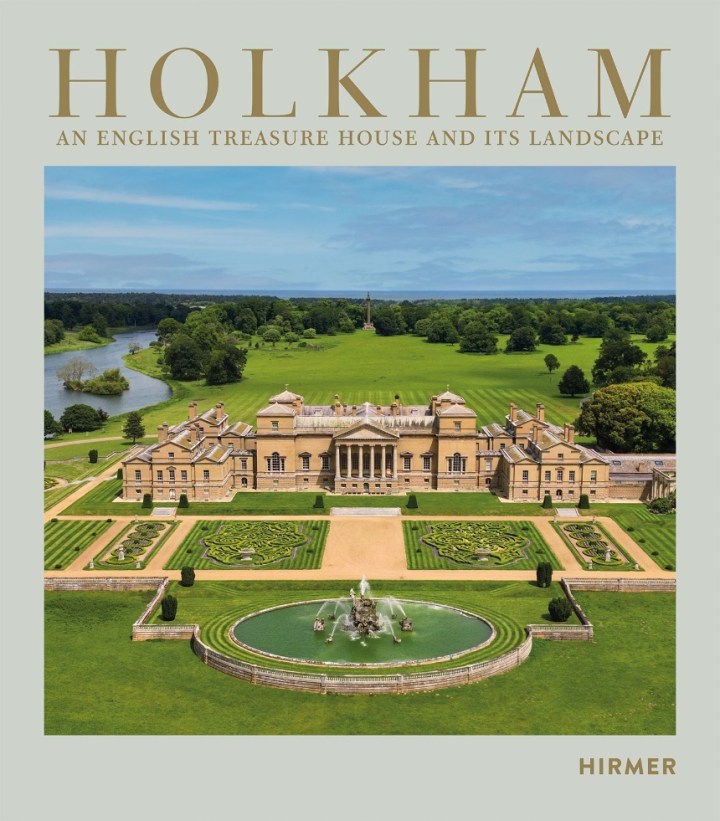 Created over four decades, from the 1720s to the 1760s, by the highly erudite, visionary, and ambitious Earl of Leicester, Holkham Hall is a masterpiece of Palladian architecture. Richly illustrated and with far-reaching essays, this volume invites us to a splendid tour through an incredibly well-preserved house, with all its splendidly furnished interiors and amazing collection of artworks still in place. Lord Leicester designed Holkham as the ideal home and setting for the ancient sculptures, distinguished paintings, and other treasures he had acquired on his Grand Tour. The unique Marble Hall and the Gallery revive and celebrate the virtues of ancient Rome, while the saloons and staterooms vibrate with a baroque sense of grandeur and splendor. With the original family still in custodianship, Holkham is a unique survivor of the golden age of English country house culture.
Elizabeth Angelicoussis is a classical archaeologist and expert on eighteenth-century sculpture collections.
Leo Schmidt is an architectural historian and emeritus professor of heritage conservation at Brandenburg University of Technology in Cottbus.
c o n t e n t s
Foreword
Introduction
1 Thomas Coke, Earl of Leiceser — The Builder of Holkham
2 The Holkham Landscape
3 The Architecture
4 The Rooms and the Collections
5 Living at Holkham
6 Holkham — Past, Present, and Future
Picture Credits
Acknowledgments
Authors and Contributors
Selected Bibliography
Index
Xavier Salomon Named Director of the Calouste Gulbenkian Museum
As noted at the Art History News Blog; from the press release (24 June 2025) . . .
 Xavier F. Salomon, the current Deputy Director and Peter Jay Sharp Chief Curator of the Frick Collection in New York, has been chosen by the Gulbenkian Foundation’s Board of Trustees as Director of the Calouste Gulbenkian Museum in Lisbon. Following an international recruitment process, Solomon will succeed António Filipe Pimentel, who will retire at the beginning of next year.
Xavier F. Salomon was born in Rome [in 1979] and grew up between Italy and the United Kingdom. He was educated at the Courtauld Institute of Art in London, where he received his BA in art history, his MA, and his PhD with a thesis on “The Religious, Artistic, and Architectural Patronage of Cardinal Pietro Aldobrandini (1571–1621).”
Salomon worked at the British Museum and at the National Gallery in London, before joining, in 2006, Dulwich Picture Gallery as the Arturo and Holly Melosi Chief Curator. At Dulwich, Salomon curated many exhibitions on artists such as Guido Reni, Paolo Veronese, Salvator Rosa, Anthony van Dyck, Nicolas Poussin, and Cy Twombly. In 2011, he joined the Department of European Paintings at the Metropolitan Museum of Art in New York, as Curator of Southern Baroque, in charge of Italian paintings from the 17th and 18th century, French 17th-century, and Spanish paintings. In 2014, he curated the monographic exhibition Paolo Veronese: Magnificence in Renaissance Venice at the National Gallery in London.
Since 2014, he has been Deputy Director and Peter Jay Sharp Chief Curator at the Frick Collection in New York where he curated exhibitions on artists such as Guido Cagnacci, Paolo Veronese, Antonio Canova, Giambattista Tiepolo, Luigi Valadier, Bartolomé Esteban Murillo, Bertoldo di Giovanni, Giovanni Bellini, and Giorgione. He also worked on projects with contemporary artists such as Doron Langberg, Salman Toor, Jenna Gribbon, Nicolas Party, and Flora Yukhnovich. In 2022, he curated the exhibitions James McNeill Whistler (1834–1903): Masterpieces of the Frick Collection, New York at the Musée d’Orsay in Paris and The Polish Rider: The King’s Rembrandt at the Royal Łazienki Museum, Warsaw and Wawel Royal Castle, Kraków. In recent years, he supervised the renovation of the galleries at the Frick, moving them first in 2021 to Frick Madison and then back to the historic location of the museum, which reopened in April 2025.
Salomon is the author of the acclaimed online series Cocktails with a Curator and Travels with a Curator and of the book thereon (2022). He is widely published and his scholarly articles have appeared in The Burlington Magazine, Apollo, Journal of the History of Collections, Master Drawings, The Metropolitan Museum Journal, and the Boletín del Museo del Prado, among others. He was a Rome Scholar at the British School at Rome in 2002–03; a Fellow at the Robert H. Smith International Center for Jefferson Studies in Monticello, Virginia in 2017; and a Leigh Fermor House Fellow at the Benaki Museum, Athens in 2024.
Salomon’s main areas of expertise are art and patronage in 17th- and 18th-century Rome and Venice, and the painters Paolo Veronese and Rosalba Carriera. He is currently working on a new catalogue raisonné of Paolo Veronese’s drawings and one of Rosalba Carriera’s works, while working also on the catalogue of the Spanish paintings at the Frick Collection. In 2018, Salomon was nominated Cavaliere della Stella d’Italia by the Italian President of the Republic.
The Calouste Gulbenkian Museum in Lisbon, Portugal houses the collection gathered by Calouste Sarkis Gulbenkian throughout his life (1869–1955). The collection includes more than 6,000 pieces from antiquity to the early 20th century, including Egyptian, Greco-Roman, Islamic, and Far Eastern art, as well as European numismatics, paintings, and decorative arts. Currently closed, the museum will reopen in the summer of 2026, after the extensive renovation of the air conditioning, lighting, and security systems in its galleries.
Conference | The 9th Feminist Art History Conference
From ArtHist.net and the conference website:
The 9th Feminist Art History Conference
Online and in-person, American University, Washington D.C., 25–26 September 2025
Registration due by 1 September 2025
The Feminist Art History Conference fosters intersectional and interdisciplinary scholarship on the ways in which gender and sexuality have shaped the visual arts and their study–with a conference program designed to advance new research on topics from the ancient past through the present and across the globe. It provides a forum for participants to examine the roles that art and its agents have played in informing and resisting historical and contemporary inequities. Through this forum, the conference aims to model a more inclusive art history and scholarly community.
The Feminist Art History Conference was established in 2010 to celebrate and build on the feminist art-historical scholarship and pedagogy of Norma Broude and Mary D. Garrard, Professors Emeriti at American University. It is sponsored by the Art History Program in the Art Department, College of Arts and Sciences, at American University, with the generous support of Robin D’Alessandro and Dr. Jane Fortune. The conference comprises 10 in-person panels, 12 online panels, and 5 hybrid panels. Keynotes will be hosted in-person with a livestream feed. Registration is available here.
Organizing Committee
Andrea Pearson, Joanne Allen, Juliet Bellow, Kim Butler Wingfield, Mary Garrard, Norma Broude, Nika Elder, Ying-chen Peng
f r i d a y , 2 6 s e p t e m b e r
10.30 Keynote 1 (online)
• Dorothy Price (Courtauld Institute)
1.00 Session 1 | Shifting Identities / Identity Shifts (online)
• Judith Rehermann — Hans Baldung Grien’s Enigmatic Painting Lot and His Daughters
• Anna Savchenkova — Beauties Replacing Popes and Crosses: The Phenomena of Renaissance Niello Medallions
• Pat Simons — The Amateur Woman Artist and the Myth of Irene di Spilimbergo
• Lauryn Smith — Transcending One’s Sex: Connoisseurial Displays in the Cabinets of Amalia van Solms-Braunfels
2.00 Session 2 | Images of the Female Body as Resistance I (online)
• Georgieva & Takeyana Jini — Embodied Revolt: Gender Perspectives on the Female Body in Japanese Modern and Contemporary Art
• Maite Luengo-Aguirre — Reimagining the Female Body: Feminist Interventions in Painting and Photography in 1990s Spain
• Maria Garth — Zenta Dzividzinska: Nude Photography and Self-Portraiture in the Soviet 1960s
• Gandotra Apeksha — Gender Analysis of Korean Drama Posters: Visual Representation and Stereotypes
3.00 Session 3 | Italy: Women Artists, Feminist Art, and Their Promotion in the 20th Century (online)
• Federica Arcorarci — Romana Loda’s Legacy: Promoting Feminist Art in 1970s Italy Francesca della Ventura: ‘La lotta é FICA1!’. Feminist Practices of Urban Art and Gender Claims in Contemporary Italy
• Camilla Paolino — Feminist Escapes from the Domestic through Art Making in 1970s Italy: On the Work of Clemen Parrocchetti and Lydia Sansoni
4.00 Session 4 | Locating Agency (online)
• Carmen Ruiz Vivas — Women and Peace in Ancient Roman Art: From Symbols to Agents
• Lydia McKelvie — Ghiberti’s Story of Rebecca: Women’s Agency in the Gates of Paradise
• Monica Zavala Cabello — Practices, Rituals, and Agency of the ‘Warrior Woman’ in the Ancient Mexican Tradition: A Gender Perspective Approach to Bernardino de Sahagún’s Images in the Florentine Codex
• Emma Luisa Cahill Marrón — Bloody Mary Tudor Revisited: Queen Mary I of England in the Prado Museum’s Female Perspective
s a t u r d a y , 2 7 s e p t e m b e r
9.00 Session 5a | From the Margins (online)
• Mey-yen Moriuchi — A Reconsideration of Las Señoritas Pintoras from 19th-Century Mexico
• Yuniya Kawamura — Female Ukiyo-e Artists in the Male-dominated Japanese Art World during the Edo Period
• Nadine Nour el-Din — Inventing the Modern: Women Who Shaped Collecting and Patronage in Egypt: Émilienne Hector Luce and Huda Shaarawi
• Georgina Gluzman — Decorative, Useful, National, and Very Feminine: Discourses and Practices around the ‘Impure’ Arts (Argentina, 1920–1940)
9.00 Session 5b | Textiles I: Tradition and Subversion (online)
• Irene Bronner — Eroticism as Gender Critique in Textile Art by South Africans Ilené Bothma, Kimathi Mafafo, and Talia Ramkilawan
• Marina Vinnik — Otti Berger and Anni Albers: Bauhaus Weaving Workshop and Architecture
• Smaranda Ciubotaru — Crafting Subversion: Intermediality and Artisanal Knowledge Among the Female Fiber Artists of the Ceaușescu Regime
• Elizabeth Hawley — Intertwined: “Ancestral Lands, Women’s Work, and Indigenous Sovereignty in the Photographic Weavings of Sarah Sense and Darby Raymond-Overstreet
9.00 Session 5c | Domestic Labor I (online)
• Sarah Evans — Twinned Mothers Set to Work? Bharti Kher’s Mother and Child Joins the Debate About Remunerated Gestational Surrogacy in India
• Bálint Juház — Gender and Motherhood on Eszter Mattioni’s female portraits in the 1930s: The contradictions of a Hungarian woman artist
• Elizabeth Hamilton — Troubled Domesticities
10.00 Session 6a | State of the Field: Asia (extended panel; runs until 11.50)
• Naoko Seki, Professor, Faculty of Letters, Waseda University
• Yoonjung Seo, Assistant Professor, Department of Art History, Myonji University
• Soyeon Kim, Associate Professor, Department of Art History, Ewha Womans University
• Yutong Li, Postdoc fellow, Center for Global Asia, NYU Shanghai
10.00 Session 6b | Spectatorship in France (online)
• Dani Sensabaugh — Virtue and Viewership in Élisabeth Vigée Le Brun’s Julie Le Brun as a Bather (1792)
• Heather Belnap — Homme Fatal: Female Spectators and the Male Nude in the Musée Napoléon
• Mathilde Leichle — Looking for the Male Gaze in 19th-Century France: Armand Silvestre and Le Nu au Salon
• Viktoriia Bazyk — The Hypermasculine Male Nude in Student Works at the Académie de France à Rome Viewed through a Queer-Feminist Lens
10.00 Session 6c | Historic Feminist Art Exhibitions (online)
• Joanna Gardner-Huggett — Beijing and Beyond: The Women’s Caucus for Art and the Fourth U.N. World Conference on Women (1995)
• Maggie Hire — Valie Export and Magna Feminism
• Emilie Martin-Neute — In the Shadows: French Female Artists Groups Exhibitions, the Case of the Société des Femmes Artistes (1893–1908)
10.00 Session 6d | Herstories across Asia (Online)
• Lily Filson — From Rada’a to Rome: Elite Women of Tahirid Yemen in the Codex Casanatense
• SaeHim Park — The Little Girl Commemorative Coin: Art, Memory, and Commodification
• Chinghsin Wu — Womanhood and Ethnicity: Chen Jin’s Paintings of Women in Modern Japan and Taiwan
• Sophia Merkin — Fanny van de Grift Osbourne Stevenson (1840–1914)
11.00 Lunch Break
12.30 Session 7a | Mother Nature (in-person)
• Katia Myers — Brú na Bóinne Monuments: The Female Body in Architecture, Myth and Landscape
• Jessica Weiss — Be Fruitful and Multiply: Vegetal Decoration and Dynastic Aspirations in Isabel of Castile’s Breviary
• Tobah Auckland-Peck — The Mine, ‘Mother Nature’, and the Woman Artist: Gender and Industry in Modern British Art
12.30 Session 7b | Feminist Methodologies (online)
• Nina Lubbren — Women’s Public Sculpture in Weimar Germany’s Regions, or: Feminist Art History and Canon Critique
• Nancy Gebhart — Theorizing a Nonlinear Art Historical Timeline as Feminist Practice and Pedagogy
• Karen Leader — Critical Contexts: Getting the Art History We Deserve
12.30 Session 7c | Public Monuments: Feminist Protest and Canon Critique (in-person)
• Sierra Rooney — On the Pedestal: Gender, Representation, and Violence in Monuments to Hannah Duston (19th-Century America)
• Francesca Gregori — The Feminist Antimonumenta Movement in Mexico: The case of ‘Antimonumenta – Vivas Nos Queremos’
• Brenda Schmahmann — Between a Torch and a Wing: Liberating Women in Two Public Sculptures in Johannesburg
12.30 Session 7d | Politics of Media (in-person)
• Agnieszka Anna Ficek — (Un)Fragile Passions: Maria Amalia’s Porcelain Salottino and Queenly Patronage
• Brittany Luberda — Forces at the Forge: 18th-Century Women Silversmiths in America
• Isabel Bird — ‘People Have No Trust in Glue’: Eve Babitz, Amateurism, and the Art of Collage
1.45 Caffe Pause
2.00 Session 8a | 1930s Germany (hybrid)
• Annika Richter — Queer-Feminist Utopias and Deviant Aesthetic Practices in the Artist Album ‘Die Ringlpitis’, 1931
• Elizabeth Otto — Designing Home: Bauhaus Designers and the Nazi Everyday
• Shalon Parker — Two in One: Doubling of the Self in Lotte Jacobi’s Interwar-Period Portraiture
2.00 Session 8b | Images of the Female Body as Resistance II (in-person)
• Theo. Triandos — Crossing: Feminist Interventions at the Intersection of Critical and Aesthetic Practice (Lynda Benglis)
• Rachel Middleman — Revisiting ‘Female Imagery’: Abstract Painting and the Central Image, c. 1963–1973
• Marissa Vigneault — Hannah Wilke: Nice Piece of Art
2.00 Session 8c | Assertions of Women Artists (hybrid)
• Ann Pleiss-Morris — ‘Embroiderers in blue, purple and scarlet yarn and fine linen’: The Reclamation of Feminine Spirituality in the Embroidered Cabinets of Early Modern Women
• Emma Thompson — Authorship, Agency, and Inventive Input: Claudine Bouzonnet Stella and Professional Self-Fashioning
• Mirja Beck — Aimée-Zoë Lizinka de Mirbel and Her Networks: European Women Miniature Painters around 1800
2.00 Session 8d | Domestic Labor II (in-person)
• Ashley McNelis — Mother Art’s Public Performances of Care
• Oriana Mejias Martinez — Art Revindicates Afro Latin American Households Run by Women
• Rebecca DeRoo — Reconsidering Motherhood and Labor in Mary Kelly’s Post-Partum Document
3.15 Katzen Museum Visit/In-person Meetings
4.00 Museum Reception
4.30 Keynote 2 (in-person)
• Joan Breton Connelly (NYU)
s u n d a y , 2 8 s e p t e m b e r
9.00 Tour at the National Museum of Women in the Arts
10.30 Transportation to Katzen Art Center at American University
11.45 Session 9a | Interrogating Female Vices (in-person)
• Michelle Moseley-Christian — Eve as Glutton: Appetite and Sensory Embodiment in 15th-Century Netherlandish Imagery
• Stephen Speiss — Representing Whoredom in the Early Modern Visual Arts
• Maria Maurer — Imagining the Mistress: Renaissance Portraits and Modern Fantasies
• Annelies Verellen — Michaelina Wautier, Judith Leyster, and Maria Schalcken
11.45 Session 9b | Italy: Women Artists, Feminist Art, and Their Promotion in the 20th Century II (in-person)
• Greta Boldorini — ‘Ashes to Ashes’: An Intimate Work by Adrian Piper from US to Italy
• Allison Belzer — Shared Origins, Distinct Paths: The Nathan and Modigliani Sisters in Post-Risorgimento Italian Art
• Jennifer Griffiths — Adriana Bisi Fabbri: Caricatures and Cartoons of the Feminist Avant-garde
• Giulia Colombo/Zompa — Photography in the Journals by Milanese Feminist Collectives (1972–1978)
11.45 Session 9c | Feminist Museum Initiatives Today (in-person)
• Bryn Schockmel — A Feast of Fruit and Flowers: Women Still Life Painters of the Seventeenth Century and Beyond, on view at The Hyde Collection in Glens Falls, New York (from October 25, 2025 to March 8, 2026)
• Élenore Besse — AWARE (Archives of Women Artists, Research & Exhibitions) Proposes to Present Its Missions, History and Research
• Maria Holtrop and Charles Kang — Point of View, Gender at the Rijksmuseum
• Carolyn Russo — Art, Space, and Gender: The Evolution of Women Artists in the NASA Art Program
11.45 Session 9d | Women of a Certain Age: Looking at the Overlooked (hybrid)
• Jessica Fripp — The ‘Critical Age’ during a Critical Time: Older Women and the French Revolution
• Alissa Adams — From Telling to Reading Stories: Older Women and the Disembodiment of Knowledge in 19th-Century Art
• Ruth E. Iskin — Mary Cassatt’s ‘Splendid Old Woman’: Aging as a Feminist Issue in Cassatt’s Art and Time
• Alice Price — Aging Bodies, Mature Careers: Intersectionality of Modernism, Gender, and Aging
1.15 Caffe Pause
1.25 Session 10a | Crossing the Binary (hybrid)
• Robin O’Bryan — A Female Dwarf as a Warrior Maiden: Poetry and Performance in a Venetian Portrait
• Consuelo Lollobrigida — Amaryllis and Mirtillo: Did Women Have in 17th-century Europe Their Same Sexual Love Affair Code of Representation in 17th-Century Europe?
• Yukina Zhang — Vogue Chang’an: Fashion, Gender, and New Female Beauty in Tang China, 618–907
• Kathrine Kiltzanidou — Women as Patrons of Ecclesiastical Institutions in the Balkans and Cyprus during the Late Medieval and Early Modern Periods
1.25 Session 10b | Textiles II: Labors of Love (in-person)
• Amy Rahn — Affiliative Threads: Made-to-Measure Clothes as Circuits of Care
• Stephanie Strother — Jeanne Goehring, Agnès Jallat, Gabrielle Rousselin, Alice Rutty
• Diletta Haberl — Herta Wedekind zur Horst / Herta Ottolenghi Wedekind
• Margot Yale — At the Seams: The Labor Politics of Sewing in Elizabeth Catlett’s Prints
1.25 Session 10c | Lesbian Self-Fashioning in the 19th and 20th Centuries (in-person)
• Justine De Young — Public Selves, Private Lives: Lesbian Self-Fashioning in Louise Abbéma’s Portraiture
• Toni Armstrong — Beauty Contest: Florine Stettheimer and Queer Modernism
• Julie Cole — Lesbian Collaboration as Subterfuge in the Works of Marcel Moore and Claude Cahun
• Rachel Silveri — Sapphic Surrealism: Valentine Penrose’s Dons des féminines
1.25 Session 10d | 1970s Feminist Art Movement: New Contexts (in-person)
• Susana Pomba — Smoke & Dust Bodies: Judy Chicago’s Atmospheres and Antonioni’s Zabriskie Point
• Jennifer Kruglinski — Eleanor Antin’s Exiled King in Solana Beach
• Stephanie Seidel — Temporary Constellations: The Installations of Betye Saar
• Lesley Shipley — Making Whiteness Visible: The Protest Paintings of Vivian Browne, Faith Ringgold, and May Stevens
Exhibition, Panels, and Talks | Trois Crayons Presents Tracing Time
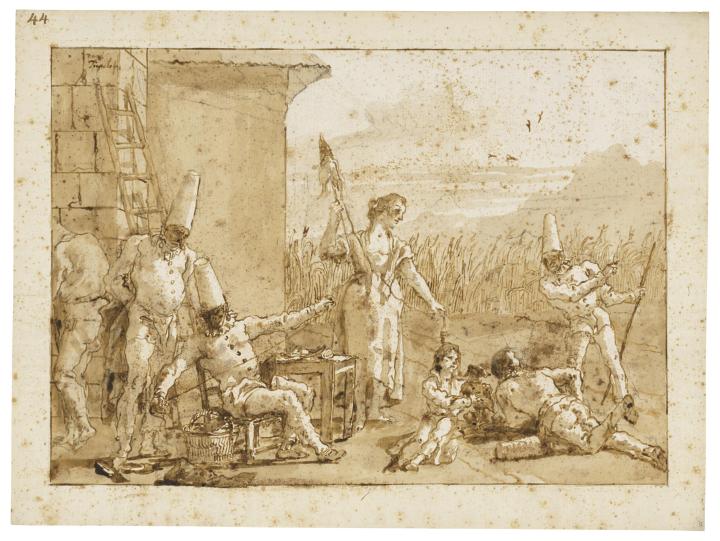
Giovanni Domenico Tiepolo, Punchinello and His Family Spinning Flax, pen and brown ink and wash, over an underdrawing in black chalk, with framing lines in brown ink; signed ‘Domo / Tiepolo f’ at the upper left and numbered 44 in the upper left margin, sheet: 345 × 464 mm (Stephen Ongpin Fine Art). More information about the drawing is available from Christie’s (Sale 21459, 4 July 2023, Lot 41).
◊ ◊ ◊ ◊ ◊
From Trois Crayons:
Tracing Time / Trois Crayons
Frieze No.9 Cork Street, London, 26 June — 5 July 2025
Trois Crayons is pleased to announce Tracing Time, a selling exhibition dedicated to drawings and works on paper held at Frieze No. 9 Cork Street this summer from 26 June until 5 July 2025. Tracing Time is the second annual exhibition hosted by Trois Crayons, an innovative platform which aims to increase the awareness, accessibility and visibility of drawings in all their forms. The exhibition will present the finest drawings and masterpieces on paper from renowned galleries and dealers which span the 15th century until the present day. Tracing Time will showcase works by artists such as Hans Rottenhammer, Giovanni Domenico Tiepolo, J.M.W. Turner, Auguste Rodin, Gustav Klimt, Jean Cocteau, and Françoise Gilot, presenting rare-to-market works.
Breaking from tradition, the Trois Crayons model includes no gallery booths; instead, all artworks are thoughtfully curated by a team of experts to create an enjoyable exhibition of the highest standard. A further deviation from the norm, the Trois Crayons model allows participants the ability to exhibit in London without the need to be physically present; dedicated and knowledgeable Trois Crayons staff will be on hand to assist visitors and buyers.
Tracing Time sees over 35 international galleries participating and more than 250 works being exhibited, doubling in size since its debut exhibition in 2024. New galleries this year include Wildenstein & Co. (New York), Rosenberg & Co. (New York), and Lowell Libson & Jonny Yarker Ltd (London), as well as a collaboration with Maak (London and Berkshire), a contemporary ceramics auction house presenting a selection of ceramic works and accompanying works on paper.
Highlights include
• Day & Faber will present a study of animals from the North Italian school that has survived more than 500 years.
• Surprising works from the world of fashion and jewellery will be presented, such as the creations of jeweller René Lalique (with Agar Marteau Fine Art) and a costume study by Antoine Caron (with Galerie Duponchel).
• John Swarbrooke Fine Art will bring a museum quality drawing by Klimt that relates to the painting Die Hoffnung I (Hope I) that hangs in the National Gallery of Canada, Ottawa.
• Works from the late 19th century to the present day from Sweden will be presented by galleries such as Clase Fine Art and Colnaghi Elliott Master Drawings, depicting the spiritual and emotional essence of Nordic art.
• Celebrating its 150th anniversary, Wildenstein & Co. will be showing a selection of French works on paper including a study for Leda and the Swan by Edmé Bouchardon and a cubist watercolour by Georges Braque.
“We have made it our mission to demystify acquiring drawings by the world’s best artists. Through our innovative presentation model, we are working to create an environment where buying drawings and works on paper is a pleasurable and straightforward experience that both established and new collectors can equally enjoy. From our installation style to our talks programme, each visitor is encouraged to engage with the medium in new and meaningful ways. Works on paper are one of the most democratic areas in the art market, and we hope to share our passion for paper with all who visit.”
–Alesa Boyle, Tom Nevile, and Sebastien Paraskevas (Founders of Trois Crayons)
◊ ◊ ◊ ◊ ◊
At Frieze No.9 Cork Street, the basement auditorium will play host to a series of talks from leaders and specialists in the field of drawings and works on paper, and Trois Crayons will offer off-site tours at The British Museum, The Courtauld Gallery, and Sotheby’s. All events are free to attend with advance registration.
o n – s i t e e v e n t s
Opening Reception (Vernissage)
25 June 2025, 6pm, rsvp@troiscrayons.art
Timeless Materials: A Conversation on Drawing with Contemporary Artists
27 June 2025, 4pm
Moderator: Annette Wickham (Former Works on Paper Curator, Royal Academy of Arts)
Panellists: Joana Galego, Nicholas C. Williams, and Pippa Young
Women Artists in Focus: Curating New Narratives
28 June 2025, 2pm
Moderator: Euthymia Procopé (Director of Development, Rediscovering Art by Women)
Panellists: Jennifer Higgie (author of The Mirror and the Palette: Five Hundred Years of Women’s Self Portraits and The Other Side: A Story of Women in Art and the Spirit World), Amy Lim (Curator of The Faringdon Collection at Buscot Park, Oxfordshire), and Rachel Sloan (Associate Curator of Works on Paper, The Courtauld Gallery)
The Drawings of John Constable
30 June 2025, 4pm
Guest speaker: Susan Owens (former Curator of Paintings at the V&A; her recent book The Story of Drawing: An Alternative History of Art won the Apollo Book of the Year award in 2024; she is currently preparing a book on Constable, to be published in 2026).
Piccadilly Jim: The Discovery of James Gibbs’s Designs for the Façade of Burlington House
1 July 2025, 4pm
Guest speaker: William Aslet (Scott Opler Fellow, Worcester College, University of Oxford)
In partnership with The Burlington Magazine
New Ways of Looking at Italian Renaissance Drawings
2 July 2025, 4pm
Moderator: Luca Baroni (L’IDEA – Testi Fonti Lessico Disegni)
Panellists: Martin Clayton (Head of Prints and Drawings, Royal Collection Trust), Rachel Hapoienu (Assistant Curator of Works on Paper, The Courtauld Gallery), Tom Nevile (co-founder, Trois Crayons), and Catherine Whistler (Research Keeper, Western Art Department, Ashmolean Museum)
In partnership with L’IDEA
The Intimate Collector: Why Drawings Thrive in the Digital Age
3 July 2025, 4pm
Moderator: Bethany Woolfall (Arcarta Vice President of Customers)
Panellists: Alesa Boyle (Co-founder, Trois Crayons, London and Gallery Director, Stephen Ongpin Fine Art, London), Gregory Rubinstein (Sotheby’s, Senior Director and Head of the Old Master Drawings Department Worldwide), and Lorna Tiller (Senior Gallery Partnerships Manager, Artsy)
In partnership with Arcarta
Between Drawings and Ceramics
4 July 2025, 4pm
A lively panel discussion exploring the parallels and contrasts in how drawings and ceramics are collected, appreciated, and understood.
In partnership with Maak
The Drawings of Jean-Antoine Watteau
5 July 2025, 2pm
Moderator: Jennifer Tonkovich (Associate Editor, Master Drawings and Eugene and Clare Thaw Curator, Drawings and Prints, Morgan Library & Museum)
Panellists: Grant Lewis (The Smirnov Family Curator of Italian and French Prints and Drawings, 1400–1880 at the British Museum and curator of Colour and Line: Watteau Drawings, British Museum) and Axel Moulinier (collaborator on A Watteau Abecedario, an online catalogue raisonné of the paintings by Antoine Watteau, and co-curator of The Worlds of Watteau, Château de Chantilly)
In partnership with Master Drawings
o f f – s i t e e v e n t s
Exhibition Visit | Colour and Line: Watteau Drawings
26 June 2025, 10.30am, The British Museum
Host: Grant Lewis (The Smirnov Family Curator of Italian and French Prints and Drawings, 1400–1880)
Auction Visit | Master Works on Paper from Five Centuries
28 June 2025, 11.00am, Sotheby’s
Hosts: Gregory Rubinstein, Cristiana Romalli, Mark Griffith-Jones, and Alexander Faber. Attendance is limited to 25 spaces.
Print Room Visit | The Courtauld Gallery’s Collection of Drawings à Trois Crayons
1 July 2025, 10.30am, The Courtauld Gallery, Somerset House
Hosts: Ketty Gottardo (Martin Halusa Senior Curator of Drawings) and Rachel Sloan (Associate Curator of Works on Paper)
Shrewsbury’s Flaxmill Maltings and the 18th-C. Origins of the Skyscraper
◊ ◊ ◊ ◊ ◊
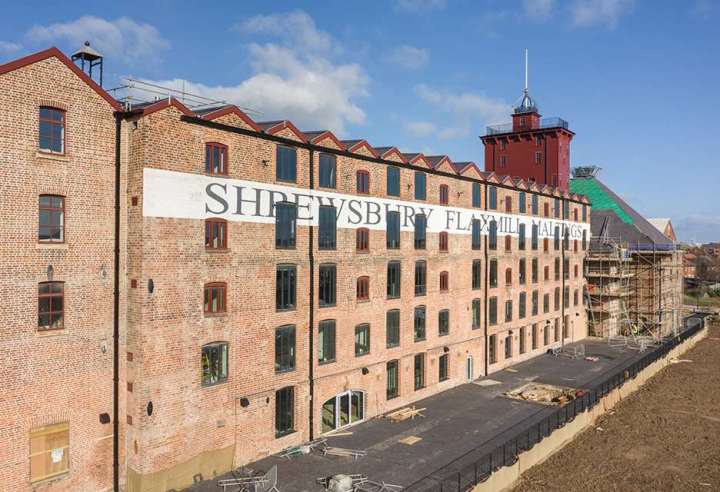
Last week in The New York Times (20 June 2025), Helen Barrett wrote about Shrewsbury’s Flaxmill Maltings, the world’s first iron-frame building, constructed in 1797, which recently opened to the public following a 20-year restoration aimed at telling the story of England’s ‘industrial heritage’. In 2024, this 18th-century forerunner of the skyscraper was selected by The Royal Institute of British Architects as ‘West Midlands Building of the Year’.
An English Heritage press release from this spring (31 March 2025) issued a plea for the site’s bell to be returned. As far as I can tell, it’s still missing, though I would be glad to hear otherwise. –CH
◊ ◊ ◊ ◊ ◊
English Heritage will open the Shrewsbury Flaxmill Maltings site on April 1 — and experts say now is the time to return its lost iconic bell. The bell, missing since the 1980s, is an important part of Shrewsbury Flaxmill Maltings’ history. It’s considered a symbol of the socio-economic change brought on by the Industrial Revolution.
The design of the late 18th-century building itself is groundbreaking too. The flaxmill was the world’s first multi-storey, iron-frame building, providing the blueprint for all modern high-rise buildings, which changed skylines around the world forever. As part of the re-opening, English Heritage will offer a self-guided exhibition and behind-the-scenes tours so the public can experience this historic site for themselves.
The main purpose of the flaxmill was to spin linen thread from flax. The business thrived since its opening in 1797, and the site expanded with the flaxmill eventually becoming Shrewsbury’s largest employer. For almost 200 years, the bell was a familiar sound to the residents of Shrewsbury. It would ring out to mark the start and finish of each working day at the flaxmill and, later, the maltings. However, during the 1980s or 1990s the bell was lost when the building was left derelict following the closure of the business in 1987. The bell, believed to be about 24 inches tall, was originally operated by a pull rope, later changing to an electric chiming mechanism after the Second World War. It is easily identifiable, with ‘1797’ distinctively cast upon it.
Matt Thompson, Interim Curatorial Director of English Heritage:
“We believe the bell went missing in the late 1980s or early 1990s, when Shrewsbury Flaxmill Maltings was left derelict. Whilst it is possible that the bell could have been melted down, it is more likely that someone took it as a souvenir of this imposing, historic building which – at the time – looked close to ruin. Maybe it’s sitting in someone’s garden or in a shed now? As Shrewsbury Flaxmill Maltings begins its new incarnation as an English Heritage site, it feels like the right time to appeal for information on the bell’s whereabouts so that we can restore it to its rightful place.
When it opened in 1797, the flaxmill needed 800 workers and a third of these were children. Shrewsbury itself was too small to provide that number, so children were brought in from as far afield as London and Hull under the parish apprenticeship system. Mostly from the workhouses and often orphans, these children were allocated to work at the mill, given housing, food and clothes but not paid wages. The bell would have called these children in from the Apprentice House nearby. Days were long and conditions often brutal, with testimony from some former child labourers at the mill eventually contributing to the 1833 Factory Act, which restricted the hours that children could work each day.
As with much of England’s industrial heritage, Shrewsbury Flaxmill Maltings is a hugely underappreciated historic site. As the world’s first multi-storey, iron-frame building, its pioneering design paved the way for modern high-rise buildings and it has rightly been dubbed ‘the grandparent of skyscrapers’. Without Shrewsbury Flaxmill Maltings, today’s cities would look very different and, for that reason alone, the building deserves international recognition.
However, the social change brought about by this very flaxmill and the factory system in general is equally as important to British history. The associated urban migration, long, hard working hours and exploitation of children were catalysts for labour reform movements and legislation to improve conditions, including the 1833 Factory Act for which the government received testimony from former workers at Shrewsbury Flaxmill.
The lost bell is a symbol of this huge societal shift: it oversaw the increased reliance on machinery, the dwindling fortunes of the flax industry, the change in purpose of the building to a maltings and, after a brief silence whilst the building housed soldiers during the Second World War, it was given an electric chiming mechanism to ring out over the handful of workers at the maltings. It would be a fitting end to the incredible story of Shrewsbury Flaxmill Maltings if we could find the bell and restore it to its rightful place, providing today’s visitors with an audible connection to the site’s history and past generations of workers.”










 Enfilade
leave a comment