New Book | Glama Ströberle tra Roma e Lisbona
This brief publication (in Italian) is available as a free PDF from De Luca Editori d’Arte; the English abstract is included below:
Sabina d’Inzillo Carranza de Cavi, Glama Ströberle tra Roma e Lisbona: Vieira, Benefial, Masucci e la pietra rossa (Rome: De Luca Editori d’Arte, 2025), 31 pages, ISBN: 978-8865576502 (PDF file), free.
 This essay, which thoroughly analyzes three notebooks now in the special collections of the Getty Research Institute in Los Angeles, focuses on the graphic style of João Glama Ströberle, a Portuguese painter of German descent, a pupil of Vieira Lusitano, and a master of Vieira Portuense. His training in Rome from 1734 to 1741 with talented artists such as the non-conformist Marco Benefial and the Marattesque Agostino Masucci made him an important trait d’union between Italy and Portugal, where he contributed to the transfer of the principles of life drawing and academic draughtsmanship. The essay discusses the graphic techniques learned in Rome, paying particular attention to the use of red chalk in the 18th century, between Rome and Lisbon.
Decorative Arts Trust, Research Grant Recipients, 2025
From The Decorative Arts Trust:
In 2025, the Decorative Arts Trust celebrates another record-breaking year for our Research Grants program, with 16 recipients receiving travel funding to study objects and archival records.
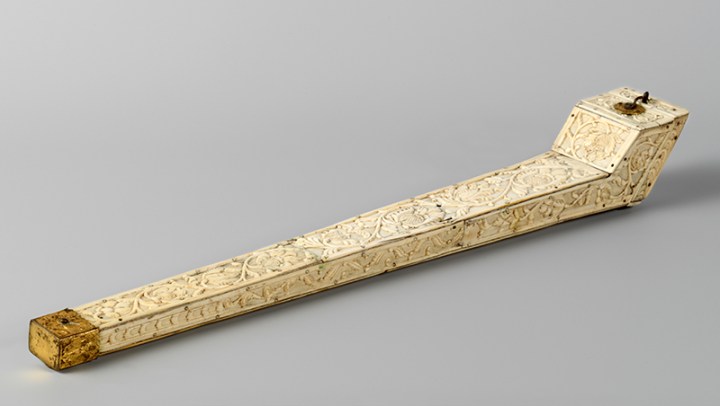
Nur’Ain Taha is studying ivory pipe cases. Pictured: Pipe case from Ceylon, 1799–1825, Sri Lanka, ivory, tropical wood, copper (Amsterdam: Rijksmuseum, NG-453).
The Trust congratulates the 2025 Research Grant recipients:
• Carson L. Beauman, MA Student, Georgia Southern University, the curriculum of Boston schools run by women, 17th–18th centuries
• Anna Flinchbaugh, PhD student, University of Southern California, embroidery’s intersection of craft and industry in the Britain and the United States, late 19th–early 20th centuries
• Kathryn Griffith, PhD student, University of Southern California, Italian goldwork in textiles and the decorative arts, 15th–16th centuries
• Julia LaPlaca, PhD student, University of Michigan, tapestries in European altar environments, 14th–16th centuries
• Jasper Martens, PhD student, University of California Santa Barbara, Netherlandish portrait miniatures with translucent mica overlays, mid-17th century (The Decorative Arts Society of Orange County Grant)
• Fiona Owens, MA student, Winterthur Program in American Material Culture, University of Delaware, the framing of Pre-Raphaelite artist Mary Macomber’s paintings, late 19th century (The Marie Zimmermann Grant)
• Emma Piercy-Wright, PhD student, University of Exeter, mother-of-pearl in French decorative arts, late 17th–early 19th centuries
• Sarah Rapoport, PhD student, Yale University, French transfer-printed ceramics, late 19th century
• Servane Rodie-Dumon, PhD student, Universite d’Artois, the career of French architect-decorator Émile Peyre, late 19th century
• Joseph Semkiu, PhD student, University of Southern California, materiality of radio chassis, mid-20th century
• Arielle Suskin, PhD student, Case Western Reserve University, Roman figural balsamaria, 3rd century BCE – 3rd century CE
• Nur’Ain Taha, PhD student, Utrecht University, ivory pipe cases that connect the early Dutch Republic and Ceylon, 17th century
• Ashley Vernon, MA student, Winterthur Program in American Material Culture, University of Delaware, ‘paper home’ collages crafted by women, late 19th century
• John White, PhD student, Princeton University, walrus and narwhal ivory in Germanic decorative arts, 15th–17th centuries
• Natalie Wright, PhD student, University of Wisconsin-Madison, The Functional Fashions Line of the Clothing Research and Development Foundation, late 20th century
• Rebecca Yuste, PhD student, Columbia University, the importation of Neoclassical style to New Spain, late 18th century
The application deadline for Research Grants is April 30 annually. For more information on grants and scholarships from the Decorative Arts Trust, read about our Emerging Scholars Program, generously supported by Trust members and donors. For deadline reminders, sign up for our e-newsletter and follow us on Facebook and Instagram. The deadline for institutions to apply for the 2025 Prize for Excellence and Innovation is approaching on June 30.
Conference | Artists’ International Social Networks, 1750–1914
From ArtHist.net and the conference website:
(Re)Searching Connections: Artists’ International Social Networks, 1750–1914
Academia Belgica, Rome, 30 September — 1 October 2025
Registration due by 20 September 2025
 This two-day international academic conference presents recent and ongoing research into the social networks of artists who lived, studied, and worked abroad between 1750 and 1914. Embracing a broad chronological and geographical scope, it brings together insights from various global contexts. By fostering interdisciplinary dialogue across art history, sociology, and digital humanities, and by connecting diverse methodologies and findings across specializations, we aim to deepen our understanding of the transnational social connections that ‘make’ art history.
The conference is organized by Musea Brugge in collaboration with the Academia Belgica. Free registration is available here before 20 September 2025.
t u e s d a y , 3 0 s e p t e m b e r
10.00 Welcome — Anne van Oosterwijk (Musea Brugge)
10.05 Introduction — Cécile Evers (Academia Belgica)
10.15 Keynote Lecture
• France Nerlich (Musée d’Orsay) — Between Legacy and the Living: Artistic Dialogues in a Transnational Europe
11.15 Session 1 | Navigating National Identities
Chair: Christine Dupont (House of European History)
• Thijs Dekeukeleire (Musea Brugge) — The Writing’s on the Wall: Mentorship, Mobility, and the Bruges-Rome Artistic Network, ca. 1800
• Cécilia Hurley-Griener (École du Louvre) — Réseaux superposés: Espaces et sociabilités dans la Rome du XIXe siècle
• Julia A. Sienkewicz (Roanoke College) — Networking and the Making of a Transnational Sculptor: The Social Sites of Luigi Persico
14.15 Session 2 | Networks’ Sources
Chair: Veerle Thielemans (INHA-Institut national d’histoire de l’art)
• Virginie D’haene (Museum Plantin-Moretus) — Achieving Ideals: The Social Network behind Andries Lens’s Neoclassicism
• Lucie Montassier (Université de Poitiers) — Reconstituer les réseaux des artistes femmes: Les approches cartographiques
• Ieva Kalnača and Aija Zandersone (Latvian National Museum of Art) — Mapping a Network: Documenting Latvian and Spanish Artistic Connections in Paris, 1900–1914
16.15 Session 3 | The Studio as a Social Hub
Chair: Laura Overpelt (KNIR-Royal Netherlands Institute in Rome)
• Oriane Poret (Université Lyon 2/LARHRA) — Beasts on Loan: Global Networks and the Economy of 19th-Century Animal Art
• Marlen Schneider (Université Grenoble Alpes/LARHRA) — In the Light of Batoni’s Studio: Artistic Networks and the Circulation of Drawing Practices between Rome and German Art Academies
w e d n e s d a y , 1 o c t o b e r
10.00 Introduction – Anne van Oosterwijk (Musea Brugge)
10.15 Keynote Lecture
• Giovanna Ceserani (Stanford University) — ‘Here in the Proper Center for Gentlemen of [t]his Profession’: Artists in 18th-Century Rome
11.15 Session 4 | From Data to Networks
Chair: Eva Geudeker (RKD-Netherlands Institute for Art History)
• Mayken Jonkman (Rijksmuseum Amsterdam) — Paris Intimates: The Role of Connections for Dutch Artists’ Success in the French Capital, 1774–1914
• Fien Messens (Ghent University and KBR-Royal Library of Belgium) — Networking over a Bowl of Onion Soup: A Data-driven Perspective on the Artist François-Joseph Navez in Rome
• Carla Mazzarelli (Università della Svizzera italiana), Gaetano Cascino (Università della Svizzera italiana and Università Roma Tre), and Luca Piccoli (Università della Svizzera italiana and Sapienza Università di Roma) — For a map of Artistic Sociability inside the Museo di Roma: 19th-Century Visiting Experiences and Networks
14.15 Session 5 | Academies as Anchor
Chair: Anne van Oosterwijk (Musea Brugge)
• Gabriel Marques (Universidade NOVA de Lisboa – FCSH) — National Academies and Artistic Communities in Rome: The Portuguese Pensioners of the 1820s–1830s
• Dominiek Dendooven (Merghelynck Museum and Yper Museum) — A Transnational Network to ‘Revive Flemish Art’: Bruges and Rouen in the 18th Century
15.45 Session 6 | Collaboration across Borders
Chair: Evelien De Wilde (Musea Brugge)
• Nina Reid (Radboud University) — The Power of the Print: International Etching Societies during the Fin-de-siècle
• Iliana Mejias-Ojajärvi (University of Helsinki) — Russian Artists’ Exhibition Activities in Helsinki, 1890–1911: Organization, Artistic Exchange, and Transnational Connections
16.45 Closing Keynote Lecture
Giovanna Capitelli (Università Roma Tre) — Transnational Sources for Studying the Cosmopolitan Art World of Early 19th-Century Rome
18.00 Reception
Exhibition | So Far, So Close: Guadalupe of Mexico in Spain
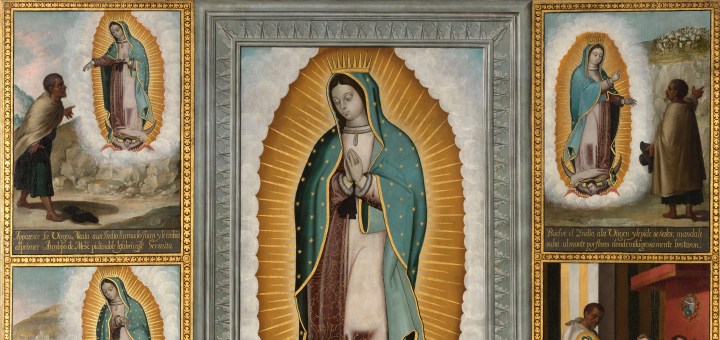
José Juárez, The Virgin of Guadalupe with Four Apparitions, detail, 1656, oil on canvas, 251 × 293 cm
(Ágreda, Soria: Monasterio de Concepcionistas Franciscanas)
◊ ◊ ◊ ◊ ◊
From the press release for the exhibition:
So Far, So Close: Guadalupe of Mexico in Spain
Museo Nacional del Prado, 10 June — 14 September 2025
Curated by Jaime Cuadriello and Paula Mues Orts
So Far, So Close: Guadalupe of Mexico in Spain casts an unprecedented gaze on the artistic dialogue between Latin America and Europe in the 17th and 18th centuries, showing how the Virgin of Guadalupe was reinterpreted, reproduced, and venerated on both continents, emerging as a transatlantic devotional and political icon. The exhibition offers a new perspective on the role of the Virgin of Guadalupe as a miraculously created image, an object of worship, and symbol of identity in the Hispanic world. Through nearly 70 works, including paintings, prints, sculptures and books, the exhibition shows how this manifestation of the Virgin, which first appeared on the Cerro del Tepeyac or Tepeyac Hill in 1531, transcended the borders of New Spain to become a powerful presence in the Spanish collective imagination. The project, curated by the Mexican professors Jaime Cuadriello (UNAM) and Paula Mues Orts (INAH), is the result of years of research and collaboration between institutions. The exhibition is structured into eleven thematic sections, combining small and large-format works that range from the earliest depictions of apparitions of the Virgin to the sophisticated vera effigies reproduced for devotional or political purposes.

Attributed to Joaquín Villegas (act. ca. 1713–53), The Eternal Father Painting the Virgin of Guadalupe, ca. 1740–50, oil on canvas (México City, INBAL/Museo Nacional de Arte, Donación FONCA, 1991).
The exhibition begins with a visual cartography that charts the surprising density of the presence of images of the Virgin of Guadalupe across all of Spain. This dissemination reflects economic, social and political factors such as trade with the Indies, mining and the movement of viceregal officials. These works reflect both devotion and the concerns of communities, artists, merchants, the nobility, and the clergy, who together made the Virgin a shared devotional cult. Themes covered in the exhibition’s different sections include the transmission of the Guadalupe story through standardised narrative and visual models; the formal genealogy of the image and its connection with European Marian icons such as the Immaculate Conception and the Tota pulchra; its status as a ‘painting not made by human hand’, which relates to the concept of the Deus pictor; and the sacredness of the Virgin’s mantle, conceived as a living relic and object of veneration. A comparison is also made with Iberian painting of the same period, revealing stylistic affinities and differences with schools such as Madrid and Andalusia.
Of particular interest are the sections dedicated to the vera effigies, which are exact copies or modified versions of the original, reproduced using specialised artistic techniques. Also notable is the presence of exotic materials, such as mother-of-pearl, ivory and brass, which arrived on the Manila Galleon, demonstrating the global reach of the cult of Guadalupe and its integration into transoceanic networks of cultural exchange. The exhibition includes masterpieces by artists from New Spain and the Iberian Peninsula, including José Juárez, Juan Correa, Manuel de Arellano, Miguel Cabrera, Velázquez, Zurbarán, and Francisco Antonio Vallejo. Together they trace an artistic and symbolic map of the cult of the Virgin of Guadalupe which lasted from the 17th to the early 19th century.
In conjunction with the exhibition, the Fundación Casa de México in Spain is collaborating on an extensive cultural programme that focuses on the symbolic and artistic dimension of the Virgin of Guadalupe. The programme includes lectures by the curators, a cycle of historical and contemporary films, informational capsules and workshops on traditional Mexican crafts taught by masters from Michoacán and Chiapas. These activities, taking place at the Museo del Prado and at the Fundación’s venue in Madrid, will offer participants a wide-ranging experience that interweaves history, art, and living tradition.
Jaime Cuadriello and Paula Mues Orts, eds., Tan lejos, tan cerca: Guadalupe de México en España (Madrid: Prado, 2025), 304 pages, ISBN: 978-8484806325, €32.
At Christie’s | Madame Simone Steinitz: The Legacy of Taste
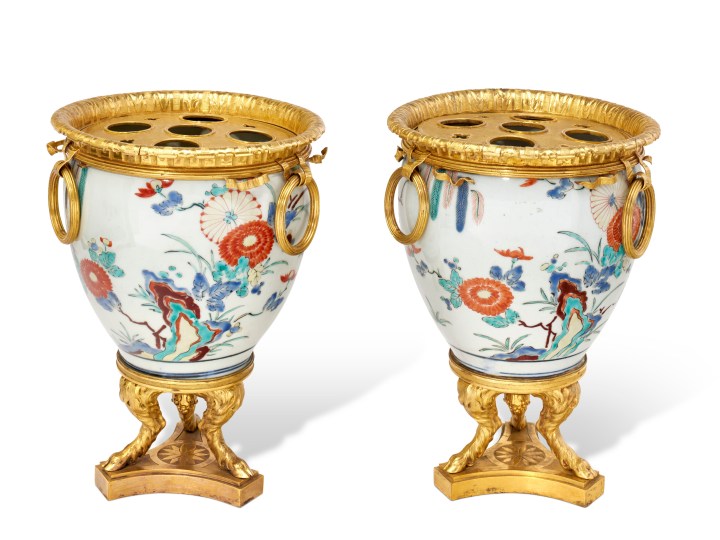
Lot 63: Pair of Louis XVI ormolu-mounted Japanese Kakiemon porcelain pique-fleurs vases (17th century), mounted last quarter of the 18th century, 11 inches high (estimate: €60,000–80,000).
◊ ◊ ◊ ◊ ◊
From the press release for the sale:
Madame Simone Steinitz: The Legacy of Taste, #24067
Christie’s, Paris, 19 June 2025
Christie’s presents the sale Madame Simone Steinitz: The Legacy of Taste, on the 19th of June in Paris, which will be dedicated to the role and influence—still too little acknowledged—of Simone Steinitz, wife of the renowned antiquaire Bernard Steinitz, founder of the eponymous gallery. The sale offers Benjamin Steinitz, now at the head of the gallery, an opportunity to pay tribute to his mother, who throughout her life was much appreciated by leading art historians, collectors, and decorators, such as François-Joseph Graf, Jacques Grange, Peter Marino, Daniel Alcouffe, and Juan Pablo Molyneux. The 130 pieces of furniture and works of art—part of her world and carefully chosen for this auction—are a testament to her unique and elegant taste, as well as well as her discerning eye. They also reflect the talent and refinement with which Simone and Bernard brilliantly combined the expert’s eye with irresistible flair, in the purest tradition of the greatest 18th-century Parisian marchands-merciers.
 Since its foundation, the quality and rarity of the pieces presented by the Steinitz gallery in Paris, now on the Rue Royale, have earned a reputation internationally among major art collectors as well as the most prestigious museums. United under one roof, the talents, skills, and expertise of the antiquaire, the art historian, and the master craftsmen have been composing, reinventing, and renewing, since 1968, what is now referred to as the magical ‘goût Steinitz’. The total pre-sale estimate of the sale is €3.3–5.2million.
At the source of the ‘gout Steinitz’ lies the relation with works of art nurtured by Simone Steinitz, which enabled her to develop and cultivate an aesthetic and an innate sense of refinement. She appreciated the materials, the colours, the memories and souvenirs evoked by these objects, making their spirit tangible, evoking a home, more than a gallery. An exceptional residence, the hôtel on the Rue Royale offers the ideal setting to pay tribute to this elegant taste and sense of décor, both intimate and magnificent. The mise-en-scene of the items in the sale, arranged specially at this hôtel for this occasion, is an invitation to engage with the essence of classical beauty and art-de-vivre. It is a celebration of decorative arts from the 17th to the late 19th century, with special focus on the 18th century, the true golden age of French savoir-faire. The result of unwavering rigour, the quality of the pieces echoes the words of Hubert de Givenchy: “Fashion changes, but 18th-century style will endure.”
As with this great collector, the selection of furniture and works of art in this collection reflects a fascination with highly architectural pieces, with a perfect sense of balance, harmony, and a certain nobility. The chosen works convey simplicity and elegance directly derived from the façades of the most beautiful hôtels particuliers. The beauty and richness of the materials, the refinement of the execution, reflect the talent and skills of the greatest French artists of the 18th century—such as Jean-Henri Riesener, Pierre-Philippe Thomire, Jean-François Leleu, and Georges Jacob, to name just a few. Superb examples of seat-furniture are also represented in the collection; herein the 18th century expresses all its refinement and creativity, illustrating the unparalleled talent of great chair-makers.
Numerous royal and other prestigious provenances can be discovered, such as three vases made by King Louis XV himself and his relatives, after a model by his intendant, Pierre-Elisabeth de Fontanieu, as well as a collection of porcelain objects mounted with gilt bronze mounts, reunited by the marchand-mercier Claude-François Julliot for King Louis XVI—not to forget the extraordinary vase mounted by the bronzier Pajot, from the fabled Rothschild collections. In the Age of Enlightenment, the marchand-mercier also became an important innovator in the development of taste. By coordinating the creation of hybrid, sometimes exotic, pieces of furniture and works of art, these pioneering dealers were at the heart of a new dialogue between crafts and creative processes, as well as between East and West.
Lecture | Mei Mei Rado on French Tapestries at the Qing Court
From the Bibliotheca Hertziana – Max Planck Institute for Art History:
Mei Mei Rado | From France to the Qing Court: Tapestries as Cross-Cultural Textiles
Online and in-person, Villino Stroganoff, Rome, 24 June 2025, 11am

Left: The Indian Hunter, from the second set of the Tenture des Indes, detail, 1689–90, the Manufacture royale des Gobelins, tapestry, wool and silk (Paris: Mobilier national). Right: Yu Sheng and Zhang Weibang, “Cassowary,” in Manual of Birds (Niaopu), detail, 1774, album leaf, ink and colors on silk (Beijing: Palace Museum).
Large-scale pictorial tapestries ranked among the most precious art forms in the early modern period. While their circulations and functions among European courts have been well studied, less known are their journeys to China and subsequent roles in stimulating new developments in Qing imperial arts.
The first part of this talk uncovers the history of French tapestries that entered the Qing court during the eighteenth century as diplomatic gifts and trade goods, including the first and second Tentures chinoises woven by the Beauvais Manufactory and the Tenture des Indes made by the Gobelins Manufactory. Their trajectories reconstructed from both the French and Qing sides offer a window into the complexity of global networks and contingency of cultural encounters. These tapestries’ themes, marked by idealized exoticism compressing distance and time, functioned as a kind of diplomatic lingua franca adaptable to express divergent cultural and political visions. The second part of this presentation examines how European tapestries gave rise to a new type of textile art form in the Qing imperial workshops and an innovative mode for furnishing the palace interiors. The medium’s architectonic tension and interactive visual potential enabled the Qianlong emperor to envision his own physical presence in relation to the tapestry in space and offered him new ways to reenact narratives charged with imperial significance.
The event will be available online through the Bibliotheca Hertziana’s Vimeo Channel»
Mei Mei Rado is assistant professor at Bard Graduate Center. Her research and teaching focus on the history of textiles, dress, and decorative arts in China and France from the eighteenth to the early twentieth centuries, especially on Sino-French exchanges. Previously she held curatorial and research positions at the Los Angeles County Museum of Art, the Metropolitan Museum of Art, and the Palace Museum, Beijing. She is the author of The Empire’s New Cloth: Cross-Cultural Textiles at the Qing Court (Yale University Press, 2025). Next spring she will be an invited researcher at the Institut national d’histoire de l’art in Paris, where she will work on a new project on the adaptations of baroque and rococo ornament in Qing arts.
Classic Art London, Summer 2025
From Classic Art London’s Instagram account:
Classic Art London, Summer 2025
Galleries around London, Monday, 23 June — Friday, 4 July 2025
 Join us during Classic Art London! Our summer season of old and modern masterworks at London’s leading dealers—in St. James’s, Mayfair, Belgravia, and Cecil Court—welcomes international collectors, curators, and connoisseurs. Selling exhibitions are accompanied by talks and events around art history and topics of debate for collections. From Titian to Turner, Paul Nash to Nordic Cubism, discover the finest works London’s art market has to offer this summer. Pick up an illustrated map from participating dealers and plan a gallery hop or leisurely stroll between venues. Enjoy special offers at Wilton’s, Franco’s, Café Murano, and Fortnum & Mason. Visit the website for full details.
Information on talks is available here»
Week-Long Courses at The Courtauld, Summer 2025

Jean-Baptiste Raguenet, A View of Paris from the Pont Neuf, 1763, oil on canvas, 46 × 84 cm
(Los Angeles: J. Paul Getty Museum, 71.PA.26)
◊ ◊ ◊ ◊ ◊
From The Courtauld, with a few of the 20 offerings noted below (there also are 5 online courses available) . . .
Summer School at The Courtauld
The Courtauld, London, June — July 2025 (each class lasts one week)
Each in-person Summer School course is full-time, and while you can take only one course per week, you are able to pursue a particular interest in a period or theme across two or more weeks. The teaching day generally lasts from 10:00 to 16:30, with registration from 9:30 on the first day. Morning or afternoon classroom sessions are complemented by object-focused study in London’s museums, galleries, printrooms, churches, and other sites. We benefit greatly from The Courtauld Gallery. It features as a teaching resource in many of our courses, and is the venue for post-graduate talks introducing aspects of our collections and for our Summer School party. The fee for all Summer School on-campus courses is £645 (each online course is £395).
◊ ◊ ◊ ◊ ◊
#6 Harvey Shepherd | Rococo to Revolution: French Art and its Geographical Contexts, 1700–1789
In-person, 23–27 June 2025
This course will examine the ever-changing roles of French art during the turbulent eighteenth century, from the later years and death of Louis XIV to the Revolution of 1789. Students will consider the role that French art played in forming identities and tastes across the world; from shaping desirable aristocratic luxury to envisaging radical futures.
French art and taste of the eighteenth century will be encountered through a series of ever-widening geographical contexts. The opening classes will examine the political and economic centres of France, looking at the Château de Versailles, as well as the artistic culture of Paris and its society during the Enlightenment and the early years of the French Revolution. Alongside the court and the capital, we will consider France’s periphery and its neighbours, examining interactions with cities like Lyon and Marseille, and both peacetime connections and wartime rivalries with European states such as Great Britain, The Netherlands, and the Holy Roman Empire. Lastly, the course considers the wider global contexts of French art as it was both collected and sent abroad, examining the colonial and imperial interactions of France in an increasingly connected world, from the court of Qing China to Senegal, India, and the Caribbean.
◊ ◊ ◊ ◊ ◊
#7 Nicola Moorby | Travelling Light: Turner, Constable, and the Shape of British Art
In-person, 23–27 June 2025
This course will explore a fascinating aspect of British art history, the parallel careers of John Constable and J.M.W. Turner. Between them, these giants of landscape painting revolutionised the status of their genre, transforming the depiction of place through empirical experience and emotive response.
However, their approaches were very different. Turner roamed throughout Britain and the Continent in search of inspirational scenery, combining observation of nature with literary and historical references. By contrast, Constable nurtured his vision at home, rooting himself in the familiar and the everyday. As well as comparing differences and similarities within their works, we shall examine the wider cultural contexts pertinent to their careers: the reproductive print market, the nineteenth-century experience of travel, and particularly the role of the Royal Academy in London, the arena where their robust professional rivalry was played out. We shall also look closely at the artists’ materials and techniques, particularly their innovations with oil paint, watercolour and their use of sketchbooks. The course culminates with a discussion of their respective artistic legacies and their changing reputations through the twentieth century and beyond.
◊ ◊ ◊ ◊ ◊
#13 Kyle Leyden | Constructing the Heart of Empire: London’s Public Architecture
In-person, 30 June – 4 July 2025 (the course is booked, but there is a waiting list)
Architecture is the art form whose presence, symbolic message and socio-political legacy cannot be avoided. The construction of great buildings is an undertaking imbued with significant symbolic and political currency which continues to have an unavoidable resonance with those who continue to interact with these spaces today.
Through an overview of key historical moments and an examination of several major architectural projects, this course will present London as a city in which architecture was consciously deployed as a potent device through which the changing essential values of, and core political vision for, the British Empire were communicated to Londoners, the wider British population and to foreign observers. It will also consider current debates about how post-imperial societies can and ought to deal with the highly contested legacies of these prominent urban spaces.
Engaging with diverse issues and concepts, the course gives students an opportunity to gain a solid understanding of the social and artistic history of London and its critical role as a stage for the theatre of Empire. It features visits to major public buildings and royal palaces and includes spaces that are otherwise inaccessible to the general public including the Royal Apartments of the Palace of Westminster, and the spectacular interiors of the Foreign, Commonwealth and Development Office.
◊ ◊ ◊ ◊ ◊
#17 Giulia Martina Weston | Beyond Artemisia: Italian Women Artists in the Long 17th Century
In-person, 7–11 July 2025
Over the last decade a conspicuous number of monographic exhibitions has been devoted to Italian women artists of the early modern period, paving the way for notable scholarly findings, chief rediscoveries and newly emerged research avenues. Focusing on the careers and production of a selected group of artists, this course will unveil the most significant discoveries gathered so far, aiming to engage its attendees in a rich exchange on the roles played by these extraordinary women in their society as well as consider what lesson can be drawn today from their experiences.
Ranging from the pioneering examples set by Sofonisba Anguissola and Lavinia Fontana to the versatile output of Artemisia Gentileschi and Giovanna Garzoni, our enquiry will look at specific geographical areas (such as the Bologna of Elisabetta Sirani and Ginevra Cantofoli) and consider a wealth of artistic media, from minute artworks on parchment to Plautilla Bricci’s grand architectural designs. Visits to the National Gallery and The Courtauld Print Room will allow us to gain first-hand knowledge of this exquisite group of artists, and to consider their legacy in dialogue with the predominant art-historical canon.
◊ ◊ ◊ ◊ ◊
#23 Sheila McTighe | Re-Imagining the Everyday: Genre Paintings and Prints in 16th- to 18th-Century Europe
In-person, 14–18 July 2025
The secular subject matter we now call ‘genre’ imagery grew steadily in popularity through the early modern period across Europe. From depictions of peasants at work or play to the erotic intrigues of the aristocracy, genre imagery explores the full range of human behaviours, sometimes imagined, and sometimes rooted firmly in real life. We shall investigate this subject matter and the artistic practices of naturalism or realism with which it was often allied in works by artists like Pieter Bruegel the Elder, Sofonisba Anguissola, Caravaggio, Jacques Callot, Diego Velazquez, Georges de La Tour, Judith Leyster, Rembrandt, Johannes Vermeer, Antoine Watteau, and Jean-Siméon Chardin.
In contemporary writings about art, genre painting was often decried as unworthy of an ambitious artist. However, primary sources show that such art was highly sought after, whether by elite patrons commissioning paintings or by ‘middling’ people buying images made for the marketplace. Printed images were a constant source of new subjects drawn from modern life, while prints reproducing paintings further expanded the range of genre art and reached a wide audience. Among other, we shall discuss what the functions of everyday imagery might have been for such a diverse body of people. Classroom sessions will be complemented by visits to London’s rich collections of paintings and prints.
In Memoriam | David Bindman (1940–2025)
Posted recently (3 June) by the Paul Mellon Centre:
David Bindman (1940–2025)
by Sarah Victoria Turner
 We are saddened to hear that David Bindman (1940–2025) Emeritus Professor of the History of Art at University College London and Fellow of the Hutchins Center for African and African American Research, Harvard University, has passed away after a short illness.
David has been an immensely influential figure in British art over the last sixty years, writing on Blake (the subject of his first published article in 1966), Hogarth, Roubiliac, the French Revolution and caricature, and race and representation. His book Blake as an Artist (1977) endures as a key text, while his Hogarth for the World in Art series (1981) remains a standard introduction to the artist. His publications for the Paul Mellon Centre (PMC) include Karl Friedrich Schinkel ‘The English Journey’ (with Gottfried Reimann, 1993) and the multiple-award-winning Roubiliac and the Eighteenth-Century Monument (with Malcolm Baker, 1995). He was a founding figure in the multi-volume project Image of the Black in Western Art (2006 to date) and co-editor of thirteen volumes in the series. . .
Keep reading here»
Call for Papers | Posterity and Fortunes of 17th- and 18th- C. Artists
From Le blog de l’ApAhAu::
Create and After? / Créer et après?
Posterity and Critical Fortunes of 17th- and 18th- Century European Artists
Postérité et fortune critique des artistes européens des XVIIᵉ et XVIIIᵉ siècles
Salle Vasari, Galerie Colbert, 2 rue Vivienne, Paris, 7–8 November 2025
Proposals due by 28 June 2025
According to Antoine Schnapper, one of the tasks of the art historian is to “go against the tide of neglect and oblivion.” Art history has been built on a selection of works and events deemed worthy of remembrance. Conversely, artists, artefacts, and other objects deemed unworthy of an era, a trend, or a discourse have been neglected or obscured. The notions of ‘critical fortune’, ‘posterity’ and ‘reception’ highlight this dynamic. The artists of the 17th and 18th centuries who enjoy lasting recognition escape oblivion, while others, less valued, disappear from the narrative. These contrasting fates are rooted in a variety of factors: changing aesthetic sensibilities, the material nature of the works, historical upheavals, and their visibility in museum collections.
The history of European art has its origins in the writing of artists’ biographies, from Vasari to Félibien to Dezallier d’Argenville. It is based not only on the objective appreciation of works, but also on the judgements made by artists, the public, critics, historians, and the art market, which can alter or reinforce an artist’s position. Since the end of the 19th century and the birth of art history as a discipline, historians such as Henry Jouin (1878; 1888; 1890), Jules Guiffrey (1877), Pierre Marcel (1914; 1924), and Jean Locquin (1912; 1933) have set out to fill these gaps by shedding light on the mechanisms that led to certain artists being forgotten. However, these early studies, which were often based on specific cases, did not provide an overall analysis of the oblivion or marginalisation of artists. Since the 1960s, many artists of the 17th and 18th centuries have been rediscovered or reassessed thanks to monographs accompanied by catalogues raisonnés. New methodologies and easier access to sources have enriched this research, thanks to digital technologies that bring to light previously unpublished information on artists’ careers and their influences. The rise of social history and gender studies has made it possible to place artists in broader contexts, and the study of materials and techniques offers new perspectives on artistic creation. These tools have considerably renewed the approach to monographs, providing a more nuanced reading of artists’ careers. However, the traditional monograph, even when accompanied by a catalogue raisonné, is not always sufficient to provide a comprehensive overview of the critical fortunes of artists.
While there are still many forgotten or neglected artists, the wealth of publications in recent decades provides fertile material for new general reflections, fleshed out by new approaches to the discipline, such as studies. This colloquium therefore proposes to question the notion of posterity, reception, and critical fortune, not only from the point of view of the artist, but also from that of the amateur, cultural institutions, and the public in the 17th and 18th centuries. It will look at the factors and mechanisms that contributed to the rise or fall of certain artists. It is therefore intended to be a reflection on the test that all artists must overcome: time. What role have critics, academies, Salons, the public, and cultural institutions played in this dynamic? What influence have the art market and collectors had on the recognition of artists? In addition, this symposium will look at the challenges faced by art historians when faced with material gaps: how do we deal with an artist or a work for which sources are rare or absent?
◊ ◊ ◊ ◊ ◊
The first theme of this colloquium will focus on the notion of posterity. In his Salon of 1765, Diderot stated: “The artist, in his studio, must feel around him the gaze of a severe and incorruptible posterity.” In so doing, he emphasised the need for artists not to work ‘for their own century’, but to create a future legacy. Taken from the Latin posteritas, posterity refers to the time that comes after, the future. As early as the 17th century, Furetière’s dictionary bears witness to this conception that it is the artist’s responsibility to look after his posterity. It was up to him to ensure that he would be remembered. Many artists in the 17th and 18th centuries directed their careers in this direction. This focus of the symposium will therefore seek to explore the means put in place by artists to ensure their posterity. How did artists’ personal strategies—whether in terms of constructing their image or managing their relations with patrons, critics or institutions—influence their posterity ? In addition, we would like to encourage papers on the material resources that certain artists have deployed to guarantee the longevity of their works. This includes, for example, a certain technical mastery to ensure the longevity and transmission of their works.
Preferred topics
• The use of writing in the construction of posterity : analysis of artists’ memory strategies
• Analysis of the use of prints to promote and disseminate a work of art
• Building a legacy: transmission within families and artists’ studios
• Absence, indifference and refusal of posterity
• The impact of the materiality of works of art on posterity: ephemeral creations, time-tested techniques, etc.
◊ ◊ ◊ ◊ ◊
The second theme of the colloquium will be reception. This term refers to the way in which a work or an artist is perceived and appreciated by the public, who are the main players here. Reception is subjective, sensitive and dependent on the tastes of an era, as well as the social and political influences of the time. By ensuring that his work is well received during his lifetime, the artist takes a step towards success and immortality. Tastes evolve regularly, and works are constantly re-evaluated in the light of one artist’s, one audience’s and one era’s view of another. Criteria differ according to time and place and can therefore be received differently by each century and each new generation. Sometimes it is the works themselves that fall victim to this process, particularly when restoration work alters the original appearance of the objects. This constant questioning of taste can be damaging for some artists, but beneficial for others. The aim is to study how these contexts have influenced artistic criticism and the fortunes of artists. How have political and social events altered the criteria by which works are judged? How does the material state of a work affect its reception?
Preferred topics
• The use and role of the written work in the reception of artists and their works : press articles, critical reviews of the Salons, Academy lectures, treatises, etc.
• The influence of taste on the reception of artists according to the context of space and time
• Lack of interest in an artist, a factor in the destruction of works
• The disappearance of works, a factor in the oblivion of artists
• Consequences of the emergence of the concept of genius in the 18th century on the reception of artists and their works
◊ ◊ ◊ ◊ ◊
The final theme of this symposium will be the notion of critical fortune. This methodical examination of an artist’s reception reflects not only the aesthetic and intellectual judgements made about their work, but also the evolution of their reputation and influence in art history. Critical fortune thus acts as a selective memory, determining which artists are preserved in history and which others sink into oblivion. It influences not only the individual trajectories of artists, but also our understanding of the evolution of styles and aesthetic debates over time. In this sense, critical fortune becomes an essential filter in the writing of art history, structured by the choices of what is valued and what is omitted. Favourable critical fortune can propel an artist to the rank of ‘master’, while unfavourable fortune can condemn him or her to indifference. However, such fortunes are often unstable, subject to fluctuations in trends, social contexts and power dynamics in the art world. This focus will explore transformations in the perception of artists : how were certain artists revalued in the 19th and 20th centuries? What are the reasons for these critical revisions, and how have these reassessments altered their place in art history ? In this way, writing the critical fortune will renew the discourse on an artist for generations to come.
Preferred topics
• The role played by monographs in building the critical fortunes of artists past and present.
• The importance of the vocabulary used to describe artists: ‘master’, ‘small’, ‘great’, ‘minor artist’, ‘major artist’, etc.
• The influence of museums (museography, exhibitions, etc.), universities (conferences, seminars, publications, etc.), the art market and the press.
• New methodologies: what contribution can they make to the writing of critical fortune ?
• Regimes of historicity: the influence of the socio-historical context on the writing of art history and on heritage issues.
Presentations will last twenty minutes and will take the form of individual and collective case studies, focusing, among other things, on the themes listed in the call for papers. Proposals (600–700 words) must be submitted, along with a short biography, to fortunecritique@gmail.com by 28 June 2025. A publication will be considered after the conference.
Organizing Committee
• Élisa Bérard, PhD candidate in Art History, Sorbonne University, Centre André-Chastel
• Romane Delsinne, PhD candidate in Art History, Sorbonne University, Centre André-Chastel
• Enzo Menuge, PhD candidate in Art History, Sorbonne University, CNRS, Centre André-Chastel
Scientific Committee
• Christine Gouzi, Professor of Modern Art History, Sorbonne University, Centre André-Chastel
• Étienne Jollet, Professor of Modern Art History, Paris I Panthéon-Sorbonne
◊ ◊ ◊ ◊ ◊
b i b l i o g r a p h y
BARBILLON, Claire, CHEVILLOT Catherine, MARTIN, François-René, Histoire de l’art du XIXe siècle, 1848–1914 : bilans et perspectives, actes du colloque École du Louvre-musée d’Orsay, 13–15 septembre 2007, Paris, École du Louvre, 2012.
BARTHES Roland, « La mort de l’auteur », In : Manteia, n°5, 4e trimestre, 1968, p. 12–17.
BONFAIT Olivier, « Réception et diffusion. Orientations de la recherche sur les artistes de la période moderne », In: Histoire de l’art, n°35–36, 1996, p. 101–114.
BONFAIT Olivier, « Conclusion : une génération La Fosse ? Nouveaux lieux et paradigmes de la peinture en France autour de 1700 », In : Bulletin du Centre de recherche du château de Versailles [en ligne], 15, 2018.
BRISAC Anne-Laure (dir.), Perspective : la monographie d’artiste. 4/2006, [revue], Paris, Armand Colin – La revue de l’INHA, 2007.
BOURDIEU Pierre, « L’illusion biographique », In : Actes de la recherche en sciences sociales, n°66–67, 1987, p. 95–104.
CHASTAGNOL, Karen, « Charles de La Fosse et la peinture d’histoire autour de 1700 », In : Bulletin du Centre de recherche du château de Versailles [en ligne], 15, 2018.
DIDEROT Denist, Salons, vol. 1 (1759–1761–1763), texte établi et présenté par J. Seznec et J. Adhémar, 2nde édition, Londres, Oxford Clarendon Press, [1957] 1975.
DIMIER Louis, Histoire de la peinture française du retour de Vouet à la mort de Le Brun, Paris et Bruxelles, 2 vol., 1926–1927.
DOSSE François, Le Pari biographique. Écrire une vie, Paris, La Découverte, 2005.
FEBVRE Lucien, « Penser l’histoire de l’art », In : Annales, économies, sociétés, civilisations, n°5/1, janvier-mars 1950, p. 134–136.
FEBVRE Lucien, « Résurrection d’un peintre : à propos de Georges de La Tour », In : Annales. Économies, sociétés, civilisations, t. 5, 1950, n°1, p. 129–134 ; rééd. Par Brigitte Mazon dans Lucien Febvre. Vivre l’histoire, Paris, R. Lafont/A. Colin, coll. « Bouquins », 2009, p. 260–265.
GOUZI Christine, « L’histoire de l’art selon Antoine Schnapper », in Commentaire, Numéro 129 (1), 2010, p. 151–158.
GOUZI Christine, « Préface », In : Antoine Schnapper, Jean Jouvenet 1644–1717 et la peinture d’histoire à Paris, Paris, Arthena, [1974] 2010.
GOUZI Christine, « L’histoire dans les règles de l’art : la monographie », In : actes du colloque Artistes, collections et musées : hommage à Antoine Schnapper, Paris, INHA, 2009, Paris, Presses de l’Université Paris-Sorbonne, 2016.
GOUZI Christine, « Préface », In : Nicolas-Guy Brenet. 1728–1792, Paris, ARTHENA, 2023.
JOLLET Etienne, « La temporalité dans les arts visuels : l’exemple des Temps modernes », in Revue de l’art, N° 178(4), 2012, p. 49–64.
JOUIN Henry, Charles Le Brun et les Arts sous Louis XIV, Paris, Imprimerie nationale, 1889.
LOCQUIN Jean, La peinture d’Histoire en France de 1747 à 1785, Paris, 1912 (rééd. 1978).
MARCEL Pierre, La Peinture Française au début du XVIIIᵉ siècle. 1690–1721, Paris, Ancienne maison Quantin, 1906.
PASSINI, Michela, L’oeil et l’archive : une histoire de l’histoire de l’art, Paris, La Découverte, 2017.
RIS (de) CLÉMENT, Les Amateurs d’autrefois, Paris, E. Plon & Cie, 1877.
ROSENBERG, Pierre, « Roberto Longhi et le XVIIᵉ siècle français », In : De Raphaël à la Révolution, les relations artistiques entre l’Italie et la France, Paris, Skira, 2005, p. 27–36 (1ère éd. dans G. Previtali [dir.], L’Arte di scrivere sull’arte. Roberto Longhi nella cultura del nostro tempo, Roma, Editori riuniti, 1982).
SCHNAPPER Antoine, « Les tâches de l’historien de l’art. », In : Contrepoint, n°2, 1973, p. 161–172.
SHAFTESBURY, Characteristics of Men, Manners, Opinions, Times, réédité par Lawrence E. Klein, University of Nevada, Las Vegas, [1711], 2000.
THUILLIER Jacques, CHÂTELET, Albert, La peinture française. De Le Nain à Fragonard, Genève, Skira, 1964.
THUILLIER Jacques, La peinture française au XVIIe siècle, vol. 2., Genève, Skira, 1992.
VAISSE Pierre, « Du rôle de la réception dans l’histoire de l’art », in Histoire de l’art, n°35-36, 1996, p. 3–8.
WARESQUIEL (de) Emmanuel, Il nous fallait des mythes : La Révolution et ses imaginaires de 1789 à nos jours, Paris, Tallandier, 2024.
WOOD, Christopher, A History of Art History, Princeton, University Press, 2019.
e x h i b i t i o n s
• Dunkerque, Lille, Valenciennes, 1980 : La Peinture française aux XVIIe et XVIIIe siècles, Dunkerque, musée des Beaux-Arts, Valenciennes, musée des Beaux-Arts, Lille, Palais des Beaux-Arts, 1980, Dunkerque, musée des Beaux-Arts, 1980 (dir. Jacques Kuhnmünche et Hervé Oursel).
• Ottawa, 1976 : Le siècle de Louis XV : peinture française de 1710 à 1774, Ottawa, musée des Beaux-Arts du Canada, 19 mars – 2 mai 1976, Ottawa, Galerie nationale du Canada, 1976 (dir. Pierre Rosenberg).
• Sceaux, 2013 : 1704, Le Salon, les Arts et le Roi, Sceaux, domaine départemental, musée de l’Île-de-France, 22 mars – 30 juin 2013, Milan, Silvana Editoriale, 2013 (dir. Dominique Brême et Frédérique Lanoë).
• Tours, Toulouse, 2000 : Les Peintres du roi, 1648–1783, Tours, musée des Beaux-Arts, 18 mars – 18 juin 2000 ; Toulouse, musée des Augustins, 30 juin – 2 octobre 2000, Paris, Réunion des musées nationaux, 2000.










 Enfilade
leave a comment