Call for Papers | Feminist Art History Conference
Feminist Art History Conference
American University, Washington, D.C., 28–30 September 2018
Proposals due by 1 December 2017
This conference builds on the legacy of feminist art-historical scholarship and pedagogy initiated by Norma Broude and Mary D. Garrard at American University. With the goal of fostering a broad dialogue on feminist art-historical practice, the event will feature papers spanning a range of chronological, geographic, and intersectional topics.
Papers may address such topics as: artists, movements, and works of art and architecture; cultural institutions and critical discourses; practices of collecting, patronage, and display; the gendering of objects, spaces, and media; the reception of images; and issues of power, agency, gender, and sexuality within visual cultures. Submissions on under-represented art-historical fields, national traditions, and issues of race and ethnicity are encouraged. We welcome submissions from established and emerging scholars of art history as well as advanced graduate students.
To be considered for participation, please provide a single document in Microsoft Word. It should consist of a one-page, single-spaced proposal of unpublished work up to 500 words for a 20-minute presentation, followed by a curriculum vitae of no more than two pages. Please name the document “[last name]-proposal” and submit with the subject line “[last name]-proposal” to feminist.ahconference@gmail.com.
Invitations to participate will be sent by 1 February 2018.
Keynote Speaker
Amelia Jones, Robert A. Day Professor in Art and Design and Vice-Dean of Critical Studies at the Roski School of Art and Design, University of Southern California
Organizing Committee
Joanne Allen, Juliet Bellow, Norma Broude, Kim Butler Wingfield, Nika Elder, Mary D. Garrard, Helen Langa, Andrea Pearson, and Ying-chen Peng
Sponsored by the Art History Program and the Department of Art, College of Arts and Sciences, American University
Lecture Series | L’art de l’Ancien Régime
From H-ArtHist:
Lecture Series: L’art de l’Ancien Régime
Deutsches Forum für Kunstgeschichte / Centre allemand d’histoire de l‘art, Hôtel Lully, Paris, 11 October — 4 December 2017
Le Centre allemand d’histoire de l’art organise des conférences publiques dans le cadre de son sujet annuel 2017/18 L’art de l’Ancien Régime – centres, acteurs, objets (Die Kunst des Ancien Régime – Zentren, Akteure, Objekte). Nous avons le plaisir d’accueillir au premier semestre:
11 October 2017, 18.00
Sophie Raux (Université Lumière Lyon 2), Explorer virtuellement un haut lieu du commerce d’art, à Paris, sous la Régence: Gersaint, Watteau et le Pont Notre-Dame
24 October 2017, 18.00
Hannah Williams (Queen Mary University of London), Inside a Parish Church: Art and Religion in 18th-Century Paris
7 November 2017, 18.00
Ulrike Gehring (Universität Trier), Land in Sicht. Verfahren der Landkartierung bei küstennaher Fahrt um 1600
4 December 2017, 18.00
Olivier Bonfait (Université de Bourgogne), Un enjeu national pour la peinture française aux XVIIe et XVIIIe siècles : le grand format
Exhibition | Monochrome: Painting in Black and White
Press release (August 2017) from The National Gallery:
Monochrome: Painting in Black and White
The National Gallery, London, 30 October 2017 – 18 February 2018
Museum Kunstpalast, Düsseldorf, 21 March — 15 July 2018
Curated by Lelia Packer and Jennifer Sliwka
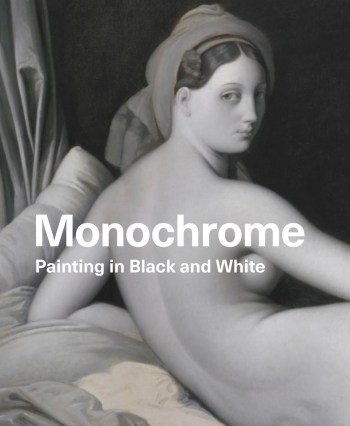 At the National Gallery this autumn, journey through a world of shadow and light. With more than fifty painted objects created over 700 years, Monochrome: Painting in Black and White is a radical new look at what happens when artists cast aside the colour spectrum and focus on the visual power of black, white, and everything in between.
Paintings by Old Masters such as Jan van Eyck, Albrecht Dürer, Rembrandt van Rijn, and Jean-Auguste-Dominique Ingres appear alongside works by some of the most exciting contemporary artists working today including Gerhard Richter, Chuck Close, and Bridget Riley. Olafur Eliasson‘s immersive light installation Room for One Colour (1997) brings a suitably mind-altering coda to the exhibition. With major loans from around the world and works from the National Gallery’s Collection, Monochrome reveals fresh insights into the use of colour as a choice rather than a necessity.
As Lelia Packer and Jennifer Sliwka, curators of Monochrome: Painting in Black and White, explain: “Painters reduce their colour palette for many reasons but mainly as a way of focusing the viewer’s attention on a particular subject, concept, or technique. It can be very freeing—without the complexities of working in colour, you can experiment with form, texture, mark making, and symbolic meaning.”
Monochrome: Painting in Black and White guides visitors through seven rooms, each addressing a different aspect of painting in black, white and grey, also known as grisaille.
Sacred Subjects
The earliest surviving works of Western art made in grisaille were created in the Middle Ages for devotional purposes, to eliminate distractions and focus the mind. As colour pervades daily life, black and white can signal a shift to an otherworldly or spiritual context. For some, colour was the forbidden fruit and prohibited by religious orders practising a form of aesthetic asceticism. Grisaille stained glass, for example, was created by Cistercian monks in the 12th century as an alternative to vibrant church windows, with its translucent greyish panels sometimes painted with images in black and yellow. Light and elegant in appearance, grisaille glass such as this window panel made for the Royal Abbey of Saint-Denis, Paris (1320–24, Victoria and Albert Museum, London) gained popularity outside the order and eventually became de rigueur in many French churches.
Studies in Light and Shadow
From the 15th century onward artists made painted studies in black and white to work through challenges posed by their subjects and compositions. Eliminating colour allows artists to concentrate on the way light and shadow fall across the surface of a figure, object or scene before committing to a full-colour canvas. The beautiful Drapery Study (possibly study for Saint Matthew and an Angel), (about 1477, Kupferstichkabinett, Staatliche Museen zu Berlin) attributed to Domenico Ghirlandaio is a template work which an artist could reuse in multiple finished colour paintings. This particular motif for example reappeared in a frescoed vault in San Gimignano, Italy.
Independent Paintings in Grisaille
Increasingly, paintings in grisaille were made as independent works of art, complete unto themselves. This section explores the inspiration and desire for such paintings, prized for their demonstration of artistic skill, for the insights they provide into the artist’s craft, and for their profound consideration of a particular subject.
Jan van Eyck’s Saint Barbara (1437, Royal Museum of Fine Arts Antwerp) is the earliest known example of a monochrome work on panel, drawn in metalpoint, India ink, and oil on a prepared ground. Although there has been ongoing debate as to whether a master colourist such as van Eyck intended Saint Barbara as a sketch in preparation for a painting in colour or a as a finished drawing, the panel was admired and collected as early as the 16th century suggesting that a taste for independent monochrome pictures existed from an early date.
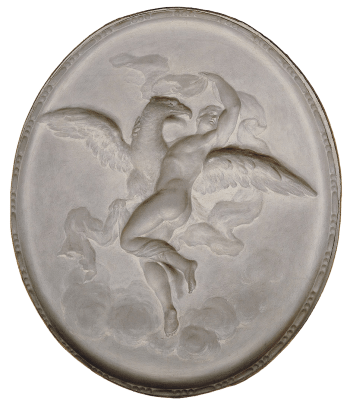
Jacob de Wit, Jupiter and Ganymede, 1739 (Hull: Ferens Art Gallery).
Monochrome Painting and Sculpture
For centuries artists have challenged themselves to mimic the appearance of stone sculpture in painting. In Northern Europe, a taste for illusionistic decorative elements—such as decorative wall painting and sculpted stucco—may have helped give rise to stunning works of trompe l’oeil painted on panel or canvas. Jacob de Wit excelled at this practice and his Jupiter and Ganymede (1739, Ferens Art Gallery, Hull) could easily be mistaken for a three-dimensional wall relief.
Monochrome Painting and Printmaking
Beginning in the 16th century, painters developed ingenious ways to compete with new developments in printmaking. An exceptionally rare grisaille work by Hendrik Goltzius, Without Ceres and Bacchus, Venus Would Freeze (1606, the State Hermitage Museum, St Petersburg) for example, dazzled viewers who could not fathom how it was made, as it very much looks like a print but was drawn by hand on prepared canvas.
Black-and-White Painting in the Age of Photography and Film
Similarly, the invention of photography in 1839, and that of film much later, prompted painters to imitate the effects of these media, in order to respond to, or compete with their particular qualities. Gerhard Richter employed a press photograph of a prostitute who had been brutally murdered as the foundation of his painting Helga Matura with Her Fiancé (1966, Museum Kunstpalast, Düsseldorf). The grey palette—for Richter, “the ideal colour for indifference”—removes any sentimentality about Helga’s murder. By deliberately blurring the photograph, the artist makes the viewer aware that this is an altered image, contrasting with the crispness and apparent objectivity of the original.
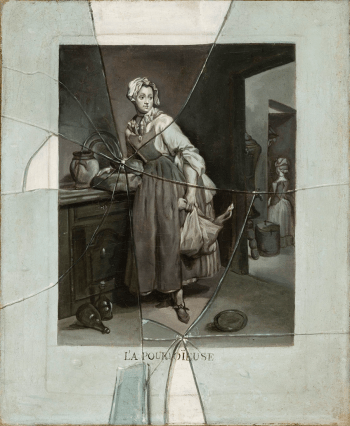
Étienne Moulinneuf, after Jean-Siméon Chardin, Back from the Market (La Pourvoyeuse), ca. 1770, oil on canvas, 46 × 38 cm (Los Angeles: LACMA).
Abstraction
Abstract and installation artists have often been drawn to black and white. When artists have ready access to every possible hue, the absence of colour can be all the more shocking or thought-provoking. In 1915, Kiev-born artist Kazimir Malevich painted the first version of his revolutionary work, Black Square (in the exhibition is the 1929 version from the State Tretyakov Gallery, Moscow)—an eponymous black square floating within a white painted frame—and declared it to be the beginning of a new kind of non-representational art. Works by Josef Albers, Ellsworth Kelly, Frank Stella, and Cy Twombly all exemplify the use of minimal colour for maximum impact.
Artists intrigued by colour theory and the psychological effects of colour (or its absence) manipulate light, space, and hue to trigger a particular response from the viewer. In this way, Olafur Eliasson brings the exhibition to a close with his large-scale, immersive light installation, Room for One Colour (1997). In a room illuminated with sodium yellow monofrequency lamps, all other light frequencies are suppressed and visitors are transported to a monochrome world.
National Gallery Director, Dr Gabriele Finaldi, says: “Artists choose to use black and white for aesthetic, emotional, and sometimes even for moral reasons. The historical continuity and diversity of monochrome from the Middle Ages to today demonstrate how crucial a theme it is in Western art.”
Exhibition organised by The National Gallery in collaboration with Museum Kunstpalast, Dusseldorf.
Lelia Packer and Jennifer Sliwka, Monochrome: Painting in Black and White (London: The National Gallery, 2017), 240 pages, ISBN: 978 18570 96132 (hardback), £35 / ISBN: 978 18570 96132 (paperback), £20.
Lelia Packer is Acting Curator of Paintings, Watercolours, Miniatures, and Manuscripts (excluding France) at the Wallace Collection, London. She was formerly McCrindle Curatorial Assistant at The National Gallery.
Jennifer Sliwka is Deputy Director of the Visual Commentary on Scripture Project and Senior Research Fellow, King’s College London. She was formerly Ahmanson Curator of Art and Religion at The National Gallery.
Call for Essays | Dix-huitième Siècle No 51: La Couleur des Lumières
From H-ArtHist:
Dix-huitième Siècle No 51: La Couleur des Lumières
Edited by Aurélia Gaillard and Catherine Lanoë
Proposals due by 30 November 2017; with final articles due by June 2018
Le dossier thématique de la revue DHS n° 51 sera consacré au thème de la « couleur des Lumières » et l’envisage comme suit : d’abord, qu’en est-il de la place de la couleur au 18e siècle ? Peut-on parler de ce siècle comme d’un univers coloré ? Et si oui, quelle en serait la couleur ou quelles en seraient les couleurs ? N’y aurait-il pas alors un siècle clivé en deux, l’un coloré (couleur de rose, couleur du rococo), l’autre blanc hygiénique (traités de blanchiment, blancheur des marbres classiques) ? Enfin, qu’en est-il de la couleur dans les textes littéraires ? À quel moment, dans quels textes, dans quels genres, chez quels auteurs passe-t-on de l’évocation abstraite des somptueux « ornements » et subtiles « grâces » à des descriptions colorées ? Y a-t-il par exemple des auteurs, des genres coloristes et d’autres non ? Et comment, pour des textes, des mots, penser une poétique de la couleur qui ne soit pas une rhétorique des images ?
Ainsi, si la subjectivité de l’être percevant conçu comme homme sensible à l’âge des Lumières a été une question majeure des recherches depuis ces dernières décennies, la valorisation corollaire des sensations chromatiques a été un peu délaissée. Il s’agit donc de mettre en évidence l’importance de la couleur dans le monde des Lumières : théories, débats, inventions, expériences, synesthésies, discours, représentations, poétique.
Les contributions pourront alors aborder les axes suivants relevant principalement de 4 paradigmes :
1) Un paradigme scientifique, la science de la couleur : de Newton (Opticks, 1704) à Goethe (Traité des couleurs, 1808).
2) Un paradigme médical et philosophique, sensualisme, sens et sensations colorés.
3) Un paradigme historique et anthropologique :
• Histoire matérielle de la couleur et des teintures : art de la peinture, de l’émail, du verre, de la porcelaine, des tissus, teintures, chimie, manuels d’art tinctorial, de blanchiment etc.
• « Les couleurs du corps » (Michel Delon dans Angelica Gooden dir., The Eighteenth-Century Body, Peter Lang, 2002) : la « couleur de chair », incarnat, rougeurs/blancheurs d’où surgit tout à coup par exemple le bleu des veines etc.
• La cosmétique, le fard rouge et le blanc de céruse (C. Lanoë, « La céruse dans la fabrication des cosmétiques… », Techniques et Culture, n°38, 2002 ; « le rouge des Lumières… », Sociétés et représentations, n°25, 2008), les encres bleues (Solange Simon-Mazoyer, « Le conflit entre les excès de la mode et de la santé au XVIIIe siècle : ‘l’habillage’ du visage », dans V. Barras et M. Louis-Courvoisier dir., La médecine des Lumières, Georg Éd., 2001)
4) Un paradigme esthétique, un visuel coloré : à la suite de la Querelle du Coloris (de Piles), on assiste à une apologie de la couleur, du stuc, de l’illusion (J. Lichtenstein, La couleur éloquente, Flammarion, 1989). Le coloriste Charles La Fosse devient recteur de l’Académie royale de Peinture et Sculpture en 1702. Diderot développe ses « Petites idées sur la couleur » (Essais sur la peinture, 1765). Mais le 18e siècle est aussi celui de l’invention de la couleur « rose », qui reste nommée pendant tout le siècle par le nom de la fleur (couleur de rose).
Pour recevoir l’appel à contribution complet, contacter Aurélia Gaillard. Les propositions de contributions uniquement en français sont à adresser simultanément à Aurélia Gaillard (aurelia.gaillard@gmail.com) et Catherine Lanoë (catherine_lanoe@hotmail.com) sous forme d’un titre et d’un résumé d’une quinzaine de lignes avant le 30 novembre 2017. Les articles définitifs seront à rendre pour juin 2018.
Call for Papers | Interior Design and Style Cohabitation
From H-ArtHist:
Interior Design and Style Cohabitation from the Eighteenth to the Twentieth Century
Institut National d’Histoire de l’Art, Paris, 19 March 2018
Proposals due by 6 November 2017
This study day will question the adaptation in domestic spaces, as a common and pragmatic custom, of objects that originally were not destined to meet, playing despite or with their differences. This theme was recently addressed by the Galerie des Gobelins with the exhibition À table avec le mobilier national, where eighteenth-century paintings, paperboards, and wall hangings from the royal manufacture oversaw fifty years of furniture creation by the Atelier de Recherche et de Création (1964–2014).
While it is common in the field of art history to encounter examples of interiors where the decorative harmony was conceived according to the ideal of a ‘total work of art’, the opposite will be examined. The assortment in a common space of objects from different periods and the ensuing reflections brought up by these unexpected, sometimes surprising, convergences will be our object of interest. When, for example, was it intended for eighteenth-0century furniture to be associated and fit in with an Impressionist painting? Was this type of seemingly insignificant practice theorized ahead of time or retrospectively?
This subject is linked to the history of taste. While a few publications devoted to collectors’ arrangements of domestic spaces have pointed out some individuals who wished to harmonize old furniture to a modern art collection, on the contrary, examples of modern furniture confronted with old works of art could be discussed during this study day.
Far from the historically based mechanism, already well studied for the nineteenth century for example (Antiquity, neo-gothic or neo-Renaissance decor and furniture), the debate here will focus on the practical necessity for a collector, dealer, or individual to design an interior with modern paintings and old furniture—or inversely—that is elements apparently disparate by their age, forms, and uses.
This thematic raises questions relating to the flexibility of fine arts and decorative arts and confronts the values and/or practices associated with the work of art, considered as a decorative element, as well as a utilitarian object of art, equally appreciated for its plastic qualities.
While composing an interior can extend to the private space, the artist’s studio, or demonstrations of domestic spaces in art galleries and department stores, the study can even include how these spaces were spread to the public by images. We will aim to define what type of media participated in this transmission. The literature and the press play for example a significant role in the circulation of these interior views and the values to which they are linked.
The study day suggests—but is not limited to—several topics:
• Paintings’ or art objects’ adaptability, flexibility or modular nature
• Migration or confusion of values and contemplative behaviors and practices when faced with paintings and furniture
• Authorship and collectors’ and decorators’ creative and recreational motivations
Proposals that extend their analysis to other types of objects and collections, particularly to sculpture, will also be reviewed with the greatest interest. Please submit an individual proposal of no more than 500 words and a CV to barbara.jouves@univ-paris1.fr and hadrien.viraben@gmail.com by 30 November 2017.
Organization: Claire Hendren (Ph.D. candidate, Université Paris-Nanterre), Barbara Jouves (Ph.D. candidate, Université Paris 1 Panthéon-Sorbonne), and Hadrien Viraben (Ph.D. candidate, Université de Rouen and Université Paris-Nanterre)
Exhibition | Maria Sibylla Merian
Opening this week at the Städel Museum:
Maria Sibylla Merian and the Tradition of Flower Depiction
Kupferstichkabinett, Staatliche Museen zu Berlin, 7 April — 2 July 2017
Städel Museum, Frankfurt am Main, 11 October 2017 — 14 January 2018

Maria Sibylla Merian, Shrub Rose with Gracillariidae, Larva and Pupa, 1679 (Frankfurt: Städel Museum)
Maria Sibylla Merian (1647–1717), a native of Frankfurt, was not only a highly prominent naturalist but also one of the most renowned artists of her time. The year 2017 marks the 300th anniversary of her death. On this occasion, the Städel Museum is presenting the special exhibition Maria Sibylla Merian and the Tradition of Flower Depiction from 11 October 2017 to 14 January 2018. The show will acquaint visitors with the fascinating and filigree world of flower and plant depiction in drawings and prints of the fifteenth to the eighteenth centuries.
Developed in collaboration with the Kupferstichkabinett of the Staatliche Museen zu Berlin and the Technische Universität Berlin, the exhibition will feature major works by Maria Sibylla Merian in the context of flower depictions by her forerunners, contemporaries and successors, among them the famous Hortus Eystettensis by the pharmacist Basilius Besler (1561–1629) of Nuremberg, ornament engravings by Martin Schongauer (ca. 1445–1491), pharmacopeia of the fifteenth and sixteenth centuries, plant studies from the circle of Albrecht Dürer, and studies of nature by Georg Flegel (1566–1638) and Joris (Georg) Hoefnagel (1542–1600/01) of the period around 1600. Flower drawings by Bartholomäus Braun will also be on view, as will floral compositions by Barbara Regina Dietzsch (1706–1783) and her circle of the eighteenth century. Maria Sibylla Merian and the Tradition of Flower Depiction will present more than 150 works in all: sheets from the collections of the Städel and the Kupferstichkabinett, but also valuable loans from the Bibliothèque Nationale in Paris, the Sächsische Landes- und Universitätsbibliothek in Dresden, the Staatsbibliothek zu Berlin, and the Universitätsbibliothek Johann Christian Senckenberg in Frankfurt.
Call for Session Proposals | SAH 2019, Providence
From SAH:
Society of Architectural Historians 72nd Annual Conference
Rhode Island Convention Center, Providence, 24–28 April 2019
Proposals due by 16 January 2019
Conference Chair: Victoria Young (University of St. Thomas)
Local Co-Chairs: Dietrich Neumann (Brown University) and Itohan Osayimwese (Brown University)
The Society of Architectural Historians will offer a total of 36 paper sessions at its 2019 Annual International Conference in Providence, Rhode Island. The Society invites its members, including graduate students and independent scholars, representatives of SAH chapters and partner organizations, to chair a session at the conference. As SAH membership is required to chair or present research at the annual conference, non-members who wish to chair a session will be required to join SAH next August 2018 when conference registration opens for Session Chairs and Speakers.
Since the principal purpose of the SAH annual conference is to inform attendees of the general state of research in architectural history and related disciplines, session proposals covering every time period and all aspects of the built environment, including landscape and urban history, are encouraged.
Sessions may be theoretical, methodological, thematic, interdisciplinary, pedagogical, revisionist or documentary in premise and ambition and have broadly conceived or more narrowly focused subjects. Sessions that embrace cross-cultural, transnational and/or non-Western topics are particularly welcome. In every case, the subject should be clearly defined in critical and historical terms. Proposals will be selected on the basis of merit and the need to create a well-balanced program. Topics exploring the architecture of the Providence and the greater region are encouraged.
Since late submissions cannot be considered, it is recommended that proposals be submitted well before the deadline. Last-minute submissions that fail posting in the online portal or are sent in error via email cannot be considered. Session proposals must be submitted online by 5:00pm CST, Tuesday, January 16, 2018. The submission portal will close automatically at this time, and no further proposals will be accepted. Proposals will be reviewed and selected by a committee chaired by SAH Conference Chair Victoria Young.
Additional information is available here»
New Book | Consumptive Chic
From Bloomsbury Academic:
Carolyn Day, Consumptive Chic: A History of Beauty, Fashion, and Disease (London: Bloomsbury Academic, 2017), 208 pages, ISBN: 978 135000 9387 (hardcover), $94 / ISBN: 978 135000 9370 (paperback), $32.
 During the late 18th and early 19th centuries, there was a tubercular ‘moment’ in which perceptions of the consumptive disease became inextricably tied to contemporary concepts of beauty, playing out in the clothing fashions of the day. With the ravages of the illness widely regarded as conferring beauty on the sufferer, it became commonplace to regard tuberculosis as a positive affliction, one to be emulated in both beauty practices and dress. While medical writers of the time believed that the fashionable way of life of many women actually rendered them susceptible to the disease, Carolyn Day investigates the deliberate and widespread flouting of admonitions against these fashion practices in the pursuit of beauty.
Through an exploration of contemporary social trends and medical advice revealed in medical writing, literature, and personal papers, Consumptive Chic uncovers the intimate relationship between fashionable women’s clothing and medical understandings of the illness. Illustrated with over 40 full color fashion plates, caricatures, medical images, and photographs of original garments, this is a compelling story of the intimate relationship between the body, beauty, and disease—and the rise of ‘tubercular chic’.
Carolyn A. Day is Assistant Professor at Furman University where she teaches British History and the History of Medicine. She received a BA in History and a BSc in Microbiology from Louisiana State University, an MPhil in History and Philosophy of Science from Cambridge University, and a PhD from Tulane University in British history.
C O N T E N T S
Introduction
1 The Approach to Illness
2 The Curious Case of Consumption: A Family Affair
3 Exciting Consumption: The Causes and Culture of an Illness
4 Morality, Mortality, and Romanticizing Death
5 The Angel of Death in the Household
6 Tragedy and Tuberculosis: The Siddons Story
7 Dying to Be Beautiful: The Consumptive Chic
8 The Agony of Conceit: Clothing and Consumption
Epilogue: The End of Consumptive Chic
Conclusion
Bibliography
Index
Conference | Fashion and Textiles between France and England
From the conference website:
Moving Beyond Paris and London: Influences, Circulation, and Rivalries
in Fashion and Textiles between France and England, 1700–1914
IHTP and Musée Cognacq Jay, Paris, 13–14 October 2017
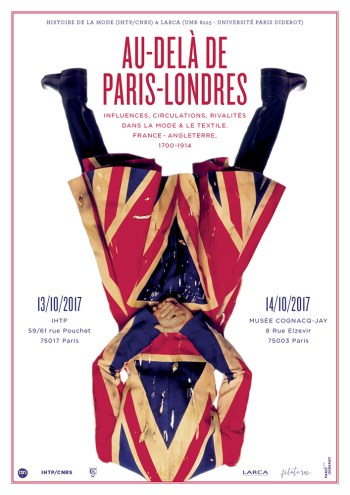 Co-organised by the LARCA/ Paris Diderot, the IHTP-CNRS and the Musée Cognacq Jay, the conference will take place in the IHTP 59/61 rue Pouchet, 75017 on the 13th and in the Musée Cognacq Jay, 8 rue Elzevir 75003 Paris on the 14th.
The keynote addresses will be given by Lesley Miller (Head of Textile and Dress at the V&A, London) and Zara Anishanslin (History, University of Delaware). The event is free and open to all, but registration is compulsory.
F R I D A Y , 1 3 O C T O B E R 2 0 1 7
9.00 Welcome and Coffee
9.30 Mapping Cross-Channel Textile Rivalries
• Fabrice Bensimon, Lace makers between Nottingham and Calais, 1816–1860
• Luc Rojas, Observer la fabrique de Coventry: Les rubaniers stéphanois à la recherche d’information
• Courtney Wilder, Band Apart: Printing ‘Rainbow’ Designs for Walls and Wardrobes in Alsace and Northern England, 1819–1851
11.00 Coffee Break
11.30 Keynote Address
• Lesley Miller (conservatrice en chef des collections mode et textiles au Victoria & Albert Museum, Londres), Lyon in London: Seduction by Silk at the End of the Seven Years War
12.30 Lunch
14.00 Entente cordiale ? Aesthetic and Economic Circulations of Embroidery
• Tabitha Baker, From Lyon and Paris to London: Commercial Networks within the French Embroidery Trade and the Role of the English Gentleman Consumer, 1748–1785
• Isa Fleischman-Heck, Manly French Style Versus Feminine English Taste: Pictorial Embroideries in France and England at the End of the 18th Century
15.00 Coffee Break
15.15 Competing for Cotton
• Jessica Barker, Toile de Jouy / Cloth of England: Copperplate Textile Printing in England and France, 1752–1820
• Ariane Fennetaux, Franco-British Cotton Rivalries: Empire, Trade, and Technology in the 18th Century
S A T U R D A Y , 1 4 O C T O B E R 2 0 1 7
9.30 Welcome and Coffee
9.50 Opening Remarks by Rose-Marie Mousseaux (Directrice du Musée Cognacq-Jay)
10.00 Business Means Business: Fashion Trades and Commercial Strategies
• Pierre-Henri Biger, Eventails et éventaillistes entre la France et l’Angleterre aux XVIII et XIXe siècles
• Audrey Millet, Protéger les dessins textiles: L’invention de la propriété industrielle comme négation du processus créatif, une compétition France-Angleterre (XVIIe–XIXe siècles)
• Véronique Pouillard and Waleria Dorogova, Couture Limited: The Short Lived Britanisation of French Fashion
11.30 Coffee Break
12.00 Keynote Address
• Zara Anishanslin (University of Delaware), An English and Even a Female Hand: Anna Maria Garthwaite, Anglo-French Rivalry, and the Gendered Politics of Flowered Silk
13.00 Lunch
14.30 Embodying Fashion Rivalries
• Elise Urbain Ruano, Une figure pré-romantique? La duchesse d’Orléans et la mode anglaise à la veille de la Révolution française
• César Imbert, Une garde-robe au service de l’Empire: l’influence vestimentaire d’Eugénie en Angleterre
• Matthew Keagle, More than Red and White: Franco-British Reform and Military Dress in the Late Ancien Régime
16.30 Guided Tour of the Cognacq-Jay Collections with Director Rose-Marie Mousseaux
Exhibition | Exchanging Gazes: Between China and Europe

Chinese Ladies Playing a Board Game, Qing Dynasty, Qianlong Period (1736–1795), 2nd half of the 18th century, watercolour and opaque watercolour on silk (Museum für Völkerkunde Hamburg)
◊ ◊ ◊ ◊ ◊
Press release from the Berlin State Museums:
Exchanging Gazes: Between China and Europe, 1669–1907
Kunstbibliothek, Staatliche Museen zu Berlin, 29 September 2017 — 7 January 2018
China and Europe are linked by a long tradition of reciprocal cultural exchange. These transactions were particularly intensive during the Qing Dynasty (1644–1911), which is regarded as one of the key phases of Chinese cultural and political history. Exquisite gifts were exchanged. European envoys attempted to establish official trade relations with China. But their efforts were in vain, as the Chinese established trade barriers, with the exception of the port of Canton—although they were very much interested in European science, art, and culture.
The exhibition illustrates the richly varied nature of this mutual fascination in objects ranging in date between 1669 and 1907. Many of the almost one hundred pieces could be classified as Chinoiserie or so-called Europerie: they provide us with information about early modern European images of China and also allow us to trace the predominant images of Europe in China. Highlights of the exhibition include impressive paintings, exquisite porcelain objects, a door from a wood-paneled room, as well as large-format photographs and copper engravings. The photographs and engravings show the ‘European palaces’ which Emperor Qianlong, who reigned from 1736 to 1795, had built in one of his parks. Today, only their ruins exist: British and French troops burned down the palaces and destroyed the extensive gardens during their 1860 Chinese campaign. Surprisingly, however, in this way they created a visual subject that was much-loved by European photographers after 1870.
 Until now, the reciprocity—and sheer variety—of cultural exchange between China and Europe has hardly been appreciated or shown in an exhibition setting. The chosen objects offer impressive testimony to a long- lived and mutual interest between the two cultures. In addition, they can help us understand how Europe’s conception of China and China’s conception of Europe changed over the course of 250 years.
Particularly in the 18th century, it was not only Europe looking to China’s art production but also China looking to that of Europe. The fact that these exchanging gazes are to be taken quite literally and that they were cast back and forth now and again is demonstrated by the Chinese production of porcelain: around 1700, European missionaries living at the imperial court contributed to the development of the so-called foreign colours (yangcai). The chinaware that was subsequently decorated with the new shades of red and pink (famille rose) became so popular that it developed into an export hit and hence also had a lasting impact on European dining culture.
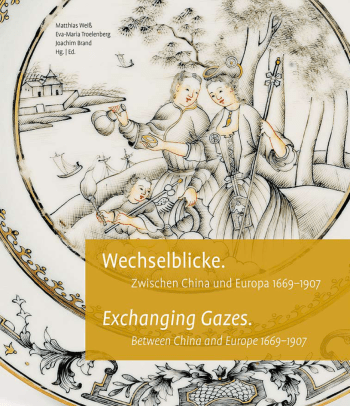
An exported plate, which was produced in China and shows two pilgrims on their way to Cythera, the island of love, allows the term ‘exchange of gazes’ to be connected more closely to the 18th century. In the European love discourse of that time, this term is connected with the concept of the love of souls. This type of love enables an encounter between lovers at eye level; yet it also involves the danger of unilateral self-reflection. Certainly this metaphor of love cannot be transferred unmitigatedly to the cooperation of cultures. Nevertheless, it points at two contradictory foundations of cultural exchange: such an exchange is only possible if, apart from differences, common features are recognized, for instance in the characteristics of systems of rule or in courtly cultures. At the same time, ‘exchange of gazes’ can allude to the fact that it is first and foremost one’s own self-interest that is respected in these constellations.
Due to political and economic changes, China and Europe had to repeatedly reconsider themselves, which means they had to come to a kind of self-understanding as well as set themselves in relation to each other. This becomes particularly evident when looking at objects called Chinoiseries, as they reflect the European image of China prevalent throughout the 18th century. Chinoiseries can be juxtaposed with the so-called Europeries, which were produced in China and give insight into the Chinese image of Europe. In order to present the foreign as alien, it had to be at least partially adapted to the familiar, which is why the objects exhibited here can be aesthetically classed in-between China and Europe. Many objects can additionally be found ‘between’ China and Europe because they circulated as export goods, diplomatic gifts or as possessions acquired abroad, all in order to develop an altered effect in their respective new repositories. It is furthermore evident that motifs and techniques migrated not only between these cultures but also between genres and materials. Prints, for example, became built architecture and vice versa. The exhibition, moreover, offers the rare occasion to simultaneously view Chinoseries and Europeries, which are usually stored in different collections. This therefore allows the gaze to wander back and forth and, in so doing, to comprehend that China and Europe share a common history.
Even though there are hardly definite dates that mark the history of exchange between China and Europe, the years in the exhibition’s title indicate two important stages in the European production of images of China. In 1669, Johan Nieuhof’s travelogue was published. Nieuhof had joined the first Dutch delegation of the United East India Company travelling to China in order to intensify the trade relationship with the empire that increasingly isolated itself—a venture which failed. From a historic point of view, the journey’s true success was Nieuhof’s richly illustrated travelogue that was published in large numbers and became one of the most important sources for European knowledge about China.
1907, on the other hand, marks the creation of four architectural photographs by Ernst Boerschmann, who travelled China as an architectural historian and re-established Western knowledge on Chinese architecture. This had become possible only because the major European powers had gradually forced the opening of China beginning in the second half of the 19th century. The objects exhibited here render not only the changing relationship between China and Europe from the late 17th to the early 20th century comprehensible—how and why it shifted in the direction of colonial policy—but also the traditional tendencies which persisted through these changes. Boerschmann, for instance, perpetuated the myth that porcelain was used as construction material, even though this was not his personal view.
A special exhibition of the Kunstbibliothek – Staatliche Museen zu Berlin, in cooperation with the Max Planck Research Group ‘Objects in the Contact Zone: The Cross-Cultural Lives of Things’ at the Kunsthistorisches Institut in Florence – Max Planck Institute.
Curatorial concept: Professor Dr. Matthias Weiß
From Michael Imhof Verlag:
Matthias Weiß, Eva-Maria Troelenberg, and Joachim Brand, eds., Wechselblicke: Zwischen China und Europa 1669–1907 / Exchanging Gazes: Between China and Europe 1669–1907 (Petersberg: Michael Imhof Verlag, 2017), 352 pages, ISBN: 9783731905738, $70.










 Enfilade
leave a comment