Exhibition | Giovan Battista Foggini (1652–1725)
Closing soon at the Palazzo Medici Riccardi:
Giovan Battista Foggini: Grand Ducal Architect and Sculptor
Palazzo Medici Riccardi, Florence, 10 April — 9 September 2025
Curated by Riccardo Spinelli
 Florence celebrates the artistic genius of Giovan Battista Foggini (1652–1725) with a monographic exhibition, promoted by the Metropolitan City of Florence and organised by the Fondazione MUS.E. Curated by Riccardo Spinelli, it marks the third centenary of the artist’s death, presenting the extraordinary figure of a man who, through his ‘interdisciplinary’ work, shaped the artistic language of late-Medicean Florence. This unique opportunity will showcase the design, stylistic, and technical prowess of Foggini, highlighting the breadth of his interventions and the distinctive signature that set a standard in Florence. His grand and eloquent style quickly gained recognition, earning the admiration of the Medici and his contemporaries, while also inspiring younger artists, who saw in him a brilliant master with an almost inexhaustible creative imagination.
Through a selection of sculptures, drawings, and artefacts, the exhibition traces Foggini’s career, from his training in Rome at the Medici Academy, founded by Cosimo III de’ Medici, to his return to Florence, where he became the Grand Ducal sculptor, court architect, and director of the Galleria Manufactories. These workshops, commissioned by the prince, were dedicated to the production of marvellous inlaid works in hard stones and precious metals. Foggini’s style, characterised by a late-Baroque language influenced by Roman art yet distinctly original, defined the image of late 17th-century Florence, paving the way for future generations.
Riccardo Spinelli, ed., Giovan Battista Foggini: Architetto e scultore granducale (Florence: Edifir Edizioni, 2025), 336 pages, ISBN: 978-8892802964, €40.
Conference | Sacred Ceramics
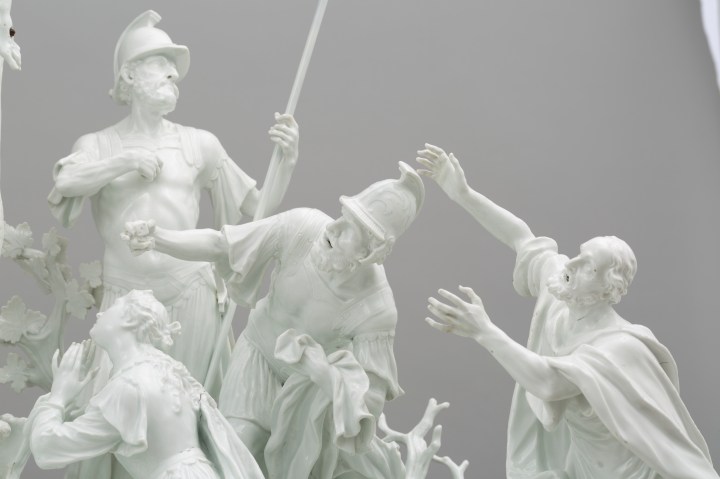
Johann Joachim Kaendler, Crucifixion Group, detail, Meissen, 1743
(Porzellansammlung, Staatliche Kunstsammlungen Dresden; photo by Adrian Sauer)
◊ ◊ ◊ ◊ ◊
Registration is open for this conference, with a limited number of bursaries available for early career scholars (online registration is available here):
Sacred Ceramics: Devotional Images in European Porcelain
Online and in-person, Victoria & Albert Museum, London, 30 September 2025
Organized by Matthew Martin and Rebecca Klarner
Was eighteenth-century European porcelain just a ceramic material to be moulded into useful objects—or could it mean more? This conference explores what European porcelain might have communicated when it was used to create devotional objects.
This conference explores the phenomenon of religious sculpture produced in European porcelain in the eighteenth century. Sculptures on religious subjects represent some of the most ambitious and complex productions in European porcelain of the period, yet they remain relatively understudied. Meissen, Doccia Vienna, Höchst, Fulda, Nymphenburg—all these factories produced devotional images in porcelain. Even factories in mid eighteenth-century Protestant England—Chelsea and Derby—produced sculptures employing Catholic devotional imagery. In each instance, cultural-political motives for the creation of these images can be reconstructed.
The 1712 letter penned by the Jesuit Father François Xavier d’Entrecolles not only conveyed to Europe first-hand knowledge of Chinese porcelain production at Jingdezhen, but it also construed access to this knowledge as a triumph of the Jesuit global mission—the successes of the Jesuits in China made the secret of kaolinic porcelain available to the Catholic princes of Europe.
Porcelain’s alchemical heritage was also not without significance: success at the alchemical enterprise had always been deemed dependent on divine favour. These factors could lead to porcelain assuming a sacral character in Catholic court contexts. Devotional images in European porcelain exploited these cultural associations of the medium itself.
This international conference will explore the religious production of European ceramic factories and consider questions such as: Who were the artists and patrons involved in these sculptures’ creation? How did these sculptures function in private and public contexts? What significance lay in the use of porcelain to create devotional images?
A small number of early career bursaries to attend the conference will be available (including a contribution towards travel cost), generously funded by the French Porcelain Society. To apply, please email fhrlmk@leeds.ac.uk by 5 September 2025, outlining in 150 words or less how you would benefit from attending this conference.
Generously supported by the French Porcelain Society
s c h e d u l e
10.00 Museum Opens / Registration
10.30 Welcome
10.45 Introduction — Julia Weber (Director, Porcelain Collection, Staatliche Kunstsammlung Dresden)
11.00 Catholic China: Porcelain, the Jesuits, and Counter-Reformation Propaganda — Matthew Martin (Senior Lecturer in Art History and Curatorship, The University of Melbourne)
11.20 Religious Sculpture in Meissen Porcelain — Maureen Cassidy-Geiger (Independent Curator and Scholar)
11.40 Break
11.55 Marian Figures in Meissen Porcelain: A Female Body between a Catholic Court and a Protestant State — Rebecca Klarner (Collaborative Doctoral Partnership Researcher, University of Leeds/V&A and Assistant Curator, V&A Wedgwood Collection)
12.15 The Divine Mission of Du Paquier: Grace, Virtue, and Propaganda in the Context of Habsburg Piety — Claudia Lehner-Jobst (Director and Collections Curator, Augarten Porcelain Museum, Vienna)
12.30 Q&A
12.40 Lunch Break
13.30 Handling Session | Ceramics, Terracotta, and Ivory — Simon Spier, (Curator Ceramics & Glass 1600–1800, V&A) and Kira d’Alburquerque, (Senior Curator Sculpture, V&A), places are limited; please sign up during registration.
14.10 Handling Session Repeated
14.50 A Reliquary Made by the Imperial Vienna Porcelain Manufactory — Manuel von Aufschnaiter (Postgraduate Student, Art History, University of Vienna)
15.10 The Influence of Religious Patronage on European Porcelain Commissioning: Investigating the Rarest Monumental Sacral Porcelain Ensembles and the Ritual Use of the Porcelain Objects in European Ecclesiastical Rites — Carina Nathalia Madonna Visconti Paff (Art Historian, Licensed Art Expert and Embassies Art Advisor)
15.30 St Augustine’s Church at Hammersmith: A Contemporary Ceramic Commission for a Catholic Church — Julian Stair (Ceramic Artist, Academic, and Writer)
15.45 Q&A
15.55 Tea and Coffee Break
16.20 Piety and Politics in Italian Porcelain — Errol Manners (Historic Ceramics Specialist)
16.40 Reflections on the Devotional Sculpture from Buen Retiro — Félix Zorzo (Assistant Curator European Decorative Arts, National Museums Scotland)
17.00 Porcelain for the Pope: Sacred Ceramics in Eighteenth-Century France — Susan Wager (Assistant Professor of Art History, University of New Hampshire, Durham)
17.15 Q&A and Closing Remarks
Abstracts for papers are available here»
◊ ◊ ◊ ◊ ◊
Note (added 28 September 2025) — The posting was updated to included the online registration link.
Call for Papers | Art, Inc.

Anonymous artist, An Address to the Proprietors of the South-Sea Capital, 1732, etching, 17 × 29 cm.
◊ ◊ ◊ ◊ ◊
From The Courtauld:
Art, Inc.
Courtauld Institute of Art, London, 5 December 2025
Proposals due by 5 September 2025
Across galleries and university curricula, art is still routinely categorised, displayed, and taught according to a conceptual framework that centres the nation. This focus has resulted in a minimisation of the significant role that corporations have played in commissioning art, innovating artistic styles and genres, and transporting art objects across the globe. Indeed, the historical process of nation-building arguably relied on visual and material practices that incorporated bodies had long used to communicate common values or cultivate loyalty. To this day, private corporations are major patrons of artists and generate considerable contestation over cultural values, with much contemporary debate over the character of corporate-sponsored art. By recentring an overlooked ‘corporate art history’, this symposium will provide insights into the place of art objects within a range of broader historical phenomena: the role of corporations in the formation of civil society and the state; the expansion of commercial and industrial capitalism; the concomitant globalisation of legal understandings of incorporation; as well as the ‘corporate character’ of European imperialism. Importantly, it will also foreground how visual and material cultures have historically played a significant role in materialising and making tangible the very concept of incorporation—the abstract notion that continues to underpin so many of today’s legal and financial modes of association. Held at a time when the political and environmental impact of multinational corporations is under particular historical and journalistic focus, Art, Inc. will not only provoke new thinking about corporations as significant actors in art history, but will open new insights into the ways visual and material cultures have shaped the histories of empire, commerce, law, and globalisation.
We invite proposals for twenty-minute papers on topics from any period or geography that address issues including, but not limited to:
• Histories of corporate patronage in art history
• Corporations as agents of stylistic innovation in art history
• Histories of visual and material culture making the abstract concept of incorporation intelligible or tangible
• The possibility of tracing a ‘corporate style’ in visual and material culture
• Histories of corporations provoking contestation over artistic values
• Antagonism, relations, or blurred boundaries between the state and corporations in art history
• Histories of states using art to manage or nationalise corporations
• How the visual and material practices of corporations contributed to the development of civil societies
Please send paper proposals of no more than 400 words, along with a full CV, to tom.young@courtauld.ac.uk. Papers should not contain material that is already in publication, as ideally this conference will lead to further collaboration and, if possible, the publication of an edited volume. The deadline for applications is Friday, 5th September. Applicants will be informed about decisions by mid-September. Successful applicants will be encouraged, where possible, to use institutional funding they have available for travel and accommodation, as only minimal funding from the Courtauld will be available and this will be reserved for early career candidates and those without institutional support.
Exhibition | An Ecology of Quilts
Opening next month at the American Folk Art Museum:
An Ecology of Quilts: The Natural History of American Textiles
American Folk Art Museum, New York, 26 September 2025 — 1 March 2026

Wholecloth Quilt, England or United States, 1785–90, cotton and linen, 96 × 93 inches (New York: American Folk Art Museum, Gift of Cyril Irwin Nelson in honor of Laura Fisher, 1995.13.3).
An Ecology of Quilts: The Natural History of American Textiles brings together approximately 30 examples, spanning the 18th to 20th centuries, from the Museum’s rich collection of more than 600 quilts and presents them from an ecological perspective, tracing patterns of relationships between the environment and traditional quilting practices. This groundbreaking exploration of the natural history of American textiles proposes an eco-critical inquiry into the many facets of global material culture that emerged in the early American republic through the 20th century.
Looking beyond the quiltmaker, An Ecology of Quilts is centered around the origins of textile production and how it informs the artistry of quiltmaking, exploring the environmental and social impact of cultivating and harvesting raw materials; the networks of overland and ocean trade required to transport dyestuffs, fibers, and fabrics; and the technologies and industrial techniques developed to process them, such as the cotton gin—all of which allowed quiltmaking to flourish as a quintessential American art form. As the exhibition documents, textiles represent an intricately woven web of environmental resources, craft and scientific knowledge, global movement, and creative collaboration. Speaking not only to the work of individual American quilters but also to the contributions of countless artisans and laborers around the globe, quilts survive as powerful material metaphors for human relationships and entanglements within the natural world.
Mellon Centre Funding Opportunities
From the Mellon Centre:
Paul Mellon Centre for Studies in British Art
Funding Opportunities for Autumn 2025
Applications due by
The Paul Mellon Centre’s autumn 2025 round of funding opportunities is now open for applications. This round is primarily designed to support organisations undertaking research, projects and activities concerned with British art or architectural history and the opportunities we offer for organisations this year are as follows:
• Curatorial Research Grants: designed to support the costs of employing an individual (full or part time) to undertake a large-scale research project which often results in an exhibition.
• Collaborative Project Grants: support the early days of a research project between two or more organisations, providing funding to facilitate meetings, research trips and workshops for participants.
• Conservation Research Project Grant: helps support an organisation when undertaking a project concerning conservation research and technical analysis.
• Digital Project Grants: designed to support the costs of employing an individual to undertake innovative and large-scale projects that use digital media.
• Digitisation Grants: designed to support organisations wishing to digitise materials and assets from their own collections, and make them available to a wide online audience.
• Event Support Grants: supporting costs incurred by an organisation when hosting an event or series of events (including workshops, symposiums and lectures).
• Exhibition Publication Grants: designed to support the costs of publishing written material relating to an exhibition.
We also have some grants on offer for individuals which include:
• Andrew Wyld Research Support Grants: a grant to support individuals who wish to travel to see works on paper and in person which is funded by the Andrew Wyld Fund.
• Author Grants (Large): amounts that range from £2,001–£6,000 to help support costs incurred by individuals when publishing books.
• Author Grants (Small): amounts of up to £2,000 to help support costs incurred by individuals when publishing articles or books.
• Research Support Grants: support costs relating to undertaking travel for research purposes.
If you are interested in applying to any of our funding opportunities we recommend reading our FAQ page and our Grant Making Policy first. Our Grants and Fellowships Manager is also available if you have any questions or if you would like to arrange a pre-application discussion
Call for Applications | Getty Residential Grants, 2026–27
The Getty Research Institute is pleased to invite applications for 2026–27 residential grants for predocs, postdocs, and scholars. Applications are due by 1 October 2025 at 5pm PT.
Getty Scholars Program | Provenance
For the 2026–2027 year, the Getty Scholars Program invites innovative proposals for projects that explore provenance and adjacent research areas, including but not limited to the history of collecting, the study of the art market, and broader explorations around the ownership of art objects. Relevant to all periods and areas of art production, the scholar cohort will be invited to examine and critique the arena of provenance studies while also envisioning its future, situated between the practices and demands of source communities, art historians, museums, and the market. Digitization and databases, such as the Getty Provenance Index, have also opened up the interdisciplinary possibilities of provenance research and laid the ground for art restitution efforts and other forms of reparation. Applicants are invited to propose projects, either individual or collaborative, that reflect upon the ownership, transfer, and movement of art objects from all world regions and time periods.
For this year, the Getty Scholars Program aims to link scholars with Getty resources and researchers and foster a lively community around the study of provenance—an increasingly significant domain of art historical and curatorial practice that centers the histories of both objects and people. While in residence, scholars will have the opportunity to delve into the Getty Research Institute’s vast collections of rare materials that support provenance research and explore the newly remodeled Getty Provenance Index, which lays the ground for cutting-edge computational approaches to the field.
Please find the full call for applications and theme text on the Getty Scholars Program and Getty Pre- and Postdoctoral Fellowships webpages.
New Book | Coffee Nation
From Penn Press:
Michelle Craig McDonald, Coffee Nation: How One Commodity Transformed the Early United States (Philadelphia: University of Pennsylvania Press, 2025), 280 pages, ISBN: 978-1512827552, $45.
 Coffee is among the most common goods traded and consumed worldwide, and so omnipresent its popularity is often taken for granted. But even everyday habits have a history. When and why coffee become part of North American daily life is at the center of Coffee Nation. Using a wide range of archival, quantitative, and material evidence, Michelle Craig McDonald follows coffee from the slavery-based plantations of the Caribbean and South America, through the balance sheets of Atlantic world merchants, into the coffeehouses, stores, and homes of colonial North Americans, and ultimately to the growing import/export businesses of the early nineteenth-century United States that rebranded this exotic good as an American staple. The result is a sweeping history that explores how coffee shaped the lives of enslaved laborers and farmers, merchants and retailers, consumers and advertisers.
Coffee Nation also challenges traditional interpretations of the American Revolution, as coffee’s spectacular profitability in US markets and popularity on the new nation’s tables by the mid-nineteenth century was the antithesis of independence. From its beginnings as a colonial commodity in the early eighteenth century, coffee’s popularity soared to become a leading global economy by the 1830s. The United States dominated this growth, by importing ever-increasing amounts of the commodity for drinkers at home and developing a lucrative re-export trade to buyers overseas. But while income generated from coffee sales made up an expanding portion of US trade revenue, the market always depended on reliable access to a commodity that the nation could not grow for itself. By any measure, the coffee industry was a financial success story, but one that runs counter to the dominant narrative of national autonomy. Distribution, not production, lay at the heart of North America’s coffee business, and its profitability and expansion relied on securing and maintaining ties first with the Caribbean and then Latin America.
Michelle Craig McDonald is the Librarian/Director of the Library and Museum at the American Philosophical Society.
New Book | The Invention of Rum
Coming in October from Penn Press:
Jordan B. Smith, The Invention of Rum: Creating the Quintessential Atlantic Commodity (Philadelphia: University of Pennsylvania Press, 2025), 320 pages, ISBN: 978-1512828184, $40.
 Making and consuming rum created a new means of profit that transformed the Atlantic world.
It was strong. It was cheap. It was ubiquitous. Fermented and distilled from the refuse of sugar production, rum emerged in the seventeenth-century Caribbean as a new commodity. To conjure something desirable from waste, the makers, movers, and drinkers of rum arrived at its essential qualities through cross-cultural experimentation and exchange. Those profiting most from the sale of rum also relied on plantation slavery, devoured natural resources, and overlooked the physiological effects of overconsumption in their pursuit of profit. Focusing on the lived experiences of British colonists, Indigenous people, and enslaved Africans, The Invention of Rum shows how people engaged in making and consuming this commodity created a new means of profit that transformed the Atlantic world.
Jordan B. Smith guides readers from the fledgling sugar plantations and urban distilleries where new types of alcohol sprung forth to the ships, garrisons, trading posts, and refined tables where denizens of the Atlantic world devoured it. He depicts the enslaved laborers in the Caribbean as they experimented with fermentation, the Londoners caught up in the Gin Craze, the colonial distillers in North America, and the imperial officials and sailors connecting these places. This was a world flooded by rum. Based on extensive archival research in the Caribbean, North America, and Britain, The Invention of Rum narrates the seventeenth- and eighteenth-century history of one of the Atlantic world’s most ubiquitous products. Smith casts this everyday item as both a crucial example of negotiation between Europeans, Africans, and Americans and a harbinger of modernity, connecting rum’s early history to the current global market. The book reveals how individuals throughout the Atlantic world encountered—and helped to build—rapidly shifting societies and economies.
Jordan B. Smith is Associate Professor of History at Widener University.
Huntington Library Quarterly, Summer 2024 | Exhibitions in London
This special issue of HLQ arises from a conference held at the Huntington Library in September 2023:
Huntington Library Quarterly 87.2 (Summer 2024)
Paintings, Peepshows, and Porcupines: Exhibitions in London, 1763–1851
Edited by Jordan Bear and Catherine Roach
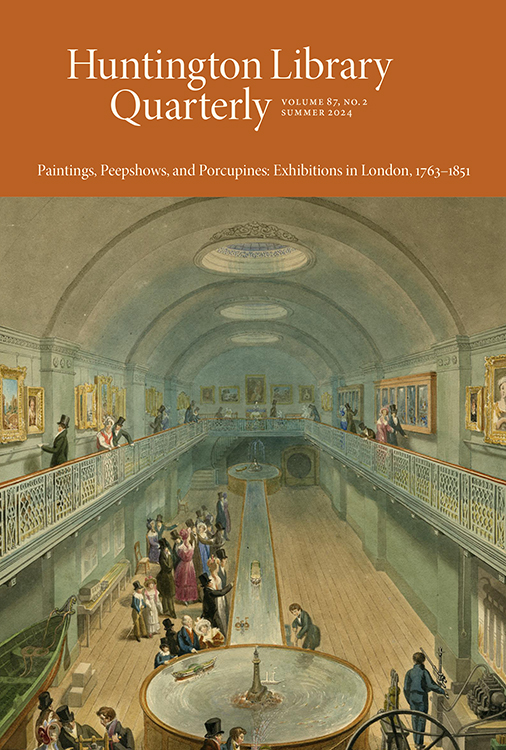 Dazzling variety characterized exhibitions in eighteenth- and nineteenth-century Britain: boxing matches, automata, contemporary art shows, panoramas, dog beauty contests, and menageries all contributed to a flourishing display culture. Despite their differences, these attractions shared both techniques for engaging audiences and widely reverberating themes. All of the essays in this volume work across multiple sites of display. By examining the varied terrain of exhibitions collectively, this issue illuminates cultural preoccupations of the time, including the multifarious impact of empire and the productively ambiguous boundaries between the cultural expressions that were deemed low and those that were deemed high.
c o n t e n t s
• Jordan Bear and Catherine Roach, “Introduction: Exhibitions in London, 1763–1851,” pp. 153–63.
• Adam Eaker, “The Art of Marring a Face: Exhibiting Boxers in Georgian London,” pp. 165–82.
• Nicholas Robbins, “The Circumference of the Subject: Figuring Race at Egyptian Hall,” pp. 183–205.
• Rosie Dias, “Making Space for Empire: India in Panoramas and Dioramas, 1830–1851,” pp. 207–31.
• Holly Shaffer, “Provisioners, Cooks, Coffeehouses, and Clubs: Exhibiting Taste in Calcutta and London in the Early Nineteenth Century,” pp. 233–54.
• Jordan Bear, “The Sea Serpent of Regent Street: On the Evidentiary Strategies of Nineteenth-Century Exhibitions,” pp. 255–71.
• Catherine Roach, “Dog Shows: Porcelain Pugs and Pre-Raphaelite Painters in Thomas Earl’s Art and Nature,” pp. 273–90.
• Alison FitzGerald, “Centers and Peripheries: Exhibiting London’s ‘Marvels’ in Britain’s ‘Second City’,” pp. 291–311.
• John Plunkett, “An Early Moving Picture Industry? Exhibition Networks and the Panorama, 1810–1850,” pp. 313–35.
Exhibition | In Vino Veritas, 1450–1800

Abraham Bosse, The Prodigal Son: Riotous Living, 1635, etching, platemark: 26 × 32.5 cm
(The Cleveland Museum of Art, 1929.560.2)
◊ ◊ ◊ ◊ ◊
Opening next month at The Cleveland Museum of Art:
In Vino Veritas (In Wine, Truth)
The Cleveland Museum of Art, 7 September 2025 — 11 January 2026
For millennia, wine has played a significant role not only in the human diet but also in cultural myths, rituals, and festivities. As a result, wine—its ingredients, making, drinking, and effects on the human body and mind—has been a constant muse for artistic creation. The exhibition In Vino Veritas (In Wine, Truth), a phrase coined by the Roman polymath Pliny the Elder, celebrates the presence and meaning of wine in prints, drawings, textiles, and objects made in Europe between 1450 and 1800. Drawn from the museum’s collection, more than 70 works by artists from throughout Europe explore wine’s myths, symbols, and stories. These images reveal how diverse cultures and religions ascribed meaning and transformational properties to the so-called nectar of the gods.

Marcantonio Raimondi, after Raphael, The Wine Press, ca. 1517–20, engraving, sheet: 18.6 × 14.7 cm (The Cleveland Museum of Art, 1922.479).
The ancient Greeks believed that the god Dionysus (in Rome, Bacchus) lived within wine: to drink wine was to partake of the god’s power. Fascinated by ancient culture, Italian Renaissance artists, such as Andrea Mantegna and Raphael, imagined scenes of boisterous festivals, or bacchanalia, along with the exploits of Bacchus and his coterie of satyrs, nymphs, and fauns. In Northern Europe, Pieter Bruegel the Elder, and later Jean-Honoré Fragonard, transformed bacchanalia into raucous peasant festivals and sensuous garden parties fueled by wine, at times tinged with moral judgment. Simultaneously, wine played a critical allegorical role in images made within the Judeo-Christian tradition. The Old Testament and Hebrew Bible traced wine’s invention to Noah. Numerous stories from these texts, portrayed by Lucas van Leyden and others, leveraged wine as an important plot element, with the ability to unify and enlighten, or to incapacitate and deceive. Many artists, such as Albrecht Dürer, used wine, grapes, and the vine to symbolize the Catholic rite of the Eucharist and its origin in Christ’s Last Supper. Throughout the exhibition, wine appears in scenes of devotion, harvest, celebration, music making, and transgression, signaling community cohesion as well as the pleasures—and hazards—of surrendering to one’s senses.










 Enfilade
leave a comment