Exhibition | Printed Fashions: Textiles for Clothing and the Home
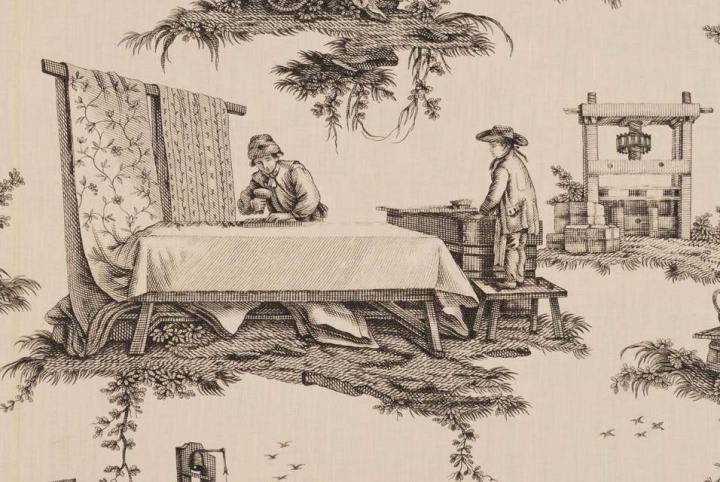
Scene of textile printing, adapted from a French copperplate-printed textile of the 1780s
(The Art Museums of Colonial Williamsburg)
◊ ◊ ◊ ◊ ◊
Press release (6 February 2017) from Colonial Williamsburg:
Printed Fashions: Textiles for Clothing and the Home, 1700–1820
DeWitt Wallace Decorative Arts Museum, Colonial Williamsburg, 25 March 2017 — March 2019
Curated by Linda Baumgarten
In the eighteenth and early nineteenth centuries, early printed textiles with their luminous colors and attractive designs were widely sought for fashionable clothing and home furnishings. Eighty examples of these stunning printed cottons and linens, many of which have never been exhibited before, will go on view in Printed Fashions: Textiles for Clothing and Home at the DeWitt Wallace Decorative Arts Museum, one of the Art Museums of Colonial Williamsburg, opening March 25, 2017. The exhibition will illustrate the design, history, and techniques of printed textiles during this formative era; these objects played their own important role in history, not just for their obvious aesthetic qualities, but also for their economic importance as trade goods and as examples of technological advances. Printed Fashions will remain on view through March 2019.
“Textiles are among the most fragile objects that survive from the past. They also afford us particularly detailed views into the lives of our forbearers,” said Ronald L. Hurst, Colonial Williamsburg’s Carlisle H. Humelsine chief curator and vice president for collections, conservation, and museums. “Thanks to decades of effort and scholarship on the part of our textile curator Linda Baumgarten and her predecessors, the Foundation is home to a remarkably large and complete collection of printed textiles. This exhibition provides an opportunity to employ many of those beautiful objects to tell these very human stories.”
“The history of printed textiles may sound modern to today’s consumers,” says Linda Baumgarten, Colonial Williamsburg’s senior curator of textiles and costumes who organized the exhibition. “Traders shipping goods from the other side of the world in ships, domestic workers trying their best to respond to foreign competition, people making the effort to dress in up-to-date styles despite their limited means and the importance of chemistry and mechanical expertise in the production of consumer goods: All of these concepts could easily represent textile production today as well as it did centuries ago.”
Although fashionable Indian chintzes had inspired European printers to begin developing competing technologies as early as the seventeenth century, it was during the eighteenth century that most of the technical advances were realized. Rather than using the Indian method of painstakingly hand-painting chemical fixatives known as mordants and then dyeing the textiles, Europeans developed laborsaving techniques to expedite the process. Blocks, copperplates, and rollers allowed printers to apply pattern at a faster rate, often with delicate and intricate linear effects rivaling prints on paper. Experiments with chemicals yielded pencil blue and china blue techniques to solve the difficult challenges of pattering textiles with indigo blue.
Printed Fashions will include a variety of objects dating between 1700 and 1820 from India, England, France, and colonial America. Among them will be men’s and women’s garments, women’s accessories, a doll dressed in original clothing from the 1770s, quilts and an Indian ‘palampore’ bedcover in brilliant colors, a trunk linked with rare, early printed cotton, case covers for chairs, curtains and valances for tall-post beds, plus study documents that show printing techniques, advances in printing chemistry, and trends in design. Among the exhibition’s highlights is a stunning bed quilt, never previously exhibited, incorporated into which is a printed panel from India as the center focus. This panel, or ‘palampore’, was too small for the finished quilt, so the unknown quilt maker enlarged the bedcover with fine silk borders and then quilted the whole with closely spaced running stitches. The flowering tree at the center of the palampore is patterned with a large tree bursting with floral blooms, growing from the hilly ground. Later known as a ‘tree of life’, this design influenced English and American appliquéd quilts for a century after the first palampores entered the West.
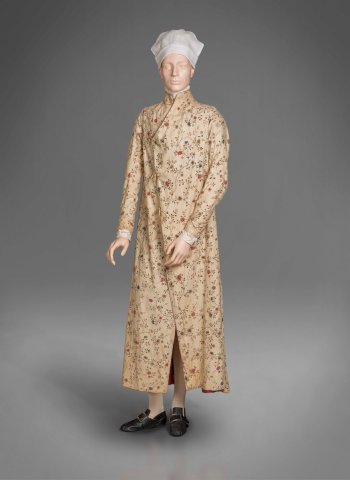 Another featured object in Printed Fashions is a gentleman’s banyan made of stylish and expensive cotton from India. The delicate floral design was mordant-painted-and-resist-dyed, creating a colorful yet comfortable garment suitable for relaxing at home. By donning his imported chintz banyan, the man at leisure signaled his wealth and fashion sense. A textile swatch or sample book from 1783 is yet another must-see object in the exhibition; it unrolls to reveal more than seven feet of swatches with 430 samples in all. The colorful printed cottons were available for sale in a single year by a Manchester, England printing establishment. In less than a century, British manufacturers went from rudimentary early attempts at copying Indian imports to becoming a major printing industry.
This exhibition was made possible through the generosity of Mary and Clinton Gilliland and the Turner-Gilliland Family Fund of the Silicon Valley Community Foundation; the DeWitt Wallace Fund for Colonial Williamsburg; and Mr. and Mrs. Jay E. Frick. Ellan and Charles Spring funded the purchase of mannequins.
To celebrate the opening of Printed Fashions, the Colonial Williamsburg Foundation will host a symposium of internationally known scholars, March 26–28, 2017. Guest speakers will include Rosemary Crill, honorary research associate, Victoria and Albert Museum; Linda Eaton, John L. & Marjorie P. McGraw director of collections & senior curator of textiles, Winterthur Museum; Susan Greene, author and independent researcher whose lecture is generously sponsored by Windham Fabrics, Inc.; Philip Sykas, research associate, Manchester School of Art, United Kingdom; and Barbara Brackman, independent scholar and researcher. In addition, twenty scholars from the United States and England will present juried papers on all aspects of textile printing and usage. The program will take place in the Hennage Auditorium at the Art Museums of Colonial Williamsburg. More information is available here.
An exhibition in formation for more than a decade, Printed Fashions: Textiles for Clothing and Home is certain to fascinate and delight decorative arts aficionados, fashion historians, and design enthusiasts who will appreciate the many patterns that could easily have modern interpretations.
Conference | Printed Fashions: Textiles for Clothing and the Home
From the conference schedule:
Printed Fashions: Textiles for Clothing and the Home
Colonial Williamsburg, 26–28 March 2017
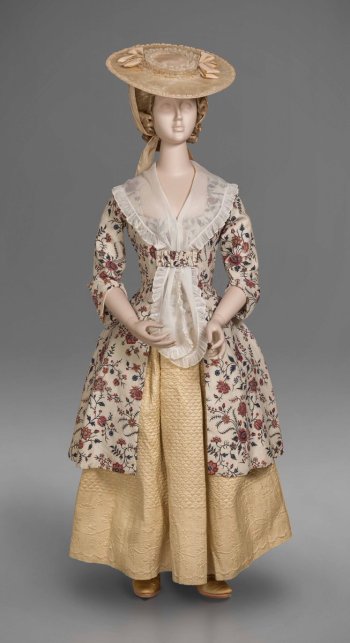 With their brilliant colors and engaging designs, early painted and printed textiles were eagerly sought for fashionable clothing, quilts, and other home furnishings. But textiles also tell human stories that sound modern: traders transporting goods from the other side of the world in ships powered by wind and sails; domestic workers trying their best to respond to foreign competition; people making the effort to dress in up-to-date styles despite their limited means; and the importance of chemistry and mechanical expertise in the production of consumer goods. The Colonial Williamsburg Foundation in Williamsburg, Virginia, hosts this symposium about painted and printed textiles with invited speakers and juried papers. The symposium coincides with the exhibition Printed Fashions: Textiles for Clothing and the Home, 1700–1820 mounted in the Gilliland Textile Gallery.
◊ ◊ ◊ ◊ ◊
S U N D A Y , 2 6 M A R C H 2 0 1 7
1:00 Conference registration
3:30 Welcome, Linda Baumgarten (senior curator of textiles and costumes, Colonial Williamsburg)
3:40 Juried Papers
• Philippe Halbert (Ph.D. candidate, Yale University, Department of the History of Art), ‘You know that my dear Mother loves Indienne’: Printed and Painted Textiles in the French Atlantic World, 1675–1800
• Ned Lazaro (associate curator of textiles and collections manager, Historic Deerfield, Massachusetts), On Risk and Account: The Fashion for Eighteenth-Century Indian Cottons in New England
• John Styles (research professor in History, University of Herfordshire and honorary senior research fellow, Victoria and Albert Museum), How Colonial America’s Taste for Printed Calicoes Drove the British Industrial Revolution
4:50 Break
5:00 Rosemary Crill (honorary research associate, Victoria and Albert Museum), When Print Meets Pen: Block-Printing and Hand-Drawing in Indian Cotton Textiles
6:00 Reception
M O N D A Y , 2 7 M A R C H 2 0 1 7
8:30 Art Museums of Colonial Williamsburg open for conference registrants
9:00 Announcements and introduction to the Printed Fashions exhibition
9:30 Linda Eaton (John L. and Marjorie P. McGraw Director of Collections and Senior Curator of Textiles, Winterthur Museum), Printed Furnitures: The Women’s Side of the Upholstery Trade
10:30 Break
11:00 Susan Greene (author and independent researcher, Alfred Station, New York), From Kalam to Cylinder
12:00 Lunch break with museum exhibitions open
2:00 Juried Papers
• Rebecca Fifield (Head of Collection Management, Special Collections, New York Public Library), Of the Lowest Prices: Printed Textile Use in the Dress of Unfree American Women, 1750–90
• Jennifer Swope (assistant curator, David and Robert Logie, Department of Textiles and Fashion Arts, Museum of Fine Arts, Boston), The Diversity of Printed Textile in Early America: The Robbins Family Collection at the Museum of Fine Arts, Boston
• Mary D. Doering (independent scholar, collector and guest curator), Case Study of a Printed Cotton Gown, Possibly Worn in Massachusetts, ca. 1780–85
• Alexandra Barlow (assistant conservator, Textile Conservation, The Metropolitan Museum of Art, New York) and Sara Reiter (The Penny and Bob Fox Senior Conservator of Costumes and Textiles, Philadelphia Museums of Art), Printed Gown Patterns: The Conservation of an Early Nineteenth-Century Block-Printed Dress: Techniques and Historical Importance
3:30 Break
4:00 Juried Papers
• Edward Heimiller (curator, The Stephen J. Ponzillo, Jr. Memorial Library & Museum of the Grand Lodge of A.F. & A.M. of Maryland), Revealing Fraternal Secrets: Establishing a Masonic Treatise for Fraternal Design
• Matthew Skic (assistant curator, Museum of the American Revolution, Clifton Heights, Pennsylvania), Stand Fast in the Liberty: A Rare Waistcoat Belt
• Angela Burnley (independent scholar, Williamsburg), 1 Gown Flowered All Over with Cards: Fashion’s Fancy through the Eyes of the Eighteenth-Century Textile Consumer
• Christina Westenberger (assistant manager for museum education, Colonial Williamsburg), Hunting, Murder and Bacon: Backstories of Three Printed Handkerchiefs in the Colonial Williamsburg Collection
T U E S D A Y , 2 8 M A R C H 2 0 1 7
8:30 Art Museums of Colonial Williamsburg open for conference registrants
9:00 Kimberly Ivey (senior curator of textiles and historic interiors, Colonial Williamsburg), Annie L. Hayslip’s Printed Textile Album
9:20 Philip Sykas (research associate, Manchester School of Art, Manchester), Pattern Books within ‘a Seasonal and Fancy Trade’: English Calico Printers, 1780–1830
10:10 Break
10:40 Barbara Brackman (independent scholar and researcher, Lawrence, Kansas), Printed Textiles in Quilts, 1775–1830
11:35 Bridget Long (visiting research fellow in history, University of Hertfordshire), ‘Have You Remembered To Collect Pieces for the Patchwork?’ The Impact of Printed Cloth on Eighteenth-Century Patchwork Practice (juried paper)
12:00 Lunch break with museum exhibitions open
2:00 Juried Papers
• Julia Brennan, Kaitlyn Munro, and Lauren Klamm (conservators, Caring for Textiles, Washington, D.C.), Burn Out: Case Studies in Conserving Printed Textiles
• Anita Loscalzo (independent textile historian, Dover, Massachusetts), Prussian Blue Textiles Found in American Quilts and Dress
• Linda Welters (professor, Textiles, Fashion Merchandising and Design, University of Rhode Island), In Small Things Forgotten: Three Eighteenth-Century Rhode Island Prints
3:10 Break
3:30 Juried Papers
• Margaret T. Ordoñez (Professor Emertia and Adjunct, Textiles, Fashion Merchandising and Design, University of Rhode Island), Printed Delaines with a French Label from East Greenwich, Rhode Island, ca. 1843
• Deborah E. Kraak (independent museum professional, Wilmington, Delaware) and Terry Tickhill Terrell (independent quilt history researcher, Masonville, Colorado), What’s in a Name? A New Database of Early Floral Chintz Motifs
• Sheryl DeJong (independent researcher, Reston, Virginia), Printed Fabrics in the Copp Quilt at the Smithsonian
• Lori Lee and Kay Triplett (authors and independent researchers, Overland Park, Kansas), Unexplored Printing Techniques in Textiles
5:00 Closing reception
New Book | London: Prints and Drawings before 1800
Published by the Bodleian and distributed by The University of Chicago Press:
Bernard Nurse, London: Prints and Drawings before 1800 (Oxford: Bodleian Library, in association with The London Topographical Society, 2017), 232 pages, ISBN: 978 18512 44126, £30 / $50.
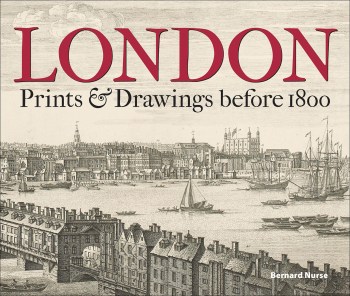 By the end of the eighteenth century London was the second largest city in the world, its relentless growth fuelled by Britain’s expanding empire. Before the age of photography, the most widely used means of creating a visual record of the changing capital was through engravings and drawings, and those that survive today are invaluable in showing us what the capital was like in the century leading up to the Industrial Revolution.
This book contains over one hundred images of the Greater London area before 1800 from maps, drawings, manuscripts, printed books, and engravings, all from the Gough Collection at the Bodleian Library. Examples are drawn from the present Greater London to contrast town and countryside at the time. Panoramas of the river Thames were popular illustrations of the day, and the extraordinarily detailed engravings made by the Buck brothers are reproduced here. The construction, and destruction, of landmark bridges across the river are also shown in contemporary engravings.
Prints made of London before and after the Great Fire show how artists and engravers responded to contemporary events such as executions, riots, fires, and even the effects of a tornado. They also recorded public spectacles, creating beautiful images of firework displays and frost fairs on the river Thames. This book presents rare material from the most extensive collection on British topography assembled in this period by a private collector, providing a fascinating insight into life in Georgian London.
Bernard Nurse is the former Librarian of the Society of Antiquaries of London.
New Book | The Print Before Photography
From Museum Bookstore:
Anthony Griffiths, The Print Before Photography: An Introduction to European Printmaking, 1550–1820 (London: The British Museum, 2016), 560 pages, ISBN: 978 07141 26951, $75.
 A landmark publication—beautifully illustrated with over 300 prints from the British Museum’s renowned collection—The Print Before Photography traces the history of printmaking from its earliest days until the arrival of photography.
Copperplate printmaking, developed alongside Gutenberg’s invention of moveable type, was a huge business employing thousands of people, and dominating image production for nearly four centuries across the whole of Europe. Its techniques and influence remained very stable until the nineteenth century, when this world was displaced by new technologies, of which photography was by far the most important. The Print Before Photography examines the unrivaled importance of printmaking in its golden age, illustrated through the British Museum’s outstanding collection of prints. This unique and significant book is destined to be a leading reference in print scholarship, and will be of interest to anyone with an interest in this era of art history.
Between 1991 and 2010, Antony Griffiths was deputy keeper, then keeper, of Prints and Drawings at The British Museum. In 1984 he co-founded the journal Print Quarterly. He was appointed a fellow of the British Academy in 2000.
New Book | The Sovereign Artist: Charles Le Brun
From Paul Holberton:
Wolf Burchard, The Sovereign Artist: Charles Le Brun and the Image of Louis XIV (London: Paul Holberton Publishing, 2017), 288 pages, ISBN: 978 19113 00052, £40.
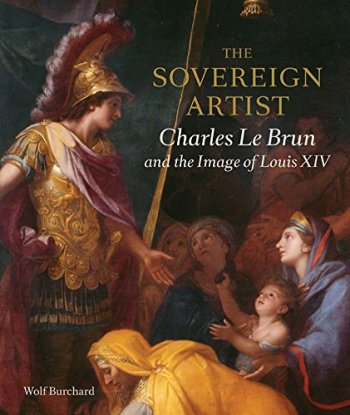 The first monograph to examine the wide artistic production of Louis XIV’s most prolific and powerful artist, Charles Le Brun (1619–1690), illustrating not only his paintings but the magnificence of the interiors and decorative works of art produced according to his designs. Revealing Le Brun’s extraordinary versatility and exploring his work at the Academy, the Gobelins and Savonnerie manufactories, and the royal building sites of the Louvre and Versailles, it is also the first book to explore in depth his artistic relationship to the Sun King.
In his joint capacities of Premier peintre du roi, director of the Gobelins manufactory and rector of the Académie royale de peinture et de sculpture, Le Brun exercised a previously unprecedented influence on the production of the visual arts—so much so that some scholars have repeatedly described him as ‘dictator’ of the arts in France. The Sovereign Artist explores how Le Brun operated in his diverse fields of activities, linking and juxtaposing his portraiture, history painting and pictorial theory with his designs for architecture, tapestries, carpets and furniture. It argues that Le Brun sought to create a repeatable and easily recognizable visual language associated with Louis XIV, in order to translate the king’s political claims for absolute power into a visual form. How he did this is discussed through a series of individual case studies ranging from Le Brun’s lost equestrian portrait of Louis XIV, and his involvement in the Querelle du coloris at the Académie, to his scheme for 93 Savonnerie carpets for the Grande Galerie at the Louvre, his Histoire du roy tapestry series, his decoration of the now destroyed Escalier des Ambassadeurs at Versailles.
One key theme is the relation between the unity of the visual arts, to which Le Brun aspired, and the strong hierarchical distinctions he made between the liberal arts and the mechanical crafts: while his lectures at the Académie advocated a visual and conceptual unity in painting and architecture, they were also a means by which he attempted to secure the newly gained status of painting as a liberal art, and therefore to distinguish it from the mechanical crafts which he oversaw the production of at the Gobelins manufactories. His artistic and architectural aspirations were comparable to those of his Roman contemporary Gianlorenzo Bernini, summoned to Paris in 1665 to design the Louvre’s East façade and to create a portrait bust of Louis XIV. Bernini’s failure to convince the king and Colbert of his architectural scheme offered new opportunities for Le Brun and his French contemporaries to prove themselves capable of solving the architectural problems of the Louvre and to transform it into a palace appropriate “to the grandeur and the magnificence of the prince who [was] to inhabit it” (Jean-Baptiste Colbert to Nicolas Poussin in 1664). The comparison between Le Brun and Bernini, made in the book, not only illustrates how France sought artistic supremacy over Italy during the second half of the 17th century, but further helps to demonstrate how Le Brun himself wanted to be perceived: beyond acting as a translator of the king’s artistic ambition, the artist appears to have sought his own sovereign authority over the visual arts.
Wolf Burchard is an art and architectural historian. He is the National Trust’s Furniture Research Curator and was formerly Curatorial Assistant at the Royal Collection Trust.
Exhibition | The Tweeddales: Power, Politics and Portraits

Attributed to Sir John Baptiste de Medina, The Family of John Hay, 1st Marquess Tweeddale, Lord High Chancellor of Scotland, ca. 1695, oil on canvas, 141 × 184 cm (Scottish National Portrait Gallery, purchased with the aid of the Art Fund and the Heritage Lottery Fund 1999).
◊ ◊ ◊ ◊ ◊
Now on view at the Scottish National Portrait Gallery:
The Tweeddales: Power, Politics and Portraits
Scottish National Portrait Gallery, Edinburgh, 23 April 2016 — 28 May 2017
Wealthy, influential, and politically savvy the Tweeddale family was at the heart of Scottish society in the second half of the seventeenth century. At the head of the family was John Hay (1626–1697), 2nd Earl and later 1st Marquess of Tweeddale. His marriage to Lady Jean Scott (1629–1688), second daughter of the Borders landowner Walter Scott, 1st Earl of Buccleuch, brought him wealth, opportunity, and a large family—the couple had several children. Members of the Tweeddale dynasty married into some of the noblest families in Scotland and England.
While several members of the Tweeddale family are acknowledged for their contribution to politics, the military, and for their strategic marriage matches, their role as patrons of the arts and architecture is often overlooked. The family were enthusiastic art collectors who commissioned portraits and landscapes by established and little-known artists, particularly those of Dutch, Flemish, and German origin including Sir Anthony van Dyck, Sir Peter Lely, Gerard Soest, and Sir John Baptiste de Medina. Paintings by each these artists feature in the exhibition. The highlight of the exhibition is the fascinating group portrait of the Marquess and his family, attributed to the Flemish artist Sir John Baptiste de Medina, which was painted around 1695.
Conference | Medals and Tokens in Europe
From H-ArtHist:
Art du puissant, objet multiple: Médailles et jetons en
Europe, de la Renaissance à la Première Guerre mondiale
Institut National d’Histoire de l’Art, Paris, 30 March — 1 April 2017
J E U D I , 3 0 M A R S 2 0 1 7
13.00 Accueil
13.30 Portrait du Puissant
Présidence de séance: Victor Hundsbuckler (Monnaie de Paris)
• Ilaria Bernocchi (University of Cambridge), Myth-making of a Renaissance Ruler: Andrea Doria as Neptune in Medals, Plaquettes, and the Allegorical Portrait by Angola Bronzino
• Aurore Chéry (LARHRA/CNRS), Déclin et renouveau protéiforme des médailles sous Louis XV et Louis XVI
• Katia Schaal (Université de Poitiers / Ecole du Louvre / INHA), Vus de profil: genèse des portraits de présidents de la République française, de Thiers à Fallières
15.30 Pause
16.00 Concevoir, Produire
Présidence de séance: Lucia Simonato (Scuola Normale di Pisa)
• James Fishburne (Getty Research Institute), Coins, Medals, and the Convergence of Two Genres: Numismatics in High Renaissance Rome
• Giulia Zaccariotto (Scuola Normale di Pisa), Vittore Gambello called Camelio: Medallist and Die Engraver between Venice and Rome
• Andrea Mayr (Kunsthistorisches Museum Wien), On the role of the k.k. Kammermedailleur under Emperor Ferdinand I and his significance and function for the medal production at the Imperial Mint in Vienna
17h30 Pause
18.00 Collections
Présidence de séance: Chantal Georgel (INHA)
• Ludovic Jouvet (Université de Bourgogne / INHA), Son histoire à portée de main: la cassette personnelle de Louis XIV
• Inès Villela-Petit (BnF), Les médailles de la collection Seymour de Ricci
V E N D R E D I , 3 1 M A R S 2 0 1 7
9.00 Accueil
9.30 Institutions
Présidence de séance: François Ploton-Nicollet (Ecole nationale des Chartes)
• Sabrina Valin (Université Paris Nanterre), L’institutionnalisation progressive des projets de jetons sous les règnes de Louis XIII et de Louis XIV, 1610–61
• Jacques Meissonnier (conservateur honoraire du patrimoine), Les jetons des puissants états de Bourgogne et de Languedoc
• Béatrice Coullaré (Monnaie de Paris), Les médailles de visites de chefs d’Etat. Deux cents ans d’histoire diplomatique et artistique à la Monnaie de Paris
11.00 Pause
11.30 Transferts de modèles
Présidence de séance: Inès Villela-Petit (Bibliothèque nationale de France)
• Thodoris Koutsogiannis (Parlement hellénique), The Ruler of Constantinople on Italian Renaissance Medals: John VII Palaeologus and Mehmed the Conqueror in European Visual Culture
• Emily Pearce Seigerman (National Museum of American History), République dans le vrai style: How French Medalic Artistry Became the Emblem of Trans-Atlantic Change
• Charles Dujour Bosquet (Université de Bordeaux 3-Montaigne), La présence française et la médaillistique au Chili au tournant du XXe siècle
13.00 Déjeuner
14.30 L’histoire en marche
Présidence de séance: Marc Bompaire (Ecole Pratique des Hautes Etudes)
• Paulina Taradaj (Musée National, Cracovie), What do John Sobieski, Augustus II of the House of Wettin and Frederick William II of Prussia Have in Common Concerning Medals?
• Thomas Cocano (SAPRAT/EPHE), La construction d’une image nationale et politique au travers de la
production de médailles durant le règne d’Anne, 1702–14
• Anna Fabiankowitsch (Kunsthistorisches Museum Wien), On Her Majesty’s Service: Protagonists of commissioning and creation as part of the medal production in the Viennese Imperial Mint under Empress Maria Theresa
16.00 Pause
16.30 Présidence de séance: Edouard Papet (Musée d’Orsay)
• Catherine Bregianni (Académie héllénique des Sciences), David d’Angers et la prosopographie du libéralisme: les médailles et médaillons sur la Révolution Grecque
• Nikoleta Tzani (Ville de Volos, Section de l’Education et de la Culture), Quelques médailles de la cour royale grecque des années 1900 à la fin de la Grande Guerre
S A M E D I , 1 A V R I L 2 0 1 7
9.00 Accueil
9.30 Pouvoirs de l’objet
Présidence de séance : Felicity Bodenstein (Musée du Quai Branly-Jacques Chirac)
• Jean-François Dubos (Service historique de la Défense), De la médaille à la récompense. Bélière et « rurbanisation », ou le mérite rendu visible
• Alain Weil (Expert numismate), Quand le puissant c’est le peuple : naissance et évolution de la médaille populaire en France
• Pierre-Christian Guiollard (Université de Mulhouse-Colmar), Les « taillettes » ou « jetons de lampisterie » des mines : fonction utilitaire et symbolique
• Cécilie Champy (Musée du Petit Palais), La médaille française et la Première Guerre mondiale : de la propagande à la douleur universelle
• Holly Crawford (PhD), Anxious Object : Enemy Alien Medals from British WW I Internment Camps
Exhibition | The Land without Music
From the Lewis Walpole Library:
The Land without Music: Satirizing Song in Eighteenth-Century England
The Lewis Walpole Library, Farmington, CT, 1 March — 29 September 2017
Curated by Amy Dunagin
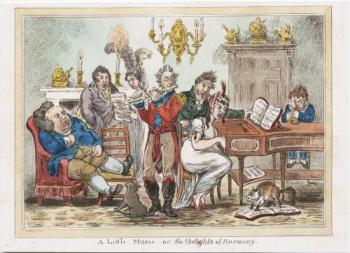
Copy after James Gillray, A Little Music, or, The Delights of Harmony, etching and stipple with hand coloring; published 1818 by John Miller and W. Blackwood (Lewis Walpole Library, 810.00.00.72).
Music pervaded public and private spaces in eighteenth- and nineteenth-century England; yet, in 1904, German critic Oscar Adolf Hermann Schmitz, heightening long-standing aspersions, dismissed England as a “land without music.” This unflattering epithet pointed to England’s meager contributions to the western musical canon during the eighteenth and nineteenth centuries—no English Gluck, Mozart, or Verdi; no English operatic or symphonic tradition that could rival those that flourished on the continent. The English, critics like Schmitz suggested, were importers rather than producers—tasteless consumers and dilettantes rather than discerning, proficient practitioners. This view did not originate with continental nationalists; in the eighteenth century the English often presented themselves as uniquely unmusical in print and in visual satire. At once self-effacing and boastful, this representation asserted a national character too sensible, too chaste, too sober to permit the excesses of musical genius. Bringing together satirical prints and documents pertaining to English music makers and listeners, this exhibition explores English attitudes toward music as lascivious, feminine, foreign, frivolous, and distinctly un-English.
Curated by Amy Dunagin, Postdoctoral Associate, European Studies Council, Yale University, and Managing Editor, Eighteenth-Century Studies
The exhibition brochure, which includes a full checklist, is available as a PDF file here»
New Book | After the Fire: London Churches
From Pimpernel Press:
Angelo Hornak, After the Fire: London Churches in the Age of Wren, Hooke, Hawksmoor, and Gibbs (London: Pimpernel Press, 2016), 384 pages, ISBN: 978 191025 8088384, £50.
 “London was but is no more!” In these words diarist John Evelyn summed up the destruction wrought by the Great Fire that swept through the City of London in 1666. The losses included St Paul’s Cathedral and eight-seven parish churches, as well as at least thirteen thousand houses.
In After the Fire, celebrated photographer and architectural historian Angelo Hornak explores, with the help of his own stunning photographs, the churches built in London during the sixty years that followed the Great Fire, as London rose from the ashes, more beautiful—and far more spectacular—than ever before. The catastrophe offered a unique opportunity to Christopher Wren and his colleagues—including Robert Hooke and Nicholas Hawksmoor—who, over the next forty years, rebuilt St Paul’s and fifty-one other London churches in a dramatic new style inspired by the European Baroque.
Forty-five years after the Fire, the Fifty New Churches Act of 1711 gave Nicholas Hawksmoor the scope to build breathtaking (and controversial) new churches including St Anne’s Limehouse, Christ Church Spitalfields and St George’s Bloomsbury. By the 1720s the pendulum was swinging away from the Baroque of Wren and Hawksmoor, and it was James Gibbs’ more restrained St Martin-in the-Fields that was to provide the prototype for churches throughout the English-speaking world—especially in North America—for the next hundred years.
Angelo Hornak is the author of Balloon over Britain (1991) and London from the Thames (1999) and has provided the photographs for many books, including histories of St Paul’s Cathedral and Westminster Abbey and the cathedrals of Canterbury, Winchester, Wells, Exeter, and Ely. He lives in London and Norfolk.
Auction Results | Givaudan Collection at Piguet
Press release, via Art Daily:
Givaudan Collection
Piguet Auction House, Geneva, 15 March 2017
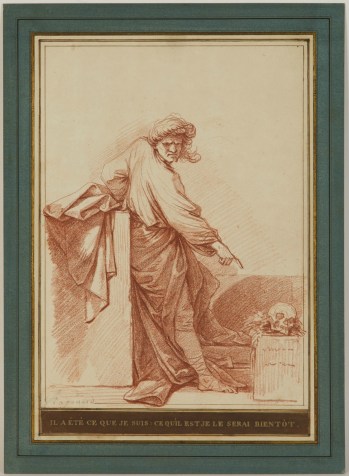
Lot 794: Jean-Honoré Fragonard, Man Pointing to a Skull, red chalk.
The prices for the Givaudan Collection soared this week at Piguet Auction House in Geneva. A red chalk drawing by Jean-Honoré Fragonard (1732–1806) sold for six times its low estimate, fetching CHF 267,500, the highest price seen at auction for the last decade (lot 794 estimated at CHF 40,000–60,000). This result is the third best price ever achieved for a red chalk drawing by Fragonard, the first and second being for works sold at Sotheby’s before the economic downturn of 2008 (one fetching €391,063 in 2007 and the other €286,534 in 1998). Another star lot from this collection, the spectacular pair of Louis XV Meissen porcelain candelabras, sold for CHF 158,000 at five times its low estimate (lot 586 estimated at CHF 30,000–50,000). The paintings, furniture, silver, and works of art from the collection totalled 55 lots altogether and fetched over one million Swiss francs (CHF 1,095,000).
The Givaudan Collection was part of the Spring Sale at Piguet Auction House, which finished Thursday evening with an end result of CHF 3.9 million. The Jewellery and Watches sale fetched CHF 1.5 million alone. The Wine and Spirits sale saw an almost clear round selling 92% of lots auctioned. Around 500 lots over the four days of auctions were sold at less than CHF 300, providing many an opportunity for a little indulgence at a low price.
Collectors and enthusiasts alike went into battle in the saleroom and over the telephones to be a successful bidder on pieces from this important collection from Xavier and Leon Givaudan’s estate. Having settled in Geneva over a century ago, the Givaudan brothers made their fortune in the production of synthetic perfumes, soaps, and chemicals. Consulting only the most renowned Parisian dealers and galleries, their collection began to take shape at the beginning of the 20th century. Furthermore, thanks to the research carried out by Piguet Auction House specialists, certain pieces were traced all the way back to their 18th-century origins.
French and American collectors were the most forthcoming in their bidding on the drawings and paintings while the Swiss and German collectors went to battle over the bronzes and works of art. Two clients in particular entered a bidding war over the telephones which saw a red chalk drawing by Jean-Honoré Fragonard reach CHF 267,500. The red chalk drawing which includes a skull is annotated in French “he has been what I am: what he is I will be soon.” Discovered by Bernard Piguet in the previous owner’s shoe cupboard, this red chalk drawing has now become the third most expensive work of its kind by the artist in the world. First and second place are held by drawings sold at Sotheby’s before the economic downturn of 2008 (red chalk drawing sold for €391,063 in 2007 and another for €286,534 in 1998).

Lot 793: Louis Léopold Boilly, Conjugal Tenderness.
Just minutes later, two other red chalk drawings by Hubert Robert (1733–1808) fetched CHF 82,700 and 94,800. Their provenance had been traced uninterruptedly from the present owner right back to the artist himself (lots 803 and 804 each estimated at CHF 15,000–20,000). The married couple sharing an intimate moment in La tendresse conjugale (Conjugal Tenderness) by Louis Léopold Boilly (1761–1845) moved one client to bid CHF 121,600 by telephone before finally becoming its next owner (lot 793 estimated at CHF 60,000–80,000).
During Wednesday afternoon’s auction, the Louis XV candelabras took centre stage. Veritable works of art in themselves, these important Meissen porcelain figures after a model by J.J. Kändler are set in ornate ormolu mounts (ca. 1740). Selling at five times their low estimate, these finely crafted candelabras fetched CHF 158,000 (lot 586 CHF 30,000–50,000).










 Enfilade
leave a comment