Research Lunch | Isabelle Baudino on Samuel Wale’s Book Illustrations
From the Paul Mellon Centre:
Isabelle Baudino, Samuel Wale’s Book Illustrations:
Designing Historical Panoramas in Georgian London
Paul Mellon Centre, London, 31 March 2017
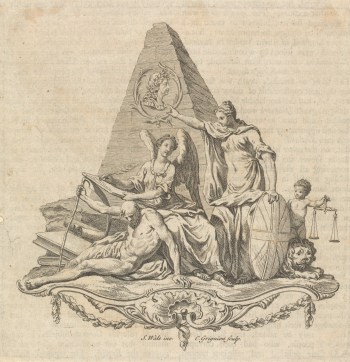
Charles Grignion, after Samuel Wale, Britannia Allegory, between 1743 and 1747, Line engraving and etching; letterpress on verso on medium, slightly textured, cream laid paper (page in book) (Yale Center for British Art, Yale Art Gallery Collection).
Despite being a founding member of the Royal Academy of Arts, Samuel Wale (1721?–1786) has remained quite an elusive figure. Most of his easel paintings have disappeared and the greater part of his decorative works has been damaged or destroyed. Although he was apprenticed as an engraver, he started his career as a painter, attending classes at St Martin’s Lane Academy, decorating the Foundling Hospital and assisting Francis Hayman. While being consistently involved in the academic movement that led to the foundation of the Royal Academy, Wale also became one of the most prolific book illustrators of the day, designing hundreds of plates that contributed to the growing popularity of pictorial histories. Over the course of his forty-year career, he established a formulaic, full-page framed historical scene offering an unprecedented visualisation of British history. Indeed, building on his first selection of historical events, and drawing inspiration from the theatre, other books or paintings, Wale established a sequence of landmarks that gave an overview of Britain’s history from its ancient origins until modern times. He thus contributed to the visual perception of historical chronology and created images of national history that were emulated, adapted and appropriated. Friday, 31 March 2017, from 12:30 to 2:00pm. Registration information is available here.
I will argue that despite their low aesthetic and commercial value, the images that composed Wale’s historical panorama proved remarkably persistent because they brought together history, nationhood and iconography, thus transforming the understanding of history and fostering a new engagement with the past and its traces in the eighteenth-century present.
Isabelle Baudino is Senior Lecturer at the ENS in Lyons and has been a Visiting Fellow at Magdalene College, Cambridge, over the past academic year. Her work focuses on eighteenth-century British art with particular interest in history painting and the Royal Academy, taken individually, but also studied together in the context of the institutionalization of the arts in eighteenth-century Britain. Her study on Samuel Wale is part of a project which is generously supported by a mid-career fellowship from the Paul Mellon Centre for Studies in British Art.
Exhibition | Volcanoes

Sir William Hamilton’s volcano archive includes paintings he commissioned (Oxford: Bodleian).
◊ ◊ ◊ ◊ ◊
From the press release (16 January 2017) for the exhibition:
Volcanoes
Weston Library, Bodleian, Oxford, 10 February 2017 — 21 May 2017
Curated by David Pyle
A new exhibition at the Bodleian Libraries uses a spectacular selection of eye witness accounts, scientific observations, and artwork to chart how our understanding of volcanoes has evolved over the past two millennia. The exhibition examines some of the world’s most spectacular volcanoes including the 79 AD eruption of Vesuvius—one of the most catastrophic eruptions in European history—and the 19th-century eruptions of Krakatoa and Santorini, two of the first volcanic eruptions to be intensely studied by modern scientists.
Today, satellites monitor volcanic activity and anyone with internet access can watch volcanic eruptions live in real time. In the past, volcanic eruptions were described in letters, manuscript accounts, and early printed books and illustrated through sketches, woodcuts, and engravings. Many of these fascinating accounts are preserved in the Bodleian’s historic collections and will be on display in Volcanoes at the Weston Library.
The human encounters with volcanoes that are traced in the exhibition range from Pliny the Younger’s account of the dramatic eruption of Vesuvius in 79 CE to early Renaissance explorers who reported strange sightings of mountains that spewed fire and stones. Also explored is how scientific understanding of volcanoes and the Earth’s interior have developed over time, from classical mythology and early concepts of subterranean fires to the emergence of modern volcano science, or volcanology, in the 19th century. The exhibition brings together science and society, art, and history and will delight visitors of all ages.
 The exhibition is curated by David M. Pyle, Professor of Earth Sciences at the University of Oxford, whose research uses historical sources to improve our knowledge of past volcanic activity and to shed light on what might happen in the future at young or active volcanoes. It will feature treasures from the Bodleian Libraries, some of which have never been on public display before. In addition, the exhibition will feature items on loan from the Natural History Museum in London and from the University of Oxford’s Museum of Natural History, the Museum of the History of Science, and Magdalen College. Highlights of Volcanoes include:
• Fragments of ‘burnt’ papyrus scrolls from the ancient Roman town of Herculaneum, which were buried during the 79 AD eruption of Vesuvius
• The earliest known manuscript illustration of a volcano, found in the margin of a 14th-century account of the voyage of St Brendan, an Irish monk who travelled across the north Atlantic in the 6th century
• A stunning illustration of the Earth’s subterranean fires from Athanasius Kircher’s Mundus Subterraneus, an influential 17th-century work which proposed that volcanoes were created where the Earth’s internal fires escaped at the surface
• Spectacular 18th-century studies of Vesuvius by Scottish diplomat and early volcanologist William Hamilton who wrote one of the first descriptive monographs of an active volcano
• 18th- and 19th-century weather diaries and paintings that capture the distant effects and freak weather conditions caused by major volcanic eruptions in Iceland and Indonesia
• ‘Infographics’ from 19th-century natural historians Alexander von Humboldt and Charles Daubeny whose work has contributed greatly to our current understanding of volcanoes
• Lava and rock samples, maps, lecture notes, and scientific equipment from 19th-century volcanologists and explorers
The exhibition curator David Pyle said: “Humans have lived with volcanoes for millions of years yet scientists are still grappling with questions about how they work. This exhibition features historical representations and ideas about volcanoes that are captivating and dramatic but most importantly these works provide scientists today with valuable insights into how these enigmatic phenomena behave. Looking back at history can help us learn valuable lessons about how best to reduce the effects of future volcanic disasters.”
Richard Ovenden, Bodley’s Librarian said: “Volcanoes are one of the most extraordinary marvels of the natural world and have fascinated us for millennia. This exhibition draws on both the rich collections held at the Bodleian and cutting edge scientific research to demonstrate the power and fascination of volcanoes through time.”
David Pyle, Volcanoes (Oxford Bodleian Libraries, 2017), 224 pages, ISBN: ISBN: 978 18512 44591, £20.
Exhibition | A Life of Seduction: Venice in the 1700s
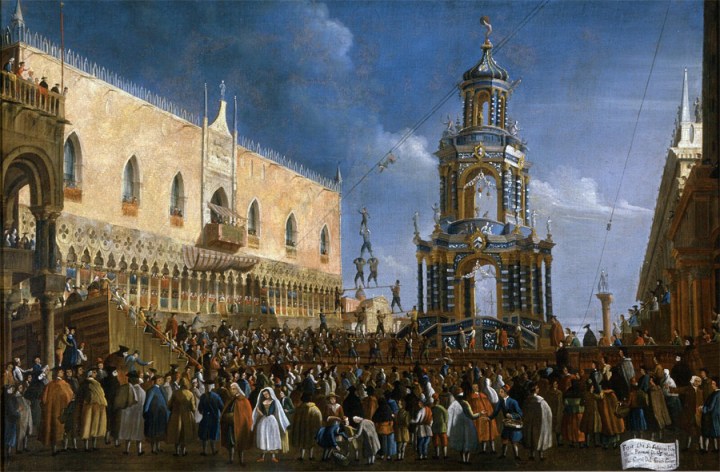
Gabriel Bella, Fat Thursday Festivity in Piazzetta, 18th century
(Venice: Querini Stampalia Foundation)
◊ ◊ ◊ ◊ ◊
Press release (11 January 2017) from NOMA:
A Life of Seduction: Venice in the 1700s
New Orleans Museum of Art, 16 February — 21 May 2017
Curated by Giandomenico Romanelli
The grandeur of Venice comes to America’s most historic city in A Life of Seduction: Venice in the 1700s, an exhibition at the New Orleans Museum of Art. NOMA is the sole venue in the United States presenting this exhibition of objects providing a glimpse into the pageantry, ceremony, and extravagance of Venetian life in the eighteenth century.

Glass sugar bowl, Venice, 18th century, glass and chalcedony (Murano: Museo del Vetro).
“It is with great pleasure that NOMA brings this remarkable exhibition to our public. Venice is presented through an elegant, multi-disciplinary installation featuring an exceptional selection of objects, costumes, and paintings that illuminate an extraordinary time in the history of Venice,” says Susan Taylor, Montine McDaniel Freeman Director at the NOMA.
A Life of Seduction illuminates Venetian life and pageantry during the century of Casanova, Canaletto, and Tiepolo. Visitors will see objects depicting the opulence of the time, when the city was a cultural mecca. Eighteenth-century carnival masks, costumes and robes, shoes, handbags, and regal glass objects are displayed among exquisite paintings by Canaletto and Guardi. “A significant strength of this exhibition is its historical and cultural point of view and the distinctive range of objects that tell the story,” says NOMA Curator Vanessa Schmid.
Fittingly, A Life of Seduction arrives in New Orleans at a time when parallels between the two cities are apparent, just before Carnival and the spring festival season. Guest-curated by the former director of the Civic Museums of Venice, Giandomenico Romanelli, the exhibition presents four themes: A City that Lives on Water, the Celebration of Power, Aristocratic Life in Town and Country, and the City as Theater. The festivals and celebration unique to Venetian culture are depicted in detailed paintings of a city transformed at carnival. Gondola models illustrate the exquisite craftsmanship and elegance of canal life and travel. Palace and country living are brought to life by resplendent costumes, silk waistcoats, gloves, and handbags, as well as furnishings and delicate, rare Venetian glass objects, for which the city is still so well known. Theater and opera—vital elements in Venetian life and imagination—are represented through paintings, decorative arts, and a full-scale puppet theater lent by the Casa Goldoni of Venice especially for this exhibition.
The exhibition is originated by NOMA, organized by the Contemporanea Progetti, and guest-curated by Giandomenico Romanelli.
Lecture | David Pullins on the Shape of Painting
Of note for anyone in the Boston area next Tuesday; from Harvard:
David Pullins | The Shape of Painting: Eighteenth-Century Departures from the Rectangle
Harvard University, Cambridge, 7 March 2017
 Informed by questions asked explicitly by twentieth-century painters (Johns, Stella, Murray) about the relationship between image and support, this talk engages with the wildly irregular formats produced in response to decorative programs in eighteenth-century France. While developing an historical understanding of the conditions that produced this pervasive (yet entirely unstudied) category of painting, the talk’s primary aim is to address what can be learned about the crises and limits of painting through this early modern departure from the rectangle. Tuesday, 7 March 2017, 5:00pm, Barker Center 133.
David Pullins is a Lecturer at MIT.
Image: Jacques de Lajoüe, Optics, ca. 1734 (private collection).
Exhibition | Glorious Years: French Calendars

François Gérard Jollain, Almanac (detail), ‘The August Portraits of the First Born Sons of Our Kings That Have Had the Title of Dauphin’ (Louis XV, the Queen, and the Dauphin surrounded by courtiers and other nations with a family tree of French kings), 1734; etching and engraving, 84 × 51 cm (Waddesdon Manor, National Trust, 2669.3.17; photo: Mike Fear).
◊ ◊ ◊ ◊ ◊
Opening next month at Waddesdon:
Glorious Years: French Calendars from Louis XIV to the Revolution
Waddesdon Manor, Buckinghamshire, 22 March — 29 October 2017
Curated by Rachel Jacobs
Glorious Years is a celebration of the power of the printed image before photography—an exhibition of rare calendars, published in Paris in the 17th and 18th centuries, from their golden period under Louis XIV, through to the Revolution, when time itself was re-invented, with new ways of illustrating and naming the days and years.
Despite their popularity, these calendars (originally named ‘almanacs’) have not survived in great numbers. They were replaced annually and were easily damaged due to their large sizes. The depicted major events, from royal weddings, and births to victorious battles and peace treaties and were designed to inform and delight the public, while glorifying the king and his image. These rare prints can be enjoyed as works of art and as important historic documents, revealing much about the social, political, and artistic world of the Old Regime.

Philibert Louis Debucourt, Almanac: Republican Calendar, 1794; etching and engraving; 51 × 41 cm (Waddesdon Manor, National Trust, 2669.3.42; photo: Mike Fear).
A number of bound pocketbook almanacs are also included in the exhibition. These small volumes were extremely popular towards the end of the 18th century. They vary hugely in content, but all contain a calendar within. Some are official directories, listing members of the royal households, schedules for the post and carriage travel; others are for amusement, containing songs, poems, illustrations and even erasable paper for recording gambling gains and losses. These small pocketbooks are not dissimilar to our modern-day smart phones, perfectly suited to distract, amuse, and inform.
In a time before photography, the printed image was the most effective communicator. Images were everywhere and consumed by all. The exhibition will explore the context in which these almanacs were made and consider how these everyday prints and books were used to educate, delight, impress, and express the official print programme of the court and the later revolutionary government.
Baron Ferdinand de Rothschild (1839–1898) was as fascinated by social history and printed ephemera—such as trade cards and lottery tickets—as he was by the finest English and French art of the 18th century. His collection of over 70 almanacs is unique in the UK, and it is the first time some 30 of these prints will be on public display. All the prints in the exhibition have been conservation cleaned, remounted, and digitised and will be available to browse and research on the website alongside our other collections of printed ephemera, including trade cards, board games, and prints from the French Revolution.
UK Government Art Collection To Set Up Its Own Gallery

Selections from the UK’s Government Art Collection as displayed in its current storage facility off Tottenham Court Road; photo from a blog posting (5 March 2014) at Please Don’t Touch The Dinosaurs, which noted the introduction of lunchtime tours of the GAC.
◊ ◊ ◊ ◊ ◊
As reported by The Art Newspaper (February 2017), p. 10.
The UK’s Government Art Collection (GAC) plans to set up its own gallery. This will open up a huge collection of 14,000 works, mainly by British artists, which is not easily accessible.
A spokeswoman for the Department for Culture, Media and Sport, which oversees the GAC, says that the collection’s offices and stores will be moved to new premises in London which should include a “display space that everyone will be able to enjoy.” Entry will presumably be free. The location and timing have not yet been announced.
At present, the collection is stored in Queen’s Yard, just off Tottenham Court Road, in central London. The stores are not environmentally controlled to museum standards, which is another reason for the move. . .
Of the 14,000 works, around one-third are in store, with most of the remainder hanging in 100 government offices in the UK and 270 offices abroad, where there is very limited public access. . .
The works are nearly all by British artists, although there are a few paintings made by foreigners of British subjects. They date from the 16th century to the present. . .
UK Export Ban Placed on a George III Barometer
Press release (23 February 2017) from Gov.UK’s Department for Culture, Media & Sport:
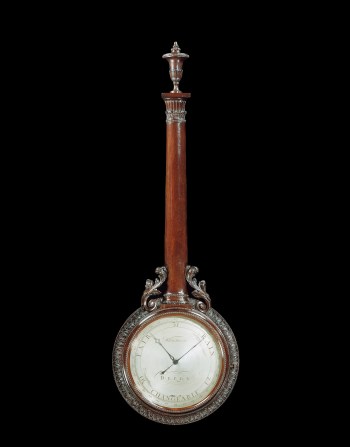
Wheel barometer, ca. 1770–80, 43 × 14 × 2.25 inches. Dial, silvered, signed ‘Whitehurst Derby’ with 3-inch scale for 29-31 inches of mercury subdivided into hundredths and inscribed for ‘changeable’, ‘rain’, ‘fair’. Case: mahogany, carved with leaves, column (housing the tube) with acanthus leaves at base, and urn finial. Made by Whitehurst of Derby.
A rare Georgian barometer is at risk of being exported from the UK unless a buyer can be found to match the asking price of £160,000. Culture Minister Matt Hancock has placed a temporary export bar on the George III mahogany wheel barometer to provide an opportunity to keep it in the country. The piece is one of a small number of its design known to have been made by the renowned Whitehurst family of clockmakers, from Derby. It is one of only nine of this type known to exist, none of which are known to be in a UK public collection.
During the reign of King George III natural philosophy had become increasingly popular, with scientific instruments finding their way into the homes of the elite classes. The ornate decoration of this instrument indicates that it was intended for this purpose. The possible association of the barometer with John Whitehurst makes this item of particular interest. As a clockmaker, instrument maker, and natural philosopher, he was a member of the Lunar Society, became Stamper of Money Weights at the Mint, was painted by Joseph Wright, and was elected a Fellow of the Royal Society.
Minister of State for Digital and Culture Matt Hancock said: “This beautiful barometer is more than just an instrument: it also gives us a glimpse into the 18th-century home and the increased interest in natural philosophy at the time. As a rare and important item associated with a significant regional workshop, this fine piece offers an intriguing possibility for further study. I very much hope that we can keep it in the UK for this purpose.”
The decision to defer the export licence follows a recommendation by the Reviewing Committee on the Export of Works of Art and Objects of Cultural Interest (RCEWA), administered by The Arts Council.
RCEWA member Christopher Rowell said: “The scientifically sophisticated design of this rare Whitehurst barometer is matched by the high quality of the carved mahogany case. No other Whitehurst barometer of this model is in a British public collection, and its retention in this country is therefore highly desirable.”
The RCEWA made its recommendation on the grounds of the barometer’s outstanding significance to the study of the Whitehurst family’s work. The decision on the export licence application for the barometer will be deferred until 22 April 2017. This may be extended until 22 July 2017 if a serious intention to raise funds to purchase it is made at the recommended price of £160,000 (plus VAT of £2,000). Organisations or individuals interested in purchasing the barometer should contact the RCEWA.
New Book | Why Preservation Matters
Released in October from Yale UP:
Max Page, Why Preservation Matters (New Haven: Yale University Press, 2016), 224 pages, ISBN: 978 03002 18589, $25.
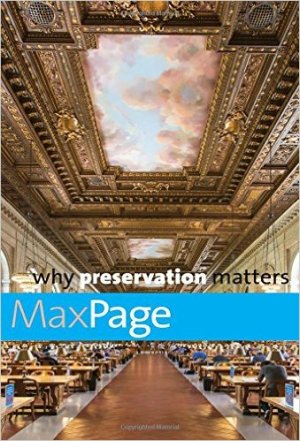 Commemorating the fiftieth anniversary of the National Historic Preservation Act, a critique of the preservation movement—and a bold vision for its future
Every day, millions of people enter old buildings, pass monuments, and gaze at landscapes unaware that these acts are possible only thanks to the preservation movement. As we approach the October 2016 anniversary of the United States National Historic Preservation Act, historian Max Page offers a thoughtful assessment of the movement’s past and charts a path toward a more progressive future.
Page argues that if preservation is to play a central role in building more-just communities, it must transform itself to stand against gentrification, work more closely with the environmental sustainability movement, and challenge societies to confront their pasts. Touching on the history of the preservation movement in the United States and ranging the world, Page searches for inspiration on how to rejuvenate historic preservation for the next fifty years. This illuminating work will be widely read by urban planners, historians, and anyone with a stake in the past.
Max Page is a professor of architecture and history at the University of Massachusetts Amherst, author of The City’s End: Two Centuries of Fantasies, Fears, and Premonitions of New York’s Destruction, and winner of the Spiro Kostof Award from the Society of Architectural Historians, a Guggenheim Fellowship and the Rome Prize. He lives in Amherst, MA.
Exhibition | The Universal Museum: From Napoleon’s Dream to Canova

Now on view at the Scuderie del Quirinale:
The Universal Museum: From Napoleon’s Dream to Canova
Il Museo Universale: Dal sogno di Napoleone a Canova
Scuderie del Quirinale, Rome, 16 December 2016 — 12 March 2017
Curated by Valter Curzi, Carolina Brook, and Claudio Parisi Presicce
A major exhibition recounting the recovery of Italy’s masterpieces from France—from Raffaello to Titian, from the Carracci to Guido Reni, Tintoretto, and Canova.
It was in 1816 that the Papal States’ masterpieces of art and archaeology returned to Rome after the Napoleonic confiscations. This event was preceded and accompanied by other administrations of the peninsula recovering many of more than 500 paintings that had been confiscated throughout the Italian territories in the course of French military campaigns from 1796 to 1814 and packed off to Paris where they were selected for display in the embryonic Musée du Louvre.
As the works of art that had been taken to France began to return home, the whole of Italy was confronted with the problem of what to do with the thousands of paintings and sculptures that had been removed from churches and convents after the religious orders had been suppressed in the early 19th century. The fate of the Musée du Louvre as a universal museum, the loss of several masterpieces of art remained in France, and most of all the sheer mass of paintings now in state ownership and stored in improvised warehouses, fuelled a lively debate on the public value of art heritage and fostered the foundation of museums that still number among the country’s leading cultural institutions today, including the Pinacoteca di Brera in Milan, the Gallerie dell’Accademia in Venice, and the Pinacoteca in Bologna.
It was in these and other museums in Italy and abroad, which looked with interest to the Louvre’s experience, that a revisitation of art history began and eventually led to significant progress being made in the fields both of scholarship and of the public display of cultural heritage. Thus the aim of this exhibition is to retrace the salient phases in these historical events but also—indeed above all—to offer a critical interpretation capable of stimulating today’s audiences to appreciate the value that our national cultural heritage acquired in those years, when it was seen for the first time as a key tool for educating citizens and at the same time as playing a linchpin role in a common European identity. This interpretation remains absolutely relevant and topical, which is why the exhibition sets out also to trigger an occasion to reflect on the cultural heritage as a primary terrain for the definition of a common European language.
Valter Curzi, Carolina Brook, and Claudio Parisi Presicce, Il Museo Universale: Dal sogno di Napoleone a Canova (Milan: Skira, 2017), 312 pages, ISBN: 978 88572 34939, £40.
New Book | English Delftware Apothecary Jars
Available from Oakeley Books:
Alan Humphries, Henry Oakeley, and Victor Hoffbrand, English Delftware Apothecary Jars and Their Contents: The Victor Hoffbrand Collection (London: Oakley Books, 2017), ISBN: 978 0952 146131 (hardcover), £20 / ISBN: 978 0952 146148 (softcover), £12.
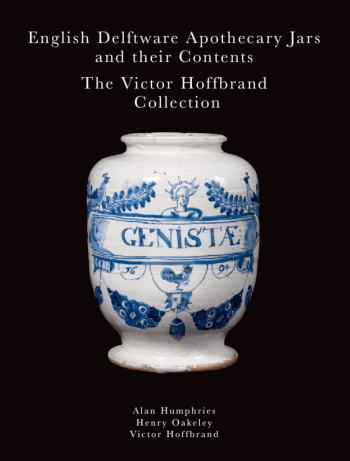 This collection of apothecary jars—used for storing medicines and their ingredients—comprises 183 items, dating from the 1640s to 1745. Collected by Professor Victor Hoffbrand, FRCP, it is the largest privately owned collection of English delftware apothecary jars in the United Kingdom. The fascination with English tin-glazed or delftware apothecary jars lies in their hand-painted designs and drug labels, in the composition and therapeutic uses of the drugs they contained, in the individual apothecaries who owned them, and in the potteries that manufactured them. The beauty of the jars’ designs may have helped to convince customers of the efficacy of their contents in treating and possibly curing diseases. For those interested in ceramics or the history of plant-based medicines, this sourcebook is complete with bibliographies, biographies, and glossaries of technical terms and materia medica.
Victor Hoffbrand is a professor of haematology. His collection of nearly 200 English delftware jars is now the second largest in the world and can be seen at the Royal College of Physicians in London.
Alan Humphries is a librarian at the Thackray Medical Museum in Leeds. He is responsible for the museum’s collections of over 10,000 books and 15,000 trade catalogues. To date he has located 2,419 English apothecary jars and has made their study his special interest.
Henry Oakeley is a garden fellow at the RCP. From contemporary pharmacopoeias, he has identified the 135 different medicines that the Hoffbrand apothecary jars contained and the plants (from Acorus to Zedoary), snakes, birds, and minerals that were used to manufacture those medicines.
◊ ◊ ◊ ◊ ◊
Book Launch: English Delftware Apothecary Jars
Royal College of Physicians, London, Thursday, 30 March 2017, 6:30–8:30
The evening begins with refreshments and a welcome by former RCP president Sir Richard Thompson. Short talks by Victor Hoffbrand, Alan Humphries, and Henry Oakeley will be followed by questions from the audience and a book signing. Copies of the book will be available to purchase (hardback £20, softback £12). Please RSVP to history@rcplondon.ac.uk by Friday, 24 March.










 Enfilade
leave a comment