Call for Papers | Jacques-François Blondel
From the appel à communications:
Jacques-François Blondel et l’enseignement de l’architecture
La dernière leçon de l’architecture « à la française »
Cité de l’architecture et du patrimoine, Paris, 14 December 2017
Proposals due by 31 March 2017

Gabriel de Saint-Aubin, Blondel démontrant des machines dans l’académie d’architecture, 1770, Recueil de poésies de Sedaine, 1770 (Chantilly, musée Condé).
La Cité de l’architecture et du patrimoine et la Ville de Metz se sont associées pour organiser une journée d’étude sur l’architecte Jacques-François Blondel (1708/9–1774). L’objectif de cette journée est d’interroger le rôle de cette gure majeure du siècle des Lumières dans l’enseignement de l’architecture. Cette rencontre annonce l’exposition monographique Blondel, architecte des Lumières, qui sera présentée à Metz en 2018, et l’exposition-dossier qui lui sera consacrée à la Cité de l’architecture et du patrimoine la même année.
Parmi les architectes ayant publié des traités ou des « cours » sur l’exercice de leur art, Jacques-Francois Blondel se distingue par la qualité de ses ouvrages. Auteur majeur de la théorie architecturale, ce collaborateur de l’Encyclopédie de Diderot et d’Alembert a su, au cœur des Lumières, redonner une actualité à l’architecture classique, en s’opposant à l’art rocaille qui domine alors. Pour J.-F. Blondel, l’architecture possède une dimension encyclopédique — elle mobilise à la fois les savoirs techniques et les di érents arts — mais aussi sociale. Les écrits de J.-F. Blondel sont par ailleurs indissociables de son action pédagogique : avec la fondation de son École des Arts (1740), qui se propose de centraliser la diversité des compétences, il opère une véritable révolution pédagogique. Cette révolution, le professeur la mène jusque dans les salles de l’Académie royale d’architecture, où il est agréé académicien en 1755, puis nommé professeur o ciel en 1762. Au cours de sa longue carrière, il a l’occasion de former plusieurs générations d’architectes français et étranger, ainsi que d’in uencer des artisans, des amateurs, des commanditaires, des hommes de lettres… En ce qui concerne la pratique, J.-F. Blondel est surtout connu pour avoir aménagé le secteur de la cathédrale de Metz. On ne saurait cependant ignorer ses projets, rééls ou pédagogiques, tels l’aménagement du centre de Strasbourg, ou ses propositions d’architecture religieuse inspirées par les structures du gothique, mais respectant le répertoire classique des formes.
Les propositions devront s’intégrer dans les thèmatiques suivantes :
1. Blondel et les institutions : de son école privée à l’école de l’Académie
Par la volonté du marquis de Marigny, directeur général des bâtiments du roi, J.-F. Blondel, après avoir fondé l’école privée d’architecture (1740), est appelé à poursuivre son enseignement dans les salles du Louvre (1762), secondé par son ancien élève, Julien-David Le Roy. Ce premier axe entend explorer la manière dont le système royal des beaux-arts fut mis en place et le rôle que J.-F. Blondel et d’autres personnages-clés, furent amenés à y jouer. Cette thématique voudrait également interroger les résultats de cette politique.
2. Enseigner l’architecture aux XVIIIe et XIXe siècles : de l’atelier à l’école de l’Académie, quelle fortune pour Jacques-François Blondel ?
Avant que J.-F. Blondel ne fonde l’École des Arts en 1740, chaque élève se formait à son futur métier en atelier, en agence, auprès de di érents professionnels (architecte, dessinateur, charpentier…). J.-F. Blondel révolutionne l’enseignement de l’architecture : il rassemble les cours dispensés par plusieurs professeurs dans de mêmes locaux. En 1747, lors de la réorganisation de son école, c’est encore J.-F. Blondel qui est sollicité pour enseigner l’architecture aux élèves de l’École des ponts et chaussées. Au-delà de cette méthode d’enseignement, comment les professeurs qui succèdent à J.-F. Blondel cherchent-ils à l’imiter ou à se démarquer de lui ? Quels liens ou ruptures peut-on établir avec l’enseignement dispensé au XIXe siècle, que ce soit à Paris ou ailleurs ?
La langue du colloque est de préférence le français. L’anglais est cependant accepté. Les propositions et les communications sont acceptées dans ces deux langues. Les propositions de communication sont à envoyer sous forme d’un résumé (entre 1500 et 2000 signes) accompa- gnées d’un titre et d’une notice biographique à l’adresse suivante : blondel@citechaillot.fr. Date limite d’envoi des propositions : 31 mars 2017 Les réponses seront communiquées début mai. La durée de chaque communication est de 20 mn. Les communications feront l’objet d’une captation video ; elles seront mises en ligne sur le site internet de la Ville de Metz et celui de la Cité de l’architecture et du patrimoine.
Comité scientifique
Présidence:
• Corinne Bélier, directrice du musée des Monuments français, Cité de l’architecture et du patrimoine
• Aurélien Davrius, maître-assistant à l’École nationale supérieure d’architecture de Paris-Malaquais
• Joseph Abram, professeur honoraire à l’École nationale supérieure d’architecture de Nancy
• Pierre Caye, directeur de recherche au CNRS
• Lorenzo Diez, directeur de l’École nationale supérieure d’architecture de Nancy
• Guillaume Fonkenell, conservateur du patrimoine, musée national de la Renaissance, Écouen
• Jean-Marc Hofman, attaché de conservation, Cité de l’architecture et du patrimoine
• Olga Medvedkova, directrice de recherche au CNRS
• Stéphanie Quantin, conservateur du patrimoine, Cité de l’architecture et du patrimoine
• Hélène Rousteau-Chambon, professeur d’histoire de l’art moderne, Université de Nantes
Exhibition | House Style: Five Centuries of Fashion at Chatsworth

Mario Testino, Stella Tennant (in Junya Watanabe) with Her Grandmother the Duchess of Devonshire (in Oscar de la Renta), from British Vogue (December 2006). © Mario Testino.
◊ ◊ ◊ ◊ ◊
Press release (via Art Daily):
House Style: Five Centuries of Fashion at Chatsworth
Chatsworth House, Derbyshire, 25 March — 22 October 2017
Curated by Hamish Bowles
In 2017 Chatsworth will present its most ambitious exhibition to date, exploring the history of fashion and adornment: House Style: Five Centuries of Fashion at Chatsworth. Hamish Bowles, International Editor-at-Large at American Vogue, will curate this landmark show with creative direction and design by Patrick Kinmonth and Antonio Monfreda, the duo behind some of the most memorable fashion exhibitions of recent years. House Style will give unprecedented insight into the depth of the Devonshire Collection and the lives of renowned style icons from Georgiana, Duchess of Devonshire to Stella Tennant.
 The exhibition will bring to life the captivating individuals from the Cavendish family, including Bess of Hardwick, one of the most powerful women of the 16th century; the 18th-century ‘Empress of Fashion’ Georgiana, Duchess of Devonshire; and Adele Astaire, the sister and dance partner of Fred Astaire. Deborah Devonshire and Nancy Mitford (two of the Mitford sisters), model Stella Tennant, and John F. Kennedy’s sister ‘Kick’ Kennedy will also be central to the show. Telling the rich history of both international style and the Devonshire Collection, the exhibition will demonstrate the power of fashion to illuminate these extraordinary characters.
House Style will be woven throughout one of Britain’s finest stately homes, including the largest and grandest room of the Baroque house, the Painted Hall, the Chapel, and the lavishly decorated State Music Room. Layering art history, fashion, jewellery, archival material, design, and textiles, the exhibition will be organised by theme, including Coronation Dress, The Devonshire House Ball, Bess of Hardwick and the Tudor influence, The Georgiana Effect, Ducal Style, Country Living, The Circle of Life, and Entertaining at Chatsworth.
Highlights of the exhibition will include exceptional couture designed by Jean Phillipe Worth and Christian Dior, together with influential contemporary garments from designers such as Gucci, Helmut Lang, Margiela, Vivienne Westwood, Erdem, Alexander McQueen, Christopher Kane, and Vetements. The show will also feature personal family collections, including items belonging to the current Duke and Duchess of Devonshire, such as a Givenchy bolero worn on the Duchess’s wedding day. These pieces will be displayed alongside livery, uniforms, coronation robes, and fancy-dress costumes, demonstrating the varying breadth of fashion and adornment from the collection throughout the generations.
Important artworks will also be on display, including rare costume designs from the 1660s by Inigo Jones, Surveyor to the King’s Works and one of the most notable architects of 17th-century England. Contemporary artist T. J. Wilcox will be showing his intimate filmed portrait of Adele Astaire, which contains the only extant film of the star, found at Chatsworth in 2015.
Hamish Bowles commented: “To be let loose in the wardrobe rooms, the gold vaults, the muniment room, and the closets, cupboards, and attics of Chatsworth, in search of sartorial treasures has been a dream come true for me. Chatsworth is a real treasure house and the characters of generations of Cavendish family members who have peopled its rooms and gardens and landscapes is revealed as vividly through their choice of clothing and adornments, as through the canvases and lenses of the great artists and photographers who have memorialised them through the centuries. In House Style, we hope to bring these compelling and fascinating people and the very different worlds they inhabited to life, through the clothes and the jewels that they wore.”
Alessandro Michele, Creative Director at Gucci, commented: “Chatsworth is unlike anywhere else in the world—a place full of charm, history, and rituals. It is a piece of England, of Europe, and the contemporary world, all at the same time. You can see history everywhere, yet everything is alive.
This exhibition proves how much historical objects are an incredible source of inspiration for creating the present. Thus far the house has been speaking, now House Style gives a voice to the wardrobes of its inhabitants and guests.”
Patrick Kinmonth commented: “The patina of Chatsworth House itself is one of the greatest treasures of the collections, and looking at the surfaces and materials of clothes worn over hundreds of years in these very rooms proves to be a novel way to rediscover both the house and the wonderful things in it. Clothes and personal objects (especially jewels), in turn bring ghosts and visions of remarkable characters to the surface of the place, and we hope to conjure the presence of these remarkable men and women who have animated, loved and created this unique ensemble of great art, furniture, and personal style in its many layers.”
Hamish Bowles, ed., House Style: Five Centuries of Fashion at Chatsworth (New York: Rizzoli, 2017), 192 pages, ISBN: 978 0847 858965, $45. With a foreword by the Duke of Devonshire, an introduction by the Countess of Burlington, and essays and texts by Hamish Bowles, Kimberly Chrisman-Campbell, Charlotte Mosley, Sarah Mower, Diana Scarisbrick, and Lady Sophia Topley.
Barograph Clock Acquired by London’s Science Museum
One of 2016’s notable acquisitions; press release (July 2016) from the Science Museum:
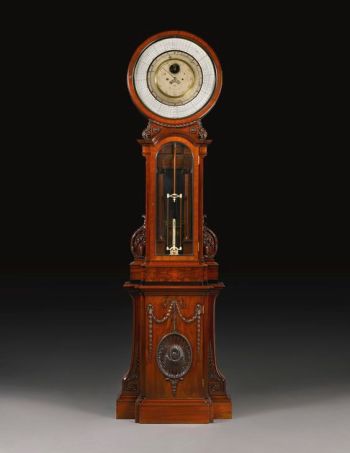
Alexander Cumming, George III Mahogany Longcase Barograph Regulator, London, 1766, with a case likely by Thomas Chippendale (London: Science Museum).
A rare Georgian clock, capable of recording changes in air pressure and used at the dawn of climate science, has been acquired for the nation by the Science Museum. The acquisition of this exceptional clock was made possible by a grant from Art Fund and was purchased through Sotheby’s. Dated 1766, the barograph clock is one of only four of its type that highly-regarded London clockmaker Alexander Cumming is known to have constructed. It was used by renowned meteorologist Luke Howard to conduct some of the world’s first urban climate studies.
Following Cumming’s death in 1814, Luke Howard purchased the clock and used it for observations of atmospheric pressure at his homes in London and Ackworth, a crucial project in the emergence of climate science. The data from the barograph traces, accompanied by notes on global weather events and descriptions of the clock, were published in the book Barometrographia in 1847. Howard’s life’s work has earned him the nickname ‘the father of scientific meteorology’.
Inside the imposing 7ft 2in-high decorated case, thought to be made by famed London cabinet maker Thomas Chippendale, is a barograph mechanism used for measuring air pressure. The barograph comprises two tubes of mercury in which a float rises and falls as atmospheric pressure changes. This data is recorded on the clock dial, which rotates once a year. A fine example of the technical innovations of the Georgian period, the clock was designed by Cumming using ideas first outlined by Royal Society founding member Robert Hooke. It has featured in previous exhibitions at the Science Museum as a loan and curators are now planning a permanent display.
Ian Blatchford, Director of the Science Museum Group, said of the acquisition “Nothing beats the marriage of an exquisite object and an enquiring mind. We are delighted to have been able to save the barograph clock so that we can share the story of Luke Howard’s contribution to climate science with future generations.”
During the Georgian period, scientific practice was often presented in public as a high-status activity expressed through ornately decorated and very finely constructed instruments such as this, and in fact the first barograph clock that Cumming constructed was commissioned by King George III as a prime example of his pursuit of Enlightenment.
New Book | The Jacobites and Their Drinking Glasses
Charles Edward Stuart (Bonnie Prince Charlie) was born on this day (31 December) in 1720; whether you harbor Jacobite sympathies or simply anticipate ringing in the new year with a toast, these glasses might provide some inspiration. Happy New Year! –CH
From ACC Distribution:
Geoffrey B. Seddon, The Jacobites and Their Drinking Glasses, third edition (Woodbridge: Antique Collectors Club, 2016), 208 pages, ISBN: 978-1851497959, £35 / $65.
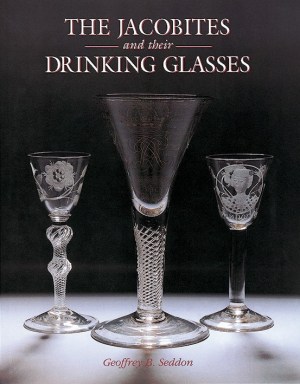 This book, first published in 1995, remains the most detailed study of Jacobite glass ever undertaken, and the glasses are described against the compelling history of the Jacobite movement in the 18th century. Hundreds of detailed photographs of the engravings help to authenticate the genuine glasses in a field well known to be infested with fakes. This third edition follows the same format as previous editions but is published in a more compact form, replete with an additional chapter.
The diamond point engraved ‘Amen’ glasses are, without question, the most valuable of all Jacobite glasses and indeed one of the most valuable of any of the 18th-century drinking glasses. Further studies have revealed that the ‘Amen’ glasses were engraved by the famous Scottish line engraver, Sir Robert Strange, and the evidence for this is provided in the final chapter.
Geoffrey B. Seddon, a retired medical practitioner, has been a member of the Glass Circle for over 40 years and has contributed papers to its publications and to Country Life magazine.
Exhibition | Enlightened Princesses
Press release (2 November 2016) for the exhibition:
Enlightened Princesses: Caroline, Augusta, Charlotte, and the Shaping of the Modern World
Yale Center for British Art, New Haven, 2 February — 30 April 2017
Kensington Palace, London, June 22–November 12, 2017
Curated by Joanna Marschner
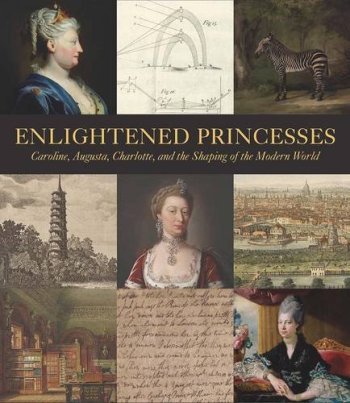 This exhibition will be the first to explore the instrumental roles played by Caroline of Ansbach (1683–1737), Augusta of Saxe-Gotha (1719–1772), and Charlotte of Mecklenberg-Strelitz (1744–1818) in the promotion of the arts, sciences, medicine, education, charity, trade, and industry in Britain over the course of the long eighteenth century. “The princesses had sweeping intellectual, social, cultural, and political interests, which helped to shape the courts in which they lived, and encouraged the era’s greatest philosophers, scientists, artists, and architects to develop important ideas that would guide ensuing generations. The palaces and royal gardens they inhabited served as incubators for enlightened conversation and experimentation, and functioned as platforms to project the latest cultural developments to an international audience. Their innovative contributions across disciplines held great signi cance centuries ago and continue to inform our lives,” said Amy Meyers, Director of the Yale Center for British Art, and organizing curator at the Center.
These three German princesses, who all married into the British royal family, played an important part in the shaping of their nation’s culture during a time of change that in its complexity and dynamism would presage our own age. “Until this point, their contributions have been little understood and it is the aim of this exhibition to demonstrate how they influenced the interests of their era in the most vibrant of ways and left a legacy that resonates in the world today,” said Joanna Marschner, Senior Curator at Historic Royal Palaces, and lead curator of this exhibition. Caroline and Charlotte became queens consort to George II and George III respectively, while Princess Augusta never achieved this distinction but held the titles of Princess of Wales and Princess Dowager, and was mother to King George III.
Nearly three hundred magnificent objects have been drawn together from numerous public and private collections from across Britain, Europe, and the United States, including the Royal Collection Trust; Royal Society; British Museum; National Portrait Gallery, London; and Smithsonian Institution, Washington, D.C., as well as Historic Royal Palaces and the Yale Center for British Art. The exhibition will feature works by the most influential artists of the period, such as Hans Holbein the Younger, Allan Ramsay, Mary Delany, George Stubbs, Thomas Gainsborough, Joshua Reynolds, and Johan Joseph Zoffany, as well as craftsmen such as Josiah Wedgwood and Matthew Boulton, and architects such as William Kent and William Chambers.
A rich variety of objects will offer a glimpse into the princesses’ private lives, their courts, and their legacy. The exhibition will bring together state portraits of the royal women, musical manuscripts, elaborate court costume, botanical and anatomical renderings, the Princesses’ own scientific instruments, architectural drawings and garden designs, royal children’s artwork, rare books and manuscripts, and much more. The display also will include a work created by the artist Yinka Shonibare MBE (RA), for this exhibition. It is inspired by the meeting, in 1753, between Princess Augusta and Mrs. Eliza Lucas Pinckney, the owner of a profitable slave plantation in South Carolina in the British colonies of North America. A letter written by Mrs. Pinckney to a friend, detailing the encounter, will be featured in the exhibition as a special loan from the collection of The National Society of The Colonial Dames of America in the State of South Carolina. The dress worn by Mrs. Pinckney on this occasion, made of silk produced on her plantation, will be lent to the Yale Center for British Art from the Smithsonian Institution.
E X H I B I T I O N T H E M E S
The exhibition will be organized according to five basic themes. Grand oil portraits by Joseph Highmore of Queen Caroline of Ansbach (ca. 1735), Allan Ramsay of Augusta, Dowager Princess of Wales (1769), and Johan Joseph Zoffany of Queen Charlotte (1771) will set the stage for the exhibition.
The Court as a Stage
In the world of the palaces, the royal court operated as a stage, not only in the literal sense for the performance of music, dance, and theater but also as a political and cultural arena in which the intricate power plays between and among monarch, consort, and courtier took place. In their furnishing of the spaces, Caroline, Augusta, and Charlotte constructed a visual statement of the authority of the Hanoverian dynasty–past, present, and future– under which the patronage of music and the arts would flourish. Yet at the same time they had to navigate the inherently political nature of public and private life (even family life) at court during a period that saw an information revolution, initiated by the mass circulation of newspapers, journals, and magazines providing commentary, debate, and critique. Art illustrative of this theme includes works by Hans Holbein the Younger, such as Lady Lister (ca. 1532–43), drawn together in celebration of the distinguished pedigree of royal ancestry, and displayed alongside images of the royal children, the future hope of the dynasty, represented by such works as a lively genre scene by Phillippe Mercier, ‘The Music Party’: Frederick, Prince of Wales with his Three Eldest Sisters (1733).
Cultures of Learning: Powerful Conversations
At the heart of their social circles, Caroline, Augusta, and Charlotte built relationships with leading cultural and intellectual figures of their age, including politicians, clergymen, natural philosophers, gardeners, architects, authors, playwrights, and composers. While each princess developed these connections in different ways and with different priorities, their interests often overlapped or had a common focus, such as in science, medicine, philanthropy, and especially maternity, the care of infants, and the commercial interests of the state in Britain and abroad. Their pursuits in this area are re ected in objects on display including an oil portrait by John Vanderbank of Sir Isaac Newton (1726); Thomas Gainsborough’s splendid grand manner portrait of his friend, the musician Carl Abel, later acquired by Queen Charlotte for whom he provided music; and Allan Ramsey’s beautifully nuanced portrait of Charlotte’s medical adviser, Dr. William Hunter.
Royal Women: Education, Charity, and Health
Attitudes regarding royal child-rearing changed rapidly over the lifetimes of Caroline, Augusta, and Charlotte. There were shifts in methodology and focus in response to the evolving contemporary philosophies about childhood, sentimentality, and the freedom of the individual. The princesses were active contributors to the educational programs devised for their children, the future promise for the dynasty, and sought to draw them into worlds outside the palace walls. In their public roles as encouragers and protectors, the princesses sought involvement with ambitious and wide-reaching public philanthropic projects, organizations, and societies, especially those connected with health and social welfare. A precious silk satin baby robe (1762) belonging to George, Prince of Wales (later George IV), the eldest child of George III and Queen Charlotte, compares poignantly with tokens left by unmarried and impoverished mothers as they consigned their children to the Foundling Hospital. The hospital was a charity supported by all three of the princesses, which reflected their concern for progressive social change.
Political Gardening
Caroline, Augusta, and Charlotte created and recast each other’s gardens, which were by turns political and social spaces, as well as private retreats. They drew in the products of empire; plants and animals were collected from many continents, not only for their beauty and rarity but also their economic value. Likewise, the development of the collections of animals and birds brought back from the exploration of these ‘new’ worlds were an important feature in the royal gardens. In the design of their gardens, the princesses explored contemporary garden philosophies and exercised their architectural ambitions. Many of their landscapes, which they invested with message, were made to
be shared, not just with the community of gardeners, philosophers, and scientists the princesses drew into their circle, but with a wider community of the middling sort, which allowed a new relationship between monarchy and subject to be brokered. The gardens served each princess well but each manifestation was different, reacting to a volatile commercial environment as well as a changing perception of the bonds between and among the dynasty, nationhood, and empire.
Over the course of the long eighteenth century these three royal women seized the opportunities of a dynamic age, and their determined and imaginative promotion of the arts, sciences, medicine, education, charity, trade, and industry, shaped not only society and politics of their own time but were the forbearers of much of the beliefs and policies that continue in modern British culture. A brilliant watercolor by Mark Catesby, The Painted Finch and the Loblolly Bay (ca. 1722–26), and an intricate cut-paper collage by Mary Delany, Cactus Grandi orus, melon thistle (1778), serve as evidence of the princesses’ interest in Britain’s widespread imperial range.
To Promote and Protect: The Princesses and the Wider World
In working to promote and encourage the arts and science, Caroline, Augusta, and Charlotte supported and championed national products and allowed their interest to be used by enterprising industrialists, which helped win hearts and minds for the new regime. The development of new industrial technologies enabled mass-produced consumer goods, ensuring for the first time the dissemination of the image of the British monarchy, in a way that today is recognized as a ‘brand’, for a domestic and international audience. In the furnishing of their homes and the development of their gardens, the princesses celebrated the fruits of empire. The first British incursions into the Americas began in the sixteenth century, burgeoned in the seventeenth century, and matured over the first half of the eighteenth century. Following the War of Independence, these efforts would be succeeded by increased colonial expansion (Caribbean, India, Africa, China, and Australasia). Masterpieces that reflect the imperatives of empire which helped to brand the character of the British monarchy internationally will include one of the Center’s treasured works, a painting by William Verelst, Audience Given by the Trustees of Georgia to a Delegation of Creek Indians (1734–35), and a painting by George Stubbs of a zebra belonging to Queen Charlotte (1763).
C R E D I T S A N D P U B L I C A T I O N
Enlightened Princesses: Caroline, Augusta, Charlotte, and the Shaping of the Modern World is a collaboration between Historic Royal Palaces and the Yale Center for British Art. Lead curator Joanna Marschner, Senior Curator at Historic Royal Palaces, is assisted by Samantha Howard, Curatorial Assistant. The organizing curator at the Center, Amy Meyers, Director, is assisted by Lisa Ford, Assistant Director of Research; Glenn Adamson, Senior Research Associate; and Tyler Griffith, Postdoctoral Research Associate. The exhibition will be accompanied by a publication of the same title, a beautifully illustrated catalogue of works edited by Joanna Marschner, with the assistance of David Bindman and Lisa Ford. Co-published with Historic Royal Palaces in association with Yale University Press, this book will feature contributions by an international team of scholars.
◊ ◊ ◊ ◊ ◊
The catalogue is scheduled for March publication from Yale UP:
Joanna Marschner, ed., with David Bindman and Lisa Ford, Enlightened Princesses: Caroline, Augusta, Charlotte, and the Shaping of the Modern World (New Haven: Yale Center for British Art, 2017), 592 pages, ISBN: 978 0300 217100, $85.
Caroline of Ansbach (1683–1737), Augusta of Saxe-Gotha (1719–1772), and Charlotte of Mecklenberg-Strelitz (1744–1818) were three German princesses who became Queens Consort—or, in the case of Augusta, Queen in Waiting, Regent, and Princess Dowager—of Great Britain, and were linked by their early years at European princely courts, their curiosity, aspirations, and an investment in Enlightenment thought. This sumptuously illustrated book considers the ways these powerful, intelligent women left enduring marks on British culture through a wide range of activities: the promotion of the court as a dynamic forum of the Hanoverian regime; the enrichment of the royal collection of art; the advancement of science and industry; and the creation of gardens and menageries. Objects included range from spectacular state portraits to pedagogical toys to plant and animal specimens, and reveal how the new and novel intermingled with the traditional.
Exhibition | 18th- and 19th-Century British Watercolours
Loan exhibition at the 2017 Works on Paper Fair:
18th- and 19th-Century British Watercolours from the Eton College Collections
Works on Paper Fair, Royal Geographical Society, London, 9–12 February 2017
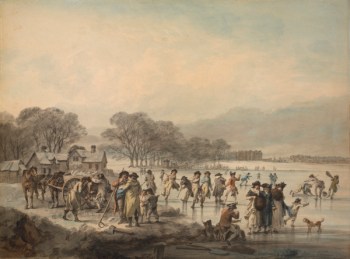
Julius Caesar Ibbotson, Skating on the Serpentine, exhibited at the Royal Academy in 1796, watercolour, pen and grey ink (Eton College Collections).
Eton College have kindly agreed to loan 38 watercolours from their impressive College Collection. This exceptional selection contains some of the finest works from the classic period of English watercolour painting that can be seen anywhere in Britain. It represents an opportunity to see watercolours which are rarely on view to the public, and shines a spotlight on the best collection of early watercolours to belong to any school in Britain. Some of the pictures have never been publicly displayed by the school before.
Most of the famous names are represented, and the selection includes work by Alexander and John Robert Cozens (Alexander taught drawing at Eton in the 1760s), Gainsborough, Francis Towne, Thomas Girtin, and J.M.W. Turner. The last is represented by a small watercolour of Chateau d’Arques, near Dieppe, which was published as an engraving in 1836, and a much earlier view from the mid-1790s of Skiddaw and Derwentwater in the Lake District, drawn before the artist visited the Lake District and very much in the manner of the influential Edward Dayes.
Other highlights include works by Edward Lear (The Forest of Valdoniello, Corsica), a large watercolour by Julius Caesar Ibbetson of figures skating (and falling over) on the Serpentine, exhibited at the Royal Academy in 1796 with the title Hyde Park—Winter, a Paul Sandby watercolour of Windsor Bridge (with animated figures and a runaway horse), and a large watercolour of Donnybrook Fair outside Dublin by Francis Wheatley dating from circa 1780 and packed with characterful figures, all drawn with the artist’s sublime skill, which belies the improvidence of his personal life.
Since the upsurge of enthusiasm for landscape drawing and watercolour painting in Britain during the final decades of the 18th century, Eton College has been associated with topographical artists and watercolourists. Views of the college from the River Thames, or of Windsor Castle from the Eton side of the river, soon became favourite subjects. Meanwhile Alexander Cozens rented rooms on the High Street in Eton, from where he offered drawing lessons to boys. These first unofficial art lessons, first led by Cozens and then from 1765 by Richard Cooper, began a tradition of professional artists being employed as Drawing Masters at the school, which continues today.
As the Eton College Drawing Schools developed, so too did the college’s collection of Fine & Decorative Art, which now includes some 1,500 drawings and watercolours. The college strives to make this rich resource available to a wide public and hence a selection will be lent for display at the Works on Paper Fair in February 2017. Although exhibitions drawn from the collection have been held at the Morgan Library & Museum, New York (1990); Christie’s, King Street, London (2003), and W.S Fine Art / Andrew Wyld, London (2010), and individual works are at times lent to public exhibitions, many of the works loaned to the fair will be exhibited in public for the first time.
At the core of Eton College’s collection of works on paper are the examples of leaving portraits, which show boys soon after leaving the school, executed in pastel, chalk and watercolour, rather than the more usual media of oil-on-canvas. To these, generous Old Etonian collectors have added impressive assemblages of drawings and watercolours and their donations reflect the particular expertise and passion of the individual benefactors. Alan Pilkington (1879–1973), who worked for his family company of glass manufacturers, started collecting watercolours in about 1920 and presented some 270 mainly 18th- and some 19th-century works in the 1960s and ‘70s. Martin Whiteley (1931–1984), who left Eton in 1948 and returned to become a House Master, began collecting in the 1950s and later gave or bequeathed over 40 works. These two considerable donations inspired others to follow suit. In addition, the college has commissioned or purchased Eton-related landscapes and portrait drawings and Drawing Masters have presented examples of their own work, further enhancing the collection.
New Book | Silver for Entertaining: The Ickworth Collection
From Philip Wilson:
James Rothwell, Silver for Entertaining: The Ickworth Collection (London: Philip Wilson Publishers, 2016), 304 pages, ISBN: 978 1781 300428, £50 / $90.
 This book is a comprehensive, well illustrated guide to one of the most important collections of 18th-century silver in Europe, extending to nearly a thousand individual pieces, being of the highest quality, style, and exuberance of form and surviving virtually intact along with extensive and previously untapped archival evidence of its commissioning and use. The book analyses the silver from stylistic and technical perspectives and uses it to shed light on the patronage, fashion, and diplomatic, political and social history of the period. It also casts new light on the Herveys, one of England’s most famous and eccentric aristocratic families.
James Rothwell studied art history at Warwick University and gained a master’s degree at the Courtauld Institute of Art. He has worked for the National Trust since 1995 and is the organisation’s adviser on silver, carrying out extensive research on the collections and guiding displays, interpretation, and acquisitions. He has published numerous articles on the subject and is the co-author of Country House Silver from Dunham Massey (2006). In collaboration with the Goldsmiths’ Company, he has overseen a ground-breaking series of exhibitions of works by contemporary silversmiths in National Trust houses.
New Book | Ceramics: 400 Years of British Collecting
From Philip Wilson:
Patricia Ferguson, Ceramics: 400 Years of British Collecting in 100 Masterpieces (London: Philip Wilson Publishers, 2016), 192 pages, ISBN: 978 1781 300435, £45 / $75.
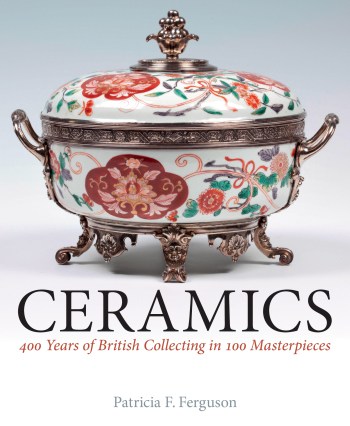 The aim of this publication is to introduce the rich and varied ceramics in the National Trust’s vast and encyclopaedic collection, numbering approximately 75,000 artefacts, housed in 250 historic properties in England, Wales, and Northern Ireland. One hundred key pieces have been selected from this rich treasure trove, each contributing to our knowledge of ceramic patronage and history, revealing the very personal stories of ownership, display, taste, and consumption. The selection includes the following Continental wares: ‘Red-figure’ wares, Italian armorial tablewares, Dutch Delft from the Greek A factory (owned by Adrianus Kocx), Chinese Kraak ware and Dehua ware, Japanese Kakiemon-style and Imari-style tablewares and garnitures, Meissen table sculpture by Johann Joachim Kandler and tablewares attributed to Adam Friedrich von Lowenfinck, along with Castelli fayence from the Grue workshop. There are wares from the following porcelain manufactories: Doccia, Vienna, Vincennes, Sevres, Dihl, and Feulliet. English pottery and porcelain includes delftware, salt-glazed stoneware, creamware, Wedgwood Black Basalt and Etruscan ware, Chelsea, Bow, Worcester and Derby porcelain, Minton China, De Morgan, and Martin ware. And from the Americas, Pueblo ware. Many pieces are published for the first time, sometimes illustrated in their original interiors. Collectively, the selection surveys patterns of ceramic collecting by the British aristocracy and gentry over a four-hundred-year period.
Patricia F. Ferguson is an external adviser on ceramics to The National Trust, having researched their collections since 2003, and is a consulting curator at the Victoria & Albert Museum, London. She has an MA from SOAS, University of London, where she studied Chinese, Japanese, and Safavid ceramics. At the George R. Gardiner Museum of Ceramic Art in Toronto, she re-displayed the European galleries, curated Containers of Beauty: The Art of Floral Display and Your Presence Is Requested: The Art of Dining in Eighteenth-Century Europe, and was author of Cobalt Treasures: The Robert Murray Bell and Ann Walker Bell Collection of Chinese Blue and White Porcelain (2003).
MFA, Boston Displays Newly Acquired Altarpiece by Benjamin West
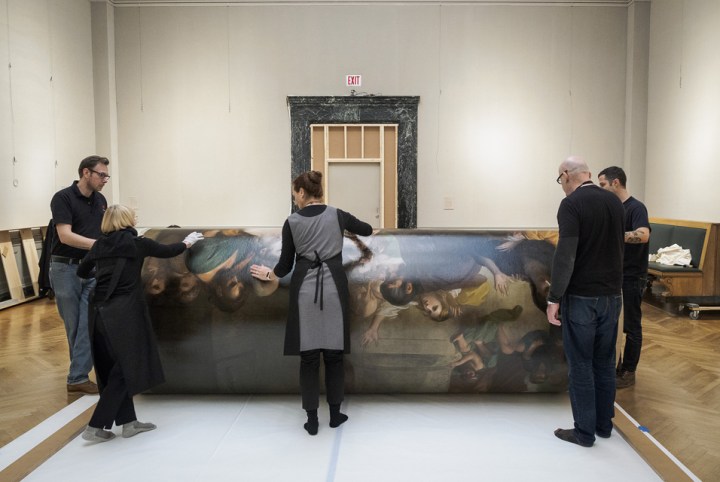
MFA staff members install Benjamin West’s large painting Devout Men Taking the Body of Saint Stephen (1776) in the Ruth and Carl J. Shapiro Gallery. Fidelity Investments chairman Edward ‘Ned’ Johnson III acquired the painting in 2014 for $2.9million from St. Stephen Walbrook (the export license was issued in March of that year). He donated it, anonymously, to the MFA in 2015 in honor of Malcolm Rogers to celebrate the museum director’s twenty years of leadership. Details and more on Johnson’s collections are available from Beth Healy’s article, “The Quiet Man of Boston’s Art Scene,” in The Boston Globe (22 August 2015).
◊ ◊ ◊ ◊ ◊
From the Museum of Fine Arts, Boston (via Art Daily), and good timing: it’s St Stephen’s Day! . . .
The recently acquired Devout Men Taking the Body of Saint Stephen (1776) by Benjamin West (1738–1820) is one of the largest paintings in the MFA’s collection—together with its towering frame, it measures more than 18 1/2 feet tall. Over the past two years, the monumental altarpiece was treated in the Conservation in Action studio, where Museum visitors were able to witness the gradual process of cleaning and restoring the work. The painting and its original gilded wood frame, which was also conserved, are now reunited as the dramatic centerpiece of a new installation that explores how 18th-century artworks and artists traveled across both intellectual and geographical borders.

Thomas Malton (1748–1804), St Stephen Walbrook, London, watercolour over pencil, 26 × 18 inches (London: Lowell Libson LTD). West’s painting is visible at the altar.
West was the first American-born painter to study abroad, second president of the Royal Academy of Arts, and painter to the English king. Devout Men Taking Away the Body of Saint Stephen, among the largest works he ever produced, was commissioned for London’s St. Stephen’s Walbrook, a church designed by Christopher Wren, and showcases West’s profound understanding of Italian Renaissance art. Italy likewise held special allure for well-to-do travelers on the Grand Tour, such as the American couple in John Singleton Copley’s portrait of Mr. and Mrs. Ralph Izard (1775), painted in Rome. Meanwhile, Italian painters ventured abroad as well—the gallery includes Canaletto’s Bacino di San Marco, Venice (about 1738), a trademark view of his home city, and Capriccio: A Sluice on a River with a Chapel (1754), painted in England, where he spent nine years catering to an enthusiastic clientele. Adding to the rich mix of works by American, English, and Italian painters are sculpture and decorative arts by French and German artists.
The 18th century was a cosmopolitan age. Artists and patrons traveled widely: in pursuit of artistic training or opportunity, political service, or social refinement. And as people moved, so too did ideas, styles, and tastes, in art and beyond. Across Europe (and America), Italy held special allure: artists traveled there to absorb its millennia of artistic traditions, as did well-heeled visitors on the Grand Tour. The fashion for Italian art was especially strong in England, where American-born painter Benjamin West created this towering altarpiece, influenced by his study of Renaissance masters Titian and Raphael. Italian artists also often ventured abroad. Canaletto, famous for his view paintings of his home city of Venice, spent nearly a decade in England, catering to an enthusiastic clientele.
Exhibition | Wooden Sculptures, Busts, Reliquaries, and Shrines
Now on view at Pinacoteca Giovanni Züst:
Sculptures, Busts, Reliquaries, and Shrines from the Middle Ages to the Eighteenth Century
Legni Preziosi: Sculture, Busti, Reliquiari e Tabernacoli dal Medioevo al Settecento
Pinacoteca Giovanni Züst, Rancate, Switzerland, 16 October 2016 — 22 January 2017
Curated by Edoardo Villata
 La mostra presenta una carrellata di sculture in legno dal XII al XVIII secolo— Madonne, Crocifissi, Compianti, busti, polittici scolpiti e persino un Presepe—provenienti da musei, chiese e monasteri del territorio ticinese, dove questi autentici capolavori sono stati oggetto di devozione e ammirazione per secoli. L’allestimento è stato curato da Mario Botta, che ha studiato, a titolo completamente gratuito, ogni dettaglio, affinché il visitatore sia immerso in un’atmosfera suggestiva e solenne, in cui la sacralità delle immagini esposte risulta pienamente valorizzata.
Edoardo Villata, Legni Preziosi: Sculture, busti, reliquiari e tabernacoli dal Medioevo al Settecento nel Cantone Ticino (Milan: Silvana, 2016), 208 pages, ISBN: 978 8836 634767, $55.










 Enfilade
leave a comment