Sculpture from Tomasso Brothers on View in New York

Massimiliano Soldani-Benzi, Ganymede and the Eagle,
ca. 1714, bronze, 31.5cm high, 38.5cm wide.
◊ ◊ ◊ ◊ ◊
Important European Sculpture from Tomasso Brothers Fine Art
Carlton Hobbs LLC, New York, 19–28 January 2017
Tomasso Brothers Fine Art returns to Manhattan soon after their participation in the inaugural TEFAF New York Fall to present their now well-established and much-anticipated annual catalogued exhibition of Important European Sculpture, at Carlton Hobbs LLC on the Upper East Side from 19th to 28th January 2017. The gallery will bring together examples of the finest antique sculptural works in terracotta, marble, and bronze—many of them rarities and new discoveries—from the Renaissance to the Neoclassical periods. Highlights include a pair of terracotta relief panels depicting Bacchanalian scenes from Pompeii created by the great English sculptor John Bacon the Elder, circa 1770; a rare bronze mythological group by Massimiliano Soldani-Benzi; a newly-discovered portrait bust by the prominent Roman Neoclassical sculptor Domenico Cardelli; and a superb and previously unpublished bronze by Gian Francesco Susini of The Borghese Satyr.

John Bacon the Elder, A Female Centaur with a Bacchante and A Male Centaur with a Bacchante, circa 1770, after Roman frescoes discovered in the Villa of Cicero at Pompeii (Naples), 1st century BC – 1st century AD, terracotta, each 34cm diameter.
A series of frescoes were uncovered at the so-called Villa of Cicero at Pompeii in January 1749 illustrating, among other subjects, the revelries of Centaurs and Bacchantes, followers of the god Bacchus. Josiah Wedgwood (1730–1795) had access to the Pompeiian models through the Marquess of Lansdowne (1737–1805). It would seem Wedgwood had the present terracotta roundels faithfully produced after the ancient prototypes around 1770 by John Bacon the Elder, one of the most prominent English sculptors of the period, who collaborated on a number of other occasions with Wedgwood. Highly finished, the roundels are the models from which Wedgwood’s white stoneware and black basalt versions of the Centaur reliefs were derived. They display a confident handling of anatomies and a sense of movement that fully does justice to the lithe dynamism of the original Pompeiian frescoes. The roundels constitute a rare and beautiful example of the early resonance of Pompeii’s influence. Formerly in the collection of Dr. Terry Friedman (b. Terence Friedman in Detroit, Michigan), a leading art historian and authority on 18th-century architecture, keeper of decorative arts at Temple Newsam historic house (1969–93), and later principal keeper at Leeds City Art Gallery.
Another mythological subject, Ganymede and the Eagle, circa 1714, by Massimiliano Soldani-Benzi (1656–1740) is a wonderful example of the dramatic and pictorial style of Soldani’s compositions and a rare model by the artist. The only other known version is held by the Fitzwilliam Museum, Cambridge. Soldani-Benzi became the finest bronze caster in late 17th- and early 18th-century Europe and, along with Giovanni Battista Foggini, is considered the most significant proponent of the Florentine late Baroque style in sculpture. In 1682 Soldani-Benzi became Director of the Grand-Ducal Mint, and his large workshop in the Galleria degli Uffizi enjoyed the patronage of kings, princes, and dukes. The present work is probably one of the four bronzes ordered by the Earl of Burlington (1694–1753) after seeing terracotta models at Soldani’s studio on his Grand Tour.
A rediscovered portrait bust by Domenico Cardelli (1767–1797) of Prince Francis Xavier of Saxony (1730–1806) is a highlight among works in marble to be presented. Cardelli displayed remarkable talent from a young age, enjoying early patronage from members of the Polish court and Grand Tourists in Rome. By 1793 his work was compared to that of Canova by the art historian Georg Zoega. In 1797 Cardelli was summoned to Naples to complete a commission for the Riario-Sforza family but fell gravely ill during the journey and died, at only 30 years of age. This untimely death shortened a most brilliant career and makes the present marble portrait bust—a recent rediscovery by Tomasso Brothers Fine Art—a major addition to Cardelli’s oeuvre.
An unpublished and newly-discovered bronze statuette of The Borghese Satyr by Gian Francesco Susini (1585–1653) is a beautifully finished reduction of one of the most impressive and admired ancient marble statues in the Borghese Collection, Rome—currently displayed in the Entrance Hall of the Villa Borghese. The statuette, immaculately modelled after its ancient prototype, displays the characteristic traits of Susini’s oeuvre. These include the remarkably high and detailed quality of the casting, the silky-smooth polished texture of the surface, the use of a warm cherry red lacquer, and the size of the bronze.
Works to be offered at the exhibition range in price from $50,000 to $1,500,000 US, and a fully-illustrated catalogue will be available.
Fellowships | The Rijksmuseum, 2017–18
Fellowship Programme
The Rijksmuseum, Amsterdam, 2017–18
Applications due by 12 March 2017
The Rijksmuseum operates a research Fellowship Programme for outstanding candidates working on the art and history of the Low Countries whose principal concern is object-based research. The aim of the programme is to train a new generation of museum professionals: inquisitive object-based specialists who will further develop understanding of art and history for the future. The focus of research should relate to the Rijksmuseum’s collection and may encompass any of its varied holdings, including Netherlandish paintings, sculpture, decorative arts, prints, drawings, photography, and historical artefacts. The purpose of the programme is to enable applicants to base part of their research at the Rijksmuseum, to strengthen the bonds between the universities and the Rijksmuseum, and to encourage the understanding of Netherlandish art and history. The programme offers students and academic scholars access to the museum’s collections, library, conservation laboratories and curatorial expertise.
Please review the eligibility, funding and application requirements by visiting the Rijksmuseum website. For the 2017–2018 academic year, candidates can apply for
• Andrew W. Mellon Fellowship for art historical research
• Johan Huizinga Fellowship for historical research
• Migelien Gerritzen Fellowship for conservation research
• Manfred & Hanna Heiting Fellowship for photo-historical research
• Dr. Anton C.R. Dreesmann Fellowship for art historical research
The closing date for all applications is 12 March 2017, at 6:00pm (Amsterdam time/CET). No applications will be accepted after this deadline. All applications must be submitted online and in English. Applications or related materials delivered via email, postal mail, or in person will not be accepted. Selection will be made by an international committee in April 2017. The committee consists of eminent scholars in the relevant fields of study from European universities and institutions and members of the curatorial staff of the Rijksmuseum. Applicants will be notified by 1 May 2017. All Fellowships will start in September 2017. Further information and application forms are available here.
Early Career Fellowships | Göttingen Institute for Advanced Study
Early Career Fellowships
The Lichtenberg-Kolleg, the Göttingen Institute for Advanced Study, October 2017 — July 2019
The Lichtenberg-Kolleg, the Göttingen Institute for Advanced Study in the Humanities and Social Sciences, invites applications for up to 10 Early Career Fellowships. For the period October 2017 to July 2019, we are inviting early career scholars to join one of the research groups for the study of
• Globalising the Enlightenment: Knowledge, Culture, Travel, Exchange, and Collections
• Human Rights, Constitutional Politics, and Religious Diversity
• Moritz Stern Fellowships in Modern Jewish Studies: Cultural, Intellectual, and Literary History (in cooperation with the Göttingen Academy of Sciences and Humanities)
Please find more information here.
Call for Papers | Beyond Reproductive Printmaking, 1500–1810
From H-ArtHist:
Beyond Reproductive Printmaking: Prints and the Canon of European Painting, ca. 1500–1810
Diesseits und jenseits von Reproduktion: Druckgrafik und der Kanon der europäischen Malerei
Kupferstich-Kabinett, Staatliche Kunstsammlungen Dresden, 18–19 September 2017
Proposals due by 15 February 2017
Conference for Ph.D. students, postgraduates and researchers at museums and universities in the Kupferstich-Kabinett (Museum of Prints, Drawings and Photographs) of the Staatliche Kunstsammlungen Dresden (Dresden State Art Collections) in collaboration with the TU Dresden Institute of Art and Music, Dresden, 18–19 September 2017.
Are paintings reproduced because they are famous, or have they become famous because they have been reproduced over and over again in the past centuries? The aim of this conference is to throw light on the status of reproductive prints in the process of the formation of (an) artistic canon(s). It aims at exploring artistic and technical aspects of the creative and innovative making process, including the printmakers’ ability to translate the original work into a new pictorial language and to the history of both reception and transmission of works of art.
The conference will cover the period running from the early 16th century to the introduction of the first lithographic press in the early 19th century. Geographically, the focus is on Europe. No restrictions are imposed concerning printing techniques—on the contrary, the characteristics of each technique as well as its ability and uses for reproducing original paintings constitute an important topic. We invite submissions of papers drawing from current research on specific prints or series of prints as well as on new theoretical approaches and methodologically promising developments in the study of interpretative prints, also exploring their potential as a source and as a subject matter of art history.
In particular we welcome submissions in (but not limited to) the following areas:
• Yet again: The original and its graphic interpretation(s): How are collaboration and competition amongst the printmakers themselves, and between the engravers and the painters represented in the prints? To what extent did the engravers take liberties with the paintings’ details? Did printmakers even perhaps hide critical or satirical messages in their interpretations?
• Questions of style: How is the painterly style of the original expressed in the graphic medium? What is the relationship between the printmaker’s technique and the pictorial style or the genre of the original? Is there experimental ground for innovations in new printmaking techniques? What role do special printmaking techniques—e.g. outline etching, aquatint, or colour(ed) print—play in the processes of translation and interpretation?
• Reception: How were differences in style and in composition between the original and its reproduction perceived by the contemporary viewer? Is it possible to identify links between prints and theoretical writings on certain paintings or painting in general? Which influence do captions have in the process of reception?
• Reproductive prints as a source for new approaches in scholarship: What potential do reproductive prints have as a source for the study of canon formation and for (art) historical network research? How can the pictorial and textual information contained in those prints be gathered, and how can this be made accessible for practical use?
An important objective of the conference is to encourage networking between academic researchers and museum professionals. Proposals by both doctoral candidates in art history and aesthetics as well as students aiming at a Ph.D. in the field of the graphic arts are welcome. We also invite applications from curators and postgraduate researchers at museums and other research institutions, and we are pleased to receive papers from colleagues working in media studies, philosophy, and history.
Please submit your proposal in the form of a 400-word abstract and a short CV and send it in English or German as a PDF file to beyond-reproduction-2017@gmx.de by 15 February 2017. Please indicate in your proposal those prints that you wish to discuss in the original; we will be happy to check if they are available in the Kupferstich-Kabinett.
Exhibition | Lafayette and the Antislavery Movement
Now on view at The Grolier Club:
‘A True Friend of the Cause’: Lafayette and the Antislavery Movement
The Grolier Club, New York, 7 December 2016 — 4 February 2017
Curated by Olga Anna Duhl and Diane Windham Shaw
 Although the Marquis de Lafayette is popularly known as ‘America’s Favorite Fighting Frenchman’ in the current Broadway musical Hamilton, his role as an ardent abolitionist has not received the same kind of attention as his contributions to the American Revolution. The groundbreaking exhibition A True Friend of the Cause: Lafayette and the Antislavery Movement, on view at the Grolier Club from December 7, 2016 to February 4, 2017, is designed to offer a more comprehensive look at the man who was a ‘hero of two worlds’. While Lafayette’s contributions in the areas of politics, diplomacy, and the military have received renewed scholarly and public recognition, his abolitionist activities are not widely known, nor have they been adequately explored in any major exhibition or publication in the last twenty-five years. This exhibition brings into focus Lafayette’s sustained efforts in France, the United States, and South America on behalf of the abolition of slavery.
Co-curators Olga Anna Duhl, Oliver Edwin Williams Professor of Languages, and Diane Windham Shaw, Director of Special Collections and College Archivist, Skillman Library, Lafayette College, offer a comprehensive view of Lafayette’s activities. Drawn from Lafayette College’s rich collections of 18th- and 19th-century rare books, manuscripts, paintings, prints, and objects—some of which are on public view for the first time—the approximately 130 works in the exhibition also include loans from Cornell University and the New-York Historical Society.
The Marquis de Lafayette (1757–1834) fought in the American War of Independence; was a friend to the Native Americans; defended the rights of French Protestants and Jews during the French Revolution; supported the national emancipation movements of the people of Poland, Ireland, Italy, Greece, and South America; and promoted the ideas and causes of women. Most significantly, he remained throughout his life a fervent advocate of the abolition of slavery and the African slave trade, earning the recognition of prominent British abolitionist, Thomas Clarkson, as “a true friend of the cause.” Early on, Lafayette learned that the ideals of liberty and equality during the revolutionary era hardly benefited all members of society. In fact, one of the most daunting paradoxes of that era, which became a source of reflection and action for him, was the incompatibility between the national independence of the newly formed United States and the practice of slavery and slave trade.
The exhibition traces Lafayette’s first encounters with slaves on the South Carolina coast upon his arrival in America in 1777. Highlights of his role in service with the Continental Army are revealed in his letters to his mentor, George Washington, written from Valley Forge, Newport, and Virginia during the Yorktown Campaign, where Lafayette writes of the intelligence gathered by one of his spies, James, an enslaved African American. On view is a highly significant letter written by Lafayette to Washington requesting his partnership in a venture to free slaves. Stunning French prints of the American Revolution are included, as is an influential portrait, Lafayette at Yorktown, by Jean-Baptiste Le Paon.
The impact of abolitionist ideas on Lafayette is represented by the Marquis de Condorcet’s seminal work of 1781, Réflexions sur l’esclavage des nègres, and writings of British abolitionists Thomas Clarkson and Granville Sharp. Lafayette’s decision to move forward on his own by purchasing property in French Guiana to carry out his experiment in gradual emancipation is documented by an extraordinary group of documents on loan from the Cornell University Library. Included among them is a list of the enslaved who were selected to work on the property. Maps, prints, and early travel volumes recreate the image of this South American colony.
Lafayette’s complicated story during the French Revolution includes his membership in the French Society of the Friends of Blacks. Publications of the Society are on view, as are printed versions of landmark French documents— the Declaration of the Rights of Man (1789), the French Constitution (1791), and the decree abolishing slavery in the French colonies (1794). Lafayette’s hasty departure from France in 1792 to avoid the guillotine is documented by the beautiful sword that was taken from him when he was arrested and imprisoned by the Austrians, which stands as a symbol of his personal experience with captivity. Lafayette’s return to a quiet life in France in 1800 found him still passionately committed to the antislavery movement, rejoicing when England outlawed the slave trade in 1807. Commemorative volumes and prints celebrate that milestone.
Lafayette’s last visit to America in 1824–25 was an extravagant moment in the nation’s history. The exhibition includes some of the spectacular souvenirs that were made to commemorate his visit—china, textiles, and even a clothes brush with the bristles dyed to spell “Lafayette 1825.” Lafayette’s emphasis on greeting all Americans is highlighted, including his visit to the African Free School in New York City, where he received a welcome address by an eleven-year-old student. Calligraphed and delivered by the student himself, James McCune Smith, who went on to become one of America’s first black physicians and a noted abolitionist, this text is a loan from the New-York Historical Society Library. The Farewell Tour section also documents Lafayette’s friendship with fellow antislavery advocate, Frances Wright, and his support of her gradual emancipation project “Nashoba” near Memphis, Tennessee.
Also included are letters from James Madison, Thomas Jefferson, and John Marshall, and letters from Lafayette to Albert Gallatin, William H. Crawford, Joel Poincett, and others. Even after his death in 1834, his influence continued, particularly in America, where abolitionists, both black and white, continued to cite his example. Finally, the exhibit includes special items chosen to remind us of the human face of slavery—manumission papers of a woman and a man freed by their Quaker owners; the pension records of an African American Revolutionary soldier from Connecticut; and the first American printing of the Brooks engraving of slaves tightly packed on board a slave ship. Despite the changing fortunes and conflicting reviews of his career, Lafayette has remained a compelling figure in world history, and the interest in his contributions shows no sign of diminishing.
Lunchtime Guided Tours with the Curators
December 7 and 14, January 11 and 18, and February 1, 1–2pm
Roundtable Discussion: Lafayette and the Antislavery Movement
24 January 2017, 2–3:30pm
With co-curators and moderators Olga Anna Duhl and Diane Windham Shaw and featuring panelists Laura Auricchio (The New School), François Furstenberg (Johns Hopkins University), and John Stauffer (Harvard University). Reception to follow.
◊ ◊ ◊ ◊ ◊
The catalogue is available from Oak Knoll Press:
Olga Ann Duhl and Diane Windham Shaw, ‘A True Friend of the Cause’: Lafayette and the Antislavery Movement (New York: The Grolier Club and Lafayette College, 2016), 76 pages, ISBN: 978 160583 0650, $40.
Call for Papers | The Art of Revolutions
From H-ArtHist:
The Art of Revolutions
Philadelphia, 19–21 October 2017
Proposals due by 15 March 2017
The tumult and transformations resulting from the Age of Revolutions (1770s–1840s) created a trans-Atlantic body of art and material culture that reflected and inspired new ideas and actions. Inspired by the American Philosophical Society’s 2017 exhibition on the legacy of the patriot portraitist Charles Willson Peale and his artistic family from the eighteenth century until the middle of the nineteenth, and the Philadelphia Museum of Art (PMA)’s forthcoming publication of The Art of the Peales: Adaptations and Innovations, along with a series of other Peale-centric events happening in Philadelphia, the APS and PMA will co-sponsor a scholarly conference, 19–21 October 2017, that explores the role of imagery in influencing and giving meaning to the political revolutions that defined the late eighteenth and early nineteenth centuries. The conference is especially interested in papers covering the American Revolution, the French Revolution, the Circum-Caribbean Revolutions, and the Revolutions of 1848.
Potential topics include
• the work of individual artists or artistic movements
• the role and influence of those who reproduced artwork for the public, such as printers or engravers
• the ways in which works were received by audiences
• the function of art in shaping public perceptions both at the time of revolutionary events and through historic memory
We hope the chronological scope and transatlantic breadth of the conference will stimulate an interdisciplinary dialogue that crosses traditional geographic barriers and transcends the limitations of strict periodization.
Applicants should submit a title and 250-word proposal along with a CV by March 15, 2017 to conferences@amphilsoc.org. Decisions will be made by the summer of 2017. All presenters will receive travel subsidies and hotel accommodations. Accepted papers will be due a month before the conference and pre-circulated to registered attendees. Papers should be no longer than 15-double spaced pages. Presenters may also have the opportunity to publish revised papers in the APS’s Proceedings, one of the longest running scholarly journals in America.
Exhibition | Curious Revolutionaries: The Peales of Philadelphia
From APS:
Curious Revolutionaries: The Peales of Philadelphia
American Philosophical Society, Philadelphia, 7 April — 30 December 2017

Charles Willson Peale, Self Portrait as a Revolutionary War Captain in the Philadelphia Brigade, 1777–78 (Philadelphia: American Philosophical Society).
The Peales were an extraordinary early American family, curious in every sense of the word. They were patriots, soldiers, politicians, inventors, explorers, naturalists, entrepreneurs, and world-class, ever busy tinkerers. Above all, the Peales embraced the Enlightenment ideal to expand man’s universal knowledge while improving life on earth.
Charles Willson Peale (1741–1827) and his brother James Peale (1749–1831) began as portrait-painters and miniaturists on the eve of the Revolution. In 1786, Charles Willson converted his portrait studio into the nation’s first successful public museum, housed in the American Philosophical Society from 1794 to 1810. By educating the American public and increasing man’s understanding of the natural world, he believed his museum would cultivate a more enlightened citizenry and advance America’s prestige around the world. The second and third generations of aptly named Peales—most notably Rembrandt, Rubens, Benjamin Franklin, and Titian Ramsay—continued the family business as significant artists, naturalists, and inventors.
Curious Revolutionaries is divided into three major thematic sections: Nationhood, The Philadelphia Museum, and The Peale Family Legacy. The exhibition draws on the APS Library and Museum holdings relating to the Peale family. These include the Library’s Peale-Sellers Family Collection of 19 linear feet, comprising some 38 boxes and 147 volumes of archival materials relating to the family. The exhibition showcases letters and diaries, as well as sketchbooks, painting palettes, hollow-cut silhouettes, and watercolors. The exhibition also features pieces from the APS Museum collections, including oil portraits of early American scientists such as David Rittenhouse; painted miniatures of Peale family members; and patent models, including miniature fireplace designs by Peale and his sons.
On view from April to December 2017, Curious Revolutionaries reveals the Peale family’s role in shaping early American public culture through innovations in art, science, and technology. Through their quest for personal prestige, as well as their commitment to advancing the new American republic, the Peales became influential members of Philadelphia’s artistic, intellectual, and political communities.
Exhibition | Gathering Voices: Thomas Jefferson and Native America
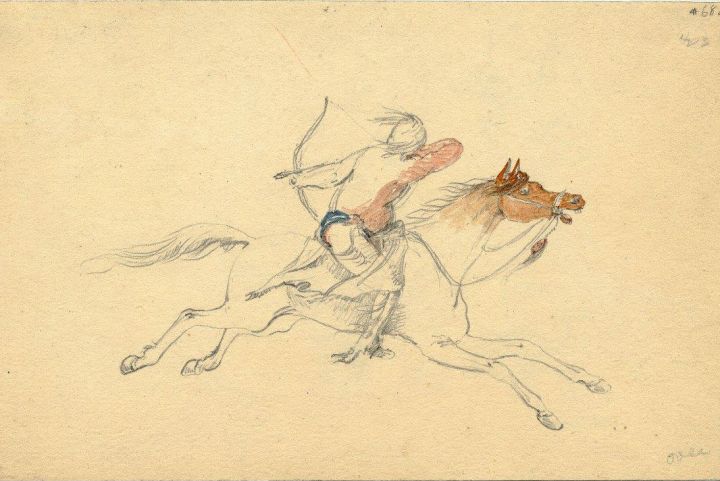
Titian Ramsay Peale, Indian on Horseback, 1820, pencil and watercolor on paper
(Philadelphia: American Philosophical Society).
◊ ◊ ◊ ◊ ◊
Closing this month at APS:
Gathering Voices: Thomas Jefferson and Native America
American Philosophical Society, Philadelphia, 15 April — 30 December 2016
Thomas Jefferson was president of the American Philosophical Society from 1797 to 1814—before, during, and after he was President of the United States—and the Society was one of Jefferson’s primary ties to Philadelphia even after he left for Washington. As the site of Charles Willson Peale’s famed natural history museum, for which Jefferson served as chairman of the first Board of Visitors, the American Philosophical Society Museum provides an ideal venue for a series of exhibitions about Jefferson. This tripartite exhibition series—exploring Jefferson as a statesman, as a promoter of science and exploration, and as a student of Native America and indigenous languages—adds not only to our historical understanding of Jefferson’s accomplishments but also demonstrates how his multifaceted legacy continues to be relevant today.
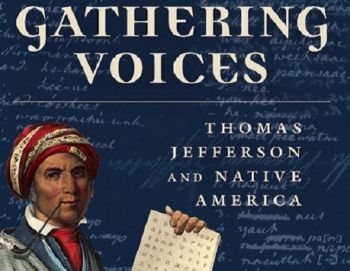 The last of three exhibitions, Gathering Voices, tells the story of Jefferson’s effort to collect Native American languages and its legacy at the Society. Jefferson had an abiding interest in Native American culture and language, while, at the same time, supporting national policies that ultimately threatened the survival of Indigenous peoples. As president of the APS from 1797 to 1814, Jefferson charged the Society with collecting vocabularies and artifacts from Native American nations. Over the next two hundred years, the APS would become a major repository for linguistic, ethnographic, and anthropological research on Native American cultures.
Gathering Voices traces the Native American language collection at the APS from Jefferson’s vocabularies to the current language revitalization projects at the Society’s Center for Native American and Indigenous Research (CNAIR). Audio stations will allow visitors to hear Native American voices from the past speaking their own languages, and interactive touchscreens will reveal the dramatic extent of Native American language loss as well as the active tribal revitalization efforts underway in collaboration with CNAIR.
“I … would with all possible pleasure have communicated to you any part or the whole of the Indian
vocabularies which I had collected, but an irreparable misfortune has deprived me of them.”
—Letter from Thomas Jefferson to Benjamin Smith Barton, 21 September 1809
When Thomas Jefferson left Washington after two terms as President of the United States, he packed 50 Native American vocabulary lists in a trunk and sent them on a river barge back to Monticello along with the rest of his possessions. Somewhere along the journey, a thief stole the heavy trunk, thinking it was full of treasure. Upon discovering it was only filled with papers, he tossed the seemingly worthless contents into the James River.
The loss of the vocabularies represented the destruction of 30 years of collecting on Jefferson’s part. Only a few precious fragments were rescued from the muddy banks along the shore. Those fragments, along with Jefferson’s original letter to Barton describing the theft, are on view in the exhibition Gathering Voices: Thomas Jefferson and Native America.
Exhibition Advisors
Dr. Margaret M. Bruchac (Abenaki) is an Assistant Professor of Anthropology, Associate Professor in the Penn Cultural Heritage Center, and Coordinator of the Native American & Indigenous Studies Initiative at the University of Pennsylvania. She directs two restorative research projects—“On the Wampum Trail” and “The Speck Connection”—that endeavor to reconnect objects and data in museums and archives with Indigenous communities and traditions. Her publications include Dreaming Again: Algonkian Poetry (Bowman Books 2012), Indigenous Archaeologies: A Reader in Decolonization (Left Coast Press 2010), and the forthcoming Consorting With Savages: Indigenous Informants and American Anthropologists (University of Arizona Press).
Richard W. Hill, Sr. (Tuscarora) is an artist, writer, and curator who lives at the Six Nations Community of the Grand River Territory in Ontario, Canada. Over the years, Rick has served as the Manager of the Indian Art Centre, Ottawa, Ontario; Director of the Indian Museum at the Institute of American Arts in Santa Fe, NM; and the Assistant Director for Public Programs at the National Museum of the American Indian, Smithsonian Institution; and taught at the State University of New York at Buffalo. Currently he is the Senior Project Coordinator, Deyohahá:ge – Indigenous Knowledge Center at Six Nations Polytechnic.

Excerpt from the vocabulary of the Unquachog (Unkechaug) Indians, collected by Thomas Jefferson, Long Island, 1791
(Philadelphia: American Philosophical Society).
First Issue of ‘Art History Pedagogy and Practice’ Released
From AHTR:
 Art History Teaching Resources (AHTR) is thrilled to release the inaugural issue of Art History Pedagogy and Practice (AHPP), the first academic journal dedicated to the scholarship of teaching and learning in art history (SoTL-AH). The result of a two year initiative, generously funded by the Samuel H. Kress Foundation, AHPP responds to the need to support, collect, and disseminate pedagogical research specific to the discipline. Published biannually by AHTR in partnership with the Graduate Center for the City University of New York and the CUNY Office of Library Services, AHPP is available as an open access e-journal on Academic Works, CUNY’s Digital Commons repository.
With its first issue, “What’s the problem with the introductory art history survey?” AHPP seeks to advance a long-running conversation in art history by exploring issues related to the introductory survey course. A robust response to the initial call for papers revealed that discourse around this topic has evolved in recent years to reflect current changes across the educational landscape. Faculty today acknowledge a broader range of skills and content to be foundational to art historical study and the significant role of digital technology in instructional practice, but research is necessary to examine the impact of new pedagogies when applied in the classroom.
The Scholarship of Teaching and Learning in Art History
The scholarship of teaching and learning (SoTL) encourages scholars to investigate their teaching practice with the same curiosity and intellectual rigour used to approach key research questions in their discipline. While SoTL research encompasses many interests, it generally involves asking meaningful questions about student learning and how it can be improved; conducting research into teaching and learning that is systematic, analytical, evidence-based, and uses a variety of research methods; and sharing the results of that inquiry to benefit colleagues and contribute to a growing body of knowledge around teaching and learning.
As a peer-reviewed journal, AHPP developed as a natural outgrowth of the AHTR Weekly, a lively and wide-ranging blog series where diverse practitioners write about their teaching ideas and experiences. Together, these forums offer a digital model of publication where informal and formal SoTL exchange can complement one another and foster public-facing discourse about education in the humanities. The articles in first issue explore different models of inquiry appropriate to SoTL in art history. They include case studies and qualitative data in the form of student comments, personal reflections, and observations in the classroom, and address quantifiable measurements around learning outcomes, graded performance, and other methods used in education and the learning sciences. Most importantly they ask questions that are important to developing conceptual frameworks for pedagogical practice in art history, and serve as a point of departure for future study in this emerging area of the discipline.
AHTR
ArtHistoryTeachingResources.org (AHTR) is a online platform that connects a diverse field of practitioners teaching art history and visual culture. The site currently provides an evolving repository of adaptable lesson plans; a weekly blog of shared assignments, teaching ideas, and reflective essays; and biannual publication of Art History Pedagogy and Practice. Founded on dual goals to raise the value of the academic labor of teaching and to provide peer support across ranks of tenured, tenure-track, and contingent instructors, AHTR began in 2011 as a collaboration between Michelle Millar Fisher (CUNY, MOMA) and Karen Shelby (Baruch College, CUNY), who created the arthistoryteachingresources.org website with support from the New Media Lab at the CUNY Graduate Center. Since its public launch in 2013, AHTR has grown an average of 120% each year and has been viewed over 500,000 times by educators in K-12, post-secondary institutions, and art museums, and academic support staff including reference librarians and curriculum designers. AHTR’s administration has similarly expanded to a leadership collective of art historians and an advisory network assembled for expertise and leadership in art history, museum education, and digital humanities.
AHTR believes that effective high-quality instruction is essential to the future of art history. We are excited to contribute to this goal by providing a platform for scholarly discourse and publication on teaching and learning in art history, and look forward to the next issue of AHPP in Spring 2017. We are grateful for the support, encouragement, and hard work of so many people who have helped to realize this major initiative. In addition to the authors and peer reviewers who contributed content to AHPP’s inaugural issue, we wish to thank Jill Cirasella and Megan Wacha at CUNY, Jillian Clark at bepress, Danielle Maestretti at Flexport, CHIPS, Max Marmor, Lisa Schermerhorn, and Wyman Meers at the Kress Foundation, AHPP’s Advisory Board, and co-editors Renee McGarry and Virginia B. Spivey.
Art History Pedagogy and Practice 1.1 (December 2016)
• Virginia B. Spivey and Renee McGarry — Editor’s Introduction: Advancing SoTL-AH
• Aditi Chandra, Leda Cempellin, Kristen Chiem, Abigail Lapin Dardashti, Radha J. Dalal, Ellen Kenney, Sadia Pasha Kamran, Nina Murayama, and James P. Elkins — Looking Beyond the Canon: Localized and Globalized Perspectives in Art History Pedagogy
• Melissa R. Kerin and Andrea Lepage — De-Centering ‘The’ Survey: The Value of Multiple Introductory Surveys to Art History
• Beth Harris and Steven Zucker — Making the Absent Present: The Imperative of Teaching Art History
• Julia A. Sienkewicz — Against the ‘Coverage’ Mentality: Rethinking Learning Outcomes and the Core Curriculum
• Glenda M. Swan — Building a Foundation for Survey: Employing a Focused Introduction
Exhibition | Opulent Fashion in the Church
From
Opulent Fashion in the Church
The Cleveland Museum of Art, 24 September 2016 — 24 September 2017

Chasuble, early eighteenth century, Genoa, silk, gilt-metal thread: velvet, cut and uncut, 106 × 68 cm (The Cleveland Museum of Art, gift of Mr. and Mrs. J. H. Wade, 1916.1443.1).
Throughout history, precious works of art have been used in worship. Radiant textiles—cherished symbols of the majesty of God as well as the wealth and power of the Catholic Church—embellished the high altar and clothed the clergy. Quality was expensive. Lustrous silk thread dyed vibrant colors was transformed into luxury textiles by skilled designers, weavers, and embroiderers. One of the most beautiful and important vestments is the chasuble, the outer garment worn for the Catholic Mass. By the 1700s, its original full shape, influenced by fashion, acquired a fiddle-shaped front to facilitate arm movement and a straight-sided back. It was worn over a long white garment called an alb, enriched with the most costly material: lace.
As part of the museum’s centennial celebration, this exhibition honors Mr. and Mrs. Jeptha H. Wade II, the museum’s visionary co-founder and president, who in 1916 donated most of these European vestments of the 1600s and 1700s with regalia from a matching set. The Cleveland Museum of Art is generously funded by Cuyahoga County residents through Cuyahoga Arts and Culture. The Ohio Arts Council helped fund this exhibition with state tax dollars to encourage economic growth, educational excellence, and cultural enrichment for all Ohioans.










 Enfilade
leave a comment