Betsy Wieseman Appointed New Curator at Cleveland
Press release (15 December 2016) from The Cleveland Museum of Art:
 The Cleveland Museum of Art (CMA) has announced the appointment of Marjorie E. (Betsy) Wieseman as the Paul J. and Edith Ingalls Vignos Jr. Curator of European Paintings and Sculpture, 1500–1800. The museum’s collection of Old Master European paintings and sculpture is of international importance, ranging from works created in the early years of the Renaissance through the Rococo period. Wieseman’s appointment follows an international search. She will assume her responsibilities at the CMA sometime this spring.
“Betsy is an extraordinarily accomplished and productive curator and an elegant writer. The exhibitions she has curated for the National Gallery, London, have been celebrated for their scholarship, sensitivity, and beauty,” said Director William Griswold.
As Curator of European Paintings and Sculpture, 1500–1800, Wieseman will oversee the care and development of the collection and work closely with the Director and Chief Curator on the identification and acquisition of artworks to augment the collection. She will oversee special exhibitions exploring all aspects of European painting and sculpture from 1500 to 1800. The collections for which Wieseman will be responsible span three hundred years of artistic production throughout Europe and encompass paintings on panel and canvas and sculpture in wood, terracotta, bronze, and marble. Areas of particular strength are the museum’s Italian and Spanish Baroque paintings and German and Austrian Baroque sculpture. The collection also has a number of internationally significant Italian Renaissance paintings and French and Flemish paintings of the 16th and 17th centuries. The museum’s holdings of portrait miniatures are among the most outstanding in the world.
“I am thrilled to have been chosen to be the next Paul J. and Edith Ingalls Vignos Jr. Curator of European Paintings and Sculpture, 1500–1800. I look forward to working with my new colleagues at the CMA to share the museum’s world-class collection with even wider audiences. The collection offers an endless source of inspiration, and I am honored to have the opportunity to bring these beautiful works to life for museum visitors,” said Betsy Wieseman.
Wieseman brings more than twenty-five years of curatorial work and museum experience to the CMA. She has been Curator of Dutch Paintings, 1600–1800, at the National Gallery, London, since 2006; 17th- and 18th-century Flemish paintings were added to her purview in 2012. At the National Gallery she curated and co-curated acclaimed exhibitions such as Dutch Flowers (2016); Rembrandt: The Late Works (2014–15); Vermeer and Music: The Art of Love and Leisure (2013); Close Examinations: Fakes, Mistakes, and Discoveries (2010); and Dutch Portraits: The Age of Rembrandt and Frans Hals (2007). Also, while at the National Gallery, she curated an exhibition at the Fitzwilliam Museum, Cambridge: Vermeer’s Women: Secrets and Silence (2011–12).
Before moving to London, Wieseman held curatorial positions in two Ohio museums. As Curator of European Paintings and Sculpture at the Cincinnati Art Museum, she curated a wide variety of exhibitions including Perfect Likeness: European and American Portrait Miniatures from the Cincinnati Art Museum (2006); Drawn by the Brush: Oil Sketches by Peter Paul Rubens (Bruce Museum of Arts and Science, Berkeley Art Museum/Pacific Film Archive, and Cincinnati Art Museum, 2004); and A Brush with Nature: The Gere Collection of Landscape Oil Sketches (2003). As Curator of Western Art before 1850 at the Allen Memorial Art Museum, Oberlin College, she spearheaded projects that focused on her area of specialization—17th-century Dutch painting—as well as working on exhibitions that featured (among other topics) American landscapes, German Expressionist paintings, and portrait miniatures.
Wieseman is a prolific scholar. Recent work has included contributions to numerous exhibition catalogues including: Vermeer and the Masters of Genre Painting: Inspiration and Rivalry (Musée du Louvre, Paris; National Gallery of Ireland, Dublin; and National Gallery of Art, Washington DC, 2017); Beyond Caravaggio (The National Gallery, London; National Gallery of Ireland, Dublin; and The Royal Scottish Academy, Edinburgh, 2016); and Vermeer and Rembrandt: The Masters of the 17th Century Dutch Golden Age (Kyoto, and Tokyo: Mori Arts Centre Gallery and Fukushima Prefectural Museum of Art, 2016). Among her many other contributions to the literature on 17th-century Dutch art are essays such as “A Courtly Art Comes to The Hague: Portrait Miniatures at the Court of Elizabeth of Bohemia,” in Face Book: Studies on Dutch and Flemish Portraiture of the 16th–18th Centuries, edited by Edwin Buijsen, Charles Dumas, and Volker Manuth (Leiden: Primavera Pers, 2012); “Rembrandt’s Portrait(s?) of Frederick Rihel,” National Gallery Technical Bulletin 31 (2010); and “Paper Trails: Drawing in the Work of Caspar Netscher, his Pupils and Followers,” in Collected Opinions: Essays on Netherlandish Art in Honour of Alfred Bader, edited by Volker Manuth and Axel Rüger (London: Holberton, 2004).
Holding a PhD from Columbia University, Wieseman has been the recipient of numerous awards including a Robert H. and Clarice Smith Fellowship from CASVA, a Theodore Rousseau Fellowship from The Metropolitan Museum of Art, as well as a Fulbright Grant for Graduate Study Abroad.
Betsy Wieseman will be moving to Cleveland with her husband, Allen Wright.
Jennifer Scott Appointed New Director of Dulwich Picture Gallery
Press release from Dulwich (as noted by The Guardian, Scott will be the first woman to lead the Gallery). . .
 Dulwich Picture Gallery has announced that Jennifer Scott has been appointed to the position of Sackler Director of Dulwich Picture Gallery, succeeding Ian A. C. Dejardin after his 12-year leadership. Scott will take up her new position in April 2017.
Professor Evelyn Welch MBE, Chair of Trustees at Dulwich, said: “I am delighted to be able to announce Jennifer’s appointment to this important role. Her passion for the Gallery is clear and her achievements at The Holburne Museum and at the Royal Collection are an excellent foundation for joining Dulwich. We look forward to welcoming her on board as we look towards the Gallery’s future ambitions.”
Scott is currently Director of The Holburne Museum, Bath, having joined in August 2014. During this time she has played a significant role in shaping the Museum’s centenary celebrations, with a series of critically acclaimed exhibitions in 2016. In addition, she led a successful £450,000 acquisition campaign with linked community engagement programme, and initiated conservation and research leading to major new attributions of the Museum’s Flemish paintings. Scott has also developed a number of national and international partnerships. Prior to joining The Holburne Museum, she was Curator of Paintings at Royal Collection Trust (2004–14).
Jennifer Scott said: “I am honoured to be appointed as Sackler Director of Dulwich Picture Gallery. Through its exceptional collection and pioneering programme, Dulwich has an enduring appeal grounded in its 200-year history. Ian Dejardin’s dynamic leadership has placed the Gallery in a strong position for the future. I look forward to working with Evelyn, the Board and the team to continue to develop the Gallery as the perfect place for people to experience the inspirational potential of art.”
2017 will welcome an exhibition line-up featuring Vanessa Bell, John Singer Sargent, and Tove Jansson. The year will also see the opening of the Gallery’s first pavilion building in June as well as a series of displays celebrating 200 years since the Gallery first opened its doors to the public. Jennifer Scott will be the Gallery’s fourth Director.
CV Highlights
• August 2014–present, Director, The Holburne Museum. Responsible for £1.4m budget, 21 staff (f/t), and 320 volunteers; led successful acquisition campaign for Sir Thomas Lawrence’s Arthur Atherley; recent discoveries of previously overlooked works by Brueghel the Younger and Teniers; achieved significant grants for outreach and community engagement work.
• Curator of Impressionism: Capturing Life (2016) and Bruegel: Defining a Dynasty (2017). Restructured staff, introduced a SMT at Deputy Director level, devised and implemented a 3-year forward plan, managed capital project of new car park / café terrace.
• January 2004–August 2014, Curator of Paintings at Royal Collection Trust. Responsible for curating exhibitions and displays and project management of loans to museums and galleries worldwide. Established academic authority on royal portraiture and British, Flemish, Spanish, and Dutch painting 1450–1900.
• Author of numerous publications including The Royal Portrait: Image and Impact (2010), Dutch Landscapes (2010), and Bruegel to Rubens: Masters of Flemish Painting (2007). Previously worked in the curatorial department of The National Gallery, London and National Museums Liverpool.
• 1998–2002, BA and MA, History of Art, The Courtauld Institute of Art. Fellow of the Society of Antiquaries and Fellow Commoner of Lucy Cavendish College, University of Cambridge.
New Book | Venice and Drawing, 1500–1800
From Yale UP:
Catherine Whistler, Venice and Drawing, 1500–1800: Theory, Practice, and Collecting (New Haven: Yale University Press, 2016), 380 pages, ISBN: 978 0300 187731, $65.
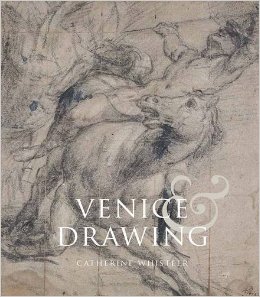 From the time of Titian and Tintoretto to that of Canaletto and Tiepolo, drawing was an important part of artistic practice and was highly valued in Venice. This exciting new study overturns traditional views on the significance of drawing in Venice, as an art and an act, from the Renaissance to the age of the Grand Tour. Gathering together the separate strands of theory, artistic practice, and collecting, Catherine Whistler highlights the interactions and tensions between a developing literary discourse and the practices of making and collecting graphic art. Her analysis challenges the conventional definition of Venetian art purely in terms of color, demonstrating that 16th-century Venetian artists and writers had a highly developed sense of the role and importance of disegno and drawing in art. The book’s generous illustrations support these striking arguments, as well as conveying the great variety, interest, and beauty of the drawings themselves.
Catherine Whistler is senior curator of European art, Ashmolean Museum, and a fellow of St. John’s College, Oxford.
2017 Scholar-in-Residence Program, Hillwood Estate in D.C.
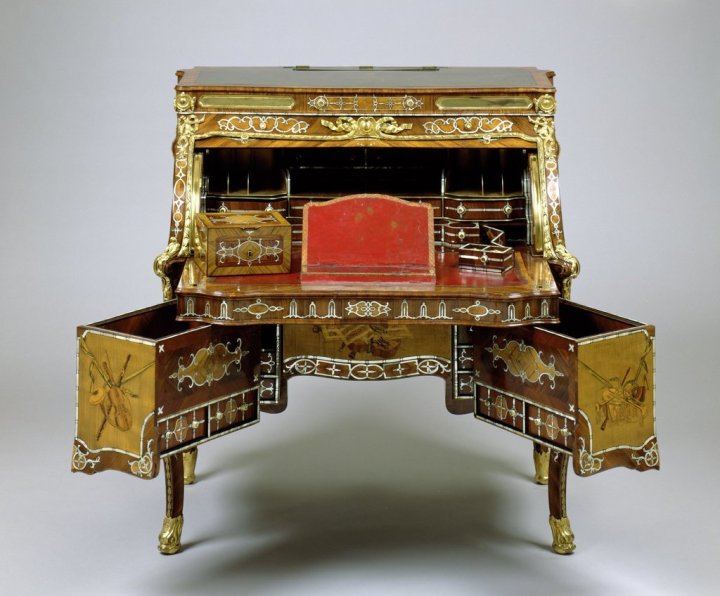
Abraham and David Roentgen, Rolltop Desk, 1765–70, wood marquetry, mother-of-pearl, gilt bronze, steel, leather, glass, 46 × 42 × 25 inches (Washington, D.C., Hillwood Estate, Museum & Gardens).
◊ ◊ ◊ ◊ ◊
2017 Scholar-in-Residence Program
Hillwood Estate, Museum & Gardens, Washington, D.C.
Applications due by 15 February 2017
PhD candidates and other highly qualified scholars conducting research that may benefit from Hillwood’s holdings are encouraged to apply. Applicants should submit a curriculum vitae and a proposal—not to exceed 500 words—stating the necessary length of residence, materials to be used, and the project’s relevance to Hillwood’s collections or exhibition program, including, but not limited to: art and architecture, landscape design, conservation and restoration, archives, library or special collections, as well as broader study areas such as the history of collecting or material culture. The project description should be accompanied by two letters of recommendation. Materials will be reviewed by the selection committee. There are three types of awards:
1 Week
Hillwood will arrange and pay for travel costs to and from the museum; housing near campus; shop and café discounts; free access to all public programs.
2–3 Weeks
Hillwood will arrange and pay for travel costs to and from the museum; shop and café discounts; free access to all public programs; a stipend of up to $1,200 depending on length of stay.
1–2 Months
Hillwood will arrange and pay for travel costs to and from the museum; shop and café discounts; free access to all public programs; a stipend of up to $1,500 per month depending on length of stay.
Founded by Marjorie Merriweather Post (1887–1973), heir to the Post Cereal Company, which later became General Foods, the Hillwood Estate, Museum & Gardens houses over 17,000 works of art. Hillwood is in a special class of cultural heritage institution as a historic site, testament to the life of an important 20th-century figure, an estate campus, magnificent garden, and a museum with world renowned special collections. It includes one of the largest and most important collections of Russian art outside of Russia, comprising pieces from the pre-Petrine to early Soviet periods, an outstanding collection of French and European art, and jewelry, textile, fashion, and accessories collections. Scholars will have access to Hillwood’s art and research collections based on accessibility and staff availability. The Library has over 38,000 volumes including monographs, serials, annotated and early auction catalogues, and electronic resources; the Archives contain the papers of Marjorie Merriweather Post, her staff, and family members. Please submit applications or inquiries to Scholarinresidence@hillwoodmuseum.org by 15 February 2017 (applicants will be notified by 13 March 2017).
Continent Allegories in the Baroque Age: A Research Database

An introduction to the Erdteilallegorien im Barockzeitalter project and database:
Continent Allegories in the Baroque Age: A Research Database
By Marion Romberg, of the Austrian Research Project Erdteilallegorien im
Barockzeitalter in the University of Vienna’s Department of History
During the late Renaissance—around 1570—humanists developed a new ‘shorthand’ way of representing the world at a single glance: personifications of the four continents Europe, Asia, Africa and America. While the continent allegory as an iconic type had already been invented in antiquity, humanists and their artists adapted the concept by creating the four- continent scheme and standardized the attributes characterizing the continents. During the next 230 years until ca. 1800, this iconic scheme became a huge success story. All known media were employed to bring the four continent allegories into the public and into people’s homes. Within this prolonged history of personifications of the continents, the peak was reached in the Late Baroque, and especially the 18th century. As a pictorial language they were interwoven with texts, dogmas, narratives and stereotypes. Thus the project team find himself asking: What did continent allegories actually mean to people living in the Baroque age?
Notably—though not exclusively—this question is the topic of a research project on continent allegories carried out between 2012 and 2016. The project team approached the subject in a new and systematic fashion. First, a clearly defined geographic area consisting of the greater part of Southern Holy Roman Empire from Freiburg in the Breisgau to the eastern frontier of Lower Austria including Vienna was chosen; the northern limit of the study area is constituted by the Main River, the southern one by South Tyrol. Secondly, the project studied continent allegories in immovable media like fresco, stucco and sculptures within abbeys, palaces, parks and gardens, townhouses and—most importantly—in churches. The systematic survey conducted by the project team identified 407 instances of continent allegories in the south of the Holy Roman Empire. To facilitate the systematic and detailed analysis of all identified instances of continent allegories, a database was developed and is now open access: continentallegories.univie.ac.at. This database allows the use of the collection of sources for various research interests: iconography and iconology, reception of aesthetics, cultural history, social history, history of identity, history of science, etc.
Further results of this research project can be found in the in English published anthology The Language of Continent Allegories in Baroque Central Europe (Stuttgart, 2016) and in the doctoral thesis by Marion Romberg “Die Welt im Dienst der Konfession. Erdteilallegorien in Dorfkirchen auf dem Gebiet des Fürstbistums Augsburg im 18. Jahrhundert“ (Stuttgart, 2017).
Project Team, 2012–16
Prof. Dr. Wolfgang Schmale, University of Vienna, www.wolfgangschmale.eu
Dr. Marion Romberg, University of Vienna, www.marionromberg.eu
Dr. Josef Köstlbauer, University of Bremen, josef.koestlbauer@univie.ac.at
◊ ◊ ◊ ◊ ◊
Wolfgang Schmale, Marion Romberg, and Josef Kostlbauer, eds., The Language of Continent Allegories in Baroque Central Europe (Stuttgart, Franz Steiner Verlag, 2016), 240 pages, ISBN 978 3515 114578, 52€ / $78.
 The iconography of the four continents dates back to 16th and early 17th centuries, at a time when Europe’s vision of the world was changed dramatically by discovery and conquest of the New World. Its peak of dissemination was reached in the 18th century. The late Baroque claims a special role for two reasons: first is the large number of reproductions and applications during this period, and the second is the multifaceted significance these allegories enjoyed. They could be inserted into religious and liturgical settings as well as into political language or that of the history of civilization and mankind. ‘Language’ in this sense means that the continent allegories were less the object of an art historical interpretation than being considered a formative part of religious, liturgical, political, historical, and other discourses. As pictorial language they were interwoven with text, dogmas, narratives, and stereotypes. Thus the authors of this volume inquire what the allegories of the four continents actually meant to people living in the Baroque age.
Cover image: Continent Allegories by Johann Baptist Enderle in the parish church St. Martin in Schwabmühlhausen (Germany) of 1759 (detail).
Call for Proposals | Companion to 18th-Century Literary Illustration
A Companion to Eighteenth-Century Literary Illustration, Volume I: Approaches
Edited by Leigh G. Dillard and Christina Ionescu
Proposals due by 20 January 2017
Proposals are invited for the first installment in a multi-volume collection, titled A Companion to Eighteenth-Century Literary Illustration. The first volume is designed for students and established researchers seeking an introduction to approaches in this field; it can also be used for book illustration scholars seeking to extend their theoretical and methodological tool kit. Contributions should provide an introduction to pertinent theoretical terms and concepts, a practical demonstration, and suggestions for further reading. When possible, examples should be chosen from more than one national tradition. We invite proposals on the following topics to fill gaps in our existing commitments:
• Book illustration and consumer culture
• Book illustration and fashion studies/costume studies
• Book illustration and visual rhetoric
Please send 300–500 word proposals to Christina Ionescu (cionescu@mta.ca) and Leigh Dillard (leigh.dillard@ung.edu) by January 20, 2017. The deadline for the submission of completed chapters will be December 15, 2017.
New Book | Bibliothèques, décors, XVIIe–XIXe siècle
From Éditions des Cendres and available from ArtBooks.com:
Frédéric Barbier, Andrea De Pasquale, István Monok, eds., Bibliothèques, décors, XVIIe–XIXe siècle (Paris, Éditions des Cendres, 2016), 306 pages, ISBN 978 2867 422546, $63.
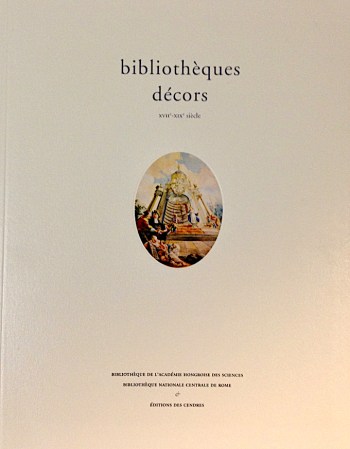 La chronologie est spécifique au domaine : dans la seconde moitié du xvie et au début du xviie siècle, la bibliothèque abandonne le mobilier traditionnel des pupitres pour prendre la forme moderne d’une grande salle de travail dont les murs sont tapissés de livres. Ce modèle deviendra à son tour de moins en moins adapté, jusqu’à ce que, face à l’accroissement de la production imprimée qui se produit au xixe siècle, le principe des magasins de stockage des livres se développe et l’organisation interne de la bibliothèque se modifie. Au fil de cet espace de temps des xviie–xixe siècles, les grands courants artistiques se succèdent, du baroque au classicisme puis au néo-classique, et jusqu’à l’émergence de l’architecture industrielle.
Parallèlement, l’institution de la bibliothèque garde une charge symbolique élevée, mise en scène par le biais du décor. On connaît les somptueuses bibliothèques baroques du monde catholique, de la péninsule Ibérique à l’Allemagne méridionale, à l’Europe centrale, ou encore à l’Italie. Pourtant, d’autres modèles de décor se rencontrent, qu’il s’agisse de la France (à la Bibliothèque Mazarine) ou encore de la géographie de la Réforme protestante. À côté des exemples les plus célèbres, y compris celui de la Hofbibliothek de Vienne, les contributions présentent un certain nombre de bibliothèques historiques largement méconnues jusqu’à aujourd’hui, notamment en Europe centrale et orientale (Alba Iulia), mais aussi en Italie (avec le Palais Borromini à Rome).
Ce travail transdisciplinaire réunit les meilleurs spécialistes européens, confrontant les leçons de l’histoire générale avec celles de l’histoire de l’art, de l’histoire des idées et de l’histoire du livre et des bibliothèques. Un ouvrage placé sous la direction de Frédéric Barbier, István Monok & Andrea De Pasquale qui ont réuni à leurs côtés une équipe internationale de spécialistes de l’histoire des bibliothèques et du livre / Ample iconographie, bibliographie et index.
T A B L E D E M A T I È R E S
• Frédéric Barbier, Bibliothèques, décors, XVIIe–XXIe siècle
• Frédéric Barbier, Illustrer, persuader, servir: le décor des bibliothèques, 1627–1851
• Elmar Mittler, Kunst oder Propaganda? Bibliothekarische Ausstattungsprogramme als Spiegel kultureller Entwicklungen und Kontroversen in Renaissance, Gegenreformation, Aufklärung und Klassizismus
• Hans Petschar, Der Pruncksaal der Österreichichen Nationalbibliothek : zur Semiotik eines barocken Denkraumes
• Andreas Gamerith, Klosterbibliotheken des Wiener Umlandes: alte und neue Motive
• Michaela Seferisová Loudová, Ikonographie der Klosterbibliotheken in Tschechien, 1770–1790
• Szabolcs Serfözö, Barocke Deckenmalereien in klosterbibliotheken des Paulinerordens in Mitteleuropa
• Anna Jávor, Bücher und Fresken: die künstlerische Ausstattung von Barockbibliothecken in Ungarn
• János Jernyei-Kiss, Die Welt der Bücher auf einem Deckenbild: Franz Sigrists Darstellung der Wissenschaften im Festsaal des Lyzeums in Erlau
• Doina Hendre Biró, Le décor de la Bibliothèque et de l’Observatoire astronomique fondés par le comte Ignác Batthyány, évêque de Transylvanie, à la fin du XVIIIe siècle
• Yann Sordet, D’un palais (1643) l’autre (1648): les bibliothèque(s) Mazarine(s) et leur décor
• Fiammetta Sabba, I Saloni librari Borrominiani fra architettura e decoro
• Andrea De Pasquale, L’histoire du livre dans le décor des bibliothèques d’Italie au XIXe siècle
• Jean-Michel Leniaud, L’invention du programme d’une bibliothèque, 1780–1930
• Alfredo Serrai, I vasi o saloni librari. Ermeneutica della iconografia bibliotecaria
New Book | Artefacts of Encounter: Cook’s Voyages
From the University of Hawaii Press:
Thomas, Nicholas Thomas, Julie Adams, Billie Lythberg, Maia Nuku, and Amiria Salmond, Artefacts of Encounter: Cook’s Voyages, Colonial Collecting and Museum Histories (Honolulu: University of Hawai’i Press, 2016), 364 pages, ISBN: 978 0824 859350, $68.
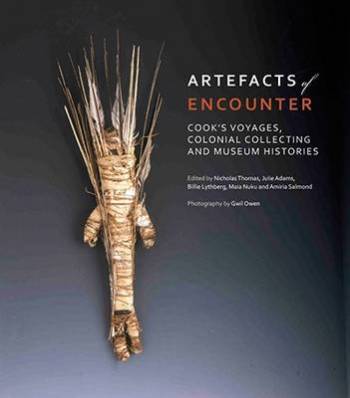 The Pacific artefacts and works of art collected during the three voyages of Captain James Cook and the navigators, traders, and missionaries who followed him are of foundational importance for the study of art and culture in Oceania. These collections are representative not only of technologies or belief systems but of indigenous cultures at the formative stages of their modern histories, and exemplify Islanders’ institutions, cosmologies, and social relationships.
Recently, scholars from the Pacific and further afield, working with Pacific artefacts at the Museum of Archaeology and Anthropology in Cambridge (MAA), have set out to challenge and rethink some longstanding assumptions on their significance. The Cook voyage collection at the MAA is among the four or five most important in the world, containing over 200 of the 2000-odd objects with Cook voyage provenance that are dispersed throughout the world. The collection includes some 100 artefacts dating from Cook’s first voyage. This stunning book catalogues this collection, and its cutting-edge scholarship sheds new light on the significance of many artefacts of encounter. Published in association with Otago University Press.
The William Blake Archive Launches Updated Website

William Blake, The First Book of Urizen, Plate 14, Object 7 (Bentley 85.7, Butlin 262.7), from A Large Book of Designs, ca. 1796 (London: British Museum).
In collaboration with UNC Libraries and ITS Research Computing, The William Blake Archive launched on 12 December 2016 a complete and transformative redesign of its website. This new site, www.blakearchive.org, retains all of the features of the previous site, which had become so indispensable to Blake scholars, and offers vast improvements, making it easier than ever for educators and scholars to access and study Blake’s inimitable works.
The Blake Archive, one of the preeminent digital humanities sites in the world, is a hypermedia archive of Blake’s poetry and art that is sponsored by the Library of Congress and supported by the University of North Carolina at Chapel Hill and the University of Rochester. Past support came from the Getty Grant Program, the Paul Mellon Centre for Studies in British Art, and the National Endowment for the Humanities. The Archive integrates, for the first time, all of Blake’s visual and literary work. It comprises almost 7000 high-resolution digital images of Blake’s illuminated books, paintings, drawings, manuscripts, and engravings drawn from over 45 of the world’s great research libraries and museums.
New Book | Clothing Art
From Yale UP:
Aileen Ribeiro, Clothing Art: The Visual Culture of Fashion, 1600–1914 (New Haven: Yale University Press, 2017), 582 pages, ISBN: 978-0300119077, $60.
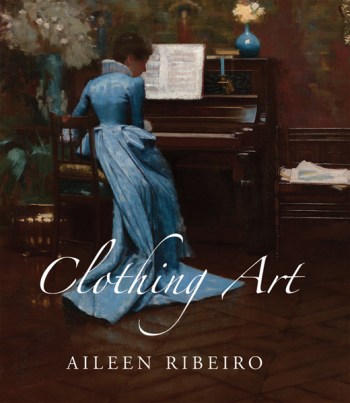 There have always been important links between art and clothing. Artists have documented the ever-evolving trends in fashion, popularized certain styles of dress, and at times even designed fashions. This is the first book to explore in depth the fascinating points of contact between art and clothing, and in doing so it constructs a new and innovative history of dress in which the artist plays a central role.
Aileen Ribeiro provides an illuminating account of the relationship between artists and clothing from the 17th century, when a more complex and sophisticated attitude to dress first appeared, to the early 20th century, when the boundaries between art and fashion became more fluid: haute couture could be seen as art, and art used textiles and clothes in highly imaginative ways. Ribeiro’s narrative encompasses such themes as the ways in which clothing has helped to define the nation state; how masquerade and dressing up were key subjects in art and life; and how, while many artists found increasing inspiration in high fashion, others became involved in designing ‘artistic’ and reform dress. Sumptuously illustrated, Clothing Art also delves into the ways in which artists represent the clothes they depict in their work, approaches which range from photographic detail, through varying degrees of imaginative reality, to generalized drapery.
Aileen Ribeiro is professor emeritus in the history of art at the Courtauld Institute of Art, London.










 Enfilade
leave a comment