Netherlands Yearbook for History of Art, November 2016
Latest issue of NKJ:
Thijs Weststeijn, Eric Jorink and Frits Scholten, eds., Netherlandish Art in its Global Context (Leiden: Brill, 2016), 296 pages, ISBN: 978-9004334977, €105 / $123. [Netherlands Yearbook for History of Art / Nederlands Kunsthistorisch Jaarboek 66 (November 2016)].
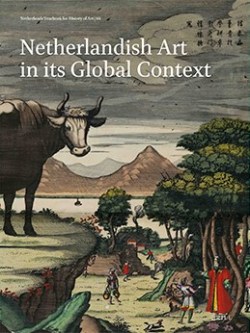 Netherlandish art testifies to the interconnectedness of the Early Modern world. New trade routes, the international Catholic mission, and a thriving publishing industry turned Antwerp and Amsterdam into capitals of global exchange. Netherlandish prints found a worldwide public. At home, everyday lives changed as foreign luxuries, and local copies, became widely available. Eventually, Dutch imitations of Chinese porcelain found their way to colonists in Surinam. This volume of the Netherlands Yearbook for History of Art breaks new ground in applying the aims and approaches of global art history to the Low Countries, with essays ranging from Greenland to South Africa and Mexico to Sri Lanka. The Netherlands, as a fringe area of the Habsburg Empire marked by internal fault lines, demonstrated remarkable artistic flexibility and productivity in the first period of intensive exchange between Europe and the rest of the world.
Thijs Weststeijn, PhD (2005), University of Amsterdam, is professor of art history before 1850 at Utrecht University. He chairs the research project The Chinese Impact: Images and Ideas of China in the Dutch Golden Age (2014–19).
Eric Jorink, PhD (2004), University of Groningen, is Teylers professor at Leiden University and researcher at the Huygens Institute (KNAW). He is the author of Reading the Book of Nature in the Dutch Golden Age, 1575–1715.
Frits Scholten, PhD (2003), University of Amsterdam, is senior curator of sculpture at the Rijksmuseum and holds the chair in the History of Western Sculpture before 1800 at the Universiteit van Amsterdam. He has published widely on Western sculpture and decorative arts. His most recent publication is Small Wonders: Late-Gothic Boxwood Micro-carvings from the Low Countries (Amsterdam 2016).
C O N T E N T S
• Thijs Weststeijn, Introduction: Global Art History and the Netherlands
• Nicole Blackwood, Meta Incognita: Some Hypotheses on Cornelis Ketel’s Lost English and Inuit Portraits
• Stephanie Porras, Going Viral? Maerten de Vos’s St Michael the Archangel
• Christine Göttler, ‘Indian Daggers with Idols’ in the Early Modern Constcamer: Collecting, Picturing and Imagining ‘Exotic’ Weaponry in the Netherlands and Beyond
• Barbara Uppenkamp, ‘Indian’ Motifs in Peter Paul Rubens’s The Martyrdom of Saint Thomas and The Miracles of Saint Francis Xavier
• Thijs Weststeijn and Lennert Gesterkamp, A New Identity for Rubens’s ‘Korean Man’: Portrait of the Chinese Merchant Yppong
• Ebeltje Hartkamp-Jonxis, Sri Lankan Ivory Caskets and Cabinets on Dutch Commission, 1640–1710
• Julie Berger Hochstrasser, A South African Mystery: Remarkable Studies of the Khoikhoi
• Ching-Ling Wang, A Dutch Model for a Chinese Woodcut: On Han Huaide’s Herding a Bull in a Forest
• Annemarie Klootwijk, Curious Japanese Black: Shaping the Identity of Dutch Imitation Lacquer
• Thomas DaCosta Kaufmann, The ‘Netherlandish model’? Netherlandish Art History as/and Global Art History
Exhibition | Master Drawings Unveiled: 25 Years of Major Acquisitions
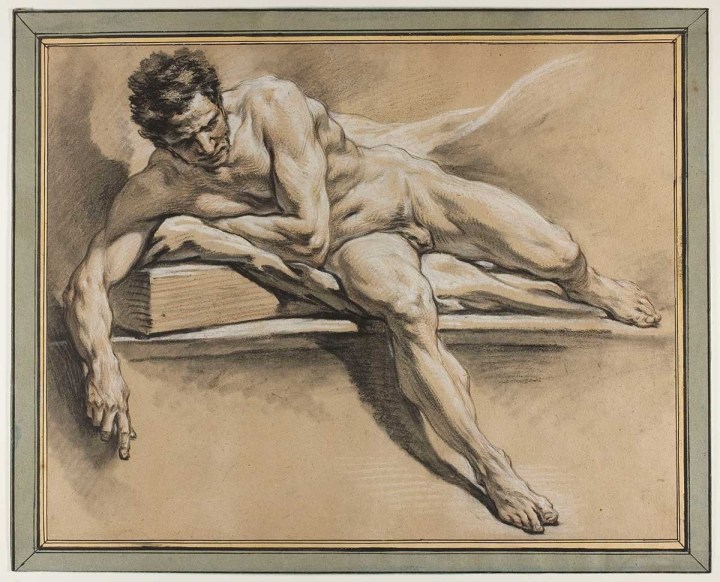
François Boucher, Academic Study of a Reclining Male Nude, ca. 1750
(Art Institute of Chicago, Regenstein Endowment Fund).
◊ ◊ ◊ ◊ ◊
Press release (8 June 2016) from AIC
Master Drawings Unveiled: 25 Years of Major Acquisitions
Art Institute of Chicago, 27 August 2016 — 29 January 2017
The Art Institute of Chicago presents 84 hitherto unexhibited masterful drawings carefully and thoughtfully acquired over the last quarter century in an exhibition titled Master Drawings Unveiled: 25 Years of Major Acquisitions. Building upon an established and world-renowned collection, these masterpieces range from the French and Italian schools of the 17th century to Swiss, German, and Austrian Romanticism, midcentury Realism, Belgian Symbolism and into the mid-20th century. The recent acquisitions will be on display from August 27, 2016 to January 29, 2017 and provide visitors a full range of artistic achievement, featuring key works by François Boucher, Henri Fantin-Latour, Edgar Degas, Odilon Redon, Francis Picabia, Grant Wood, and other iconic figures.
The exhibition is a culmination of the legacy and focus of curator Suzanne Folds McCullagh, who along with Mark Pascale, Martha Tedeschi, and Douglas Druick strategically acquired the works to reinforce the strengths of the collection and add new dimensions and greater depth. The selected works offer a “leap through the ages,” says McCullagh. “This is only the tip of the iceberg, not including gifts or bequests, or works that have been or will be shown in other exhibitions here. We have acquired over 9,000 prints and drawings since 1991; this installation reveals some of the areas we have sought to develop through purchases. The range of the materials means the show offers something for everyone.”
Among the works never-before-seen in Chicago are three studies for beloved works in the permanent collection. A full-scale study of A Young Peasant Woman Drinking her Café au Lait, 1881, is almost the same size as the painting (Gallery 246). There is a final compositional study for Puvis de Chavanne’s Sacred Grove, Beloved of the Arts and the Muses, 1883/84 (Gallery 245). And, most surprising of all is the large abstract planning drawing for Gustave Caillebotte’s Paris Street; Rainy Day, 1877 (Gallery 201).
Exhibition | Doctrine and Devotion: The Spanish Andes
Now on view at AIC:
Doctrine and Devotion: Art of the Religious Orders in the Spanish Andes
Art Institute of Chicago, 19 March — 25 June 2017
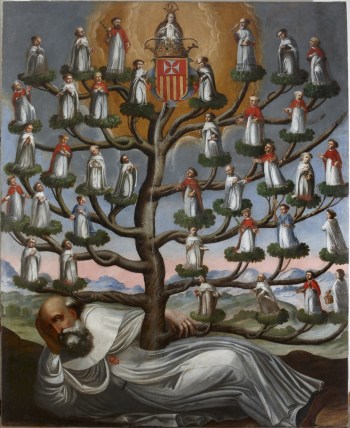
Unidentified artist, active in Potosí, Bolivia, Genealogical Tree of the Mercedarian Order, mid-18th century (Thoma Collection).
Presenting 13 paintings by South American artists from the 17th through 19th century, this focused exhibition introduces visitors to images promoted by several Catholic orders at work in the Spanish Andes—the Dominicans, Franciscans, Mercedarians, and Jesuits—examining the politics of the distinct iconographies each group developed as they vied for devotees and dominion.
Francisco Pizarro arrived in Peru with a mandate from Charles V to impose Spanish law and order, as well as the Roman Catholic religion, upon the indigenous Inca society that he encountered. The enormous task of converting the indigenous peoples of Spain’s overseas territories to Christianity fell largely to missionaries from several religious orders rather than parish clergy. For a native population that had no written language tradition, the missionaries relied heavily on works of art to illustrate their sermons and lessons and help them gain converts.
In the wake of the Protestant Reformation, the Catholic church embraced the use of images both as pedagogical tools and instruments of devotion, and the religious orders in South America relied on them in similar ways—as didactic materials employed in the teaching of new converts, and in later years as a means of spreading devotions specific to their own interests. While their ultimate goals were the same, each religious order promoted images specific to their own histories, identities, and goals. This exhibition explores examples of the iconographies that were particular to each group.
Doctrine and Devotion: Art of the Religious Orders in the Spanish Andes is generously supported by the Carl and Marilynn Thoma Art Foundation.
Exhibition | Shakers and Movers
Now on view at AIC:
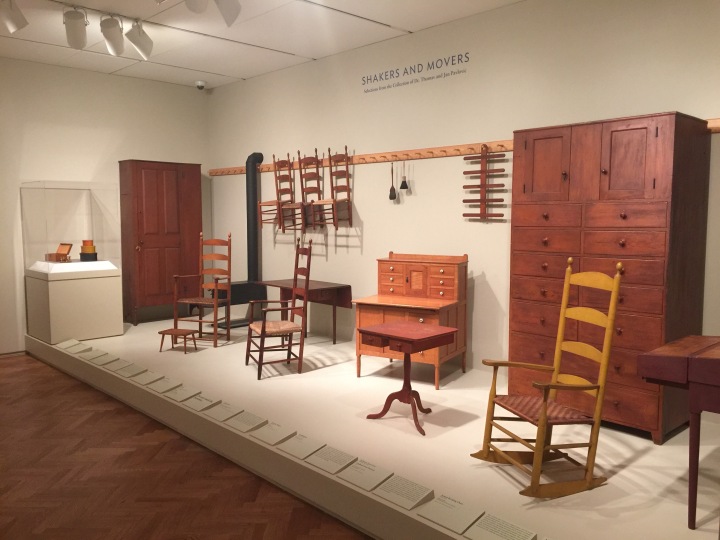
Shakers and Movers: Selections from the Collection of Dr. Thomas and Jan Pavlovic
Art Institute of Chicago, December 2015 — Fall 2017
For Shakers, work was a form of worship, and objects were expressions of their attempt to create heaven on earth. They employed unique techniques to build furniture that was like their faith: honest, simple, and humble. Featuring over 20 such objects generously loaned by collectors Thomas and Jan Pavlovic, this exhibition—the first of its kind at the Art Institute—shows the range of items made by the Shakers in the late 18th and 19th centuries. Presented within the chronology of the permanent collection galleries, the exhibition considers Shakers in the larger context of American furniture production, demonstrating the artistic exchange and innovation that defined the country’s early history.
Shakers were well known for their austere and rigid lifestyle. Believers lived in separate men’s and women’s dormitories and practiced celibacy and communal ownership. Their worship, however, could be quite lively; the name Shaker derives from the frenzied, whirling dancing that took place at services. Following the arrival of the first Shakers from England in 1774, the group peaked in the mid-19th century, boasting more than 6,000 members from Maine to Kentucky. Though only one Shaker community survives today, the impact of Shakers on American culture has endured, particularly in art and design. The Pavlovics’ collection—passionately assembled over the last 40 years—exemplifies the virtuosic craftsmanship synonymous with this influential utopian religious community.
New Book | American Silver in the Art Institute of Chicago
Due for a February release from Yale UP:
Elizabeth McGoey, ed., American Silver in the Art Institute of Chicago (New Haven: Yale University Press, 2017), 266 pages, ISBN: 978 0300 222364, $50.
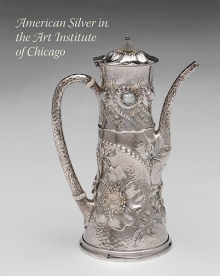 The history of American silver offers invaluable insights into the economic and cultural history of the nation itself. Published here for the first time, the Art Institute of Chicago’s superb collection embodies innovation and beauty from the colonial era to the present. In the 17th century, silversmiths brought the fashions of their homelands to the colonies, and in the early 18th, new forms arose as technology diversified production. Demand increased in the 19th century as the Industrial Revolution took hold. In the 20th, modernism changed the shape of silver inside and outside the home. This beautifully illustrated volume presents highlights from the collection with stunning photography and entries from leading specialists. In-depth essays relate a fascinating story about eating, drinking, and entertaining that spans the history of the Republic and trace the development of the Art Institute’s holdings of American silver over nearly a century. Contributors include Debra Schmidt Bach, David Barquist, Jennifer Goldsborough, Judith Barter, Medill Higgins Harvey, Patricia Kane, Barbara Schnitzer, Janine Skerry, Ann Wagner, Gerald W. R. Ward, Deborah Dependahl Waters, Beth Carver Wees, and Elizabeth Williams.
Elizabeth McGoey is Ann S. and Samuel M. Mencoff Assistant Curator of American Decorative Arts at the Art Institute of Chicago.
Call for Papers | Design and Displacement: Graduate Student Symposium
From H-ArtHist:
Design and Displacement
26th Annual Parsons/Cooper Hewitt Graduate Student Symposium on the History of Design
Cooper Hewitt, Smithsonian Design Museum, New York, 7–8 April 2017
Proposals due by 23 January 2017
The challenges faced by vast numbers of migrants and refugees worldwide—uprooted by war, persecution, or ecological crises or relocating in search of economic opportunity—are giving rise to innovative design solutions. Although often urgent, these crises are unfortunately rarely new. This symposium attempts to take a broader historical view of the relationship of design and decorative arts to the displacement and movement of people and populations since the Renaissance. From French Huguenot artisans emigrating to England in the early 18th century to artisans exiled in the wake of the 1848 revolutions to the Bauhaus’s re-establishment after its dissolution by the fascists to designers’ migrations all over the world, the movement of populations has spurred great change in the cultural landscape, including the creation of opportunities for new cross-cultural synthesis. Migrations also inspire architectural solutions, such as temporary housing for displaced persons during wartime or natural disasters or more substantial interventions into the landscape, such as buildings erected to accommodate the exponential growth of cities like Lagos or Rio de Janeiro. Papers might consider historical or contemporary designers or whole populations. The symposium also seeks to address issues of national and transnational identity as well as anti-immigrant sentiment.
Proposals are welcome from graduate students at any level in fields such as art history, history of design, design studies, fashion studies, history of the decorative arts, urban studies, cultural anthropology, history of architecture, consumer studies, design and technology, media studies, museum studies, food studies.
The symposium’s Catherine Hoover Voorsanger Keynote speaker will be Jeremy Aynsley, professor of design history at the University of Brighton (UK) and chair of the Design History Society. Professor Aynsley’s research interests concern late-19th- and 20th-century design in Europe and the United States, with a particular focus on design in modern Germany, which he has explored in major exhibitions and academic publications including Nationalism and Internationalism in Design in the 20th Century (1994), Graphic Design in Germany 1890–1945 (2000), and Designing Modern Germany (2009). He is especially interested in the phenomenon of the migration of Modernism and is currently working on a project about German graphic designers in the United States on the eve of World War II. The keynote address will be given on Friday evening, April 7, 2017, and the symposium sessions will be held in the morning and afternoon of Saturday, April 8.
To submit a proposal, send a two-page abstract, one-page bibliography, and a CV to Ethan Robey, Associate Director, MA Program in the History of Design and Curatorial Studies, robeye@newschool.edu.
The symposium is sponsored by the MA History of Design and Curatorial Studies program, offered jointly by Cooper Hewitt, Smithsonian Design Museum and Parsons School of Design.
Exhibition | Making Nature: How We See Animals
Press release (23 September 2016) from the Wellcome Collection:
Making Nature: How We See Animals
Wellcome Collection, London, 1 December 2016 — 21 May 2017
Curated by Honor Beddard
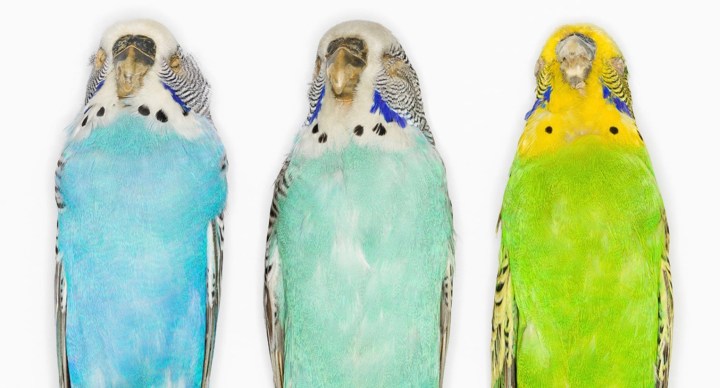
The question of how humans relate to other animals has captivated philosophers, anthropologists, scientists, ethicists and artists for centuries. Making Nature brings together over 100 objects from literature, film, taxidermy, and photography to examine what we think, feel, and value about other species and the consequences this has for the world around us. It will include works by contemporary artists including Allora and Calzadilla and Phillip Warnell and asks how and why we look at animals and what we see when we do.
From the formalisation of natural history as a science, through the establishment of museums and zoos, to lavish contemporary wildlife documentaries, Making Nature reveals the hierarchies in our view of the natural world and considers how these influence our actions, or inactions, towards the planet. The exhibition—organised around four themes: ordering, displaying, observing, and making—opens with Marcus Coates’s Degreecoordinates, Shared Traits of the Hominini (Humans, Bonobos and Chimpanzees), 2015. This recent work questions the definitions of difference between species and establishes this as an idea that runs throughout the exhibition.
Attempts to categorise the natural world in the 18th century will be introduced through the work of Carl Linnaeus and the publication of Systema Naturae in 1735. His efforts to record, describe, and classify the animal kingdom solved the practical problem of identifying species but introduced a manmade ranking system. Similarly, Charles Bonnet’s Scale of Natural Beings 1783 provided a ladder of the animal kingdom with humans placed at the top. Such views are challenged by the depictions of animals—and human-like animals—in Jonathan Swift’s satire of man, Gulliver’s Travels.
Making Nature questions the approach of ‘learning through looking’, including artists such as herman de vries, a trained botanist interested in the challenge of objectivity, and Edwina Ashton who explores the politics of representation. The importance of listening is also examined by artists Allora and Calzadilla in The Great Silence (2014). This film installation is a depiction of endangered parrots paired against footage of the Arecibo Observatory, the world’s largest telescope, in Puerto Rica.
The exhibition also charts changing fashions of museum displays alongside society’s changing attitudes to nature, from overstuffed cabinets in Victorian institutions to elaborately staged dioramas from natural history museums in the 20th century. Contemporary photographers Richard Ross and Hiroshi Sugimoto expose the complexities of successive attempts to give visitors an authentic representation of the animal in a museum setting, revealing works of art as yet another form of mediation. Roger Fenton’s 1855 image of an unnaturally upright gorilla skeleton next to a human one, taken during his time as the British Museum’s documentary photographer, interrogates the idea that natural history displays may not necessarily represent an objective truth.
The search for an authentic encounter with nature will be further examined through our ever more ambitious attempts to get closer to animals—in zoos, national parks, and on screen—while simultaneously hoping to preserve their wildness. The New Architecture and The London Zoo (1936), a film by László Moholy-Nagy, and Casson Condor’s architectural photographs from the 1970s provide examples of how the designs of zoo enclosures are used to frame animals. The phenomena of the ‘zoo-pet’, or mascot, is explored through cases like Jumbo the elephant, adored by Victorian audiences and subject of a public outcry when he was sold to P. T. Barnum’s Circus in 1882. Souvenirs and toys will show how zoo animals have frequently been anthropomorphised in popular culture.
Depictions of animals on film include, Woodpeckers 1954, the first documentary to use new camera technologies to film a family of woodpeckers from within their nest. When broadcast on the BBC, it was second in popularity only to the Queen’s coronation that year and set the precedent for natural history documentaries that remain popular today. The exhibition also features an extract from Seal Island (1948), part of Walt Disney’s True-Life Adventures series of nature films promoted as entertainment.
Phillip Warnell’s film installation Ming of Harlem: Twenty One Storeys in the Air (2016) explores the true story of Antoine Yates, who lived in a high-rise New York apartment with a tiger called Ming and a large alligator. Combining documentary with recreated scenes, Warnell offers new insights on the human/animal relationship and the question of representation.
The final section of the exhibition is curated in collaboration with the Center for PostNatural History, Pittsburgh, USA, the only organisation to solely collect organisms that have been intentionally altered by humans. Specimens, paintings, literature, and scientific models—many on loan from the Center’s museum—will chart a relationship to animals that is bound up with the history, and future, of human civilisation. This includes the breeding of domesticated pigeons by Charles Darwin that helped to inform his theories of natural selection and the genetic modification of mosquitos in the fight against disease spread. Further case studies comprise dog breeding, the origins of laboratory mice and rats, and a history of songbirds as told by musicologist Ian Nagoski. Unlike traditional natural history collections, the significance of postnatural organisms lies in the role they play in human culture.
Making Nature is the first part of a year-long exploration of our relationship with the natural world in the past, present, and future. The exhibition is curated by Honor Beddard, and the exhibition design is by AOC.
◊ ◊ ◊ ◊ ◊
Tim Dee and Anna Faherty, Animal, Vegetable, Mineral: Organising Nature: A Picture Album (London: Wellcome Collection, 2016), 112 pages, ISBN: 978 095 7028593, £13.
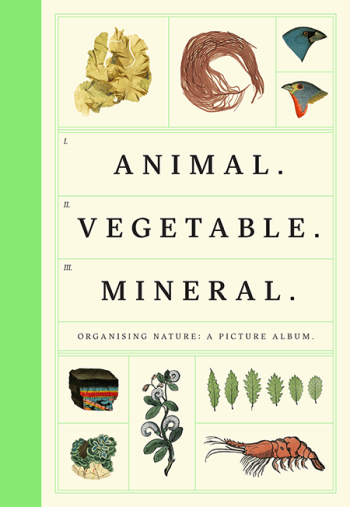 Animal, Vegetable, Mineral celebrates the beauty and strangeness of the very early ‘infographics’, charts, and ordering systems devised in an age that transformed how we see and understand nature. These are the tools created by pioneering European naturalists, artists, scientists, housewives, and explorers in the 18th and 19th centuries in an attempt to better understand (and control) a teeming and shifting natural world: the original big data challenge. In a collision of science, art, and imagination, these images and objects range from intricate specimen illustrations, taxonomy charts, and animal distribution maps, to lavish colour dictionaries, and more. Together, they attest to the deeply human desire to order and identify the world around us—and a restless quest to find our own place in it.
New Book | William Hogarth: A Complete Catalogue of the Paintings
From Yale UP:
Elizabeth Einberg, William Hogarth: A Complete Catalogue of the Paintings (London: The Paul Mellon Centre for Studies in British Art, 2016), 432 pages, ISBN: 978 030 0221749, £95 / $150.
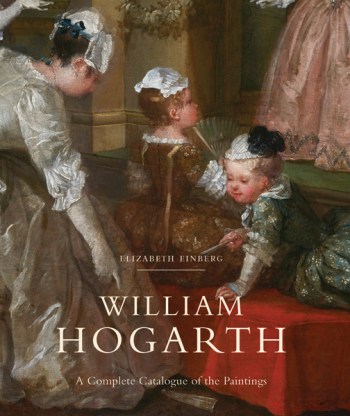 William Hogarth (1697–1764) was among the first British-born artists to rise to international recognition and acclaim and to this day he is considered one of the country’s most celebrated and innovative masters. His output encompassed engravings, paintings, prints, and editorial cartoons that presaged western sequential art.
This comprehensive catalogue of his paintings brings together over twenty years of scholarly research and expertise on the artist and serves to highlight the remarkable diversity of his accomplishments in this medium. Portraits, history paintings, theater pictures, and genre pieces are lavishly reproduced alongside detailed entries on each painting, including much previously unpublished material relating to his oeuvre. This deeply informed publication affirms Hogarth’s legacy and testifies to the artist’s enduring reputation.
Elizabeth Einberg is a senior research fellow at the Paul Mellon Centre for Studies in British Art and former curator at Tate Britain.
Exhibition | The Frick Collects: From Rubens to Monet

Arthur Devis, Sir Joshua Vanneck and His Family, 1752, oil on canvas, 146 × 142 cm
(Pittsburgh: Frick Art & Historical Center, 1984.24)
◊ ◊ ◊ ◊ ◊
Now on view at The Frick Pittsburgh:
The Frick Collects: From Rubens to Monet
Frick Art & Historical Center, Pittsburgh, 29 October 2016 — 14 May 2017
Take a look at the Frick in a new way in this exhibition, which, for the first time tells the story of the Frick through its collection. From Henry Clay Frick’s early purchases, to his daughter Helen’s collecting interests, through to the acquisitions that have been made by the museum in recent years, visitors will see and learn about the enduring legacy of the Frick family as art collectors. Objects will be brought together to tell a unified story—a story that doesn’t stop with Henry Clay Frick’s early purchases for Clayton, but continues, looking at both Henry and Helen as the collectors who have shaped the Frick Art & Historical Center’s holdings.
The earliest acquisitions in the collection date to Henry Clay Frick’s bachelor days. Before his marriage (and for the first months after his marriage) he lived in downtown Pittsburgh at the fashionable Monongahela House. He bought his first paintings and decorative objects for his rooms there: an elaborate rococo revival clock and candelabra set purchased through Tiffany’s, an ebonized cabinet, and his first documented painting purchase, a landscape by local artist George Hetzel.
When they moved into Clayton, Henry Clay Frick and his wife furnished it as many young couples do—most of the purchases were new, fashionable and of the period. Frick had met his wife, Adelaide Howard Childs (1859–1931) in February 1881. Adelaide was the sixth daughter of the wealthy Pittsburgh Childs family, who were manufacturers and importers of shoes and boots. For young couples during America’s Gilded Age like the Fricks, art collecting was not simply a way to exercise taste and create a suitable environment—although these were important considerations. More subtly the right objects gave their owner a sense of history and pedigree. Collecting was a personal pleasure and an indicator of status, discernment and good taste.
The rise in American collecting of this period also coincided with the establishment of the first museums in the country, including the Wadsworth Athenaeum of Hartford, Connecticut in 1842, the Museum of Fine Arts, Boston in 1870, New York’s Metropolitan Museum of Art in 1872, and in 1896, Pittsburgh’s Carnegie Institute. As the century progressed, forming collections and bequeathing them to the public became one way to put wealth and the accumulation of a collection to public service.
It was Helen Clay Frick’s vision that led to the restoration of Clayton as a house museum. The Frick Art Museum, which was opened to the public in 1970 just a block south of Clayton, was built primarily for the collection she developed, rather than the one she inherited. Helen even had the family cars and carriages carefully preserved and brought back to Pittsburgh from the family’s Massachusetts summer estate.
The Frick Art Museum opened in 1970 with its main galleries devoted to Helen’s greatest interests: early Italian Renaissance paintings and eighteenth-century French fine and decorative art. Since Helen’s death in 1984, the collection has continued to develop—through generous donations and acquisitions that reflect the same quality as that evinced by the founding collection. Through the foresight of Helen Clay Frick who valued Pittsburgh, and who understood that her youth at Clayton was one of unique privilege—not simply financially, but aesthetically—these collections are the heart of the experience at the Frick Pittsburgh.
The Frick Collects is accompanied by a new, fully-illustrated guide to the collection published by Scala, specialists in working with museums to produce beautiful publications. The publication is generously underwritten by The Richard C. von Hess Foundation.
Robin Nicholson, Sarah Hall, and Dawn Reid Brean, The Frick Pittsburgh: A Guide to the Collection (New York: Scala, 2016), 120 pages, ISBN: 9781785510717, $15.
 The collections at The Frick Pittsburgh are the combined legacy of famed art collector and industrialist Henry Clay Frick and his daughter Helen. Two essays tell the story of Frick’s early collecting and his daughter’s interest in continuing his mission to purchase great art and make it publicly accessible. The book also provides a photographic tour of Clayton, the Frick family’s historic Pittsburgh home, which is now a house museum.
Collection highlights presented include fabulous examples of early Renaissance Italian painting, eighteenth-century French painting, furniture, and decorative arts, spectacular Chinese porcelains, and masterpieces by artists like Rubens, Guardi, Boucher, Gainsborough, Fragonard, Millet, and Monet. The entirety of the Frick’s collections—spanning the thirteenth century to the present—are displayed at The Frick Art Museum, Clayton, and the Car and Carriage Museum—all located on the Frick’s five-plus acres of landscaped grounds.
Robin Nicholson has been Director of The Frick Pittsburgh since 2014. Sarah J. Hall began working at The Frick Pittsburgh in 1994 and has been Director of Curatorial Affairs since 2007. Dawn Reid Brean joined the Frick as Associate Curator of Decorative Arts in 2015.
Exhibition | Winckelmann, Florence, and the Etruscans
Winckelmann turns 300 next December 9th. In anticipation of the event, the National Archaeological Museum presents this exhibition:
Winckelmann, Florence, and the Etruscans: The Father of Archeology in Tuscany
Winckelmann, Firenze e gli Etruschi: Il padre dell’archeologia in Toscana
Museo Archeologico Nazionale, Florence, 26 May 2016 — 30 January 2017

Anton von Maron, Portrait of Johann Joachim Winckelmann, 1767, oil on canvas, 136 × 99 cm (Weimar: Stadtschloss).
Johann Joachim Winckelmann (1717–1768), the Prussian art scholar who was superintendent of antiquities of Rome, had a purpose behind his stay in Florence: to broaden knowledge of the Etruscan civilization. From 1758 to 1759, Winckelmann lived in Florence, where he hoped to complete his work. Ahead of the three hundredth anniversary of his birth—and while waiting to celebrate more widely with a conference in 2017—the Archaeological Museum of Florence presents the exhibition Winckelmann, Firenze e gli Etruschi (Winckelmann, Florence and the Etruscans), from May 26 to January 30, 2017.
Winckelmann’s studies of classical works, particularly his Geschichte der Kunst des Alterthums (The History of Art in Antiquity) of 1764, promoted the aesthetics of neoclassicism and created a sensibility and a taste that influenced all of late eighteenth-century Europe; furthermore, the Winckelmann methodological approach provides the basis of modern art history. The exhibition, installed on the ground floor of Florence’s Archaeological Museum, consists of three sections. The first addresses the study of antiquities and private collecting in mid-eighteenth-century Florence. The second section is more specific to Winckelmann’s Florentine studies, including his cataloguing of Baron von Stosch’s collection of gems, of which casts are on exhibit. Finally, the third section shows the cultural legacy that Winckelmann left to the Grand Ducal city and the whole of Europe, with the neoclassical style born from this man’s notes and publications.
 Visitors are welcomed to the exhibition by the large, late-Etruscan bronze sculpture of The Orator (Aulus Metellus). It must be remembered, however, that in Winckelmann’s opinion, Etruscan art was not at the level of Greek art because of the Etruscans’ inability to detach themselves from their passions. After visiting this exhibit, visitors can continue on to the Museum to admire other masterpieces of Etruscan art, including the Chimera and the Idolino.
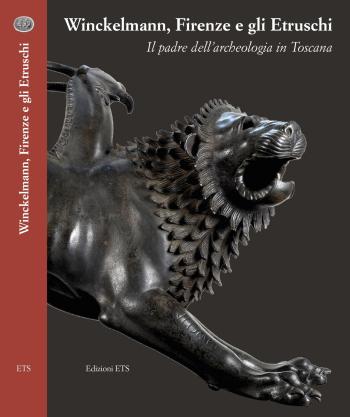
Barbara Arbeid, Stefano Bruni, Mario Iozzo, eds., Winckelmann, Firenze e gli Etruschi: Il padre dell’archeologia in Toscana / Winckelmann, Florenz und die Etrusker: Der Vater der Archäologie in der Toskana (Pisa: Edizioni ETS, 2016), 347 pages, ISBN: 978 8846745187 (Italian) / ISBN: 978 8846745194 (German), 28€.










 Enfilade
leave a comment