New Book | Hyacinthe Rigaud: Le Catalogue Raisonné
Published by Faton and available from Artbooks.com:
Ariane James-Sarazin, Hyacinthe Rigaud (1659–1743): Le Catalogue Raisonné, 2 volumes (Dijon: Faton, 2016), 1408 pages, ISBN: 978-2878441734, 320€ / $395.
 Fruit d’années de recherches, l’ouvrage en deux volumes d’Ariane James-Sarazin, archiviste, conservateur en chef du patrimoine et directrice des musées d’Angers, s’impose comme une étape décisive dans l’histoire de l’art moderne. Pour la première fois, l’auteur propose le catalogue exhaustif des oeuvres du grand peintre français Hyacinthe Rigaud (Perpignan, 1659 – Paris, 1743) : plus d’un millier de numéros organisés chronologiquement, tous rigoureusement étudiés, dévoilent bien des aspects méconnus du portraitiste des élites européennes, à travers peintures, dessins, répliques, copies et gravures. Les amateurs d’art exigeants et passionnés y trouveront l’étude la plus complète jamais publiée sur le peintre et son oeuvre, et une analyse inédite de la peinture, de la société au tournant du Grand Siècle et du siècle des Lumières. Le catalogue est précédé d’une biographie complète du peintre, établie avec une méthodologie rigoureuse, déjà saluée par les spécialistes pour les précédents travaux d’Ariane James-Sarazin sur l’artiste, ainsi que d’une étude fouillée sur la clientèle, le processus de création, l’oeuvre et son évolution. De nombreuses annexes complètent cette somme d’érudition : iconographie du peintre, chronologie raisonnée, généalogies, dictionnaire inédit des élèves et collaborateurs, aperçu de la fortune critique, table de concordances avec l’édition des livres de comptes de Joseph Roman en 1919, sources commentées, bibliographie, pièces justificatives et plusieurs index. Marqueur de l’évolution de la mode et des textiles, révélateur des intrigues de Cour, objet du paraître social, symbole de l’image royale, le portrait, miroir des enjeux d’une époque, offre une mine d’informations aux disciplines connexes de l’histoire de l’art.
Exhibition | From Alcove to Barricades, From Fragonard to David
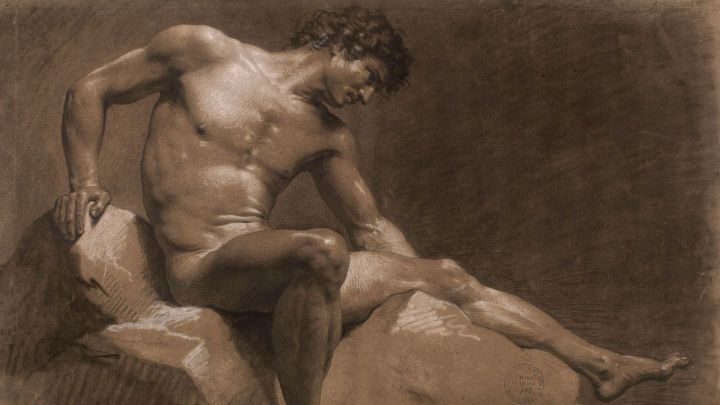
Jean-Baptiste Isabey, Academy Figure of a Nude Man Seated, Resting on his Left Arm, 1789, black chalk with stumping and white chalk heightenings on brown paper, 46.8 × 60.7 cm (Collection des Beaux-Arts de Paris / photo Thierry Ollivier)
◊ ◊ ◊ ◊ ◊
Now on view at the Fondation Custodia:
From Alcove to Barricades, From Fragonard to David: Drawings from the École des Beaux-Arts
De l’alcôve aux barricades, De Fragonard à David: Dessins de l’École des Beaux-Arts
Fondation Custodia, Paris, 15 October 2016 — 8 January 2017
Curated by Emmanuelle Brugerolles
Renowned for its precious drawings collection, the École des Beaux-Arts de Paris collaborates with the Fondation Custodia in the context of its Bicentennial celebration, presenting this autumn at 121 rue de Lille one of the most glorious components of its collections. With 145 drawings, the exhibition From Alcove to Barricades presents an ambitious historical survey of art in the second half of the 18th century.

Jacques-Louis David, Head of a Plague Victim, 1780, pen and black ink over a sketch in black chalk, 21.3 × 15.2 cm (Collection des Beaux-Arts de Paris)
The selected works cast light on a period of historical as well as artistic turmoil. From the last decades of the reign of Louis XV (1715–1774) to the close of the revolutionary period (1789–1799), we observe the transition from a monarchy to the Republic: a world that shifts from the space of the court occupied by the nobility to that of the city where the notion of citizenship prevails. Following suit, the arts pass through multiple transformations. This process was long considered a clear break between two opposing styles: rocaille (or rococo)—defined at the time as a feminine style owing to its arabesques, whims and at times extravagance—and neoclassicism, a masculine style whose noble simplicity is inspired by the Antique.
Arranged according to seven thematic chapters—academic training, Roman sojourn, genre scenes, history painting, landscape in France, architectural drawing, and decorative arts—the exhibition reveals a more complex situation.
The great number of masterpieces assembled here for the first time evoke this diversity of styles and approaches. They also enable us to follow the careers of the artists who played a role in these developments. We discover them during their training at the Académie Royale de Peinture et de Sculpture in their large-format nude studies after live models and drawings done for the competition for a Tête d’expression (a face depicting an emotion). A number of awards established in the second half of the 18th century, aimed at inspiring emulation among the Academy’s pupils in order to regenerate the arts, offered young artists opportunities to gain recognition.
We then follow these draughtsmen to Palazzo Mancini, the seat of the Académie de France in Rome, where they were pensionnaires. Whether copies of ancient and modern masters or views of classical ruins, gardens and recently discovered sites, the Beaux-Arts sheets reveal the motifs that impressed French artists during their stay in Italy.

Anne-Louis Girodet, Étude pour la Scène de déluge, figure de la mère, pierre noire et rehauts de craie blanche, 53.7 × 43.9 cm (Collection des Beaux-Arts de Paris)
On their return to France we see these artists obtain official recognition through important State commissions and trying to satisfy the changing taste of connoisseurs. Employing the strategies of history painting—expressive intensity, narrative clarity and theatrical layout—Jean-Baptiste Greuze (1725–1805) renews the genre scene, evoking everyday dramas in moralising tones. His art, admired by the public of the Salon and Denis Diderot, is illustrated in the exhibition by a number of drawings.
Ranging from the scenes à la grecque by Joseph-Marie Vien (1716–1809) to the large neoclassical compositions by Jacques-Louis David (1748–1825) that inspired an entire generation of painters, the drawings shown in the next section allow us to follow the evolution of history painting as it gradually leaves behind amorous and sensual mythological subjects to explore heroic scenes drawn from ancient history. Indeed, since the mid-18th century rocaille art was highly criticised by scholars, such as the German art historian Winckelmann, and members of the artistic community. The Academy sought to resume ties with the Grand Genre by proposing Antiquity as the model to follow, as it had been in Poussin’s day.
Whether impressive designs—sometimes several metres long—sketched for the competitions organised by the Académie royale d’architecture, or inventions of imaginary buildings in the manner of Piranesi’s capricci, most of the works that introduce the sixth chapter of the exhibition are sheer graphic elaborations. They attest to the autonomy of architectural drawing in the second half of the 18th century and the beginning of a new form of urban planning around public buildings that offered citizens a richer social and cultural life.
In the exhibition’s final section, devoted to the decorative arts, many drawings are preparatory for engravings forming collections of models, a flourishing genre at the time, while others were used directly to make furniture or ornaments. Through these works we can measure the influence of classical art in the evolution of the repertory of decorative motifs. Although characterised by a return to the straight line and a certain restraint, neoclassicism remained open to the lasting taste for the pleasing and the exotic, the legacy of the rocaille style.
From academic exercises to large-format preparatory studies for paintings, sculpture, furniture and architecture, these drawings thus encompass all the arts. They place us at the heart of the artistic practices and creative processes prevalent in a society undergoing profound transformations.
Emmanuelle Brugerolles, ed., De l’alcôve aux barricades, De Fragonard à David: Dessins de l’École des Beaux-Arts (Paris: Beaux-Arts de Paris éditions, 2016), 400 pages, ISBN: 978 2840564904, 39€.
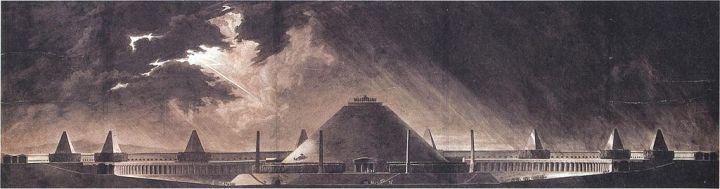
Pierre-François-Léonard Fontaine, Sepulcral monument: Section of the overall monument and elevation of the central pyramid, 1785, pen and black ink, grey wash, 76.5 x 275 cm (Collection des Beaux-Arts de Paris)
Prado Commission Awarded to Norman Foster and Carlos Rubio
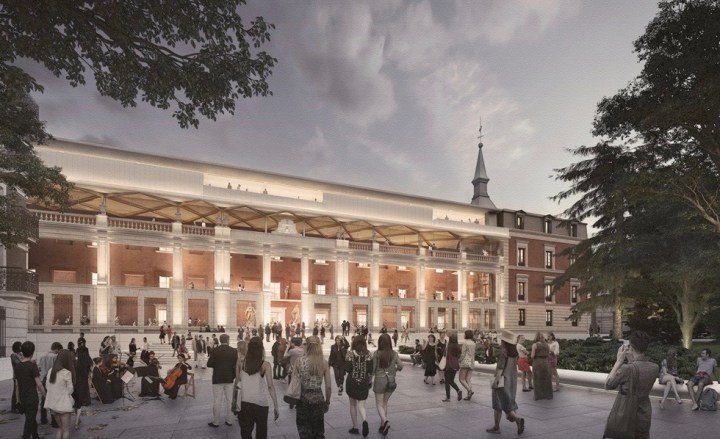
Foster + Partners and Rubio Arquitectura, ‘Hidden Design’: Winning Proposal for the Restoration and Remodeling of the Salón de Reinos Museo del Prado, announced November 2016.
◊ ◊ ◊ ◊ ◊
Press release (24 November 2016) from the Prado:
Architects Norman Foster and Carlos Rubio have been announced as winners of the projects competition to remodel the Hall of Realms at the Museo del Prado. The Museum will exhibit the winning proposal along with those of the other seven teams of finalists from 1 December.
 Iñígo Méndez de Vigo, Minister of Education, Culture and Sport, led the plenary meeting of the Royal Board of Trustees of the Museo del Prado in which the jury announced the winner of the international competition for the architectural restoration and museological remodelling of the Salón de Reinos [Hall of Realms] of the former Buen Retiro palace. The winning proposal is the one presented by the team of Foster + Partners LTD and Rubio Arquitectura SLP, as decided at the jury’s meeting on 22 November.
The winning proposal, entitled Hidden Design, makes maximum use of the building’s museological aspect and creates a large entrance atrium on the south façade, making this space semi-open and permeable to the exterior but sufficiently controlled for it to function to protect the original façade of the Hall of Realms, the windows and balconies of which will be reinstated. Emerging over the top of this façade will be a large exhibition space on the third floor, which is higher and wider than the present one, forming the roof of the atrium and a terrazza facing the Museum’s ‘campus’. The winning design fully responds to the spatial requirements specified by the Museum for this project, without the need to excavate new basement levels. It emphasises the historical spaces that form the core of the building, particularly the Hall of Realms. Similarly, it strengthens and consolidates the identity of the Museo del Prado campus, proposing a pedestrian section of the Retiro Park—Paseo del Prado axis along calle Felipe IV which will revitalise its connection with the city.
In its decision statement the jury singled out the principal merits of this project as the high quality of the architectural proposal, which respects and emphasises the pre-existing structure, adapting it to present-day requirements; the intelligent way in which this project meets museological requirements; the skilled integration of the building into its surroundings and into the overall context of the Museo del Prado campus; and the project’s efficient cost study.
The aim of the competition of which the winner has now been announced and which was originally published in the Boletín Oficial del Estado on 1 March 2016, was to select the architectural team to devise the project to restore and refit the Hall of Realms, part of the lost Buen Retiro palace and the former home of the Museo del Ejército [Army Museum]. This building was formerly passed to the Museo del Prado in October 2015.
The competition, entered by 47 teams of architects, has consisted of two parts. The first, open part ended in June with the selection of eight teams:
• CRUZ Y ORTIZ ARQUITECTOS, SLP
• NIETO SOBEJANO ARQUITECTOS, SLP
• UTE: B720 ARQUITECTURA, SL – DAVID CHIPPERFIELD ARCHITECTS
• OFFICE FOR METROPOLITAN ARCHITECTURE (OMA) STEDEBOUW BV
• UTE: SOUTO MOURA ARQUITECTOS, SA – JUAN MIGUEL HERNÁNDEZ LEÓN – CARLOS DE RIAÑO LOZANO
• UTE: FOSTER + PARTNERS LTD – RUBIO ARQUITECTURA SLP
• UTE: GARCES DE SETA BONET ARQUITECTES, SLP – PEDRO FEDUCHI CANOSA
• UTE: GLUCKMAN TANG ARCHITECTS LLP – ESTUDIO ÁLVAREZ SALA, SLP – ARQUITECTURA ENGUITA Y LASSO DE LA VEGA, SLP
These teams devised their proposals for the second phase, presenting them on 31 October. In its decision statement, jury singled out the quality of all the projects presented, which will be displayed in the Cloister of the Museum’s Jerónimos Building from 1 December. Preparation of the project will commence in 2017 and is expected to take about 16 months. Building work will begin in 2018.

UTE: Foster + Partners LTD – Rubio Arquitectura SLP
This is a temporary alliance of the architectural studios Foster + Partners and Rubio Arquitectura. Foster + Partners was founded in 1967 by Norman Foster (born Manchester, 1935). With its headquarters in London, it has offices in 14 cities around the world including Hong Kong, New York, São Paulo, Singapore, and Madrid. Among Foster + Partners’ most important projects for museums are those undertaken for the Carré d’Art (Nîmes, 1993), the Great Court and Sainsbury Galleries in the British Museum (London, 2000), the Robert and Alene Kogod Courtyard at the Smithsonian Institution (Washington, D.C., 2007), the Boston Museum of Fine Arts (Boston, 2010), the Lenbachhaus (Munich, 2013), and the Imperial War Museum (London, 2014). Among numerous awards and honours, Norman Foster received the Pritzker Prize in 1999, the Mies van der Rohe Award for Contemporary Architecture in 1990, and the Gold Medal of the American Institute of Architects in 1994. The Prince of Asturias Prize for the Arts in 2009 recognised his entire career as an architect.
Rubio Arquitectura was founded in 2014 by the architect Carlos Rubio Carvajal (born Barcelona, 1950) and has its headquarters in Madrid. The studio is currently working on various projects in Spain and abroad, including Russia and Saudi Arabia. Awards include the COAM Architecture Prize in 1989.
Exhibition | Antonio Balestra: Nel Segno della Grazia
Now on view in Verona:
Antonio Balestra: Nel Segno della Grazia / In the Sign of Grace
Museo di Castelvecchio, Verona, 19 November 2016 — 19 February 2017
 Il Comune di Verona, Direzione Musei d’Arte e Monumenti honors the painter Antonio Balestra (1666–1740) on the occasion of the 350th anniversary of the artist’s birth with the exhibition Antonio Balestra: In the Sign of Grace, staged in the Castelvecchio Museum. The exhibition presents over sixty works: paintings, drawings, etchings, and volumes of prints, coming from public and private lenders.
Andrea Tomezzoli, Antonio Balestra: Nel Segno della Grazia (Verona: Scripta Edizioni, 2016), 208 pages, ISBN: 978-8898877690, $38.
Workshop | Etching for Curators and Researchers

From the workshop flyer:
Etching: A Practice-Based Workshop for Curators and Researchers
Gainsborough’s House, Sudbury, Suffolk, 29–30 March 2017
Convened by Jason Hicklin and Peter Moore
Join us for a two-day workshop at Gainsborough’s House that will bring together professionals whose work deals with prints—and in particular, etchings. Through a series of practical sessions in the Gainsborough’s House Print Workshop, accompanied by discussions around works from the collection, participants will gain a better appreciation of the materiality of etchings and a more nuanced understanding of how these processes have been applied and adapted by different artists at different times. The conception of this workshop represents a methodological shift in the academic study of prints, in which object-led and practice-based forms of research are increasingly recognised as valuable components of an art-historical education—especially for those who care for or interpret prints in a curatorial capacity.
Day one (Wednesday) will explore the processes of hard ground and soft ground etching. The first of these techniques, developed in the early sixteenth century, was mastered by artists such as Dürer and Rembrandt and came to occupy a central role in the history of western European art. The innovation of soft ground etching occurred later, in the second half of the eighteenth century, and was particularly popular in Britain; Gainsborough was among its earliest pioneers.
Day two (Thursday) will focus on aquatint, developed in the 1770s. As a tonal method, aquatint presented printmakers with a range of new possibilities for image making. Since its conception, it has been considered as a complementary technique to soft ground etching, and Gainsborough often used it in this way. The popularity of aquatint has continued into the modern era, with the sugar-lift process being favoured by Picasso.
The course will be jointly convened by Jason Hicklin, Lead Tutor and Head of Printmaking at the City & Guilds of London Art School, and Dr Peter Moore, Research Curator at Gainsborough’s House. Each day will run from 10am to 4pm. The cost is £180 (inc. VAT) and includes lunch and refreshments, but not accommodation. For further enquiries and to reserve your place, please contact peter@gainsborough.org. Limited places are available, so early booking is advised.
Journées d’Étude | Académies d’Art et Mondes Sociaux, 1740–1805
From the conference programme:
Académies d’Art et Mondes Sociaux, 1740–1805
Fonder les institutions artistiques : l’individu, la communauté et leurs réseaux
Centre Allemand d’Histoire de l’Art, Paris, 8–9 December 2016
 Le XVIIIe siècle connaît un mouvement inédit de fondation d’écoles de dessin et d’académies d’art dans toutes les régions en France. Le phénomène émerge à partir des années 1740 à Rouen et à Toulouse puis se déploie sur l’ensemble du territoire. Il est le fait de quelques hommes déterminés, qui s’inscrivent à la suite des grands projets colbertiens de modernisation de l’État. Ils agissent dans un jeu de tension entre pouvoirs municipaux et autorité royale, ambitions personnelles et intérêts communautaires, projet pédagogique et visée commerciale. Comment naissent ces institutions et quel rôle y prend l’individu selon son rang, ses activités, son milieu ? Quelles stratégies sont mises en œuvre pour donner un cadre juridique et une légitimité sociale à ces établissements ? Quelles logiques président à leur fondation, ces écoles étant pensées comme des structures-clef de la formation et des échanges artistiques, mais aussi comme des viviers d’artistes, d’artisans et d’entrepreneurs prêts à développer des centres de production en Europe. De quelle manière le « modèle » de l’Académie royale de peinture et de sculpture est-il utilisé ou, à l’inverse, contourné devant les contraintes et les logiques locales ?
Ces journées d’étude, premier volet d’une série consacrée aux réseaux des académies d’art, seront l’occasion de questionner la genèse des institutions à travers le prisme de l’individu. En prenant l’exemple de quelques figures phare—entendues comme les ego et leurs alter engagés dans des liens aux configurations multiples, notamment familiales, amicales, socio-professionnelles—nous interrogerons l’épaisseur et l’efficacité des relations humaines dans la construction et l’organisation des établissements. Dans un aller-retour permanent entre l’individuel et le collectif, il s’agira aussi de réfléchir à la fonction des structures institutionnelles comme régulateur social. L’objectif est donc d’accompagner une relecture du mouvement académique à l’appui d’outils d’analyse encore peu usités. Les intervenants s’attacheront à la fois à examiner les sources qui documentent l’ouverture des écoles (correspondances, lettres patentes, etc.) et à déterminer les réseaux sociaux activés.
Issu d’un partenariat scientifique entre le programme de recherche ACA-RES (Les Académies d’art et leurs réseaux dans la France pré-industrielle, soutenu par le Labex Structuration des Mondes Sociaux de l’Université de Toulouse et la MSH-T2) et le Centre allemand d’histoire de l’art de Paris, cette journée d’étude entend privilégier le dialogue entre spécialistes et jeunes chercheurs.
Comité d’organisation
Markus Castor (Centre allemand d’histoire de l’art)
Anne Perrin-Khelissa (Université Toulouse – Jean Jaurès, Laboratoire FRAMESPA UMR 5136)
Émilie Roffidal (CNRS, Laboratoire FRAMESPA UMR 5136)
◊ ◊ ◊ ◊ ◊
J E U D I , 8 D É C E M B R E 2 0 1 6
17.30 Ouverture — Thomas Kirchner, directeur de Centre allemand d’histoire de l’art Paris
Conférence introductive — Christian Michel, Université de Lausanne, Les relations complexes entre l’Académie royale de peinture et de sculpture et les autres académies du royaume
18.30 Apéritif dinatoire pour les participants
V E N D R E D I , 9 D É C E M B R E 2 0 1 6
Intervenants de la journée
• Aude Gobet (musée du Louvre), L’académie de Rouen
• Arianne James-Sarazin, L’école de dessin d’Angers
• Gaëtane Maës (université de Lille 3), Les académies de Lille et Valenciennes
• Laëtitia Pierre et Gérard Fabre (musée des beaux-arts de Marseille), L’académie de Marseille
• Fabienne Sartre (université Paul-Valéry-Montpellier 3), L’académie de Toulouse
• Elsa Trani (université Paul-Valéry-Montpellier 3), L’académie de Montpellier
• Nelly Vi-Tong (université de Bourgogne), L’académie de Dijon
9.00 Accueil par Markus Castor, Anne Perrin Khelissa, Emilie Roffidal
9.20 Séance de travail 1 : les hommes
Il s’agira de mettre l’accent sur le rôle des individus dans la création des écoles de dessins et des académies artistiques. Nous interrogerons notamment leur origine sociale, leur carrière, leur entregent, etc.
10.20 Pause
11.30 Table-ronde avec l’ensemble des intervenants et les organisateurs
12.30 Pause déjeuner
14.00 Séance de travail 2 : les textes fondateurs
Au cours de cette séance, les textes fondateurs des établissements (lettres patentes, statuts, règlements et d’autres sources) seront examinés pour en questionner les contenus, les objectifs et leurs évolutions.
15.15 Pause
16.15 Table-ronde avec l’ensemble des intervenants et les organisateurs
17.00 Conférence conclusive — Nathalie Heinich (EHESS), Le phénomène académique : une approche sociologique
New Book | Women Artists in Early Modern Italy
From Brepols:
Sheila Barker, ed., Women Artists in Early Modern Italy: Careers, Fame, and Collectors (Turnhout: Harvey Miller, 2016), 181 pages, ISBN: 978-1909400351, $125.
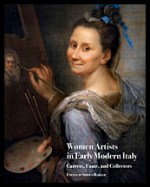 Enhancing our understanding of early Italian female painters including Sofonisba Anguissola and introducing new ones such as Costanza Francini and Lucrezia Quistelli, this volume studies women artists, their patrons, and their collectors, in order to trace the rise of the social phenomenon of the woman artist.
In ten chapters spanning two centuries, this collection of essays examines the relationships between women artists and their publics, both in early modern Italy and across Europe. Drawing upon archival evidence, these essays afford abundant documentary evidence about the diverse strategies that women utilized in order to carry out artistic careers, from Sofonisba Anguissola’s role as a lady-in-waiting at the court of Philip II of Spain, to Lucrezia Quistelli’s avoidance of the Florentine market in favor of upholding the prestige of her family, to Costanza Francini’s preference for the steady but humble work of candle painting for a Florentine confraternity. Their unusual life stories along with their outstanding talents brought fame to a number of women artists even in their own lifetimes—so much fame, in fact, that Giorgio Vasari included several women artists in his 1568 edition of artists’ biographies. Notably, this visibility also subjected women artists to moral scrutiny, with consequences for their patronage opportunities. Because of their fame and their extraordinary (and often exemplary) lives, works made by women artists held a special allure for early generations of Italian collectors, including Grand Duke Cosimo III de’ Medici (1642–1723), who made a point of collecting women’s self-portraits. In the eighteenth century, British collectors wishing to model themselves after the Italian virtuosi exhibited an undeniable penchant for the Italian women artists of a bygone era, even though they largely ignored the contemporary women artists in their midst.
Sheila Barker directs the Jane Fortune Research Program on Women Artists at the Medici Archive Project, the first archival program of its kind. Her publications of documentation on women artists have shed light on Lucrezia Quistelli, Artemisia Gentileschi, Irene Parenti Duclos, and the phenomenon of female copyists.
◊ ◊ ◊ ◊ ◊
C O N T E N T S
1 Editor’s Preface, Sheila Barker (The Medici Archive Project)
2 ‘Piu che famose’: Some Thoughts on Women Artists in Early Modern Europe, Sheila ffolliott (George Mason University, emerita)
3 Sofonisba Anguissola at the Court of Philip II, Cecilia Gamberini (Universidad Autonoma de Madrid Felsina Cattòlica)
4 Sofonisba Anguissola, ‘Pittora de Natura’: A Page from Van Dyck’s Italian Sketchbook, Barbara Tramelli (Max Planck Institute, Berlin)
5 Lucrezia Quistelli (1541–1594): A Noblewoman and Artist in Vasari’s Florence, Sheila Barker (The Medici Archive Project)
6 Arcangela Paladini and the Medici, Lisa Goldenberg Stoppato (Independent Scholar)
7 Costanza Francini. A Painter in the Shadow of Artemisia Gentileschi, Julia Vicioso (Archivio Storico dell’Arciconfraternita dei Fiorentini)
8 A Newly Discovered Late Work by Artemisia Gentileschi: Susanna and the Elders of 1652, Adelina Modesti (La Trobe University)
9 The Medici’s First Woman Court Artist: The Life and Career of Camilla Guerrieri Nati, Eve Straussman-Pflanzer (The Davis Museum, Wellesley College)
10 Female Painters and Cosimo III de’ Medici’s Art Collecting Project, Roberta Piccinelli (Univerity of Teramo)
11 The English Collectors of Italy’s Female Old Masters, 1700–1824, Nicole Escobedo (Independent Scholar)
Exhibition | The Artist
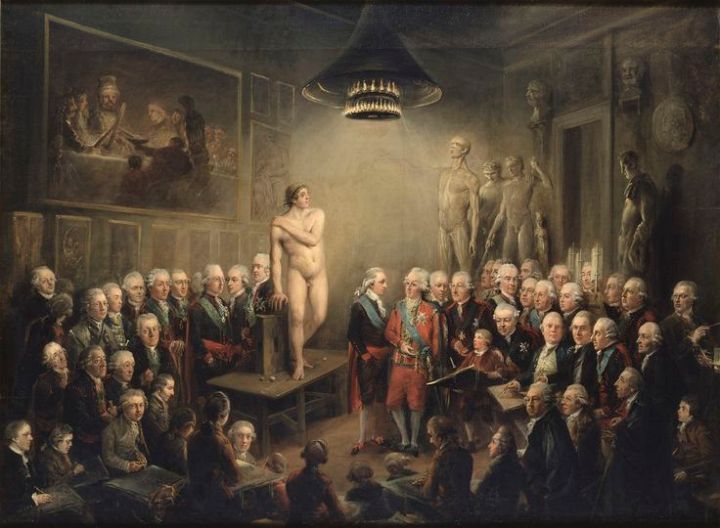
Elias Martin, King Gustav III Visits the Academy of Fine Arts in 1780, 1782, oil on canvas, 99 × 135 cm
(Stockholm: Nationalmuseum)
◊ ◊ ◊ ◊ ◊
Now on view at the Moderna Museet in Malmo:
The Artist / Konstnären
Konstakademien (Royal Academy of Fine Arts), Stockholm, 11 February — 11 September 2016
Moderna Museet, Malmö, 24 September 2016 — 19 February 2017
Throughout history, artists have played a wide variety of different roles. It’s a huge leap from the courtly painter who works on commission to the bohemian who refuses to rely on the approval of high society. This exhibition explores a number of different roles for artists, and also uncovers some of the myths that surround them.
How independent was the bohemian really? What kinds of new standards and rules have emerged within the avant-garde of modern art? And where did the idea of the free, creative, male genius come from? Women artists have often been portrayed as ‘exceptional anomalies’ in the history of art, but this exhibition shows just how numerous and how influential they have been, and how in the 1870s and 80s they shook up the preconception of the artist as a role for men.

Alexander Roslin, The Artist and His Wife Marie Suzanne Giroust Painting the Portrait of Wilhelm Peill, 1767, oil on canvas 131 × 98.5 cm (Stockholm: Nationalmuseum).
In more recent times, many artists have played the role of entrepreneur. Jeff Koons and Ernst Billgren work as modern businessmen in a commercial market economy. But the entrepreneurial artist has historical roots. Rosa Bonheur and Anders Zorn were both skilled painters as well as extremely competent when it came to building up their own personal brands, which helped them achieve great success in the international art market at the end of the nineteenth century. Entrepreneurial artists played an important role in seventeenth-century Holland as well.
During the eighteenth and nineteenth centuries, it was the values of the art academies of Europe that set the standard in the art world. Artists in these academies were trained in reproducing the classical ideals. Today the research conducted in university art schools is an example of a new form of academic work for artists.
This exhibition illuminates how artists relate to travel and to encounters with other cultures. In some cases an artist’s view of foreign cultures may be full of clichés and stereotypes. But there are also plenty of examples of artists who have worked to expose underlying power structures and standards in their encounters with other cultures.
Many artists throughout history have seen themselves as visionaries or prophets. Feminist artists such as Siri Derkert and Gittan Jönsson have worked both with criticism of contemporary society and with politically charged visions of the future. Other artists have been preoccupied with visions of a more spiritual nature, including Hilma af Klint and Vassilij Kandinskij.
This exhibition is a collaboration between Moderna Museet, the Royal Academy of Fine Arts, and the National Museum of Fine Arts. We want to show how powerful it is when we allow our collections from different eras to meet, and then complement that mix with a number of key works on loan.
Anne Dahlström, Margareta Gynning, Per Hedström, Carl-Johan Olsson, Andreas Nilsson, John Peter Nilsson, and Eva-Lena Bengtsson, Konstnären / The Artist (Stockholm: Nationalmuseum, 2016), 130 pages, ISBN: 978–9171008626, SEK149.
Exhibition | Portrait of the Artist

Press release (6 September 2016) from the Royal Collection Trust:
Portrait of the Artist
The Queen’s Gallery, Buckingham Palace, London, 4 November 2016 — 17 April 2017
The Queen’s Gallery, Palace of Holyroodhouse, Edinburgh, TBA
The first-ever exhibition of portraits of artists in the Royal Collection examines the changing image of the creative genius through more than 150 paintings, drawings, prints, photographs and decorative arts. Portrait of the Artist explores themes such as the cult of the artistic personality, the artist at work, and artists’ self-portraits.
From the 16th century, artists rose from the ranks of skilled artisans to a more elevated social status, a change in part influenced by royal patronage. The medieval tradesmen’s guilds were replaced first by workshops run by a master and subsequently by the first art academies. The lives of the most successful artists were recorded for posterity in the new literary genre of artists’ biographies. One of the most important collections of biographies from this period was Giorgio Vasari’s Delle vite de’ piu eccellenti pittori, scultori et architettori (1568), which described the lives of over 150 artists including that of the author. As artists became more prominent in society, a market developed for images of those deemed to be exceptional by virtue of their artistic talent. At the same time, artists increasingly saw self-portraiture as a way of demonstrating their skills to potential collectors and asserting their new standing in the world.
Images of artists became a valuable commodity, keenly acquired by monarchs and other influential patrons. The inventory compiled by Charles I’s Surveyor of Pictures in the late 1630s shows that three of the most important artists’ portraits owned by the monarch, including self-portraits by Daniel Mytens (c.1630) and Sir Peter Paul Rubens (1623), hung outside the King’s Withdrawing Room at Whitehall Palace. The 1666 inventory of Charles II’s collection lists 24 portraits of artists in “the Pafsage betweene ye Greene Roome and ye Clofet.” In this most intimate part of the royal apartments, accessible only to the King’s closest acquaintances and family, were Artemisia Gentileschi’s Self-portrait as the Allegory of Painting (La Pittura) (c.1638–39), Rubens’s self-portrait (1623) and portrait of his former assistant Anthony van Dyck (c.1627–28).
During the 17th century, general advancements in optics and practical developments in the production of mirrors enabled artists to be increasingly experimental and ambitious in their self-portraits. Artemisia Gentileschi used two mirrors to capture herself from an unusual angle for her powerful self-portrait as the personification of Painting, a remarkably unorthodox representation of a woman at this early date.
Artists frequently incorporated their own image into their works, as major players in historical and mythological narratives or through more subtle means. In Judith with the Head of Holofernes (1613), the painter Cristofano Allori appears as the decapitated Holofernes, his former lover Maria di Giovanni Mazzafiri is the murderous Judith, and her mother is Judith’s maidservant. Jan de Bray’s The Banquet of Cleopatra (1652) is a thinly disguised family portrait in which the artist casts his father Salomon de Bray, also a successful painter, in the role of Mark Antony.

Jean-Étienne Liotard, Self-Portrait, ca. 1753, enamel (London: Royal Collection Trust, RCIN 421436).
Through the choice of costume, gesture, props and setting, a self-portrait enabled an artist to take on a variety of roles. After visiting the Levant in 1738–43, the painter Jean-Étienne Liotard adopted a style of clothing for which he was to become known as ‘Le Peintre Turc’. His unconventional appearance—the Moldavian fur headdress and long beard seen in his self-portrait miniature of 1753—was thought by some to have contributed to his commercial success.
For young artists without the funds to pay a professional model, self-portraiture was a convenient way to practice their drawing skills. Annibale and Agostino Carracci’s self-portraits of c.1575–80 were probably produced by the teenage artists to hone their talents in this way. Some self-portraits appear to have been produced solely for the purpose of self-scrutiny. In a chalk drawing, possibly executed at the age of 80 in the final year of his life, Gianlorenzo Bernini records his hooded eyes and sunken cheeks with unflinching honesty.
The relationship between contemporaries in the art world is explored in the exhibition through representations of artists by their friends, admirers and pupils. Francesco Melzi’s chalk drawing of the aged Leonardo da Vinci (c.1515) is thought to be the most reliable surviving likeness of his teacher. Rubens’s portrait of his former assistant and lifelong friend Van Dyck shows the artist in three-quarter profile, his gaze averted to make him appear reflective, in contrast to the confident figure presented in Van Dyck’s self-portraits. The friendship between the engraver Francesco Bartolozzi and the painter Giovanni Battista Cipriani, Italian artists working in London, is recorded in charming pencil sketches that the pair made of each other in 1770—one painting, the other dozing in a chair.
In the 19th century, romanticised episodes from the lives of famous artists from the past were popular subject-matter. Johann Michael Wittmer’s Raphael’s First Sketch of the ‘Madonna della Sedia’ (c.1853) depicts the fable of how the Renaissance master came to create one of his best-known works on the base of a wine barrel. Frederick Leighton’s monumental work Cimabue’s Madonna Carried in Procession (1855) encapsulates the Victorian artist’s belief that, during the Renaissance, great art was appreciated at all levels of society and artists were held in high esteem, their genius widely acknowledged.
◊ ◊ ◊ ◊ ◊
In the US and Canada, the catalogue is distributed by The University of Chicago Press:
Anna Reynolds, Lucy Peter, and Martin Clayton, Portrait of the Artist (London: Royal Collection Trust, 2016), 240 pages, ISBN: 978-1909741324, $48.
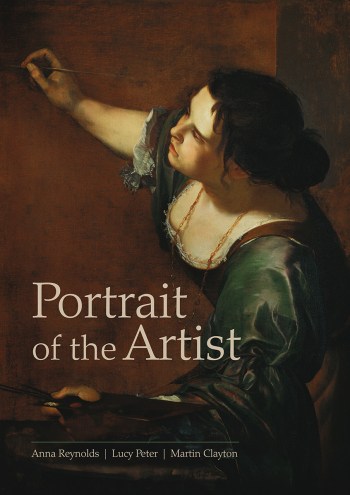 Dürer’s Self-Portrait at Age Twenty-Eight. Hockney’s Self-Portrait with Cigarette. Melzi’s drawing of Leonardo da Vinci, widely regarded as the most reliable surviving likeness of this most famous Old Master. Throughout history, many of the world’s most renowned artists have made portraits to represent themselves and others.
The first book to focus on images of artists from within the Royal Collection, Portrait of the Artist brings together paintings, drawings, prints, and photographs by artists from across the centuries, including works by Rembrandt van Rijn, Peter Paul Rubens, David Hockney, and Lucian Freud. While some of the portraits included in this book were created to showcase the artist’s talent, others were motivated by more personal reasons, to preserve the images of cherished friends. Anna Reynolds, Lucy Peter, and Martin Clayton explore the miscellany of themes running throughout the discipline of portraiture, from the rich symbolism found in images of the artist’s studio to the transformation of styles with which artists depicted themselves, changing their portrayals to align with their changing status. They also explore the relationships between artists and patrons, including the important role of the monarchy in commissioning and collecting portraits of artists.
New Book | Chinese and Japanese Works of Art in the Royal Collection
Published by the Royal Collection Trust and distributed in the U.S. and Canada by Chicago:
John Ayers, Chinese and Japanese Works of Art in the Collection of Her Majesty The Queen, 3 volumes (London: Royal Collection Trust, 2016), 1296 pages, ISBN: 978-1905686490, £150 / $250.
 The Royal Collection includes some of the most important examples of Eastern applied art in the Western world, reflecting the West’s long-standing appetite for rarities from distant lands. With more than 2,000 objects distributed across the royal residences in England and Scotland, the collection represents a rich cross-section of Chinese and Japanese porcelains, jades, lacquers, and other works of art.
This three-volume catalogue raisonné covers this substantial and important collection in comprehensive detail. It includes for the first time the many eighteenth- and nineteenth-century bronze mounts that are such a striking feature of the collection. Made in French and British workshops to enhance the objects they display, the mounts themselves are often of superb quality and of great historical importance.
More than 2,400 colour images are used to illustrate the collection, including intricate decorative details and makers’ marks. Introductory essays cover the history and development of the collection and the ways in which these works of art have been displayed in the royal palaces and adapted according to the fashions of the day.
Volume One presents the Chinese ceramics of the Ming and Qing dynasties in chronological order (continued in Volume Two). In addition, due to their unique historical significance, the contents of the collection at Hampton Court Palace are presented here separately. Volume Two continues the works of the Qing dynasty, and ends with the Japanese works; the volume also contains a special focus on the European mounts that were added to works of Chinese and Japanese porcelain during the eighteenth and early nineteenth centuries. Volume Three contains non-porcelain works, namely lacquer, jade and other hardstones, carved ivories, textiles and metalwork. Many of these works came into the Royal Collection as Imperial gifts, to George III, Queen Victoria, King Edward VII, and Queen Alexandra, with the exception of the Japanese lacquer wares, which were acquired for George IV to furnish the Royal Pavilion at Brighton. Although not much studied, these pieces were admired by the royal family, and Chinese rooms were created at Windsor and Sandringham House, decorated with an eclectic mixture of European chinoiserie and authentic works of Asian art.










 Enfilade
leave a comment