Buckingham Palace Slated for £369Million Renovation

Buckingham Palace, London. The East Front, originally constructed by Edward Blore and completed in 1850, acquired its present appearance following a remodeling in 1913 by Sir Aston Webb (Photo by David Iliff, April 2009, License: CC-BY-SA 3.0, Wikimedia Commons).
◊ ◊ ◊ ◊ ◊
As reported by Stephen Castle for The New York Times (19 November 2016) . . .
The boilers are shot, the water pipes sag, and the 60-year-old cabling is a fire hazard. Buckingham Palace, home to Queen Elizabeth II, may not exactly be falling down, but it badly needs refurbishing, the British government said on Friday, citing “a serious risk of fire, flood and damage.” Renovations on the building will start in April and will take a decade to complete, at a cost of £369 million ($456 million). The announcement adds to the list of prestigious structures in Britain that need work, including the crumbling Palace of Westminster, home of the British Parliament.
The building that would become Buckingham Palace was built in the early 1700s and became a royal residence when George III bought it in 1761. The queen carries out most of her official ceremonial and diplomatic duties as head of state in the palace. She would not have to move out while the work was in progress, officials said. . . .
The full article is available here»
Writing for The Guardian, Caroline Davies addresses in more detail the financial arrangements, including the controversies around spending £369 million in a time of austerity.
The Morgan Launches Refreshed Website

Press release (17 November 2016) from The Morgan:
The Morgan Library & Museum today announced the launch of a refreshed website. The updated look for themorgan.org offers a sleek, contemporary design, and also introduces features that make the site more compatible across platforms: mobile, tablet, and desktop computers. The unveiling of the new design coincides with the ten-year anniversary of the Morgan’s 2006 expansion, and is the first major makeover since then.
Digital initiatives at the Morgan are part of a larger strategic undertaking to expand access to the institution’s holdings. The upgrades to the Morgan’s website represent a significant development for scholars, students, and members of the general public interested in accessing the Morgan’s vast collections. Prior to undertaking digitization initiatives, the Morgan’s collection had been available on a select basis onsite at the museum’s New York headquarters, while some of the works have been published in various museum catalogs. Digitization efforts enable access to the collection from anywhere in the world and includes a zoom feature to study individual works in detail.
In recent years, almost 700 music manuscripts from its extraordinary collection—represented by such masters as Mozart, Beethoven, Bach, and Handel—have been digitized and made available on its website. The museum’s most ambitious undertaking—the digitization of its collection of over 14,500 drawings —began in Fall 2013, and as of today over 95% of this undertaking is complete, including a cache of over 500 Rembrandt prints and etchings. Additionally, the Morgan offers online access to illuminations from 823 Medieval and Renaissance manuscripts (including over 20,000 illuminations) and thousands of highlights from literary and historical manuscripts, rare books, and ancient near eastern seals and tablets, which can be rotated and zoomed. In the past six months, highlights that have been added include the entire collection of the Morgan’s Coptic bindings and the Lindau Gospels.
Looking ahead, the Morgan plans to continue sharing more objects from its vast collections through the website. Collections ranging from early Mesopotamian and Egyptian through Greco-Roman culture, the Middle Ages, the Renaissance, and beyond, will be further represented on the website. The music manuscripts pages will also be upgraded to provide more download options and improved navigation.
◊ ◊ ◊ ◊ ◊

Luigi Valadier, Drawing of an inkstand in Rococo Style, 1764, pen and brown ink, with brown and red wash, over graphite, on paper, 37.5 × 52.4 cm (New York: The Morgan Library & Museum, 1991.15, purchased on the Sunny Crawford von Bülow Fund 1978). Multiple filters (including ‘centuries’) accommodate collection searches.
New Book | The Learned Draftsman: Edme Bouchardon
From The Getty:
Édouard Kopp, The Learned Draftsman: Edme Bouchardon (Los Angeles: J. Paul Getty Museum, 2017), 336 pages, ISBN: 978-1606065044 , $65.
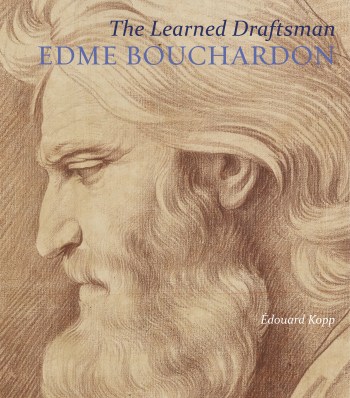 The celebrated French artist Edme Bouchardon (1698–1762) is primarily known as a sculptor today, but his contemporaries widely lauded him as a draftsman as well. Talented, highly innovative, and deeply invested in the medium, Bouchardon made an important contribution to the European art and culture of his time, and in particular to the history of drawing. Around two thousand of his drawings survive—most of which bear no relation, conceptual or practical, to his sculpture—yet, remarkably, little scholarly attention has been paid to this aspect of his oeuvre. This is the first book-length work devoted to the artist’s draftsmanship since 1910.
Ambitious in scope, this volume offers a compelling narrative that effectively covers four decades of Bouchardon’s activity as a draftsman—from his departure for Rome in 1723 as an aspiring student to his death in Paris in 1762, by which time he was one of the most renowned artists in Europe. His accomplished and dynamic style is analyzed and copiously illustrated in a series of five interrelated chapters that serve as case studies, each of which focuses on a coherent group of drawings from a particular period of Bouchardon’s career.
Edouard Kopp is the Maida and George Abrams Associate Curator of Drawings, Harvard Art Museums. He is the coauthor, with Scott Allan, of Unruly Nature: The Landscapes of Théodore Rousseau (Getty Publications, 2016) and the author of Capturing Nature’s Beauty: Three Centuries of French Landscapes (Getty Publications, 2009).
New Book | Les Rothschild: Une Dynastie de Mécènes en France
From Somogy:
Pauline Prévost-Marcilhacy, ed., Les Rothschild: Une Dynastie de Mécènes en France, 3 volumes (Paris: Somogy éditions d’Art, 2016), 1112 pages, ISBN: 978-2757202128, 290€.
 Grands collectionneurs et mécènes d’exception selon une tradition familiale « qui veut qu’à chaque génération, nous nous efforcions d’enrichir de notre mieux le patrimoine de notre pays », les Rothschild ont joué un rôle essentiel dans le domaine culturel depuis le dernier quart du XIXe siècle. L’ampleur de leur générosité à l’égard des musées et des collections publiques françaises—près de cent vingt mille œuvres d’art données à plus de deux cents institutions—est pour la première fois l’objet d’une publication d’envergure. De l’Antiquité à nos jours, toutes les périodes de l’histoire de l’art y sont représentées, ainsi que tous les continents et les domaines de création.
Pour mener à bien cet ambitieux projet, Pauline Prevost-Marcilhacy a réuni cinquante-trois spécialistes, conservateurs et universitaires, français et étrangers, qui explorent ici tous les aspects de ce mécénat exceptionnel.
Auteurs: Sous la direction de Pauline Prevost-Marcilhacy, Historienne de l’art – avec les textes de Mathilde Avisseau-Broustet (BNF), François Avril (BNF), François Baratte (Universitaire), Marc Bascou (Louvre), Blaise Ducos (Louvre), Gwenaëlle Fellinger (Louvre), Anne Forray-Carlier (Musée des Arts décoratifs), Pascale Gorguet-Ballesteros (Musée Galliéra), Dominique Hollard (BNF), Philippe Malgouyres (Louvre), Julie Olivier (BNF), Alain Pasquier (Louvre), Evelyne Possémé (Musée des Arts décoratifs), Marie-Hélène Tesnière (BNF), Dominique Thiébaut (Louvre), Dimitrios Zikos (Universitaire).
◊ ◊ ◊ ◊ ◊
V O L U M E 1 : 1 8 7 3 – 1 9 2 2
Les Rothschild: Une Dynastie de Mécènes en France
Edmond James de Rothschild (1845–1934)
• Edmond James de Rothschild
• Edmond James et Gustave de Rothschild, mécènes de l’archéologue et donateurs au musée du Louvre, 1873
• Le trésor de Boscoreale au musée du Louvre, 1895
• Dons de la baronne James Édouard et du baron Edmond James de Rothschild au département des Manuscrits de la Bibliothèque nationale, 1902–08
• Dons de costumes rares du baron et de la baronne Edmond James de Rothschild au musée Carnavalet et au musée des Arts décoratifs, 1906–08
• Le mécénat envers les artistes vivants, 1906–20
• Un ensemble de moucharabiehs au musée du Louvre et au musée des Arts décoratifs, 1920
Alphonse de Rothschild (1827–1905)
• Alphonse de Rothschild
• Le mécénat envers les artistes vivants en faveur des musées de région, 1895–1905
Charlotte de Rothschild (1825–1899) et Nathaniel de Rothschild (1812–1870)
• Charlotte et Nathaniel de Rothschild
• Dons et legs de la baronne Nathaniel de Rothschild, 1885–99
• Le goût pour la Renaissance italienne, musée du Louvre, 1899
• Un ensemble de coffrets en cuir au musée des Arts décoratifs, 1899
• Une collection de bijoux au musée des Arts décoratifs, 1899
Adolphe de Rothschild (1823–1900) et Julie de Rothschild (1830–1907)
• Adolphe et Julie de Rothschild
• L’art médiéval au musée du Louvre et au musée de Cluny, 1901
• Les objets de la Renaissance, musée du Louvre, 1901
James Édouard de Rothschild (1844–1881) et Thérèse de Rothschild (1847–1931)
• James Édouard et Thérèse de Rothschild
• Les manuscrits de la première rédaction des œuvres de Brantôme à la Bibliothèque nationale, 1903
• Monnaies et pierres gravées au Cabinet des médailles de la Bibliothèque nationale, 1903–04
Arthur de Rothschild (1851–1903)
• Arthur de Rothschild
• Une collection de bagues au musée de Cluny, 1904
• Peintures flamandes, hollandaises et françaises au musée du Louvre, 1904
V O L U M E 2 : 1 9 2 2 – 1 9 3 5
Salomon de Rothschild (1838–1864) et Adèle de Rothschild Pauline (1843–1922)
• Salomon et Adèle de Rothschild Pauline
• Peintures, dessins et sculpture, 1922
• Un ensemble exceptionnel d’orfèvrerie et de bijoux, 1922
• Ivoires et Bronzes, 1922
• Arts du feu de la Renaissance, 1922
• Armes occidentales, 1922
• Objets d’art islamique, 1922
• Porcelaines du XVIIIe siècle, 1922
• Tabatières du XVIIIe siècle, 1922
• Montres et écailles piquées, 1922
• Meubles et tapisseries du XVIIIe siècle, 1922
• Objets d’art d’Extrême-Orient, 1922
• Manuscrits, 1922
• Livres et estampes, 1922
• Albums de photographies, 1922
• Monnaies, 1922
Robert de Rothschild (1880–1946)
• Robert de Rothschild
• Dons au musée des Arts décoratifs
Henri de Rothschild (1872–1946)
• Henri de Rothschild
• Le mécénat envers les artistes vivants en faveur des musées de régions, 1906–194
• Têtes de mort au musée des Arts décoratifs, 1926
• Autographes à la Bibliothèque nationale, 1933
Alice de Rothschild (1847–1922)
• Pipes et boîtes d’allumettes
• Don d’Alice de Rothschild à la bibliothèque de Grasse, 1927
Béatrice Ephrussi de Rothschild (1864–1934)
• Béatrice Ephrussi de Rothschild
• Sculptures, 1933
• Peintures italiennes et espagnoles, 1933
• Le XVIIIe siècle à la villa Ephrussi de Rothschild, 1933
• Porcelaines françaises, 1933
• Porcelaines étrangères, 1933
• Biscuits, 1933
• Textiles, 1933
• Arts d’Extrême-Orient, 1933
• Peintures et dessins du XIXe siècle, 1933
V O L U M E 3 : 1 9 3 5 – 2 0 1 6
La Donation Edmond de Rothschild au Département des Arts Graphiques du Musée du Louvre, 1935
• Histoire de la constitution d’un « Musée de la gravure »
• Les nielles
• Les débuts de la gravure en Allemagne, dans les anciens Pays-Bas et en Italie
• Dürer et Rembrandt
• Les estampes allemandes du XVIe siècle
• La gravure flamande au XVIe siècle
• Les estampes italiennes du XVIe siècle
• Les estampes françaises du XVIe siècle
• Les estampes du XVIIe siècle
• Les estampes du XVIIIe siècle
• Les gravures d’architecture, d’ornements et d’arts décoratifs du XVIIIe siècle
• Les dessins du XVe siècle au XVIIIe siècle
• Les livres illustrés
• La fortune critique
• Historique et installation au musée du Louvre
Dons de la Baronne Edmond James et de James Armand de Rothschild, 1934–36
• La collection de dentelles de la baronne Edmond James de Rothschild au musée des Arts décoratifs, 1935
• Monnaies et médailles à la Bibliothèque nationale, 1935
• Objets de fouilles en Palestine, 1936
Les Rothschild et La Bibliothèque Nationale Après-Guerre
Le Legs Henri de Rothschild en 1947
• La bibliothèque de James Édouard de Rothschild (1844–1881)
• Les manuscrits enluminés de la collection de James Édouard, Thérèse et Henri de Rothschild
• Théâtre et poésie entre Moyen Âge et Renaissance
• La collection théâtrale d’Henri de Rothschild
Deux Manuscrits d’Edmond James et Adolphe de Rothschild
• Deux livres d’heures royaux : les Heures de Jeanne de Navarre, 1972; et les Très Belles Heures de Jean de Berry, 1956
Les Rothschild et les Musées Après-Guerre: Dons et Dations
• La récupération et la restitution des collections spoliées, 1945–53
• Les héritiers du baron Édouard de Rothschild
• Le château de Ferrières
• Les héritiers du baron Robert de Rothschild
• Mobilier Art déco au musée des Arts décoratifs
• Dons de Maurice et Miriam Alexandrine de Rothschild, 1935–37
• Dons d’Edmond de Rothschild à Versailles, 1966–88
• Don d’Edmond de Rothschild au musée du Louvre, 1990
• Objets antiques, peintures, dessins et objets d’art du XVIIIe siècle. Dation de 1990
Donations et Mécénat, 1955–2016
• Alix de Rothschild (1911–1987)
• Dons d’Alix de Rothschild au musée national des Arts et Traditions populaires et au musée de l’Homme
• Dons d’Alix de Rothschild au musée de l’Homme
• Dons de la baronne Élie de Rothschild aux musées français
• Dons du baron Élie de Rothschild au Centre Pompidou – Musée national d’Art moderne
• Dons de Béatrice Rosenberg au musée d’Orsay et au musée des Arts décoratifs, 2005–06
Mécénat au Bénéfice des Musées, 1963–2016
• Mécénat au bénéfice des musées
Annexes
• Historique et installation au musée du Louvre, 1935 ; textes cités en annexes
• Le don de la baronne Edmond James de Rothschild au Cabinet des médailles de la Bibliothèque nationale
• Liste des livres légués par le baron James de Rothschild (1792–1868) à son petit-fils James (1844–1881)
• Bibliographie
• Index des lieux de conservation
• Index des noms de personnes
UK Export Bar Placed on Hogarth’s ‘The Christening’

William Hogarth, The Christening, ca. 1728.
◊ ◊ ◊ ◊ ◊
Press release (16 November 2016) from Gov.UK’s Department for Culture, Media & Sport:
Culture Minister Matt Hancock has placed a temporary export bar on a satirical painting by William Hogarth to provide an opportunity to keep it in the country. The Christening by William Hogarth is at risk of being exported from the UK unless a buyer can be found to match the asking price of £1,223,100.
William Hogarth is considered to be one of the most important figures in eighteenth-century British art and culture. He was known for his satirical artwork, and The Christening was his first painted comical scene. It shows a christening taking place in a wealthy but disorderly home. From the little girl about to knock over the christening bowl, to the dog about to rip apart the hat on the ground, the painting is a satirical scene of contemporary life in the eighteenth century. The painting marks Hogarth’s beginning as a satirical artist and demonstrates his development into comical artwork.
Culture Minister Matt Hancock said: “Hogarth is known as one of our greatest ever satirists, and this is a significant early example of his work. The painting provides a valuable insight into eighteenth-century life. Satire is an important part of our cultural heritage, and as a fan of Hogarth’s work I hope it can remain in the UK for the public to enjoy.”
The decision to defer the export licence follows a recommendation by the Reviewing Committee on the Export of Works of Art and Objects of Cultural Interest (RCEWA), administered by The Arts Council. The RCEWA made its recommendation on the grounds of its outstanding significance for the study of William Hogarth, as well as for the study of the cultural, literary, and historical life of the eighteenth century.
RCEWA member Lowell Libson said: “Hogarth’s importance in imbuing art and artists with a sense of a national character at a time when England was consolidating its international position as the dominant economic and political power cannot be underestimated. This important painting demonstrates Hogarth’s concern with the effects that this new affluence had on all sectors of society. Hogarth himself noted that “my picture was my stage,” and The Christening, a small, beautifully executed painting, is a deceptively charming and significant early precursor of the great cycles of modern moral paintings and their related engravings. Its retention in this country would considerably add to the story we can tell of a painter who helped define our national identity.”
The decision on the export licence application for the painting will be deferred until February 15, 2017. This may be extended until May 15, 2017, if a serious intention to raise funds to purchase it is made at the recommended price of £1,223,100. Offers from public bodies for less than the recommended price through the private treaty sale arrangements, where appropriate, may also be considered by Matt Hancock. Such purchases frequently offer substantial financial benefit to a public institution wishing to acquire the item.
Exhibition | The Culture of Wine: Masters of Printmaking

Jan Popels, after Peter Paul Rubens, The Triumph of Bacchus, etching.
◊ ◊ ◊ ◊ ◊
Now on view at the Bilbao Fine Arts Museum:
Ardoaren Kultura / La Cultura del vino
The Culture of Wine: Masters of Printmaking from the Vivanco Collection
Bilboko Arte Ederren Museoa / Museo de Bellas Artes de Bilbao, 8 November 2016 — 6 February 2017
The Bilbao Fine Arts Museum is joining forces with the 5th edition of the International Festival of Printmaking and Art on Paper (FIG Bilbao), presenting a selection of prints from the collection of the Fundación Vivanco [cultural arm of the Vivanco family winery] based on the theme of the world of wine. The Culture of Wine: Masters of Printmaking from the Vivanco Collection brings together 76 works from the 15th century to the present day by artists of the stature of Andrea Mantegna, Albrecht Dürer, Hendrick Goltzius, Giulio Bonasone, José de Ribera, Lucas van Leyden, Pablo Picasso, Joán Miró, Marc Chagall, Roy Lichtenstein, Antoni Tàpies, Andy Warhol, Paula Rego, Antonio Saura, Eduardo Chillida, Manolo Valdés, Eduardo Arroyo and Miquel Barceló, among others: all classic masters whose works are part of the holdings not normally on display at the Museo Vivanco de la Cultura del Vino. The exhibition is organised as a comprehensive survey of the evolution of the print from the perspective of the culture of wine as perceived by each of the selected artists. As such, it constitutes a reflection on the importance of wine within the history of humanity and on a recurring iconographic motif in works of art of all periods.
The International Festival of Printmaking and Art on Paper (FIG Bilbao) has been working with the Bilbao Fine Arts Museum since 2012, programming an exhibition in its galleries to coincide with the fair. Over the past four years the public has been able to see Giovanni Battista Piranesi: Visionary Memory (2012), Deciphering Sardinia: The Engraved Symbol (2013), Mimmo Paladino: Prints (2014), and The Long Shadow of the Burin: Lucas van Leyden in the Mariano Moret Collection (2015). This year The Culture of Wine: Masters of Printmaking from the Vivanco Collection is part of the 5th edition. The FIG’s art fair will be taking place from 17 to 20 November in the Palacio Euskalduna.
The exhibition is structured into two clearly differentiated sections. The first focuses on historical prints and is sub-divided into three parts: mythology, scenes of everyday life and customs, and Christianity. The second, which centres on the modern print, is a more varied section determined by the artistic personality of each of the artists represented.
Mythology
The presence of wine in classical mythology is exemplified in the figure of Bacchus, Roman god of excess, madness, theatre and wine, whose Greek counterpart was Dionysus. With his colourful story, Bacchus was a notably ambiguous figure who could arouse passions but was simultaneously ingenuous. This dual nature brought his emotions close to those of human beings, for which reason he has attracted numerous artists over the course of the centuries. Subject since birth to the wrath of the goddess Hera, he was a homeless god who travelled around Egypt, Syria and India, from where he returned triumphant, giving rise to the splendid iconography known as ‘The Triumph of Bacchus’, which inspired various prints in this collection. These works depict the elements characteristic of the god’s retinue: fauns, maenads, panthers, Bacchus’s companion Silenus (almost always shown drunk), myrtle, vine tendrils, and the recurring presence of music and dance.
As a result, a number of printmakers, including Andrea Mantegna (1430/1431–1506), Giulio di Antonio Bonasone (1510–1576), Johannes Sadeler (1550–1600), Annibale Carracci (1560–1609), Jan Saenredam (1565–1607), Jacob Matham (1571–1631), Theodor Galle (1571–1633), José de Ribera (1591–1652), Johannes Popels (ca. 1600–1663), Pierre Lombart (1612/1613–1681), Gerard de Lairesse (1641–1711), Bernard Picart (1673–1733), Francesco Bartolozzi (1727–1815), Nicolas de Launay (1739–1792), Francesco Piranesi (ca. 1785–1810), and Johann Adam Klein (1794–1875), depicted episodes from the life of the god of wine.
Bacchus thus appears in the series of twelve prints by Jacob Matham, notable for their technical virtuosity despite the small scale of the compositions, or the splendid print by José de Ribera based on one of his own paintings of 1626 in which Silenus yields to excess and inebriation in a setting in which the narrative details set this story in a human context. The same worldly air is evident in the engraving by Annibale Carracci, which reproduces his design for the background of a silver goblet made for Cardinal Odoardo Farnese. Among works relating to classical antiquity is the print by Andrea Mantegna inspired by Bacchic sarcophagi and by the celebrated Apollo Belvedere. The same classical source is also evident in three engravings by Jan Saenredam after drawings by Hendrick Goltzius—an erudite allegory on the pleasures of the table and love, which would re-emerge with force during the Renaissance and Baroque periods as a metaphor of fertility and prosperity.
Scenes of Everyday Life and Customs
This group includes scenes of taverns, banquets, and figures drinking, in addition to images of labours associated with the cultivation of vines and with winemaking and its related trades, such as barrel-making, as seen in the print by Johannes van Vliet (ca.1610—?). Also notable is the engraving by William Hogarth (1697—1764), a moralistic work in a satirical mode typical of this artist.
Christianity
In the classical world wine was one of the most appreciated products in the Mediterranean region, seen as a civilising element and above all associated with a spiritual dimension through the myths and rituals of numerous societies. The symbolic value of wine and the vine and wine’s intoxicating effect encouraged encounters between man and the sacred realm of a universal type. The colour of wine, easily identifiable with that of blood, was a symbol shared by different beliefs which related it to the mortal and divine realms, from ancient libations to Christian Transubstantiation in which it was transformed into the blood of Christ.
Artists thus depicted numerous biblical episodes using grapes and wine as the principal symbolic element in the narrative. This is the case with Lot and his Daughters, brilliantly depicted in prints by Lucas van Ledyen, Jan Saenredam, and Johann Gotthard von Müller; The Supper at Emmaus by Albrecht Dürer; and Noah’s Vineyards by Francesco Bartolozzi.
Modern Prints
The modern section of works from the Vivanco Collection presents the world of wine through the multiplicity of styles of the principal artistic movements of the 20th century and their offshoots. This section opens with works from the 1920s, notably the unique narrative style of Marc Chagall (1887—1985) and a Cubist still-life by Juan Gris (1887—1927). In the 1930s Pablo Picasso (1881—1973) focused with particular interest on mythology, evident in images such as the Minotauromachie and in the print series entitled The Metamorphoses of Ovid and the Suite Vollard. In works from the Vivanco Collection from the 1950s and 1960s the Bacchic universe is also a recurring theme as an expression of human passions. Represented here by an etching from the 1960s and another from the 1970s, Joan Miró (1893—1983) expressed his work in a graphic style that reveals the influence of Japanese art at this period.
The mid-20th-century Spanish avant-garde, represented by the El Paso and Dau al Set groups, is present in the exhibition with unique works by Antoni Tàpies (1923—2012) and Antonio Saura (1930—1998). The Basque sculptor Eduardo Chillida (1924—2002) is present with a print that reflects his style of compact forms and ‘imprecise geometry’. Its title Zapatu (‘to press’) subtly relates it to the overall theme of this exhibition.
Roy Lichtenstein (1923—1997) and Andy Warhol (1928—1987), both represented in the exhibition, were two of the leading exponents of American Pop Art of the late 1950s and early 1960s. Their influence and a reinterpretation of their artistic principles is to be found in the work of Spanish artists such as Eduardo Arroyo (b. 1937), with his subtly ironic figuration, and Manolo Valdés (b. 1942), who offers his particular vision of the Cubist still-life.
Finally, this section includes some strikingly unique works such as the mezzotints by Yozo Hamaguchi (1909—2000) and the lithographs by Paula Rego (b. 1935) and Miquel Barceló (b. 1957).
Exhibition | Reuniting the Masters: European Drawings

François Boucher, The Birth of Venus, n.d., black and white chalks and charcoal on beige laid paper, 32.6 × 44.9 cm
(Sacramento: Crocker Art Museum).
◊ ◊ ◊ ◊ ◊
Press release for the exhibition now on view at the Crocker:
Reuniting the Masters: European Drawings from West Coast Collections
Crocker Art Museum, Sacramento, 13 November 2016 — 5 February 2017
Reuniting the Masters: European Drawings from West Coast Collections brings together related European drawings, separated over centuries and continents, that are now in the possession of the West Coast’s great art collections. By coincidence or by design, drawings by the same artist, for the same project, and even from the same sketchbook, have made their way separately into galleries and museums on the West Coast. Bringing these long-estranged drawings together again illuminates the work and process of specific artists in the rich history of European draftsmanship and brings forward the history of drawings collectors and scholars in the West.
“Through the generosity of our fellow West Coast institutions, we are delighted to unite these drawings, some separated for centuries, in our galleries,” said Crocker curator William Breazeale. “They illuminate not only artists’ working process but also a chapter in American patronage and scholarship that should be better known. West Coasters from E.B. Crocker to Vincent Price and Cary Grant have fallen under the spell of master drawings, and distinguished curators here have furthered their study.”
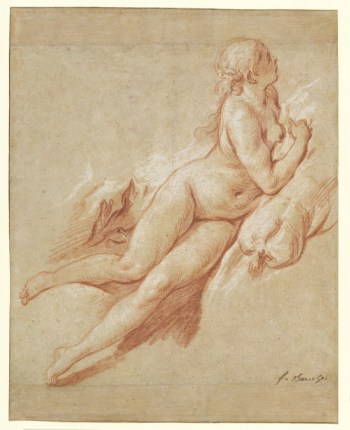
François Boucher, Study of a Reclining Nude. 1732–35, red and white chalk on beige laid paper, 32.5 × 24.6 cm (Los Angeles: The J. Paul Getty Museum, 84.GB.21).
Some works, such as François Boucher’s Study of a Reclining Nude at the J. Paul Getty Museum in Los Angeles and his Birth of Venus at the Crocker Art Museum, relate to the same project, though one made its way to California a century later than the other. Pieter Quast’s A Man in Oriental Dress at the Iris and B. Gerald Cantor Arts Center for Visual Arts at Stanford University and A Skater at the Achenbach Foundation for Graphic Arts in San Francisco, come from the same sketchbook, where they originally appeared just pages apart. Others, such as Adolph Menzel’s Artist’s Model in Eighteenth-Century Costume at the Cantor Center and Study for a Tree at the Fine Arts Museums of San Francisco illustrate contrasting aspects of the same artist’s work.
Reuniting the Masters is presented in four sections representing the major European schools, showcasing the development of draftsmanship across the continent in a series of comparative pairs. Many of the most appealing artists from the 16th through 19th centuries are highlighted, including Italy’s Fra Bartolommeo and Guercino, the Low Countries’ Adriaen Frans Boudewijns and Anthonie van Waterloo, Germany’s Friedrich Heinrich Füger and Adrian Zingg, and France’s Jean-Baptiste Oudry and Charles-Nicolas Cochin the Younger. Among the objects are newly acquired and newly attributed drawings, representing the continuing work of patrons and scholars in the West.
Consisting of 52 drawings, Reuniting the Masters is accompanied by an 150-page, full-color catalogue authored by Breazeale; Cara Denison, curator emerita at the Morgan Library and Museum in New York City; and Victoria Sancho Lobis, Prince Trust curator of prints and drawings at the Art Institute of Chicago.
Online Resources from the National Portrait Gallery
From the newsletter of the Society of Antiquaries of London, Salon 375 (15 November 2016). . .
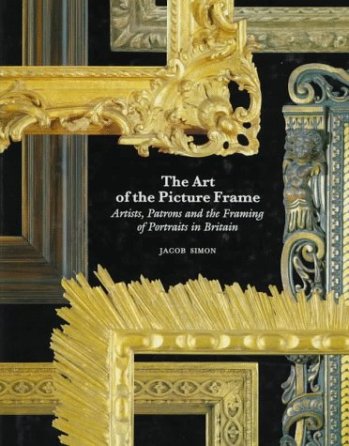 Jacob Simon FSA, Research Fellow at the National Portrait Gallery, notes that 2016 is the tenth anniversary of the launch of the Gallery’s online resource British Artists’ Suppliers, 1650–1950, in partnership with Cathy Proudlove. Three other resources have since been added: British Picture Framemakers, 1600–1950 (2007), British Picture Restorers, 1600–1950 (2009), and British Bronze Sculpture Founders and Plaster Figure Makers, 1800–1980 (2011). These four online resources are selectively updated twice a year and have doubled in size since launch. Further reviews and additions are planned, including to the features on picture framing; the Gallery’s exhibition, The Art of the Picture Frame, celebrated its 20th anniversary on 8 November. Karen Hearn FSA writes to commend these remarkable online resources and “the exceptional amount of research, work, and coordination that their originator, Jacob Simon, has put into making so much invaluable information available to a wide audience.”
British Miniatures on View at Compton Verney
As noted at Art Daily (15 November 2016). . .
The Dumas Collection of British Portrait Miniatures
Compton Verney Art Gallery and Park, Warwickshire
Over forty miniature paintings, not previously seen in public, have now gone on show at Compton Verney Art Gallery and Park in Warwickshire. The works are part one of the most important collections of this art form held anywhere in the world. The collection consists of 842 works in total and has been generously loaned on a permanent basis by Simon Dumas following the death of his father in 2013.
Simon Dumas said: “We wanted Dad’s exceptionally broad and, in the context of miniatures, important collection to be in the Midlands and not in London, Cambridge, or Oxford—since the Victoria and Albert Museum and National Portrait Gallery, the Fitzwilliam and the Ashmolean already have such wonderfully rich resources to display. We approached Compton Verney because they already have a fine collection of English portraits, which we thought Dad’s mainly English collection would complement well.”
Upon his retirement from a successful career in the City, Dumas’s firm, ED&F Man Capital Markets, gave him and his wife a round-the-world trip as a leaving present. It was on a wet day in Canada that the couple visited an art gallery that happened to be staging an exhibition of miniatures.
“They captivated Dad, who at the time was vaguely looking around for an indoor hobby for his retirement. He asked a curator where these little paintings were from, only to learn that they were from his own country, England. He started collecting almost immediately on their return from their trip in 1975, with the objective—impossible to achieve, but still a reference point—of acquiring an example, signed if possible, by every artist who ever worked in the British Isles,” Simon explained.
With his enthusiasm fired, Dumas developed and added to his collection over the next thirty years.
The advent of photography and its ability to capture people’s likenesses relatively cheaply and led to the rapid decline of the portrait miniature from about 1850 onwards. Miniatures were often carried around or worn as a necklace or brooch but, because of the skill required to create them, were expensive to commission. Deeply personal and available only to the wealthier echelons of society, miniatures were rarely seen by the greater public; consequently, miniature painting is not a well-known aspect of art—albeit that it flourished for some three centuries.
Steven Parissien, Director of Compton Verney, believes the Dumas loan makes a significant contribution to our understanding of the British tradition of miniature portraits: “We are delighted that this world-class collection of outstanding British portrait miniatures has finally come back to England from Scotland, allowing us to share in the hidden delights of this most intimate and touching form of portraiture—as well as to learn much about their Stuart and Georgian sitters.”
Highlights include Lucas Horenbout’s Unknown Lady, painted ca. 1543. Sir Roy Strong has suggested that the sitter was King Henry VIII’s sixth and last wife, Queen Catherine (Parr). Horenbout worked for Henry VIII from 1525 and is said to have taught Holbein how to paint miniatures—thus introducing this skill into Britain. Catherine herself died aged 36, five years after this portrait was painted, giving birth to a child by her fourth husband.
The celebrated Elizabethan and Jacobean painter Nicholas Hilliard is also represented, with Unknown Gentleman (1589). Hilliard made portrait miniatures popular in Britain, largely due to the patronage of Queen Elizabeth I herself. Having helped create fashionable images of the Virgin Queen and her court—one of whose members may be depicted here—Hilliard became the royal miniaturist (‘court limner’) to her successor, James I.
Also of note are the works of six female artists, including the exceptional Sarah Biffin (1784–1850). Born without hands, arms, or feet, Sarah taught herself to paint and write by using her mouth. Apprenticed by her family to a man who exhibited her round the country as a sideshow freak, she simultaneously taught herself how to paint miniatures. She was rescued by the Earl of Morton, who sponsored formal painting lessons for her at the Royal Academy, and she built up a large practice painting miniatures as a result of Queen Victoria’s patronage.
Having just visited the national gallery in Warwickshire to see the first selection from the collection on display, Simon Dumas says he is very pleased that his father’s collection has found the ideal place for members of the public to enjoy them: “I hope the miniatures stay for many years in the beautiful surroundings of Compton Verney, where they are displayed so very well in the newly-made cabinet alongside the British paintings of the permanent collection. The display is far better than those in some of the London galleries in my opinion!”
The Dumas Loan can be seen in the British Portraits gallery at Compton Verney, along with remarkable collections such as the nationally-designated Chinese Bronzes and Britain’s best collection of British Folk Art.
Exhibition | Meta-painting: A Journey to the Idea of Art
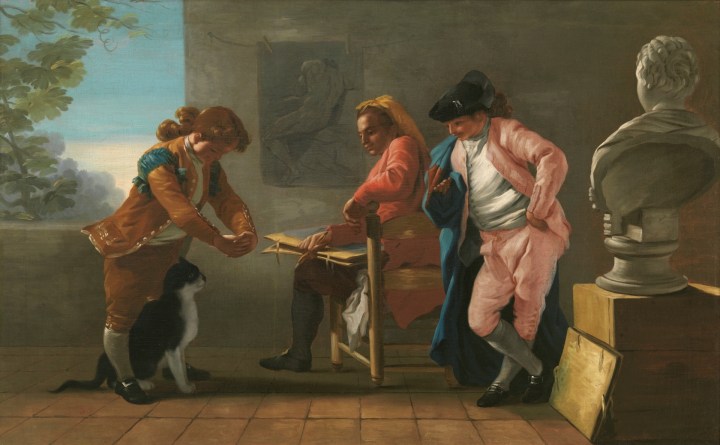
José del Castillo, The Study of Drawing, 1780, oil on canvas, 105 × 160 cm
(Madrid: Prado).
◊ ◊ ◊ ◊ ◊
Now on view at the Prado:
Meta-painting: A Journey to the Idea of Art / Metapintura: Un viaje a la idea del arte
Museo Nacional del Prado, Madrid, 15 November 2016 — 19 February 2017
Curated by Javier Portús
With Meta-painting, the Museo del Prado is offering a new approach to its collection in the latest in a series of exhibitions that began in 2010 with Rubens and continued with Captive Beauty (2013) and Goya in Madrid (2014). This series has aimed to offer visitors the chance to reflect on the Museum’s own collections and to look at its works in a new context which encourages different interpretations. Meta-painting proposes a journey that begins with mythological and religious narratives on the origins of artistic activity at the dawn of the modern age and concludes in 1819, the year of the Prado’s foundation. The exhibition thus also celebrates the 197th anniversary of the Museum’s founding as a temple of the arts, signifying their full acceptance as disciplines of social utility.
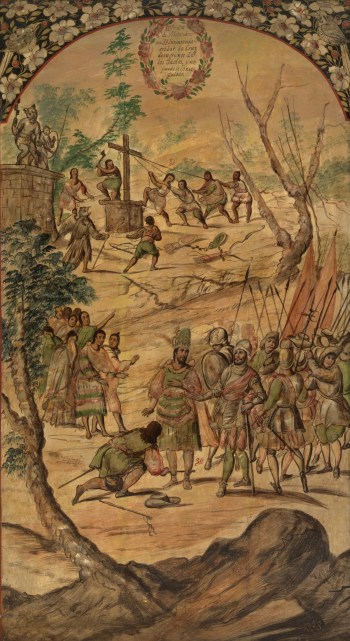
Juan González / Miguel González, Conquista de México por Hernán Cortés (30 y 31), 1698. Enconchado, Óleo sobre lienzo sobre tabla, 97 × 53 cm.
Two aspects central to the Prado—the Spanish royal collections and Spanish art—provide the context for the exhibition’s structure. Furthermore, these are two inseparable terms, given that the evolution of Spanish art was determined by the existence of the royal collections. The survey offered by the exhibition is a wide-ranging and varied one, including paintings, drawings, prints, books, medals, examples of the decorative arts and sculptures. Twenty-two of these works have been loaned by eighteen museums and collections, including the Fundación Casa de Alba, the National Gallery in London, the Museo de Bellas Artes in Seville, the Banco de España, and the Museo de la Real Academia de Bellas Arts de San Fernando in Madrid.
All the 137 works in the exhibition refer to art or to images, either as self-portraits of creators such as Titian, Murillo, Bernini and Goya; or because they include other paintings and sculptures, such as Saint Benedict destroying Idols by Ricci and Arachne by Rubens; or because they analyse issues relating to the definition of art and its history, such as José García Hidalgo’s book Principles for studying the very noble and royal art of painting […] and Goya’s Portrait of Jovellanos.
The exhibition’s ‘journey’ is divided into different phases. Fifteen sections focus on the relationship between art, the artist and society, each one of which looks at a specific issue, among them: the powers attributed to religious images; the role played by the ‘painting within the painting’; artists’ attempts to break through the pictorial space and continue it towards the viewer; the origins and practice of the idea of artistic tradition; portraits and self-portraits of artists; places for the creation and collecting of art; the origin of the modern concept of art history; the subjectivity that emerged in self-portraits from the Enlightenment onwards; and the importance of the concepts of love, death and fame in the modern artistic discourse.
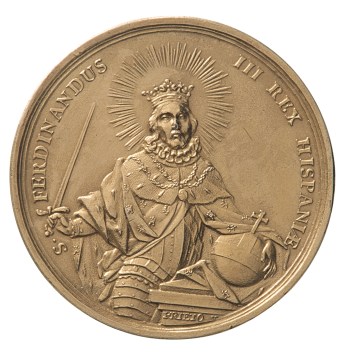
Francisco Tomás Prieto, Segundo premio de primera clase de la Academia de San Fernando, 1753, Silver-gilt, 44,5 mm diameter (Madrid: Prado)
The exhibition also represents a tribute by the Museo del Prado to Cervantes on the 400th anniversary of his death as it includes a section on Don Quixote as one of the great examples of self-referential literature, juxtaposed with Las Meninas. Thus, just as Cervantes’ text is a ‘novel within a novel’ so Velázquez’s painting is a ‘painting on painting’ in which the artist not only depicts himself painting but which involves various important issues regarding the potential of the art of painting and the role of the painter.
Las Meninas will remain in Room 12 of the Villanueva Building where it is habitually displayed but it is present in the exhibition through a modern facsimile of part of Laurent’s graphoscope which is displayed alongside editions of the two parts of Don Quixote, reminding visitors that these two masterpieces of the Spanish Golden Age are both reference points in the history of meta-fiction.
Javier Portús, Metapintura: Un viaje a la idea del arte (Madrid: Museo Nacional del Prado, 2016), 304 pages, ISBN: 978-8484803270.










 Enfilade
leave a comment