Display | Garnitures: Vase Sets from National Trust Houses

Five-piece vase set, porcelain, China, ca. 1690, H: 26.9 cm; rescued from Clandon Park, Surrey, the night of the fire, 29 April 2015 (The Mrs. David Gubbay Collection, Clandon Park, Surrey, National Trust, 1440409.1-5 / National Trust Images/ James Dobson).
◊ ◊ ◊ ◊ ◊
Now on view at the V&A:
Garnitures: Vase Sets from National Trust Houses
Victoria and Albert Museum, London, 11 October 2016 — 30 April 2017
This ground-breaking display at the Victoria and Albert Museum, organised in collaboration with the National Trust, explores the phenomenon of matching sets of vases and garnitures. In the 1650s, assembled sets of Chinese porcelain beakers, bottles, bowls, and jars—often in odd numbers—were used in elite European interiors as an integral part of the decorative scheme— displayed on chimney-pieces, cupboards, tables, or over doors. Specifically for the display, a mid-seventeenth-century garniture in the French taste has been recreated from Chinese porcelain of the 1630s. When imports of Chinese porcelain officially ceased between 1657 and 1683, European potters at Delft and Nevers copied the exotic Asian forms but unified the elements with matching patterns to form sets of from three to eleven vessels. In the Netherlands, merchants also ordered jars and beakers from Japan, and, in England, sets were ordered from London silversmiths. In France, merchants in luxury goods applied matching metal mounts to form sets from assembled objects and vessels. When the export trade resumed in the 1680s, ornamental jars and beakers with matching patterns were produced in Jingdezhen specifically for the West. The fashion continued throughout the 1700s, with almost every ceramic manufactory producing examples. It came to its conclusion during the Arts and Crafts period, when the singular vase became the rage and sets were broken up and dispersed.
A day-long symposium on ceramics and interiors is planned for 17 March 2017. The display, publication, and symposium are generously sponsored by The Headley Trust.
Patricia Ferguson’s blog entry on the display is available here»
◊ ◊ ◊ ◊ ◊
Patricia Ferguson, Garnitures: Vase Sets from National Trust Houses (London: V&A Publishing, 2016), 64 pages, ISBN: 978-1851779000, £10.
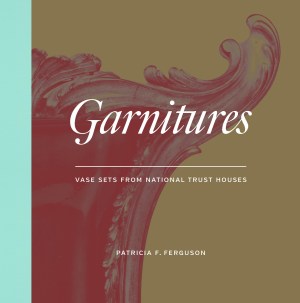 This exquisite book brings together some of the National Trust’s most important sets of garnitures, showing them in their historic context and drawing on their rich narratives. Following an introductory essay, the catalogue records the 15 garnitures in the display borrowed from 13 National Trust properties: Blickling, Norfolk; Dunham Massey and Tatton Park, Cheshire; Nostell Priory, Yorkshire; Ickworth, Suffolk; Kingston Lacy, Dorset, Stourhead, Wiltshire, Saltram, Devon, Clandon Park, Surrey, Scotney Castle and Knole, Kent; Petworth, West Sussex; and Upton House, Warwickshire (with more information here). The entries are richly supported by engraved sources, paintings and photographs of vase sets and garnitures in situ. As many have never been published before, the publication will be an important souvenir of a unique exhibition.
Patricia F. Ferguson, an adviser on ceramics to the National Trust, has been researching their ceramics collection for a publication on elite ceramic patronage in Britain. She has an MA in Chinese ceramics from the School of Oriental and African Studies and works as a curatorial consultant in the Asian department of the V&A.
◊ ◊ ◊ ◊ ◊
This 4-minute film showcases rare surviving examples of vase sets and ceramic ornaments from National Trust houses being displayed on furniture and in period rooms at the V&A that would have been typical at the time of their manufacture. Reino Leifkes, curator of ceramics at the V&A, discusses this ceramic phenomenon and its rise to the height of fashion.
Exhibition | Emma Hamilton: Seduction and Celebrity
The Emma Hamilton exhibition opens next week in Greenwich, with walking tours part of the programming:
Walking Tour | The Life of Emma Hamilton
London, offered 18 November and 3 December 2016, 11am–1pm
Take a walk around St. James’s and Mayfair for glimpses into Emma Hamilton’s life. Celebrity, mistress and muse, Emma was an extraordinary woman. In this guided walk, we’ll be looking at her life, her love affair with Nelson, and her connections to London Society. Adults £20 / members £16.
More information is available here»
Exhibition | 1,000 m2 of Desire: Architecture and Sexuality

From the Centre de Cultura Contemporània de Barcelona:
1,000 m2 of Desire: Architecture and Sexuality
1.000 m2 de Desig: Arquitectura i Sexualitat / 1.000 m2 de Deseo: Arquitectura y Sexualidad
Centre de Cultura Contemporània de Barcelona, 25 October 2016 — 19 March 2017
Curated by Adélaïde de Caters and Rosa Ferré
The exhibition looks at the way Western society has planned, built, and imagined spaces for sex from the 18th century to the present day. With some 250 exhibits, including drawings and architectural models, art installations, audiovisuals, books, and other materials, the exhibition explores the power of spaces as the driving force of desire and shows how architecture has been a tool that controls behaviour and creates gender stereotypes in our patriarchal society.
 It presents some of the projects that have subverted traditional models and advocated utopias of sexual cohabitation or private spaces designed solely for pleasure. It looks afresh at the proposals of Claude-Nicolas Ledoux, Charles Fourier, De Sadeand Guy Debord, the radical architecture of the 1960s and 1970s, Carlo Mollino, Adolf Loos, Nicolas Schöffer, Wilhelm Reich, Playboy architecture, and works by contemporary architects and artists.
1000m2 of Desire underpins the need to reappraise, for contemporary times, the validity and interest of some of the radical, speculative projects that seem to speak directly to us today, even though some of them date back more than 200 years. It invite us to consider how sexualities are constructed in accordance with specific cultural codes subject to norms that govern bodies and discourses and the nature of the space of desire and pleasure in our society. The exhibition highlights the way certain forms of resistance to established norms have largely originated from informal architecture and the appropriation of places. It shows how architectural practice has been dominated by men until very recently and, as a result, how spaces designed for pleasure have been imagined from male desires and fantasies. Architecture as the physical design of a space and setting makes up a substantial part of our sexual fantasies. Many of the exhibits have never been created before and are constructed through language or the projected image.
The exhibition is divided into three thematic sections—sexual utopias, libertine refuges, and sexographs—and includes several independent spaces that act as ‘mini exhibitions’, each one curated by different specialists: a recreation of Nicolas Schöffer’s Centre for Sexual Leisure (Eléonore de Lanvandeyra Schöfferand Guillaume Richard), a reading room containing libertine novels (Marie-Françoise Quignard), an installation dedicated to Playboy Magazine and its architecture (Beatriz Colomina and Pep Avilés), and an archetypal 1970s’ porn cinema (Esther Fernández). It also presents William Kentridge’s new installation Right into Her Arms, which the South African artist created for his production of Alban Berg’s Lulu.
Sexual Utopias (18th–20th Centuries)
The exhibition begins with some of the speculative projects by architects, thinkers, artists and communities who have sought to have an impact on sexual behaviour by monitoring spaces. It examines the sexual utopias of the 18th century such as the temple of pleasure, the Oikema, imagined by the architect Claude-Nicolas Ledoux; the Parthenions, which Restif de la Bretonne organised according to detailed rules in his treatise on prostitution, Le Pornographe; and Charles Fourier’s settings for erotic and gastronomic orgies. Fourier’s proposal reveals an imagination, a radicalism and extreme relevance with the phalanstery as the engine of a utopian community governed solely by its inhabitants’ desires. The exhibition also features one of the Marquis de Sade’s cabinets which reveals how he constructed his narrative utopia of excess through his passion for architecture and the performing arts.
Reformist or subversive, these sexual architectures of the 18th and early 19th centuries are contrasted and establish a certain continuity with more contemporary utopias from the modus vivendi of hippy communities to the radical architecture of the 20th century: Ettore Sottsass, the Archigram and Superstudio groups, Rem Koolhaas/OMA, Haus-Rucker-Co and Ricardo Bofill’s Taller de Arquitectura.
The exhibition also seeks to put the spotlight on the visionary work of Nicolas Schöffer who was closely associated with the Situationists and part of the French radical architecture movement in the 1960s. He designed a utopian city, the Ville Cybernétique (1955–69), which contained its own Centre for Sexual Leisure. A vast installation recreates this space made up of sex, volts, dancing cybernetic sculptures, and perfume.
Libertine Refuges (18th–20th Centuries)
This section explores the power wielded by spaces as driving forces of desire and analyses the nature of private realms conceived entirely as settings for pleasure, from the French aristocracy’s petites maisons of the 18th century, with their rooms, décor, and specialist furnishings, to the bachelor pads suggested by Playboy Magazine. It shows the role of architecture as a sensorial experience in seduction strategies and how sophistication in the design of constructional and mechanical devices can fire the erotic imagination.
Architecture and storytelling worked osmotically during the 18th century in a game of mutual fascination. The exhibition presents the architecture of two iconic novels in this regard, La Petite Maison (1758) by Jean-François de Bastide and Point de Lendemain (1777) by Vivant Denon.
The reading room containing libertine novels is presented in this section of the exhibition. Devised by the specialist Marie-Françoise Quignard, it features novels by Nerciat, Crébillon, Servigné, Choderlos de Laclos, and De Sade, among others. The libertine novel, related to the materialistic philosophy of the day, has a single objective: to celebrate desire and the enjoyment of the body. Entering the libertine’s chamber is like entering an imaginary world where the characters are subjected to all the fantasies of desire. It is also like stepping into the atmosphere of enclosed places: into boudoirs, convent cells or brothels where we follow the narrator, the clandestine observer, while the story unfolds.
The exhibition devotes a whole section to Playboy, curated by Beatriz Colomina. The magazine defined a new identity for men that included how they should dress, what they should listen to, drink and read, as well as the environment they ought to live in as well as the furnishings and interior décor. From Frank Lloyd Wright to Mies van der Rohe and including John Lautner and Ant Farm, alongside designs by the Eames, George Nelson, Eero Saarinen and Harry Bertoia, architecture and design are presented as tools capable of altering a code of conduct. As a media machine that had an enormous impact by treating women and buildings as objects of fantasy and desire, Playboy made a significant contribution to the transformation of ‘intimacy’ into a public spectacle. This section reproduces Hugh Hefner’s legendary bed (in contrast to the traditional double bed invented in the 18th century which remains the dominant setting for our sex lives today). According to another of the leading specialists in the Playboy phenomenon, Beatriz Preciado: “The round, revolving bed, connected to a radio-cum-phone-cum-hi-fi system, was used as a place for orgies as well as an office for Hefner who ran his business for years in his pyjamas and without leaving the house. The bed has become a true multimedia platform, the direct predecessor of our laptop computer and a media extension of our libido, as well as a new centre of production and consumption.”
The exhibition also reveals that the architecture of the Modern Movement is a project based on masculinity, which underplays its erotic dimension. Beatriz Colomina sums it up by saying “women are the ghosts of modern architecture.” Adolf Loos designed a bedroom for his wife, Lina, as if it were a fur-lined case and dreamt up a Parisian house for Joséphine Baker. The exhibition also presents the enigmatic and sensualised home interiors designed by Carlo Mollino, and, as a counterpoint to these intimate spaces, the home of Rudolph Schindler in California, which features an experimental programme for two couples living together, with outdoor beds/sleeping baskets.
Sexographs (20th–21st Centuries)
Following in the wake of Guy Debord’s Situationism, the exhibition presents a number of maps of contemporary passions through pieces by architects and artists (such as Bernard Tschumi, ecoLogicStudio [Claudia Pasquero and Marco Poletto], Jean-Didier Bergilez, Danli Wang, Pol Esteve, Marc Navarro and Ania Soliman). It reveals public spaces coded for sex, among them parks, streets, and public toilets. The exhibits in this section include two impressive series of photographs: The Valley by Larry Sultan and The Park by Kohei Yoshiyuki.
The screening room was one of the spaces transformed by the discourses of the sexual revolution of the late 1960s. It was a space that embraced an increasing sexualisation until the advent of the first legal porn films. The so-called ‘porn chic’ that emerged in the United States in the 1970s opened up spaces for the consumption of pornography to the female gaze and envisaged an experience of collective viewing that continued until the mid-1980s, when video technology moved porn into people’s homes. The exhibition features an archetypal porn cinema of the 1970s, where clips from legendary X-rated films will be shown, curated by Esther Fernández,
We will see how venues for sexual encounters (from luxury resorts to brothels, whorehouses-cum-hotels on highways, bathhouses and gay dark rooms, discotheques and bars, oubliettes and BDSM spaces, as well as sex shops) are all highly ritualised social systems. They are domains in which initiation and transgression act as the driving force of desire: a particular type of lighting, smells and music are part of this informal architecture. They are designed for and, at the same time, govern particular practices. They are all spaces of representation that reflect group mythologies.
But what are the spaces for sex today? Undoubtedly cyberspace, with internet porn and encounters apps for every taste, is growing in importance. Now that we are fully steeped in the technological utopia, artists, such as Yann Mihn, are engaged in a search for telepathic ecstasy. Mihn is working on the prototype of a machine that will enable total immersion in virtual reality and stimulation (teledildonics), his “NooScaphe-X1 Cybersex immersion engine”.
In Hacer el amor en abstracto: la arquitectura de la cultura de baile, the architect and artist Pol Esteve examines the spatial experience of discotheques and raves and the way in which a combination of technologies such as stroboscopic lights, music and drugs can produce orgasmic effects and a displaced sexuality.
Ingo Niermann proposes a community of sex volunteers with his platform of an army of love, thearmyoflove.net, who will create situations and spaces of satisfaction for those who are ‘usually excluded’, people with physical problems or with a body that does not match conventions of attractiveness.
Desire in the 21st century is the desire of others expressed through recognition and in the competition for representation. From the selfie to Instagram, we are compelled to look sexy and happy; the internet makes the laborious construction of the image of our private lives compulsory. Do sexual images on the web represent or replace relationships by sublimating them? Is the hypersexualisation of society, as it is represented by the media, substituting actual sexual life? Society seems to have plunged into a narcissistic depression in which the internet functions as a masturbatory machine. In the Western context, in which permissiveness is no longer transgression but the norm, what role does space play in reviving transgressive eroticism, in re-eroticising society?
This project explores the interstices of freedom in certain non-normative spaces for desire, such as the queer movement, and the way these constitute revolutionary resistance to commodified scenarios and to the control of increasingly all-encompassing social structures.
Adélaïde de Caters, Rosa Ferré, Beatriz Colomina, Marie-Françoise Quignard, Pol Esteve, Ester Fernández Cifuentes, Ingo Niermann, Fulvio Ferrari, and Rem Koolhaas, 1,000 m2 of Desire: Architecture and Sexuality / 1.000 m2 de Desig: Arquitectura i Sexualitat / 1.000 m2 de Deseo: Arquitectura y Sexualidad (Barcelona: CCCB and Direcció de Comunicació de la Diputació de Barcelona, 2016), 200 pages, ISBN: 978-8498037500 (Català / English), ISBN: 978-8498037517 (Castellano / English), 20€.
S E L E C T E D O B J E C T S
The exhibition has received loans from prestigious international institutions, including FracTurbulence Orleans, the MoMA Architecture Department New York, the Bibliothèque Nationale de France (BNF), the Biblioteca Nacional de España (BNE), and from the collections of the architects who have taken part in the project and given generously of their time.
Architectural Originals
• Drawings by Jeremy Bentham and his Panopticon
• The Campo Marzio by Giovanni Battista Piranesi
• Drawings by Jean-Jacques Lequeu, Pierre-Adrien Pâris, Charles Fourier, Ettore Sottsass, Superstudio, Archigram, Madelon Vriesendorp, Ant farm, Douglas Darden, Coop Himmelb(l)au, and Haus-Rucker-Co, among others
Original Photographs
• Polaroids by Carlo Mollino
• The Valley series by Larry Sultan
• The Park series by Kohei Yoshiyuki
Installations
• Centre for Sexual Leisure (CLS) with original works by Nicolas Schöffer
• METAfolly Pavilion by ecoLogicStudio
• Right into Her Arms, a new work by William Kentridge for the exhibition
• In front of the Green Door by Johannes Wohnseifer
• Hacer el amor en abstracto: la arquitectura de la cultura de baile by Pol Esteve
• Army of Love, Ania Soliman
• Playboy installation with a reproduction of Hugh Hefner’s bed
• Reproduction of Wilhelm Reich’s Orgone
Maquettes and Models
• Reproduction of the city of the Royal Saltworks at Arc-et-Senans and the Oikema Temple of Pleasure
• Reproduction of the room in the Château de Silling where stories are told in The 120 Days of Sodom by the Marquis de Sade
• Models of the Playboy Townhouse and of Hugh Hefner’s private jet Big Bunny
• Model of the Villa Rosa by the Coop Himmelb(l)au
Treatises on Architecture
• Fransesco Colonna, Hypnerotomachia Poliphili ou Le Songe de Poliphile (first edition published in Venice in 1499)
• Jacques-François Blondel, De la distribution des maisons de plaisance et de la décoration en général (1737–38), 2 volumes
• Claude-Nicolas Ledoux, L’architecture considérée sous le rapport de l’art, des mœurs et de la législation (1804), 2 volumes
• Nicolas Le Camus de Mézières, Le génie de l’architecture, ou L’analogie de cet art avec nos sensations (1780)
Libertine Books
• Crébillon, Le Sofa, 1742
• Boyer d’Argens, Thérèse philosophe, 1748
• Julian Offray de la Mettrie, L’art de jouir, 1751
• Jean-Baptiste-Marie Guillard de Servigné, Les sonnettes ou Mémoires du marquis D**, 1751
• Marquis de Sade, La philosophie dans le boudoir, 1795
• Marquis de Sade, Histoire de Juliette, 1797
Prints from the 18th and 19th Centuries
• Rebus sur l’Amour by Stefano Della Bella (18th century)
• Le Phallus phénoménal and Le Roi Phallus malade et défait reçoit la visite de ses médecins by Dominique Vivant Denon, 1793–94
• Works by unknown artists and printmakers, such as Portes et fenêtres (19th century)
• Le verrou and Les heureux hasards de l’escarpolette by Jean-Honoré Fragonard
Audio-Visual Materials
• Documentaries on Bentham’s Panopticon and hippie communes by Andrés Hispano and Félix Pérez Hita
• Virtual 3D reproduction of the house designed by Adolf Loos for Joséphine Baker
• Playboy’s Progress, an animated work by Olivier Otten
• Documentaries by Ant Farm, Haus-Rucker-Co and Superstudio
• Films such as Un chant d’amour by Jean Genet and Army of Love by Ingo Niermann
Exhibition | Emperors, Scholars, and Temples
From
Emperors, Scholars, and Temples: Tastemakers of China’s Ming and Qing Dynasties
The Nelson-Atkins Museum of Art, Kansas City, 12 August 2016 — 9 July 2017

Coat, early 18th century, Chinese. Brocade, 54 x 81 inches (Kansas City: The Nelson-Atkins Museum of Art; William Rockhill Nelson Trust, 35-184/1)
During the Ming (1368–1644) and Qing (1644–1911) dynasties, the arts of China reached full maturity. Painting, calligraphy, porcelain and textiles flourished, and new styles and techniques emerged. The imperial court, scholars, and temples supported this profusion of creativity, each establishing distinctive, yet overlapping artistic styles. Emperors held court in the Forbidden City in Beijing in unparalleled splendor. Courtiers, empresses, and concubines wore extravagant garb and beautiful jewelry. Across the empire, an educated class of scholars pursued elegant and cultured lifestyles. Buddhism was also an inspiration for the arts. Thousands of ornate temples stored precious relics and images of Buddhist deities. Presenting rarely seen objects from the Nelson-Atkins Chinese collection, the exhibition explores currents of taste during this five hundred-year period.
Aimee Marcereau DeGalan Appointed Curator at The Nelson-Atkins
Press release (25 October 2016) from The Nelson-Atkins:
The Nelson-Atkins Museum of Art in Kansas City has hired Dr. Aimee Marcereau DeGalan as the Louis L. and Adelaide C. Ward Senior Curator of European Art. Marcereau DeGalan comes to the Nelson-Atkins from The Dayton Art Institute (DAI), where she was Chief Curator and Curator of European Art.

Aimee Marcereau DeGalan, photo by Chris Dissinger.
“The timing of this important addition to our staff could not be better,” said Julián Zugazagoitia, Menefee D. and Mary Louise Blackwell CEO & Director of the Nelson-Atkins. “Aimee’s scholarship will be immediately called upon as we prepare to open the Bloch Galleries in the spring, and she will continue the important work that has begun on our catalogue of French paintings.”
A specialist in British and French 18th- and 19th-century art, Marcereau DeGalan will lead the European Arts division, which includes the departments of Ancient Art, European Paintings & Sculpture and Architecture, Design and Decorative Arts. She will pursue senior-level research exhibition and catalogue projects, and be responsible for acquisitions, interpretation and presentation of the European collections.
“Aimee’s experience at institutions of varying scale and type has been excellent training for the job at the Nelson-Atkins,” said Catherine Futter, Director of Curatorial Affairs. “A 2014 Center for Curatorial Leadership Fellow, she has worked across many disciplines to engage a wide range of audiences and is also an amazing leader.”
Marcereau DeGalan was hired at the DAI in 2012 as Curator of Collections and Exhibitions. Previously, she held curatorial posts at the Fleming Museum of Art at the University of Vermont, The Cleveland Museum of Art, and The Detroit Institute of Arts. While in Dayton, Marcereau DeGalan raised major funds for conservation treatments to seven significant European paintings, accessioned more than 400 objects, regularly brought scholars into the museum to advise on its different collections, and presented 24 exhibitions during her tenure. Importantly, she worked to broaden the DAI’s engagement with the Dayton community.
“The DAI will forever be grateful for Aimee’s meaningful contributions to the museum and the community,” says Dayton Art Institute Director and CEO Michael R. Roediger. “During her time at the museum, she has led the Curatorial Department and the Collections Committee, been a valued member of the museum’s leadership team, and been an integral part of the development of the museum’s Centennial Plan. The Dayton Art Institute can be proud that one of our own is moving on to such a prestigious organization.”
“I am thrilled to be joining the curatorial team at the Nelson-Atkins,” said Marcereau DeGalan. “It has long been an institution I have admired not only for the scope and depth of its collections, but also for its commitment to research, scholarship, and to broadening its reach within the regional community and on the national and international stage.”
Marcereau DeGalan will begin her position on November 1st.
Aimee Marcereau Degalan completed her PhD in 2007 with Anne Helmreich at Case Western Reserve University with a dissertation entitled “Dangerous Beauty: Painted Canvases and Painted Faces in Eighteenth-Century Britain.”
HGSCEA Essay Prize for Emerging Scholars
From H-ArtHist:
Historians of German, Scandinavian, and Central European Art
Fifth Annual Essay Prize for Emerging Scholars
Nominations due by 19 December 2016
Submissions are now being accepted for the fifth annual HGSCEA Emerging Scholars Publication Prize, an award of $500 given to the author of a distinguished essay published the preceding year on any topic in the history of German, Central European, or Scandinavian art, architecture, design, or visual culture. Submissions, which must be in English and may be from electronic or print publications, must have a publication date of 2016; authors must be either current PhD students or have earned a PhD in or after 2012 and must be members of HGSCEA at the time of submission. The recipient of the Prize and one honorable mention will be chosen by the members of the HGSCEA Board and announced at the HGSCEA dinner reception during the College Art Association annual conference. Nominations and self-nominations are welcome; submissions should include a copy of the publication and a CV and should be sent by electronic attachment to the HGSCEA president Marsha Morton (mortonmarsha10@gmail.com) before December 19, 2016.
Conference | Decor and Architecture in the 17th and 18th Centuries
From H-ArtHist (25 October 2016). . .
Decor and Architecture in the 17th and 18th Centuries
University of Lausanne, 24–25 November 2016
During the early modern period, décor was considered to be one of the most fundamental elements of architecture. Thanks to décor, architecture could elevate itself beyond simple masonry and claim a superior status. Décor was thus defined as a necessary prerequisite for architecture, rather than a marginal component. However, despite its privileged status, many authors mistrusted it, fearing the harmful effect which an uncontrollable proliferation of ornament would surely have on architecture. This conference aims to question how the relations between décor and architecture were defined and implemented in Europe in the 17th and 18th centuries.
Our perception of these relations has often been informed by teleological approaches: indeed, the radical ideas conveyed by certain 20th-century texts, which define décor as an unnecessary bi-product of architecture, have acted as a distorting prism. The history of art, for its part, has often separated décor-related studies from architecture-related ones, suggesting a de facto rupture between these fields and potentially biasing our understanding of the artistic production of the Early Modern Period by reducing its scope. As various case studies have shown, the conditions to which the invention of a décor was subjected varied greatly from one building to another. The architects’ prerogatives differed according to the circumstances and constraints imposed on them: while some were largely involved in the invention of the décor, others delegated its conception to artists or workmen.
Scientific Organisers
Matthieu LETT (université de Lausanne, université Paris Ouest Nanterre La Défense)
Carl MAGNUSSON (The Courtauld Institute of Art, université de Lausanne)
Léonie MARQUAILLE (Université de Lausanne)
Scientific Committee
Marianne COJANNOT-LE BLANC (université Paris Ouest Nanterre La Défense)
Alexandre GADY (université Paris-Sorbonne)
Dave LÜTHI (université de Lausanne)
Christian MICHEL (université de Lausanne)
Werner OECHSLIN (Eidgenössische Technische Hochschule Zürich)
Antoine PICON (Harvard University)
Katie SCOTT (The Courtauld Institute of Art)
◊ ◊ ◊ ◊ ◊
T H U R S D A Y , 2 4 N O V E M B E R 2 0 1 6
9.30 Accueil des participants
9.45 Introduction by Matthieu LETT, Carl MAGNUSSON, Léonie MARQUAILLE
10.15 1. Les artistes au service de l’architecte? (Président: Christian Michel, Université de Lausanne)
• Sébastien BONTEMPS (Bibliothèque nationale de France), Invention, fonction(s) et exécution du décor architectural: Paul-Ambroise Slodtz et l’embellissement du chœur de l’église Saint-Merry à Paris
• Hermann DEN OTTER (University of Amsterdam), Changes in the Role of the Joiner in 18th-Century Paris
• Sandra BAZIN-HENRY (Université Paris IV Sorbonne), Le langage architectural des glaces: La part de l’architecte et du miroitier dans l’invention des décors
13.00 Lunch
14.30 2. Le rôle de l’architecte (Président: Alexandre Gady, Université Paris IV Sorbonne)
• Léonie MARQUAILLE (Université de Lausanne), Jacob van Campen, architecte et peintre de la Salle d’Orange à la Huis ten Bosch
• Alexia LEBEURRE (Université Bordeaux Montaigne), « Tout est de son ressort » : l’architecte et la décoration intérieure dans la seconde moitié du XVIIIe siècle
• Matthieu LETT (Université de Lausanne), La question de la répartition de l’invention sur le chantier du nouveau palais royal de Madrid, 1735–1790
• Adrian Fernandez ALMOGUERA (Université Paris IV Sorbonne), De Versailles à Pompéi: Continuités, transformations et hybridations dans le décor architectural espagnol à la fin du XVIIIe siècle
F R I D A Y , 2 5 N O V E M B E R 2 0 1 6
9.30 3. La question de la décoration intérieure (Président: Carl Magnusson, The Courtauld Institute, Université de Lausanne)
• Hendrik ZIEGLER (Université de Reims Champagne-Ardenne), La place de la décoration intérieure française dans les récits de voyage d’architectes allemands, 1685–1723
• Jason NGUYEN (Harvard University), Smoke and Mirrors: Architectural Decoration and the Physics of Fire, ca. 1700
• Thomas WILKE, Jacques-François Blondel and the Rules of Interior Decoration
• Paolo CORNAGLIA (Politecnico di Torino), Leonardo Marini, Giuseppe Battista Piacenza and Carlo Randoni: Neoclassical Interior Decoration at the Turin Court, 1775–1793
Lunch
14.30 4. Les programmes d’embellissement: une nécessaire adaptation du décor à l’architecture? (Présidente: Marie Theres Stauffer, Université de Genève)
• Emmanuelle BORDURE (Université Paris IV Sorbonne), Architecture religieuse et décor sculpté dans le dernier quart du XVIIIe siècle: étude comparative de quatre cas d’églises paroissiales en Ile-de-France
• Léonore LOSSERAND et Alexandra MICHAUD (Université Paris IV Sorbonne), Les embellissements du chœur de Saint-Germain-l’Auxerrois: entre architecture et sculpture, 1755–1762
• Tomas MACSOTAY (Universitat Pompeu Fabra), The Rise and Fall of the Décor Economy in Ecclesiastical Interiors in Murcia, Valencia, and the Balearic Islands
17.15 Concluding remarks from Christian MICHEL (Université de Lausanne)
Call for Papers | Romantic Art in the Context of Philosophy and Science
From H-ArtHist:
Romantic Art in the Context of Natural Philosophy and Natural Science
Die Kunst der Romantik im Kontext von Naturphilosophie und Naturwissenschaft
Goethe Museum, Frankfurt am Main, 14–16 September 2017
Proposals due by 3 December 2016
“All art should become science and all science art,” declared Friedrich Schlegel in one of his many aphoristic fragments. As Schlegel envisioned, strengthened ties among art, philosophy, and natural science characterized the Romantic epoch. Literary salons in European artistic and intellectual centers, such as Dresden, facilitated the exchange of ideas and nurtured collaborations among intellectuals and artists that transgressed disciplinary boundaries.
In recent years, there has been substantial scholarly interest in how Romantic literature engaged with the scientific activities of its day. For example, the writings of Johann Wolfgang Goethe, Novalis, Jane Austen, William Blake, E. T. A. Hoffmann, Heinrich von Kleist, and Mary Shelley have all been linked to developments and concepts in the natural sciences. This attention to science and literature around 1800 is just beginning to prompt re-evaluations of related projects in the visual arts. In the 1990s, studies by Rebecca Bedell, Werner Busch, Charlotte Klonk, James Hamilton, Timothy Mitchell, and John Thornes brought the practice of Romantic landscape painting in proximity to natural science. These scholars proposed that new theories in optics, geology, botany, and meteorology to varying degrees inflected depictions of primordial mountain ranges, glaciers, vegetation, skies, and cyclical facets of nature by artists such as Carl Blechen, Caspar David Friedrich, Carl Gustav Carus, Joseph Anton Koch, Johan Christian Dahl, John Constable, J. M. W. Turner, and John Martin. However, in the German context especially, links between science and the visual arts remain contested. Caspar David Friedrich is an especially polarizing figure. With a few notable exceptions, most scholars continue to focus on the aesthetic, political, and, above all, religious dimensions of his practice, and locate his work outside of larger, European-wide trends in the visual arts.
This conference—a cooperation between the German Society for the Study of the Nineteenth Century and the Freies Deutsches Hochstift, where the German Museum of the Romantics will be established—considers anew the intersection between the visual arts (including, but not limited to landscape painting) and the natural sciences, as well as nature philosophy in the Romantic context across Europe. Papers are especially encouraged that explore how the nature philosophy of Friedrich Wilhelm Joseph Schelling or his contemporaries, such as Carl Gustav Carus, Gotthilf Heinrich Schubert, Lorenz Oken, Johann Wilhelm Ritter, and Frederik Christian Sibbern, influenced artists, informed their practices, and shaped art theory in the early nineteenth century. Please send abstracts (ca. 300 words) for 30-minute presentations, along with a curriculum vitae, to the conference chairs by December 3, 2016. Travel expenses and accommodations will be covered.
Gregor Wedekind
Johannes Gutenberg-Universität Mainz
Institut für Kunstgeschichte und Musikwissenschaft
Jakob-Welder-Weg 12
55128 Mainz
gregor.wedekind@uni-mainz.de
and
Nina Amstutz
Assistant Professor
History of Art and Architecture
Lawrence Hall 212
5229 University of Oregon
Eugene, OR 97403-5229 USA
namstutz@uoregon.edu
Exhibition | Charles Percier: Architecture and Design
Press brochure for the exhibition at Bard Graduate Center:
Charles Percier: Architecture and Design in an Age of Revolutions
Bard Graduate Center Gallery, New York, 18 November 2016 — 5 February 2017
Château de Fontainebleau, 18 March — 19 June 2017
Curated by Jean-Philippe Garric
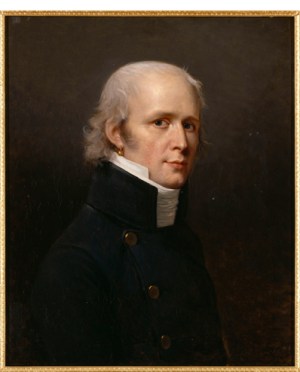
Robert Lefèvre, Portrait of Charles Percier, 1807, oil on canvas (Chateaux de Versailles et de Trianon, Versailles; photo by Gerard Blot).
Charles Percier: Architecture and Design in an Age of Revolutions will be the first large-scale exhibition to survey the magnificent range of projects undertaken by the French architect and designer from the end of the eighteenth to the beginning of the nineteenth century. Jean-Philippe Garric, professor of the history of architecture at the University of Paris I, Panthéon- Sorbonne, is the curator.
Although largely remembered for his close collaboration with Pierre François Léonard Fontaine (1762–1853)—together they defined the Empire style and created the decorative program of Napoleon’s reign—Charles Percier’s (1764–1838) artistic style was unique, complex, and ever-evolving. From the last years of the ancien régime, when Percier was a promising student—first at the Académie royale d’architecture in Paris and then at the French Academy in Rome, where he concentrated on graphic work—his commissions for public and private clients significantly influenced decorative arts and architecture during an extremely turbulent and rapidly changing period in French history.
Charles Percier: Architecture and Design in an Age of Revolutions breaks with the tradition of considering Percier and Fontaine together. This choice, shaped by the discovery of new documents relating to the production of the two partners, allows a better understanding of Percier’s multifaceted artistic practice. The exhibition will feature more than 130 art works from principal museums and cultural institutions in France and the United States, as well as key objects from private collections, including his designs for furniture, porcelain, metalwork, and the renovation of the rue de Rivoli—the construction of which transformed the center of Paris. Rare drawings and spectacular examples of early nineteenth-century cabinets, candelabras, and tureens will also be displayed. By focusing on his most famous and seminal works, such as sketches for the arc du Carrousel, the interior designs for Josephine Bonaparte’s rooms in the Tuileries Palace, and the magnificent books dedicated to Roman palaces and interior decoration, the exhibition will demonstrate the diverse and extraordinary creations of an artist whose work brilliantly bridged ancien régime court culture and the industrial production of the nineteenth and early twentieth centuries.
Organized by Bard Graduate Center Gallery, New York, in association with the château de Fontainebleau and the Réunion des musées nationaux-Grand Palais, Paris. Following its presentation at Bard Graduate Center Gallery, Charles Percier: Architecture and Design in an Age of Revolutions will be on view at château de Fontainebleau from March 18, 2017 to June 19, 2017.
Background
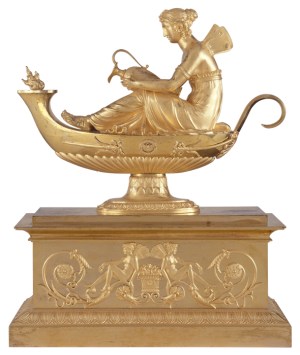
Pierre Phillippe Thomire after design by Charles Percier, Andiron with Psyche, 1809, chased and gilt bronze (Château de Fontainebleau, inv. F 943 C)
With thousands of drawings in public and private collections, several architectural and urban interventions of prime importance in the heart of Paris, numerous furniture and interior designs commissioned by prestigious patrons, publications that left their mark on several generations of architects and decorators, and, among his students, sixteen Prix de Rome winners and seven members of the Institut de France, the genius of Charles Percier was evident to his contemporaries. While his importance has been acknowledged by most historians of art, architecture, and decorative arts, no exhibition or book has yet attempted an overview of his production as a whole. This is not merely an injustice to him given his central role in the arts at a time of transition between the ancien régime and the modern period and his proximity to those in power under Napoleon, it has compromised our understanding of the architecture and decorative arts produced during this time, not just in France but throughout Europe.
While there are many surviving graphic documents and other works by Percier, there is no Percier archive. The principal sources—Fontaine’s journal and memoirs, the former written for posterity and the latter for his grandchildren—purport to be accurate, but often overlook entire aspects of his career. Fontaine failed to mention all of the projects undertaken by Percier alone. As a result, this exhibition, by concentrating on Percier, offers a biographical synthesis of his career that focuses on specific projects, whether realized, published, or drawn.
Percier and His Circles
Charles Percier owed a great deal to the academic world, and he gave a great deal back to it. After studying drawing at an exemplary philanthropic institution of the last years of the ancien régime, the École gratuite de dessin (Free Drawing School), he was a model student at the Académie royale d’architecture (Royal Academy of Architecture) and then, after winning the prestigious Prix de Rome in 1786, an enthusiastic pensioner (fellow) at the Académie royale d’architecture. He began teaching students of his own in 1791—almost immediately after returning to Paris from Italy—and gradually became one of the most important French architecture professors of the first third of the nineteenth century, entering the Institut de France in 1811. Percier lived alone but often worked with others—Pierre Fontaine, the most important of these, was by no means the only one—and befriended many of his fellow Rome pensioners as he would later do with several of his students, many of whom collaborated with him. His circle included fellow École gratuite de dessin pupils such as Anne Louis Girodet-Trioson (1767–1824); his teacher Antoine François Peyre (1739–1823); fellow Rome pensioners, most notably Jean German Drouais (1763–1788); architects and painters including François Gérard (1770–1837); and several generations of students who engaged in com- mon projects and socialized, both casually and within more structured frameworks such as the dinners of the society of artists known as the Duodi.
This theme presents Percier’s various academic projects, including his Grand Prix winning architectural design, sketches he made in Rome, his graphic reconstruction of Trajan’s Column, as well as portraits of and work by his students.
Between Italy and France
Percier’s Italian sojourn (1786–91) had a profound effect on him. Like many fellowship students at the French Academy in Rome, his stay there was characterized by enthusiasm and wonder, but, more than any other, he made this experience a key moment in his emotional, artistic, and intellectual life. A relentless campaign of measuring and drawing made it possible for him to gather material for two volumes of engravings that were to have considerable influence on his con- temporaries and later designers. For the rest of his life, he remained a fervent admirer of Italian antiquity and Renaissance art and architecture, and planned a second trip to Italy that never happened.
Despite his ardent Italophilia, Charles Percier was not indifferent to French architecture, especially that of the French Renaissance, and he admired the decorative and sculptural production of Jean Goujon (active 1540–65) and Pierre Lescot (ca. 1515–1578). Consistent with his admiration of Italian architecture, he carefully studied the château de Fontainebleau through hundreds of drawings. He also collaborated with art historian Alexandre Lenoir (1761–1839) on the installation and graphic reproduction of works in the Musée des monuments français, a museum dedicated to French architectural heritage, which Lenoir opened in 1795.
This theme evokes the artistic context of Percier’s Italian sojourn through drawings from his stay at the French Academy in Rome, a volume on Roman palaces and villas, and sketches. It also examines his involvement with the Musée des monuments français.
A Graphic Artist
Apart from a few letters, Percier left behind almost no writings. From the several thousand carefully organized drawings he bequeathed, it is apparent, even during his early training at the École gratuite de dessin, that his skill as a draftsman enabled him to stand out, consolidate his position, and prevail over his contemporaries. His line is fine and precise, and he was less interested in the art of perspective than in delineation and linear agility. His mastery of outline and contour coupled with his passion for abundant ornament were the very heart of his creative work. This ability, cemented by his prolonged study of the bas-reliefs of Trajan’s Column, enabled him to stand out as the illustrator, graphic designer, and decorator of his own publications and other prestigious editions, as well as of luxury objects.
Percier’s most remarkable achievements, given that he’s an architect, are his drawings for the editions of Horace and the Fables of La Fontaine published by Didot. –Alexandre Lenoir, 1805
This theme emphasizes Percier’s graphic work, considered both as an independent artistic domain and as the unifying thread between Percier’s other creative projects. Exquisite drawings from the Louvre, luxury books, including a commemorative book for Napoleon’s coronation, prints, and even a fan for Josephine will be on view.
The Recueil de décorations intérieures

Charles Percier, Clock, by Sèvres Porcelain Manufactory, 1813, bisque porcelain, gold highlights (Sèvres, Cité de la céramique, MNC 13022).
Percier’s production in the realm of interior decoration and furniture design was considerable. Not only was he called upon to design a great many interiors, furnishings, and objects—from his first commissions for the National Convention in 1793 to the carriage for the coronation of Charles X—his major works were much publicized by the Recueil de décorations intérieures (1801–12). This collection of 72 plates of furniture and interior designs was one of the most important and influential ornament books in France and indeed in Europe of the time. It established an international neoclassical taste and became a model for commercial catalogues of ornaments, unwittingly inaugurating an era of industrial arts production. The Recueil was a major source of inspiration for generations of decorators and designers. It ensured Percier’s legacy while simultaneously linking it inextricably to that of Fontaine.
Percier, whose temperament and taste, indeed his gifts, were ill-suited to the trouble and demands of business, left all practical matters to me. I handled the correspondence as well as the accounts, and he focused almost exclusively on study drawings and graphic compositions. –Pierre Fontaine, 1804
As Fontaine acknowledged himself, the Recueil was Percier’s masterwork. Percier drew and engraved the plates largely on his own, despite including both of their signatures. ‘Percier and Fontaine’ is thus perhaps more akin to a luxury brand than an indication of shared artistic paternity. Separating Percier from Fontaine, this exhibition restores Percier’s role and singular contribution to the decorative arts as an expert draftsman and designer.
But the contributions Charles Percier made to the realms of furniture and interior decoration do not all fall within the chronological parameters of the Recueil de decorations intérieures, nor are they limited to the ensembles and objects represented there. His work for artisanal firms like Jacob frères and that of Martin Guillaume Biennais and his designs for manufactories like Sèvres were the point of departure for national and international diffusion of the style Percier. This diffusion ran parallel to the gradual industrialization of the arts, as well as a certain democratization of access to luxury objects.
This theme first focuses on the Recueil de décorations intérieures, juxtaposing rare hand-colored prints from the publication with corresponding drawings, furniture, and objects. It will include extraordinary pieces made for Napoleon, Josephine, and members of the imperial circle from the collections of Versailles, Fontainebleau, and the Elysée Palace. It also demonstrates the dissemination of Percier’s style and its vulgarization, as well as Percier’s continued artistic development after 1815.
The Louvre, the Tuileries and the rue de Rivoli
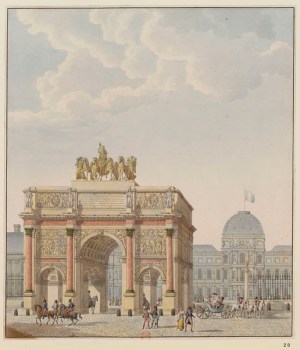
Charles Percier and Pierre Fontaine, Arc du Carrousel, south side view, 1806–15, watercolor and pen (Paris: Bibliothèque nationale de France, département Estampes et photographie, RESERVE FOL-VE-53 C).
At the beginning of the nineteenth century Napoleon engaged Percier and Fontaine to execute one of the most ambitious projects of his reign and of their careers—linking the Louvre and Tuileries palaces. This large-scale enterprise had three principal ambitions. The first and oldest one was to connect the Louvre with the Tuileries, thereby creating a palace of unmatched magnitude. As heir to the Revolution, Napoleon could not reside at Versailles, and he wanted to complete a project that a century of royal rule had been unable to bring to fruition. The Tuileries became the principal imperial residence, with all its practical and symbolic consequences. The second ambition was to transform the surrounding city. Given their dimensions and location, connecting the Louvre with the Tuileries meant recasting the center of Paris. From this perspective, the operation constitutes a link between the great urban embellishment projects of the eighteenth century and the transformations of the Second Empire. Finally, the third ambition, doubtless the most contemporary, was cultural in nature: to complete and restore buildings considered jewels of French architectural patrimony as well as to create, within the Louvre, the world’s largest museum.
This theme presents Percier and Fontaine’s designs for the Louvre and the Tuileries, from an urban scale to the arrangement of interiors and decoration. It will also include their designs for the renovation of the arcades on the nearby rue de Rivoli.
Paper Architecture
Much of the architecture Charles Percier designed with Pierre Fontaine was never built. Paper architecture, or plans for unrealized structures, was the reality for architects during this era of political turmoil. In fact, paper architecture became a practice in itself at the Académie royale d’architecture when Percier was a student there during the late eighteenth century. Economic crises in the 1780s resulted in a lack of architectural commissions and architects like Percier began defining themselves as artists who produced beautiful drawings of hypothetical structures, rather than builders.
When Percier left Paris for Rome, he was still training to be a court architect. By the time he returned in the midst of the French Revolution, the world he knew was shattered. Percier’s talent for drawing enabled him to be flexible and versatile in seeking other forms of work. Besides book illustration, in the 1790s, Percier and Fontaine served as co-directors of set design at the Paris Opera, where they created spectacular yet ephemeral scenery for the stage.
Despite being swept into Napoleon’s extravagant ambitions, including his plans for a Palace of the King of Rome, Percier and Fontaine managed to build only a small number of important structures. Their contributions to the staging of Napoleonic power, notably the emperor’s coronation and his marriage to Marie-Louise, represent a significant portion of their realized work. The fact that they produced more ephemeral projects and—especially—designs for buildings that were never constructed resulted in a corpus of works on paper that reveal the richness and diversity of their imaginations. This final theme presents architectural drawings, water- colors, commemorative volumes, and objects, related to Napoleonic ceremonies and commissions, as well as opera sets designed by both Percier and Fontaine.
◊ ◊ ◊ ◊ ◊
Symposium | Percier: Antiquity and Empire
Bard Graduate Center, New York, 18 November 2016
Taking place on Friday afternoon, 18 November 2016, the symposium will feature speakers including Jean-Philippe Garric, Ulrich Leben, Iris Moon, Darius Spieth, and more. RSVP is required. Please click on the registration link here or email public.programs@bgc.bard.edu.
◊ ◊ ◊ ◊ ◊
From Yale UP:
Jean-Philippe Garric, ed., Charles Percier: Architecture and Design in an Age of Revolutions (New Haven: Yale University Press, with Bard Graduate Center, 2017), 304 pages, ISBN: 978-0300221589, $75.
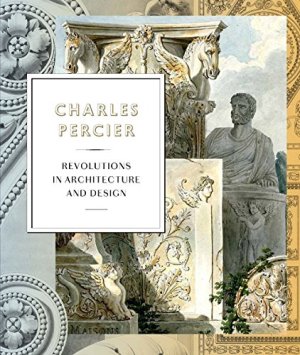 Handsomely designed and richly illustrated, this publication surveys the magnificent spectrum of projects undertaken by French architect and interior designer Charles Percier (1764–1838). After gaining an illustrious reputation for supervising the scenery at the Paris Opéra during the French Revolution, Percier was later appointed by Napoleon Bonaparte. With the Emperor’s support, he developed the opulent versions of neoclassicism closely associated with the Napoleonic era, and now known as Directoire style and Empire style. Percier worked on the renovation or redecoration of many of France’s royal palaces, including the Louvre, the Tuileries, and the chateaux of Malmaison, Saint-Cloud, and Fontainebleau. The full scope and variety of Percier’s design projects are revealed in this book, which also includes archival material detailing Percier’s relationships with patrons and peers.
Jean-Philippe Garric is professor of architecture at the University of Paris I, Panthéon Sorbonne.
◊ ◊ ◊ ◊ ◊
Note (added 28 November 2016) — The symposium included the following presentations:
• Jean-Philippe Garric (Professor, History of Architecture, University of Paris I, Panthéon-Sorbonne and curator of the exhibition Charles Percier: Architecture and Design in an Age of Revolutions), Charles Percier: Beyond the Antique Model
• Iris Moon (Visiting Assistant Professor, School of Architecture, Pratt Institute), New Heads for Old Bodies: Percier’s Designs for the French Revolution
• Ulrich Leben (Research Scholar and Visiting Professor, Bard Graduate Center), Charles Percier’s Vision of Antiquity
• Darius Spieth (Professor, Art History, Louisiana State University), Percier and Piranesi
• Jean-François Bédard (Associate Professor, School of Architecture, Syracuse University), Franks, Not Romans: Medieval Imagery and the Making of Imperial France
UK Export Bar Placed on Mazarind Tapestry, ca. 1700

Michael Mazarind Workshop, Chinoiserie Tapestry with Courtly and Hunting Scenes, made in London,
ca. 1696–1702.
◊ ◊ ◊ ◊ ◊
Press release (20 October 2016) from Gov.UK’s Department for Culture, Media & Sport:
Culture Minister Matt Hancock has placed a temporary export bar on a rare tapestry by Michael Mazarind to provide an opportunity to keep it in the country. The tapestry is at risk of being exported from the UK unless a buyer can be found to match the asking price of £67,500. Inspired by Indian, Chinese, and Japanese design, it is the only surviving tapestry to feature Michael Mazarind’s workshop mark [lower right-hand corner]. Little is known of his workshop, but it is believed he was based in Portugal Street, London, between 1696 and 1702. Mazarind was relatively unknown, but is said to have connections to John Vanderbank, the Soho-based weaver. The tapestry includes small groups of oriental figures, buildings, exotic creatures, and plants. This combination of elements was described as ‘in the Indian manner’ and was one of the most popular decorative fashions of the period.
Minister of State for Digital and Culture Matt Hancock said: “This intricate design provides us with a unique opportunity to explore the tapestry workshops of 1600s London. I hope we are able to keep it in the country so we can learn more about our nation’s textile industry, and of the decorative fashions of the time.”
The decision to defer the export licence follows a recommendation by the Reviewing Committee on the Export of Works of Art and Objects of Cultural Interest (RCEWA), administered by The Arts Council. The RCEWA made its recommendation on the grounds of significance for the study of Mazarind’s work, English tapestry of the period, and London’s history.
RCEWA member Christopher Rowell said: “This beautiful blue ground tapestry, with an equally unusual border of Chinese inspiration, dates from the late 1600s and is the only one to bear the woven signature of the mysterious Michael Mazarind, who was a rival of the more well-known London tapestry weaver, John Vanderbank. This type of ‘Indian’ tapestry depicting a Chinoiserie fantasy paradise in Cathay, with courtly and hunting scenes, was devised for the court but soon became more broadly popular. Saving the tapestry for the nation will allow specialists to study it in detail and help to reconstruct Mazarind’s contribution to tapestry production in early-Georgian London.”
The decision on the export licence application for the tapestry will be deferred until 19 January 2017. This may be extended until 19 April 2017 if a serious intention to raise funds to purchase it is made at the recommended price of £67,500. Offers from public bodies for less than the recommended price through the private treaty sale arrangements, where appropriate, may also be considered by Matt Hancock. Such purchases frequently offer substantial financial benefit to a public institution wishing to acquire the item.










 Enfilade
leave a comment