New Book | The Dublin Civic Portrait Collection
From Four Courts Press:
Mary Clark, The Dublin Civic Portrait Collection: Patronage, Politics, and Patriotism, 1603–2013 (Dublin: Four Courts Press, 2016), 238 pages, ISBN: 978-1846825842, €40 / $65.
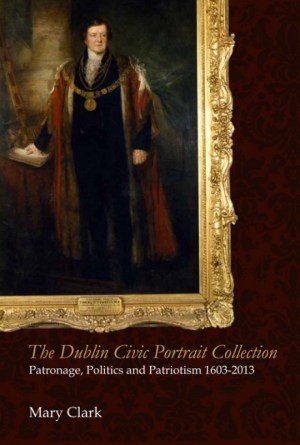 Beginning in the early 17th century and continuing to the present day, the city of Dublin has built up a portrait collection that is unique on the island of Ireland in terms of range and diversity and is brilliantly expressive of the political aspirations and realities that have informed its creation. The collection contains sixty-six works in oil-on-canvas and eight statues in bronze and marble. These can be placed in three principal categories: royal personages; lord lieutenants of Ireland; and lord mayors and aldermen of Dublin. It includes works by Irish artists Thomas Hickey, Hugh Douglas Hamilton, Martin Cregan, Stephen Catterson Smith, Dermod O’Brien, Robert Ballagh and Carey Clarke and by leading English portraitists including Sir Joshua Reynolds, George Romney, Sir William Beechey, and Sir Thomas Lawrence.
This book contains a catalogue of the entire collection with an introduction placing it within the broader context of civic imagery and regalia, giving due regard to ceremony, heraldry, dress and accoutrements of office. The Dublin collection is placed within its historical context to show how developments in Dublin and in Ireland as a whole influenced its formation. This lavishly illustrated book illuminates the complex relationship between politics, pageantry, art and history in the Irish capital over a sustained period of 400 years.
Mary Clark is the Dublin City Archivist and curator of the Dublin Civic Portrait Collection.
Call for Papers | Trashed: Rejection and Recovery
From Boston University:
Trashed: Rejection and Recovery in the History of Art and Architecture
33rd Annual Boston University Graduate Symposium in the History of Art and Architecture
Boston University, 24–25 March 2017
Proposals due by 21 November 2016
What happens to the ideas and materials that end up in the scrap bin of history? While some projects are laid to waste, others are repurposed or reimagined. The 33rd Annual Boston University Graduate Symposium in the History of Art and Architecture invites submissions that explore themes of dispensability and resourcefulness.
Possible subjects include, but are not limited to, the following: spolia; creative use of recycled materials; deletions and deaccessioned objects; abandoned or reclaimed architectural spaces; drafts, drawings, or models for unrealized works; and the impact of unfavorable reception, as dictated by time, place, or audience. We welcome submissions from graduate students at all stages of their studies, working in any area or discipline.
Papers must be original and previously unpublished. Please send an abstract (300 words or less), a paper title, and a CV to bugraduatesymposiumhaa@gmail.com. The deadline for submissions is Monday, November 21, 2016. Selected speakers will be notified before January 1, 2017 and are expected to accept or decline the offer within a week of notification. Papers should be 20 minutes in length and will be followed by a question and answer session.
The Symposium will be held Friday, March 24 – Saturday, March 25, 2017, with a keynote lecture (TBD) on Friday evening at the Boston University Art Gallery at the Stone Gallery and graduate presentations on Saturday in the Riley Seminar Room of the Museum of Fine Arts, Boston.
This event is generously sponsored by The Boston University Center for the Humanities; the Boston University Department of History of Art & Architecture; the Museum of Fine Arts, Boston; the Boston University Graduate Student History of Art & Architecture Association; and the Boston University Art Gallery at the Stone Gallery.
Nationalmuseum Releases 3,000 images on Wikimedia Commons

Jean-Baptiste Pater (1695–1736), A Company of Bathers in a Park, oil on canvas, 49 x 59 cm (Stockholm: Nationalmuseum, NM874, photograph by Cecilia Heisser).
◊ ◊ ◊ ◊ ◊
Press release (11 October 2016) from Sweden’s Nationalmuseum:
Nationalmuseum is making 3,000 high-resolution images of its most popular artworks available for free download on Wikimedia Commons. Zoomable images will also be added to the museum’s online database. The digitization project is a major advance in making Nationalmuseum’s collections more accessible.

David von Cöln, Pineapple Plant, 1729, oil on canvas, 112 x 91 cm (Stockholm: Nationalmuseum / Gripsholm Castle).
While the Nationalmuseum building is under renovation, only a small part of the collections is accessible to the public. To provide more opportunity for people to enjoy its artworks, the museum embarked last year on a joint project with Wikimedia Sweden. As a result, high-resolution images of some 3,000 paintings from the collections are now available for download on Wikimedia Commons as public domain. This means they are part of our shared cultural heritage and can be freely used for any purpose. The images are also now zoomable, but not currently downloadable, in Nationalmuseum’s online database.
“We are committed to fulfilling our mission to promote art, interest in art, and art history by making images from our collections an integral part of today’s digital environment,” said Berndt Arell, director general of Nationalmuseum. “We also want to make the point that these artworks belong to and are there for all of us, regardless of how the images are used. We hope our open collection will inspire creative new uses and interpretations of the artworks.”
Nationalmuseum will continue to make its collections more accessible as digitization gathers pace and digital infrastructure improves. The longer-term goal is to create a portal offering quick and easy access to all the museum’s fine art collections and archives. Nationalmuseum joins a growing number of museums that have released images of their collections, including The Royal Armoury and Skokloster Castle with the Hallwyl Museum Foundation in Sweden, the Rijksmuseum in Amsterdam, and the National Gallery of Denmark in Copenhagen. Data on the images in Wikipedia Commons, including links to the zoomable versions, is available on GitHub as raw material for coders taking part in Hack4Heritage—an event being organized by Digisam, the agency coordinating the digitization of Sweden’s cultural heritage, in partnership with the Stockholm City Archives, on 14–16 October.
Exhibition | The Art of Alchemy

Alchemists Revealing Secrets from the Book of Seven Seals, The Ripley Scroll (detail), ca. 1700
(Los Angeles: The Getty, 950053).
◊ ◊ ◊ ◊ ◊
Press release (5 October 2016) from The Getty . . . (with The Getty Alchemy Collection available here)
The Art of Alchemy
Getty Research Institute, Los Angeles, 11 October 2016 — 12 February 2017
Staatliche Museen zu Berlin, May — August 2017
Curated by David Brafman with Rhiannon Knol
Long shrouded in secrecy, alchemy was once considered the highest of arts. Straddling art, science, and natural philosophy, alchemy has proven key to both the materiality and creative expression embedded in artistic output, from ancient sculpture and the decorative arts to medieval illumination, and masterpieces in paint, print, and a panoply of media from the European Renaissance to the present day. Drawing primarily from the collections of the Getty Research Institute as well as the J. Paul Getty Museum, the exhibition The Art of Alchemy examines the impact of alchemy around the world on artistic practice and its expression in visual culture from antiquity to the present.
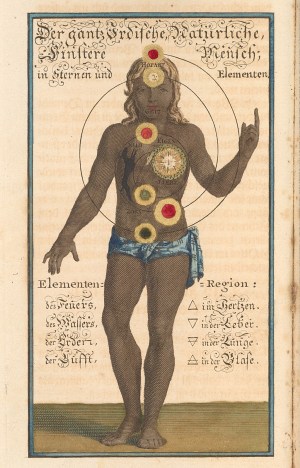
The Entire Earthly, Natural, and Dark Man, 1723. From Johann Georg Gichtel, Theosophia Practica (Practical Theosophy) (Leiden, 1723), pl. before p. 25. 2611–134.
“Alchemy is a fascinating subject that cuts across continents and epochs,” said Thomas W. Gaehtgens, director of the Getty Research Institute. “It is because the Getty Research Institute collections are so diverse and intricately connected that we are able to deeply investigate and present this often misunderstood subject. This exhibition reflects the human ambition to explore and understand the wonders, the materiality, and the laws of nature since the earliest times. Imagination, curiosity, scholarship, enchantment, science, philosophy, and chemistry amalgamate in the artistic processes of alchemy.”
On view at the Getty Research Institute from October 11, 2016, through February 12, 2017, The Art of Alchemy features more than 100 objects, including manuscripts and rare books, prints, sculpture, and other works of art dating from the 3rd century BCE to the 20th century and coming from across Europe and Asia. The exhibition was organized in partnership with the Staatliche Museen zu Berlin, where it will be on view in 2017, and is curated by David Brafman, associate curator of rare books with assistance from Rhiannon Knol.
The Art of Alchemy approaches the subject from a global perspective, tracing how alchemy historically bonded art, science, and natural philosophy in visual cultures throughout the world. From its origins in Classical and Eurasian antiquity to the advances made and spread throughout the Islamic world and the ‘silk’ routes of Central Asia, material and intellectual exchange across cultures reached mediaeval Europe, and catalyzed alchemy’s ‘golden age’ from the Renaissance to the Enlightenment. The persistence of its spirit is still present in artistic expression and technocratic trends of the modern day, and the historical echoes of this chemical obsession with artificial reproduction also resound throughout more modern technologies of art, from chromolithography in the Industrial Age to the media that now claim artistic boasting rights as the ultimate chemical mirrors of nature: photography and the liquid crystal displays of the digital world.
“Alchemy was a science tinged with spirituality and infused with a spritz of artistic spirit. Most people think of alchemy as a fringe subject when really it was a mainstream technology and worldview that influenced artistic practice and expression throughout the world,” said David Brafman, curator of the exhibition. “Alchemy may well have been the most important human invention after that of the wheel and the mastery of fire. Certainly it was a direct consequence of the latter.”
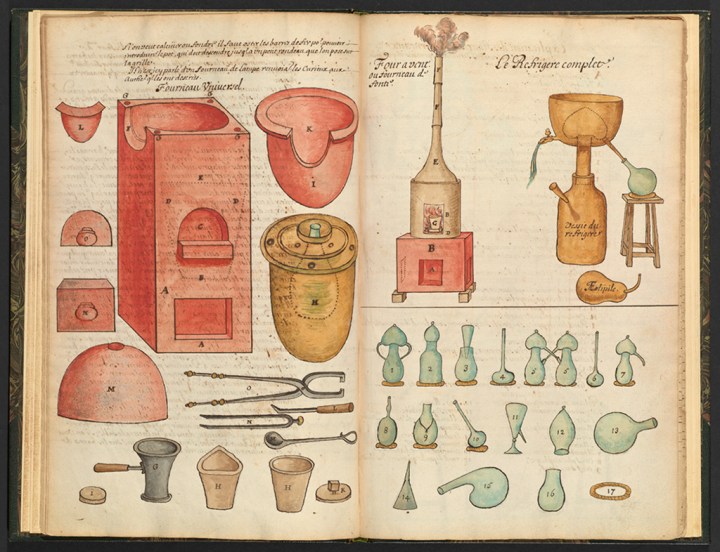
Alchemical Equipment, from Traité de Chymie [Treatise on Chemistry], ca. 1700, pp. 10–11
(Los Angeles: The Getty, 950053.2). View a digitized version of this book.
◊ ◊ ◊ ◊ ◊
The exhibition is presented in three parts: ‘Alchemical Creation’, ‘Alchemy and Creativity’, and ‘Alchemical Culture’.
Alchemical Creation explores alchemy’s origins in Greco-Egyptian antiquity, illustrated by ancient artifacts reflecting alchemical theories and techniques, including a second-century mummy portrait painted with red lead, an early example of synthetic pigments with both medicinal and artistic applications. This union of Greek and Egyptian thought flourished in the ancient city of Alexandria, producing the legendary sage Hermes Trismegistos, whose fabled Corpus Hermeticum provided the philosophical blueprint of alchemical theory. At the same time, the flow of materials and technologies between the ancient Mediterranean, Middle East, India, and China along the Silk Routes of Eurasia spread these ideas widely, inspiring dazzling glass imitations of precious stones and gems, as well as scientific developments in the use of mysterious metals like mercury to create synthetic gold—or at least, its appearance—through gilding techniques.
This section also explores alchemical ideas about the nature of creation itself, which was the secret alchemists worked to unlock in order to harness the powers of nature for their own imaginative ends. Renaissance books depict the act of divine creation as analogous to that of a draftsman or an artist, linking the creativity of the artist (or alchemist) with that of the prime mover and igniting centuries of debate over the scope and legitimacy of the art of alchemy.
The section Alchemy and Creativity illustrates how practical alchemy and its larger scientific and spiritual concerns crucially influenced both artistic practice and expression. The centerpiece of this section is the twenty-food long Ripley Scroll, a cryptic, hand-painted 18th-century manuscript scroll named for a Catholic clergyman and poet George Ripley. This unusual art object is filled with fantastical allegorical symbolism depicting the operations of alchemy and the creation of the fabled ‘philosophers’ stone’.
The Body as Alchemical Laboratory, Engraving in Joachim Becher, Physica subterranea (Leipzig, 1738), frontispiece, The Getty Research Institute Alchemical techniques for the synthetic production of color became an industrial mainstay for artistic applications in medieval and renaissance Europe, the most important of which was mercury sulfide: vermilion red—often referred to by alchemical texts as the philosophers’ stone itself. While alchemists experimented with the production not only of all the colors of the rainbow, but also effects in glassmaking, inks, dyes, oil paints, ceramic glazes, and metallurgical techniques, their laboratory pursuits in turn inspired psychedelic symbolic imagery for the expression of science through art. Images such as the hermaphrodite, or the ‘Chemical Wedding’, were used to depict chemical bonding—a metaphor which appears in both European and Chinese art—while various other chemical actions and substances were depicted as dragons, lions, birds, and even tiny humans within laboratory vessels. Their vaunting ambitions of playing God increasingly inspired alchemists to create and commission elaborate works of art encompassing their understanding of the entire universe through an alchemical lens, from the operations of the heavens to the anatomy of the human form.
While some of these chemical techniques were the purview of expert alchemists toiling in their labs, some of the techniques were simple and could be duplicated by the average artist, craftsman, or apothecary. By the Renaissance, diaries with scribbled notes and diagrams became commonplace, as did a publishing market for ‘secret’ recipe books for both art and medicine catering to not just artists but also female heads of household, such as the ‘Secrets’ of the Venetian woman Isabella Cortese, published in 1565. Also on view in the exhibition are the personal notebooks of the artists Hans Hanberg and Francesco Boccaccino, containing designs for furnaces, laboratory notes, and even a few accidental stains and singes.
The third section of the exhibition, Alchemical Culture, explores how the successes achieved by the experimental spirit of alchemy continued to spark creative inspiration from the Renaissance to the Enlightenment, while advances in technology continually fed the ambitions of the human imagination. Alchemists’ expertise in the management of mines and the other material resources of empire building attracted rulers whose technocratic ambitions were fueled by the discovery of a new world and its bounty of untapped natural resources. Patrons were not motivated simply by the possibility of filling the treasury with gold made to order, however; alchemical efforts also included perfecting the soul, relieving pain and sickness, and even proposing social utopias modeled after the divinely designed intelligent order of the cosmos.
The spirit of alchemy persisted into the Industrial Age, even after its transformation into the field of chemistry. The Bayer pharmaceutical company developed a rainbow of aniline coal tar dyes from petroleum waste, while at the same time working on a new, more effective painkiller—which would eventually be patented as ‘heroin’. The age of plastics also renewed the alchemical urge to imitate nature, offering the possibilities of imitation horn, ivory, and gemstones for the creation of everything from costume jewelry to life-saving medical devices. The discovery in 1888 of liquid crystals, which now provide the primary canvas of our digital world, inspired the scientific illustrator Ernst Haeckel to write Kristallseelen (‘Crystal Souls’), on display at the Getty, proposing that this new form of matter—which although not alive, seemed to move and grow in response to stimuli—was a sign of the ultimate unity of all matter, animated by a divine creative spark.
Concurrent with the GRI exhibition, the Getty Museum will present the complementing exhibition The Alchemy of Color in Medieval Manuscripts, which looks at how book illuminators drew from alchemy for pigments and inks as well as imitation gold for lavish manuscripts.
◊ ◊ ◊ ◊ ◊
Lecture by David Brafman | Chemical Rainbows and Liquid Crystal Souls: The Spirit of Alchemy in the History of Art
Wednesday, 18 January 2017, 7:00pm
The Art of Alchemy Colloquium
Thursday, 19 January 2017
Conference | Synagogue and Museum
From the Society of Architectural Historians:
Synagogue and Museum: 3rd International Congress on Jewish Architecture
Technische Universität Braunschweig, 21–23 November 2016
Organized by the Bet Tfila – Research Unit for Jewish Architecture (Technische Universität Braunschweig/ Center for Jewish Art at the Hebrew University of Jerusalem) and Hochschule für jüdische Studien Heidelberg, in cooperation with the Braunschweigisches Landesmuseum, Braunschweig, and the Israel Jacobson Netzwerk für jüdische Kultur und Geschichte e.V.
Since antiquity and especially since the destruction of the Jerusalem Temple in the year 70 CE, synagogues have become the central places of gathering of Jewish communities. They are complex, highly significant and polyvalent objects of for religious, social, economic, architectural, and artistic developments in Jewish culture. At the same time, they reflect the interdependencies with the surrounding cultures. Since the holocaust, historic synagogues also gained high importance as focal points of remembrance and education.
However, scholars were interested in the material culture(s) of Jews all over the world well before the holocaust and turned synagogues and their furnishings into a focus of their research. The documentation of synagogues as objects of cultural and historical significance started alongside with the establishment of Jewish ethnography (jüdische Volkskunde) as an academic discipline at the end of the 19th century. They became items of collecting, which were set up in exhibitions and museums. Objects from the religious and cultural practice got ‘musealised’, as well as entire synagogue furnishings and sometimes even architectural elements. After 1945, the interest in synagogues as objects of cultural history continued. Besides ritual objects and furnishings, the ’empty’ buildings of the annihilated communities became objects of interest. Historic synagogue buildings were regarded as museums, their material substance was and is restored and interpreted in different ways. The virtual and haptic reconstruction of destroyed synagogues generated another group of ‘immaterial’ exhibits.
The congress will examine the subject in a wide range of perspectives of theoretical and historical reflections. Historic and actual examples of documenting, collecting, and researching synagogues and their furnishing will shed light on the history, the presence, and the future of synagogues in and as museums.
For registration and any questions, please, contact us by email, synagogen@tu-bs.de; registration should be done by 7 November 2016. A congress fee of 50€ is payable directly at the registration desk; it includes coffee breaks and refreshments, the visit of the Braunschweigisches Landesmuseum Hinter Aegidien, and the evening events on Tuesday, 22 November.
◊ ◊ ◊ ◊ ◊
M O N D A Y , 2 1 N O V E M B E R 2 0 1 6
13:00 Opening Session
• Welcome from Alexander von Kienlin (Braunschweig)
• Greetings, Jürgen Hesselbach (President of the TU Braunschweig), Johannes Heil (Rektor of the Hochschule für Jüdische Studien Heidelberg), Heike Pöppelmann (Braunschweigisches Landesmuseum), Aliza Cohen-Mushlin (Center for Jewish Art, Jerusalem), and Jochen Litterst (Braunschweig)
• Keynote address by Annette Weber (Heidelberg)
• Introduction, Ulrich Knufinke (Braunschweig)
14:30 Coffee break
15:00 Panel 1 | Displaying Synagogues: A History of Transfers and Transformations
Chair: Barbara Kirshenblatt-Gimblett (New York)
• Sabine Offe (Bremen), Synagogues as Traces
• Ilia Rodov (Bar Ilan), Synagogue as Museum: Ritual and Exposition
• Naomi Simhony (Jerusalem), Synagogue Exhibitions in National Museums in the State of Israel
16:45 Panel 2 | Synagogues as Sources for Research and Education
Chair: Jutta Dick (Halberstadt)
• Mirko Przystawik (Braunschweig), The Hornburg Synagogue and Its Furnishing
• Renato Athias (Pernambuco/Brazil), Memory and Architectural Preservation of the First Synagogue in the Americas
• Marc Grellert (Darmstadt), Synagogues Destroyed in Germany: 20 Years of Virtual Reconstructions in Museums
T U E S D A Y , 2 2 N O V E M B E R 2 0 1 6
9:00 Panel 3 | Collecting Contexts: Objects From Synagogues in Jewish and Non-Jewish Collections
Chair: Chana C. Schütz (Berlin)
• Felicitas Heimann-Jelinek (Wien), The Judaica-Collection at the Braunschweigisches Landesmuseum and its Presentation(s)
• Sergey Kravtsov (Jerusalem), The Jewish Museum in Lviv: Genius Loci and Realpolitik
• Miranda Crowdus (Hannover), Synagogue Music-Objects as Metonyms: Ethics and Dissonances in the Material Representation/Display of Jewish Practice
10:30 Coffee break
11:00 Panel 4 | Objects and Sites of Jewish Material Culture
Chair: Alexander von Kienlin (Braunschweig)
• Svetlana Tarkhanova (Moscow), The Chorazin Synagogue (4th–6th centuries) at the Archaeological Site and in the Museum Space
• Askold Ivantchik (Bordeaux), Archeological and Epigraphical Traces of an Early Diaspora Community in Tanais, Russia
• Hans-Christof Haas (Bamberg), The Sukkah of Mendel Rosenbaum in Zell /Lower Franconia: Tradition – Research – Presentation
12:30 Lunch break
13:30 Poster presentation
14:15 Panel 5 | Synagoguges as Museums: New Concepts of Display and Education
Chair: Samuel Gruber (Syracuse NY)
• Ron Epstein (Zurich), Re-Used Synagogues in Switzerland
• Martha Keil (St. Pölten/Wien), ‘Who is in need of a Judentempel?’ The Former Synagogue of St. Pölten (Lower Austria) and Its Cultural Location
• Barbara Kirshenblatt-Gimblett (New York), The Example of the Wooden Synagogue in the Polin-Museum, Warsaw
16:30 Visit of the Jüdisches Museum des Braunschweigischen Landesmuseums
18:00 Reception by the Lord Mayor of the City of Braunschweig, Altstadtrathaus
19:00 Public Lecture
Ismar Schorsch (New York), Leopold Zunz und die Wissenschaft des Judentums
W E D N E S D A Y , 2 3 N O V E M B E R 2 0 1 6
9:00 Panel 6 | Reconstruction, Re-contextualization: Synagogue-Museums and Their
Environments
Chair: Rudolf Klein (Budapest)
• Anselm Hartinger (Erfurt), The Museum Old Synagogue
• Gabi Rudolf M.A. (Würzburg), Synagogue Arnstein: Visual Fragment of an Invisible History
• Givi Gambashidze, Tbilisi), Museum as a Space of Peace
10:30 Coffee break
11:00 Panel 7 | The Future of Synagogues in/ as Museums
Chair: Vladimir Levin (Jerusalem)
• Eszter Gantner (Marburg), Synagogue as Space of Conflicts: The Formal Synagogue of Esztergom, Hungary
• Heike Pöppelmann and Hans Jürgen Derda (Braunschweig), The Museum of Religions in the Braunschweigisches Landesmuseum
• Benigna Schönhagen (Augsburg), The Example of Augsburg
• Christiane Twiehaus and Sebastian Ristow (Cologne), The Findings, Reconstruction, and Museum Presentation of the Cologne Medieval Synagogue and the Jewish Quarter
12:30 Final discussion
Exhibition Preview | The Great Spectacle: The Royal Academy
In the latest issue of PMC Notes (October 2016), pp. 4–7.
The Great Spectacle: The Royal Academy and its Summer Exhibitions, 1769–2017
Royal Academy of Arts, London, opening June 2018
Curated by Mark Hallett and Sarah Turner
The Royal Academy’s summer exhibition is the world’s longest running annual display of contemporary art. Ever since 1769, and at a succession of locations ranging from Pall Mall to Piccadilly, the Academy’s exhibition rooms have been crowded for some two months each year with hundreds of paintings and sculptures produced by many of Britain’s leading artists. Over the last two hundred and fifty years, these spectacular displays of art—dominated by what has become a famously crowded and collage-like arrangement of pictures across the Academy’s walls—have provided thousands of artists with a crucial form of competition, inspiration, and publicity, and captured the interest of millions of visitors.
As well as expressing the Academy’s own ambitions and achievements, these exhibitions have played a central role within London’s and the nation’s art world. In the eighteenth and nineteenth centuries, they provided the main forum within which Britain’s artists could showcase their individual practice and compete with their rivals for popular and critical acclaim. Today, even as they continue to feature the works of many distinguished painters and sculptors, they are just as famous for providing hitherto unknown, sometimes amateur practitioners with the opportunity of seeing their creations hanging alongside the works of their more celebrated peers. These exhibitions thus offer a unique prism through which to view the history of the Royal Academy itself, and of modern British painting and sculpture more generally.
Our exhibition, which has the working title, The Great Spectacle: The Royal Academy and its Summer Exhibitions, 1769–2017, is intended to tell the story of these displays, and in doing so to provide an innovative, illuminating, and visually stunning means of commemorating the Academy’s first 250 years. . .
The exhibition, which is due to open in June 2018, and which will be accompanied by a scholarly catalogue and an online chronicle (for which, see Jessica Feather’s Spotlight feature following this article), will occupy a run of ten gallery rooms at the Royal Academy. Furthermore, visitors to the display will have the opportunity of moving directly from The Great Spectacle into the 2018 Summer Exhibition itself, thereby bringing the story full circle.
The full article is available here»
New Book | The British School of Sculpture, c. 1760–1832
From Routledge:
Sarah Burnage and Jason Edwards, eds., The British School of Sculpture, c. 1760–1832 (New York: Routledge, 2016), 292 pages, ISBN: 978-1472435767, $150.
 The British School of Sculpture is the first essay collection examining the rich array of sculpture produced and exhibited in Britain between 1768 and 1837. Featuring nearly 60 illustrations, many never reproduced before, and combining essays from leading scholars in the field with exciting new voices, the volume challenges the notion that neoclassicism dominated British art history in the period, and returns to centre stage a number of compelling baroque works. The volume also emphasises the regional specificities of the British School, paying particular attention to the importance of country house collections and Scottish influences, and the British School’s broader cosmopolitanism, revealing how sculptors also engaged with contemporary continental artists, especially in Rome, and ancient classical and Indian antiquities. In addition, the volume combines a novel account of some of the period’s most significant anti-war memorials, emphasises the importance of religion, and reveals sculpture’s relation to contemporary prints and literary sources. Featuring an unprecedentedly extensive bibliography, the volume is specifically designed for art historians and cultural historians of the period, as well as for visitors to British churches and country houses, and heritage sites such as St Paul’s Cathedral and Westminster Abbey.
Sarah Burnage is an Independent art historian and curator based in the UK. Jason Edwards is Professor of Art History, University of York.
◊ ◊ ◊ ◊ ◊
C O N T E N T S
List of Illustrations
Acknowledgements
Notes on Contributors
1 Jason Edwards, Introduction: Sculpture Victorious, or, The British School, c. 1760–1832?
2 Sarah Burnage, Introduction: The British School of Sculpture – A Case Study
3 Joan Coutu, Sculpture and the Forming of National Tastes in the Middle of the Eighteenth Century
4 Matthew Craske, Extracting the Meaning of a Pile of Pancakes: An Analysis of Nicholas Read’s Monument to Admiral Tyrrel, 1766–70
5 Sarah Burnage, ‘Delighting the Common People’: John Bacon’s Monuments to the Earl of Chatham, 1778–84
6 Tomas Macsotay, Artistic Labour and Cosmopolitan Sociability: British Sculptors in Accounts from Late Eighteenth-Century Visitors to Rome
7 Roberto Ferrari, Before Rome: John Gibson and the British School of Art
8 Martin Myrone: ‘The Chatterton of Sculpture’: Thomas Procter and the Limits of the British School
9 Eleanor Hughes, Smoke and Marble: Thomas Banks’s Monument to Captain George Blagdon Westcott
10 Jason Edwards, John Charles Felix Rossi’s Cornwallis Monument (1807–11) and the Colonial Cosmopolitanism of the British School
11 M. G. Sullivan, Cunningham, Chantrey, and the British School of Sculpture
Bibliography
Index
New Book | Empire Style: The Hôtel de Beauharnais in Paris
From Rizzoli:
Ulrich Leben and Jörg Ebeling, with photographs by Francis Hammond, Empire Style: The Hôtel de Beauharnais in Paris (Paris: Flammarion, 2016), 348 pages, ISBN: 978-2080202727, $135.
 This monograph dedicated to the most spectacular example of Parisian First Empire interior architecture retraces the history of the building and the lives of its residents. The Hôtel de Beauharnais, constructed in 1713, gained renown during the Consulate period. In 1803, Josephine Bonaparte acquired the property for her son, Eugène de Beauharnais, and had the building renovated and decorated at great expense. At the fall of the Napoleonic Empire, it was sold to the King of Prussia and became an embassy during the nineteenth century. With its unique Consulate and Empire decor, the palace is an invaluable specimen of Parisian interior architecture.The result of more than ten years of research and restoration work, this book recounts three centuries of European political history through the lives of the Hôtel’s successive owners.
Ulrich Leben is the consultant for furniture and interiors restoration at Beauharnais. Jorg Ebeling is director of research at the Centre Allemand d’Histoire de l’Art and renovation consultant at Beauharnais. Francis Hammond’s photographs have appeared in numerous books including Historic Houses of Paris and Private Houses of France.
Exhibition | Maria Theresa: Strategist – Mother – Reformer
A preview of a series of exhibitions opening next spring in Vienna:
Maria Theresa: Strategist – Mother – Reformer
300 Jahre Maria Theresia: Strategin – Mutter – Reformerin
Vienna, 15 March – 29 November 2017
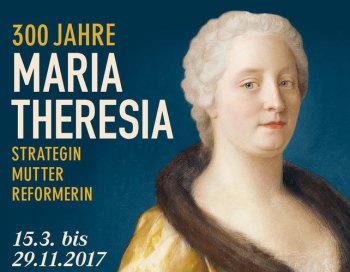 To mark the third centenary of the birth of Maria Theresa, on 13 March 2017 a major exhibition will be launched exploring the life and influence of one of the most important rulers in European history.
Maria Theresa’s reign lasted for forty years, from 1740 to 1780. After a turbulent period at the beginning of her rule, the Habsburg monarchy entered a golden age. In the fields of state administration and foreign policy, Maria Theresa, the daughter of Charles VI, enacted measures that were to have a decisive influence on the further development of the monarchy. Although the monarch had a sceptical attitude towards the ideals of the Enlightenment, this epoch is still seen as a period of reform in which the Habsburg lands underwent a distinct process of modernization.
Under Maria Theresa courtly pomp and ceremony reached a final zenith before the sober-mindedness of the Josephine era that followed and the fall of the ancien régime in the French Revolution.
The idealization of Maria Theresa as the great ‘mother of the nation’ was a phenomenon that started well before her death. Thanks to her sixteen children she became a symbolic figurehead during her own lifetime. The exhibition examines the image of Maria Theresa as a family person and explores the often very complicated relationships between the individual members of the family.
The dark sides of this forceful monarch are also explored. Her intolerance towards other faiths, the creation of the mythic figure of Maria Theresa and her transformation into a positive figure of identification for the Habsburg dynasty are all subjected to critical examination.
This major jubilee exhibition is being mounted by Schloss Schönbrunn Kultur- und Betriebsges.m.b.H. in cooperation with KHM-Museumsverband. Various aspects of the monarch’s life and work will be explored at four different venues:
Family and Legacy
Vienna Imperial Furniture Collection (Hofmobiliendepot)
In the ‘Hofmobilieninspektion’, an institution founded by Maria Theresa in 1747 to administer the court holdings of furniture, the exhibition examines the family circle, the personal destinies and the dynastic marriage policy pursued by Maria Theresa together with the legacy of her status as a mythic figure that continued long after her death.
Alliances and Enmities
Schloss Hof
Around 1775 Maria Theresa had a dower apartment furnished for herself at Schloss Hof, her country residence in Lower Austria. On the piano nobile of the palace the exhibition deals with her initial difficulties in establishing her rule, wars and peace agreements, losses and gains of territory as well as Maria Theresa’s powerful creative political will.
Modernization and Reforms
Schloss Niederweiden
Also located in the Marchfeld region of Lower Austria, the small and intimate Schloss Niederweiden was used for hunting parties and celebrations. At this exhibition venue the focus will be on the major domestic reforms enacted by Maria Theresa that were to change the state substantially.
Women Power and Joie de Vivre
Imperial Carriage Museum (Kaiserliche Wagenburg)
At the Imperial Carriage Museum, the focus will be on Maria Theresa’s projection of her own image, caught as she was between the sometimes conflicting priorities of her identity as a woman and the ‘masculinity’ of her power as a ruler. Ornate coaches, liveries, uniforms and gowns will recreate the resplendence of formal court occasions and exuberant festivities.
Call for Nominations | Eldredge Book Prize
2017 Charles C. Eldredge Prize
Nominations due by 1 December 2016
The Smithsonian American Art Museum is now accepting nominations for the 2017 Charles C. Eldredge Prize. Single-author books devoted to any aspect of the visual arts of the United States and published in the three previous calendar years are eligible. To nominate a book, send a letter (not to exceed one page in length) explaining the work’s significance to the field of American art history and discussing the quality of the author’s scholarship and methodology. Nominations by authors or publishers for their own books will not be considered. The deadline for nominations is December 1, 2016. Please send them to: The Charles C. Eldredge Prize, Research and Scholars Center, Smithsonian American Art Museum, P.O. Box 37012, MRC 970, Washington, D.C. 20013-7012. Nominations will also be accepted by email: eldredge@si.edu or fax: (202) 633-8373.










 Enfilade
leave a comment