New Book | Satire, Prints and Theatricality in the French Revolution
From the Voltaire Foundation:
Claire Trévien, Satire, Prints and Theatricality in the French Revolution (Oxford: Oxford University Studies in the Enlightenment, 2016), 280 pages, ISBN: 978-0729411875, £65 / €80 / $92.
 The Revolutionary era was a period of radical change in France that dissolved traditional boundaries of privilege, and a time when creative experimentation flourished. As performance and theatrical language became an integral part of the French Revolution, its metaphors seeped into genres beyond the stage. Claire Trevien traces the ways in which theatrical activity influenced Revolutionary print culture, particularly its satirical prints, and considers how these became an arena for performance in their own right.
Following an account of the historical and social contexts of Revolutionary printmaking, the author analyses over 50 works, incorporating scenes such as street singers and fairground performers, unsanctioned Revolutionary events, and the representation of Revolutionary characters in hell. Through analysing these depictions as an ensemble, focusing on style, vocabulary, and metaphor, Claire Trévien shows how prints were a potent vehicle for capturing and communicating partisan messages across the political spectrum. In spite of the intervening centuries, these prints still retain the power to evoke the Revolution like no other source material.
Claire Trévien is a cultural historian who completed her AHRC-funded CDA doctorate at the University of Warwick in conjunction with Waddesdon Manor. She is the author of two poetry collections: The Shipwrecked House and Astéronymes.
◊ ◊ ◊ ◊ ◊
C O N T E N T S
List of illustrations
List of abbreviations
1 Introduction: The Other Stage of the French Revolution
Revolutionary Prints: A Brief Historiography
Theatricality and Prints
2 Singing the Scene: Chansons and Images in Prints
The Case of Bonvalet (1788–89)
The Aftershocks of 1789
Multiple Voices (1791–92)
Songs and Martyrdom (1793–94)
Epilogue
3 Le Monde à l’envers: The Carnivalesque in Prints
The Commedia dell’Arte in Revolutionary prints
Individual Actors
Epilogue
4 The Spectacle of Science: Illusion in Prints
Charlatanism and Theatricality (1784–95)
Spellbound Ccience (1789–90)
Spectator and Performer (1791–92)
Science as a Propaganda tool (1794)
Epilogue
5 Théâtre de l’ombre: Visions of Afterlife in Prints
Setting the Stage
Executing Theatre
Lighting Shadows
Epilogue
6 Conclusion
Bibliography
Index
Research Project | Sir Hans Sloane’s Catalogues
From the project announcement:
Enlightenment Architectures: Sir Hans Sloane’s Catalogues of His Collections
Leverhulme Trust Research Project, Autumn 2016 — 30 September 2019
Applications due by 31 October 2016
We are delighted to be able to announce the inception of Enlightenment Architectures: Sir Hans Sloane’s Catalogues of His Collections, a new research project based at the British Museum in collaboration with the Department of Information Studies at University College London. Enlightenment Architectures will start on 3 October 2016 and will run for three years until 30 September 2019.
The project has received generous funding from the Leverhulme Trust in the form of a Research Project Grant totalling £332,552 awarded to the British Museum, where Dr Kim Sloan is the Principal Investigator. The Co-Investigator on the project is Dr Julianne Nyhan and the Senior Research Assistant is Dr Martha Fleming. The grant will also accommodate two Post Doctoral Research Assistantships and one Doctoral Studentship. The call for applications for the PDRA positions are live now on the British Museum jobs website. The call for applications for the Doctoral Studentship will appear shortly on the University College London jobs website.
The objective of Enlightenment Architectures: Sir Hans Sloane’s Catalogues of His Collections is to understand the intellectual structures of Sloane’s own manuscript catalogues of his collections and with them the origins of the Enlightenment disciplines and information management practices they helped to shape. The project will employ a pioneering interdisciplinary combination of curatorial, traditional humanities and Digital Humanities research to examine Sloane’s catalogues which reveal the way in which he and his contemporaries collected, organised and classified the world, through their descriptions, cross-references and codes. The project will draw on the research framework that emerged from the 2012 AHRC-funded Sloane’s Treasures workshops, and findings will make significant contributions to histories of information science, histories of collections, and philosophy of knowledge, and will benefit a wide range of other disciplines as well.
Six manuscript catalogues created from 1680 to 1753 and selected from across the three institutions now holding Sloane’s materials—the British Museum, the British Library, and the Natural History Museum—will be transcribed and closely analysed by the interdisciplinary research team with the assistance of curatorial support from those three institutions. Regular workshops between curators, humanities researchers, and digital humanities practitioners will produce a deeper understanding of the structure and content of the catalogues. This will be disseminated through
• scholarly publications and conference contributions
• focused workshops and a project website
• a prototype linked data ontology for use in digital analysis of early modern collections
We look forward to communicating with you about our work, and welcome contributions from the wide-ranging scholarly communities whose disciplines will participate in and benefit from this research. We ask you to assist us in disseminating the announcements for the two Post Doctoral Research Associateships and the Doctoral Studentship and would ask you to alert colleagues and students who are eligible and appropriate to apply. As this is a Leverhulme Grant, the Doctoral Studentship is open to the EU as well as to UK applicants. The Research Associateships are open to international applicants.
With very best regards,
Dr Kim Sloan and Dr Julianne Nyhan
Partners
The British Museum
University College London Centre for Digital Humanities
Project Team
Kim Sloan is Curator of British Drawings and Watercolours before 1880 and the Francis Finlay Curator of the Enlightenment Gallery at the British Museum.
Julianne Nyhan is Senior Lecturer (Associate Professor) in Digital Information Studies at UCL’s Department of Information Studies.
Martha Fleming is a specialist in collections-based research and an historian of science.
Exhibition | Brest: Port of Liberty
Now on view at the National Maritime Museum in Brest:
Brest: Port of Liberty at the Time of American Independence
Brest: Port de la Liberté au temps de l’indépendance américaine
Musée National de la Marine, Brest, 30 June 2016 — 30 April 2017
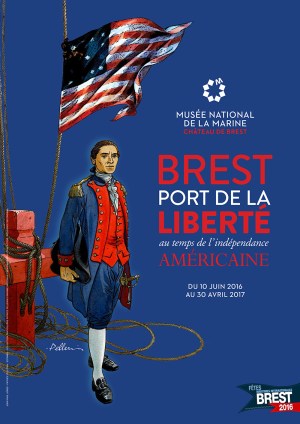 In the context of the 240th anniversary of American independence, the naval museum in Brest presents its new exhibition Brest: Harbor of Liberty at the Time of the American Revolution. Upstream of the centenary celebrations of the American landing in Brest in 1917, this exhibition recalls the strong ties between France and the United States. It traces the commitment of Louis XVI’s France in the war between the North American colonies and Britain from 1775 to 1783 and highlights the strategic role played then by the port of Brest.
In February 1778 the Scottish privateer John Paul Jones arrived in Brest. He was the first officer of the American Navy in which young Louis XVI entrusted a ship. France had to engage with the colonial side in the struggle against the British crown. The freedom of the young American nation was preparing on the banks of the Penfeld . . . The exhibition, indoor and outdoor, the discovery of the port city and the major role of Brest in the American war in the late Enlightenment.
Commissioner
Jean-Yves Besselièvre, Administrateur du musée national de la Marine à Brest
Lénaïg L’Aot-Lombart, Adjointe chargée de médiation
Scientific advice
Alain Boulaire, docteur d’État en histoire, Olivier Corre, docteur en histoire
Marjolaine Mourot, Conservateur en chef du patrimoine, chef du service Conservation au Musée national de la Marine
Exhibition | Views of the Grand Tour from The Hermitage

From the exhibition website:
Città del Grand Tour dall’Ermitage e Paesaggi Apuani da Collezioni Italiane
Fondazione Giorgio Conti, Palazzo Cucchiari, Carrara, 9 July — 23 October 2016
Curated by Sergej Androsov and Massimo Bertozzi
For centuries, knowing Italy—its extraordinary artistic heritage and millennial civilisation, as well as the nature and human qualities of a beautiful and complicated country—was a significant part of the cultural development of the elite class of all Europe. The Voyage of Italy was an experience to have at least once in a lifetime for the youth of the most important European families, both the noble ones and the rising trade and financial ones, between the very end of the 17th century and the first half of the 19th. The voyage became a true and authentic mania for all the classes that could afford it.
The Grand Tour was more than a simple touristic journey: it was a period of extraordinary development in contact with exceptional history and culture. Every European cultured man from that age dreamt to do at least one trip to Italy, for the signs of the classic past, both Greek’s and Roman’s, for the wonderful bucolic landscapes and to appreciate a kind of happy-go-lucky way of living, in which the daily challenges were tempered by an infinity of festivals and parties and countless occasions for entertainment and show. Rome was the favourite destination, but the voyage pace—both outward and the return—was set by the stops, longer and shorter ones, in the main cities scattered along the route, with mandatory deviations to Venice, Florence, and Naples.

Hubert Robert, View of the Colosseum (St Petersburg: The Hermitage Museum).
An important role, for choosing both the routes and what to see and keep in the memory, was played by scholars, art dealers, and painters who were able to produce images, not only for monuments, but also for the events which characterised the voyage of Italy, for each traveller personally.
For this exhibition, some traditional Grand Tour views have been assembled as a gallery of ‘portraits’ of places, imagination, and memory. Thus, they do not pay attention to the appearance of the Italian landscape only, but also to the nature of the men who have built that landscape. These views can nurture those psychological sensations that the Italy image gives to the Italians’ character, especially abroad and at least in the mind of those people who could see it only once, but who wanted to remember it forever.
So, some other painting are together with the ones of some Grand Tour ‘pioneers’, such as the Flemish Jan Miel and Hendrik Frans van Lint, the Dutch Johannes Lingelbach, the German Philipp Hackert, the French Hubert Robert, true and authentic reference points of the foreign groups visiting Rome or Naples, across the various ages. These painting are by a wide rank of Italian landscape painters, from Giovanni Paolo Panini to Ippolito Caffi, from Giulio Carlini to Angelo Inganni, to arrive at the naturalist turning point by Giovanni Fontanesi.
Included are the most appreciated Italian postcards: from The Arch of Titus by Hendrik Frans van Lint to The Colosseum by Hubert Robert, from View of the Bay of Baiae by Carlo Bonavia to View of Rome, with Castel Sant’Angelo by Ippolito Caffi, from The Grand Canal by Antonio de Pian to the Piazza del Duomo (Milan Cathedral Square) by Angelo Inganni.
Also represented are the peculiarities of the local traditions and the strange Italian way of life: The Charlatan by Jan Miel, the chaotic Market Square by Johannes Lingelbach; and also the celebration, from the lavish one in front of the Palazzo del Quirinale by Antonio Cioci, to the noisy Venice Carnival, in the Concert in the Gondola by Friedrich Paul Nerly, and the private party which they seem to prepare to in The Tolstoy Family in Venice by Giulio Carlini.
But Rome was still the capital of Christianity and here it is the allusive Saint Paul’s Sermon, in the Ruins of Ancient Rome, by Giovanni Paolo Panini; and also the people and visionary devotion of the Prayer to the Virgin Mary by Joseph Severn or the cozy and composed one of In the Church of S. Maria della Pace by Anselmo Gianfanti.
Next to the classic views of the Grand Tour, the exhibition places a section on the ‘discovery’ of the Apuan landscape, with artworks from the Museo Civico of Reggio Emilia, Archivio di Stato di Massa, Provincia di Massa-Carrara and private collections, to represent one of the many pleasant places for which Italy has always been considered as the garden of Europe. A territory whose nature suggested strong emotions to the ancient travellers, from Petrarch to Michel de Montaigne, comes to the attention of modern travellers, thanks to the view of its mountains, shaping the far or close horizon of a large area, from Florence to Lucca and Pisa, in addition to the coast of Liguria or the northern part of the Tyrrhenian Sea, from Lerici with its Poets’ Bay to Livorno. In conclusion, an attractive landscape not only for travellers, but also for the people visiting the art cities nearby or the coast.
The first views of the Apuan territory must be attributed to foreign travellers staying nearby, like the English Admiral William Paget or his fellow countrywoman Elisabeth Fanshawe, or the Swiss painter and writer Julie Goldenberger who settled down here and also spent her last years in Carrara. But there are also ones from professional painters, such as Saverio Salvioni from Massa, who painted for a long time the wide panoramas of the Carrara quarry at the beginning of the 19th century, or Giovanni Fontanesi from Emilia who, showing the interest for the territory images, dedicated a great deal of his output to the Ligurian-Apuan landscapes. The exhibition path ends with the painting Michelangelo Quarries of Carrara Marbles (1860–1865) by Antonio Puccinelli. It represents the perfect summary of the work of an artist loyal to the Purism of his masters (Bezzuoli and Minardi) while telling the ‘history painting’, but who adheres to a new way of looking at the sentimental suggestion of the landscape, in the Apuan area.
Sergej Androsov and Massimo Bertozzi, Citta del Grand Tour dall’Ermitage e Paesaggi Spuani da Collezioni Italiane (Carrara: Fondazione Giorgio Conti, 2016), 131 pages, $59.
Conference | Celebrating Scott’s ‘The Antiquary’
From Eventbrite:
Romantic Antiquarianism: A Conference Celebrating Scott’s The Antiquary
The Georgian Group, 6 Fitzroy Square, London, 26 November 2016
Co-organised by Fiona Robertson and Peter Lindfield
This one-day conference in the heart of London celebrates the bicentenary of the publication of Sir Walter Scott’s novel The Antiquary by looking at the multi-faceted nature of antiquarianism in Georgian Britain. Leading scholars from across the UK gather to present new and engaging material on the topic. Registration (£30) includes teas/coffees and lunch in one of Robert Adam’s town houses. Register online here.
◊ ◊ ◊ ◊ ◊
P R O G R A M M E
9.30 Registration and Introductions: Peter N. Lindfield (University of Stirling) and Fiona Robertson (University of Durham)
10.00 Plenary 1 (Chair: Fiona Robertson)
• Nicola J. Watson (Open University): ‘The Antiquary, the Discomforts of Antiquarianism, and the Ambitions of Abbotsford’
11.00 Morning Panel (Chair: Peter N. Lindfield)
• Rosemary Sweet (University of Leicester): ‘Antiquaries and the Antiquities of Everyday Life’
• Kelsey Williams (University of Stirling): ‘Antiquarianism and The Antiquary’
• Frances Sands (Sir John Soane Museum): ‘Robert Adam as Antiquarian Architect’
12.15 Lunch
1.15 Plenary 2 (Chair: Peter N. Lindfield)
• Christopher Woodward: ‘Ruins, Rescue and Antiquarianism in the Eighteenth-Century Imagination’
2.15 Afternoon Panel (Chair: Fiona Robertson)
• Catherine Jones (University of Aberdeen): ‘Mapping Antiquarianism’
• Peter N. Lindfield (University of Stirling): ‘Antiquarian Identities and Thomas Barritt’s Assumed Persona’
• Andrew Teverson (Kingston University): ‘Nicht Nought Nothing & Rashin Coatie: Andrew Lang’s Border Tales and the Influence of Walter Scott’
New Book | Niebuhr’s Museum
From Forlaget Vandkunsten:
Anne Haslund Hansen, with photographs by Torben Eskerod, Niebuhr’s Museum: Artefacts and Souvenirs from the Royal Danish Expedition to Arabia, 1761–1767 (Copenhagen: Forlaget Vandkunsten, Carsten Niebuhr Biblioteket, 2016), 260 pages, ISBN: 978-8776954406, £40.
 Niebuhr’s Museum: Artefacts and Souvenirs from the Royal Danish Expedition to Arabia, 1761–1767 is the first comprehensive presentation of the largely unknown collection of antiquities and ethnographic objects acquired during this important 18th-century scientific expedition to the Middle East. The expedition, a brainchild of the Göttingen professor Johann David Michaelis, aimed at shedding light on the historical and cultural background to the Old Testament. Its scholarly and scientific results were multifaceted and are best known from the publications of the cartographer Carsten Niebuhr (1733–1815), the only survivor of the expedition, which included among others, the Swedish naturalist and pupil of Linnaeus, Peter Forsskål. The Niebuhr collection, primarily held in the National Museum of Denmark, offers an invaluable resource for the study of 18th-century travellers and expeditions to the Middle East.
In its investigation of the history and context of each of these intriguing objects, Niebuhr’s Museum presents a new narrative of the ill-fated voyage. Analysis of this collection also illuminates the collecting practices of the period, providing insights into the genesis of the core holdings of many of today’s museums.
Anne Haslund Hansen has previously published (with Stig T. Rasmussen) the journal of the expedition’s philologist, Frederik Christian von Haven: Min Sundheds Forliis (2005). She works as a curator at the National Museum of Denmark. She can be contacted at anne.haslund.hansen@natmus.dk.
Fellowships | Residential Awards at the Yale Center for British Art
Visiting Scholar Awards
Yale Center for British Art, New Haven
Applications due by 9 January 2017
The Yale Center for British Art’s Visiting Scholar Awards provide academic, museum, and independent scholars, as well as doctoral students, working in any field related to British art an opportunity to study the Center’s collection. Awards are offered to scholars and predoctoral students working in any discipline, including history, the history of art, literature, and other fields related to British art. Predoctoral applicants from North America must be ABD to qualify.
One award per annum is reserved for a member of the American Society for Eighteenth-Century Studies. Scholars may apply to the Delaware Art Museum, Wilmington, for awards in the same year; every effort will be made to offer consecutive dates.
Postdoctoral awards may be held between one to four consecutive months. While all applications are given equal consideration, stays of at least two months are encouraged. Predoctoral awards may be held from one to two months.
Awards cover the cost of travel to and from New Haven, and provide accommodation as well as a living allowance. Recipients are required to be in residence in New Haven for the duration of their award and must be free of all other significant professional responsibilities during their stay.
The closing date for awards is Monday, January 9, 2017. Applicants should complete the online application and upload a cover letter (no more than one page), a CV, an outline of the project (no more than three pages) that provides an indication of the resources to be consulted at the Center, and preferred months of tenure. Applicants should also provide a title for their research project and place their full name on each page of the application. Two confidential letters of recommendation should be e-mailed to Research (ycba.visitingscholars@yale.edu) under separate cover by the same deadline.
More information is available here»
Call for Papers | Enchanted Isles, Fatal Shores: Living Versailles

Hall of Mirrors (Galerie des Glaces), 1678–84
(Château de Versailles)
◊ ◊ ◊ ◊ ◊
From the National Gallery of Australia:
Enchanted Isles, Fatal Shores: Living Versailles
NGA, the Australian National University, and the University of Sydney, 17–18 March 2017
Proposals due by 30 October 2016
Organized by Mark Ledbury, Robert Wellington, and Lucina Ward
On the occasion of the Versailles: Treasures from the Palace exhibition at the NGA, which brings major works of art from the Palace of Versailles to Canberra, this conference showcases the latest ideas about the lives of past people and objects, as well as the living culture of Versailles today. Staged in Canberra, which like Versailles is a planned capital city, centre of government and culture, this is a unique opportunity to explore the enduring influence and resonance of Versailles, its desires and self-perceptions of modernity, from film to fashion to architecture. Gathering a generation of scholars whose work is shifting our perceptions of the art, culture and life of ancien-régime Versailles and its reception, this is the occasion for fresh and challenging research, and new perspectives on canon-defining works.
1664 is formative in the history of Versailles—the year a modest hunting lodge began to be transformed, to become a centre of art, fashion and power in Europe for more than a century. The dream of Versailles as an enchanted isle for the French aristocracy came to a grisly end with the 1789 revolution. Only two years later, the first fleet of British colonists came to settle on the east coast of Australia, on what Robert Hughes famously dubbed ‘the fatal shore’. Life at Versailles changed irreparably just as it would for those who lived in, and migrated to, Australia at the close of the eighteenth century.
Versailles was not the static creation of one man but a hugely complex cultural space, a centre of power, of life, love, anxiety and creation, as well as an enduring palimpsest of aspirations, desires and ruptures. The splendour of the castle, and the masterpieces of art and design it contains, masks a more sordid history. The conference’s theme, Enchanted isles, fatal shores, encourages examination of the tensions between splendour and misery, insiders and outsiders, display and privacy that framed life at Versailles.
Conference conveners seek proposals to deliver 20-minute papers addressing the subject of the conference; those that address the key themes below are especially welcome. Please send an abstract of 300 words and a short CV to the conveners at Versaillesconference@nga.gov.au by 30 October 2016.
Key Themes
• The ‘lives’ of Versailles
• Virtual Versailles
• Adaptations and destructions
• Challenging period terms
• The private and the public
• ‘Le sale et le propre’
• Versailles and Paris
• Being there
• Resonances of Versailles
• Versailles on film
Conveners
Mark Ledbury, Power Professor of Art and Visual Culture, University of Sydney; Robert Wellington, Lecturer, ANU School of Art Centre for Art History and Art Theory; and Lucina Ward, Senior Curator and coordinating curator for the exhibition, National Gallery of Australia
Book Launch | Georgian Gothic
From Eventbrite:
Talk and Book Launch: Georgian Gothic: Medievalist Architecture, Furniture and Interiors
Strawberry Hill, Twickenham, 17 November 2016
Dr Peter Lindfield, an expert on the Gothic Revival, will be giving an illustrated 30-minute lecture at Strawberry Hill, Twickenham, on the topic of Georgian Gothic design between 1730 and 1840. Strawberry Hill and Horace Walpole, along with Thomas Chippendale, Robert Adam, Gillows of Lancaster and A.W.N. Pugin, will figure heavily in the talk. Architecture, interiors and furniture will be covered as well as key issues of design, fashion and taste in the Georgian period.
Following a Q&A session and a champagne reception, Peter will be signing copies of his new book at this launch party, Georgian Gothic: Medievalist Architecture, Furniture and Interiors, 1730–1840. Copies of the book will be available on the night for purchase at a specially reduced price (£35: RRP £50). You can select a registration option for the talk and reception only, or additionally pre-purchase the book to be signed and collected on the night.
2017 ISECS Seminar for Early Career Scholars: Cities and Citizenship
From H-ArtHist:
2017 ISECS Seminar for Early Career Scholars
Cities and Citizenship in the Enlightenment / Cité et citoyenneté des Lumières
Université du Québec, Montreal, 11–15 September 2017
Proposals due by 30 January 2017
The International Society for Eighteenth-Century Studies (ISECS) is pleased to announce the 2017 International Seminar for Early-Career Eighteenth-Century Scholars. Colleagues from all fields of eighteenth-century studies are invited to submit abstracts for this one-week event. Formerly called the East-West Seminar, the International Seminar for Early-Career Eighteenth-Century Scholars brings together young researchers from a number of countries each year. The 2017 meeting will take place in Montreal, Canada and will be organized by the University of Quebec in Montreal (UQAM) and the Research Group on the History of Sociabilities (RGHS).
The seminar will be held from Monday, September 11 to Friday, September 15, 2017 in Montreal, under the direction of Pascal Bastien (History, UQAM), Marc André Bernier (Literature, UQTR), Sébastien Charles (Philosophy, UQTR), Peggy Davis (Art History, UQAM), Benjamin Deruelle (History,UQAM), Geneviève Lafrance (Literature, UQAM), Laurent Turcot (History, UQTR).
The seminar will also be an opportunity to pay tribute to Professor Robert Darnton (Harvard University), former president of ISECS as well as co-founder, with Jochen Schlobach (1938–2003), of the East-West Seminar.
The theme this year’s seminar will be Cities and Citizenship in the Enlightenment. The ISECS International Seminar for Early Career Scholars will engage discussions on the forms, representations and modalities of political action and social and political identities in the eighteenth century. ‘Citizenship’ in the eighteenth century did not yet encompass the notions of property rights, equality before the courts, or even the electoral system of political representation. The result of a process rather than a status, urban citizenship can be understood as an appropriation of the urban space, the sociabilities found therein, and, fundamentally, civic culture within a civil society. The study of citizenship should not, therefore, be restricted to nationality and naturalization. Is the public space strictly an urban space? How should we understand political dynamics, collective emotions and urban citizenship in eighteenth-century cities?
If the Marxist undertones of the Habermas model have been questioned over the years, the notion of ‘public space’ still retains its significance and relevance. The questions surrounding language, verbal exchanges, and discourse in general remain at the center of the reflections by historians of society and class consciousness. At the crossroad of texts, discourses and practices, sociability is the field of enquiry for those who wish to grasp the different forms of public opinion and citizen commitment, especially within eighteenth-century urbanization. A detailed description of this theme is available online.
The seminar is limited to 15 participants. The proposals (approx. 2 pages, single spaced) should be based on an original research project (e.g. a doctoral dissertation) which addresses one of the aspects mentioned above. Because this is a seminar rather than a conference, each participant will be given approximately one hour to present the texts and questions that will then form the basis of a group discussion. Preference will be given to scholars who are at the beginning of their academic career (PhD or equivalent for less than six years). The official languages are French and English.
Accommodation costs will be covered in full by the organizers, who will be responsible for reserving hotel rooms. Other travel costs are currently under evaluation for a grant from the Government of Canada. If the seminar should benefit from such funding, airline tickets and other living expenses (lunches and dinner) may also be covered.
As it is the case each year, the proceedings of the seminar will be published by Honoré Champion (Paris) in the Lumières internationales series.
Applications should include the following information: a brief curriculum vitae with date of PhD (or equivalent); a list of principal publications and scholarly presentations; a brief description of the proposed paper (approx. 2 pages, single-spaced); and one letter of recommendation. Colleagues are invited to submit proposals by January 30, 2017. Please send abstracts by e-mail to Pascal Bastien: bastien.pascal@uqam.ca.










 Enfilade
leave a comment