New Book | Bibliothèques, décors, XVIIe–XIXe siècle
From Éditions des Cendres and available from ArtBooks.com:
Frédéric Barbier, Andrea De Pasquale, István Monok, eds., Bibliothèques, décors, XVIIe–XIXe siècle (Paris, Éditions des Cendres, 2016), 306 pages, ISBN 978 2867 422546, $63.
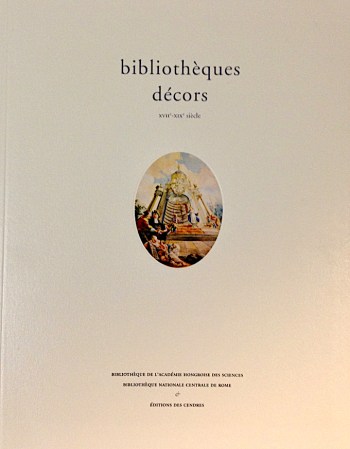 La chronologie est spécifique au domaine : dans la seconde moitié du xvie et au début du xviie siècle, la bibliothèque abandonne le mobilier traditionnel des pupitres pour prendre la forme moderne d’une grande salle de travail dont les murs sont tapissés de livres. Ce modèle deviendra à son tour de moins en moins adapté, jusqu’à ce que, face à l’accroissement de la production imprimée qui se produit au xixe siècle, le principe des magasins de stockage des livres se développe et l’organisation interne de la bibliothèque se modifie. Au fil de cet espace de temps des xviie–xixe siècles, les grands courants artistiques se succèdent, du baroque au classicisme puis au néo-classique, et jusqu’à l’émergence de l’architecture industrielle.
Parallèlement, l’institution de la bibliothèque garde une charge symbolique élevée, mise en scène par le biais du décor. On connaît les somptueuses bibliothèques baroques du monde catholique, de la péninsule Ibérique à l’Allemagne méridionale, à l’Europe centrale, ou encore à l’Italie. Pourtant, d’autres modèles de décor se rencontrent, qu’il s’agisse de la France (à la Bibliothèque Mazarine) ou encore de la géographie de la Réforme protestante. À côté des exemples les plus célèbres, y compris celui de la Hofbibliothek de Vienne, les contributions présentent un certain nombre de bibliothèques historiques largement méconnues jusqu’à aujourd’hui, notamment en Europe centrale et orientale (Alba Iulia), mais aussi en Italie (avec le Palais Borromini à Rome).
Ce travail transdisciplinaire réunit les meilleurs spécialistes européens, confrontant les leçons de l’histoire générale avec celles de l’histoire de l’art, de l’histoire des idées et de l’histoire du livre et des bibliothèques. Un ouvrage placé sous la direction de Frédéric Barbier, István Monok & Andrea De Pasquale qui ont réuni à leurs côtés une équipe internationale de spécialistes de l’histoire des bibliothèques et du livre / Ample iconographie, bibliographie et index.
T A B L E D E M A T I È R E S
• Frédéric Barbier, Bibliothèques, décors, XVIIe–XXIe siècle
• Frédéric Barbier, Illustrer, persuader, servir: le décor des bibliothèques, 1627–1851
• Elmar Mittler, Kunst oder Propaganda? Bibliothekarische Ausstattungsprogramme als Spiegel kultureller Entwicklungen und Kontroversen in Renaissance, Gegenreformation, Aufklärung und Klassizismus
• Hans Petschar, Der Pruncksaal der Österreichichen Nationalbibliothek : zur Semiotik eines barocken Denkraumes
• Andreas Gamerith, Klosterbibliotheken des Wiener Umlandes: alte und neue Motive
• Michaela Seferisová Loudová, Ikonographie der Klosterbibliotheken in Tschechien, 1770–1790
• Szabolcs Serfözö, Barocke Deckenmalereien in klosterbibliotheken des Paulinerordens in Mitteleuropa
• Anna Jávor, Bücher und Fresken: die künstlerische Ausstattung von Barockbibliothecken in Ungarn
• János Jernyei-Kiss, Die Welt der Bücher auf einem Deckenbild: Franz Sigrists Darstellung der Wissenschaften im Festsaal des Lyzeums in Erlau
• Doina Hendre Biró, Le décor de la Bibliothèque et de l’Observatoire astronomique fondés par le comte Ignác Batthyány, évêque de Transylvanie, à la fin du XVIIIe siècle
• Yann Sordet, D’un palais (1643) l’autre (1648): les bibliothèque(s) Mazarine(s) et leur décor
• Fiammetta Sabba, I Saloni librari Borrominiani fra architettura e decoro
• Andrea De Pasquale, L’histoire du livre dans le décor des bibliothèques d’Italie au XIXe siècle
• Jean-Michel Leniaud, L’invention du programme d’une bibliothèque, 1780–1930
• Alfredo Serrai, I vasi o saloni librari. Ermeneutica della iconografia bibliotecaria
New Book | Artefacts of Encounter: Cook’s Voyages
From the University of Hawaii Press:
Thomas, Nicholas Thomas, Julie Adams, Billie Lythberg, Maia Nuku, and Amiria Salmond, Artefacts of Encounter: Cook’s Voyages, Colonial Collecting and Museum Histories (Honolulu: University of Hawai’i Press, 2016), 364 pages, ISBN: 978 0824 859350, $68.
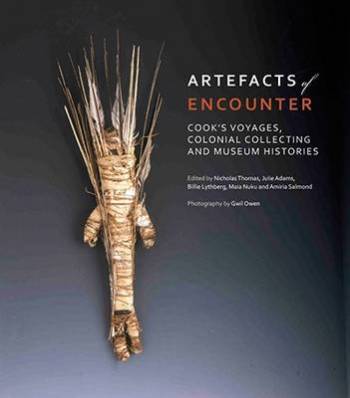 The Pacific artefacts and works of art collected during the three voyages of Captain James Cook and the navigators, traders, and missionaries who followed him are of foundational importance for the study of art and culture in Oceania. These collections are representative not only of technologies or belief systems but of indigenous cultures at the formative stages of their modern histories, and exemplify Islanders’ institutions, cosmologies, and social relationships.
Recently, scholars from the Pacific and further afield, working with Pacific artefacts at the Museum of Archaeology and Anthropology in Cambridge (MAA), have set out to challenge and rethink some longstanding assumptions on their significance. The Cook voyage collection at the MAA is among the four or five most important in the world, containing over 200 of the 2000-odd objects with Cook voyage provenance that are dispersed throughout the world. The collection includes some 100 artefacts dating from Cook’s first voyage. This stunning book catalogues this collection, and its cutting-edge scholarship sheds new light on the significance of many artefacts of encounter. Published in association with Otago University Press.
The William Blake Archive Launches Updated Website

William Blake, The First Book of Urizen, Plate 14, Object 7 (Bentley 85.7, Butlin 262.7), from A Large Book of Designs, ca. 1796 (London: British Museum).
In collaboration with UNC Libraries and ITS Research Computing, The William Blake Archive launched on 12 December 2016 a complete and transformative redesign of its website. This new site, www.blakearchive.org, retains all of the features of the previous site, which had become so indispensable to Blake scholars, and offers vast improvements, making it easier than ever for educators and scholars to access and study Blake’s inimitable works.
The Blake Archive, one of the preeminent digital humanities sites in the world, is a hypermedia archive of Blake’s poetry and art that is sponsored by the Library of Congress and supported by the University of North Carolina at Chapel Hill and the University of Rochester. Past support came from the Getty Grant Program, the Paul Mellon Centre for Studies in British Art, and the National Endowment for the Humanities. The Archive integrates, for the first time, all of Blake’s visual and literary work. It comprises almost 7000 high-resolution digital images of Blake’s illuminated books, paintings, drawings, manuscripts, and engravings drawn from over 45 of the world’s great research libraries and museums.
New Book | Clothing Art
From Yale UP:
Aileen Ribeiro, Clothing Art: The Visual Culture of Fashion, 1600–1914 (New Haven: Yale University Press, 2017), 582 pages, ISBN: 978-0300119077, $60.
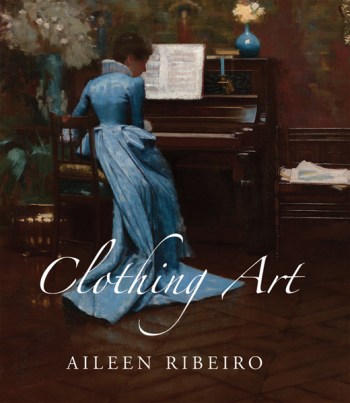 There have always been important links between art and clothing. Artists have documented the ever-evolving trends in fashion, popularized certain styles of dress, and at times even designed fashions. This is the first book to explore in depth the fascinating points of contact between art and clothing, and in doing so it constructs a new and innovative history of dress in which the artist plays a central role.
Aileen Ribeiro provides an illuminating account of the relationship between artists and clothing from the 17th century, when a more complex and sophisticated attitude to dress first appeared, to the early 20th century, when the boundaries between art and fashion became more fluid: haute couture could be seen as art, and art used textiles and clothes in highly imaginative ways. Ribeiro’s narrative encompasses such themes as the ways in which clothing has helped to define the nation state; how masquerade and dressing up were key subjects in art and life; and how, while many artists found increasing inspiration in high fashion, others became involved in designing ‘artistic’ and reform dress. Sumptuously illustrated, Clothing Art also delves into the ways in which artists represent the clothes they depict in their work, approaches which range from photographic detail, through varying degrees of imaginative reality, to generalized drapery.
Aileen Ribeiro is professor emeritus in the history of art at the Courtauld Institute of Art, London.
Netherlands Yearbook for History of Art, November 2016
Latest issue of NKJ:
Thijs Weststeijn, Eric Jorink and Frits Scholten, eds., Netherlandish Art in its Global Context (Leiden: Brill, 2016), 296 pages, ISBN: 978-9004334977, €105 / $123. [Netherlands Yearbook for History of Art / Nederlands Kunsthistorisch Jaarboek 66 (November 2016)].
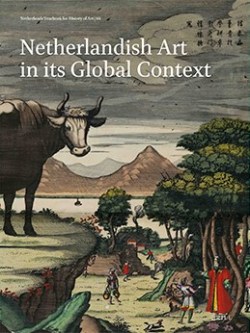 Netherlandish art testifies to the interconnectedness of the Early Modern world. New trade routes, the international Catholic mission, and a thriving publishing industry turned Antwerp and Amsterdam into capitals of global exchange. Netherlandish prints found a worldwide public. At home, everyday lives changed as foreign luxuries, and local copies, became widely available. Eventually, Dutch imitations of Chinese porcelain found their way to colonists in Surinam. This volume of the Netherlands Yearbook for History of Art breaks new ground in applying the aims and approaches of global art history to the Low Countries, with essays ranging from Greenland to South Africa and Mexico to Sri Lanka. The Netherlands, as a fringe area of the Habsburg Empire marked by internal fault lines, demonstrated remarkable artistic flexibility and productivity in the first period of intensive exchange between Europe and the rest of the world.
Thijs Weststeijn, PhD (2005), University of Amsterdam, is professor of art history before 1850 at Utrecht University. He chairs the research project The Chinese Impact: Images and Ideas of China in the Dutch Golden Age (2014–19).
Eric Jorink, PhD (2004), University of Groningen, is Teylers professor at Leiden University and researcher at the Huygens Institute (KNAW). He is the author of Reading the Book of Nature in the Dutch Golden Age, 1575–1715.
Frits Scholten, PhD (2003), University of Amsterdam, is senior curator of sculpture at the Rijksmuseum and holds the chair in the History of Western Sculpture before 1800 at the Universiteit van Amsterdam. He has published widely on Western sculpture and decorative arts. His most recent publication is Small Wonders: Late-Gothic Boxwood Micro-carvings from the Low Countries (Amsterdam 2016).
C O N T E N T S
• Thijs Weststeijn, Introduction: Global Art History and the Netherlands
• Nicole Blackwood, Meta Incognita: Some Hypotheses on Cornelis Ketel’s Lost English and Inuit Portraits
• Stephanie Porras, Going Viral? Maerten de Vos’s St Michael the Archangel
• Christine Göttler, ‘Indian Daggers with Idols’ in the Early Modern Constcamer: Collecting, Picturing and Imagining ‘Exotic’ Weaponry in the Netherlands and Beyond
• Barbara Uppenkamp, ‘Indian’ Motifs in Peter Paul Rubens’s The Martyrdom of Saint Thomas and The Miracles of Saint Francis Xavier
• Thijs Weststeijn and Lennert Gesterkamp, A New Identity for Rubens’s ‘Korean Man’: Portrait of the Chinese Merchant Yppong
• Ebeltje Hartkamp-Jonxis, Sri Lankan Ivory Caskets and Cabinets on Dutch Commission, 1640–1710
• Julie Berger Hochstrasser, A South African Mystery: Remarkable Studies of the Khoikhoi
• Ching-Ling Wang, A Dutch Model for a Chinese Woodcut: On Han Huaide’s Herding a Bull in a Forest
• Annemarie Klootwijk, Curious Japanese Black: Shaping the Identity of Dutch Imitation Lacquer
• Thomas DaCosta Kaufmann, The ‘Netherlandish model’? Netherlandish Art History as/and Global Art History
Exhibition | Master Drawings Unveiled: 25 Years of Major Acquisitions
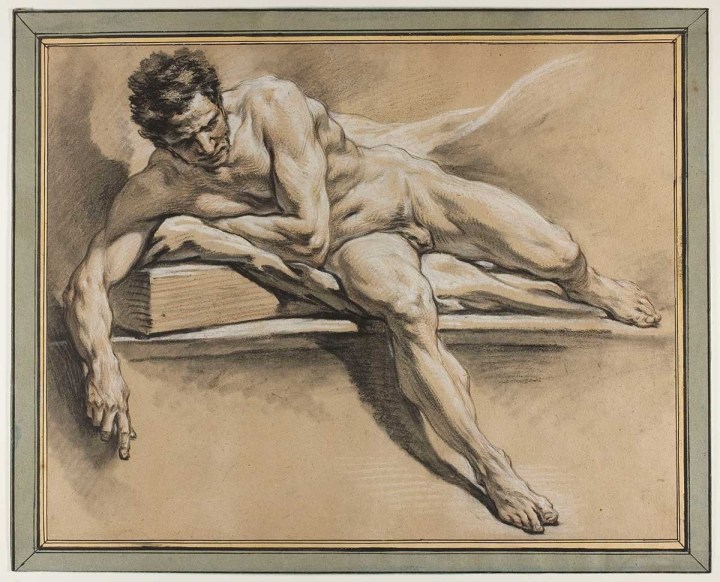
François Boucher, Academic Study of a Reclining Male Nude, ca. 1750
(Art Institute of Chicago, Regenstein Endowment Fund).
◊ ◊ ◊ ◊ ◊
Press release (8 June 2016) from AIC
Master Drawings Unveiled: 25 Years of Major Acquisitions
Art Institute of Chicago, 27 August 2016 — 29 January 2017
The Art Institute of Chicago presents 84 hitherto unexhibited masterful drawings carefully and thoughtfully acquired over the last quarter century in an exhibition titled Master Drawings Unveiled: 25 Years of Major Acquisitions. Building upon an established and world-renowned collection, these masterpieces range from the French and Italian schools of the 17th century to Swiss, German, and Austrian Romanticism, midcentury Realism, Belgian Symbolism and into the mid-20th century. The recent acquisitions will be on display from August 27, 2016 to January 29, 2017 and provide visitors a full range of artistic achievement, featuring key works by François Boucher, Henri Fantin-Latour, Edgar Degas, Odilon Redon, Francis Picabia, Grant Wood, and other iconic figures.
The exhibition is a culmination of the legacy and focus of curator Suzanne Folds McCullagh, who along with Mark Pascale, Martha Tedeschi, and Douglas Druick strategically acquired the works to reinforce the strengths of the collection and add new dimensions and greater depth. The selected works offer a “leap through the ages,” says McCullagh. “This is only the tip of the iceberg, not including gifts or bequests, or works that have been or will be shown in other exhibitions here. We have acquired over 9,000 prints and drawings since 1991; this installation reveals some of the areas we have sought to develop through purchases. The range of the materials means the show offers something for everyone.”
Among the works never-before-seen in Chicago are three studies for beloved works in the permanent collection. A full-scale study of A Young Peasant Woman Drinking her Café au Lait, 1881, is almost the same size as the painting (Gallery 246). There is a final compositional study for Puvis de Chavanne’s Sacred Grove, Beloved of the Arts and the Muses, 1883/84 (Gallery 245). And, most surprising of all is the large abstract planning drawing for Gustave Caillebotte’s Paris Street; Rainy Day, 1877 (Gallery 201).
Exhibition | Doctrine and Devotion: The Spanish Andes
Now on view at AIC:
Doctrine and Devotion: Art of the Religious Orders in the Spanish Andes
Art Institute of Chicago, 19 March — 25 June 2017
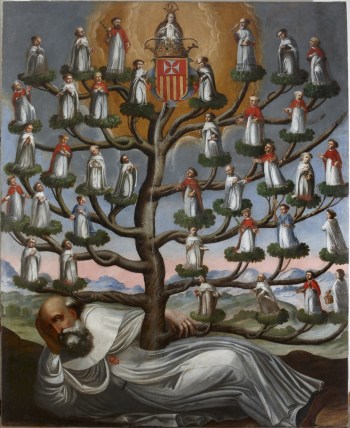
Unidentified artist, active in Potosí, Bolivia, Genealogical Tree of the Mercedarian Order, mid-18th century (Thoma Collection).
Presenting 13 paintings by South American artists from the 17th through 19th century, this focused exhibition introduces visitors to images promoted by several Catholic orders at work in the Spanish Andes—the Dominicans, Franciscans, Mercedarians, and Jesuits—examining the politics of the distinct iconographies each group developed as they vied for devotees and dominion.
Francisco Pizarro arrived in Peru with a mandate from Charles V to impose Spanish law and order, as well as the Roman Catholic religion, upon the indigenous Inca society that he encountered. The enormous task of converting the indigenous peoples of Spain’s overseas territories to Christianity fell largely to missionaries from several religious orders rather than parish clergy. For a native population that had no written language tradition, the missionaries relied heavily on works of art to illustrate their sermons and lessons and help them gain converts.
In the wake of the Protestant Reformation, the Catholic church embraced the use of images both as pedagogical tools and instruments of devotion, and the religious orders in South America relied on them in similar ways—as didactic materials employed in the teaching of new converts, and in later years as a means of spreading devotions specific to their own interests. While their ultimate goals were the same, each religious order promoted images specific to their own histories, identities, and goals. This exhibition explores examples of the iconographies that were particular to each group.
Doctrine and Devotion: Art of the Religious Orders in the Spanish Andes is generously supported by the Carl and Marilynn Thoma Art Foundation.
Exhibition | Shakers and Movers
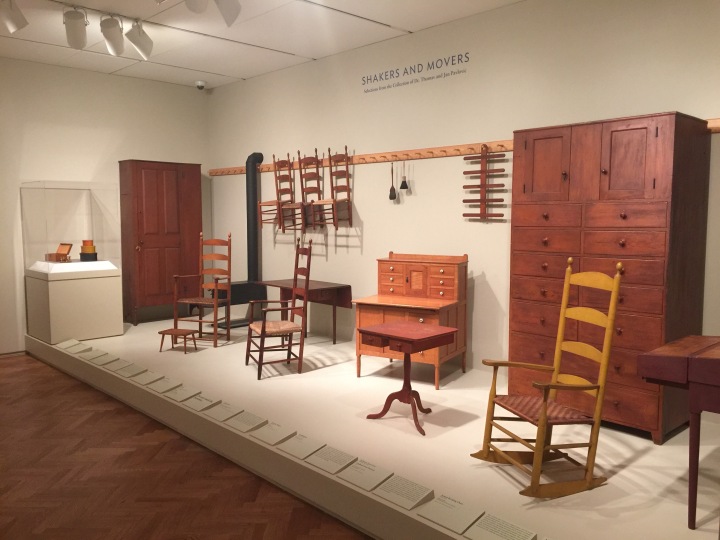
Now on view at AIC:
Shakers and Movers: Selections from the Collection of Dr. Thomas and Jan Pavlovic
Art Institute of Chicago, December 2015 — Fall 2017
For Shakers, work was a form of worship, and objects were expressions of their attempt to create heaven on earth. They employed unique techniques to build furniture that was like their faith: honest, simple, and humble. Featuring over 20 such objects generously loaned by collectors Thomas and Jan Pavlovic, this exhibition—the first of its kind at the Art Institute—shows the range of items made by the Shakers in the late 18th and 19th centuries. Presented within the chronology of the permanent collection galleries, the exhibition considers Shakers in the larger context of American furniture production, demonstrating the artistic exchange and innovation that defined the country’s early history.
Shakers were well known for their austere and rigid lifestyle. Believers lived in separate men’s and women’s dormitories and practiced celibacy and communal ownership. Their worship, however, could be quite lively; the name Shaker derives from the frenzied, whirling dancing that took place at services. Following the arrival of the first Shakers from England in 1774, the group peaked in the mid-19th century, boasting more than 6,000 members from Maine to Kentucky. Though only one Shaker community survives today, the impact of Shakers on American culture has endured, particularly in art and design. The Pavlovics’ collection—passionately assembled over the last 40 years—exemplifies the virtuosic craftsmanship synonymous with this influential utopian religious community.
New Book | American Silver in the Art Institute of Chicago
Due for a February release from Yale UP:
Elizabeth McGoey, ed., American Silver in the Art Institute of Chicago (New Haven: Yale University Press, 2017), 266 pages, ISBN: 978 0300 222364, $50.
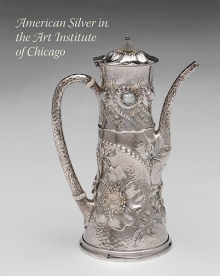 The history of American silver offers invaluable insights into the economic and cultural history of the nation itself. Published here for the first time, the Art Institute of Chicago’s superb collection embodies innovation and beauty from the colonial era to the present. In the 17th century, silversmiths brought the fashions of their homelands to the colonies, and in the early 18th, new forms arose as technology diversified production. Demand increased in the 19th century as the Industrial Revolution took hold. In the 20th, modernism changed the shape of silver inside and outside the home. This beautifully illustrated volume presents highlights from the collection with stunning photography and entries from leading specialists. In-depth essays relate a fascinating story about eating, drinking, and entertaining that spans the history of the Republic and trace the development of the Art Institute’s holdings of American silver over nearly a century. Contributors include Debra Schmidt Bach, David Barquist, Jennifer Goldsborough, Judith Barter, Medill Higgins Harvey, Patricia Kane, Barbara Schnitzer, Janine Skerry, Ann Wagner, Gerald W. R. Ward, Deborah Dependahl Waters, Beth Carver Wees, and Elizabeth Williams.
Elizabeth McGoey is Ann S. and Samuel M. Mencoff Assistant Curator of American Decorative Arts at the Art Institute of Chicago.
Call for Papers | Design and Displacement: Graduate Student Symposium
From H-ArtHist:
Design and Displacement
26th Annual Parsons/Cooper Hewitt Graduate Student Symposium on the History of Design
Cooper Hewitt, Smithsonian Design Museum, New York, 7–8 April 2017
Proposals due by 23 January 2017
The challenges faced by vast numbers of migrants and refugees worldwide—uprooted by war, persecution, or ecological crises or relocating in search of economic opportunity—are giving rise to innovative design solutions. Although often urgent, these crises are unfortunately rarely new. This symposium attempts to take a broader historical view of the relationship of design and decorative arts to the displacement and movement of people and populations since the Renaissance. From French Huguenot artisans emigrating to England in the early 18th century to artisans exiled in the wake of the 1848 revolutions to the Bauhaus’s re-establishment after its dissolution by the fascists to designers’ migrations all over the world, the movement of populations has spurred great change in the cultural landscape, including the creation of opportunities for new cross-cultural synthesis. Migrations also inspire architectural solutions, such as temporary housing for displaced persons during wartime or natural disasters or more substantial interventions into the landscape, such as buildings erected to accommodate the exponential growth of cities like Lagos or Rio de Janeiro. Papers might consider historical or contemporary designers or whole populations. The symposium also seeks to address issues of national and transnational identity as well as anti-immigrant sentiment.
Proposals are welcome from graduate students at any level in fields such as art history, history of design, design studies, fashion studies, history of the decorative arts, urban studies, cultural anthropology, history of architecture, consumer studies, design and technology, media studies, museum studies, food studies.
The symposium’s Catherine Hoover Voorsanger Keynote speaker will be Jeremy Aynsley, professor of design history at the University of Brighton (UK) and chair of the Design History Society. Professor Aynsley’s research interests concern late-19th- and 20th-century design in Europe and the United States, with a particular focus on design in modern Germany, which he has explored in major exhibitions and academic publications including Nationalism and Internationalism in Design in the 20th Century (1994), Graphic Design in Germany 1890–1945 (2000), and Designing Modern Germany (2009). He is especially interested in the phenomenon of the migration of Modernism and is currently working on a project about German graphic designers in the United States on the eve of World War II. The keynote address will be given on Friday evening, April 7, 2017, and the symposium sessions will be held in the morning and afternoon of Saturday, April 8.
To submit a proposal, send a two-page abstract, one-page bibliography, and a CV to Ethan Robey, Associate Director, MA Program in the History of Design and Curatorial Studies, robeye@newschool.edu.
The symposium is sponsored by the MA History of Design and Curatorial Studies program, offered jointly by Cooper Hewitt, Smithsonian Design Museum and Parsons School of Design.










leave a comment