Venice Archaeological Museum Reopens Courtyard of Agrippa
The original core collection of ancient sculpture that would become the Archaeological Museum of Venice was on public view in the Marciana Library—built by Sansovino and Scamozzi—starting in 1596. Of the several courtyards of the Procuratie Nuove, the Courtyard of Agrippa is the only one designed by Scamozzi. From the press release (via Art Daily) . . .
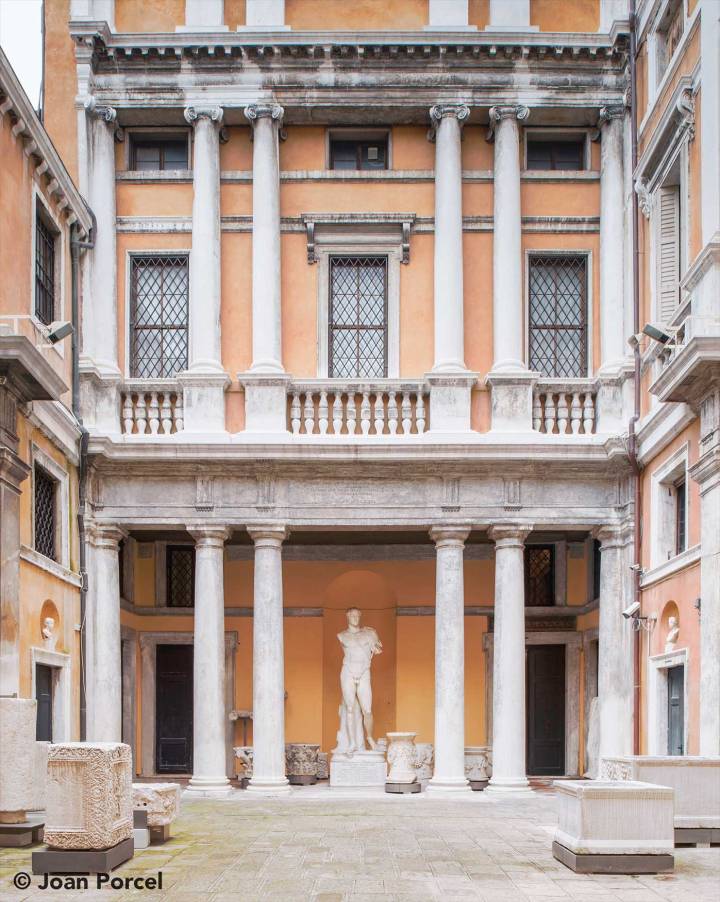
Courtyard of Agrippa. Photo from the website of the National Archaeological Museum of Venice.
The Museo archeologico nazionale di Venezia (National Archaeological Museum of Venice)—part of the Musei archeologici nazionali di Venezia e della Laguna (National Archaeological Museums of Venice and the Lagoon)—announces the reopening of the Courtyard of Agrippa, marking the beginning of a new chapter in the museum’s history. Starting May 6, the museum reopens its historic entrance at No. 17 Piazzetta San Marco, directly facing the Doge’s Palace. This new access complements the existing one through the Correr Museum and signifies the launch of a significant reorganization process. It also underscores the museum’s commitment to accessibility and a renewed, inclusive visitor experience.
In line with this vision, the museum route returns to the original order established between 1924 and 1926 by Carlo Anti, a distinguished classicist, professor of Archaeology, and later rector of the University of Padua. The itinerary offers a chronological narrative of Greek and Roman art through sculpture—from the 5th century BC to the late imperial era—alongside ceramics, bronze statuettes, coins, and other precious objects collected and donated by the Venetian aristocracy between the 16th and 19th centuries.
To enhance the visitor experience, a new independent ticketing system for the Archaeological Museum and the Marciana Library is introduced and added to the existing one, along with an annual subscription that provides unlimited, flexible access to the collections. A newly created multifunctional space will also showcase prestigious artifacts and provide visitors with updates on the museum’s ongoing reinstallation project.

The Courtyard of Agrippa is visible at the left edge of this screenshot from Google Maps.
These initiatives represent the first tangible step in the formation of a new institution under Italy’s Ministry of Culture: the Musei archeologici nazionali di Venezia e della Laguna (National Archaeological Museums of Venice and the Lagoon), established in May 2024 under the direction of Marianna Bressan. This institution encompasses the Museo archeologico nazionale di Venezia, the Museo di Palazzo Grimani, the Parco archeologico di Altino (Archaeological Park of Altino), and the upcoming Museo archeologico nazionale della laguna di Venezia (National Archaeological Museum of the Venice Lagoon) on the island of Lazzaretto Vecchio. Together, they promote an integrated and coherent cultural offering that enhances the archaeological heritage of Venice and its lagoon.
To celebrate this reopening, the courtyard will also host a striking site-specific installation during the preview days of the 2025 Venice Architecture Biennale. Lines by Kengo Kito, curated by Masahiko Haito and supported by anonymous art project, will be installed both in the Courtyard of Agrippa and Room V of the Museum. The work establishes a dialogue with Venetian cultural heritage and Renaissance architecture, sparking a reflection on the interaction between art and public space.
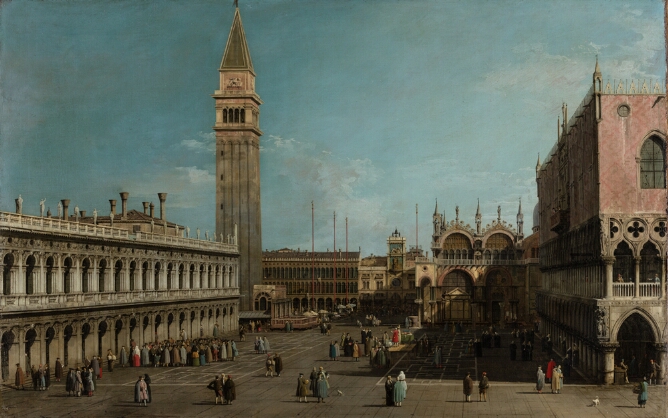
Canaletto, The Piazzetta, Venice, Looking North, ca. 1740 (Pasadena: Norton Simon Museum). The Marciana Library is visible to the left, in front of the bell tower.
Also part of the exhibition, a temporary conservation intervention—also supported by anonymous art project—on the wall behind the statue of Agrippa, weathered by time and humidity. The work includes surface dust removal, consolidation, and subtle tone harmonization, aiming to create a dynamic relationship between ancient, modern, and contemporary art. This experimental restoration model may inform future developments within the museum. The artistic project will contribute to further enhance this restoration, underlining the importance of the continuous comparison between the historicity of the place and current artistic expressions.
“The reopening of the museum’s historic entrance on Piazzetta San Marco,” states Marianna Bressan, Director of the Musei archeologici nazionali di Venezia e della Laguna, “is the first tangible act in Venice by this new institution. It reflects the cultural vision we aim to develop. The intervention in fact returns to the city and to the world a jewel of Renaissance architecture, studies the distribution of ancient sculptures and the architectural space for a mutual valorisation, proposes a conceptually flexible installation, part permanent exhibition and part visitable depot. Furthermore, it intends to reconnect the relationship of the Archaeological Museum with Venice both physically, through the access directly from the Piazza level, and in the proposal of cultural fruition: in the room adjacent to the ticket office, the Museum will recount step by step the phases of its rebirth, visitors, both male and female, by subscribing, will be able to return as many times as they want to see the progress, to participate in the dedicated events, to familiarize themselves with the collections and the history of this place, so linked to the history of Venice itself.”
Crossing the museum’s new threshold, visitors are welcomed into the Courtyard of Agrippa, home to the monumental statue believed to depict the Roman statesman and general Marcus Vipsanius Agrippa (63 BC – AD 12). This space acts as a bridge between the Marciana area’s architecture, Venice’s political centre, and the legacy of classical antiquity collecting. The statue introduces the deep connection between Venice and ancient Rome, a theme echoed throughout the museum’s collection. This link reveals how collecting was a strategic tool to bolster the cultural and political identity of the Serenissima.
Having become part of public collections in the 1860s, the work represents a significant historical testimony, which confirms a long tradition of private collections donated to the Republic and begun in the early decades of the sixteenth century by Domenico Grimani (1461–1523). Integrating his uncle’s donation with his own collections, in 1587 Giovanni Grimani (1506–1593) donated part of his collection to the Serenissima and committed to setting up the Statuary in the anteroom of the then ‘Libreria’ Marciana, opened to the public in 1596 among the first examples of a public museum in the world. The Grimani donations marked the beginning of a process of active involvement of the Venetian patriciate in strengthening the prestige of the State. Numerous members of the Venetian nobility, in fact, would follow their example, donating part of their collections to the city. The predominance of ancient works of art, especially Roman, becomes clear evidence of the desire to associate Venice with a historical tradition that, although not part of its foundation, could legitimise it as a cultural, political and military power. The collection of ancient art thus becomes a bridge between the Serenissima and the great Roman history, strengthening the position of Venice as heir to the dominion and power of the Roman Empire, especially in the eastern Mediterranean.
In a program that aims to offer a complete cultural experience, the new independent entrance to the museum, designed for those who wish to visit only the Archaeological Museum, integrates with the existing access from the Museo Correr.
The addition of a new passageway restores the Courtyard of Agrippa to its original visibility and accessibility: the space, in fact, is the only one among the courtyards of the Procuratie Nuove designed by Vincenzo Scamozzi, one of the greatest interpreters of the Renaissance architectural language.
To re-establish the visit according to the original route, the new entrance corresponds to a separate ticket. To this is also added an adjacent multifunctional space, where stone works belonging to the permanent collection will be set up, creating a real visitable depot. Here, an infographic designed to be flexible and updatable will tell visitors about the process of re-setting up the National Archaeological Museum of Venice, which begins with the reopening of the Courtyard of Agrippa.
Finally, to make the offer as inclusive and usable as possible, an annual subscription will be introduced, which will allow flexible entry to the collections, as well as access to the Museum’s event program. The initiative thus opens the institution to the city, building visitor loyalty and guaranteeing them a more dynamic visit.
The reopening of the Courtyard of Agrippa marks an important step in the process of reorganization and enhancement of the archaeological heritage of Venice, which finds new synergy within the National Archaeological Museums of Venice and the Lagoon. Within this institution, belonging to the Ministry of Culture, the different facets of the identity and history of the Venetian territory are integrated.
The Museum of Palazzo Grimani and the National Archaeological Museum offer a historical-artistic narrative on collecting linked to archaeology and classical art: Palazzo Grimani, in particular, celebrates, through the reorganization of the Tribuna, the collecting experience of the Grimani family—specifically the patriarch of Aquileia, Giovanni—while the National Archaeological Museum of Venice tells the story of Venetian collecting.
Exhibition | Art and Power in the Age of the Doges of Genoa
Some 100 works—paintings, sculpture, and decorative arts—from the 17th and 18th centuries are now on view in Turin for this exhibition produced in collaboration with the National Museums of Genoa–Palazzo Spinola and the National Gallery of Liguria.
Magnificent Collections: Art and Power during the Age of the Doges of Genoa
Reggia di Venaria, Torino, 10 April — 7 September 2025
Curated by Gianluca Zanelli, Marie Luce Repetto, Andrea Merlotti, and Clara Goria, with Donatella Zanardo

Anton von Maron, Portrait of Maria Geronima Pellegrina ‘Lilla’ Cambiaso and Her Daughter Caterina, 1792, oil on canvas (Genoa: Palazzo Spinola di Pellicceria).
In mostra alla Reggia di Venaria le straordinarie raccolte d’arte di alcune delle più importanti famiglie del patriziato genovese (i Pallavicino, i Doria, gli Spinola, i Balbi) conservate a Palazzo Spinola di Pellicceria, insieme alle più recenti acquisizioni dei Musei Nazionali di Genova con prestiti da altri musei e collezioni private.
Un patrimonio unico di arte e storia che annovera celebri dipinti di Peter Paul Rubens, Antoon Van Dyck, Orazio Gentileschi, Guido Reni, Carlo Maratta, Luca Giordano, e poi ancora Hyacinthe Rigaud e Angelica Kauffman, oltre ai maestri della grande scuola figurativa genovese. Attraverso un centinaio di opere tra dipinti, sculture, argenti e arredi del Sei e Settecento, si proporrà un percorso espositivo, suddiviso in sei sezioni, riferito alle raccolte del palazzo poi divenuto museo, ma anche il racconto del secolo d’oro di Genova ‘la Superba’, teatro del Barocco, antica repubblica retta dai dogi, con la sua regalità e fasto. La mostra continua il grande filone dedicato alla storia, all’arte, alla cultura e alla magnificenza delle corti inaugurato dalla riapertura della Reggia e proseguito negli anni.
Gianluca Zanelli and Marie Luce Repetto, eds., Magnifiche collezioni: Arte e potere nella Genova dei Dogi (Genoa: Sagep Editori, 2025), 128 pages, ISBN: 979-1255902041, €18.
New Book | The Fricks Collect
After a $220million renovation that lasted nearly five years, The Frick reopens today. There’s been lots of media coverage; I especially enjoyed Patricia Leigh Brown’s piece in The New York Times (1 April 2025), highlighting various artists and craftspeople who contributed. –CH
From Rizzoli:
Ian Wardropper, with a foreword by Julian Fellowes, The Fricks Collect: An American Family and the Evolution of Taste in the Gilded Age (New York: Rizzoli Electa, 2025), 160 pages, ISBN: 978-0847845750, $50.
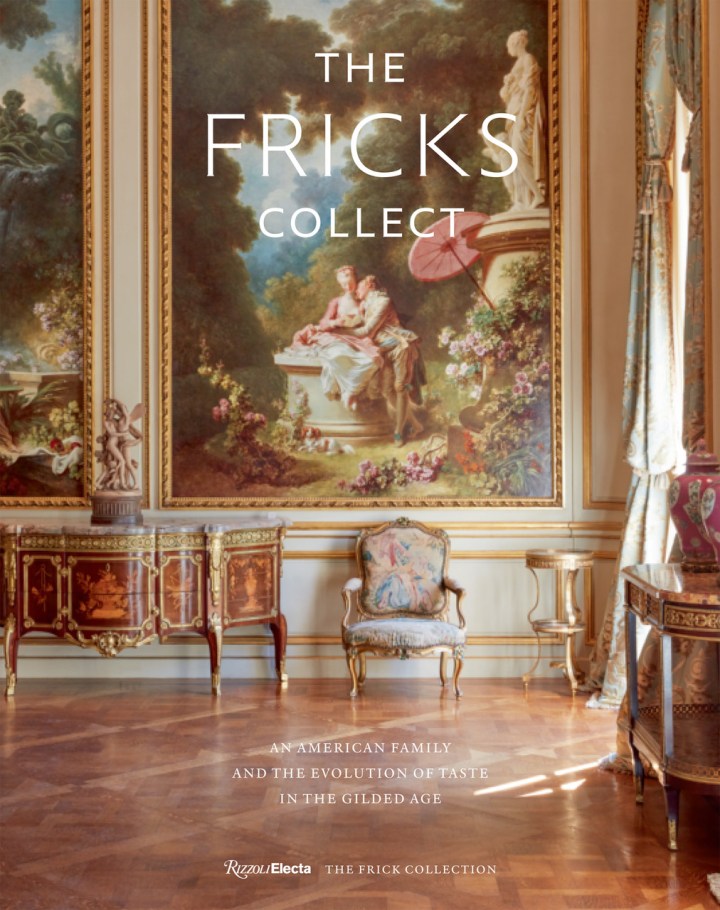 Before his New York home became a museum, Henry Clay Frick engaged some of his era’s most important art dealers to build a notable collection and the best decorators to create suitable Gilded Age interiors to accommodate the works. This story traces the journey that led to the creation of one of America’s finest art collections.
At its heart, this story centers on Frick and his daughter Helen Clay Frick, both pivotal figures in the formation of the renowned Frick Collection. The volume delves into the Fricks’ exposure to and acquisition of some of the finest art of their time. With an exquisite blend of textual narrative and ample imagery showcasing masterpieces and the sumptuous interiors of homes in Pittsburgh and New York, the book offers a captivating narrative of ambition, wealth, and cultural patronage.
White, Allom & Co. and Elsie de Wolfe worked with Frick on the decoration of his houses and influenced the choice of many furnishings the owner acquired and that formed the backdrop for his paintings. As was commonplace at the time, decorators often collaborated with dealers in creating spaces suitable for the esteemed works of art. Further influential figures who shaped the era’s cultural landscape include Frick’s business partner Andrew Carnegie and noted art dealers Joseph Duveen in London and Charles Carstairs of M. Knoedler & Co. in New York. Presenting the glittering halls of their homes and the masterpieces adorning the walls of The Frick Collection, this volume is a testament to the enduring allure of art and the power of patronage in shaping cultural institutions.
Ian Wardropper is the Anna-Maria and Stephen Kellen Director of The Frick Collection. Julian Fellowes is an English novelist, director, and screenwriter, best known as the creator and head writer of the popular TV series Downton Abbey.
New Book | Le Comte d’Angiviller
From Éditions Monelle Hayot:
Monelle Hayot and Antoine Maës, Le Comte d’Angiviller: Directeur des Arts sous Louis XVI (Saint-Rémy-en-l’Eau: Éditions d’art Monelle Hayot, 2025), 384 pages, ISBN: 979-1096561421, €60.
 Gentilhomme de la manche, le comte d’Angiviller (1730–1809) élève le futur Louis XVI et ses frères. Dès son accession au trône en 1774, Louis XVI le nomme directeur des Bâtiments. Son rôle est immense. Fondateur du musée du Louvre il orchestre les travaux et constitue les collections en acquérant des œuvres majeures. Il est responsable de tous les bâtiments royaux, achète Rambouillet pour le roi. Angiviller préside au sort des manufactures de Sèvres et des Gobelins, dirige l’Académie de peinture et de sculpture, ainsi que l’Académie de France à Rome.
L’époque révolutionnaire fait de lui un témoin oculaire majeur de faits historiques auxquels il participe. Le roi lui demande d’émigrer en Espagne. D’une fidélité sans faille, il revient pour aider le roi en danger, mais sa tête est sur la liste des aristocrates à décapiter. Il part pour l’Allemagne dont il ne reviendra jamais.
Angiviller avait un secrétaire, Narcisse, qui recopiait toute sa correspondance avec le roi. Il fut le témoin de sa vie et émigra avec lui. Sur ses vieux jours, Narcisse écrit ses mémoires pour la marquise de Capellis qui vit au château de Saint-Rémy-en-l’Eau, lieu de naissance d’Angiviller. Ce manuscrit inédit est entièrement retranscrit à la fin de cet ouvrage.
Lecture | Meredith Martin on Unpacking the Choiseul Box
This month at BGC:
Meredith Martin | Unpacking the Choiseul Box
An Iris Foundation Awards Lecture
Bard Graduate Center, New York, 22 April 2025

Louis-Nicolas van Blarenberghe (miniaturist; 1716–1794) and Louis Roucel (goldsmith; ca. 1756–1787), tabatière Choiseul (Choiseul snuffbox), ca. 1770/71, gouache on vellum, assembled in an architectural gold setting, 8 × 6 × 2.4 cm (Paris: Louvre).
This interactive lecture will explore the famous Choiseul snuffbox, a tiny but extraordinary monument of the eighteenth century that features views of the Parisian mansion and art collection of the Duc de Choiseul, foreign minister to Louis XV. The snuffbox, or tabatière, became a cause célèbre in France in 2023 when it was offered for sale to the tune of nearly four million euros. The Louvre launched a massive public campaign to raise funds to acquire the box and published a scholarly tome dedicated to giving readers “all the keys you still need to unlock the secrets of this highly prized tabatière.” And yet in all the recent literature around this object, no mention has been made of its deep, unsettling connections to colonialism and enslavement at the level of material, iconography, patronage, and use. This talk will seek to ‘unpack’ this box and will invite attendees to confront its materiality and multisensory dimensions through digital reconstructions produced in collaboration with Bard Graduate Center’s digital humanities team.
Meredith Martin is a professor of art history at New York University and a founding editor of Journal18. A specialist in early modern French art and empire, she is the coauthor (with Gillian Weiss) of the prizewinning book The Sun King at Sea: Maritime Art and Galley Slavery in Louis XIV’s France (Getty, 2022; French edition 2022), which is related to an exhibition that she and Dr. Weiss are co-curating for the Institut du monde arabe in Paris. Martin is also the author of Dairy Queens: The Politics of Pastoral Architecture from Catherine de’ Medici to Marie-Antoinette (Harvard, 2011), and a coauthor of Meltdown: Picturing the World’s First Bubble Economy (2020), which is related to an exhibition she co-curated for the New York Public Library. Together with Phil Chan, Martin reimagined and restaged a lost French ballet from 1739 known as the Ballet des Porcelaines, which premiered at the Metropolitan Museum of Art in 2021 and was performed throughout the US and Europe in 2022. She is currently working on a multimedia collaborative project called Colonial Networks, which explores links between Haiti/Saint-Domingue and the Paris art world during the late eighteenth and early nineteenth centuries.
28th Annual Iris Foundation Awards — In 1997 Susan Weber created the Iris Foundation Awards to recognize scholars, patrons, and professionals who have made outstanding contributions to the field of decorative arts, design history, and material culture. Meredith Martin will receive the Iris Award for Outstanding Mid-Career Scholar on April 23 at the Cosmopolitan Club. This year’s other recipients are Irene Roosevelt Aitken (Outstanding Patron), Julius Bryant (Outstanding Lifetime Achievement), and Katherine Purcell (Outstanding Dealer). Proceeds benefit the Bard Graduate Center Scholarship Fund.
New Book | La Tabatière Choiseul
Published in October by Faton:
Michèle Bimbenet-Privat, ed., La Tabatière Choiseul: Un monument du XVIIIe siècle (Dijon: Éditions Faton, 2025), 256 pages, ISBN: 978-2878443721, €49.
 Acquise en 2023 par le musée du Louvre, la tabatière Choiseul est incontestablement la plus originale et la plus célèbre des tabatières du XVIIIe siècle. La précieuse monture en or de l’orfèvre Louis Roucel sert d’écrin à six miniatures de Louis Nicolas Van Biarenberghe mettant en scène le flamboyant duc de Choiseul, le grand ministre de Louis XV, au faîte de sa gloire. Toutes les facettes de la vie quotidienne de ce personnage généreux et arrogant s’y succèdent, soulignant son travail acharné, parfois solitaire, indissociable de l’exercice du pouvoir. La tabatière Choiseul séduit aussi par sa description minutieuse du cadre de vie raffiné du ministre, de son immense collection de tableaux et d’objets d’art, esquissant ainsi une réflexion sur les relations entre art et pouvoir. Elle offre enfin une multitude d’énigmes à résoudre sur son origine, ses possesseurs successifs, la signification des scènes, l’identification des lieux et des personnages représentés.
Exhibition | Music and the Republic
Now on view at the Musée des Archives Nationales:
Music and the Republic: From the French Revolution to the Popular Front
Hôtel de Soubise, Paris, 26 March — 14 July 2025
Curated by Marie Ranquet, Sophie Lévy, and Christophe Barret
 L’exposition Musique et République, de la Révolution au Front populaire—organisée avec le concours du Conservatoire national supérieur de musique et de danse de Paris—souhaite mettre en lumière les liens entre la musique et la construction de la République. De la Révolution, qui organise de nouvelles institutions et utilise la musique pour fonder un sentiment patriotique, au Front populaire de 1936, qui fait le pari de l’émancipation sociale du citoyen par l’accès aux loisirs et à la culture, la formation et la pratique musicale permettent à la fois le partage d’un patrimoine sonore commun et l’expression personnelle, parfois subversive.
Les Archives nationales retracent l’histoire de cette rencontre entre le citoyen et la musique. Des partitions inédites retrouvées dans les fonds des Archives nationales, des instruments de musique étonnants ou oubliés, des correspondances politiques, des commandes passées à des compositeurs prestigieux et de nombreux autres documents, racontent une histoire mouvementée : celle d’un siècle et demi de production, d’éducation et de pratique musicales, envisagées en regard de l’idée républicaine.
Commissariat scientifique
• Marie Ranquet, conservatrice en chef du patrimoine aux Archives nationales
• Sophie Lévy, responsable des archives au Conservatoire national supérieur de musique et de danse de Paris
Commissariat technique
• Christophe Barret, chargé d’expositions au département de l’Action culturelle et éducative des Archives nationales
Musique et République: De la Révolution au Front populaire (Paris: Éditions Snoeck, 2025), 168 pages, ISBN: 978-9461619464, €30. With contributions by Adrián Almoguera, Mathias Auclair, Rémy Campos, Myriam Chimènes, Peter Hicks, Sophie Lévy, Marie Ranquet, Émeline Rotolo, and Charles-Éloi Vial.
New Historical Fiction | Allegro
From Other Press, where one can also find a playlist for the book:
Ariel Dorfman, Allegro: A Novel (New York: Other Press, 2025), 272 pages, ISBN: 978-1635424485, $18.
 This thrilling historical mystery starring Mozart tells of friendship and betrayal, and how music allows us to defy death—from the acclaimed author of Death and the Maiden and The Suicide Museum.
In 1789 Wolfgang Amadeus Mozart visits the grave of Johann Sebastian Bach in Leipzig, looking for a sign, a signal, an answer to an enigma that has haunted him since childhood: Was Bach murdered by a famous oculist? And years later, was Handel a victim of the same doctor? Allegro follows his investigation, from the salons of London to the streets of Paris, recreating an enthralling and turbulent time, full of rogues and brilliant composers, charlatans and presumptuous nobles. Running parallel to this search is the rise of Mozart, his knowledge and fame, his trials and losses.
Ariel Dorfman is a Chilean-American author, born in Argentina, whose award-winning books in many genres have been published in more than fifty languages and his plays performed in more than one hundred countries. Among his works are the plays Death and the Maiden and Purgatorio, the novels The Suicide Museum (Other Press, 2023), Widows, and Konfidenz, and the memoirs Heading South, Looking North and Feeding on Dreams. He lives with his wife Angélica in Santiago, Chile, and Durham, North Carolina, where he is the Walter Hines Page Emeritus Professor of Literature at Duke University.
New Book | On the Calculation of Volume
The shortlist for this year’s International Booker Prize was announced on Tuesday. Included is the first installation Solvej Balle’s seven-part novel On the Calculation of Volume. As noted by Hilary Leichter in her review for The New York Times (25 January 2025), the central character is an antiquarian bookseller “specializing in illustrated works from the 18th century.” I’ve not yet read the book, but that feels just about perfect to me. –CH
From New Directions:
Solvej Balle, On the Calculation of Volume, Part I, translated from the Danish by Barbara Haveland (New Directions, 2024), 160 pages, ISBN: 978-0811237253, $16.
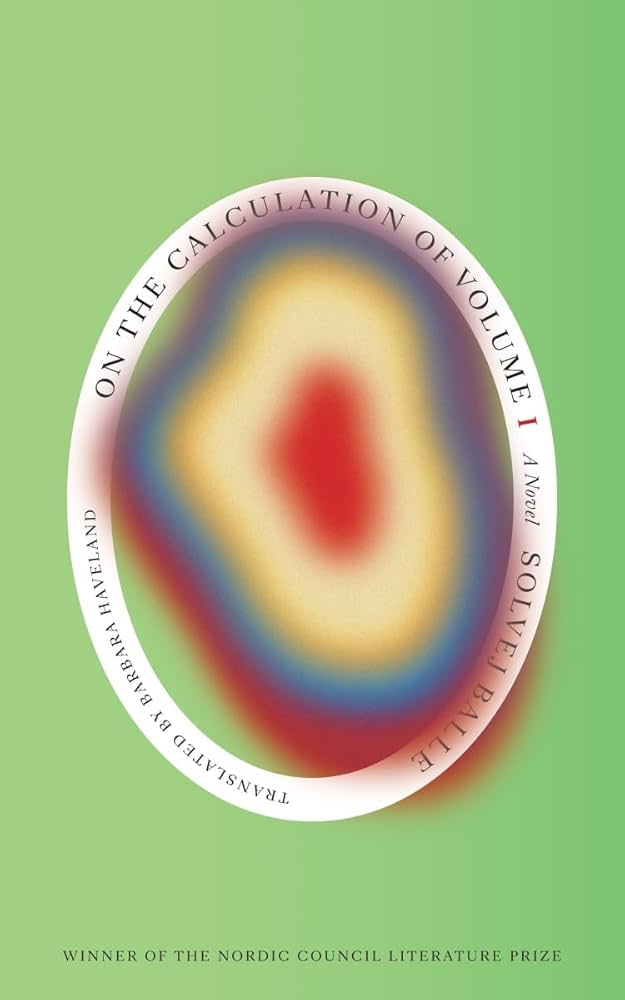 Tara Selter, the heroine of On the Calculation of Volume, has involuntarily stepped off the train of time: in her world, November eighteenth repeats itself endlessly. We meet Tara on her 122nd November 18th: she no longer experiences the changes of days, weeks, months, or seasons. She finds herself in a lonely new reality without being able to explain why: how is it that she wakes every morning into the same day, knowing to the exact second when the blackbird will burst into song and when the rain will begin? Will she ever be able to share her new life with her beloved and now chronically befuddled husband? And on top of her profound isolation and confusion, Tara takes in with pain how slight a difference she makes in the world. (As she puts it: “That’s how little the activities of one person matter on the eighteenth of November.”)
Balle is hypnotic and masterful in her remixing of the endless recursive day, creating curious little folds of time and foreshadowings: her flashbacks light up inside the text like old flash bulbs. The first volume’s gravitational pull―a force inverse to its constriction―has the effect of a strong tranquilizer, but a drug under which your powers of observation only grow sharper and more acute. Give in to the book’s logic (its minute movements, its thrilling shifts, its slant wit, its slowing of time) and its spell is utterly intoxicating. Solvej Balle’s seven-volume novel wrings enthralling and magical new dimensions from time and its hapless, mortal subjects. As one Danish reviewer beautifully put it, Balle’s fiction consists of writing that listens. “Reading her is like being caressed by language itself.”
Solvej Balle was born in 1962, made her debut in 1986 with Lyrefugl, and she went on to write one of the 1990s’ most acclaimed works of Danish literature, According to the Law: Four Accounts of Mankind (praised by Publishers Weekly for its blend of “sly humor, bleak vision, and terrified sense of the absurd with a tacit intuition that the world has a meaning not yet fathomed”). Since then, she’s published a book on art theory, Det umuliges kunst, 2005, a political memoir Frydendal og andre gidsler, 2008, and two books of short prose Hvis and Så, published simultaneously in 2013. On the Calculation of Volume is Solvej Balle’s major comeback, not just to Danish or Nordic fiction, but―expanding the possibilities of the novel―to all of world literature.
Barbara J. Haveland (born 1951) is a Scottish literary translator, resident in Copenhagen. She translates fiction, poetry, and drama from Danish and Norwegian to English. She has translated works by many leading Danish and Norwegian writers, both classic and contemporary, including Henrik Ibsen, Peter Høeg, Linn Ullmann, and Carl Frode Tiller.
New Book | Oxford Libraries: Architecture
Coming soon, with distribution by The University of Chicago Press:
Geoffrey Tyack, with photographs by Dan Paton, Oxford Libraries: Architecture (Oxford: Bodleian Library Publishing, 2025), 336 pages, ISBN: 978-1851246052, £50 / $80.
 Curated illustrations of the architectural design and history of the most beautiful libraries in Oxford and a close look at the artistic prowess of the architects responsible.
The libraries of the colleges and the University of Oxford are among the finest, but also among the least-known, buildings in the city. Ranging in date from the thirteenth to the twenty-first centuries, they embody successive changes in internal design and architectural taste. Libraries were originally established as repositories of knowledge in the form of manuscripts and printed books, and until fairly recently, they were used only by scholars. Over time, the University’s libraries, and those of the constituent colleges, attracted wealthy donors, some of whom, like John Radcliffe, gave generously to the provision of impressive and architecturally innovative buildings in which to house the books. These buildings are still among the most impressive features of Oxford’s architectural landscape, helping to define its visual identity. Architectural styles range from medieval wooden stalls to the concrete and glass of twentieth-century Brutalism, and notable architects include Sir Christopher Wren, Nicholas Hawksmoor, Sir Giles Gilbert Scott, James Gibbs, Sir Edwin Lutyens, and Arne Jacobsen. With specially commissioned photography, this profusely illustrated book invites readers through the doors of over fifty beautiful and iconic libraries, revealing how they are steeped in history, learning, and cultural change.
Geoffrey Tyack is an emeritus Fellow of Kellogg College, University of Oxford, and the Director of Stanford University Centre in Oxford.
Dan Paton is a commercial photographer specialising in architecture, lighting, interiors, and the built environment, as well as portrait, PR, and event photography.










 Enfilade
leave a comment