Book | Jewish Treasures from Oxford Libraries
This is a book that I should have noted years ago; David Stern’s review for Mosaic usefully introduces the collectors, many of whom lived in the 18th century. –CH
Distributed by The University of Chicago Press . . .
Rebecca Abrams and César Merchán-Hamann, eds., Jewish Treasures from Oxford Libraries (Oxford: Bodleian Library Publishing, 2020), 304 pages, ISBN: 978-1851245024, $55.
 Representing four centuries of collecting and a thousand years of Jewish history, this book brings together Hebrew manuscripts and rare books from the Bodleian Library and Oxford colleges. Highlights of the extraordinary collections include a fragment of Maimonides’ autograph draft of the Mishneh Torah, the earliest dated fragment of the Talmud, exquisitely illuminated manuscripts of the Hebrew Bible, stunning festival prayer books, and one of the oldest surviving Jewish seals in England. Lavishly illustrated essays by experts in the field bring these outstanding works to life, exploring the personalities and diverse motivations of their original collectors. Saved for posterity by religious scholarship, intellectual rivalry, and political ambition, these extraordinary collections also detail the consumption and circulation of knowledge across the centuries, forming a social and cultural history of objects moved across borders from person to person. Together, they offer a fascinating journey through Jewish intellectual and social history.
Rebecca Abrams is Royal Literary Fund Fellow at Brasenose College, Oxford and author of The Jewish Journey: 4000 Years in 22 Objects.
César Merchán-Hamann is the Victor Blank Hebraica and Judaica curator in the Bodleian Library and director of the Leopold Muller Memorial Library at the University of Oxford.
c o n t e n t s
Librarian’s Foreword — Richard Ovenden
Preface — Martin J. Gross
Introduction to the Bodleian Library and College Collections — César Merchán-Hamann
1 The Laud Collection — Giles Mandelbrote
2 The Pococke Collection — Benjamin Williams
3 The Huntington Collection — Simon Mills and César Merchán-Hamann
4 The Kennicott Collection — Theo Dunkelgrün
5 The Canonici Collection — Dorit Raines
6 The Oppenheim Collection — Joshua Teplitsky
7 The Michael Collection — Saverio Campanini
8 The Genizah Collection — Nadio Vidro
9 The College Library Collections — Rahel Fronda
From Collectors to Readers — Piet van Boxel
Notes
Further Reading
Contributors
Picture Credits
Index
Online Talk | Karen Jensen on Cataloging Rare Maps
From the registration page:
Karen Jensen | An Introduction to Cataloging Rare Maps
Online, 30 April 2025, 3pm (Eastern Time)
The Bibliographic Standards Committee (BSC) of the ACRL Rare Books and Manuscripts Section (RBMS) invites you to the webinar, “An Introduction to Cataloging Rare Maps.” The session will introduce rare map cataloging with the original RDA Toolkit; it will include discussion of DCRM(C)—Descriptive Cataloging of Rare Materials (Cartographic)— highlighting the distinctive aspects of cataloging pre-twentieth century maps. The aim is to assist those who rarely work with maps. Participants will become familiar with searching for cataloging records in WorldCat and selecting the best record for the map in hand. They will be able to decide when a new record is justified and be able to add an original cataloging record. The webinar will also briefly review map subject analysis and Library of Congress call numbers.
Karen Jensen is Head of Cataloguing and Collection Maintenance at Concordia University Library in Montreal.
Representing nearly 8,500 individuals and libraries, the Association of College and Research Libraries (ACRL), the largest division of the American Library Association, develops programs, products, and services to help those working in academic and research libraries learn, innovate, and lead within the academic community. Founded in 1940, ACRL is committed to advancing learning, transforming scholarship, and creating diverse and inclusive communities.
New Book | Global Germany Circa 1800
From PSU Press (and for now, 30% off with discount code NR25) . . .
Todd Kontje, Global Germany Circa 1800: A Revisionist Literary History (University Park: Penn State University Press, 2025), 266 pages, ISBN: 978-0271099668, $60.
 Global Germany Circa 1800 asks two interrelated questions: How did Germans participate in the European conquest of the world, and how were they different from other imperial powers? In other words, what is the relation between the German form of empire, the old Reich, and the modern European empires that emerged in the global age? Todd Kontje presents a revisionist literary and intellectual history, inviting readers to consider how we might understand ‘Germany’ at the turn of the nineteenth century if we remove the nation-state as the inevitable goal of cultural and political development. Focusing on the pivotal years around 1800, when many of the concepts that define the modern era first came into being, Kontje investigates how thinkers in and around Weimar―from Goethe, Schiller, and Kant to Georg Forster, Heinrich von Kleist, and Alexander von Humboldt―worked within existing political structures to make sense of the region’s place in the world. Ultimately, he reveals how Weimar, a remote artist hub long thought to exemplify the insularity of a soon-to-be-unified nation, was in fact utterly worldly, and in a manner very different from the political capitals of imperial nation-states like London and Paris. Accessible and entertaining, this literary history is essential reading for German studies students and scholars, and it will appeal to audiences in world history, empire studies, intellectual history, and comparative literature.
Todd Kontje is Distinguished Professor of German and Comparative Literature at the University of California, San Diego. He is the author of four books, including Georg Forster: German Cosmopolitan, winner of the 2023 DAAD/GSA Prize for the Best Book in Literature and Cultural Studies.
c o n t e n t s
Preface
Acknowledgments
Introduction
1 The World in Letters
2 The World in Motion
3 Goethe’s Journey to the Center of the Earth
4 Schiller and the Drama of Empire
5 Kleist and the Revolution
6 Alexander von Humboldt and the Anthropocene
Conclusion
Notes
Bibliography
Index
Call for Papers | Romantic Circulations
From ArtHist.net:
Romantic Circulations
Nordic Association of Romantic Studies Conference
University of Oslo, 10–12 September 2026
Organized by Ellen Rees with Tonje Haugland Sørensen
Proposals due by 1 October 2025
This three-day conference at the University of Oslo invites scholars engaged in the study of romanticism writ large from the expanded Nordic region to present new research on the circulation of romantic ideas and objects. The topic Romantic Circulations encompasses both romantic discourses that arose in the period most typically associated with romanticism, but also the afterlives of romantic ideas, people, objects, discourses, etc. Focusing on processes like dissemination, circulation, and transference, we aim to challenge traditional understandings of the relationship between center and periphery in the spread of romantic discourses and aesthetics. We also posit that the recent turn toward transnational and transdisciplinary aspects of romanticism in scholarship demands a reassessment of approaches, methodologies, and historiographic structures of the field. We therefore encourage meta-theoretical perspectives, as well as meta-critical reevaluations of entrenched narratives about romantic phenomena. We also welcome cultural interventions from various perspectives, including Indigenous, environmental, postcolonial, gender, and other marginalized groups.
With this conference, we aim to expand our understanding of romanticism and explore together how it manifests and adapts in different times, place, and artistic forms. We encourage contributions from a broad range of fields, including art history and visual culture, literary studies, musicology, history of ideas, philosophy, cultural studies and museology, and history.
Keynote Speakers
• Timothy Tangherlini (University of California, Berkeley)
• Stephanie O’Rourke (University of St. Andrews)
We welcome individual proposals as well as pre-constituted panels. Early career scholars are particularly encouraged to apply. Please send an abstract (of no more than 500 words) and a short biography (200 words) by 1 October 2025 to romanticcirculations@gmail.com. Note of acceptance will follow by 1 February 2026.
Organized by Ellen Rees (University of Oslo) in collaboration with Tonje Haugland Sørensen (NARS Executive Committee) and co-funded by the ERC project NORN.
Online Talk | Michael Ohajuru on the Black Presence in European Art

◊ ◊ ◊ ◊ ◊
This evening from YCBA:
Michael Ohajuru | From Subjects of Capital to Makers of Culture
The Black Presence in Western European Art
Online and in-person, Norma Lytton Lecture, Yale Center for British Art, 10 April 2025, 5.30pm (ET)
Michael Ohajuru explores how Black figures, once positioned as exotic, subservient, or symbolic, have moved toward the center of artistic representation—sometimes through shifts in artistic intention, sometimes through reinterpretation by contemporary audiences. Through this lens, Ohajuru questions historical silences and considers how the Black presence in art speaks to the evolving relationship between Black and white identities in the Western world.
Join the livestream here»
Michael Ohajuru is a Fellow of the Royal Society of Arts and a Senior Research Fellow of the Institute of Commonwealth Studies. He blogs, writes, and speaks regularly on identifying, understanding, and interpreting the Black African presence in Renaissance art. He is founder of the Image of the Black in London Galleries, a series of gallery tours that highlight the overt and covert Black presences to be found in the national art collections of London. Ohajuru is the project director of the John Blanke Project, a contemporary art and archive project celebrating John Blanke, the Black trumpeter to the Tudor courts of Henry VII and Henry VIII. He is also a founding member of the Black Presence in British Portraiture network, managing their podcast The BP2 Podcast.
Generous support for this program has been provided by the Norma Lytton Fund for Docent Education, established in memory of Norma Lytton by her family. Lytton was an active docent at the YCBA for more than twenty years and subsequently spent a decade engaged in research for the museum’s Department of Paintings and Sculpture.
Banner images from left to right (all details): Francis Harwood, Bust of a Man, ca. 1758, black limestone on a yellow marble socle (Yale Center for British Art, Paul Mellon Collection); Sir Joshua Reynolds, Charles Stanhope, Third Earl of Harrington and Marcus Richard Fitzroy Thomas, 1782, oil on canvas (Yale Center for British Art, Paul Mellon Collection); Joanna Mary Wells (née Boyce), Fanny Eaton (née Antwistle or Entwistle), 1861, oil on paper laid to linen (Yale Center for British Art, Paul Mellon Fund); and Kehinde Wiley, Portrait of Lynette Yiadom-Boakye, Jacob Morland of Capplethwaite, detail, 2017, oil on canvas (Yale University Art Gallery and Yale Center for British Art, purchased with a gift from Mary and Sean Kelly in honor of Courtney J. Martin and with the Janet and Simeon Braguin Fund and Friends of British Art Fund. © Kehinde Wiley. Courtesy of Sean Kelly, New York).
Exhibition | Hogarth’s Progress
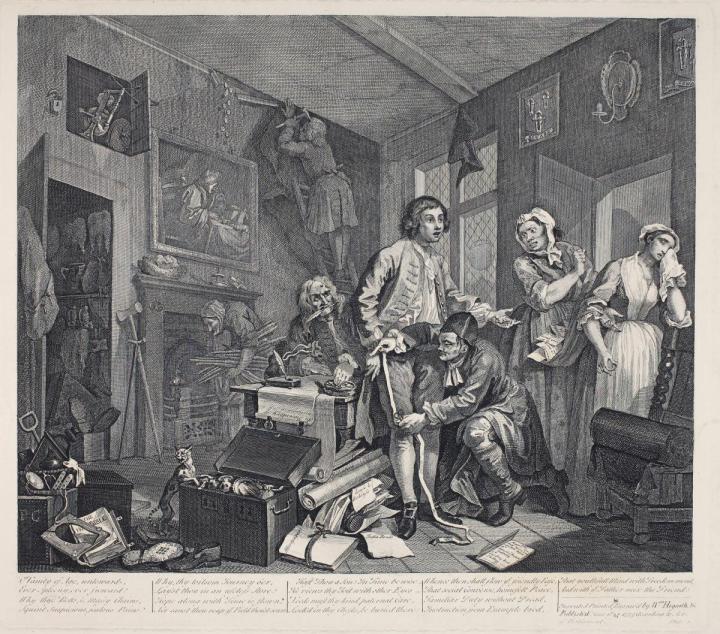
William Hogarth, The Rake’s Progress, Plate 1, published 25 June 1735, etching and engraving
(Allen Memorial Art Museum, Oberlin College, 1975.203)
◊ ◊ ◊ ◊ ◊
Now on view at Oberlin:
Hogarth’s Progress
Allen Memorial Art Museum, Oberlin College, Ohio, 31 January — 10 August 2025
Organized by Marlise Brown
English artist William Hogarth (1697–1764) used his art to hold up a moralizing mirror to all levels of 18th-century society. From rakes to harlots and aristocrats to the clergy—no one was exempt from his biting yet humorous art.
In 1731, Hogarth began creating a series of artworks that he termed ‘modern moral subjects’, which focused on the immoral bend of contemporary London while satirizing the vice and folly of his characters. This exhibition focuses on his first two ‘modern moral subjects’: The Harlot’s Progress (1732), which is a narrative in six scenes, and The Rake’s Progress (1735), which is completed in eight scenes. These sets, offered on subscription, sold out quickly because they were immensely popular with people from all walks of life in England.
Hogarth’s term ‘progress’ was inspired by the book The Pilgrim’s Progress, first published by the English author John Bunyan in 1678. However, unlike the protagonists in Bunyan’s moralizing Christian allegory, Hogarth’s ‘Harlot’ and ‘Rake’ do not grow or learn from life’s experiences. Instead, Hogarth’s narrative series exposes the shallowness of aristocracy, the vices and indulgences of modern London, and showcases complicated ideas in a new form of visual theater.
Organized by Marlise Brown, Assistant Curator of European and American Art.
Call for Papers | ‘Deviant’ Women and the Visual Arts
From ArtHist.net:
‘Deviant’ Women and the Visual Arts
University of Bristol, 10 July 2025
Proposals due by 5 May 2025
The Women and the Visual Arts Research Cluster at the University of Bristol is excited to announce our forthcoming symposium taking place at the University of Bristol on Thursday, 10th July 2025. Women have long been viewed as ‘deviant’ in their roles as artists, authors, models, patrons, and collectors. Their paths to becoming artists or patrons may ‘deviate’ from the norm, their chosen medium or subjects may diverge from those expected by the market, and their representations of themselves and those around them may be unorthodox compared to the art historical canon. How can we, as researchers, contextualise this ‘deviancy’ in our work on women and the visual arts?
We welcome submissions that think about women’s ‘deviancy’ in their relationship to the visual arts in diverse ways: women who push the boundaries on what has been seen as the norm or whose work is divergent from accepted standards. While we are explicitly seeking contributions that foreground the visual, we are excited to hear from colleagues working across fields and disciplines, including (but not limited to) history of art, visual culture, classics, film and theatre studies, history, religious studies, and those doing practice-based research.
Potential topics could include, but are not limited to
• Exhibiting and collecting strategies used by women or the curation and collecting of work by women
• Self-representation and self-portraiture — identity and sexuality
• Transnational feminine identities — culture, race, immigration, and exile
• The nude and representations of the body
• The archive — the formation of celebrity, reception, and legacy
• Women and the environment
• Women’s work — motherhood, domesticity, labour, artist collectives
• ‘Deviant’ use of artistic medium through textual approaches, the applied arts, craft, performance, etc.
In addition to proposals for papers, we also welcome submissions for videos or artist talks related to the symposium’s themes. To apply, please submit a 150- to 200-word abstract with a short bio to Helena Anderson (helena.anderson@bristol.ac.uk) and Valéria Fülöp-Pochon (vf15404@bristol.ac.uk) by Monday, 5th May 2025.
Art History 48 (February 2025)
The 18th century in the latest issue of Art History:
Art History 48 (February 2025)
a r t i c l e s
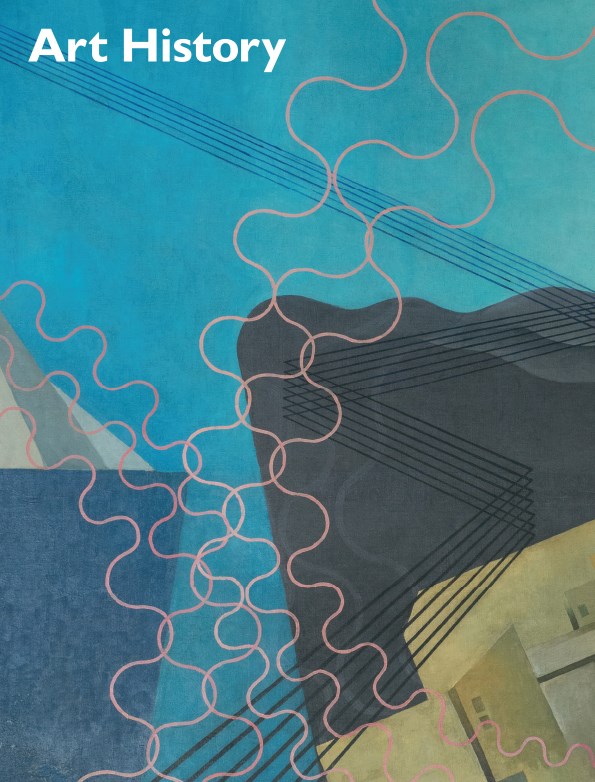 • Oliver Wunsch, “The Aesthetic Redemption of the Black Body in Eighteenth-Century France,” pp. 14–44.
Audiences in eighteenth-century France felt little compunction about admiring African people in art while denigrating them in life. They reconciled this apparent contradiction through a belief in the ameliorative effects of art, yielding what is described here as a theory of aesthetic redemption. This essay argues that the theory of aesthetic redemption that developed in eighteenth-century France gave art a unique position in the construction of race. Because those who believed in the possibility of aesthetic redemption distinguished between art’s content and its manner of representation, they created the conditions for artists to depict people of colour using materials, techniques, and formal structures whose qualities would otherwise be considered at odds with the subject. The resulting art often strikes audiences today as progressive, yet it did little to challenge the biases of the original viewers, who admired aesthetic departures from stereotypes precisely because they took those stereotypes for granted.
• Diarmuid Costello, “Die Schönheit des Mittelmenschen: Stephan Balkenhol’s ‘Everyday Beauty’,” pp. 132–61.
This essay considers Stephan Balkenhol’s ‘everyman and woman’ sculptures through the optic of Kant’s ‘ideal of beauty’ (§17, Critique of Aesthetic Judgement, 1790). I take a pair of miniature figures as my test case. Despite minor variations, all these sculptures depict the same generic man and woman, a man or woman who average or middling in every way. What could make depictions of average everydayness so compelling? For a clue, I turn to Kant’s ‘ideal of beauty’. This comprises a ‘standard aesthetic idea’ and an ‘idea of reason’: the former is a (culturally specific) ‘model image’ of the human being; the latter implicates Kant’s (universal) conception of ‘humanity in the person’, where the latter manifests itself through the former. I ask whether this illuminates Balkenhol’s work, suggesting that although the relevance of the former is clear, and the latter less so, there is reason not to rule it out.
• Viccy Coltman, “Travelling Knick-Knacks and Picturesque Points of View: Reverend James Plumptre’s Narrative of a Pedestrian Journey … to the Highlands of Scotland … in the Summer of the Year 1799,” pp. 162–84.
This essay revisits later eighteenth-century picturesque aesthetics in Britain as they were articulated in theory, applied in practice, and reproduced in travel literature and art. It considers the sometimes congruent, at other times contested, relationship between the natural landscape, written descriptions of that landscape, and its pictorial representation. Focusing on unpublished extracts from Reverend James Plumptre’s manuscript travel journal, Narrative of a Pedestrian Journey […] to the Highlands of Scotland […] in the Summer of the Year 1799, it argues for an original interpretation of the pedestrian picturesque as a suite of practices which entailed travelling by foot, viewing the landscape with a range of hand-held implements or ‘knick-knacks’, and representing nature ‘as seen’ without remedial artistic correction or improvement. According to this account, ‘people, places, and things’ becomes a useful rubric for conceptualising Plumptre’s 1799 pedestrian tour of Scotland which included visits to the Edinburgh studios of artists Alexander Nasmyth, Henry Raeburn, and Hugh William Williams.
r e v i e w s
• Brigid von Preussen, “A Woman’s Work,” Review of Paris Spies-Gans, A Revolution on Canvas: The Rise of Women Artists in Britain and France, 1760–1830 (Yale UP, 2022) and Rosalind Blakesley, Women Artists in the Reign of Catherine the Great (Lund Humphries, 2023), pp. 186–92.
Call for Papers | Material Culture Pre-1850 Workshop, Lifecycles
From the announcement:
Lifecycles | Material Culture Pre-1850 Workshop, University of Cambridge
Hybrid format, alternate Monday evenings, Easter Term 2025
Proposals due by 28 April 2025
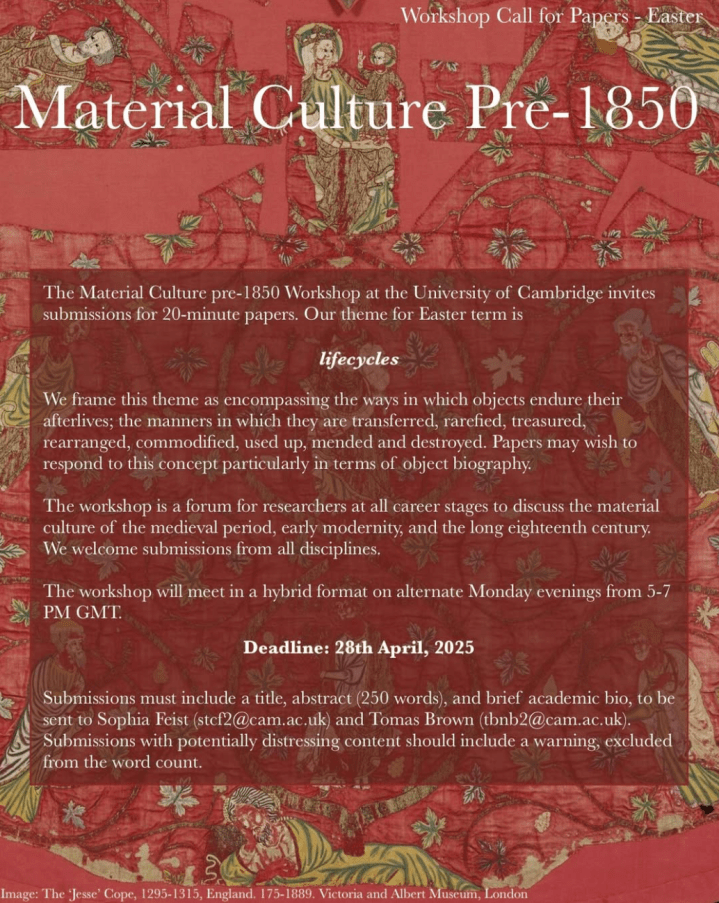 The Material Culture pre-1850 Workshop at the University of Cambridge invites submissions for 20-minute papers. Our theme for Easter term is Lifecycles, which we frame as encompassing the ways in which objects endure their afterlives; the manners in which they are transferred, rarefied, treasured, rearranged, commodified, used up, mended and destroyed. Papers may wish to respond to this concept particularly in terms of object biography.
The workshop is a forum for researchers at all career stages to discuss the material culture of the medieval period, early modernity, and the long eighteenth century. We welcome submissions from all disciplines. The workshop will meet in a hybrid format on alternate Monday evenings from 5 to 7pm GMT.
Submissions must include a title, abstract (250 words), and brief academic bio, to be sent to Sophia Feist (stcf2@cam.ac.uk) and Tomas Brown (tbnb2@cam.ac.uk) by 28 April 2025. Submissions with potentially distressing content should include a warning, excluded from the word count.
Ten Axioms: Drimmer and Nygren on Art History and AI
I was slow finding this essay on artificial intelligence, but it strikes me as immensely helpful (it seems someone asks me about art and AI at least once a week these days). –CH
Sonja Drimmer and Christopher Nygren, “Art History and AI: Ten Axioms,” International Journal for Digital Art History 10 (2023): 5.01–10. Link»
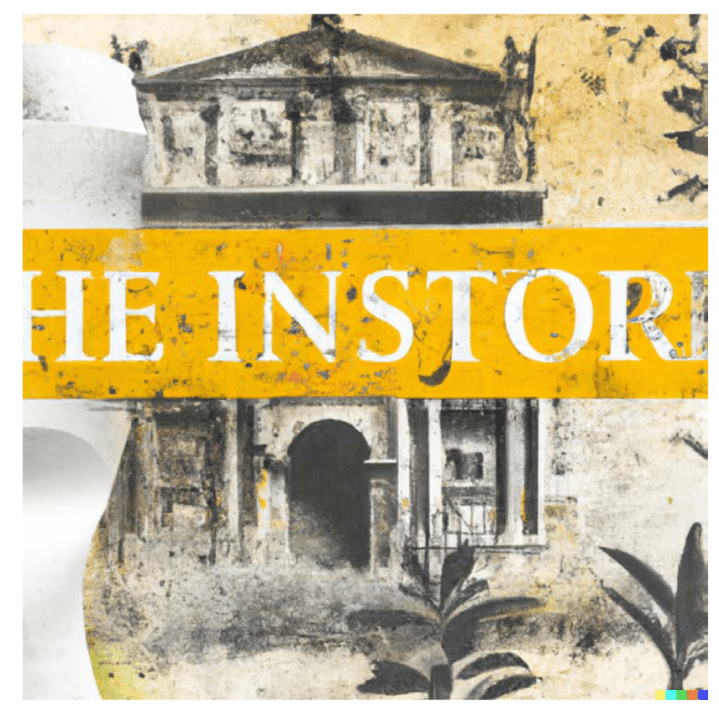
One of a handful of digital images accompanying the article created by Dall-e-2 using the following prompt: “the history of art as understood by artificial intelligence.”
Abstract | AI has become an increasingly prevalent tool for researchers working in Digital Art History. The promise of AI is great, but so are the ethical and intellectual issues it raises. Here we propose 10 axioms related to the use of AI in art historical research that scholars should consider when embarking on such projects, and we make some proposals for how these axioms might be integrated into disciplinary conversations.
Sonja Drimmer is associate professor of medieval art in the Department of the History of Art and Architecture at the University of Massachusetts Amherst. Her research is chiefly concerned with the book arts of the Middle Ages, addressing in particular issues of mediation, collaborative production, and replication. She is the author of The Art of Allusion: Illuminators and the Making of English Literature, 1403–1476 (University of Pennsylvania, 2018), which received High Commendation for Exemplary Scholarship from the Historians of British Art.
Christopher J. Nygren is associate professor of early modern art in the Department of the History of Art and Architecture at the University of Pittsburgh. In 2022, his book, Titian’s Icons: Charisma, Tradition, and Devotion in the Italian Renaissance (Penn State, 2020), won the Phyllis Goodhart Gordan Prize for best book in Renaissance studies from the Renaissance Society of America. Profesoor Nygren is also developing several collaborative research projects, including in the Digital Humanities. From 2017 to 2019 he served as Principal Investigator on “The Morelli Machine,” a project funded by the National Science Foundation that sought to examine whether computational methods might be used in the attribution of Old Master paintings.










 Enfilade
leave a comment