Call for Papers | Seeing Through? The Materiality of Dioramas
From H-ArtHist:
Seeing Through? The Materiality of Dioramas, 1560–2010
University of Bern, 1–2 December 2016
Proposals due by 31 May 2016
Dioramas are at the crossroads of artistic and scientific practices. They bring together artists, scientists, and collectors, thus providing an opportunity to reflect on the polyvalence of these actors and the definition of their expertise. In 1822, Louis Daguerre coined the term ‘diorama’ when describing his theater. The word diorama means literally ‘seeing through’. In accordance with this etymology, dioramas embody a sense of transparency and life-likeness. In addition to providing theatrical and visual experiences, dioramas are multidimensional installations that incorporate paintings, objects, stuffed animals or mannequins. Habitat groups mixing taxidermy and painted backgrounds were designed for natural history museums, while anthropological dioramas were disseminated all over Europe during the second half of the nineteenth century. They were usually life-sized and site specific, but they could also be reduced to maquettes.
To date, these installations have been studied by scholars from various disciplines, mainly as side topics. Media historians have considered them primarily as proto-cinematic, whereas within the fields of anthropology, museum studies and postcolonial studies, they are generally analyzed as displays that reflect political taxonomies and stereotyped representations.
However, dioramas are not merely images or displays: they are also physical objects made of multiple materials, such as plaster, wood, paper, paint, glass, fur, wax, and metal. The discipline of art history thus provides us with the opportunity to approach the materiality of these installations. Indeed, dioramas are composite and hybrid things, created through cultural interaction and physical encounter. Multiple hands as well as various visions are involved in the process of their creation—and later on, during their conservation. Dioramas therefore allow for the study of contact zones and material exchanges between private and public spheres, as well as between Western and non-Western contexts. Finally, dioramas as objects of study within the field of art history enable us to address values such as authenticity and realism in various contexts.
Part 1 A Genealogy, 1560–1822
This session will explore the diorama’s prehistory before its ‘invention’ by Daguerre, starting with objects, installations, and machinery created for churches and theaters between the sixteenth and eighteenth centuries. Three-dimensional installations, such as groups gathering natural history specimen (taxidermic animals, skeletons) will be of greatest interest. Presentations may focus on wax museums, and more broadly on hyperrealistic figures that were displayed in groups and used for entertainment as well as for pedagogical or medical purposes. Early forms of panoramas, and diaphanoramas will also be of primary importance, such as the creations of the Swiss landscape painter Franz Niklaus König, first exhibited in Bern in 1811.
Part 2 Dioramania, 1822–1970
The second session will consider the numerous dioramas created during the nineteenth and twentieth centuries. Habitat Groups and anthropological dioramas became very popular in international fairs and museums until the mid-twentieth century. They were common in both Western and non-Western cultures, and were especially prominent in the Middle East. In some cases, dioramas were intended to represent national identities and in others, they became forms of resistance used, for instance, by African-American or Native American communities. The contributions to this section may explore the creation of specific sets of installations in fairs, museums, and public space, as well as the politics of dioramas.
Part 3 Re-appropriation, 1970–2010
As of the 1970s, state-sponsored museums created displays of traditional craftsmanship through life-size dioramas, such as the Dubai Museum or the Jewels and Costume Museum in Amman. Native American community centers, such as The Mashantucket Pequot Museum in Connecticut, have been using life-size dioramas since the late 1990s. They are also being reinterpreted by contemporary artists, as shown, for example, in the photographs of Hiroshi Sugimoto. In that perspective, the re-exhibition of dioramas would be a topic of interest. Finally, writing the history of dioramas today might also be a way to reframe the creation of artistic movements such at Surrealism or Dada, as well as the work of such artists as Marcel Duchamp, Edward Kienholz, and Joseph Cornel, by filling in important gaps in the history of art, and the history of installations.
Submissions
An abstract of approximately 500 words and a brief CV should be sent to Noémie Etienne (netienne@getty.edu) and Nadia Radwan (nadia.radwan@ikg.unibe.ch) by May 31. Responses will be given by June 30. The colloquium will be held in English.
New Book | The Empress of Art: Catherine the Great
From Pegasus Books:
Susan Jaques, The Empress of Art: Catherine the Great and the Transformation of Russia (New York: Pegasus Books, 2016), 384 pages, ISBN: 978-1605989723, $21.
 Ruthless and passionate, Catherine the Great is singularly responsible for amassing one of the most awe-inspiring collections of art in the world and turning St. Petersburg in to a world wonder. The Empress of Art brings to life the creation of this captivating woman’s greatest legacy.
An art-oriented biography of the mighty Catherine the Great, who rose from seemingly innocuous beginnings to become one of the most powerful people in the world. A German princess who married a decadent and lazy Russian prince, Catherine mobilized support amongst the Russian nobles, playing off of her husband’s increasing corruption and abuse of power. She then staged a coup that ended with him being strangled with his own scarf in the halls of the palace, and she being crowned the Empress of Russia.
Intelligent and determined, Catherine modeled herself off of her grandfather in-law, Peter the Great, and sought to further modernize and westernize Russia. She believed that the best way to do this was through a ravenous acquisition of art, which Catherine often used as a form of diplomacy with other powers throughout Europe. She was a self-proclaimed “glutton for art” and she would be responsible for the creation of the Hermitage, one of the largest museums in the world, second only to the Louvre. Catherine also spearheaded the further expansion of St. Petersburg, and the magnificent architectural wonder the city became is largely her doing. There are few women in history more fascinating than Catherine the Great, and for the first time, Susan Jaques brings her to life through the prism of art.
Susan Jaques is a journalist specializing in art. She holds a BA in history from Stanford University and an MBA from UCLA. She is the author of A Love for the Beautiful: Discovering America’s Hidden Art Museums and lives in Los Angeles, where she’s a gallery docent at the J. Paul Getty Museum.
Call for Papers | HECAA at CAA 2017, New York
Superpowers in the Global Eighteenth Century: Empire, Colonialism, and Cultural Contact
HECCA Session at the Annual Meeting of the College Art Association, New York, 15–18 February 2017
Chair: Tara Zanardi (Hunter College / CUNY)
Proposals due by 5 April 2016 (in order to meet CAA’s 18 April due date)
The long eighteenth century witnessed European countries vying for global command, from fighting over territories in quick skirmishes or lengthy wars, forming new colonial outposts, pirating cargo, outwitting trade regulations, funding scientific expeditions that fueled the creation of natural history museums and collections and the improvement of cartographic knowledge, enacting free trade policies, and instituting competing trading companies. With the inauguration of new commercial routes for maritime travel and trading strategies, all in an effort to proclaim oneself a superpower, the circulation of goods increased exponentially, making products of all kinds available to a wider audience. While Portugal and Spain had dominated world trade and exploration beginning in the sixteenth century, the Dutch and English soon followed on their heels. Not all competition for global domination happened abroad or at sea: Debates about luxury, the preference for foreign over locally-manufactured goods, women’s role as active consumers and tastemakers, slavery, colonialism, and enlightenment ideas about race emerged on European soil, often pitting one country against another. Outside of Europe, colonists experienced greater independence, which fueled the desire to break from European control.
Within this geopolitical context, this panel seeks papers that address artistic engagement with the broad concept of the European superpower in the long eighteenth century. How did artists both respond to and generate interest in the global and imperial rule? While many artists accompanied expeditions abroad, others could only imagine the world beyond—how were such experiences of contact (real or imagined) expressed in visual terms? How did expanding international networks and political desire for global authority inform artists’ understanding and perspective of empire? How did artists actively support or challenge imperial narratives? This panel particularly welcomes papers that explore the intersection of art and empire by utilizing new methodological approaches to the study of empire, that investigate understudied sites of imperial and colonial history, and that showcase novel forms of artistic expression that employ, directly or subtly, imperial themes.
If you would be interested in participating in this panel, please contact the chair at tarazanardi@yahoo.com, attaching your proposal (limited to 400 words) and a brief CV by April 5, 2016.
Call for Papers | HBA Sessions at CAA, 2017
Conflict as Cultural Catalyst in Britain
HBA Session at the Annual Meeting of the College Art Association, New York, 15–18 February 2017
Chair: Michael J K Walsh (Nanyang Technological University, Singapore)
Proposals due by 7 April 2016
Let me have war, say I; it exceeds peace as far as day does night: it’s spritely waking, audible, and full of vent. Peace is a very apoplexy, lethargy; mull’d, deaf, sleepy, insensible; a getter of more bastard children than war’s a destroyer of men.
–William Shakespeare, 1607, Coriolanus, Act IV Sc. V
This panel investigates the relationship between struggle and conflict (be it social, political, territorial, ideological etc) and artistic production in Britain and its empire. More specifically, ‘Conflict as Cultural Catalyst in Britain’ interrogates the contentious philosophical notion that art thrives in times of war, and expires in peace, and then asks whether art, as a form of social barometer, can anticipate / foreshadow conflict, or merely respond to it. How has cultural production derived from conflict been used to create specific social identities, national histories and contemporary concepts of memory in Britain and beyond? A range of historically and geographically diverse case studies is encouraged, spanning both the globe and the centuries.
If you would be interested in participating in this panel, please contact the chair at mwalsh@ntu.edu.sg, attaching your proposal, limited to 400 words, together with a brief c.v., by April 7th, 2016.
◊ ◊ ◊ ◊ ◊
Transglobal Collecting: Co-Producing and Re-visioning British Art Abroad
HBA Session at the Annual Meeting of the College Art Association, New York, 15–18 February 2017
Chair: Julie Codell (Arizona State University)
Proposals due by 7 April 2016
This session will focus on art collecting of British outside Britain. The study of art collecting has blossomed; studies of agents, dealers, collectors and auctions are subjects of recent conferences (three in London in 2016 alone) and publications. Art collecting, both as a form of reception and as a form of art production (e.g., theories of Walter Benjamin, Pierre Bourdieu, museology studies), created new contexts, meanings, audiences and interpretations for art. Collecting intervened into aesthetic, national, economic, hermeneutic and social valuations of art. This was even more dramatic and transformative when collectors of British art lived outside Britain. Panelists may consider questions such as (but not limited to): How was an artwork’s social and cultural functions re-defined/re-purposed by distant geographies? How did distant collecting blend local, national and global ideas and interests? Did transatlantic or colonial collecting have distinct cultural features, purposes and identities? Did collected British art affect production of local/indigenous art outside Britain and vice versa? How did collecting British art abroad shape museums and cultural exchanges abroad? How was art positioned to affect distant spectators culturally and nationally, and who constituted that public?
If you would be interested in participating in this panel, please contact the chair at julie.codell@asu.edu, attaching your proposal, limited to 400 words, together with a brief c.v., by April 7th, 2016.
Exhibition | Ukiyo-e Tales: Stories from the Floating World
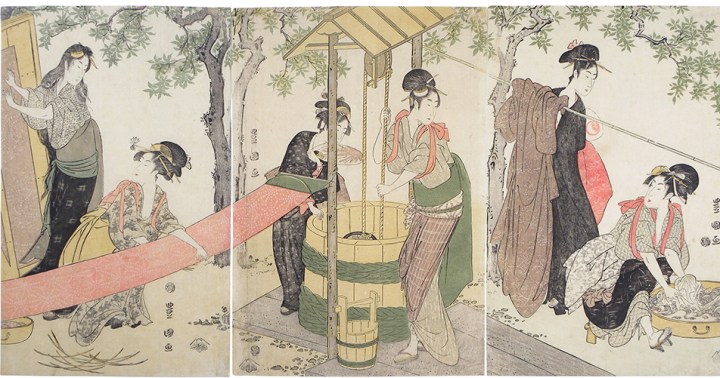
Utagawa Toyokuni I, Women Washing and Stretching Cloth, ca. 1795,
woodblock print triptych, 71.5 by 37 cm
◊ ◊ ◊ ◊ ◊
This year’s Asia Week in New York (March 10–19) offers an array of auctions, lectures, and exhibitions, including this one at Scholten Japanese Art:
Ukiyo-e Tales: Stories from the Floating World
Scholten Japanese Art, New York, 10–31 March 2016
Scholten Japanese Art participates in Asia Week 2016 with Ukiyo-e Tales: Stories from the Floating World, an exhibition focused on classic Japanese woodblock prints. The exhibition will take us back to the golden age of ukiyo-e and will feature works by some of the most important artists of the late 18th and up to the mid-19th century. We will focus predominately on images of beauties and the layers of meaning and stories that are conveyed via subtle (and sometimes not so subtle) clues found in the compositions. The exhibition will begin with works by Suzuki Harunobu (ca. 1724–70), who is largely credited with bringing together all of the elements that launched the production of nishiki -e (lit. brocade pictures), the full-color prints that we recognize today as ukiyo-e or images of the floating world. The term ukiyo (lit. ‘floating world’) references an older Buddhist concept regarding the impermanence of life, but during the prosperity of the Edo period in Japan the term began to be used to encompass and embolden everyday indulgences because of that impermanence. It was Harunobu’s designs, primarily celebrating youth and beauty, that are believed to have first launched the production of full-color woodblock printing in Japan around 1765.
One of the finest Harunobu prints included in this exhibition, Fashionable Snow, Moon, and Flowers: Snow, ca. 1768–69 depicts an elegant courtesan accompanied by her two kamuro (young girl attendants) and a male servant holding a large umbrella sheltering her from falling snow. The subject, a beautifully adorned courtesan parading en route to an assignation, and her placement within the lyrical setting of an evening snowfall, are hallmarks that define the genre of ukiyo-e. There are relatively few Harunobu prints extant, and due to their scarcity and the fragile nature of the vegetable pigments used at that time it is unusual to find a work in such good condition. Hence there are only two or three other authentic impressions of this particular design which have been recorded in public collections.
A print by a contemporary of Harunobu, Ippitsusai Buncho (fl. ca. 1755–90), titled Eight Views of Inky Water: Night Rain at Hashiba, ca. 1768–75, depicts the world from the perspective of a courtesan, without the pageantry of her parade through the pleasure quarters. Stepping out on to the verandah overlooking the Sumida River, she seems lost in thought as she adjusts the comb in her hair and looks down towards the small ferry boats navigating the dark (‘inky’) waters during a rainstorm while the passengers try vainly to protect themselves from the downpour. Streaks of rain partially obscure the view across the river where we see a figure carrying a lantern approaching a teahouse near the shore at Mukojima. While it was not uncommon to use accepted themes such as landscapes or literary subjects as a way to circumvent restrictions on overt depictions of famous actors and beauties or decadent displays of wealth, most of the time the ‘cover’ subject was relegated to an inset cartouche and the figural subject was front and center. In this composition the figure and the landscape are given equal consideration in a way that is unusual for the period because the landscape in the background tells as much of the ‘story’ as the figure in the foreground.
Another important artist well-represented in the show is Kitagawa Utamaro (1753–1806), a leading painting and print artist in his time, who practically owned the market for images of beauties in the 1790s and early 1800s, until his untimely death in 1806 shortly after a traumatizing episode when he was made to wear manacles under house arrest in punishment for having the audacity to depict the shogunate in an irreverent manner. A triptych of ‘Brine Carriers’ at a seashore was produced in happier times and visually references a classical literary subject, the sisters Matsukaze (‘Wind in the Pines’) and Murasame (‘Autumn Rain’), from the famous 14th-century Noh Drama, Matsukaze. Although the original story is about love and loss, Utamaro only barely references the cautionary legend and instead focuses on the opportunity to sidestep restrictions and depict women in revealing clothing in an everyday setting. The two sisters have been replaced by a bevy of beauties wearing grass skirts far shorter than acceptable in normal public settings, and their kimono tops are literally falling open while they wade in the surf collecting the brine.
Another story told by Utamaro is of a lovers’ quarrel. Eight Pledges at Lovers’ Meetings: Maternal Love between Sankatsu and Hanshichi, ca. 1798–99, is from a series that plays on puns referencing the classic landscape theme of Omi hakkei (‘Eight Famous Views of Omi’). This print uses the word ‘ bosetsu ‘ in the title, which can be translated as ‘a mother’s constant love,’ but also works as a pun for ‘evening snow,’ a clever reference to Hira no bosetsu (‘Evening Snow on Mount Hira’), one of the Omi hakkei subjects. But clever wordsmithing aside, what makes this print so remarkable is the tiny gesture of the woman, holding her index finger to her eye to wipe away a tear. For all of the dramas and tragedies in ukiyo-e, this small display of emotion stands out. While there are numerous visual shortcuts that artists employed to convey elements to a story, such as wisps of hair being out of place signaling excitement (good or bad), wiping away a tear is not at all common. Even more telling is the body language of her lover, who is looming over her shoulder and glaring at her. Their story is from a kabuki play (based on a true incident), in which the lovers resolve to give up their daughter and commit double suicide. Thus the ‘maternal love’ in the title suggests Sankatsu’s heartache over leaving her child, and it would seem Hanshichi is impatient with her hesitation. Utamaro, an artist known for his depictions of beautiful women of all ranks as well as erotic art, seems to convey his disapproval of their decision. Rather than feeding into the high drama in a way that romanticizes their story, Hanshichi especially is portrayed in an unflattering light.
There are several prints in the exhibition that show how young women, both in and out of the pleasure quarters, pass their time. Fashionable Five Festivals: Amusements of the Girls in the Seventh Month by Utagawa Toyokuni (1769–1825) from ca. 1796 shows a young girl struggling with writing her poetic wish for the Tanabata Festival. She sits at a writing table, brush in hand, with all the accoutrements needed, but the blank paper looms before her. On the floor are completed poems on decorative paper, rejected or not, is unclear. But a companion at her side holds open a copy of the poetry anthology, Ehon hyakunin shu (Picture Book of One Hundred Poets), ready to provide inspiration to the young poetess.
The private life of a courtesan inside the pleasure quarters is depicted by Kikugawa Eizan’s (1787–1867) Twelve Hours in the Pleasure Quarters: Daytime, Hour of the Snake, Courtesan Tomoshie of the Daimonji, ca. 1812. The so-called hour of the snake was a two-hour increment that began around 10 in the morning. Here we see the courtesan Tomoshie who is just getting up. She barely keeps her lightweight kimono closed, exposing an astounding length of leg and a deep décolletage. She seems to have just finished washing up and is using the sleeve of her robe to dry behind her ears. A young assistant holding a bowl of water is not entirely put together herself; her robe is disheveled at the collar and is opening at the legs revealing her upper thigh.
While some prints provide titles and puns to help us identify the story behind the composition, others provide only oblique clues and leave the rest to our imaginations. A stunningly well-preserved print by Keisai Eisen (1790–1848), has a curious title that seems to marry manufacturing with artistry: Modern Specialties and Dyed Fabrics: Sound of Insects at the Bank of the Sumida, ca. 1830. While the series title references a certain type of cloth dyed in a dappled pattern, the print title evokes the poetic sound of insects along the Sumida River in the summertime, and the composition itself seems to have little to do with either. The image is of a woman reading a letter by the light of a lantern which casts a dramatic beam across the room. The temperature must be uncomfortably warm because she wears her kimono very loosely, leaving the collar wide open at her chest with the sleeves pushed up, allowing it to open between her thighs to reveal a suggestive view of the red under-robe. She sits awkwardly with her knees folded at an angle, hunched over a long scroll of paper with an anguished look on her face with tell-tale wisps of hair falling forward signaling her distress. What is in the letter? Why is she so intense? Is it good or bad? We don’t know, her story is open for our interpretation.
The exhibition will feature 48 woodblock prints including works by: Suzuki Harunobu (ca. 1724–70), Katsukawa Shunsho (1726–1792), Kitao Shigemasa (1739–1820), Katsukawa Shunko (1743–1812), Kitagawa Utamaro (1753–1806), Ippitsusai Buncho (fl. ca. 1755–90), Hosoda Eishi (1756–1829), Katsukawa Shunsen (1762–ca. 1830), Utagawa Toyokuni I (1769–1825), Utagawa Toyokuni II (1777–1835), Chokosai Eisho (fl. ca. 1780–1800), Keisai Eisen (1790–1848), Kikugawa Eizan (1787–1867), and collaborative works by Utagawa Kunisada (1786–1865) and Utagawa Hiroshige (1797–1858); and one painting by Hosoda Eishi.
Gallery viewing will begin on Thursday, March 10th, and continue through Friday, March 18th. An online exhibition will be posted in advance of the opening. Scholten Japanese Art, located at 145 West 58th Street, Suite 6D, is open Monday through Friday, and some Saturdays, 11am–5pm, by appointment. For the duration of the first segment of the exhibition, March 10–18, the gallery will have general open hours (no appointment needed), 11am–5pm, and thereafter by appointment through March 31st.
Exhibition | Dutch Flowers
From The National Gallery:
Dutch Flowers
The National Gallery, London, 6 April — 29 August 2016
Curated by Betsy Wieseman
The first display of its kind in 20 years, this exhibition will explore the development of Dutch flower painting from its beginnings in the early 17th century to its blossoming in the late 18th century. Coinciding with the flower shows at Chelsea and Hampton Court, Dutch Flowers will draw connections between the development of flower painting in the Netherlands to increased interest in botany, horticulture, and the phenomenon of ‘tulip mania’. The exhibition will present an overview of the key artists active within the field and highlight the connections between them. Viewers will be invited to examine each work closely and in detail to appreciate the stylistic and technical characteristics of each artist. Works from the National Gallery Collection will be displayed alongside long-term loans from private collectors. The exhibition will include a major recent acquisition, Ambrosius Bosschaert the Elder’s A Still Life of Flowers in a Wan-Li Vase, acquired in 2010.
Note (added 5 April 2016) — The press release is available here
Call for Articles | British Art Studies, Issue 4 (November 2016)
British Art Studies Issue 4 (November 2016)
Articles due by 1 June 2016
British Art Studies is a new online journal published by the Paul Mellon Centre for Studies in British Art, London, and the Yale Center for British Art, New Haven. The journal provides an innovative space for the best new research on British art. We encourage submissions on all aspects of British art, architecture, and visual culture, ranging across periods and geographies and are now soliciting content for our fourth issue, due to be published in November 2016, marking our first anniversary.
The digital platform of British Art Studies offers new opportunities for displaying images alongside text and multimedia content. The editors are open to proposals and ideas from authors to develop innovative and visually stimulating ways to publish art-historical scholarship online.
We invite submissions of scholarly articles (which are subject to a rigorous peer review process), as well as proposals for innovative special features for issue 4. Texts may range from 5000 to 8000 words, although the editors will also consider shorter pieces. It is recommended that articles are illustrated with between 5 to 10 images, but the editors will consider image requirements on a case-by-case basis. Articles should be submitted by email in Word format, together with a Word document containing low resolution accompanying images (where possible), as well as a list of proposed images and sources, as outlined in our style guide, available at britishartstudies.ac.uk. For special feature proposals, an abstract of no more than 500 words, together with images should be submitted for initial consideration by the editors. Final numbers of images, and the sourcing and commissioning media for articles accepted for publication, will be decided in consultation with authors on an individual basis. British Art Studies will endeavour to meet reasonable costs and copyright issues for illustrative materials essential to the argument of published texts. Please note we are not currently accepting proposals for special issues of collected essays.
Please forward submissions to Hana Leaper (journal@paul-mellon-centre.ac.uk) by 1 June 2016.
Lectures | Benjamin West at Spencer House
I noted this small exhibition a week ago but failed to include the programming details. The first lecture takes place on Monday. –CH
Benjamin West at Spencer House
Spencer House, London, 31 January 2016 — 29 January 2017
In celebration of the 25th anniversary of the restoration of the State Rooms at Spencer House, James ‘Athenian’ Stuart’s early neo-classical interiors will showcase work of Benjamin West, a central figure in the development of neo-classical painting. Central to the exhibition is West’s Milkmaids in St. James’s Park, Westminster Abbey Beyond (ca. 1801, oil on panel, Paul Mellon Fund), which is on special loan to the Rothschild Foundation from the Yale Center for British Art. . . .
To complement the exhibition, a series of three lectures about Benjamin West will take place at Spencer House, followed by drinks:
• Loyd Grossman, How to Paint History: Benjamin West and the Death of General Wolfe, 14 March at 6.30pm
• Desmond Shawe-Taylor (The Surveyor of The Queen’s Pictures), Benjamin West and George III, 18 July at 6.30pm
• Lars Kokkonen (Assistant Curator of Paintings and Sculpture, Yale Center for British Art), Evaporations: Milkmaids in St. James’s Park No More, 14 November at 6.30pm
Booking information is available here»
Exhibition | Louis-Auguste Brun, Painter to Marie-Antoinette
Now on view at the Swiss National Museum:
Louis-Auguste Brun, Painter to Marie-Antoinette: From Prangins to Versailles
Musée National Suisse, Château de Prangins, Prangins, 4 March — 10 July 2016
Curated by Martine Hart and Helen Bieri Thomson

Louis-Auguste Brun, Portrait of Marie-Antoinette on Horseback, 1783, 59 x 64.5 cm (Musée national des châteaux de Versailles et de Trianon)
From 4 March to 10 July 2016, the Swiss National Museum – Château de Prangins presents an exhibition devoted to the remarkable career of Louis-Auguste Brun, a painter from the Geneva school best known for his equestrian portraits of Queen Marie-Antoinette. Some one hundred works, together with a film recounting the surprising last years of his life as both art dealer and Vaud patriot, allow visitors to explore the life of an individual who defies easy classification. With scent-based guided tours and a Marie-Antoinette-inspired menu at the Café du Château, it’s an experience for all the senses.
A skilled draughtsman and an outstanding painter of portraits, animals and landscapes, the Swiss artist Louis-Auguste Brun (1758–1815) is today principally known for the works he produced at the French court, in particular two equestrian portraits of Marie-Antoinette. In fact, however, there is much more to his oeuvre. How did a young painter from the village of Rolle who completed his apprenticeship with a local craftsman come to enjoy the splendours of Versailles and gain an introduction to the Queen herself?
The exhibition retraces his remarkable story in around a hundred oil paintings and drawings. It highlights the decisive role of Brun’s encounters in the early stages of his career at Château de Prangins, a centre of cultural life in the Vaud region. The rest is down to Brun’s talent as an artist. Entirely at his ease depicting the diversions and carefree life of the privileged class, Brun begins producing large numbers of portraits, landscapes, hunting and horse racing scenes from the time he arrives in Paris. The exhibition also presents the works created on the shores of Lake Geneva after his return from France. It ends with a film recounting the surprising final years of his life, as an art dealer, collector and Vaud patriot.
The 16-page press packet is available as a PDF file here»
The catalogue is available from the Boutiques de musées de France:
Martine Hart and Helen Bieri Thomson, Louis-Auguste Brun, Peintre de Marie-Antoinette: De Prangins à Versailles (Paris: La Bibliothèque des Arts, 2016), 104 pages, ISBN: 978-2884531993, €29.
Tomasso Brothers Fine Art Offerings at TEFAF 2016
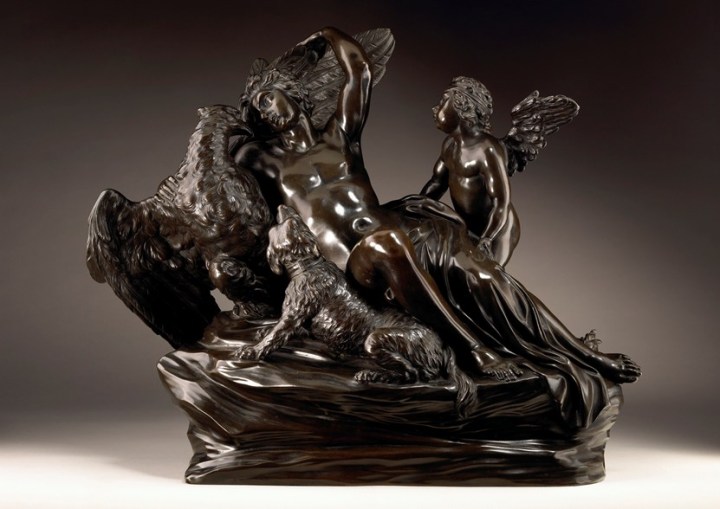
Massimiliano Soldani-Benzi, Ganymede and the Eagle,
bronze, 31.5cm high, 38.5cm wide, ca. 1714.
◊ ◊ ◊ ◊ ◊
Press release for the Tomasso Brothers:
Tomasso Brothers Fine Art at TEFAF
Maastricht, 11–20 March 2016
Leading international dealers in the field of important European sculpture, Tomasso Brothers Fine Art will unveil a rare work by the Florentine master of the late Baroque era, Massimiliano Soldani-Benzi (1656–1740). Ganymede and the Eagle, circa 1714, depicts a poetic moment from classical mythology when Zeus, disguised as an eagle, captures Ganymede, in Homer’s words “the loveliest born of the race of mortals,” to become his cup-bearer. This dramatic composition is a wonderful example of Soldani-Benzi’s suave modelling of form and the sumptuous finish of his bronzes. It is also an extremely rare model: the only other known version is held by the Fitzwilliam Museum, Cambridge.
Soldani-Benzi is acknowledged as the finest bronze caster in late 17th- and early 18th-century Europe and, along with Foggini, is considered the most significant proponent of the Florentine late Baroque style in sculpture. He excelled in medal and coin-making, enjoying commissions from Pope Innocent XI and Queen Christina of Sweden, and in 1682 he became Director of the Grand-Ducal Mint. His workshop, situated on the ground floor of the Galleria degli Uffizi, was patronised by the Medici Grand Dukes, the Elector Palatine, and the 1st Duke of Marlborough, among many prestigious foreign clients.
The present model is first mentioned in correspondence between Soldani-Benzi and his London agent Zamboni, dated 15th October 1716, regarding four casts Lord Burlington had ordered two years previously but not yet paid for. They included a Venus and Adonis, of which there is an example in the J. Paul Getty Museum, and a matching pair of groups depicting Leda and the Swan and Ganymede and the Eagle. The latter was sent to England, although Leda and the Swan is now missing. The present bronze was previously at Swithland Hall, Leicestershire, residence of the Earls of Lanesborough.
This historic work is just one of the highlights at Tomasso Brothers Fine Art, stand 166, TEFAF 2016, offered for sale priced in excess of €1,000,000 (euros). The fair, which is the world’s leading art and antiques event, takes place at the Maastricht Exhibition and Congress Centre (MECC) from 11–20 March 2016.
◊ ◊ ◊ ◊ ◊
And as a centrepiece for their TEFAF offerings, the Tomasso Brothers reunite a pair of Roman busts from Wilton House:
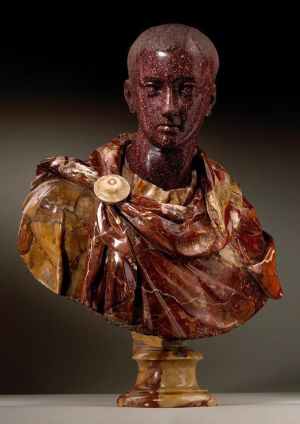
Horace, Rome, 17th century, Red Imperial Porphyry and Breccia Pernice marble , 54.5 cm wide, 71.5 cm high.
Extensive research by Tomasso Brothers Fine Art has reunited an important pair of polychrome marble portrait busts depicting Cicero, civic hero of the Roman Republic, and Horace, the famed poet. Carved in the same seventeenth-century Roman workshop, the busts have an illustrious provenance. Originally part of the Valletta collection in Naples, they were acquired around 1721 by Thomas Herbert, the 8th Earl of Pembroke (1654–1733) for his family’s splendid residence, Wilton House, near Salisbury, one of England’s finest stately houses.
For more than two centuries, the busts were displayed at the heart of one of the finest private art collections ever assembled in Europe. They flanked the main chimneypiece in the Earl’s ‘sanctum sanctorum’ of the Great ‘Double Cube’ Room designed by Inigo Jones, among family portraits by Sir Anthony Van Dyck, and works formerly in the esteemed collections of Cardinals Mazarin and Richelieu, King Charles I of England, and Thomas Howard, the 14th Earl of Arundel.
Pembroke’s influence on the tastes and collecting trends of the aristocratic English in the early eighteenth century were considerable. When he embarked on his Grand Tour in 1676 and set about building a collection in the 1680s, he was all but alone. Yet the fame of the galleries at Wilton House spread among the aristocracy, and by the time of his death in 1733, many of England’s great country houses were beginning to be decorated with antiquities, renaissance, and baroque sculpture.

Cicero, Rome, 17th century, Black Touchstone and Breccia Pernice marble, 61 cm wide, 76 cm high.
The history of this pair of busts is inextricably linked to some of the most important European art collections ever assembled, the rise of ‘The Grand Tour’, and thus with the history of art collecting.
It is through the expertise of Tomasso Brothers Fine Art that the two works have been reunited since their dispersal from Wilton House. Cicero came into the gallery’s collection a short while after the directors had become aware of Horace. They knew instinctively that they were both great 17th-century busts and that the particular specimen of imperial porphyry used for the Horace was a wonderful quality. While recognising the physical similarities of the two works, it was finding an old photograph of the Double Cube Room at Wilton House that set off months of study to discover the full history of the busts [photo from Arthur Stratton, The English Interiors (London 1920), plate XLII].
“Our research has taken us across Britain, from the Pembroke archives in Wiltshire, to the British Library, and on to the Bodleian Library, Oxford” says Dino Tomasso, Director. “We have uncovered eighteenth-century manuscripts, printed catalogues, and early guidebooks to the Wilton House Collection that detail in remarkable depth the journey of these illustrious busts from Naples to Wiltshire in the first quarter of the eighteenth century.”
Raffaello Tomasso, Director, adds: “It has been an exciting discovery to unearth the provenance of these two important works from Thomas Herbert’s famous collection, and our privilege to reunite them at TEFAF.”
◊ ◊ ◊ ◊ ◊
This year’s loan exhibition includes drawings by Fra Bartolommeo assembled in 1729 by Niccolò Gabburri:
Collecting Collectors in the Boijmans
Maastricht, 11–20 March 2016
As in previous years, the loan exhibition in TEFAF Paper will offer visitors a one-off opportunity to view a unique selection of prints and drawings from a museum with a major collection in the field. This year’s exhibition, entitled Collecting Collectors, shows a selection of master drawings and prints from Museum Boijmans Van Beuningen, Rotterdam, the Netherlands. The drawings and prints were acquired over the last 167 years.
A particular highlight of the collection are the works by Fra Bartolommeo (1473–1517), numbering 400 sheets with 500 drawings assembled in two luxury albums by Florentine collector Niccolò Gabburri in 1729. One of the albums will be included in the selection at TEFAF Maastricht 2016, as a prelude to the forthcoming large Fra Bartolommeo exhibition in the Boijmans in the autumn of 2016. Also included in Collecting Collectors are works by old masters such as Albrecht Dürer, Lucas van Leyden and Rembrandt van Rijn to modern and contemporary artists like Paul Cézanne, Salvador Dalí, René Magritte and Yayoi Kusama. . . .










 Enfilade
leave a comment