Colnaghi’s at New York’s Old Masters Week

Luis Egidio Meléndez, Still Life with Oysters,
Plate of Eggs, Garlic and Receptacles, 1772.
◊ ◊ ◊ ◊ ◊
As noted at Art Daily (20 January 2016). . .
Colnaghi’s Winter Exhibition of European Old Master Paintings and Sculpture will be held in the prestigious New York Galleries of Carlton Hobbs, from 21st to 30th January 2016, located at 60 East 93rd Street, together with Tomasso Brothers and Carlton Hobbs LLC. This joint exhibition will represent the first Colnaghi’s show in the United States after its merger with the Fine Art Dealers Coll & Cortés (London and Madrid). The exhibition will coincide with the New York annual Old Masters Week. The aim of this exhibition is to display the latest discoveries and examples of masterpieces that have never been presented before to the American public.
Still Life with Oysters, Plate of Eggs, Garlic and Receptacles is one of the most beautiful works by the highly regarded painter of still lifes, Luis Egidio Meléndez (Naples, 1716 – Madrid, 1780). The painting represents food and utensils typical of any eighteenth-century Spanish kitchen, but in Meléndez’s hands the arrangement results in an image of timeless and sublime beauty. This composition was so successful that Meléndez repeated it several times with small variations. One example that is particularly close to the one presented here, although slightly smaller is now in the collection of The Museo Nacional del Prado in Madrid. The work is signed and dated in black on the table edge at the right : Ls. Eo. Mz. Do ANNO 1772.
Colnaghi will also be exhibiting a Magnificat Anima Mea (My soul doth magnify the Lord) by the Spanish Baroque painter, Francisco de Zurbarán. The painting is signed ‘FZ’, and it has been dated by the artists scholar Odile Delenda between 1628 and 1630. This beautiful image was discovered by D. Manuel Gómez Moreno in the south of Spain in the middle of the twentieth century. After being rediscovered by Colnaghi it will be shown for the first time in more than 80 years.
Unlike painting, the art of polychrome sculpture is remarkable for the fact that many of its greatest masterpieces are not in museums but in the churches, convents and cathedrals for which they were originally made. Rather than being considered primarily as art works, Spanish polychrome sculpture is still revered today primarily for its function, as religious objects that are worshiped by the devout and carried through the streets during the annual Holy Week. But this fact has recently changed and a testimony to this shift is that museums have begun to acquire masterpieces of Spanish Sculpture. The Metropolitan Museum of Art acquired Pedro de Mena’s Ecce Homo and Mater Dolorosa from Coll & Cortés in 2014. They are now on display at one of the museum’s galleries dedicated to the Spanish art of the sixteenth and seventeenth centuries (Gallery 611). Notable for its outstanding quality is an Infant Christ by Mena (Spanish, Granada 1628–1688 Málaga). Carved wood sculpture, enhanced by paint and other media, including glass eyes and hair. Equally impacting is Mena’s highly sensitive Saint John the Baptist, made by Polychrome wood, glass and silver. The eyebrows, almond-shaped eyes and the modelling of the head and locks of hair that are softly carved to appear like modelled clay.
New Book | The Country House: Material Culture and Consumption
Published by Historic England and distributed by The University of Chicago Press:
Jon Stobart and Andrew Hann, eds., The Country House: Material Culture and Consumption (Swindon: English Heritage, 2016), 224 pages, ISBN: 978-1848022331, £70 / $140.
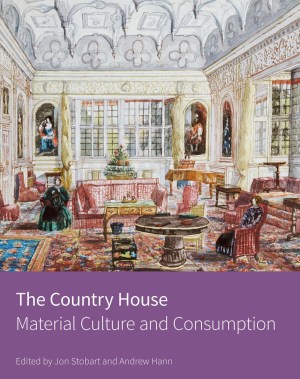 The country house has long been recognised as symbol of elite power—a showpiece demonstrating the wealth and ambition of its owner, but also their taste and discernment. Ownership of a country house distinguished the landed classes from the rest of society and signalled an individual’s arrival amongst a privileged elite. Yet, as the contributions to this book amply demonstrate, the country house in Britain and elsewhere in Europe was much more than this: it was a lived and living space, populated by family, visitors and servants. This formed the context in which decisions were made about what to buy, what to keep and what could be discarded; about what taste comprised and how it would be balanced against financial constraints or the imperatives of pedigree and heritance.
In this collection, consumption is thus explored as an active and ongoing process that involved the mundane as well as the magnificent. It drew the country house into complex and overlapping networks of supply that stretched from the local to the international. Material culture and elite identity were shaped by a cosmopolitan mixture of the everyday, the European and the exotic, thus food from the kitchen garden was served a la francaise from Chinese porcelain.
Jon Stobart is Professor of History at Manchester Metropolitan University.
Andrew Hann is Properties Historians’ Team Leader at English Heritage.
◊ ◊ ◊ ◊ ◊
C O N T E N T S
Introduction, Jon Stobart: The Country House and Cultures of Consumption
Section 1 | Elites, consumption and the country house
1. Yme Kuiper: The rise of the country house in the Dutch Republic: Beyond Johan Huizinga’s narrative of Dutch civilisation in the 17th century
2. Jane Whittle: The gentry as consumers in early 17th-century England
3. Johanna Ilmakunnas: To build according to one’s status: A country house in late 18th-century Sweden
4. Mark Rothery and Jon Stobart: Geographies of supply: Stoneleigh Abbey and Arbury Hall in the 18th century
5. Shelley Garland: The use of French architectural design books in De Grey’s choice of style at Wrest Park
Section 2 | Continuity, heritage and the country house
6. Hannah Chavasse: Fashion and ‘affectionate recollection’: Material culture at Audley End, 1762–1773
7. Hanneke Ronnes: A sense of heritage: Renewal versus preservation in the English and Dutch palaces of William III in the 18th century
8. Victor Hugo López Borges: An Anglo-Irish country house in Spain: The Palacio de Castrelos
Section 3 | Eastern connections, adoptions and imitations
9. Emile de Bruijn: Consuming East Asia: Continuity and change in the development of chinoiserie
10. Kate Smith: Imperial objects? Country house interiors in 18th-century Britain
11. Patricia F Ferguson: ‘Japan China’ taste and elite ceramic consumption in 18th-century England: Revising the narrative
12. Helen Clifford: ‘Conquests from North to South’: The Dundas property empire. New wealth, constructing status and the role of ‘India’ goods in the British country house.
Section 4 | Country house interiors as lived spaces
13. Rosie MacArthur: Settling into the country house: The Hanburys at Kelmarsh Hall
14. Susan Jenkins: Fashion and function: The decoration of the library at Kenwood in context
15. Karol Mullaney-Dignam: Useless and extravagant? The consumption of music in the Irish country house
16. Annie Gray: Broccoli, bunnies and beef: Supplying the edible wants of the Victorian country house
Section 5 | Presenting the country house
17. Nicola Pickering: Mayer Amschel de Rothschild and Mentmore Towers: Displaying ‘le goût Rothschild’
18. Anna McEvoy: Following in the footsteps of 18th-century tourists: The visitor experience at Stowe over 300 years
19. Karen Fielder: X marks the spot: Narratives of a lost country house
The George B. Clarke Prize for Stowe Studies
From The Georgian Group (20 January 2016). . .
The George B. Clarke Prize
Applications due by 30 June 2016
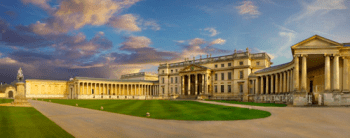 A biennial prize of £2,000 has been launched by the Hall Bequest Trust in association with The Georgian Group in recognition of the great contribution that George Clarke has made to Stowe in Buckinghamshire. In the course of over sixty years, the historian and champion of Stowe was a Chairman of the Hall Bequest Trust, which aims to support Stowe through acquisitions and education.
Stowe House (a school since 1923) was built as a summer residence of the Temple-Grenville family, and in its completed form remains amongst the grandest of eighteenth-century mansions. From c.1688–1810 it was remodelled in numerous phases by many of the leading architects of the age including Vanbrugh, Gibbs, Kent and Soane, though the family also took a personal involvement in aspects of design. Recent restoration work has spurred new research and interest. Yet the magnificent landscape gardens which remain remarkably intact are no less interesting. They are owned by the National Trust which has recently invested heavily in replanting the early Georgian gardens and creating a new visitor centre.
Much remains to be discovered about Stowe, as its cultural context is notably broad, while the 350,000 historic Stowe papers are held at the Huntington Library in Pasadena, California, with which George Clarke was instrumental in developing a close working relationship. The £2,000 Prize will be awarded for original research pertinent to Stowe within the fields of architecture, architectural history, the material arts or landscape design.
To apply, please e-mail your research proposal to office@georgiangroup.org.uk by 30 June 2016. The winner will be invited to write an article arising from his or her research, which will be considered for publication in The Georgian Group Journal, and to give a lecture within three months of completion of the research.
Exhibition | Meant to Be Shared: Prints from the Arthur Ross Collection

Giovanni Battista Piranesi, Veduta della Piazza di Monte Cavallo (View of the Piazza di Monte Cavallo [now the Piazza del Quirinale with the Quirinal Palace]), from Vedute di Roma (Views of Rome), 1750, etching (New Haven: Yale University Art Gallery, The Arthur Ross Collection).
◊ ◊ ◊ ◊ ◊
Press release (11 December 2015) from the Yale University Art Gallery:
Meant to Be Shared: Selections from the Arthur Ross
Collection of European Prints at the Yale University Art Gallery
Yale University Art Gallery, New Haven, 18 December 2015 — 24 April 2016
Samuel P. Harn Museum of Art, University of Florida, Gainesville, 29 January — 8 May 2017
Syracuse University Art Galleries, Syracuse University, 17 August — 19 November 2017
Curated by Suzanne Boorsch
The Yale University Art Gallery is delighted to announce Meant to Be Shared: Selections from the Arthur Ross Collection of European Prints at the Yale University Art Gallery, an exhibition presenting highlights of the more than 1,200 prints donated to the Gallery in 2012 by the Arthur Ross Foundation. Beginning in the late 1970s, philanthropist Arthur Ross (1910–2007) avidly collected works of art by some of the most renowned Italian, Spanish, and French printmakers of the last several centuries for his eponymous foundation. Highlights of the Arthur Ross Collection include works by Francisco Goya, the first artist whom Ross collected; Giovanni Battista Piranesi’s images of ancient and 18th-century Rome, which reflect Ross’s love of classicism and the Eternal City; and Édouard Manet’s illustrations for Edgar Allan Poe’s famous poem The Raven.
The Arthur Ross Collection comprises three major segments. The largest is a group of some 800 18th-century Italian works by Giovanni Battista Piranesi, Giovanni Antonio Canal (called Canaletto), Giovanni Battista Tiepolo and his sons, and others. A group of close to 200 prints by the Spaniard Francisco Goya includes the three intriguing and enigmatic series of etchings he made in the second decade of the 19th century, during which Spain suffered, first, Napoleon Bonaparte’s invasion, and then, with the restoration of the Bourbon monarchy, the repressive rule of King Ferdinand VII. The third segment consists of about 200 French prints by some of the greatest artists of the 19th and 20th centuries: Eugène Delacroix, Honoré Daumier, Camille Pissarro, Édouard Manet, Edgar Degas, Paul Gauguin, Henri Matisse, and Pablo Picasso.
This inaugural exhibition features 19 of Goya’s profoundly mysterious Disparates (Los proverbios) (Follies [Proverbs]) series, made around 1816 to 1819 but not published in Goya’s lifetime, for fear of the Inquisition. Ten images from the Tauromaquia (The Art of Bullfighting; 1815, published 1816) series and nine of the Desastres de la guerra (Disasters of War; ca. 1810–11, published 1863) are on display as well. The installation also highlights illustrations of great works of literature—one of the salient themes of the French work—including Delacroix’s 13 lithographs illustrating William Shakespeare’s Hamlet (1834–43) and some of his illustrations for Johann Wolfgang von Goethe’s Faust (1827, published 1828), and Manet’s truly revolutionary illustrations for Edgar Allan Poe’s The Raven (1875).
An entire gallery is devoted to views of places that might have been visited on the Italian segment of the Grand Tour, the cultural tour of Europe that was deemed an essential cap to the classical education of young gentlemen, especially those from Britain. Sparkling views of the Venetian region by Canaletto set the stage. The largest section is devoted to Rome; this part of the exhibition features a spectacular six-by-seven-foot map of the Eternal City, published in 1748, designed by the surveyor Giovanni Battista Nolli, and 20 of Piranesi’s Vedute (Views; ca. 1748–60) of Rome. The final area focuses on images of Pompeii and Paestum, in southern Italy, where in the mid-18th century rediscoveries of ancient sites excited the intelligentsia across Europe.
The title of the exhibition, Meant to Be Shared, reflects the raison d’être of the collection. Arthur Ross collected these prints for his foundation with the express purpose, in the words of his widow, Janet C. Ross, “to lend first-class prints … to educational institutions in the United States and abroad that would not otherwise have access to such objects for study and enjoyment.” In this spirit, the inaugural exhibition travels to the Samuel P. Harn Museum of Art at the University of Florida, Gainesville, in early 2017, and to the Syracuse University Art Galleries, New York, later that year. Gallery staff members have partnered with Harn Museum Director Rebecca M. Nagy and Syracuse University Art Galleries Director Domenic Iacono to plan ways to use the prints as teaching tools at each institution—including related university courses, public programs, and close-looking sessions—throughout the run of the exhibition. Suzanne Boorsch, the Gallery’s Robert L. Solley Curator of Prints and Drawings and curator of the exhibition, explains, “Far and away the most difficult aspect of preparing this exhibition was to make a selection from the abundance of riches that constitute this extraordinary donation. The possibilities that the Arthur Ross Collection offers for exhibition, research, and teaching are virtually endless, and, indeed, this inaugural exhibition and the collection catalogue are just the beginning of the rewards to be reaped by the study and enjoyment of this gift.”
The Gallery’s mission of sharing its collections broadly honors both the legacy of Arthur Ross and the value of the work he collected. Jock Reynolds, the Gallery’s Henry J. Heinz II Director, states, “We are grateful that the Arthur Ross Foundation has chosen the Gallery to be the steward of this remarkable collection, ensuring its proper care and always sharing it generously with active learners of all ages.”
◊ ◊ ◊ ◊ ◊
P R O G R A M M I N G
Gallery Talks
Wednesday, December 9, 12:30 pm
“Piranesi’s Rome: The Vision of an 18th-Century Architect and Printmaker,” Jakub Koguciuk, Ph.D. candidate in the History of Art and Renaissance Studies, Yale University
Wednesday, February 24, 12:30 pm
“Bullfighting: Audience and Perspective in Prints by Antonio Carnicero, Francisco Goya, and Pablo Picasso,” Ian Althouse, Ph.D. candidate in the Department of Spanish and Portuguese, Yale University
Wednesday, February 24, 1:30 pm
“Las corridas de toros: Audiencia y mirada en el arte de Antonio Carnicero, Francisco Goya y Pablo Picasso” (in Spanish), Ian Althouse
Wednesday, April 13, 12:30 pm
“Intensité, Obscurité, Frivolité: The Proliferation of Print Media in 19th-Century France,” Lisa Hodermarsky, the Sutphin Family Senior Associate Curator of Prints and Drawings, Yale University Art Gallery
Ryerson Lectures
Thursday, January 21, 5:30 pm
“Goya’s Prints in Context,” Janis A. Tomlinson, Director of University Museums, University of Delaware, Newark
Friday, February 5, 1:30 pm
“The Marriage of Venice and Rome, or What Makes Piranesi Great?,” Andrew Robison, the Andrew W. Mellon Senior Curator of Prints and Drawings, National Gallery of Art, Washington, D.C.
Friday, April 1, 1:30 pm
“From Paris to Tahiti: Paul Gauguin’s Innovative Prints,” Elizabeth C. Childs, the Etta and Mark Steinberg Professor of Art History and Chair of the Department of Art History and Archaeology, Washington University in Saint Louis
Performance
Thursday, March 31, 5:30 pm
Chamber Music of the 18th Century, Tiny Baroque Orchestra
Studio Programs
Friday, February 12, 1:30 and 3:00 pm
Printmaking Workshops
Inspired by the over 1,200 prints in the Arthur Ross Collection, Mauricio Cortes Ortega, M.F.A. candidate, and Caroline Sydney, SM ’16, both of Yale University, invite visitors to explore the art of printmaking. In this hands-on workshop, participants learn the basic techniques of intaglio printing and create a unique print of their own. Space is limited. Registration required; please call 203.432.9525.
◊ ◊ ◊ ◊ ◊
The catalogue is distributed by Yale UP:
Suzanne Boorsch, Douglas Cushing, Alexa Greist, Elisabeth Hodermarsky, Sinclaire Marber, John Moore, and Heather Nolin, with a foreword by Janet Ross, Meant to Be Shared: The Arthur Ross Collection of European Prints (New Haven: Yale University Press, 2016), 196 pages, ISBN: 978-0300214390, $60.
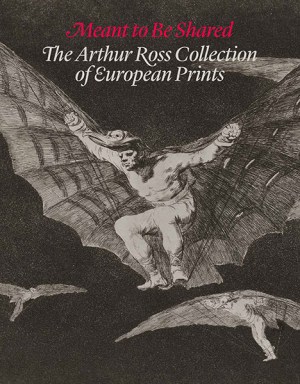 This important volume offers the first comprehensive look at the Arthur Ross Collection—more than 1,200 17th- to 20th-century Italian, French, and Spanish prints—and is published to mark the inaugural exhibition of the collection in its new home at the Yale University Art Gallery. Highlights include superb etchings by Canaletto and Tiepolo; the four volumes of Piranesi’s Antiquities of Rome, as well as his famous Vedute (Views) and Carceri (Prisons); Goya’s Tauromaquia in its first edition of 1816; an extremely rare etching by Edgar Degas; and numerous other 19th-century French prints, by Eugène Delacroix, Honoré Daumier, Édouard Manet, Paul Gauguin, Paul Cézanne, and others. The accompanying essays discuss the life of Arthur Ross, a significant philanthropist who funded several arts institutions; the formation of the collection and the art-historical significance of the works; and several thematic approaches to studying the collection, reinforcing its legacy as an important teaching resource.
Exhibition | No Cross, No Crown: Prints by James Barry
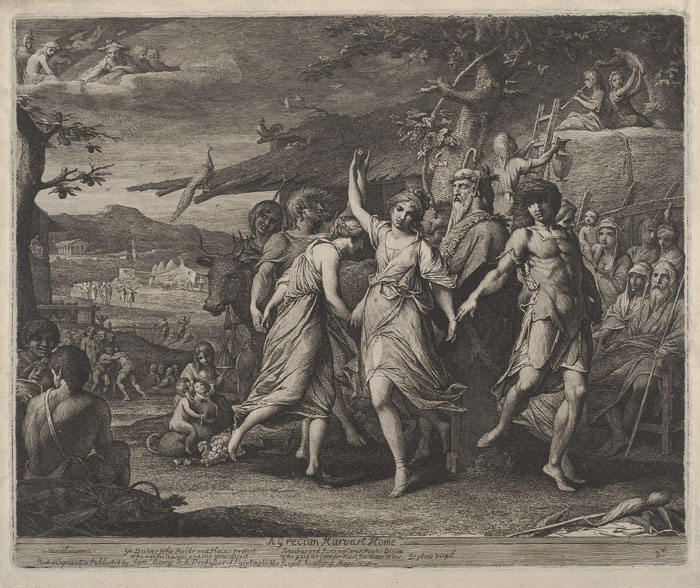
James Barry, A Grecian Harvest Home, from the series The Progress of Human Culture, 1792, etching and engraving in black ink, 17 ½ x 20 15/16 inches (Snite Museum of Art, University of Notre Dame: The William and Nancy Pressly Collection acquired with funds made available by the F. T. Stent Family, 2015.001.014).
◊ ◊ ◊ ◊ ◊
Press release (27 October 2015) from the Snite:
No Cross, No Crown: Prints by James Barry
Snite Museum of Art, University of Notre Dame, 24 January — 17 April 2016
The Snite Museum of Art will present an exhibition of 28 monumental prints by James Barry, the eighteenth-century Irish provocateur whose work challenged the British art establishment and questioned the government’s policies. The exhibition No Cross, No Crown: Prints by James Barry will be on view from January 24 through April 17, 2016.
James Barry (1741–1806) was born in Cork, made his artistic debut in Dublin, and was awarded membership in the Royal Academy in London in 1773, although he was later expelled for his belligerence and acrimony. The series of six murals he painted to decorate the Great Room of the Royal Society of Arts in Adelphi from 1777 through 1783 is his claim to fame. Included in the exhibition is a complete set of the prints he made after these grand paintings, once referred to as Britain’s answer to Michelangelo’s Sistine Chapel ceiling.
Barry’s prints are significant in the history of printmaking and eighteenth-century trans-Atlantic studies for their scale, their technical innovations, and the role they played in the artist’s creative process. These are not mere reproductive prints, but rather charts illustrating Barry’s evolving positions on hot political and artistic issues of the day. Peppering his religious and historical works with portraits of his contemporaries, such as the philosopher Edmund Burke and the politician William Pitt, the ensemble reads like a Who’s Who of British society in the late 1700s.
The Snite Museum acquired the prints in 2015 from Nancy and William Pressly, the latter being the foremost scholar on James Barry and professor emeritus of eighteenth- and nineteenth-century European art at the University of Maryland. Pressly said, “Over the years, as I looked and relooked at these prints, I was amazed at both the subtlety and richness of Barry’ process, but he never pursued virtuosity for its own sake: all is in the service of his passion to transform his audience, a transformation, however, that places great demands on his viewer.”
Pressly’s book James Barry’s Murals at the Royal Society of Arts: Envisioning a New Public Art (Cork 2015) received the William MB Berger Prize for British Art History in 2015.
The acquisition of eighteen of the prints was made possible by a generous gift from the F. T. Stent Family of Atlanta with ten additional prints donated by the Presslys. No Cross, No Crown: Prints by James Barry is made possible by the Snite Museum General Endowment.
◊ ◊ ◊ ◊ ◊
Programs
• Public reception Friday, February 12, 2016, from 5:00 p.m. to 8:00 p.m.
• Gallery Talk at 12:30 p.m., Wednesday, February 17, by Patrick Griffin, Madden-Hennebry Professor of History.
• Gallery Talk at 12:30 p.m., Friday, April 1, by William Pressly, Professor Emeritus of Art History, University of Maryland.
• Lecture, 4:00–5:30 p.m. Saturday, April 2, “An Irishman’s Address to the English Establishment: James Barry’s Murals at the Society of Arts in London” by William Pressly, Professor Emeritus of Art History, University of Maryland.
All programs are free and open to the public.
Call for Papers | Gendering Museum Histories
From H-ArtHist:
Gendering Museum Histories
Ashmolean Museum of Art and Archaeology Museum, Oxford, 7–8 September 2016
Proposals due by 11 March 2016; poster proposals due by 29 April 2016
Museums and Galleries History Group Biennial Conference
This conference addresses the relationship between museums, galleries and gender during the last 400 years. Museums can be understood as buildings, institutions, collections, displays, interpretations and groups of people; each of these aspects has both reflected and shaped ideas about gender and its construction and meaning. While the gendering of collections and museum displays has attracted some attention (for example Porter 1990; Machin 2008), too often other gendered aspects of museum and gallery history, such as employment practices or visitors, have been mentioned only in passing; yet it seems likely that museums have been responsible both for defining and for subverting gender roles and identities. This conference aims to draw attention to this topic and to bring ideas and practices relating to gender from different periods of museum history into productive dialogue.
We are delighted that the keynote speaker will be Merete Ipsen, Director of the Women’s Museum in Aarhus, Denmark, who will be speaking about gender in museums between the 1970s and the present.
We welcome proposals for 20-minute papers which address the points below, or which address other aspects of gender and museum history (papers dealing with contemporary museums should also have a historical comparative aspect). We are keen to receive proposals which engage with the full spectrum of gender presentation.
Topics may include but are not restricted to:
• Gender, display and curatorial practice
• Interpreting and narrating gender in museums
• Museum collecting/collections and gender
• Gendered performances: museum and gallery visitors
• Gender and invisible workers: museum photographers, copyists, clerks, warders, assistants etc.
• Gender and volunteering
• The development of museum governance: trustees, committees, &c
• Gender, philanthropy and patronage/matronage
• Museums and the enforcing/contestation of gender roles
• Gendered space and gendered buildings
• Gender, sexuality and museums
• Gendered objects of study in museums: personality museums, &c
Please submit a 300-word proposal, along with a 1-page CV, to gendermuseumhistory@gmail.com, by 11 March 2016. We will consider proposals for 3-paper panels; please submit individual paper proposals along with a rationale for the panel as a whole and indicate if you will supply a chair for the panel or not.
We also welcome proposals for posters as there are likely to be a relatively small number of paper slots. Posters should address the themes given above. Proposals for posters should be received by 29 April 2016 (same email address) and should include title, author(s) and brief description (200–300 words) of the poster content. The final poster format will be as follows:
• Maximum size A2
• Orientation may be landscape or portrait
• The title of the poster and the names and contact details of all authors should appear at the top
Please note, all participants whether speakers or poster presenters will have to cover their own costs including conference registration (though it is anticipated this will be less than £10 for MGHG members).
New Book | An Anthology of Decorated Papers: A Sourcebook
From Thames & Hudson:
P. J. M. Marks, An Anthology of Decorated Papers: A Sourcebook for Designers (London: Thames & Hudson, 2016), 256 pages, ISBN: 978-0500518120, $60 / £38.
 Rich in ornamentation, decorated papers have been in use for centuries—as wrappers and endpapers for books, as the backing for playing cards, and even as linings for chests and cases. Yet despite the many contexts in which they can be found, they often go unnoticed. This remarkable new book not only showcases several hundred of the best and most exquisite examples of decorated paper but also provides a fascinating introduction to its history, traditions, and techniques. Drawing on the Olga Hirsch collection at the British Library, one of the largest and most diverse collections of decorated papers in the world, this beautifully produced anthology will both delight and inspire designers, bibliophiles, and anyone with a love of pattern and decoration.
P. J. M. Marks is curator of bookbindings at the British Library. Her previous books include The British Library Guide to Bookbinding, Treasures in Focus: Decorated Papers, and Beautiful Bookbindings. Her most recent publication is a chapter on selected European decorated bookbindings in The Arcadian Library: Bindings and Provenance.
◊ ◊ ◊ ◊ ◊
From the BL:
The Olga Hirsch collection of decorated papers, bequeathed in 1968, comprises over 3,500 sheets of paper and around 130 books in paper wrappers or with decorated end-leaves. There are hand-made papers from the 16th century onwards, and also later, machine-made papers. Various techniques of decorating paper are represented: there are brush-coated, sprinkled, sprayed, flock, marbled, block-printed, embossed, and metallic-varnish papers, as well as book jackets and 20th-century artists’ papers.
Mirjam Foot, “The Olga Hirsch Collection of Decorated Papers,” British Library Journal 7 (Spring 1981): 12–38, available as a PDF file here.
Goya’s Portrait of Don Pedro, Duque de Osuna on Loan at The Prado
Press release (18 January 2016) from The Prado:
Goya’s Portrait of Don Pedro de Alcántara Téllez-Girón y Pacheco, 9th Duke of Osuna
Museo Nacional del Prado, Madrid, 19 January — 24 April 2016
The Museo del Prado and the Fundación Amigos del Museo del Prado are presenting Goya’s Portrait of Don Pedro de Alcántara Téllez-Girón y Pacheco, 9th Duke of Osuna. Through the collaboration of The Frick Collection in New York, where it is normally housed, the painting will be on display in Room 34 of the Villanueva Building until 24 April this year.

Francisco de Goya y Lucientes, Portrait of Don Pedro, Duque de Osuna, oil on canvas, 137.8 x 109.2 x 10.2 cm (New York: The Frick Collection; photo by Michael Bodycomb).
Traditionally dated to around 1798, the recent cleaning of the portrait at The Metropolitan Museum in New York has revealed a complexity of technique and use of colour that may allow it to be dated later, possibly even to after the Duke’s death in 1807. While the sitter’s clothing corresponds to the late 1790s, the dark tonality and manner of painting the dress coat and hands are closer to Goya’s technique during the period of the Peninsular War. This hypothesis is supported by the fact that the work does not appear in the records of the Osuna residence in which purchases made in the 18th century are rigorously recorded, but it does however appear in the sale of the Osuna collection in 1896. It is also possible that this is the portrait referred to in an inventory of the collection of around 1834 as an oil painting “of half-length of the Duke of Osuna, grandfather.” This information seems to indicate that the portrait was commissioned during a turbulent period, possibly at the time when the Osuna family moved to Cadiz after the Duke’s death and prior to the French invasion.
In Goya’s image the Duke transmits the sensitive, enthusiastic personality that made him a popular figure among intellectuals of the time. The dimensions of the work, which are similar to those of the portrait of the Duchess of 1786 (Marita March collection), the Duke’s pose and the direction of his gaze all suggest that Goya probably painted it from a miniature and that it was used as a pair to the portrait of the Duchess.

Francisco de Goya y Lucientes, Portrait of the Duke and Duchess of Osuna and Their Children, oil on unlined canvas, 225 x 174 cm (Madrid: The Prado).
Don Pedro de Alcántara Téllez-Girón y Pacheco, 9th Duke of Osuna (1755–1807) was one of Goya’s earliest and most eminent patrons from the mid-1780s onwards. After his death the artist continued to work for his wife and children until 1817. The Prado has various works painted by Goya for the Osunas, including the group portrait of the entire family of 1785, those of the Marchioness of Santa Cruz (1805) and the Duchess of Abrantes (1816), and the unique Witches’ Flight, one of the ‘scenes of witches’ from the series that Goya sold to the Duke in 1798.
The special loan of this portrait of the Duke falls within the context of the Museum’s ‘Invited Work’ programme, an activity sponsored by the Fundación Amigos del Museo del Prado since 2010 with the aim of further enriching a visit to the Museum and establishing points of comparison that allow for a reflection on the works in the Prado’s Permanent Collection.
◊ ◊ ◊ ◊ ◊
The painting was exhibited two years ago at the Norton Simon Museum in Pasadena (6 December 2013 — 3 March
2014); more information is available here.
Exhibition | John Akomfrah: Vertigo Sea

Still from John Akomfrah, Vertigo Sea, 2015; three channel HD video installation, colour, sound, 48 minutes. Smoking Dogs Films.
◊ ◊ ◊ ◊ ◊
From Arnolfini:
John Akomfrah: Vertigo Sea
Venice Biennale, 5 May — 22 November 2015
Arnolfini, Bristol, 16 January — 10 April 2016
Turner Contemporary, Margate, 8 October 2016 — 8 January 2017
The Whitworth, Manchester, TBA
Vertigo Sea, a three-screen film, first seen at the 56th Venice Biennale as part of Okwui Enwezor’s All the World’s Futures exhibition, is a sensual, poetic and cohesive meditation on man’s relationship with the sea and exploration of its role in the history of slavery, migration, and conflict. Fusing archival material, readings from classical sources, and newly shot footage, the work explicitly highlights the greed, horror and cruelty of the whaling industry. This material is then juxtaposed with shots of African migrants crossing the ocean in a journey fraught with danger in hopes of ‘better life’ and thus delivering a timely and potent reminder of the current issues around global migration, the refugee crisis, slavery, alongside ecological concerns.
Shot on the Isle of Skye, the Faroe Islands and the Northern regions of Norway, with the BBC’s Bristol based Natural History Unit, Vertigo Sea draws upon two remarkable books: Herman Melville’s Moby Dick (1851) and Heathcote Williams’ epic poem Whale Nation (1988), a harrowing and inspiring work which charts the history, intelligence and majesty of the largest mammal on earth.
As part of the exhibition, a new work Tropikos (2016) will also be shown. Set in the sixteenth century and using the writings and memoirs of a number of seafarers as its raw material, this single channel film is a Brechtian costume drama which merges Shakespeare’s The Tempest with true accounts of the journeys to and dreams of the ‘New World’. Exploring the point in history when Britain’s economic exploitation of Africa began, this work focuses on the waterways of the South West and their relationship to the slave trade, referencing larger themes of colonialism, maritime power and loss.
Shown together, these two lyrical and melancholic films propose a ‘voyage of discovery’, a meditation on water and the unconscious, referring specifically to the passage of migration into the UK. Placed in the context of Bristol, the films connect to this city’s complicated maritime history and its position as port—a point at both the start and end of epic journeys in the past and the present.
Vertigo Sea is presented in Bristol with support awarded to Arnolfini through Arts Council England’s Strategic Touring Fund. During 2016 and 2017 Arnolfini will lead a national tour of the work to venues across the UK including Turner Contemporary, Margate and The Whitworth, Manchester. Tropikos is a 70th Anniversary Commission for the Arts Council Collection, Southbank Centre London, with the River Tamar Project and Smoking Dogs Films.
John Akomfrah is an artist and filmmaker whose works are characterised by their investigations into personal and collective histories and memory, cultural, ethnic and personal identity, post-colonialism and temporality. Importantly, his focus is most often on giving voice to the experience of the African diaspora in Europe and the USA. A founding member of the influential Black Audio Film Collective, his work has been shown in museums and exhibitions around the world including the Liverpool Biennial; Documenta 11, Centre Pompidou, the Serpentine Gallery; Tate; and Southbank Centre, and MoMA, New York. A major retrospective of Akomfrah’s gallery-based work with the Black Audio Film Collective premiered at FACT, Liverpool and Arnolfini, Bristol in 2007. His films have been included in international film festivals such as Cannes, Toronto, Sundance, amongst others. He has recently been shortlisted for the Artes Mundi 7 prize.
Call for Papers | Identity in Art and Art History
From H-ArtHist:
Graduate Student Symposium: Identity in Art and Art History
San Jose State University, 16 April 2016
Proposals due by 26 February 2016
The Art History Association at San José State University invites advanced undergraduate and graduate students in art history and related disciplines to submit proposals that engage art in dialogue with identity for consideration for a 20-minute presentation at the 22nd Annual Graduate Student Symposium, Identity in Art and Art History. Cultural identity informs art, and art informs cultural identity at the collective and individual level. Cultural identity has a tremendous impact on the philosophies and methods engaged by artists, and it contributes greatly to works of art understood as embodiment, performance, representation or, occasionally, provocation to an operation of meaning. But what do art historians mean when we invoke ‘identity’?
Possible subjects include, but are not limited to, the following:
• the nature of representation and construction of identity
• identity in the context of globalization or global exchange
• identity as expressed in popular culture
• gendered and/or racialized identity
• identity of artist as innovator, investigator, or integrator
• displaying identity in museums, galleries and exhibitions
• images of patriotism and national identity
• urban image construction and the city
• the role of images in the construction of collective identity
• fluidity and shifting identity; art works that resist fixed identifications
• performative identity
We welcome proposals for 20-minute presentations on academic and creative inquiry into cultural identity. Submissions must include a 300-word abstract; completed 10-page paper; author’s name, institutional affiliation and biographical statement; one-page curriculum vitae with contact information, academic status, and relevant work; and brief recommendation from advising professor. All candidates will be contacted by the second week of March, 2016. Please email all documents in PDF format to the SJSU Art History Association: sjsuarthistory@gmail.com.










 Enfilade
leave a comment