Call for Papers | Paragons and Paper Bags: Early Modern Prints
From the Rijksmuseum:
Paragons and Paper Bags: Early Modern Prints from the Consumer’s Perspective
Rijksmuseum, Amsterdam, 9 June 2016
Proposals due by 1 March 2016
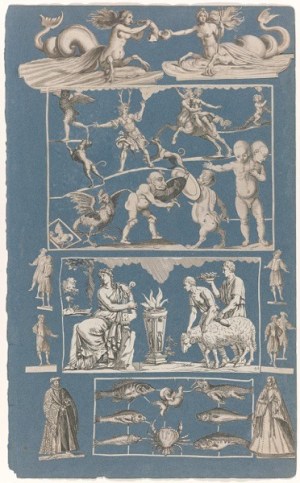
Blue album sheet with cut out prints of various printmakers, ca. 1690–1720
The scholarly research on early modern printmaking has evolved from a focus on the Romantic concept of the Peintre-Graveur to studies of artists and printmakers in their specific cultural and socioeconomic context. In addition, the idea that publishers played a vital role in artistic, commercial, and organisational aspects of printmaking is now widely accepted. Both art-historical and art-technical research on these matters have resulted in reference works and exhibition catalogues of high standard. In these studies, however, the position of the consumer has often been ignored or dealt with only briefly. In addition, print collections in the past have often failed to recognise the importance of contemporary adaptations, signs of usage, and collecting conditions.
However, for a proper understanding of early modern culture, it is crucial to study the consumption of printed images and the socioeconomic and artistic processes behind it. Prints were a widespread and artistically diverse medium and the creative process of a print did not stop after printing. Researching the creative afterlife of prints is therefore an essential development in the study of early modern visual culture. Although the consumption and reception of early modern books has received increasing attention in the past decades, only some scholars such as Peter Schmidt (Gedruckte Bilder in handgeschriebenen Büchern. Zum Gebrauch von Druckgraphik im 15. Jahrhundert, 2003), Jan van der Waals (Prints in the Golden Age: From Art to Shelf Paper, 2006), Kathryn Rudy (Virtual Pilgrimages in the Convent: Imagining Jerusalem in the Late Middle Ages, 2011), and Suzanne Karr Schmidt (Altered and Adorned: Using Renaissance Prints in Daily Life, 2011) have integrated the consumer’s side of the print market and the concrete use of prints in their research.
In order to stimulate this promising evolution, the Rijksmuseum Amsterdam is organising an international conference on early modern prints, ranging from precious artistic prints that were carefully collected to cheap printed images that were used and discarded. Paragons and Paper Bags: Early Modern Prints from the Consumer’s Perspective will take place at the Rijksmuseum on Thursday 9 June 2016. The aim of this symposium is to further develop this new approach in order to achieve new insights on target audiences, the application and usage of prints, and special collection practices.
The organisers particularly welcome object-based proposals regarding printed pictorial material or written primary sources. Topics for discussion may include, but are not limited to:
Techniques
• Prints with particular engraving or printing techniques, colouring, or multi-sheet compositions, resulting in a special visual or practical experience
Usage and manipulation
• Prints that were applied to objects, furniture or walls
• Prints that were altered by the consumer, deviating from the printmaker’s intentions such as censoring, colouring, and cutting
• Manuscripts and printed books in which prints were added and integrated
• Prints as a source of inspiration for other forms of art
• Prints depicted on other works of art
• Printed primary sources or archival documents on the intended use of specific prints
Target audiences and collection practices
• Print albums that reveal particular contemporary collection practices or the target market for specific prints or print genres
• Prints or primary sources on prints that were created on the initiative of a private individual or professional organisation with a particular purpose in mind
• The appreciation and appraisal of specific prints and printed oeuvres
• Printed primary sources or archival documents on the consumers of early modern prints
• Printed primary sources or archival documents on target audiences of specific prints
The organisation will consider proposals for 20-minute papers, presenting the findings of new or ongoing research. The application, consisting of a proposal abstract (maximum 300 words and an image) and a concise curriculum vitae, should be sent to j.luyckx@rijksmuseum.nl before 1 March 2016. The final program of the conference will be announced later that month.
Scientific Committee
Thomas Döring (Herzog Anton Ulrich-Museum, Braunschweig), Erik Hinterding (Rijksmuseum Amsterdam), Huigen Leeflang (Rijksmuseum Amsterdam), Ger Luijten (Fondation Custodia, Paris), Jeroen Luyckx (Rijksmuseum Amsterdam/ Illuminare – University of Leuven), Mark McDonald (The Metropolitan Museum of Art, New York), Jane Turner (Rijksmuseum Amsterdam), An Van Camp (Ashmolean Museum, Oxford), Peter van der Coelen (Museum Boijmans Van Beuningen, Rotterdam), Jan Van der Stock (Illuminare – University of Leuven), Joris Van Grieken (Royal Library of Belgium, Brussels), Joyce Zelen (Rijksmuseum Amsterdam/ Radboud University Nijmegen)
Exhibition | Body Image in French Art and Visual Culture
From Harvard Art Museums:
Body Image in French Art and Visual Culture, 18th and 19th Centuries
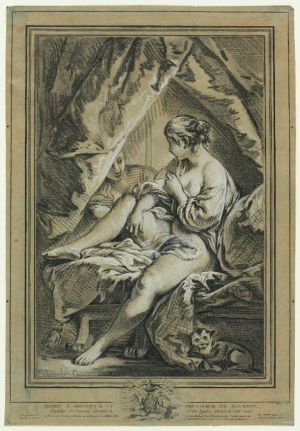
Louis-Marin Bonnet, after François Boucher, Young Woman in Bed / Figure de femme sur un lit, 1767, crayon manner etching printed in black and white on blue paper, 43.5 x 29.9 cm. Signed: L. Bonnet sculp. (Cambridge: Harvard Art Museums/Fogg Museum, M14332)
The goal of this installation is to consider the role of different artists and mediums (drawing, sculpture, print) in producing the modern understanding of the body. Spanning the period from rococo to post-impressionism, the installation addresses the issues of artistic instruction, the formation of gender and sexual identity and ethnic/racial stereotypes, the representation of history and modern life, the political and social critique, and the subjective vision. The 20 works on view include drawings by Degas and Seurat; prints by Gauguin, Manet, and Toulouse-Lautrec; and a bronze sculpture by Rodin.
This installation complements a course taught by Ewa Lajer-Burcharth, the William Dorr Boardman Professor of Fine Arts. The University Teaching Gallery serves faculty and students affiliated with Harvard’s Department of History of Art and Architecture. Semester-long installations are mounted in conjunction with undergraduate and graduate courses, supporting instruction in the critical analysis of art.
Display | A Room for Damascus
This posting is about nine months late, but the display is still on view at the V&A:
A Room from Damascus
Victoria & Albert Museum, London, 17 April 2015 — 15 April 2016
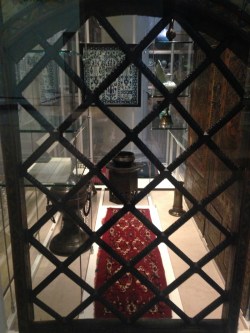 In the 18th century, the main reception rooms in Syrian upper-class houses began to be highly decorated with colourful painted wooden panelling. These rooms were the focus of hospitality, but the objects displayed there also announced a family’s wealth and status. When cities began to modernise in the late 19th century, many of these decorative interiors were removed for sale. The V&A was the earliest western collection to acquire one. This display will present some of the panelling and a selection of the objects that once dressed this room.
Mariam Rosser-Owen, the curator responsible for the Arab World collections at the V&A, provides a blog posting, available here, on the installation of the display.
Her earlier posting details the history of the room as it came to the V&A.
The Holburne Museum Buys a Sketch by Thomas Lawrence
Press release (15 January 2015) from the UK’s Art Fund:
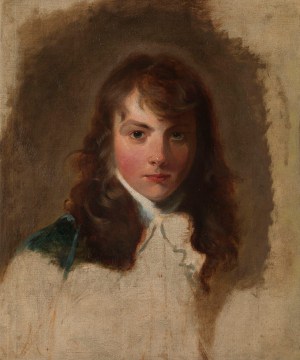
Thomas Lawrence, Sketch of Arthur Atherley, 1791
(Bath: The Holburne Museum)
The Holburne Museum in Bath has acquired a preparatory oil sketch of Arthur Atherley by Thomas Lawrence that has never been displayed in a public museum. Lawrence was commissioned to paint Arthur Atherley, who had recently left Eton College and who would later become an MP for the Southampton constituency. The artist was just three years older than his 19-year-old sitter.
In autumn 2015 the Holburne set out to raise £450,000, including a public appeal target of £61,209, for the acquisition of the sketch and the delivery of a learning programme. Following the successful campaign to raise the funds, Jennifer Scott, the Holburne’s director said: “The response from our visitors, friends, patrons and supporters at all levels has been overwhelming, enabling us to raise this large amount in a short time period. It is a reflection of both the quality of the painting itself, and the relevance of an outstanding early Lawrence portrait coming to the southwest.”
Thomas Lawrence was a child prodigy. He was born in Bristol, but after several of his father’s ventures failed to prosper, the family moved to Bath. From the age of ten he supported his family through the money he earned from painting portraits. Talented, charming, handsome and surprisingly modest, the young Lawrence was popular with Bath residents and visitors.
Just before his 18th birthday, he relocated his family to London and soon established his reputation as a portrait painter. From his arrival in London in 1787 until his death in 1830, Lawrence showed work at almost every annual Royal Academy Summer Exhibition, with two exceptions. In the 1792 exhibition, he exhibited his three-quarter length portrait of Arthur Atherley. It is one of his best-known works and now hangs at the Los Angeles County Museum of Art.
Stephen Deuchar, director of the Art Fund, said: “We are so pleased to support the acquisition of this important portrait, an excellent addition to the museum’s fine collection of 18th-century art. Heartfelt thanks to everyone else who helped through the public appeal to make this happen—a sign of widespread support for the Holburne’s admirable collecting ambitions.”
The work was acquired with support from the Art Fund, the Heritage Lottery Fund, and ACE/V&A Purchase Grant Fund, along with members of the public.
At Sotheby’s | Masters Week 2016
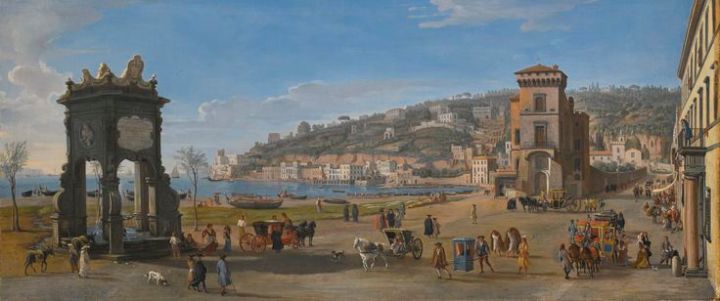
Gaspar van Wittel, called Vanvitelli, Naples, A View of the Riviera di Chiaia, oil on canvas, 75.7 by 174.8 cm (estimate: $1.5 / 2 million)
◊ ◊ ◊ ◊ ◊
Readers may recall that Christie’s decided to shift its Old Master sales (rebranded ‘Classic’) to April. Press release (19 January 2016) from Sotheby’s:
Sotheby’s Masters Week
New York, 27–30 January 2016
Sotheby’s annual Masters Week auctions in New York will be held 27–30 January 2016. This exciting auction series features rare and important European paintings, drawings, and sculpture dating from the 14th through the 19th centuries, including Orazio Gentileschi’s Danaë, one of the most important Baroque masterpieces left in private hands, and two very special private collection sales: The Collection of A. Alfred Taubman and The Road to Rome. The Masters Week exhibitions open 22 January in Sotheby’s York Avenue galleries.
The Collection of A. Alfred Taubman: Old Masters
27 January 2016 | 6:00pm
Master Drawings
28 January 2016 | 10:00am
The Road to Rome: A Distinguished Italian Private Collection, Part I
28 January 2016 | 2:00pm
Master Paintings Evening Sale
28 January 2016 | 6:00pm
Master Paintings and Sculpture Day Sale
29 January 2016 | 10:00am
Master Paintings and 19th-Century European Art
29–30 January 2016 | 2:00pm and 11:00am
◊ ◊ ◊ ◊ ◊
The Collection of A. Alfred Taubman: Old Masters
27 January 2016, 6:00pm

Thomas Gainsborough, The Blue Page, oil on canvas, ca. 1770, 165.5 by 113 cm.
Mr. Taubman’s remarkable collection of Old Masters includes rare pieces by two of the most iconic names in the history of art: Raphael, whose small Portrait of Valerio Belli, Bust Length, Facing Left (estimate: $2/3 million)—one of the last of his paintings remaining in private hands—is unique in the artist’s oeuvre as the only known profile bust representation, and Dürer, whose Christ Being Nailed To The Cross (estimate: $1/1.5 million) is related to his important series of drawings known as the Green Passion. Mr. Taubman’s collection also offers one of the strongest groups of Baroque works in private hands, led by Valentin de Boulogne’s The Crowning With Thorns (estimate: $1.5/2 million), as well as a number of classic 18th-century British pictures, featuring Thomas Gainsborough’s The Blue Page (estimate: $3/4 million).
Master Drawings
28 January 2016, 10:00am
Sotheby’s 28 January sale of Master Drawings offers a strong selection of Italian drawings, led by Giandomenico Tiepolo’s The Country School (estimate: $600/800,000) from his famous series of scenes from the life of ‘Punchinello.’ The auction also features: newly-discovered drawings by 17th-century Dutch masters Jacob van Ruisdael and Dirck Helmbreeker; major British works by William Blake and J.M.W. Turner; a series of studies by Ingres; a portrait of Jean-Claude Gaspard de Sireul (estimate: $120/180,000) by François Boucherand; and Guercino’s masterly red-chalk Study of a Baby in a Basket (estimate: $60/80,000)—one of an outstanding group of four drawings by the artist.
The Road to Rome: A Distinguished Italian Private Collection, Part I
28 January 2016, 2:00pm
The Road to Rome: A Distinguished Italian Private Collection, Part I comprises 35 view and portrait paintings that display a splendid overview of ‘Grand Tour’ taste. Throughout the 18th century, young aristocrats partook in the Grand Tour, visiting Italian cities including Venice, Naples and Rome as the culmination of their academic studies. Inspired by their voyages, many of these travelers developed an interest in art, sitting for some of the great portrait painters of the time and immortalizing their adventures by purchasing breathtaking view paintings. Many of the great artistic talents of the time including Vanvitelli, Bellotto, the Van Lint family, Hackert and Caffi directly benefited from the patronage of these Grand Tourists, and paintings by them will be highlights of the auction.
Master Paintings Evening Sale
28 January 2016, 6:00pm

Giovanni Antonio Canal, called Canaletto, An Interior View of The Henry VII Chapel, Westminster Abbey, 1750s, oil on canvas, 74.3 by 65.1 cm.
Orazio Gentileschi’s superb Danaë (estimate: $25/35 million) will lead the Master Paintings Evening Sale on 28 January. This undisputed masterpiece is one of the most important Italian Baroque paintings to come to market since World War II. Sotheby’s invited Pamela Romanowsky, writer and director of The Adderall Diaries, to create a film inspired by the work resulting in a beautiful and modern interpretation. View her film here: Reimagining Gentileschi’s Danaë.
In addition, the evening sale offers paintings by an impressive list of iconic artists: Sir Peter Paul Rubens, Lucas Cranach the Elder, Pieter Jansz. Saenredam, Sandro Botticelli, Eustache Le Sueur and Jacob Jordaens, whose St. Martin Healing a Possessed Man (estimate: $4/6 million) is one of the most exciting Flemish Baroque rediscoveries in decades. Further highlights include Canaletto’s An Interior View of The Henry VII Chapel, Westminster Abbey (estimate: $5/8 million), dating from the early 1750s, which depicts an remarkable view of Henry VII’s chapel in Westminster Abbey—one of the artist’s
rare works of an interior.
Master Paintings and Sculpture Day Sale
29 January 2016, 10:00am
The Day Sale offers a wide range of European paintings and sculpture spanning six centuries. Highlights of the paintings include works by esteemed artists Hubert Robert, Hans Bol, Jan van Goyen, Lucas Cranach the Younger, Apollonio di Giovanni di Tommaso, Edwaert Collier, and Pietro Antonio Rotari. Sculpture and works of art from the Medieval, Renaissance, and Baroque periods include an important pair of Venetian 15th-century Istrian stone figures of Hope and Charity (estimate: $400/600,000) by Bartolomeo Bon; a beautifully-painted enamel plaque of The Annunciation (estimate: $50/80,000) by Royal enameller Leonard Limosin; and a pair of elegant Italian terracotta figures of Mercury and Minerva (estimate: $80/120,000), attributed to the late 17th-century Florentine sculptor Giovanni Baratta.
Master Paintings and 19th-Century European Art
Session 1: 29 January 2016, 2:00pm / Session 2: 30 January 2016, 11:00am
Part 1 of the sale includes works by European artists from the 15th through the 18th centuries, while Part 2 focuses on 19th-century French, Italian, British, Dutch, German, Spanish and Scandinavian paintings, with a selection of Sporting pictures.
Colnaghi’s at New York’s Old Masters Week

Luis Egidio Meléndez, Still Life with Oysters,
Plate of Eggs, Garlic and Receptacles, 1772.
◊ ◊ ◊ ◊ ◊
As noted at Art Daily (20 January 2016). . .
Colnaghi’s Winter Exhibition of European Old Master Paintings and Sculpture will be held in the prestigious New York Galleries of Carlton Hobbs, from 21st to 30th January 2016, located at 60 East 93rd Street, together with Tomasso Brothers and Carlton Hobbs LLC. This joint exhibition will represent the first Colnaghi’s show in the United States after its merger with the Fine Art Dealers Coll & Cortés (London and Madrid). The exhibition will coincide with the New York annual Old Masters Week. The aim of this exhibition is to display the latest discoveries and examples of masterpieces that have never been presented before to the American public.
Still Life with Oysters, Plate of Eggs, Garlic and Receptacles is one of the most beautiful works by the highly regarded painter of still lifes, Luis Egidio Meléndez (Naples, 1716 – Madrid, 1780). The painting represents food and utensils typical of any eighteenth-century Spanish kitchen, but in Meléndez’s hands the arrangement results in an image of timeless and sublime beauty. This composition was so successful that Meléndez repeated it several times with small variations. One example that is particularly close to the one presented here, although slightly smaller is now in the collection of The Museo Nacional del Prado in Madrid. The work is signed and dated in black on the table edge at the right : Ls. Eo. Mz. Do ANNO 1772.
Colnaghi will also be exhibiting a Magnificat Anima Mea (My soul doth magnify the Lord) by the Spanish Baroque painter, Francisco de Zurbarán. The painting is signed ‘FZ’, and it has been dated by the artists scholar Odile Delenda between 1628 and 1630. This beautiful image was discovered by D. Manuel Gómez Moreno in the south of Spain in the middle of the twentieth century. After being rediscovered by Colnaghi it will be shown for the first time in more than 80 years.
Unlike painting, the art of polychrome sculpture is remarkable for the fact that many of its greatest masterpieces are not in museums but in the churches, convents and cathedrals for which they were originally made. Rather than being considered primarily as art works, Spanish polychrome sculpture is still revered today primarily for its function, as religious objects that are worshiped by the devout and carried through the streets during the annual Holy Week. But this fact has recently changed and a testimony to this shift is that museums have begun to acquire masterpieces of Spanish Sculpture. The Metropolitan Museum of Art acquired Pedro de Mena’s Ecce Homo and Mater Dolorosa from Coll & Cortés in 2014. They are now on display at one of the museum’s galleries dedicated to the Spanish art of the sixteenth and seventeenth centuries (Gallery 611). Notable for its outstanding quality is an Infant Christ by Mena (Spanish, Granada 1628–1688 Málaga). Carved wood sculpture, enhanced by paint and other media, including glass eyes and hair. Equally impacting is Mena’s highly sensitive Saint John the Baptist, made by Polychrome wood, glass and silver. The eyebrows, almond-shaped eyes and the modelling of the head and locks of hair that are softly carved to appear like modelled clay.
New Book | The Country House: Material Culture and Consumption
Published by Historic England and distributed by The University of Chicago Press:
Jon Stobart and Andrew Hann, eds., The Country House: Material Culture and Consumption (Swindon: English Heritage, 2016), 224 pages, ISBN: 978-1848022331, £70 / $140.
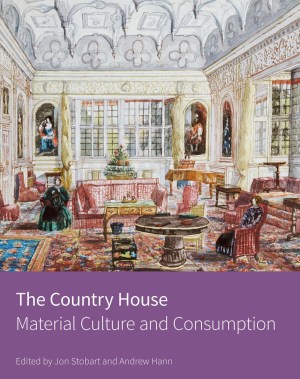 The country house has long been recognised as symbol of elite power—a showpiece demonstrating the wealth and ambition of its owner, but also their taste and discernment. Ownership of a country house distinguished the landed classes from the rest of society and signalled an individual’s arrival amongst a privileged elite. Yet, as the contributions to this book amply demonstrate, the country house in Britain and elsewhere in Europe was much more than this: it was a lived and living space, populated by family, visitors and servants. This formed the context in which decisions were made about what to buy, what to keep and what could be discarded; about what taste comprised and how it would be balanced against financial constraints or the imperatives of pedigree and heritance.
In this collection, consumption is thus explored as an active and ongoing process that involved the mundane as well as the magnificent. It drew the country house into complex and overlapping networks of supply that stretched from the local to the international. Material culture and elite identity were shaped by a cosmopolitan mixture of the everyday, the European and the exotic, thus food from the kitchen garden was served a la francaise from Chinese porcelain.
Jon Stobart is Professor of History at Manchester Metropolitan University.
Andrew Hann is Properties Historians’ Team Leader at English Heritage.
◊ ◊ ◊ ◊ ◊
C O N T E N T S
Introduction, Jon Stobart: The Country House and Cultures of Consumption
Section 1 | Elites, consumption and the country house
1. Yme Kuiper: The rise of the country house in the Dutch Republic: Beyond Johan Huizinga’s narrative of Dutch civilisation in the 17th century
2. Jane Whittle: The gentry as consumers in early 17th-century England
3. Johanna Ilmakunnas: To build according to one’s status: A country house in late 18th-century Sweden
4. Mark Rothery and Jon Stobart: Geographies of supply: Stoneleigh Abbey and Arbury Hall in the 18th century
5. Shelley Garland: The use of French architectural design books in De Grey’s choice of style at Wrest Park
Section 2 | Continuity, heritage and the country house
6. Hannah Chavasse: Fashion and ‘affectionate recollection’: Material culture at Audley End, 1762–1773
7. Hanneke Ronnes: A sense of heritage: Renewal versus preservation in the English and Dutch palaces of William III in the 18th century
8. Victor Hugo López Borges: An Anglo-Irish country house in Spain: The Palacio de Castrelos
Section 3 | Eastern connections, adoptions and imitations
9. Emile de Bruijn: Consuming East Asia: Continuity and change in the development of chinoiserie
10. Kate Smith: Imperial objects? Country house interiors in 18th-century Britain
11. Patricia F Ferguson: ‘Japan China’ taste and elite ceramic consumption in 18th-century England: Revising the narrative
12. Helen Clifford: ‘Conquests from North to South’: The Dundas property empire. New wealth, constructing status and the role of ‘India’ goods in the British country house.
Section 4 | Country house interiors as lived spaces
13. Rosie MacArthur: Settling into the country house: The Hanburys at Kelmarsh Hall
14. Susan Jenkins: Fashion and function: The decoration of the library at Kenwood in context
15. Karol Mullaney-Dignam: Useless and extravagant? The consumption of music in the Irish country house
16. Annie Gray: Broccoli, bunnies and beef: Supplying the edible wants of the Victorian country house
Section 5 | Presenting the country house
17. Nicola Pickering: Mayer Amschel de Rothschild and Mentmore Towers: Displaying ‘le goût Rothschild’
18. Anna McEvoy: Following in the footsteps of 18th-century tourists: The visitor experience at Stowe over 300 years
19. Karen Fielder: X marks the spot: Narratives of a lost country house
The George B. Clarke Prize for Stowe Studies
From The Georgian Group (20 January 2016). . .
The George B. Clarke Prize
Applications due by 30 June 2016
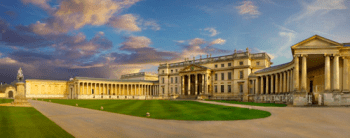 A biennial prize of £2,000 has been launched by the Hall Bequest Trust in association with The Georgian Group in recognition of the great contribution that George Clarke has made to Stowe in Buckinghamshire. In the course of over sixty years, the historian and champion of Stowe was a Chairman of the Hall Bequest Trust, which aims to support Stowe through acquisitions and education.
Stowe House (a school since 1923) was built as a summer residence of the Temple-Grenville family, and in its completed form remains amongst the grandest of eighteenth-century mansions. From c.1688–1810 it was remodelled in numerous phases by many of the leading architects of the age including Vanbrugh, Gibbs, Kent and Soane, though the family also took a personal involvement in aspects of design. Recent restoration work has spurred new research and interest. Yet the magnificent landscape gardens which remain remarkably intact are no less interesting. They are owned by the National Trust which has recently invested heavily in replanting the early Georgian gardens and creating a new visitor centre.
Much remains to be discovered about Stowe, as its cultural context is notably broad, while the 350,000 historic Stowe papers are held at the Huntington Library in Pasadena, California, with which George Clarke was instrumental in developing a close working relationship. The £2,000 Prize will be awarded for original research pertinent to Stowe within the fields of architecture, architectural history, the material arts or landscape design.
To apply, please e-mail your research proposal to office@georgiangroup.org.uk by 30 June 2016. The winner will be invited to write an article arising from his or her research, which will be considered for publication in The Georgian Group Journal, and to give a lecture within three months of completion of the research.
Exhibition | Meant to Be Shared: Prints from the Arthur Ross Collection

Giovanni Battista Piranesi, Veduta della Piazza di Monte Cavallo (View of the Piazza di Monte Cavallo [now the Piazza del Quirinale with the Quirinal Palace]), from Vedute di Roma (Views of Rome), 1750, etching (New Haven: Yale University Art Gallery, The Arthur Ross Collection).
◊ ◊ ◊ ◊ ◊
Press release (11 December 2015) from the Yale University Art Gallery:
Meant to Be Shared: Selections from the Arthur Ross
Collection of European Prints at the Yale University Art Gallery
Yale University Art Gallery, New Haven, 18 December 2015 — 24 April 2016
Samuel P. Harn Museum of Art, University of Florida, Gainesville, 29 January — 8 May 2017
Syracuse University Art Galleries, Syracuse University, 17 August — 19 November 2017
Curated by Suzanne Boorsch
The Yale University Art Gallery is delighted to announce Meant to Be Shared: Selections from the Arthur Ross Collection of European Prints at the Yale University Art Gallery, an exhibition presenting highlights of the more than 1,200 prints donated to the Gallery in 2012 by the Arthur Ross Foundation. Beginning in the late 1970s, philanthropist Arthur Ross (1910–2007) avidly collected works of art by some of the most renowned Italian, Spanish, and French printmakers of the last several centuries for his eponymous foundation. Highlights of the Arthur Ross Collection include works by Francisco Goya, the first artist whom Ross collected; Giovanni Battista Piranesi’s images of ancient and 18th-century Rome, which reflect Ross’s love of classicism and the Eternal City; and Édouard Manet’s illustrations for Edgar Allan Poe’s famous poem The Raven.
The Arthur Ross Collection comprises three major segments. The largest is a group of some 800 18th-century Italian works by Giovanni Battista Piranesi, Giovanni Antonio Canal (called Canaletto), Giovanni Battista Tiepolo and his sons, and others. A group of close to 200 prints by the Spaniard Francisco Goya includes the three intriguing and enigmatic series of etchings he made in the second decade of the 19th century, during which Spain suffered, first, Napoleon Bonaparte’s invasion, and then, with the restoration of the Bourbon monarchy, the repressive rule of King Ferdinand VII. The third segment consists of about 200 French prints by some of the greatest artists of the 19th and 20th centuries: Eugène Delacroix, Honoré Daumier, Camille Pissarro, Édouard Manet, Edgar Degas, Paul Gauguin, Henri Matisse, and Pablo Picasso.
This inaugural exhibition features 19 of Goya’s profoundly mysterious Disparates (Los proverbios) (Follies [Proverbs]) series, made around 1816 to 1819 but not published in Goya’s lifetime, for fear of the Inquisition. Ten images from the Tauromaquia (The Art of Bullfighting; 1815, published 1816) series and nine of the Desastres de la guerra (Disasters of War; ca. 1810–11, published 1863) are on display as well. The installation also highlights illustrations of great works of literature—one of the salient themes of the French work—including Delacroix’s 13 lithographs illustrating William Shakespeare’s Hamlet (1834–43) and some of his illustrations for Johann Wolfgang von Goethe’s Faust (1827, published 1828), and Manet’s truly revolutionary illustrations for Edgar Allan Poe’s The Raven (1875).
An entire gallery is devoted to views of places that might have been visited on the Italian segment of the Grand Tour, the cultural tour of Europe that was deemed an essential cap to the classical education of young gentlemen, especially those from Britain. Sparkling views of the Venetian region by Canaletto set the stage. The largest section is devoted to Rome; this part of the exhibition features a spectacular six-by-seven-foot map of the Eternal City, published in 1748, designed by the surveyor Giovanni Battista Nolli, and 20 of Piranesi’s Vedute (Views; ca. 1748–60) of Rome. The final area focuses on images of Pompeii and Paestum, in southern Italy, where in the mid-18th century rediscoveries of ancient sites excited the intelligentsia across Europe.
The title of the exhibition, Meant to Be Shared, reflects the raison d’être of the collection. Arthur Ross collected these prints for his foundation with the express purpose, in the words of his widow, Janet C. Ross, “to lend first-class prints … to educational institutions in the United States and abroad that would not otherwise have access to such objects for study and enjoyment.” In this spirit, the inaugural exhibition travels to the Samuel P. Harn Museum of Art at the University of Florida, Gainesville, in early 2017, and to the Syracuse University Art Galleries, New York, later that year. Gallery staff members have partnered with Harn Museum Director Rebecca M. Nagy and Syracuse University Art Galleries Director Domenic Iacono to plan ways to use the prints as teaching tools at each institution—including related university courses, public programs, and close-looking sessions—throughout the run of the exhibition. Suzanne Boorsch, the Gallery’s Robert L. Solley Curator of Prints and Drawings and curator of the exhibition, explains, “Far and away the most difficult aspect of preparing this exhibition was to make a selection from the abundance of riches that constitute this extraordinary donation. The possibilities that the Arthur Ross Collection offers for exhibition, research, and teaching are virtually endless, and, indeed, this inaugural exhibition and the collection catalogue are just the beginning of the rewards to be reaped by the study and enjoyment of this gift.”
The Gallery’s mission of sharing its collections broadly honors both the legacy of Arthur Ross and the value of the work he collected. Jock Reynolds, the Gallery’s Henry J. Heinz II Director, states, “We are grateful that the Arthur Ross Foundation has chosen the Gallery to be the steward of this remarkable collection, ensuring its proper care and always sharing it generously with active learners of all ages.”
◊ ◊ ◊ ◊ ◊
P R O G R A M M I N G
Gallery Talks
Wednesday, December 9, 12:30 pm
“Piranesi’s Rome: The Vision of an 18th-Century Architect and Printmaker,” Jakub Koguciuk, Ph.D. candidate in the History of Art and Renaissance Studies, Yale University
Wednesday, February 24, 12:30 pm
“Bullfighting: Audience and Perspective in Prints by Antonio Carnicero, Francisco Goya, and Pablo Picasso,” Ian Althouse, Ph.D. candidate in the Department of Spanish and Portuguese, Yale University
Wednesday, February 24, 1:30 pm
“Las corridas de toros: Audiencia y mirada en el arte de Antonio Carnicero, Francisco Goya y Pablo Picasso” (in Spanish), Ian Althouse
Wednesday, April 13, 12:30 pm
“Intensité, Obscurité, Frivolité: The Proliferation of Print Media in 19th-Century France,” Lisa Hodermarsky, the Sutphin Family Senior Associate Curator of Prints and Drawings, Yale University Art Gallery
Ryerson Lectures
Thursday, January 21, 5:30 pm
“Goya’s Prints in Context,” Janis A. Tomlinson, Director of University Museums, University of Delaware, Newark
Friday, February 5, 1:30 pm
“The Marriage of Venice and Rome, or What Makes Piranesi Great?,” Andrew Robison, the Andrew W. Mellon Senior Curator of Prints and Drawings, National Gallery of Art, Washington, D.C.
Friday, April 1, 1:30 pm
“From Paris to Tahiti: Paul Gauguin’s Innovative Prints,” Elizabeth C. Childs, the Etta and Mark Steinberg Professor of Art History and Chair of the Department of Art History and Archaeology, Washington University in Saint Louis
Performance
Thursday, March 31, 5:30 pm
Chamber Music of the 18th Century, Tiny Baroque Orchestra
Studio Programs
Friday, February 12, 1:30 and 3:00 pm
Printmaking Workshops
Inspired by the over 1,200 prints in the Arthur Ross Collection, Mauricio Cortes Ortega, M.F.A. candidate, and Caroline Sydney, SM ’16, both of Yale University, invite visitors to explore the art of printmaking. In this hands-on workshop, participants learn the basic techniques of intaglio printing and create a unique print of their own. Space is limited. Registration required; please call 203.432.9525.
◊ ◊ ◊ ◊ ◊
The catalogue is distributed by Yale UP:
Suzanne Boorsch, Douglas Cushing, Alexa Greist, Elisabeth Hodermarsky, Sinclaire Marber, John Moore, and Heather Nolin, with a foreword by Janet Ross, Meant to Be Shared: The Arthur Ross Collection of European Prints (New Haven: Yale University Press, 2016), 196 pages, ISBN: 978-0300214390, $60.
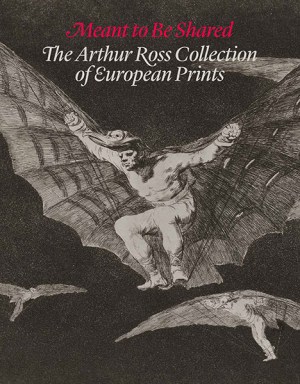 This important volume offers the first comprehensive look at the Arthur Ross Collection—more than 1,200 17th- to 20th-century Italian, French, and Spanish prints—and is published to mark the inaugural exhibition of the collection in its new home at the Yale University Art Gallery. Highlights include superb etchings by Canaletto and Tiepolo; the four volumes of Piranesi’s Antiquities of Rome, as well as his famous Vedute (Views) and Carceri (Prisons); Goya’s Tauromaquia in its first edition of 1816; an extremely rare etching by Edgar Degas; and numerous other 19th-century French prints, by Eugène Delacroix, Honoré Daumier, Édouard Manet, Paul Gauguin, Paul Cézanne, and others. The accompanying essays discuss the life of Arthur Ross, a significant philanthropist who funded several arts institutions; the formation of the collection and the art-historical significance of the works; and several thematic approaches to studying the collection, reinforcing its legacy as an important teaching resource.
Exhibition | No Cross, No Crown: Prints by James Barry
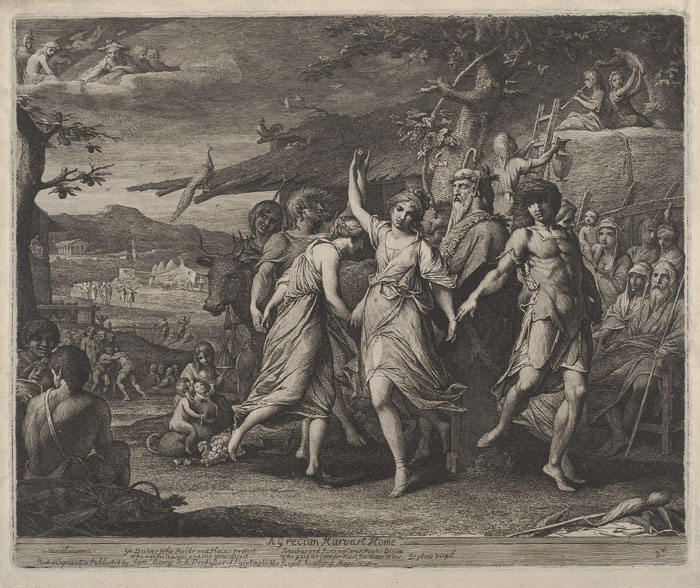
James Barry, A Grecian Harvest Home, from the series The Progress of Human Culture, 1792, etching and engraving in black ink, 17 ½ x 20 15/16 inches (Snite Museum of Art, University of Notre Dame: The William and Nancy Pressly Collection acquired with funds made available by the F. T. Stent Family, 2015.001.014).
◊ ◊ ◊ ◊ ◊
Press release (27 October 2015) from the Snite:
No Cross, No Crown: Prints by James Barry
Snite Museum of Art, University of Notre Dame, 24 January — 17 April 2016
The Snite Museum of Art will present an exhibition of 28 monumental prints by James Barry, the eighteenth-century Irish provocateur whose work challenged the British art establishment and questioned the government’s policies. The exhibition No Cross, No Crown: Prints by James Barry will be on view from January 24 through April 17, 2016.
James Barry (1741–1806) was born in Cork, made his artistic debut in Dublin, and was awarded membership in the Royal Academy in London in 1773, although he was later expelled for his belligerence and acrimony. The series of six murals he painted to decorate the Great Room of the Royal Society of Arts in Adelphi from 1777 through 1783 is his claim to fame. Included in the exhibition is a complete set of the prints he made after these grand paintings, once referred to as Britain’s answer to Michelangelo’s Sistine Chapel ceiling.
Barry’s prints are significant in the history of printmaking and eighteenth-century trans-Atlantic studies for their scale, their technical innovations, and the role they played in the artist’s creative process. These are not mere reproductive prints, but rather charts illustrating Barry’s evolving positions on hot political and artistic issues of the day. Peppering his religious and historical works with portraits of his contemporaries, such as the philosopher Edmund Burke and the politician William Pitt, the ensemble reads like a Who’s Who of British society in the late 1700s.
The Snite Museum acquired the prints in 2015 from Nancy and William Pressly, the latter being the foremost scholar on James Barry and professor emeritus of eighteenth- and nineteenth-century European art at the University of Maryland. Pressly said, “Over the years, as I looked and relooked at these prints, I was amazed at both the subtlety and richness of Barry’ process, but he never pursued virtuosity for its own sake: all is in the service of his passion to transform his audience, a transformation, however, that places great demands on his viewer.”
Pressly’s book James Barry’s Murals at the Royal Society of Arts: Envisioning a New Public Art (Cork 2015) received the William MB Berger Prize for British Art History in 2015.
The acquisition of eighteen of the prints was made possible by a generous gift from the F. T. Stent Family of Atlanta with ten additional prints donated by the Presslys. No Cross, No Crown: Prints by James Barry is made possible by the Snite Museum General Endowment.
◊ ◊ ◊ ◊ ◊
Programs
• Public reception Friday, February 12, 2016, from 5:00 p.m. to 8:00 p.m.
• Gallery Talk at 12:30 p.m., Wednesday, February 17, by Patrick Griffin, Madden-Hennebry Professor of History.
• Gallery Talk at 12:30 p.m., Friday, April 1, by William Pressly, Professor Emeritus of Art History, University of Maryland.
• Lecture, 4:00–5:30 p.m. Saturday, April 2, “An Irishman’s Address to the English Establishment: James Barry’s Murals at the Society of Arts in London” by William Pressly, Professor Emeritus of Art History, University of Maryland.
All programs are free and open to the public.










 Enfilade
leave a comment