Exhibition | Artist and Empire: Facing Britain’s Imperial Past
Opening this week at Tate Britain:
Artist and Empire: Facing Britain’s Imperial Past
Tate Britain, London, 25 November 2015 — 10 April 2016
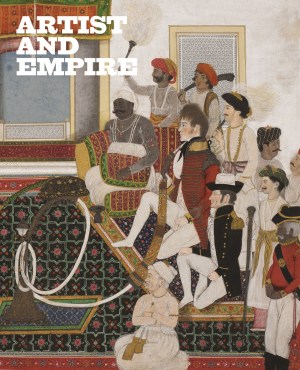 This autumn Tate Britain presents a major exhibition of art associated with the British Empire from the 16th century to the present day. In 21st-century Britain, ‘empire’ is highly provocative. Its histories of war, conquest and slavery are difficult and painful to address but its legacy is everywhere and affects us all. Artist and Empire will bring together extraordinary and unexpected works to explore how artists from Britain and around the world have responded to the dramas, tragedies and experiences of the Empire. Featuring a vast array of objects from collections across Britain, including maps, flags, paintings, photographs, sculptures and artefacts, the exhibition examines how the histories of the British Empire have shaped art past and present. Contemporary works within the exhibition suggest that the ramifications of the Empire are far from over. The show raises questions about ownership, authorship and how the value and meanings of these diverse objects have changed through history, it also asks what they still mean to us today.
Historic works by artists such as Joshua Reynolds and George Stubbs are shown with objects including Indian miniatures and Maori artefacts, as well as contemporary works by Hew Locke and Sonia Boyce. Through this variety of artworks from a complex mix of traditions, locations and cultures the fragmented history of the Empire can be told.
Alison Smith, David Blayney Brown, Carol Jacobi, Artist and Empire: Facing Britain’s Imperial Past (London: Tate, 2015), 240 pages, ISBN: 978-1849763431, $65.
◊ ◊ ◊ ◊ ◊
From Tate Britain:
Artist and Empire: New Dynamics, 1790 to the Present Day
Tate Britain, London, 24–26 November 2015
Tate Britain’s major conference, held in collaboration with Birkbeck, University of London and culture at King’s College London, marks the opening of the exhibition Artist and Empire. Scholars, curators and artists from around Britain and the world consider art created under the conditions of the British Empire, its aftermath, and its future in museum and gallery displays.
Scholarship of art associated with the British Empire has expanded over the last two decades, across a huge span of disciplines and locations. This conference takes the historic opportunity of the exhibition, featuring diverse artists from the sixteenth century to the present day, to bring together people to meet and share the latest research being developed around this subject. The papers, roundtables and audience discussions will consider the cosmopolitan character of objects and images, and the way geographical, cultural and chronological dislocations have in many instances obscured, changed or suppressed their history, significance and aesthetics. We will also explore how approaches to contemporary art, archives, curation and collecting can help develop new ways to look at them now.
T U E S D A Y , 2 6 N O V E M B E R 2 0 1 5
18.00 Opening Conversation
Introduction by Nicholas Serota, Director, Tate
Frank Bowling OBE, Artist and Writer, with Zoe Whitley, Curator, International Art, Tate Modern
W E D N E S D A Y , 2 5 N O V E M B E R 2 0 1 5
9.00 Registration and refreshments
9.30 Introduction
9.40 Panel 1 | Displaced Practices: Artists and Exchanges
Chaired by Felix Driver, Professor of Human Geography at Royal Holloway
• Michael Rosenthal (Emeritus Professor of Art History at the University of Warwick), Augustus Earle: Seeing Straight
• Geoff Quilley (Professor of Art History at the University of Sussex), Inside Empire Looking Out: The View from Dent’s Veranda
• Partha Mitter (Emeritus Professor of Art History at the University of Sussex), Art Education in India
11.20 Refreshment break
11.40 Panel 2 | Moving Objects: Collecting, Archives, Display
Chaired by John Mack, Professor of World Art Studies at the University of East Anglia and Chairman of the Sainsbury Institute for Art
• Alison Inglis (Associate Professor in Art History at the University of Melbourne), Collecting and Displaying British Art in the Australian Colony
• Zachary Kingdon (Curator of the African Collections at the World Museum in Liverpool), Unofficial Exchanges: Investigating West Africans’ Gifts to UK Museums in the Early Colonial Period
• Nick Thomas (Director of the Museum of Archaeology and Anthropology, Cambridge), Artefacts of Encounter: Rethinking Objects and Collections
13.20 Lunch break
14.00 Panel 3 | Face to Face: Figures, Portraits and Identities
Chaired by Elizabeth Edwards, Research Professor in Photographic History and Director of Photographic History Research Centre, De Montfort University
• Temi Odumosu (Marie Curie Postdoctoral Fellow at Copenhagen University), This Is How You See Her? Rachel Pringle of Barbados by Thomas Rowlandson’s Hand
• Gillian Forrester (Senior Curator of Prints and Drawings at the Yale Center for British Art), Noel B. Livingston’s Gallery of Illustrious Jamaicans
• Ruth Phillips (Canada Research Chair in Modern Culture and Professor of Art History at Carleton University), Sir Henry Acland Mi’kmaq Woman from Nova Scotia and a Mi’kmaq Dressed Doll: The Tensions of Imperialism and Indigenous Survivance and Resistance
15.40 Refreshment break
16.00 Plenary: Reflecting on the Future
Chaired by Augustus Casely-Hayford, Historian, Writer and Curator
Catherine Hall, Professor of Modern British Social and Cultural History at University College London
Zareer Masani, Historian and Writer
T H U R S D A Y , 2 6 N O V E M B E R 2 0 1 5
9.00 Registration and refreshments
9.30 Introduction
9.40 Panel 4 | Confronting Empire: Curating Artistic Legacies
Chaired by Sarah Victoria Turner, Assistant Director for Research at the Paul Mellon Centre
• Elisabeth Lalouschek (Artistic Director of the October Gallery)
• Devika Singh (Smuts Research Fellow at the Centre of South Asian Studies, Cambridge University)
10.55 Refreshment break
11.15 Panel 5 | Archived Futures: Mediating Collections and Archives
Chaired by Hammad Nasar, Head of Research and Programmes at the Asia Art Archive in Hong Kong
• Brook Andrew (Artist), Re-envisioning Archives and Aboriginal Culture
• Caroline Bressey (Director of the Equiano Centre, Department of Geography at UCL)
• Shaheen Merali (Writer, Curator and Co-founder of Panchayat), Panchayat
12.55 Lunch break
13.35 Panel 6 | Curating in Transnational Contexts in London
Chaired by Professor Paul Goodwin, Director of the Research Centre for Transnational Art, Identity and Nation (TrAIN) at the University of the Arts London
• The India Festival (Victoria and Albert Museum, June 2015 — March 2016)
Kriti Kapila, Lecturer in Social Anthropology and Law at King’s College, London
• West Africa: Word, Symbol, Song (British Library, October 2015 — February 2016)
Toby Green, Lecturer in Lusophone African History and Culture at King’s College, London, Marion Wallace, Lead Curator, African Collections, British Library, Co-curator
• Artist and Empire: Facing Britain’s Imperial Past (Tate Britain, November 2015 — April 2016)
Javed Majeed, Professor of English and Comparative Literature at King’s College London, Alison Smith, Senior Curator of British Art at Tate Britain
14.50 Refreshment break
15.10 In Conversation: Reflecting on Artists and Empire
Chaired by Achim Borchardt-Hume, Director of Exhibitions, Tate Modern
• Lubaina Himid, MBE (Artist, Curator, Professor of Contemporary Art at the School Art, Design and Fashion University of Central Lancashire)
• Yinka Shonibare, MBE (Artist and Curator)
16.05 Plenary: Reflecting on the Future
Chaired by Paul Gilroy, Professor of American and English Literature, King’s College London
Baroness Lola Young of Hornsey OBE
Mike Phillips, Novelist, Historian and former curator at Tate
Panellist TBC
Exhibition | Olafur Eliasson: Baroque Baroque

Olafur Eliasson, Wishes versus Wonders, 2015, as installed at the Winter Palace of Prince Eugene of Savoy, Vienna, 2015
Photo by Anders Sune Berg
◊ ◊ ◊ ◊ ◊
Press release for the exhibition now on view in Vienna’s Winter Palace:
Olafur Eliasson: Baroque Baroque
Winter Palace of Prince Eugene of Savoy, Vienna, 21 November 2015 — 6 March 2016
With works from Thyssen-Bornemisza Art Contemporary (TBA21), Vienna and Juan & Patricia Vergez private collections, Buenos Aires
Olafur Eliasson: Baroque Baroque brings together a significant selection of artworks by Danish-Icelandic artist Olafur Eliasson from the private collections of Thyssen-Bornemisza Art Contemporary and Juan and Patricia Vergez and presents them within the grand baroque setting of the Belvedere’s Winter Palace. The former city residence of Prince Eugene of Savoy (1663–1736), was an important site of artistic and scientific patronage in baroque Vienna. Baroque Baroque is an encounter between artworks, aesthetics, and worldviews from two vastly different epochs. The exhibition challenges viewers’ habits of perception and proposes that reality can be understood as unstable and evolving, as a process of constant negotiation. Surprising affinities between Eliasson’s works and their temporary settings become evident as the juxtapositions explore the relationships between object and viewer, representation and experience, actual and virtual, giving rise to a concept of the baroque superimposed on itself—the Baroque Baroque.
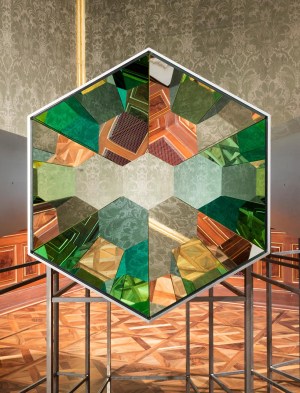
Olafur Eliasson, Seu planeta compartilhado (Your shared planet), 2011, as installed at the Winter Palace of Prince Eugene of Savoy, Vienna in 2015. Photo by Anders Sune Berg.
While emphasizing the way spaces are constructed by history and tradition, Eliasson’s works address the viewer in her embodied experience. Through the use of projections, shadows, and reflections, the artworks foreground the relationship between body, perception, and image. They anchor agency in the body and mind in motion as they invite the viewer’s active engagement by mirroring, fragmenting, and inverting her position within space.
Eliasson says, “I find it inspiring that the baroque exhibited such confidence in the fluidity of the boundaries between models of reality and, simply, reality. The presentation of my works at the Winter Palace is based on trust in the possibility of constructing reality according to our shared dreams and desires and on faith in the idea that constructions and models are as real as anything.”
TBA21 Founder, Francesca von Habsburg says: “This exhibition brings together several elements that I think support the vision of collectors and their responsibility as well as their ability to create art projects that defy traditional categorization. Both Patricia and Juan Vergez and I have been collecting and supporting Olafur Eliasson for many years with great enthusiasm, as he is indeed a renaissance man of many talents! In this presentation we wanted to introduce a parallel, that Olafur himself has mirrored in the exhibition rooms, that juxtaposes the precious Baroque cultural heritage of Vienna with the work of an artist that I feel very close to.”
In the entrance Vestibule, the light installation Die organische und kristalline Beschreibung (1996) floods the walls, floor, and ceiling with swelling washes of blue and yellow light, an ocean of color that loosens the viewer’s sense of the stability of her environment. In Yellow corridor (1997), monofrequency light is used to heighten the precariousness of our relationship to visible space. Eliasson’s optical machines and installations—such as Kaleidoscope (2001), New Berlin Sphere (2009), Your welcome reflected (2003), and Seu planeta compartilhado (Your shared planet, 2011)—reflect the artist’s ongoing investigations of color, perception, transformation, and deconstruction, an inquiry that is particularly interesting in relation to the baroque context. A site-specific intervention in the form of a continuous mirror traversing the enfilade of grand rooms further disorients the viewer by folding and re-folding the complex spaces it produces. Wishes versus wonders (2015), a steel half-ring mounted to the mirror wall in the Hall of Battle Paintings, stages an encounter between reality, illusion, and the elaborate artifice of the surroundings, simultaneously multiplying lines of potentiality.
Within this terrain of doubling and paradox, Eliasson calls into question our received habits of seeing and experiencing space. His artworks make us wonder and reconsider, giving meaning to the enigmatic doubling inherent in Baroque Baroque.
Belvedere–The Winter Palace of Prince Eugene of Savoy
Prince Eugene’s Winter Palace [begun in 1697] is one of the most magnificent baroque edifices in Vienna and is the fourth exhibition venue of the Belvedere Museum. Originally built as a lavish urban residence for Prince Eugene of Savoy (1663–1736), then acquired in the eighteenth century by Empress Maria Theresa before being used for the Court Treasury and later as the Ministry of Finance, this baroque palace underwent extensive renovation before reopening as a public museum in October 2013. Since then the Belvedere has staged numerous exhibitions at the Winter Palace, placing particular emphasis on programs and projects that create a dialogue between the baroque setting and contemporary art. Artistic interventions result in inspiring new artworks created in situ that draw on the palace’s unique ambiance and history. Vital starting points have been the city palace’s architecture, the prince’s former collections, and the holdings of the Belvedere.
On Site | The Fritz Lugt Collection (Paris) and the Pars Museum (Shiraz)

◊ ◊ ◊ ◊ ◊
From the November issue of WoI:
Valérie Lapierre, with photographs by Roland Beaufre, “Dutch Originals: The Frits Lugt Collection,” The World of Interiors (November 2015), pp. 108–17.
A connoisseur like no other, Frits Lugt was just 15 when he bought his first Rembrandt sketch (he’d already written a book). Fifty years on, he opened the Fondation Custodia in Paris [housed in the eighteenth-century Hôtel Turgot], so that generations of experts and laymen alike could share his collection of Golden Age art for free. With brocatelle-lined walls and Vermeer-inspired floors, it’s ‘the place to see drawings in Paris’, as Valérie Lapierre learns.
More information is available from the Fondation Custodia.
Marie-France Boyer, with photographs by Olivia Froudkine, “Splendour in the Grass: The Pars Museum,” The World of Interiors (November 2015), pp. 152–59.
The garden of Nazar (meaning ‘dazzling’) in the Iranian city of Shiraz is home to the jewel-like Pars Museum. Decorated with vibrant panels of tiles, this octagonal pavilion incorporates a sparkling collection of pottery, glassware and bronze work. It also houses the tomb of an enlightened ruler who oversaw an era of urban development and artistic outpouring.

Pars Museum of Shiraz, Iran, The octagonal structure, called the Kolah Farangi (‘foreign hat’) was built by Karim Khan Zand (ca. 1705–79), who is buried there (Photo: Wikimedia Commons, February 2013).
◊ ◊ ◊ ◊ ◊
From the Wikipedia entry for the Pars Museum:
The Pars Museum is a museum in Shiraz, Fars Province, southern Iran and is located in Nazar Garden. The octagonal building was the place in which royal guests were hosted during the Zand dynasty of Iran. It was also used for holding official ceremonies. It is also the burial place of Karim Khan Zand.
The old Nazar Garden was one of the largest gardens of Shiraz during the Safavid rule (1501–1722). During Zand dynasty (1750–1794) Karim Khan built an octagon structure which was called Kolah Farangi. It was used to receive and entertain foreign guests and ambassadors and hold official ceremonies. In 1936 the pavilion became a museum. It was the first museum which was located outside the capital city of Tehran. The brick designs, tiling, pictures and big stone dadoes are among the architectural features of the building. . . .
New Acquisitions | Pair of 18th-Century Silver Sculptures at Mia
Now on view at Mia:
The Archangels Saint Michael and Saint Raphael: A Pair of 18th-Century Silver Sculptures
Minneapolis Institute of Art, 14 November 2015 — 3 January 2016
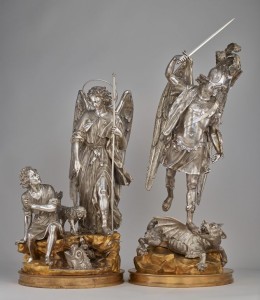
Giuseppe Sanmartino, Saint Raphael with Tobias, his Dog, and the Fish, c. 1780, 27 inches high; The Archangel Saint Michael in Triumph, c. 1780, 33 inches high, silver, gilt bronze (Minneapolis Institute of Art, 2015.24.1,2)
A pair of two silver statues by Neapolitan artist Giuseppe Sanmartino (1720–93), donated to the museum by long-time trustees Al and Mary Agnes McQuinn, marks one of the most important additions to Mia’s silver collection. Executed with amazing detail, the statues testify to a devotion to the two Archangels, an act that goes back to the Early Christian period and continues to flourish in Southern Italy (as well as in the Greek and Russian Orthodox churches) to the present day. Throughout Christianity, Saint Michael and Saint Raphael are venerated for their healing powers. The exhibition celebrates the acquisition of these unique masterpieces, without peer in any American museum collection, and whose only comparables remain in Italian churches.
Exhibition | The Jane Austen Reading Room
Now on view at Mia:
Living Rooms: The Jane Austen Reading Room
Minneapolis Institute of Art, 21 November 2015 — 26 June 2016

This installation situates Jane Austen in a unique period room setting. Taking up two of Mia’s well-loved English interiors—the Queen Anne room and the Georgian Drawing room—this display will discuss Austen’s habits as a reader and writer, recreate scenes from her novel Emma (celebrating its 200th birthday in 2015), and invite museum visitors to read works that Austen read, wrote, or inspired. This project is part of Living Rooms, an initiative to present Mia’s historic interiors and decorative arts collections in new ways.
Exhibition | Italian Dreams: Watteau and French Landscape Painting
From the website for Valenciennes:
Réveries Italiennes: Watteau et les paysagistes français au XVIIIe siècle
Italian Dreams: Watteau and French Landscape Painting in the Eighteenth Century
Musée des Beaux-Arts, Valenciennes, 25 September — 17 January 2016
Curated by Martin Eidelberg
 La Ville de Valenciennes a la chance d’avoir vu naître l’un des artistes français les plus illustres : Jean Antoine Watteau (1684–1721). La réouverture de son musée des Beaux-Arts, qui conserve un ensemble d’œuvres du peintre, est couronnée par le don exceptionnel d’une œuvre tout récemment redécouverte d’Antoine Watteau, La Chute d’eau, rare paysage du peintre des fêtes galantes inspiré des cascades de Tivoli près de Rome, qui témoigne de la fascination de l’artiste pour l’Italie, pays où il n’eut pourtant jamais l’occasion de se rendre !
L’exposition Rêveries italiennes, propose ainsi de souligner les emprunts que le maître fit tout au long de sa carrière au modèle italien, soit à travers l’exemple des peintres vénitiens du XVIe siècle qui constituèrent pour l’artiste une source importante d’inspiration, soit à travers le filtre des œuvres réalisées à Rome par ses contemporains. Autour d’un ensemble de peintures et de dessins d’Antoine Watteau, des œuvres des XVIe, XVIIe et XVIIIe siècles montreront comment ce peintre des songes puisa dans la culture artistique européenne pour créer des œuvres qui ouvriront la voie à une nouvelle école de paysage, née au siècle des Lumières, autour de Natoire, Boucher, Fragonard et Hubert Robert. À partir des rêveries italiennes de Watteau, l’exposition valenciennoise souhaite ainsi éclairer sous un jour nouveau la fécondité d’un modèle artistique qui, bien au-delà d’une iconographie séduisante, mena à l’éclosion du Romantisme.
L’exposition s’intègre dans la programmation liée à l’élection de la cité voisine belge de Mons comme capitale européenne de la culture pour l’année 2015. Elle bénéficie également du soutien exceptionnel du Musée du Louvre, qui a accordé pour l’occasion un prêt conséquent d’œuvres et a proposé, dans le cadre de la programmation du Louvre Lens, une exposition venant en écho à l’initiative valenciennoise, consacrée à Antoine Watteau et la fête galante, Dansez, embrassez qui vous voudrez. Fêtes et plaisirs d’amour au siècle de Mme de Pompadour, du 5 décembre 2015 au 29 février 2016.
Commissariat scientifique
Martin Eidelberg, Professeur émérite d’Histoire de l’Art, Rutgers University
Commissariat général
• Emmanuelle Delapierre, anciennement conservatrice du musée des Beaux-Arts de Valenciennes, actuelle conservatrice du musée des Beaux-Arts de Caen
• Vincent Hadot, directeur du musée des Beaux-Arts de Valenciennes
• Virginie Frelin-Cartigny, Attachée de conservation du Patrimoine, musée des Beaux-Arts de Valenciennes
Martin Eidelberg, Réveries Italiennes: Watteau et les paysagistes français au XVIIIe siècle (Heule: Snoeck, 2015), 163 pages, ISBN: 978-9461612397, 29€ / $55.
More information is available at Culture.Fr, and the press release is available as a PDF file here»
Exhibition | Dance, Kiss Whom You Wish

François Boucher, Les Charmes de la vie champêtre, ca. 1735–40
(Paris: Musée du Louvre)
◊ ◊ ◊ ◊ ◊
From the exhibition press materials, via Claudine Colin Communications:
Dansez, embrassez qui vous voudrez: Fêtes et plaisirs d’amour au siècle de la Pompadour
Dance, Kiss Who You Wish: Parties and Pleasures in the Time of Madame de Pompadour
Musée du Louvre-Lens, 5 December 2015 — 29 February 2016
Curated by Xavier Salmon
 Rustic decor, elegant young people and refined leisure pursuits: the 2015–16 winter exhibition at the Louvre-Lens celebrates the genre of the fête galante and the pastoral. Popularised in the first half of the 18th century, first by Antoine Watteau, then by François Boucher, these themes achieved great success until the French Revolution. First adopted by painters, they spread quickly to other disciplines—in particular the decorative arts—and became widespread throughout Europe. Thanks to exceptional loans from the Louvre Museum and around twenty prestigious institutions, this exhibition is able to bring together 220 works.
The bucolic design of the exhibition combines paintings, graphic arts, furniture, ceramics, tapestries, and stage costumes. From the roots to the latest developments, the exhibition traces the fortunes of a delicate, seductive genre, which enchanted Europe in the Age of Enlightenment. A tribute to French taste and the joy of living!
◊ ◊ ◊ ◊ ◊
From ArtBooks.com:
Xavier Salmon, Dansez, embrassez qui vous voudrez: Fêtes et plaisirs d’amour au siècle de Madame de Pompadour (Milan: Silvana, 2015), 320 pages, ISBN: 978-8836631544, $75.
Cet ouvrage rend hommage au genre de la Fête galante, popularisé par Antoine Watteau (1687–1721) et qui connut en France et en Europe un succès non démenti tout au long du Siècle des Lumières. Répondant à une soif de liberté et à un assouplissement des moeurs pendant la Régence, ce thème clamait la joie de vivre, les délices de l’amour, l’alchimie des sentiments et le besoin de paraître. Dans le sillage de Watteau, le genre de la Fête galante fut adopté par son élève Jean-Baptiste Pater ainsi que par ses suiveurs Nicolas Lancret, Bonaventure de Bar ou Pierre-Antoine Quillard. D’autres maîtres en proposèrent à leur tour des variations, pastorales chez François Boucher, mélancoliques chez Jean-Honoré Fragonard ou délicatement sentimentales chez Louis-Joseph Watteau de Lille. Le thème fournit aussi un exceptionnel répertoire de sujets aux manufactures de porcelaine, notamment celles de Sèvres. De Meissen à Venise, il connut en Europe un succès non démenti. Peintres, tel Dietrich, Troost ou Gainsborough, sculpteurs, comme Ferdinand Tietz ou Giovanni Bonazza déclinèrent à l’envi tant en peinture, en dessin, qu’en sculpture, ces sujets aimables qui célébraient les sentiments partagés. Les Arts appliqués s’emparèrent aussi de la thématique et s’attachèrent à la multiplier, en rendant hommage à la fois au goût français et au bonheur de vivre.
Save Ashgate Publishing
I know many of you are already aware of the bad news regarding the planned closures of Ashgate’s Burlington and UK offices. The online petition now includes 3,700+ signatures (and counting). –CH
Save Ashgate Publishing
Petition to Rachel Lynch, Managing Director, Ashgate Publishing & Managing Director, Humanities & Social Science Books, Taylor & Francis Group Jeremy North
Ashgate Publishing Company was purchased by Informa (Taylor & Francis Publishing) in 2015. On November 24th, 2015, the North American office of the press in Burlington, Vermont will close and Ashgate’s US staff members, including Erika Gaffney, Ann Donahue, Margaret Michniewicz, Alyssa Berthiaume, Kathy Bond Borie, Seth Hibbert, Stephanie Peake, Martha McKenna, Lea Durfee, Suzanne Sprague, and Emilly Ferro will cease to be representatives of Ashgate.
According to an e-mail sent to series editors, plans are still being discussed for Ashgate’s publishing business in the UK. However, information has since emerged that the UK office is scheduled to close in December.
Independent academic presses like Ashgate have offered a safe haven for scholars working in certain subfields as University presses closed entire publishing specializations and fired editorial staff in response to campus austerity measures. Academic presses are more than profit margins, income from the backlist, utility bills, payroll, and marketing campaigns. Ashgate flourished through the bonds formed between editors and authors, the care and attention of copy editors, and above all, the good will of authors and readers. We the undersigned authors, readers, and reviewers of Ashgate books write to voice our appreciation for the accomplishments of Ashgate’s North American office. We urge Taylor & Francis to reverse course immediately and restore Ashgate’s US and UK offices.
Exhibition | Palladian Design: The Good, the Bad and the Unexpected

Chiswick House by Lord Burlington, 1729
(London: RIBA Collections)
◊ ◊ ◊ ◊ ◊
Press release (23 July 2015) for the exhibition now on view at RIBA:
Palladian Design: The Good, the Bad and the Unexpected
Royal Institute of British Architects, London, 9 September 2015 — 9 January 2016
The Renaissance architect Andrea Palladio is the only architect who has given his name to a style, one that is still in use around the world after nearly 500 years. From the US Capitol to a 21st-century Somerset cowshed, Palladian Design: The Good, the Bad and the Unexpected introduces Palladio’s design principles and explores how they have been interpreted, copied and re-imagined across time and continents from his death in 1580 right up to the present day.
Focusing on his legacy, RIBA’s exhibition explores how architects such as Inigo Jones and Lord Burlington turned Palladianism into a national style. The style was adopted in the design of houses, churches, and public buildings around the world from New Delhi to Leningrad. Palladianism became so widespread that it seeped into people’s unconscious references and desires: elements were found popping-up in American Negro Churches and terraced housing and homes in the UK. The 20th century saw a revival of traditional Palladian mansions while the 21st century has seen his design principles being utilised in a more abstract way. The exhibition asks many questions about what makes a building ‘Palladian’. Does a building have to look classical to be Palladian? Is it the design principles or the social and political connotations of tradition, power, and establishment that have led to the enduring popularity of the style? The exhibition is structured chronologically around three themes: revolution, evolution, and the contemporary. It includes 50 original works, including drawings, models, and busts.
The first part of the exhibition introduces Palladio and outlines his unique system of architecture. It charts the development of Anglo-Palladianism from 17th-century England, through to the transformation of Palladianism into a national style by the mid-18th century. It also explores the role of books in spreading Palladio’s ideas—both his own Four Books of Architecture and later publications that spread Palladian style beyond Britain. Highlights include Palladio’s A Design for a Palace (1540s) and projects for low-cost housing in Venice (1550s), original drawings by Inigo Jones include a preliminary design for the Queen’s House at Greenwich (1616), Colen Campbell’s original pen and wash design for Mereworth Castle, Kent (1723), and an original drawing of Lord Burlington’s Chiswick House (1729).
The second part of the exhibition follows Palladio’s legacy worldwide in a series of themes that explore how others have either followed his guidelines to the letter or employed them more creatively. It looks at how Palladian design has been adopted for commercial viability and in the service of politics and religion—both in western countries and in colonial and post-colonial contexts. Away from the centres of power, people turned their hand to Palladian self-builds with anonymous builders using pattern books to fuse Palladian elements with local vernacular traditions. Highlights include the original 1721 model of St Martin-in-the-Fields church by James Gibbs, a perspective of Catherine the Great’s Pella Palace near St Petersburg by Ivan Starov (c.1786), a watercolour perspective of Stormont in Belfast by Sir Arnold Thornely (1927), and Palladio’s original designs for the Villa Valmarana (c.1560) and the Palazzo Antonini (c.1560).
The last section of the exhibition follows the story of 20th- and 21st-century Palladianism. Despite the rise of modernism, Palladianism survived in Britain and America as a domestic style both for landed families and the newly rich who commissioned grand classical homes to evoke a sense of history and confer status. Highlights include a linocut perspective of Kings Walden Bury, Essex by Raymond Erith and Quinlan Terry (1971) and photographs and models of houses built since the 1960s. The exhibition goes on to explore post-modern Palladianism, where the style has been referenced historically, playfully or ironically. Key exhibits include works by Swedish architect Erik Asplund and Belgian architect Charles Vandenhove alongside other new buildings on the continent and in Canada. The exhibition ends by examining contemporary abstract Palladianism—buildings that contain no visual references to classical architecture but follow Palladian design principles in terms of proportion or planning. It asks whether a building has to look like a Palladian building in order to be one? It will include a newly commissioned film comparing Palladio’s Villa Caldogno with Brick House (2005) by Caruso St John and looks at a selection of contemporary buildings, ranging from a model of an underground house in Mongolia by OFFICE Architects to offices in Switzerland by Peter Märkli.
The exhibition coincides with the 300th anniversary of the publication of two books key to the spread of Palladianism worldwide: Giacomo Leoni’s first full translation into English of Palladio’s I Quattro Libri dell’ Architettura and Colen Campbell’s survey of English architecture Vitruvius Britannicus, both published in 1715. These books paved the way for a flood of cheaper pattern books that enabled anyone, from Russian royalty to a American carpenters, to create Palladian designs.
The RIBA Collections contain over 350 drawings and sketches by Andrea Palladio, the world’s largest assemblage of his drawings—85% of all those in existence. The exhibition is designed by Caruso St John Architects. The design takes its inspiration from the interior of Palladio’s villas and the way that his Four Books of Architecture have been used by generations of architects. The palette will reference Villa Caldogno’s frescos. Palladian Design is generously supported by the Blavatnik Family Foundation, The Headley Trust, and the American Friends of the British Architectural Library.
The Burlington Magazine, November 2015
The eighteenth century in The Burlington:
The Burlington Magazine 157 (November 2015)

Interior of the Church of Santiago de Surco, Lima, Peru, attributed by Gauvin Alexander Bailey to Johann Rehr and Santiago Rosales, before 1759–1773.
A R T I C L E S
• Gauvin Alexander Bailey, “The Fantastical Rococo Altarpieces of Santiago de Surco, Peru,” pp. 769–75.
R E V I E W S
• Simon Swynfen Jervis, Review of Giuseppe Beretti and Alvar González-Palacios, Giuseppe Maggiolini: Catalogo ragionato dei disegni (In Limine, 2014) and Michael Sulzbacher, Peter Atzig, Sabine Schneider, and Karsten Hommel, Friedrich Gottlob Hoffmann (Grassi Museum, 2014), pp. 790–91.
• David Bindman, Review of William Pressly, James Barry’s Murals at the Royal Society of Arts: Envisioning a New Public Art (Cork University Press, 2014), pp. 791–92.
• Richard Green, Review of Christopher Wright, The Schorr Collection of Old Master and Nineteenth-Century Paintings (The Schorr Collection, 2014), pp. 792–93.
• David Pullins, Review of Carolyn Weekley, Painters and Paintings in the Early American South (Yale University Press, 2013), p. 795.










 Enfilade
leave a comment