Call for Panel Proposals | SAH in Glasgow, 2017

From SAH:
Society of Architectural Historians Annual Conference
Glasgow, 7–11 June 2017
Session Proposals due by 16 January 2016
At its 2017 Annual International Conference in Glasgow, Scotland, SAH will offer a total of 36 paper sessions. The Society invites its members, including graduate students and independent scholars, representatives of SAH chapters, and partner organizations, to chair a session at the conference. As SAH membership is required to chair or present research at the conference, non-members who wish to chair a session will be required to join SAH at the time of submitting a proposal.
Since the principal purpose of the SAH Annual International Conference is to inform conference attendees of the general state of research in architectural history and related disciplines, session proposals covering every period in the history of architecture and all aspects of the built environment, including landscape and urban history, are encouraged.
Session proposals are to be submitted online beginning October 1, 2015, through 5:00 pm CST, January 16, 2016. The portal will close automatically at this time. Proposals will be reviewed by Sandy Isenstadt, SAH 1st vice president-elect and conference chair.
Prospective chairs must include the following in their proposal:
1. A session title not longer than 65 characters, including spaces and punctuation
2. Summary of the subject and the premise in no more than 500 words
3. Name, professional affiliation (if applicable), address, telephone and email address
4. A current CV (2 pages maximum)
View the complete call for sessions and submit a proposal online at sah.org/2017.
Questions? Contact Sandy Isenstadt at sandy.isenstadt@gmail.com or Kathy Sturm at 312.543.7243 or ksturm@sah.org.
Bard Graduate Center’s 2015–16 Seminar Series
Here are some of the highlights that might be of particularly relevant for eighteenth-century studies, though be sure to have a look at the full schedule. -CH
◊ ◊ ◊ ◊ ◊
2015–16 Seminar Series
Bard Graduate Center, New York
RSVP is required. For general information or to reserve your place, please visit us online, email academicevents@bgc.bard.edu, or call 212.501.3019.
 BGCTV. All events listed below will be live-streamed on BGC’s online live-streaming channel. The live-streaming of our research events reflects Bard Graduate Center’s commitment to making our innovative programming more widely available and so shaping the global discourse about the cultural history of the material world.
October 6, 6–7:30pm
Susan Hunter
MA Candidate, Bard Graduate Center; Associate Director, Winston Art Group
“Case Study: Sir Thomas Hanmer’s Silver Gilt Sideboard Dish in the Collection of the Federal Reserve Bank of New York”
October 13, 6–7:30pm
Anne Higonnet
Professor of Art History, Barnard College, Columbia University
“A Digital Enlightenment: Experiments in the Teaching of Eighteenth-Century Decorative Arts”
November 10, 12–1:30pm
Tian Chun
Associate Professor, Art and Design History, Guangzhou Academy of Fine Arts; Visiting Fellow, Bard Graduate Center
“Parasols and Pagodas: Lacquer Furniture and East West Exchange in the Seventeenth and Eighteenth Centuries”
January 26, 6–7:30pm
Robert Wellington
Lecturer, Center for Art History and Art Theory, Australian National University
“Sun King to Moon King: Emulating the Grand Siècle in the Eighteenth and Nineteenth Centuries”
March 2, 12–1:30pm
Margaret Holben Ellis
Eugene Thaw Professor of Paper Conservation, New York University; Director, Thaw Conservation Center, Morgan Library and Museum
“Paper is Part of the Picture”
March 22, 6–7:30pm
Dedo von Kerssenbrock-Krosigk
Head, Glasmuseum Hentrich
“The Meaning of Glass: What Do People Think When They Think About Glass?”
March 29, 6–7:30pm
Anne T. Gerritsen
Associate Professor of History, University of Warwick
“‘The best Rubarbe is that which is brought from China fresh and newe’: Rhubarb and the Imagination of China in European Visual Print Culture, 1500–1850”
April 5, 5:30–7pm
Giorgio Riello
Professor of Global History and Culture, Director of the Institute of Advanced Study, University of Warwick
“Global Things: Trade and Material Culture in the First age of Globalization, c. 1500–1800”
Exhibition | Woven Gold: Tapestries of Louis XIV
Press release (30 April 2015) from The Getty:
Woven Gold: Tapestries of Louis XIV
The Getty Center, Los Angeles, 15 December 2015 — 1 May 2016
Curated by Charissa Bremer-David
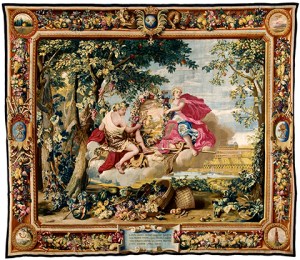
Autumn, after 1664, tapestry, wool, silk and gilt-metal wrapped thread, Gobelins Manufactory, cartoon attributed to Beaudrin Yvart (French, 1611–1690), after Charles Le Brun (French, 1619–1690), The Mobilier National, France. Photo by Lawrence Perquis.
It was during the reign of the Sun King, Louis XIV (r. 1643– 1715), that the art of tapestry weaving in France blossomed. Three hundred years after his death, the Getty Museum will showcase 15 monumental tapestries—from the French royal collection during the reign of Louis XIV. Woven Gold: Tapestries of Louis XIV will be the first major museum exhibition of tapestries in the Western United States in four decades.
During Louis XIV’s time, colorful and glittering tapestries, handwoven after designs by the most renowned artists, were the ultimate expression of status, power, taste, and wealth. The exhibition will feature 15 larger-than-life tapestries ranging in date from about 1540 to 1715 and created in weaving workshops across northern Europe. In an exclusive loan from the French nation, most of the tapestries are from the collection of the Mobilier National, which preserves the former royal collection. Eleven have never before been exhibited in the Unites States. The Getty Museum is supporting the conservation of two of the tapestries.
At the Getty, preparatory drawings, related prints and a life-sized cartoon (oil) will accompany the immense hangings. The tapestries in the exhibition are after works of art by Raphael (Raffaello Sanzio, Italian, 1483–1520), Peter Paul Rubens (Flemish, 1577–1640), Charles Le Brun (French, 1619–1690), and others. They come from the most notable workshops in Europe, including the Gobelins, which rose to preeminence under Louis XIV’s patronage. Several of the best-preserved and most famous examples of Gobelins weaving will be on view in the exhibition.
Woven Gold: Tapestries of Louis XIV is curated by Charissa Bremer-David, curator of sculpture and decorative arts at the Getty, and was organized by the J. Paul Getty Museum in association with the Mobilier National et les Manufactures Nationales des Gobelins, de Beauvais et de la Savonnerie.
◊ ◊ ◊ ◊ ◊
Charissa Bremer-David, with essays by Pascal-François Bertrand, Arnauld Brejon de Lavergnée, and Jean Vittet, Woven Gold: Tapestries of Louis XIV (Los Angeles: Getty Publications, 2015), 168 pages, ISBN: 978-1606064610, $50.
 Meticulously woven by hand with wool, silk, and gilt-metal thread, the tapestry collection of the Sun King, Louis XIV of France, represents the highest achievements of the art form. Intended to enhance the king’s reputation by visualizing his manifest glory and to promote the kingdom’s nascent mercantile economy, the royal collection of tapestries included antique and contemporary sets that followed the designs of the greatest artists of the Renaissance and Baroque periods, including Raphael, Giulio Romano, Rubens, Vouet, and Le Brun. Ranging in date from about 1540 to 1715 and coming from weaving workshops across northern Europe, these remarkable works portray scenes from the bible, history, and mythology. As treasured textiles, the works were traditionally displayed in the royal palaces when the court was in residence and in public on special occasions and feast days. They are still little known, even in France, as they are mostly reserved for the decoration of elite state residences and ministerial offices. This catalogue accompanies an exhibition of fourteen marvelous examples of the former royal collection that will be displayed exclusively at the J. Paul Getty Museum at the Getty Center from December 15, 2015, to May 1, 2016. Lavishly illustrated, the volume presents for the first time in English the latest scholarship of the foremost authorities working in the field.
Charissa Bremer-David is curator in the Department of Sculpture and Decorative Arts at the J. Paul Getty Museum. She is author of French Tapestries and Textiles in the J. Paul Getty Museum (Getty Publications, 1997) and has published extensively on French tapestries.
◊ ◊ ◊ ◊ ◊
Also on view at the Getty
As 2015 is the tercentenary of the death of Louis XIV, several exhibitions at the Getty Center will explore the Sun King’s tremendous influence on Western Art and his distinctive role as collector, heir, and patron of the art of tapestry and other arts.
• A Kingdom of Images: French Prints in the Age of Louis XIV, 1660–1715
16 June to 6 September 2015
• Louis XIV at the Getty
9 June 2015 to 31 July 2016
• Louis Style: French Frames, 1610–1792
15 September 2015 – 3 January 2016
New Book | Conundrum: Puzzles in the Grotesques Tapestry Series
Forthcoming from The Getty:
Charissa Bremer-David, Conundrum: Puzzles in the Grotesques Tapestry Series (Los Angeles: Getty Publications, 2015), 76 pages, ISBN: 978-1606064535, $20.
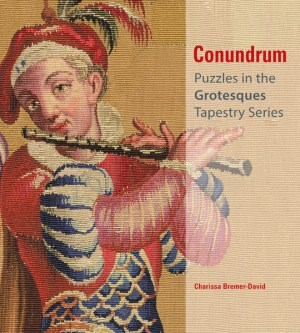 The whimsical imagery of four tapestries in the permanent collection of the J. Paul Getty Museum and currently on display at the Getty Center is perplexing. Created in France at the Beauvais manufactory between 1690 and 1730, these charming hangings, unlike most French tapestries of the period, appear to be purely decorative, with no narrative thread, no theological moral, and no allegorical symbolism. They belong to a series called the Grotesques, inspired by ancient frescos discovered during the excavation of the Roman emperor Nero’s Domus Aurea, or Golden House, but the origins of their mysterious subject matter have long eluded art historians. Based on seven years of research, Conundrum: Puzzles in the Grotesques Tapestry Series reveals for the first time that the artist responsible for these designs, Jean-Baptiste Monnoyer (1636– 1699), actually incorporated dozens of motifs and vignettes from a surprising range of sources: antique statuary, Renaissance prints, Mannerist tapestry, and Baroque art, as well as contemporary seventeenth-century urban festivals, court spectacle, and theater.
Conundrum illustrates the most interesting of these sources alongside full-color details and overall views of the four tapestries. The book’s informative and engaging essay identifies and decodes the tapestries’ intriguing visual puzzles, enlightening our understanding and appreciation of the series’ unexpectedly rich intellectual underpinnings.
Charissa Bremer-David is curator in the Department of Sculpture and Decorative Arts at the J. Paul Getty Museum. She is author of French Tapestries and Textiles in the J. Paul Getty Museum (Getty Publications, 1997) and has published extensively on French tapestries.
Exhibition | Louis Style: French Frames, 1610–1792
◊ ◊ ◊ ◊ ◊
Press release for the exhibition now on view at The Getty:
Louis Style: French Frames, 1610–1792
The Getty Center, Los Angeles, 15 September 2015 — 3 January 2016
Curated by Davide Gasparotto, Anne Woollett, and Gene Karraker
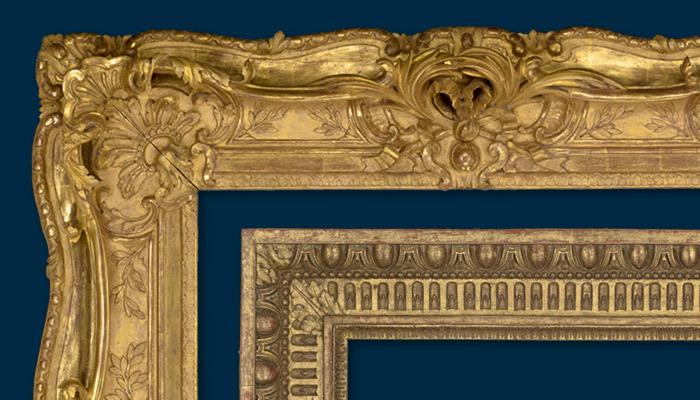
Louis Style: French Frames, 1610–1792 celebrates the dramatic stylistic transformation and technical skill of French frame making in the 17th and 18th centuries. Drawn from the J. Paul Getty Museum’s collection of antique frames, this exhibition presents an array of French design in wall furniture under four kings—from the simple moldings and Italian-inspired ornaments in the time of Louis XIII (1610–1643), to the opulent carved and gilded masterpieces in the age of Louis XIV (1643–1715), to the sculptural forms and rich finishes of the transitional period of the Régence (1715–1723) and Louis XV (1723–1774), and concluding with the restrained treatments preferred during the reign of Louis XVI (1774–1792).
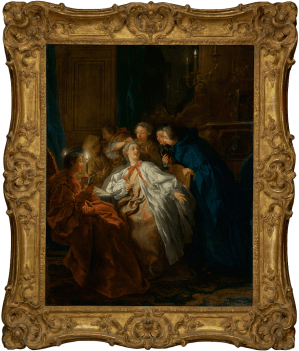
Jean-François de Troy, Before the Ball, 1735, oil on canvas, in a Louis XV frame, carved and gilded oak (The J. Paul Getty Museum)
Louis Style: French Frames, 1610–1792 will be the first exhibition devoted to frames at the Getty Museum. Featuring more than forty frames and framed paintings, Louis Style offers visitors the rare opportunity to consider in depth the types and function of this art form. The installation provides a rich compendium of French design and craftsmanship, along with practical tools, such as the vocabulary of ornament needed to identify the period of a frame, as well as insight into the construction and gilding techniques specific to frames made in France. By addressing the important relationship between a painting and its frame (which sometimes date from different periods and regions), visitors to the exhibition will also gain an awareness of the significance and use of frames in museums.
During the early 1600s through the 1700s—a golden age for frame-making in Paris—the functional surrounds for paintings became expressions of artistry, innovation, taste, and wealth. The primary stylistic trendsetters were the kings of France, whose desire for increasingly opulent forms of display spurred the creative efforts of brilliant designers and craftsmen to magnificent expressions of their personal styles. French frames of this period are distinguished by the use of oak and gold leaf as materials, and techniques of water gilding, elaborate carved ornamentation and varied finishes.
Over the course of several decades, the Museum has assembled a substantial group of period frames to enhance and appropriately display its paintings collection, resulting in a rich and varied assemblage of moldings. Enduring visitor interest in frames and framing led to the publication of D. Gene Karraker’s Looking at European Frames: A Guide to Terms, Styles and Techniques (J. Paul Getty Museum, 2009), illustrated exclusively by works in the collection. The celebration of the 300th anniversary of the death of Louis XIV this year, marked by two major loan exhibitions at the Getty Center, provides the opportunity to present one of the largest and most beautiful areas of the frame collection.
Louis Style: French Frames, 1610–1792 was organized by Senior Curator of Paintings and Department Head, Davide Gasparotto, Curator of Paintings, Anne Woollett, and Associate Conservator of Frames, Gene Karraker.
Hartwig Fischer Appointed as Director of The British Museum
Press release (29 September 2015) from The British Museum:
 Sir Richard Lambert, Chair of the Trustees of the British Museum, this morning announced to staff that Hartwig Fischer had been appointed Director of the British Museum. Dr Fischer, who is currently the Director General of the Staatliche Kunstsammlungen Dresden, will take up the post in Spring 2016. The current Director, Neil MacGregor, will retire from the Museum at Christmas. The appointment has been confirmed by the Prime Minister, the Rt Hon David Cameron.
Chairman of the Trustees Sir Richard Lambert said, “On behalf of the Trustees I am very happy to announce the appointment of Hartwig Fischer—currently Director General of the Staatliche Kunstsammlungen Dresden—as Director of the British Museum. He is one of the outstanding museum directors in the world. He is not only a great scholar, but an experienced administrator and a gifted linguist with a global reputation for rethinking and representing great collections. In Essen he directed one of the leading museums of 20th-century art in Germany and in Dresden he directs a museum whose collections are amongst the greatest in the world. Neil MacGregor has been a brilliant Director of the British Museum and has transformed its presence across the world. The Trustees are confident Dr Fischer will be a worthy successor.”
Hartwig Fischer said: “When I was growing up in Hamburg, Britain was always present in my family life. It has remained so ever since. I never dreamt that I would be invited to be responsible for this great British institution and I am conscious that nobody could fail to grasp what the British Museum represents not only for the UK but for the whole world. For many years I have looked to the British Museum as a model of public engagement, critical scholarship, and international outreach. I am of course daunted by such a responsibility but I know that nobody directs such a museum alone and the colleagues of the British Museum are admired and envied around the world. I am greatly looking forward to working with them. I have visited the British Museum on many occasions as a member of the public and have always admired the way every member of the team plays their part in making the collection available to the public all over the world. It’s an honour to be asked to become the Director of the British Museum and to follow in the footsteps of Neil MacGregor, who has done more than anybody else to position the Museum as one of modern society’s key institutions, fostering knowledge, understanding, and global citizenship.”
Neil MacGregor said “Hartwig Fischer is the perfect choice to run the British Museum. The Museum, its staff, its Trustees and its unparalleled collection is truly international. It therefore makes absolute sense for the new Director to reflect this global outlook. Dr Fischer is a well-respected scholar with extensive experience. He will, I am sure, build on the British Museum’s recent successes to ensure the Museum remains one of the world’s greatest museums.”
Hartwig Fischer is currently the Director General of the Dresden State Art Collections (Staatliche Kunstsammlungen Dresden) where he is responsible for fourteen museums and four separate institutions in four cities. His focus since his appointment in 2012 has been on modernizing and developing the State Art Collections, which date back to the 16th century. The collections are some of Germany’s finest, spanning more than 5,000 years of art, archaeology, anthropology and cultural history. Prior to that appointment, Fischer was Director of the Folkwang Museum in Essen (2006–2012). Whilst in post he oversaw the fundraising and restoration of the historic museum and the construction of a new building, and presided over a period of increasing visitor figures and popularity. He began his museum career at the Kunstmuseum in Basel, where he was curator of 19th-century and Modern Art from 2001–2006. Fischer has studied the History of Art, History and Classical Archaeology in Bonn, Berlin, Rome and Paris and holds a Doctorate in Philosophy from the University of Bonn. He speaks German, English, French and Italian. He was born in Hamburg 14 December 1962 and is married to psychoanalyst Ilaria Piqueras Fischer.
Exhibition | La Fibre des héros, l’Histoire racontée par la Toile de Jouy
Now on view at the Musée Lambinet:
La Fibre des héros, l’Histoire racontée par la Toile de Jouy
Musée Lambinet, Versailles, 19 September — 20 December 2015
 Dans le cadre des commémorations nationales du bicentenaire de la disparition de Christophe-Philippe Oberkampf (1738–1815), fondateur de la manufacture de Jouy, le musée Lambinet présente l’exposition La fibre des héros. Celle-ci propose de retrouver, grâce à la toile imprimée, le reflet des idéaux et des événements qui ont intéressé la société à la fin du XVIIIe siècle et dans la première moitié du XIXe siècle. Les toiles à personnages, fidèles aux canons néo-classiques en vogue à leur époque, représentent souvent des héros antiques. D’autres toiles mettent en scène des épisodes et héros du monde littéraire, militaire ou scientifique contemporain. Reflets de l’actualité, elles montrent aussi le vol des premiers aérostats ou encore des combats navals marquants. Ces décors ultra-narratifs ont été principalement produits par la manufacture de Jouy-en-Josas, mais aussi les manufactures de Rouen, de Nantes ou de Mulhouse. Empruntées majoritairement au musée de la toile de Jouy, à Jouy-en-Josas, les toiles exposées forment un complément de l’exposition Christophe-Philippe Oberkampf, 1738–1815: Les toiles de Jouy, une aventure humaine, industrielle et artistique, qui se tient à Jouy du 15 septembre au 27 décembre 2015.
Exhibition | Oberkampf: Les Toiles de Jouy
Now on view at the Musée de la Toile de Jouy:
Christophe Phillipe Oberkampf. Les toiles de Jouy: Une aventure humaine, industrielle et artistique
Musée de la Toile de Jouy, Jouy-en-Josas, 15 September — 27 December 2015
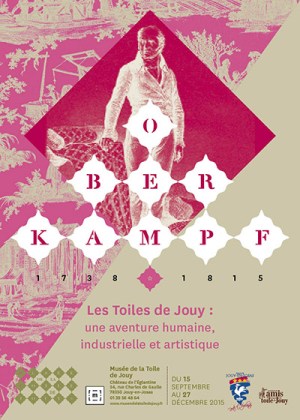 Pour tout savoir sur l’histoire de Christophe-Philippe Oberkampf et la façon dont il a fait de la Toile de Jouy un produit mondialement connu, le musée propose un parcours chronologique qui relate l’ascension de ce fils d’un teinturier allemand, né en 1738 et devenu un des pionniers de la révolution industrielle. Arrivé à Paris comme simple ouvrier, peu instruit (il le déplorera toute sa vie) mais visionnaire, Oberkampf fit de la manufacture qu’il fonda à Jouy-en-Josas la deuxième entreprise de France à la fin de l’Ancien Régime. Toujours à l’avant-garde des progrès techniques, il sut par ailleurs s’entourer de peintres talentueux, comme Horace Vernet ou Jean-Baptiste Huet, pour imaginer les motifs de ses toiles. L’exposition raconte cette histoire, ou comment les Toiles de Jouy ont supplanté les ‘palampores’, ces toiles indiennes importées des lointains comptoirs et comment elles ont conquis toutes les couches de la société, participant à une démocratisation de la mode et de la décoration, grâce à l’industrialisation des procédés inventée par Oberkampf.
Colloquium | Oberkampf et la toile imprimée XVIIIe–XIXe siècle
From the conference programme:
Oberkampf et la toile imprimée XVIIIe–XIXe siècle: Production, création, consommation
Musée de la toile de Jouy, Jouy-en-Josas, 8–10 October 2015
 J E U D I , 8 O C T O B R E 2 0 1 5
14.00 Accueil des participants par le Maire et le Secrétaire général d’HEC
14.30 L’industrie du coton en Île-de-France
Modérateur Aziza Gril-Mariotte
• Introduction par Serge Chassagne, président du comité scientifique, « Les entreprises cotonnières d’Île-de-France»
• Martine Lefèvre, conservateur en chef, Bibliothèque de l’Arsenal, « La manufacture de Jacques Daniel Cottin à l’Arsenal»
• Anne de Thoisy et le Groupe de Recherches Historiques de Jouy-en-Josas, « Les domaines textiles de la famille Oberkampf illustrés par Julie Féray »
• Karine Berthier, Laboratoire d’Archéologie et d’Histoire médiévales de l’Université de Picardie, EA 4284 TRAME, « Le centre de production des installations essonniennes : évolution, organisation et production, XVIIIe–XIXe siècle»
• Xavier Petitcol et Michel Perrier, « Chronologie de la production de la manufacture Oberkampf à partir des chefs de pièces et numéros de dessin »
17h30 Échanges avec la salle
V E N D R E D I , 9 O C T O B R E 2 0 1 5
9.30 Accueil des participants
10.00 Innovations et transferts techniques dans l’industrie cotonnière
Modérateur Natacha Coquery
• Sophie Patte, Musée des arts décoratifs de l’Océan Indien, «Les Mascareignes, îles privées de la Compagnie des Indes, terres d’expérimentation dans la quête de la chimie de la couleur, au XVIIIe siècle »
• Marguerite Martin, « Une matière première : L’indigo, l’approvisionnement au XVIIIe siècle »
• Philip Sykas, Manchester University, « Entente cordiale: Anglo-French exchange among calico printers »
• Ezio Ritrovato, Università di Bari Aldo Moro, « L’impression et la teinture du coton dans les
études et dans la vie d’un chimiste italien du XIXe siècle »
12.00 Échanges avec la salle
14.30 Histoire industrielle
Modérateur Pascale Gorguet-Ballesteros
• Isabelle Bernier, FRAMESPA UMR 5136 Université Toulouse II Jean Jaurès, « L’indiennage, moteur de l’industrialisation à Mulhouse au début du XVIIIe siècle »
• Roberto Rossi, Dept of Economics and Statistics, University of Salerno, « The division of labor and salary skills in the Barcelona’s indianas manufactures in the second half of the XVIII Century »
• Aziza Gril-Mariotte, « Évolution de l’impression aux plaques de cuivre à Jouy »
• Vibe Maria Martens, Ph.D Researcher European University Institute, Florence, « Cotton printing at the European fringe: the case of Denmark »
16.20 Évolution artistique
Modérateur Pascale Gorguet-Ballesteros
• William DeGregorio, PhD Candidate, Bard Graduate Center, New York, « Two newly discovered Indian chintzes copied at the Oberkampf manufactory ca. 1774: Preliminary investigations into design, origins, and context »
• Ji Eun You, Ph.D candidate, University of North Carolina, « Toile-de-Jouy at the Garde Meuble de la Couronne during the French Revolution »
17h00 Échanges avec la salle
S A M E D I , 1 0 O C T O B R E 2 0 1 5
10.00 Accueil des participants
10.30 Histoire des collections
Modérateur Esclarmonde Monteil
• Danièle Veron-Denise, Conservateur honoraire du Patrimoine, « Destins croisés : les toiles imprimées de Jouy et de Mulhouse dans l’ameublement du château de Fontainebleau »
• Véronique de La Hougue, Conservateur en chef, Musée des Arts décoratifs, « Les toiles de Jouy dans la collection des Arts Décoratifs »
• Kirsten Toftegaard, textile curator, Designmuseum Danmark, « A study of West European printed textiles in the State Hermitage Museum’s collection focusing on the tradition of narrative prints »
• Jacqueline Jacqué, conservateur honoraire du patrimoine, «Des toiles de Jouy à Mulhouse, histoire croisée de deux collections»
Conclusion du colloque : S. Chassagne & E. Monteil
Après-midi : Visite de l’exposition Oberkampf au Musée de la Toile de Jouy
Exhibition | Simeon De Witt: Mapping the Revolution
From the exhibition press release (23 September 2015). . .
Simeon De Witt: Mapping the Revolution
Zimmerli Art Museum, Rutgers, New Brunswick, New Jersey, 1 September 2015 — 31 July 2016
Curated by Jenevieve DeLosSantos with Donna Gustafson

Ezra Ames, Portrait of Simeon De Witt, 1804 (Zimmerli Art Museum at Rutgers, photo by Jack Abraham)
When General George Washington led troops into colonial New Jersey during the early months of the Revolutionary War, he did not have access to an app—or even adequate drawings on paper—to guide him across the region. But in 1776, Simeon De Witt (1756–1834), the sole graduate that year from Rutgers (then known as Queen’s College), joined the Continental Army to fight the British. As a signature project of Rutgers 250, the year-long celebration of the university’s founding in 1766, the Zimmerli Art Museum presents Simeon De Witt: Mapping the Revolution, on view through July 31, 2016. The exhibition honors De Witt’s crucial role during the Revolutionary War and, throughout the rest of his life, documenting the geography of New York State (he was a native of Ulster County). It also explores the practice of 18th-century cartography through his original maps and tools.
“As we get ready to celebrate the 250th anniversary of Rutgers in 2016, this exhibition reminds us of the important role that New Jersey and its citizens played in the colonies’ efforts to win their independence and form a new democracy,” observed Jenevieve DeLosSantos, who organized the exhibition while working as a graduate curatorial assistant at the Zimmerli and recently received her PhD in Art History from Rutgers. By 1780, De Witt was named surveyor general and sketched maps of New Jersey’s uncharted land, working directly under George Washington. His topographic renderings were a valuable resource to the Commander-in-Chief as he navigated the terrain and evaded British forces.
After the successful conclusion of the war, De Witt built a career with accomplishments that aided new Americans who were instrumental in the early stages of westward expansion. In 1784, De Witt was appointed Surveyor General of the State of New York, a post he held for 50 years. In 1802, he drafted the first large-scale map of the state to be printed. It was the most detailed to date—depicting newly established cities, towns, and county lines—and distributed to salons and offices as an accurate reference of the Empire State’s geography. An 1804 version of this map is on view, on loan from Special Collections and University Archives at Rutgers University Libraries. The map is accompanied by several of De Witt’s original drafting tools, on loan from the Albany Institute of History and Art, and a field compass commonly used during the era, also from Special Collections. These historical objects provide insight into the resources available to De Witt at the time.
The Zimmerli’s 1804 three-quarter length portrait of De Witt in a stately interior captures him in the prime of his life. He thoughtfully gazes beyond the frame of the image, surrounded by the tools of his profession: a telescope, a globe. De Witt’s hand rests on a table, with the top portion of the aforementioned map of New York State visible. That it was painted by the prominent portrait artist Ezra Ames (1768–1836), who lived in Albany, New York, indicates De Witt’s status as an accomplished and respected member of society. More than 700 portraits have been attributed to Ames; among them, Founding Father Alexander Hamilton and the first governor of New York, George Clinton.
The selection includes other items that indicate the popularity of Revolution-era subjects in fine art and popular culture during the nation’s early decades. The Zimmerli’s recently cleaned and conserved portrait of George Washington was painted by Jane Stuart around 1840. The daughter of the renowned portraitist Gilbert Stuart, she opened her own studio after his death in 1828 and sold her work; especially popular were replicas of her father’s portrait of the country’s first president. Also on view are prints that depict important battles in New Jersey during America’s War for Independence, including a map by English engraver William Faden that depicts the positions of Washington’s troops in New Jersey and Pennsylvania at the beginning of the war.
Simeon De Witt: Mapping the Revolution is organized by Jenevieve DeLosSantos, PhD Art History, Rutgers University and Graduate Curatorial Assistant, 2013–2015, with the assistance of Donna Gustafson, Curator of American Art and Mellon Director for Academic Programs. The exhibition is a signature project of Rutgers 250, a yearlong celebration beginning November 10, 2015, to mark the university’s 250th anniversary. Complete information and a list of related events can be found at 250.rutgers.edu.
The Jane Voorhees Zimmerli Art Museum houses more than 60,000 works of art, ranging from ancient to contemporary art. The permanent collection features particularly rich holdings in 19th-century French art; Russian art from icons to the avant-garde; Soviet nonconformist art from the Dodge Collection; and American art with notable holdings of prints. In addition, small groups of antiquities, old master paintings, as well as art inspired by Japan and original illustrations for children’s books, provide representative examples of the museum’s research and teaching message at Rutgers. One of the largest and most distinguished university-based art museums in the nation, the Zimmerli is located on the New Brunswick campus of Rutgers, The State University of New Jersey. Established in 1766, Rutgers is America’s eighth oldest institution of higher learning and a premier public research university.










 Enfilade
leave a comment