Conference | The Artist’s Studio in Eighteenth-Century Britain
From the Paul Mellon Centre for Studies in British Art:
The Painting Room: The Artist’s Studio in Eighteenth-Century Britain
Sotheby’s Institute of Art, London (Thursday), and Gainsborough’s House, Sudbury, Suffolk (Friday), 29–30 October 2015
 This two-day conference, sponsored by the Esmée Fairbairn Collections Fund and the Paul Mellon Centre for Studies in British Art, examines the role and character of artists’ painting rooms in the long eighteenth century. It is organised in association with an exhibition focusing on the painting room that is to be held at Gainsborough’s House between October 2015 and January 2016.
The conference aims to bring together current scholarship on the nature of the painting room, primarily in Britain but also in France, which was a constant model for British artists. The first day, to be held at the Sotheby’s Institute of Art, considers the varying character and function of the painting room in London, Bath and Paris: how it was used, how it was seen by outsiders, and how artists exploited it to create spaces for the display and sale of their work. Detailed studies of the painting rooms of Joshua Reynolds and Joseph Wright of Derby will help to illustrate these arguments. The second day of the conference, which will take place at Sudbury, will focus more particularly on the example of Thomas Gainsborough. Speakers will consider technical issues such as the use of materials, lay figures, drapery and costumes within the painting room, together with the role of the copy. This second day will also feature a discussion of the relationship between the painting room and the modern-day artist’s studio.
The aim of the conference as a whole is to explore the distinctive world of the Georgian painting room, and to complement the innovative recreation of such an environment within the exhibition at Gainsborough’s House.
Confirmed Speakers
Mark Bills (Gainsborough’s House)
Spike Bucklow (Hamilton Kerr Institute)
Matthew Craske (Oxford Brookes University)
Edwina Ehrman (Victoria & Albert Museum)
Karen Fielder (Portsmouth University)
Rica Jones (Independent Scholar)
Kristina Mandy (Hamilton Kerr Institute)
Peter Moore (Gainsborough’s House)
Jane Munro (Fitzwilliam Museum)
George Shaw (Artist)
Susan Sloman (Independent Scholar)
Hannah Williams (Queen Mary, University of London)
Jonathan Yarker (Lowell Libson Ltd)
Tickets
£30 Standard Ticket (for both days)
£20 Concession Ticket (students and senior citizens, for both days)
Tickets include refreshments, lunch and a drinks reception on both days. Tickets will not be sold separately for each day; attendees must commit to both days.
Please note your ticket does not include your travel to Sudbury on Day 2 and we kindly ask you to make your own way there. If you are travelling from London to Sudbury, the conference organisers will be travelling on the train stated on the timetable, if you wish to join them.
Funding the Larson Historic Fashion Collection for the FIDM Museum
$4 for 400 Years of Fashion: Helen Larson Social Media Fundraising Campaign
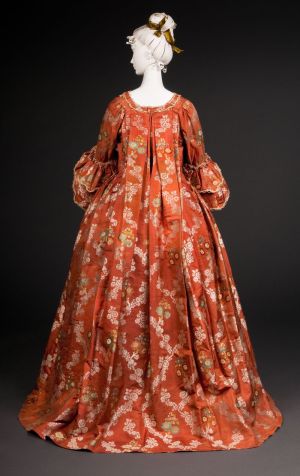
Robe volante, France, ca. 1745 (Helen Larson Historic Fashion Collection)
The Fashion Institute of Design and Merchandising Museum is fundraising to acquire a truly remarkable collection of rare historical fashion, ranging from a man’s red velvet jerkin dating to 1600 to stunning couture creations of the twentieth century. These pieces were collected by Helen Larson, a collector and successful entrepreneur who understood the importance of fashion history. The Helen Larson Historic Fashion Collection encompasses more than 1,400 pieces representing 400 years of history—but this critically important collection could be broken up and lost forever. The Museum has until the end of 2015 to raise the remaining $2 million needed to purchase the collection for our institution. Without these funds, the collection will be dispersed or absorbed into another private collection, inaccessible to students, researchers, and the general public.
On August 4, 2015, the FIDM Museum will launch the #4for400 project, a social media fundraising campaign to keep the Larson Collection at a public institution. The Museum’s Facebook, Twitter, and Instagram accounts will ask supporters to text MUSEUM to 243-725 and donate just $4 to save more than 400 years of fashion. Our hope is that a momentum will build, resulting in #4for400 posts being shared, liked, re-tweeted, and re-grammed, creating a flurry of donation activity. In conjunction with the launch, the Museum will host an Open House event from 3–7 pm, allowing the public to join in the excitement of the fundraising campaign with refreshments, raffles, music, and gallery tours.
The #4for400 campaign has the power to keep this one-of-a-kind cultural treasure at an academic institution in downtown Los Angeles, where it can be appreciated by museum visitors and used for research and inspiration by generations to come.
You can also donate by clicking here»
Exhibition | Dionysos Unmasked: Ancient Sculpture and Early Prints
Now on view at AIC:
Dionysos Unmasked: Ancient Sculpture and Early Prints
Art Institute of Chicago, 31 July 2015 — 15 February 2016

Hellenistic or Roman, Eastern Mediterranean. Statue of Young Dionysos, 100 BC–AD 100, bronze, copper and silver (modern). 136 x 62 x 52 cm (54 x 24 1/2 x 20 in.). Anonymous loan, 1.2013. Photography by Richard Valencia.
This innovative collaboration between the Department of Ancient and Byzantine Art and the Department of Prints and Drawings examines Renaissance and Baroque printmakers’ direct responses to Classical antiquity through the figure of Dionysos, the ancient Greek god of wine and theater. Installed in the Mary and Michael Jaharis Galleries of Greek, Roman, and Byzantine Art, this exhibition juxtaposes ancient sculpture with prints from the 15th through the 18th century with nearly 100 objects—pieces from the permanent collection, new loans of ancient art, and recently acquired works on paper.
Dionysos—known as Bacchus to the Romans—cavorted with an entourage of satyrs, the god Pan, and frenzied maenads, female followers of the god. All these devotees represented the untamed and hedonistic desires of humanity, which were unleashed by the intoxicating elixir of wine. Because performance was a part of the early Greek festivals of Dionysus, he also became known as the patron god of theater, an aspect of the deity that is less well known today. In ancient art, Dionysos could take many forms, from a graceful youth to a bearded mature man. During the Renaissance and Baroque periods, the time of early printmaking, interest in antiquity—especially Dionysos—flourished. Ancient sculptures depicting the god and his raucous retinue inspired artists to find new ways to transform age-old Dionysian subjects into prints and drawings that would appeal to their own contemporary audiences.

Left: Statue of a Young Satyr Wearing a Theater Mask of Silenos, ca. 1st century AD, restorations by Alessandro Algardi, 1628. Anonymous loan. Right: John Downman, Antique Statue of Seated Putto Holding Mask of Pan, 1775 (AIC, Leonora Hall Gurley Memorial Collections).
Anchoring the exhibition are Greek and Roman sculptures depicting Dionysos and his wild followers along with vessels used in ritual drinking parties and festivals honoring the god of wine and theater. Their printed counterparts are masterpieces from the Italian Renaissance to the French Rococo, including notably Andrea Mantegna’s Bacchanal with a Wine Vat, a 15th-century Italian engraving with striking visual similarity to the bronze Statue of Young Dionysos (a current long-term loan to the museum). Bringing together this rich selection of works, separated by as many as 1,500 years, this exhibition offers new, enticing insights into the art of Classical antiquity and its later revivals.
The June 2013 press release announcing the long-term loan of the bronze Statue of Young Dionysos is available as a PDF
file here»
New Book | Indian Cotton Textiles from the Karun Thkar Collection
From ACC Distribution:
John Guy, Indian Cotton Textiles: Chintz from the 14th to the Early 20th Centuries in Karun Thkar Collection (New York: ACC Art Books, 2015), 172 pages, ISBN: 978-1851498093, $70.
 India has been at the heart of the global trade in textiles since ancient times, and cotton has been at the heart of the Subcontinent’s economy for millennia. Indian dyed and painted cottons were admired in and traded to the Far East and the Mediterranean world for many generations before European interest in chintz created a new market. The trade in Indian cloth flourished due to the ability of its craftsmen to create a multitude of detailed and expressive patterns with strong and fast colors. Such textiles gained high esteem among the elite at home and abroad, ultimately acquiring heirloom status.
Karun Thakar has been collecting textile art for more than 30 years, and has one of the world’s leading private collections from the Indian Subcontinent, with costume and fabrics from the 14th century through to the early 20th. Aspects of the Thakar Collection have been exhibited in the Victoria & Albert Museum in London and at the Metropolitan Museum of Art in New York.
The Indian dyed and painted cotton cloths in the Thakar Collection are perhaps the best in private hands. Many have never previously been published. Dating from the 15th century onwards, the collection illustrates the trade in textiles across the Indian Ocean with the Malay-Indonesian world, with Sri Lanka, Armenia and Europe, as well as within the Indian domestic market.
John Guy is the Florence and Herbert Irving Curator of the Arts of South and Southeast Asia, Department of Asia Art, The Metropolitan Museum of Art, New York, and an elected Fellow of the Society of Antiquaries, London. His major publications include: Woven Cargoes: Indian Textiles in the East (1998), Indian Temple Sculpture (2007), Wonder of the Age: Master Painters of India, 1100–1900, and Lost Kingdoms: Hindu-Buddhist Sculpture of Early Southeast Asia (2014).
2014 Dissertation Listings
From caa.reviews:
Dissertation Listings
PhD dissertation authors and titles in art history and visual studies from US and Canadian institutions are published each year in caa.reviews. Titles can be browsed by subject category or year.
Titles are submitted once a year by each institution granting the PhD in art history and/or visual studies. Submissions are not accepted from individuals, who should contact their department chair or secretary for more information. Department chairs: please consult our dissertation submission guidelines for instructions. The annual deadline is January 15 for titles from the preceding year.
In 2003, CAA revised the subject area categories of art history and visual studies used for all our listings, including dissertations. These categories are listed in the Dissertation Submission Guidelines.
◊ ◊ ◊ ◊ ◊
The index for 2014 lists eight eighteenth-century dissertations completed, including:
• Cannady, Lauren, “Owing to Nature and Art: The Garden Landscape and the Eighteenth-Century French Interior” (IFA/NYU, T. Crow)
• Fox, Abram, “The Great House of Benjamin West: Family, Workshop, and National Identity in Late Georgian England” (Maryland, College Park, W. Pressly)
• Francis, Razan, “Secrets of Enlightenment Spain’s Contested Islamic Craft Heritage” (MIT, D. Friedman)
• Marchand, Marie-Ève, “L’histoire de l’art mise en pièces. Analyse matérielle, spatiale et temporelle de la period room comme dispositif muséal” (Université de Montréal, J. Lamoureux)
◊ ◊ ◊ ◊ ◊
and forty-one dissertations in progress, including:
• Brosnan, Kelsey, “Seductive Surfaces: Anne Vallayer Coster and the Eighteenth-Century Still Life” (Rutgers, S. Sidlauskas)
• Cooper, John, “Imperial Balls: The Arts of Sex, War, and Dancing in India, England, and the Caribbean, 1780–1870” (Yale, T. Barringer, R. Thompson)
• DiSalvo, Lauren, “Micromosaics as Grand Tour Souvenirs in Europe from the Early Eighteenth Century to the Late Nineteenth Century” (Missouri, M. Yonan, K. W. Slane)
• Gratta, Eva, “‘Great Links of the Chain’: Maritime Imagery in North America, 1750–1850” (CUNY, K. Manthorne)
• Greenberg, Daniel, “A New Imperial Landscape: Ritual, Representation, and Foreign Relations in the Qianlong Court (1735–1796)” (Yale, Y. Kim)
• Mitchell, David, “Mimetic Heresies: Waxworks in Paris, 1661–1723” (McGill, A. Vanhaelen; R. Taws)
• Presutti, Kelly, “Terroir after the Terror: Landscape and Representation in Nineteenth-Century France” (MIT, K. Smentek)
• Rado, Mei, “Xiyang Textiles in the Eighteenth-Century Qing Imperial Court: Fabrication, Display, and Representation of the West” (Bard Graduate Center, F. Louis)
• Ridlen, Michael T., “Prud’hon and the Graceful Style” (Iowa, D. Johnson)
• Szalay, Gabriella, “Materializing the Past: The History of Art and Natural History in Germany, 1750–1800” (Columbia, K. Moxey)
• Von Preussen, Brigid, “The Antique Made New: Commercial Classicism in Late Georgian Britain” (Columbia, A. Higonnet)
• Wunsch, Oliver, “Painting Against Time: The Decaying Image in the French Enlightenment” (Harvard, E. Lajer-Burcharth)
Call for Papers | Posing the Body
From The Courtauld:
Posing the Body: Stillness, Movement, and Representation
Regent Street Cinema, University of Westminster and The Courtauld Institute of Art, London, 6–7 May 2016
Proposals due by 2 October 2015
Posing has been central to art, dance, and sculpture for thousands of years. In recent years, the growing interest in fashion media and modelling has also focused attention on questions of pose and posing. Incorporating notions of movement and stillness, posing can be understood in terms of historical modes of representation, as well as contemporary media and rapidly evolving relationships between bodies, subjects, and technologies of representation. Posing incorporates symbolic and semiotic meaning alongside embodied action and feeling. Recent coverage of the work of choreographer Stephen Galloway in 032c magazine, and new publications such as Steven Sebring’s Study of Pose: 1000 Poses by Coco Rocha testify to the growing interest in the cultural significance of posing and the pose—yet both remain under-researched areas with little discussion of their significance.
This symposium will assert the importance of pose as both a creative practice and an emerging area of critical inquiry. It will bring together multi-disciplinary academics and practitioners to discuss and develop new ways of understanding pose and posing in a historical and contemporary context. We encourage proposals for papers that address pose from global and diverse perspectives. This event represents a potentially fruitful and exciting moment to bring these strands together to the benefit of researchers within practice and theory-based media, historians of dress, photography, art and film and allied disciplines.
The keynote lecture will be delivered by David Campany, internationally recognised writer and curator, and Reader in Photography at the University of Westminster.
Possible themes include (but are not limited to)
• Modelling (fashion and artistic)
• Gesture
• Dance (popular and classical)
• Pose and the everyday
• Movement and stillness
• Posing, corporeality and the body
• Posing and social media (blogs, Instagram, etc.)
Please submit abstracts of 150–200 words in English, along with a short biography of approximately 100 words to Posingthebody@gmail.com by 2 October 2015.
Organised by Rebecca Arnold, Oak Foundation Lecturer in History of Dress & Textiles, The Courtauld Institute of Art; Katherine Faulkner, Study Skills and Widening Participation Academic Coordinator, The Courtauld Institute of Art; Katerina Pantelides, Visiting Lecturer, The Courtauld Institute of Art and Eugénie Shinkle, Reader in Photography, University of Westminster.
New MA in the Art Market and History of Collecting
From The University of Buckingham and The National Gallery:
MA in the Art Market and History of Collecting
 The University of Buckingham and the National Gallery, in association with Waddesdon Manor (The Rothschild Collection), are delighted to announce the launch of a new MA course on the History of Collecting and the Art Market in January 2016.
The study of the art market and the history of collecting has been one of the most significant growth areas within Art History in the last 30 years, attracting wide interest internationally, particularly in Europe and the United States. Competitively priced, this new MA will investigate American and European art markets and cultures of collecting from the Renaissance to the present day. The first of its kind in the UK, it will be taught by staff from the University of Buckingham, the National Gallery and Waddesdon Manor. The course will include study trips to Paris and Florence. All the London-based teaching, spread over two terms, will be based at the National Gallery in London.
A unique feature of the course will be access to two of the greatest surviving art dealers’ archives: Agnew’s, acquired by the National Gallery in 2014, and Colnaghi’s, housed in the Windmill Hill Archive, Waddesdon, since February 2014. Under the guidance of experts, students will be given practical training on how to use, unlock and analyse their rich holdings. Aimed at art historians, would-be curators, collectors, those with a professional interest in the art market or a general interest in the arts, the programme provides a pathway to a career in the art world or a step towards further postgraduate research.
University of Buckingham Programme Director, Jeremy Howard said: “I am thrilled by the exciting opportunities that our new MA will offer. Developed and delivered by the University of Buckingham and the National Gallery in association with Waddesdon, the MA will enable Buckingham to offer students privileged access to the two greatest London-based dealer archives, first-class research training, and an entrée to one of the fastest-growing areas of art history. For those with an eye on a PhD, a possible career in curatorship or the art market, the course will provide a valuable spring-board; but we are also hoping that this new MA will appeal to those who are interested in studying the history of collecting as a fascinating subject in its own right.”
Sir Nicholas Penny, Director of The National Gallery, said: “I am delighted that the National Gallery is collaborating with the University of Buckingham’s research-led MA focusing on the history of collecting and the art market. In an increasingly popular area of research, this course, designed and taught by leading figures in the field, will introduce students to the many and varied facets of the subject, as well as providing much-needed training in the use of archives, drawing on some of the National Gallery’s own important holdings, including the recently-acquired Agnew’s archive.”
Pippa Shirley, Head of Collections and Gardens at Waddesdon Manor said: “We are delighted to be working with the University of Buckingham and the National Gallery on this new MA, which explores a critical aspect of the nineteenth-century art market. There is a particular appropriateness for Waddesdon to be a part of this collaboration—not only is the Colnaghi Archive housed with us, but the collections at the Manor are a reflection of the passions of one of the most influential of nineteenth-century collecting dynasties, the Rothschilds, who bought through both Colnaghi and Agnew, which allows their archives to be brought to life in a very vivid way.”
Buckingham, set up in 1976, was the only university to be independent of direct government support in the United Kingdom and has used its independence to pioneer a distinctive approach to higher education.
The programme brochure is available as a PDF file here»
New Book | Carlo Marchionni: Caricaturista
From Campisano:
Simonetta Prosperi Valenti Rodino, Carlo Marchionni: Caricaturista tra Roma, Montefranco, Civitavecchia e Ancona (Rome: Campisano, 2015), 464 pages, ISBN: 978-8898229482, $90.
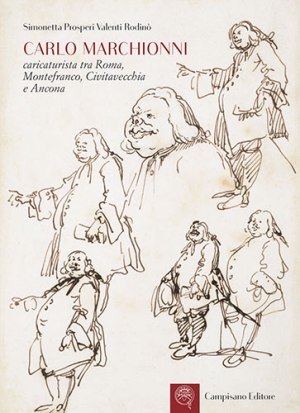 Carlo Marchionni (1702–1786) è assai noto per la sua attività di architetto e decoratore nel Settecento a Roma, città dove lavorò nelle imprese più significative del tempo: la Fabbrica e la Sacrestia di San Pietro, anche se la sua fama è legata alla celebre Villa Albani sulla via Salaria, da lui progettata per raccogliere la collezione di antichità del cardinal Alessandro Albani. Accanto a questa attività, Marchionni si dedicò anche alla caricatura, realizzando per suo divertimento un’ampia serie di divertenti studi caricaturali dedicati a personaggi d’ogni ambiente sociale del suo tempo: da gentiluomini ed ‘offiziali’, prelati e personaggi di Curia, artisti suoi colleghi incontrati all’Accademia di San Luca, quali l’architetto Barigioni, i pittori Benefial, Batoni e Monosilio, senza dimenticare servi, mendicanti, gobbi ed appartenenti alla più bassa categoria sociale, che ci offrono nel loro insieme uno spaccato interessantissimo della società romana del Settecento. Se le strade di Roma, fornirono il materiale umano più interessante all’occhio curioso dell’architetto, la sua vena satirica lo accompagnò anche nei suoi viaggi di lavoro a Civitavecchia ed Ancona, luoghi dove si soffermò a ritrarre figure di turchi, levantini e lavoranti portuali incontrati per caso. Una pausa serena gliela offrì la cittadina umbra di Montefranco, nei pressi di Terni, dove soggiornò con la sua famiglia in una tranquilla vacanza ospitato dall’amico Lorenzo Sinibaldi: lì ebbe modo di fissare in divertentissime vignette i personaggi più in vista del piccolo centro agricolo, dal Segretario comunale, ai villici, al barbiere, sino a fabbri, contadini e i caratteristici gobbi, da lui presi bonariamente in giro. Tre di questi tomi, ed indubbiamente i più significativi, sono confluiti nelle raccolte del Museo di Roma a Palazzo Braschi: insieme agli analoghi volumi, oggi conservati uno nella Biblioteca Palatina di Parma, l’altro nella Biblioteca Apostolica Vaticana, ed infine l’ultimo nel Département des Arts Graphiques del Louvre di Parigi, essi costituiscono il documento della produzione di caricature, davvero non secondaria, del più noto architetto attivo a Roma nel Settecento. Questo libro illustra tale attività, offrendo il catalogo completo delle ben 294 caricature conservate nei tre volumi del Museo di Roma.
Simonetta Prosperi Valenti Rodinò è professore ordinario di Storia dell’arte moderna all’Università di Roma Tor Vergata. Èspecialista del disegno italiano ed in particolare romano dal XVI al XVIII secolo, soggetto ai cui ha dedicato molti saggi in riviste italiane e straniere ed in cataloghi di mostre. Da anni approfondisce lo storia del collezionismo ed il mercato del disegno in Italia dei secoli XVII e XVIII. Le sue più recenti e significative pubblicazioni su questi soggetti sono i volumi Il Codice Resta di Palermo (2007), I disegni del Codice Capponiano 237 della Biblioteca Apostolica Vaticana (2010), Dilettanti del disegno nell’Italia del Seicento: padre Resta tra Malvasia e Magnavacca (2013). È uno dei curatori ed autori del volume di Atti del Convegno Maratti e l’Europa (Roma, 11–12 novembre 2013), di prossima pubblicazione.
Call for Papers | ASECS 2016, Pittsburgh
2016 American Society for Eighteenth-Century Studies Conference
Pittsburgh, 31 March — 3 April 2016
Proposals due by 15 September 2015
 The 2016 ASECS conference takes place in Pittsburgh, March 31 – April 3, at the Omni William Penn. Along with our annual luncheon and business meeting, HECAA will be represented by the Anne Schroder New Scholars’ Session, chaired by Janet White. In addition, a selection of sessions that might be relevant for HECAA members are included below. A full list of panels is available as a PDF file here»
◊ ◊ ◊ ◊ ◊
Anne Schroder New Scholars’ Session (Historians of Eighteenth-Century Art and Architecture)
Janet R. White, UNLV School of Architecture, 4505 Maryland Pkwy, Box 454018, Las Vegas, NV 89154- 4018; janet.white@unlv.edu.
This session will feature outstanding new research by emerging scholars of art and architecture in the long eighteenth century.
◊ ◊ ◊ ◊ ◊
Felines and Philosophers in the Eighteenth Century
Michael Yonan, Department of Art History and Archaeology, University of Missouri, 365 McReynolds Hall, Columbia, MO 65211; yonanm@missouri.edu.
The Comte de Buffon was not a cat person. “Unfaithful domestics,” he dubbed them, possessing “only the appearance of attachment or friendship” with their human keepers. Behind those enticing purrs and rubs lay malicious, distrustful natures, leading Buffon to question whether cats could ever be socialized completely. Even worse, unlike their wild cousins, house cats were dissimulators, “easily assuming the habits of society, but never acquiring its manners.” Buffon’s comments prophesize sentiments voiced today by those wondering how creatures with strong independent and predatory instincts ended up sleeping on our couches. They likewise reveal that something about felines remained difficult to describe within schema of animal behavior formulated in the Enlightenment. Following in the footsteps of recent ASECS panels devoted to birds, otters, and monkeys, this panel seeks papers discussing perceptions of domesticated felines in the eighteenth century. How did philosophers understand cats? How did natural historians explain their role in nature and subsequent migration into human domains? How did artists and writers formulate images and narratives that engaged with these perceptions? Papers from all disciplines are welcomed and interdisciplinary inquiries strongly encouraged.
◊ ◊ ◊ ◊ ◊
In the 1720s. . .
Regina Janes, Dept of English, Skidmore College, 815 N. Broadway, Saratoga Springs, NY 12866; rjanes@skidmore.edu.
Papers are invited on any aspect of the culture (sermons to opera), economics, or politics of the 1720s. The decade beginning with the South Sea Bubble, saw Gulliver’s Travels, The Beggar’s Opera, two versions of The Dunciad, Defoe’s novels, Mandeville’s enflaming additions to the Fable of the Bees, Watteau’s death, Hogarth’s early work, Handel’s operas, Swift’s Irish tracts, Voltaire’s English visit and commentary, the beginning of Haywood’s career and the end of Centlivre’s, the death of George I and the coronation of George II, not to mention the controversy over who translated Pope’s Odyssey. Much has been omitted. Submissions are invited, but not required, to consider whether the work or problem under consideration, the tea kettle or the map, the garden or the statistical analysis, the book or the silver tray, constitutes a beginning at this period, or an ending, or merely a fecund middle muddle.
◊ ◊ ◊ ◊ ◊
Mapping the Eighteenth-Century City
Hannah Williams, St John’s College, University of Oxford, Oxford, OX1 3JP, United Kingdom; hannah.williams@sjc.ox.ac.uk.
This session seeks to explore eighteenth-century approaches to mapping cities and current approaches to mapping eighteenth-century cities. Academically these two pursuits are often distinct, with inquires into historical maps as visual images or textual documents, and inquiries using modern mapping techniques to communicate aspects of urban life in the past. This session draws connections between these practices inviting scholars from a range of fields, including art historians, historians, historical geographers, and digital humanists, among others, to bridge the discursive gaps. Papers might consider the functions of eighteenth-century city maps—then and now; eighteenth-century cartographic aesthetics and technologies; the kinds of information eighteenth-century map- makers were trying to record or reveal; and the role these material objects can play in our own attempts, as historians, to explore eighteenth-century cities, to visualise historical data in flexible and discoverable ways, and to probe the social lives and urban experiences of eighteenth-century city inhabitants. In particular, proposals relating to recent or on-going research projects engaging with digital mapping techniques and methods are especially welcomed.
◊ ◊ ◊ ◊ ◊
Oriental Networks: Culture, Commerce and Communication, 1662–1842
Greg Clingham, Bucknell University Press, Bucknell University, Taylor Hall 6, Lewisburg, PA 17837; clingham@bucknell.edu.
Recent recognition of the global scope of the enlightenment has emphasized international networks informing travel, scientific exploration, trade, and politics, not to mention the fascination with exotic geographies and peoples that surfaces in poetry, fiction, drama, landscape design, art, material culture, and aesthetics. This panel seeks papers that explore any aspects of the cultural and commercial transactions and networks linking the Orient – understood as China, Japan, South East Asia, the Near East (and perhaps even the Cape Colony, as a pivotal geographical link between East and West)—with Europe and America from the time of the Kangxi emperor (1662–1722) to the first Opium War (1839–42). Contributors might explore either oriental or occidental perspectives. All critical and theoretical approaches are welcome, as are papers (of no longer than 20 minutes in length) in any discipline or combination of disciplines. If circumstances are right, abstracts (or full papers) will be circulated to interested parties before the conference, and contributors will be invited to submit their papers for publication in a volume of essays by Bucknell UP. Send 1–2 page abstract plus 1-page cv to Greg Clingham (clingham@bucknell.edu).
◊ ◊ ◊ ◊ ◊
Inside the Artist’s Studio
Heather McPherson, Department of Art and Art History, AEIVA 211, 1221 10th Avenue South, University of Alabama at Birmingham, Birmingham, AL 35294; mcphers@uab.edu.
This session will examine the artist’s studio as a multi-faceted site of artistic experimentation, creation, and display; social interchange and artistic camaraderie; and financial exchange with collectors and dealers that frequently blurred the lines between public and private and art and commerce. I am interested in papers exploring the artist’s studio in the long eighteenth century from diverse national and global perspectives ranging from painting techniques and chemical experiments; to apprenticeship and the role of assistants in producing art and replicas; to the studio’s role as an exhibition venue; to its growing significance as an artistic and literary theme that was closely tied to artistic identity and professional status, sometimes functioning as a figurative self-portrait of the artist. The expanding coverage of the arts in the press and the advent of public exhibitions contributed to the public’s growing interest in the visual arts and the image and personality of the artist.
◊ ◊ ◊ ◊ ◊
The Competitive Edge: Ambitious Relations Among Women
Julia Douthwaite, Dept. of Romance Languages and Literatures, University of Notre Dame, Notre Dame, IN 46556; jdouthwa@nd.edu.
At the 2015 ASECS in Los Angeles, several panels were devoted to women’s tributes to women. Such panels showed how women writers either before or during the eighteenth century provided inspiring models or much-needed mentorship for other women writers. This 2016 seminar proposes to look at potentially more problematic relations among women. Under what conditions and why did eighteenth-century women compete with other women, whether precursors or contemporaries? How might we assess such competition? Presumably driven by ambition, whether conscious or not, was competition between or among women necessarily destructive, dividing women from each other, or could competition be productive, and if so how? In what genres—novels, painting, journals, philosophical or scientific texts, for instance—did women represent competition with other women, and does the genre affect what might be at stake for women competing with women? This seminar invites contributions from a variety of disciplines and cultural traditions to examine different forms of competition among women and interpret the reasons for that competition and the effects of it.
◊ ◊ ◊ ◊ ◊
Empires of Print
Douglas Fordham, McIntire Department of Art, University of Virginia, Fayerweather Hall, P.O. Box 400130, Charlottesville, VA 22904; fordham@virginia.edu.
A quarter century after Mary Louise Pratt published Imperial Eyes: Travel Writing and Transculturation, this session reconsiders travel narratives in the long eighteenth century, and it places a particular emphasis on books and reproductive prints as physical objects with their own imperial histories and narratives. With books, prints, and printed ephemera more accessible to scholars than ever before, this session reconsiders ‘imperial print culture’ not just from the perspective of subject matter and thematics, but also as commodities and agents within the flows and networks of Western imperialism. Paper submissions are encouraged from a variety of disciplines and the travel narratives and images may pertain to any region or nation in the long eighteenth century.
◊ ◊ ◊ ◊ ◊
Rubens in the Eighteenth Century
Kaylin Haverstock Weber and Leslie M. Scattone, (Weber) 4120 Oberlin Street, Houston, Texas 77005; (Scattone) 6236 Overbrook Lane, Houston, Texas 77057; kaylinhweber@yahoo.com and leslie.scattone@gmail.com.
Peter Paul Rubens (1577–1640) cast a long shadow on art and culture not just in the seventeenth century, but throughout the eighteenth century to the present day. Through hundreds of paintings as well as thousands of reproductive prints, the work of Rubens had a major impact on artists, patrons, collectors and writers. In the eighteenth century, the dynamic art market brought even greater access to his work both in Europe and her colonies. While many artists looked to Rubens for artistic inspiration, some also saw him as a model of an artist who attained the status of a gentleman, collector, diplomat, and court painter. His legacy, which has been the subject of a recent major exhibition, is a vast topic that deserves greater investigation. Through this seminar we hope to expand the scope of the current discourse to include not only European art, but also colonial art, as well as Rubens’s influence in terms of art criticism, literature, and fashion.
◊ ◊ ◊ ◊ ◊
Satirical Images: Between Sociability, Animosity, and Entertainment
Kathryn Desplanque and Jessica Fripp, (Desplanque) AAHVS, Duke University, PO Box 90766, Duham, NC 27708; (Fripp) TCU School of Art, PO Box 298000, Ft Worth, TX, 76129; kathryn.desplanque@duke.edu and j.fripp@tcu.edu.
The use of graphic satire proliferated in the eighteenth century, from the caricature and portrait charges of the Grand Tour (Pier Leoni Ghezzi, Thomas Patch, François-André Vincent), to political caricature on the continent and in England, to the verbal-visual puns of broadside imagery and street cries series, to the complex allegories that criticized and supported the French Revolution. These different genres of graphic satire are difficult to reconcile because they vary widely in tone: some are oppositional, others are sociable, and others still seemed destined primarily for entertainment. Scholarship on eighteenth-century graphic satire has privileged oppositional and political imagery, neglecting the prolific sociable, amusing, and cultural caricatures whose imagery and tone are often more challenging to decode. Recent scholarship, such as The Efflorescence of Caricature (2010), The Saint-Aubin ‘Livre de caricatures’ (2012), L’Art de la caricature (2014), and Ann Bermingham’s 2015 Clifford Lecture, “Coffee-House Characters and British Visual Humor at the End of the Eighteenth Century,” has begun to bridge persistent gaps in the study of graphic satire, putting into conversation formerly disparate genres of satirical imagery. This panel seeks papers that nuance, overturn, or refine the categories applied to graphic satire—oppositional versus entertaining; political versus cultural; sociable versus slanderous. Possible topics might include, but are not limited to: satire (especially political satire) in the light of sociability; how the circulation of these images through commercial or social exchange relates to their format, including tone or medium; and how satire informs our understanding of relationships between individuals and groups, such as friendship, enmity, rivalry, or comradery.
◊ ◊ ◊ ◊ ◊
Home Entertainment: Artistic Production and Domestic Life
Linda Zionkowski and Miriam Hart, Department of English, Ohio University, Athens, OH 45701; zionkows@ohio.edu and hartmim@aol.com.
Writing in the mid-nineteenth century, Anna Lefroy recalled the home of her aunt, Jane Austen, as a haven for “the flow of native homebred wit,” where “all the fun & nonsense of a clever family” found expression in the art they produced. This session will examine the prevalence of homebred amusements in the long eighteenth century, particularly those involving music, drama, and literature. Journals, diaries, and literary texts from this period repeatedly describe the importance of home as a place for artistic creation, experimentation, and enjoyment, particularly for women like Austen but also for men like Alexander Pope; they also portray home entertainment as the occasion for dissipation and transgressive conduct—behavior that is all the more disruptive when it occurs in the midst of family life. Panelists might consider the way in which playing, singing, acting, or writing at home challenges concepts of gender roles and domesticity; enables individuals to fashion an identity as actors, writers, and musicians; and confuses the categorization of private and public venues for artistic production.
◊ ◊ ◊ ◊ ◊
Picturing the News
Leslie Ritchie, Department of English Language and Literature, John Watson Hall 4th Floor, 49 Bader Lane, Queen’s University, Kingston, Ontario, Canada K7L3N6; ritchiel@queensu.ca.
Unlike their image-laden modern counterparts, eighteenth-century newspapers present their readers with a wall of words. Within their tight columns of text, however, eighteenth-century newspapers allude to, advertise, or represent the pictorial in myriad ways. This panel will consider the role played by the pictorial in news media. Topics may include: advertisements for particular artists or prints; allusions to visual arts topoi or particular art works within the news; reviews that rely upon the visual; broadsides, pamphlets and prints that comment on news items using visual means; the typography and formatting of news.
◊ ◊ ◊ ◊ ◊
Worrying about Money in France: The Art and Literature of Financial Crisis Kate Jensen, Dept. of French, Studies 416 Hodges Hall, Louisiana State University, Baton Rouge, LA 70803-5309; kjensen@lsu.edu.
The 2015 ASECS Annual Meeting included at least six ‘economic’ panels that covered topics including the triangular trade, double-entry bookkeeping, and works of political economy by Smith and Montesquieu. Some scholars connected political economy to novels by authors such as Burney and Austen, or sought to understand the norms dictating the literary market and how it was gendered. A round-table focused on the surprise best-seller of 2014, Piketty’s Capitalism in the 21st Century. But the question of method remains somewhat elusive. Can media such as art and literature predict, prejudice or otherwise affect the course of financial history? Or do they play a more passive role, as a mirror of mentalities? Whereas Piketty studies the realism of Balzac to enable readers to identify the wealth needed to frequent the elite of the 1820s, and to understand the fears of bankruptcy felt by the have-nots, this panel would like to explore other methods of analyzing literature’s role in moments of economic turbulence. Before declaring on fiction’s use-value to realistically portray money worries, we need to explore where those worries came from, who generated them, and what forms they later took. This session seeks to prompt scholars to make interdisciplinary connections between art, literature and economic history, to see if and to what extent these media may be seen as active participants in fanning the flames of financial worry in eighteenth-century France, especially in reaction to the financial crisis of 1719–21 (the Law System) and the build- up to the French Revolution.
◊ ◊ ◊ ◊ ◊
Realism and ‘Real Life’: New Approaches to Material Culture and Literature
Karen Lipsedge and Julie Park, (Lipsedge) English Literature Department, Kingston University, Kingston-upon-Thames, Surrey, England; (Park) English Department, Vassar College, Poughkeepsie, NY 12604-0744; K. Lipsedge@Kingston.ac.uk and jupark@vassar.edu.
One of the major innovations attributed to the eighteenth-century novel was its development of realism as a literary mode and representational system. So realistic was the narrative art of fiction during this period, the worlds depicted in it were recognizable as the readers’ own. Scholars from Ian Watt and Naomi Schor to Cynthia Wall have explored the critical role physical details play in producing narrative realism. What might happen if we were to focus not only on eighteenth-century material culture as it appears in literature as description or plot device, but on the referents themselves? How might research—including embodied research in physical environments—in the material worlds of eighteenth-century life complicate our understandings of realism’s realism? How might information about the way carriages, pockets, toothpick cases, personal letters, bowling greens, scissors, etc., were designed and used in their eighteenth-century contexts transform our understanding of their significance when they emerge in literature as setting, prop or detail? We invite papers exploring eighteenth-century literature of all genres and material culture research of all fields, from theater design, costume history, landscape and garden design to print and manuscript studies.
◊ ◊ ◊ ◊ ◊
Tableaux Vivants: Life and/as Art in the Eighteenth Century
Noémie Etienne, Getty Research Institute; and Meredith Martin, New York University, Department of Art History, New York University, 303 Silver Center, 100 Washington Square E, New York, NY, 10003; msm240@nyu.edu.
During the eighteenth century, a whole series of artistic productions aimed to simulate motion and life, at the same time that individuals became ever more preoccupied with performing or embodying static works of art. This session aims to explore such hybrid creations and the boundaries they challenged between animate and inanimate form, art and technology, the living and the dead. Papers may focus on specific objects, such as the automata created by the clockmaker Pierre-Jacques Droz that imitated human acts of writing or harpsichord playing; hyperrealistic wax figures, sometimes displayed in groups or dioramas, that were used for entertainment as well as pedagogical and medical purposes; and ‘tableaux mécaniques’, mixed-media paintings with motors on the back that enabled the figures represented to move across their surfaces. Other possible topics include the staging of collaborative tableaux vivants in eighteenth-century theaters, gardens, and salons; and related attempts to resurrect or animate ancient artifacts, as in Emma Hamilton’s ‘living statue’ performances. Papers that consider the eighteenth-century specificity of such artistic productions, introduce new methodological perspectives, or discuss relevant examples from outside of Europe are especially encouraged.
◊ ◊ ◊ ◊ ◊
Eighteenth-Century Freemasonry and the Arts
Rebecca Dowd Geoffroy-Schwinden, Music History, College of Music, Division of Music History, Theory, and Ethnomusicology, University of North Texas, 1155 Union Circle, Denton, TX 76203-5017; rebeccageoffroy@gmail.com.
Freemasonry represented a new social and cultural institution during the eighteenth century. The ideologies of Freemasonry opened new frontiers to the application of Enlightenment philosophy to lived experience, to the creation of new spaces of socialization, and to the integration of new forms of spirituality with Newtonianism and sensationism. The practices and ideologies of Freemasonry called for humans to rethink their relationships: with themselves and their peers, with authority figures, and toward the natural and supernatural realms. Artists across the visual, performing, and literary arts came to occupy a crucial role in the development, expansion, and sociality of Masonic lodges. This panel seeks to explore the significance of the relationship that Freemasonry, from its rituals to its social structure to its values, shared with the arts. Recent scholarship has begun to reveal the rapport between Freemasonry and the visual, performing, and literary arts. This panel aims to bring scholars of the arts into conversation to pursue a holistic theoretical and methodological framework through which to understand the mutual influence of Freemasonry and the arts during the eighteenth century.
◊ ◊ ◊ ◊ ◊
‘The Delight of the Eye’: Eighteenth-Century Painting and/as Decoration
Yuriko Jackall, National Gallery of Art, Washington D.C. and Katherine Brion, Kalamazoo College, Jackall: Department of French Paintings, National Gallery of Art, 2000B South Club Drive, Landover, MD 20785; Y-jackall@nga.gov and kbrion@kzoo.edu.
In 1747, the critic Étienne La Font de Saint-Yenne lamented that painting of the French school had been divested of its rightful purpose: bringing great deeds of the past to splendid visual life. For his contemporaries, La Font argued, painting had become nothing more than another form of vanity or ornamentation, a “delight of the eye” equated with surface treatments such as mirrors, gilding, paneling, and plasterwork. In the context of this lament, he drew a sharp distinction between history painting (broadly defined as narrative representation with moral and didactic intent) and painting as decoration (associated with pleasure and flattery). Apart from some temporary upsets, this distinction held sway over painting and its reception through the nineteenth century and into the twentieth.
The goal of this session is to explore the relationship between painting and decoration in the practice and reception of eighteenth-century art—a relationship that begs to be reexamined, particularly in the light of increasing scholarly interest in later ‘decorative’ impulses. In what contexts was the category of decoration meaningful, and how was it defined? To what extent were site-specificity, the constitution of ensembles, the formal qualities of paintings themselves, and/or other concerns determining factors in the role of painting as decoration? Was ‘decorative’ painting aligned with, or distinguished from, other ‘decorative’ practices and media? Finally, do the answers to these questions dispute, nuance or confirm La Font’s opposition of decoration and edifying representation? Case studies in a variety of fields ranging from architecture to the decorative arts are welcome, as are papers examining the subsequent historical impact of eighteenth-century models of painting and/as decoration.
◊ ◊ ◊ ◊ ◊
Istanbul: Beyond Tulips and Turqueries
Jonathan Haddad; jhaddad@berkeley.edu.
How should we situate Istanbul in Eighteenth Century Studies? Traditionally, scholarship has pivoted on the Tulip period (1703–30) as a moment of unprecedented adoption by the Ottoman state and society of European influences in the arts and technology, extending to advances in military tactics and the advent of print. However, recent revisions of studies in Orientalism have brought to bear evidence of more complex cultural flows that blur the frontiers between Europe and the Ottoman Empire. In a similar vein, situating Istanbul within the field of Mediterranean Studies has been fruitful in revealing the work done in facilitating these cultural flows by transcultural intermediaries, such as dragomans, renegades, and Armenian merchants. However, narratives of mobility reconstitute a European relationship with the Islamicate Orient at the risk of deemphasizing the internal dynamics of the Ottoman state and society as factors of artistic production.
This panel, then, seeks to reconcile these disparate approaches to the Ottoman Empire in the eighteenth century through contributions that explore how Ottoman and other identities (Persianate, European, Islamic, provincial, urban, transcultural, etc.) were articulated through poetry, performance, court ceremonials, the visual arts, ekphrasis, and/or artistic patronage in eighteenth-century Istanbul. Please send abstracts of 200–350 words.
◊ ◊ ◊ ◊ ◊
Violence and Death in Eighteenth-Century Visual Culture
Amy Freund, Department of Art History, Southern Methodist University, P.O. Box 750356 Dallas, Texas 75275- 0356; afreund@smu.edu.
Chardin’s eviscerated ray, William Blake’s tortured slaves, Copley’s Watson eternally escaping his shark, Goya’s terrifying Disasters of War, David’s deaths of everyone from Hector to Marat: violence and death haunt eighteenth-century visual culture. This panel will explore the depiction of violence and death in eighteenth-century art, with the aim of mapping an alternative history of the visual arts and revising our understanding of aesthetic categories such as the Rococo and Neoclassicism. Topics might include: representations of sick, injured, aging or dying bodies, both human and animal; violent practices (hunting, executions, warfare); the impact of eighteenth- century colonial violence and global war on artistic production; memorialization of the dead (including saints and ancient or contemporary heroes); examinations of objects of violence (arms, armor, the guillotine), domestic or sexual violence; and violence against inanimate things (iconoclasm, the demolition of buildings, attacks on the state or religion).
◊ ◊ ◊ ◊ ◊
Portraiture Before 1750
Jennifer Germann, Department of Art History, Ithaca College, 953 Danby Road, Ithaca, NY 14850; jgermann@ithaca.edu.
Over the last decades, the topic of portraiture has generated significant scholarly interest. Much of this attention has been focused on painted portraits in the second half of the eighteenth century. This panel proposes to turn attention to the late seventeenth and early eighteenth century. What are the major trends or themes emerging in the practice of portraiture at this time? What about sculpted portraits or those incorporated into the decorative arts (such as in tapestries)? How are artists working internationally, within and beyond Europe? What cross-cultural exchanges are emerging with the expansion of colonial networks? Papers are welcomed from diverse cultural traditions around the globe engaging both the analysis of cross-cultural exchange in terms of the approaches to and forms of portraiture as well as facilitating the cross-cultural comparison of portrait traditions.
◊ ◊ ◊ ◊ ◊
Illustration, Visual Interpretation, and the Eighteenth-Century Book Market
Kwinten Van De Walle, Department of Literary Studies (English Studies), Ghent University, Blandijnberg 2, 9000 Ghent, Belgium; kwinten.vandewalle@ugent.be.
In the last two decades, scholars such as Peter Wagner and W.B. Gerard have abandoned the notion that illustrations are secondary to the typographic text proper in favour of a more balanced, and often interdisciplinary, approach which considers book illustration as an important and integral facet of print culture and the book market. Illustrations not only allowed publishers to generate appeal and to distinguish their products from their competitors’, it also had an impact on a reader’s approach to and interpretation of the text. A major intervention in the field is Sandro Jung’s recent book, James Thomson’s The Seasons, Print Culture, and Visual Interpretation, 1730–1842, which is a compelling study of the ways in which book illustration can significantly affect the cultural reception and reputation of texts. This panel wishes to acknowledge the value of book illustration studies and its potential to contribute to and even revise existing scholarly accounts of eighteenth-century literature. Open to presentations on a broad range of illustrations, from up-market productions (such as furniture prints) intended for an elite audience to cheaply manufactured ornaments in widely disseminated print forms (such as ballad-sheets and chapbooks), this panel invites 300-word paper proposals, aiming to consider the visual (re)interpretation of texts as well as the role of illustrations within the broader context of the eighteenth- and early nineteenth-century book market in general.
◊ ◊ ◊ ◊ ◊
Fashion, Beauty, and Social Mores in Eighteenth-Century Europe
Catherine Sama, University of Rhode Island, Department of Modern and Classical Literatures, 60 Upper College Rd., Kingston, RI 02881; csama@uri.edu.
This panel invites papers from a variety of disciplines addressing the intersections among fashion, beauty, and social mores in eighteenth-century Europe. Papers might address (but are not limited to) the following topics:
• Fashion periodicals as proscriptive and/or descriptive texts of gendered norms
• Fashion, beauty, and the construction of literary, domestic, social, and national spaces
• Translations and adaptations of fashion periodicals across Europe
• Women, genre (textual, visual) and space/place in fashion periodicals and trends
• Notions of performance, gender, class in fashion periodicals and trends
◊ ◊ ◊ ◊ ◊
Artists’ Artists in the Long Eighteenth Century
Ryan Whyte, Faculty of Liberal Arts & Sciences, OCAD University, 100 McCaul Street, Toronto, ON, Canada, M5T 1W1; rwhyte@faculty.ocadu.ca.
In the long eighteenth century, artists commissioned, collected, and published criticism of the work of fellow living artists. Superficially, artists’ patronage and criticism of other artists appears consistent with the activities of the larger world of art, yet in fact it represents a parallel world of artistic engagement that was, and remains, at least partially inaccessible and incompletely understood beyond professional artistic circles. This session aims to shed light on artists’ taste for one another’s work in a period when the emergence of art criticism and periodic public exhibitions of contemporary art created tensions between the increasingly public nature of artists’ careers, and the exclusive, technical nature of studio practice and language.
What did it mean when an artist—rather than a critic or a patron—favored the work of a fellow living artist? Who were considered ‘artists’ artists’, as reflected, for example, in artists’ collections of one another’s work, and why? To what extent was the notion of an ‘artist’s artist’ even understood beyond the confines of the studio? When artists commissioned, collected, and published criticism of the work of fellow living artists, how and why did their patronage and criticism depart from state and private initiatives? How did homages and rivalries manifest in artists’ portraits of fellow living artists, so prevalent and sophisticated in this period? This session welcomes new approaches to these problems, including interdisciplinary and methodologically innovative papers.
◊ ◊ ◊ ◊ ◊
Re-Framing the Picturesque
William C Snyder, Department of English, Saint Vincent College Latrobe PA 15650; william.snyder@email.stvincent.edu.
My intent is to pick the brain of ASECS members to uncover the latest scholarship addressing the Picturesque, the late eighteenth century movement that involved landscape, prospects, natural process and the relation of these to multiple arts, especially painting, poetry, and gardening. Digital Humanities and other recovery tools have provided new texts and evidence of material culture that suggest that the Picturesque in its time was (1) not bounded on one end by the touring of the 1770s and on the other by Romanticism in the 1790s; (2) subject to competing aesthetic criteria as articulated by various theorists and practitioners; (3) part of, and not simply precedent to, theory and creative work of several Romantic writers and painters well into the 1800s. I have drafted this CFP: The ‘mode’ or ‘school’ of the Picturesque is generally fixed in the last quarter of the eighteenth century, but recent research questions the period boundaries of the Picturesque as well as its theoretical underpinnings. Papers are invited to re-assess the phenomenon of the Picturesque, focusing on the connections between its visual art and verbal art, its theory, its tools and practices, its implications involving class and gender, or its influence on some Romantic writers and painters. Send 300-word proposals.
◊ ◊ ◊ ◊ ◊
Framing the Eighteenth Century: Borders and Peripheries in Visual Culture
Daniella Berman and Blythe C. Sobol, Institute of Fine Arts, 1 East 78th Street, New York, NY 10128, daniella.berman@nyu.edu and bcs265@nyu.edu.
In its entry on bordure, the 1792 Dictionnaire des arts de peinture, scupture, et gravure considers the dynamic between painting and frame, between border and center: “Cependant, d’après les loix d’un gout éloigné de trop de sévérité, la bordure d’un tableau, ainsi que la parure d’une femme, ne doit point fixer les yeux, en les détournant trop de l’objet qu’elle embellit; mais l’une & l’autre doivent faire valoir les beautés dont elles sont l’ornement.”
Watelet and Levesque underscore the distinct remit of the central work of art and its border, in terms of iconographic program and decorative function. How do framing devices augment our understanding of the artworks they surround? How do borders and margins function in visual culture? How intentional is the association between picture plane and the embellishments on the fringe? How vital is the periphery to the center—artistically, and spatially? This panel will explore the complex and sometimes fraught relationship between the artwork and its frame, between the ornament and the ornamented, between the periphery and the center in visual culture of the long eighteenth century. We welcome a variety of interpretations of the subject of borders and peripheries in the visual arts. Topics might include, but are not limited to, the role of borders in landscape architecture or manuscript illumination; relationships between (literal) framing, display, and status; re-woven tapestry borders; considerations of luxury and superfluity in artistic discourses; and examinations of the role of Paris versus the provinces in artistic production.
◊ ◊ ◊ ◊ ◊
Representing the Fragment in the Eighteenth Century
Olaf Recktenwald, McGill University, School of Architecture, 815 Sherbrooke St. W., Montréal, QC H3A 0C2, Canada; olaf.recktenwald@mail.mcgill.ca.
Whether it be in discussions of architecture, art, music, philosophy, literature, or theatre, the fragment rose to a new level of significance in the eighteenth century. An obsession with torsos, ruins, fragments themselves, and unfinished conditions could be linked to an understanding of nature that found its fulfilment in future growth. In the case of the built artificial ruin, the confidence that architecture could provide humans with true places of dwelling was lost, thus necessitating a desire to return to nature’s garden. Pittsburgh collections such as the Carnegie Museum of Art’s Hall of Sculpture and Hall of Architecture attest to this cultural preoccupation. This panel readily welcomes interdisciplinary readings of the fragment and ones that address either international or local topics.
◊ ◊ ◊ ◊ ◊
Rethinking the Academic Conference (Women’s Caucus Professional Panel)
Emily C. Friedman, Auburn University, 9030 Haley Center, Auburn, AL 36849, ecfriedman@auburn.edu.
Even as travel budgets shrink (when they exist at all), conferences still play an important part in the life of the profession, and maximizing one’s time at a conference seems all the more vital. It is possible to spend 21+ hours (almost 8 hours a day) seated in a chair listening to papers. In response, “innovative formats” such as roundtables, lunches, pre-conference events, and other session forms (in addition to ‘playing hooky’ altogether) have begun to proliferate as alternatives to the traditional 15-minute-paper format.
In light of this, this session asks: what kinds of knowledge-production and collaboration do our current formats support? How can we (and should we) alter formatting, programming, and scheduling to better foster our organizational, individual, and scholarly goals? Can we steal good ideas from sister organizations or learn from their mistakes?
The 2016 Women’s Caucus Professional Session will thus take the form of Pecha-Kucha style presentations (http://www.pechakucha.org) with an extended workshop period. We seek presenters who can bring examples of productive alternative format sessions from other academic organizations, their own institutions, or dream formats that have not yet been attempted, to inspire a lively and productive discussion among all session attendees. The session will end with a working document of potential session formats, with the advantages and challenges of each form as they apply to ASECS.
◊ ◊ ◊ ◊ ◊
Intersections of Digital and Public Humanities: New Media and New Audiences for Eighteenth-Century Studies (Roundtable)
Jessica Richard, Wake Forest University, 1834 Wake Forest Road Winston-Salem, NC 27109; richarja@wfu.edu.
This roundtable will explore the challenges and benefits of studying the eighteenth century in public, using the digital environment and reaching new audiences. Participants with public-oriented digital humanities projects (small- or large-scale, nascent or established) will address some of the following questions: What does it mean to take our scholarly work online? What is gained and/or lost when addressing a public or blended public/student/scholarly audience? How do you elicit scholarly contributors? How do you engage readers in the online environment? What opportunities does the digital environment offer? Roundtable participants might be bloggers, editors, designers, contributors, or users of online journals or other digital projects, or scholars of the digital humanities.
◊ ◊ ◊ ◊ ◊
Note (added 14 August 2015) — The original posting failed to included the roundtable session on Intersections of Digital and Public Humanities.
New Book | The Writings of James Barry
From Ashgate:
Liam Lenihan, The Writings of James Barry and the Genre of History Painting, 1775–1809 (Farnham: Ashgate, 2014), 218 pages, ISBN: 978-1409467526, $110.
 Examining the literary career of the eighteenth-century Irish painter James Barry through an interdisciplinary methodology, The Writings of James Barry and the Genre of History Painting, 1775–1809 is the first full-length study of the artist’s writings. Liam Lenihan critically assesses the artist’s own aesthetic philosophy about painting and printmaking, and reveals the extent to which Barry wrestles with the significant stylistic transformations of the pre-eminent artistic genre of his age: history painting. Lenihan’s book delves into the connections between Barry’s writings and art, and the cultural and political issues that dominated the public sphere in London during the American and French Revolutions.
Barry’s writings are read within the context of the political and aesthetic thought of his distinguished friends and contemporaries, such as Edmund Burke, his first patron; Joshua Reynolds, his sometime friend and rival; Mary Wollstonecraft and William Godwin, with whom he was later friends; and his students and adversaries, William Blake and Henry Fuseli. Ultimately, Lenihan’s interdisciplinary reading shows the extent to which Barry’s faith in the classical tradition in general, and the genre of history painting in particular, is permeated by the hermeneutics of suspicion. This study explores and contextualizes Barry’s attempt to rethink and remake the preeminent art form of his era.
Liam Lenihan was National University of Ireland Centennial Postdoctoral Fellow in Irish Studies from 2009 to 2011. He teaches English literature and History of Art at University College Cork.
◊ ◊ ◊ ◊ ◊
C O N T E N T S
Introduction: James Barry’s Writings and the Genre of History Painting
1 Barry’s Inquiry into public taste
2 The Progress of Human Culture as a Narrative of Enlightenment
3 Barry’s Lectures on Painting and the Royal Academy of Arts
4 Wollstonecraft’s Reading of Milton and the Sublime of Barry, Fuseli and Blake
5 Barry’s Self-Portrait as Timanthes and His Tenure as Professor of Painting
Conclusion: History Painting as a ‘Union of Talents’
Works Cited
Index










 Enfilade
leave a comment