Exhibition | La Manufacture des Lumières: La Sculpture à Sèvres
Opening at Sèvres in September:
La Manufacture des Lumières: La Sculpture à Sèvres de Louis XV à la Révolution
Cité de la Céramique, Sèvres, 16 September 2015 — 18 January 2016
Curated by Guilhem Scherf
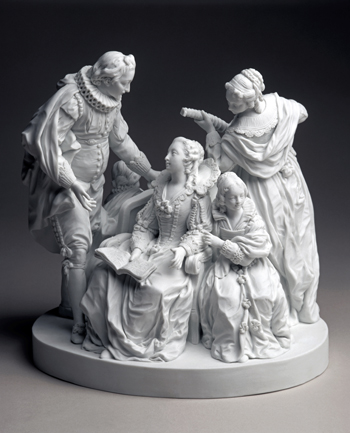
Jean-François Duret, La Mandoline ou La conversation espagnole, 1772 (Collection Sèvres—Cité de la céramique, SCC.2012.2.1)
Raconter l’histoire de la sculpture à Sèvres, de la création de la Manufacture par la volonté de Louis XV et de Madame de Pompadour jusqu’à la période révolutionnaire, permet de dévoiler tour à tour l’excellence du goût des élites de l’Ancien Régime pour la perfection des objets d’art et l’explosion d’une thématique nourrie par le siècle des Lumières.
La sculpture à Sèvres relève d’un processus minutieux partant d’un modèle en terre pour aboutir au biscuit de porcelaine. La surface de porcelaine, non émaillée mais polie, permet ainsi de rivaliser le marbre. Le biscuit de porcelaine, inventé par la Manufacture vers 1752, connait immédiatement un immense succès et a concurrencé la production venant de Chine puis celle de sa grand rivale saxonne, la Manufacture de Meissen.
Les artistes de la Manufacture ont su créer et diffuser des sujets remplis de charme, de délicatesse et de vie sur les thèmes de l’enfance, de la fable et de l’allégorie, de la littérature et de la vie quotidienne tout en innovant dans le domaine du portrait et de l’iconographie politique. Les biscuits exécutés sous la direction des sculpteurs du roi (Falconet, Pajou, Boizot), parfois inspirés par des compositions de Boucher ou de Coypel, ont délecté les amateurs du temps les plus exigeants.
L’exposition présente plus de 80 terres cuites et 120 biscuits de porcelaine, mais aussi des dessins, des estampes, ainsi que des modèles et des moules en plâtre originaux. Cette richesse des collections patrimoniales complétée par des prêts extérieurs, permet de montrer au mieux cette apothéose du goût et de l’excellence artistique que fut la création au XVIIIe siècle des célèbres biscuits de Sèvres.
Cet événement a été rendu possible grâce à la restauration financée par la Fondation BNP Paribas, des modèles originaux en terre cuite du XVIIIe siècle, étape initiale à la production des sculptures en porcelaine.
Après une introduction historique et technique, le parcours de l’exposition se décompose en dix sections. Elles abordent les thèmes du goût pour l’enfance, les animaux, la fable et l’allégorie, le surtout de table, la vie contemporaine, les sujets littéraires, les œuvres religieuses, les portraits, les statuettes des grands hommes et, enfin, la décennie révolutionnaire.
Aujourd’hui, la fabrication de biscuits se poursuit dans les ateliers de la Manufacture de Sèvres, pour certains issus du répertoire de Sèvres, pour d’autres fruits de l’imagination des artistes contemporains invités.
Le commissariat général de l’exposition est assuré par Guilhem Scherf, conservateur en chef au département des sculptures du musée du Louvre, spécialiste de la sculpture du XVIIIe siècle et auteur de nombreux ouvrages. La scénographie est confiée à Cécile Degos.
Le catalogue est édité sous la direction de Tamara Préaud par les éditions Faton. Une première partie traite de la Manufacture de Sèvres, des techniques et de la restauration des terres cuites et du dialogue des arts (l’estampe, la sculpture, le costume). La deuxième est le catalogue des œuvres exposées, selon dix sections. Quant à la dernière partie, elle présente le catalogue sommaire illustré de l’ensemble des sculptures du XVIIIe siècle conservées à Sèvres – Cité de la céramique.
La Cité de la céramique – Sèvres & Limoges et la Société Pyramis Design ont signé un accord de mécénat de compétence en matière de digitalisation 3D. Dans le cadre de l’exposition, grâce à cette technologie, une lecture inédite du surtout de table La Conversation espagnole sera proposée aux visiteurs, en regard de l’œuvre originale.
Tamara Préaud, ed., La Sculpture à Sèvres au XVIIIe Siècle (Dijon: Éditions Faton, 2015), 432 pages, 45€.
The Alamo Now a World Heritage Site
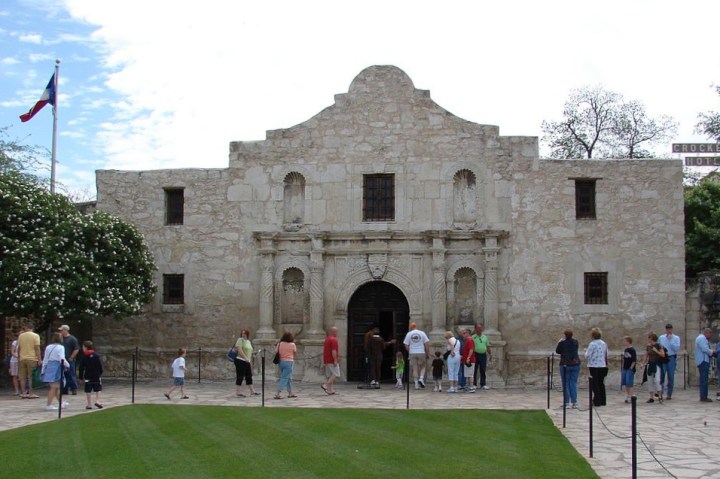
The Alamo, San Antonio
(Wikimedia Commons, 18 April 2007)
◊ ◊ ◊ ◊ ◊
As reported by Reuters, via The Guardian (5 July 2015). . .
Alamo Named First World Heritage Site in Texas after Nine-Year Campaign
Spanish colonial missions in San Antonio chosen as part of 23rd US site deemed of ‘outstanding importance’ to human heritage
A United Nations agency on Sunday [5 July 2015] named the Alamo and the four Spanish colonial Catholic missions in San Antonio a World Heritage Site, making them the first places in Texas deemed to be of “outstanding cultural or natural importance to the common heritage of humanity.”
The decision capped a nine-year campaign by San Antonio and Texas to have the early 18th-century missions listed alongside world treasures such as Stonehenge, the Taj Mahal and Angkor Wat. The missions are now the 23rd World Heritage Site in the US.
“The city of San Antonio is delighted with Unesco’s decision today and the recognition that our Spanish colonial missions are of outstanding value to the people of the world,” mayor Ivy Taylor said from Bonn, Germany, where the announcement was made.
Sarah Gould, archivist at the Institute of Texan Cultures, said there were many reasons for the listing of the four missions, which are still used as Catholic churches, and the Alamo, a fortified church, barracks and other buildings that was the scene of the 1836 battle for Texan independence. . . .
But the designation has not been entirely embraced in Texas, where the phrase ‘United Nations’ provokes suspicion among some. . . .
The full article is available here»
Call for Papers | Fabrications: Designing for Silk in the 18th Century
From H-ArtHist:
Fabrications: Designing for Silk in the 18th Century
The Courtauld Institute of Art, London, 5 March 2016
Proposals due by 4 September 2015
Organised by Katie Scott and Lesley Miller
Joubert de la Hiberderie’s Le Dessinateur d’étoffes d’or, d’argent, et de soie (1765) was the first book to be published on textile design in Europe. In preparation for the publication of an English translation and critical edition of the text this one day conference calls for papers that will analyse, critique, contextualise, review or otherwise engage with the Le Dessinateur in the light of its themes: production, design, technology, education, botany and art. Joubert’s manual argues for both a liberal and a technological education for the ideal designer. Such a person must, he argues, have detailed knowledge of the materials, technologies and traditions of patterned silk in order successfully to propose new designs; he or she must also have taste and an eye for beauty, which call, he says, for travel in order to see both the beauties of nature and those of art gathered in the gardens and galleries of Paris and the île de France.
We invite contributions from historians—of the book, of art and design, of science, of technology, and of matters social, industrial and economic. General questions we hope the conference will consider are: Who did Joubert hope to address through his book and to what end? What was the international reach of the book? And what other texts were its competitors? What does Le Dessinateur tell us about the status, role and skills of the designer? How did attitudes to gender inform Joubert’s notion of design and manufacture? How did his ideal designer compare to what we know about the careers and livelihoods of designers at Lyons and elsewhere? What relationship did Joubert envisage between design and technology, drawing and weaving? We welcome proposals that address silk in its uniqueness and also those attentive to its relations of difference and similarity to other textile technologies. Finally, we welcome submissions from writers and critics on contemporary textiles interested in thinking about issues of fabric threaded through concerns and examples from the past.
Whatever the historical perspective, we call for submissions that engage with the priorities and explicit arguments of Joubert’s text and also those that look at it awry: for example, with a view to the phenomenology as well as the technology of production, or with respect to the cut, tuck and fold as well than the plane in design, with regard also to the iterations of pattern in use as well as the invention of singular design motifs, or to give one last example, in relation to tradition and memory as well as novelty and fashion.
Please send your proposed title, a brief 150 word abstract and a short CV to Katie Scott (katie.scott@courtauld.ac.uk) and Lesley Miller (le.miller@vam.ac.uk) by Friday, 4th September. Some financial support for travel expenses may be available.
Call for Papers | Symposium of the Association of Print Scholars
Inaugural Symposium of the Association of Print Scholars
Hunter College, City University of New York (CUNY), New York, 7 November 2015
Proposals due by 15 August 2015
Organized by Maeve Coudrelle (Tyler School of Art, Temple University), Allison Rudnick (The Graduate Center, CUNY and The Metropolitan Museum of Art), Britany Salsbury (RISD Museum), and Christina Weyl (Independent Scholar)
The Association of Print Scholars (APS) is pleased to announce a symposium to support new critical ideas and research about printmaking. The event will occur during Print Week in New York, which includes major events such as the IFPDA Print Fair, the E/AB Fair and more. We invite two types of proposals:
• 20-minute papers for a scholarly panel entitled ‘Method, Material and Meaning: Technical Art History and the Study of Prints’ (details below)
• 5-minute presentations for the Graduate Student Lightning Round; proposed papers should come from
current graduate students at the dissertation stage
Interested participants are invited to submit an abstract of no more than 500 words along with a CV or brief biographical statement by August 15 to symposium@printscholars.org. Please indicate in the subject line which type of paper (scholarly session or lightning round) you are proposing and apply to only one session type. Non-members may submit abstracts, but presenters must be APS members by the time of the symposium.
Method, Material, and Meaning: Technical Art History and the Study of Prints
Technical art history, an interdisciplinary methodology with growing popularity among scholars, curators, and conservators, draws connections between an object’s making and its interpretation. The application of technical art history to the study of prints is particularly fruitful as printmakers often draw upon diverse and complex techniques in order to generate imagery. From the sixteenth-century engravings of Hendrik Goltzius, who skillfully imitated other media, to the prints of contemporary artist Kiki Smith, who produces fleshy bodies on thin, skin-like Gampi paper, printmakers throughout history have engaged a variety of processes and materials in order to elicit particular ideas, emotions, or interactions. The selection of technique, matrix, ink, varnish or support may have a profound effect on the final product and its meaning.
This conference seeks to investigate the relationship between specific technical choices made by printmakers, printers, or publishers in order to rethink more broadly the relationship between process, material and meaning in the graphic arts. We seek papers that focus on a wide range of chronological periods and geographic locations in order to highlight overarching methodological issues. Questions to consider:
• How can technical analysis aid in understanding artists’ strategic decisions, including their use of printmaking within a larger multimedia practice?
• What can conservation science tell us about the life and contemporary importance of a print?
• How has print scholarship grown beyond connoisseurship, towards a more holistic account of engagement with the viewer?
• How does the transfer of information from the matrix to the receiving surface affect the resulting imagery and its significance?
APS is a nonprofit members’ group for enthusiasts of printmaking that brings together the diverse print community: curators, collectors, academics, graduate students, artists, conservators, critics, independent scholars, and art dealers. APS’s goals are to encourage innovative and interdisciplinary study of printmaking and to facilitate dialogue among its members.
Call for Papers | Early Modern Artistic Lexicography, 1600–1750
From H-ArtHist:
Early Modern Artistic Lexicography: Words for Theory, Words for Practice
Forms, Uses, and Issues in Early Modern Artistic Lexicography, 1600–1750
Montpellier, 15–17 June 2016
Proposals due by 15 October 2015
In the prospect of the circulation of concepts and practices and the permeability of artistic boundaries, the project LexArt—Words of Art: The Rise of a Terminology (1600–1750) which began in April 2013, studies the development of artistic vocabulary in the seventeenth-century, beginning with the Italian vocabulary of the great foundational texts, and how it transforms in the first part of the eighteenth-century among North European theorists in relation with artistic practices in France, Germany, England and the Netherlands. Words are agents in the circulation of concepts, and turn out to be a significant site of experimentation, dissemination, transfers and networks across artistic communities in early modern Europe. Though the chronological and geographical boundaries, as well as the scope of the LexArt project itself are defined precisely, the purpose of this symposium is the necessary confrontation with other patterns from a methodological and conceptual perspective, and the extending of precise themes in order to provide a theoretical as well as concrete framework for the tools being developed by the LexArt project, namely the database (web application with interface under development), and the Encyclopedic Dictionary of artistic Terminology (in preparation) which are both based on publication of specific and targeted sources. This symposium proposes various directions and fields of research through interdisciplinary and related approaches, to better grasp and define the forms, uses and issues of early modern artistic theory.
1. Books on art
This interdisciplinary session examines the book as object in the broadest possible sense: from the publication of a book to its dissemination and its audiences, but also its composition (index, glossaries, table of contents). It may also consider the place and role of illustrations in texts on art, the complementarity or discrepancy between illustrations and text, the use and revival of models, as well as the confrontation between literary and visual descriptions of the work of art.
2. Languages: the book as lexical laboratory
To provide a more comprehensive account of the issues at stake, this session considers topics that lie beyond the geographical and chronological scope of the LexArt Project. Different approaches may be imagined from examples found in historical lexicography from Baldinucci to the Encyclopédie méthodique: the mutation of lexical models from classical antiquity or from foundational Italian texts in early modern Europe; the vocabulary of theoretical texts versus that of artistic biographies; poetical language in the theory of art: words and the idiom of an artistic theory.
3. Words and practices: from the studio to the Academy
This session addresses the rapport between theory and practice, and more specifically the transfer of knowledge through the words used in texts on art. It will explore the connections and differences between the appearance of a word and its practice as well as more generally the question of jargon or the relation between words and artistic professions.
4. Translating words
The session approaches artistic lexicography by looking at strategies and process of transfers in textual translations from the early modern era. As well as focusing on networks, it may examine the use of multilingualism in historical lexicography, the notion of transfer as an element of conciliation or differentiation, or even leading to loss of meaning, and more generally on the life of European transfer networks between vivification, transformation, forgotten or abandonment, or the role of the translator as creator of words.
5. Workshop (or round table discussion): Questions, themes and perspectives
This session welcomes contributions that focus on methods of research or more general issues of methodology related to the construction of databases or other web-based instruments.
• The publication of illustrations: selection and indexation of images in databases.
• Cartography, the atlas of words, and the dictionary: the genealogy and typology of words and their topography, the transfer of words from a text to a figured word in an atlas.
• Paradigms of research and interactivity in databases: computerization, digitalization, navigation.
• Questions and perspectives: using concrete examples to think about the use of computer systems for the study of artistic lexicography according to different objects (whether monographic or transversal) but also to raise questions about use and misuse of these new tools.
Submission Modalities
• abstracts for papers should be no longer than 400 or 500 words and be headed by a title
• they can be in either French or English
• they should be complemented by a CV
• each proposal will be examined by the Scientific Committee of LexArt
Proposals should be sent to these two addresses: michele-caroline.heck@univ-montp3.fr and marianne.freyssinet@univ-montp3.fr
Scientific Committee
• Michèle-Caroline Heck, porteur du projet LexArt, Professeur d’histoire de l’art moderne – Université Paul-Valéry Montpellier 3
• Jan Blanc, Professeur d’histoire de l’art moderne – Université de Genève
• Olivier Bonfait, Professeur d’histoire de l’art moderne – Université de Bourgogne
• Ralph Dekoninck, Professeur d’histoire de l’art moderne – Université catholique de Louvain
• Emmanuelle Henin, Professeur de littérature française – Université de Reims Champagne-Ardenne
• Cecilia Hurley, Enseignant-chercheur (HDR) – Ecole du Louvre et Université de Neuchâtel
• Thomas Kirchner, Professeur d’histoire de l’art moderne – Directeur du Deutsches Forum für Kunstgeschichte – Max Weber Stifung
• Christian Michel, Professeur d’histoire de l’art moderne – Université de Lausanne
• Alessandro Nova, Professeur d’histoire de l’art – Directeur du Kunsthistorisches Institut in Florenz – Max-Planck-Institut
• Caroline Van Eck, Professeur d’histoire de l’art moderne – Universiteit Leiden
Exhibition | Gardens & Groves: George Washington’s Mount Vernon
◊ ◊ ◊ ◊ ◊
Now on view at Mount Vernon:
Gardens & Groves: George Washington’s Mount Vernon
Mount Vernon, Virginia, 22 February 2014 — 30 May 2016
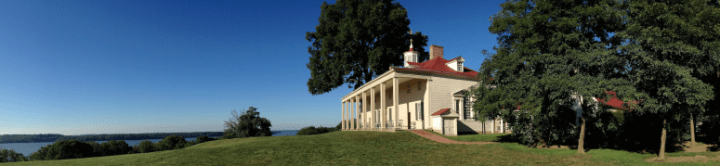
Countless photographs testify to the beauty of Mount Vernon’s landscape. Two hundred years after its creation, it continues to delight. Although the beautiful gardens, sweeping lawns, and inviting paths seem perfectly natural, these features were all carefully planned by George Washington. When he returned to Mount Vernon after the American Revolution, General Washington found the estate in need of extensive repairs and improvements. The buildings and grounds surrounding the Mansion lacked an overall design, having evolved over time with an eye more for practical function than beauty.
Between 1785 and 1787, George Washington completely transformed Mount Vernon’s grounds into a landscape very similar to the one that survives today. During this break from public affairs, few days passed without the General working on the landscape. To update Mount Vernon, Washington had his free and enslaved workers install such picturesque features as sweeping lawns, groves of trees, curving paths, vistas, and hidden walls (called “ha-has”). From laying out paths to tagging trees for transplanting, the General was involved in every aspect of designing and installing his gardens and grounds.
From the exhibition press release (27 January 2014) . . .
Mount Vernon invites visitors to explore George Washington’s design for the grounds of his estate, through the exhibition, Gardens & Groves: George Washington’s Landscape at Mount Vernon, on view until May 2016. Gardens & Groves is the first museum exhibition to focus specifically on Washington’s landmark achievements as a landscape designer combining rarely-seen original documents, artworks, and books with period garden tools, gorgeous landscape photography, and a stunning scale model of the Mount Vernon estate. In Gardens & Groves, visitors can view the first president’s spyglass, watering can, and garden roller, in addition to reading Washington’s notes and instructions for Mount Vernon’s landscape in his own hand.

Kitchen garden at Mount Vernon
“Each year, more than a million visitors enjoy the remarkable beauty of Mount Vernon’s gardens and grounds,” said Mount Vernon curator, Susan Schoelwer. “But few realize that the views that we enjoy today were all carefully planned by George Washington himself. Gardens & Groves aims to change that, as visitors have the opportunity to ‘unpack’ the landscape surrounding the Mansion, following in Washington’s footsteps to examine each of the elements in the design.”
The exhibit presents five 18th-century views of Mount Vernon—oil paintings of both river and land fronts of the Mansion, by Edward Savage; two detailed drawings of the layout of the grounds, by English admirer Samuel Vaughan; and a recently-acquired image of the Washingtons relaxing on the piazza in 1796, by Benjamin Henry Latrobe, architect of the US Capitol Building (due to their fragility, the Vaughan and Latrobe drawings were on view in Gardens & Groves through August 17, 2014).
“Bringing these five important works together presents a rare opportunity to see Mount Vernon through the eyes of artists who visited during George Washington’s lifetime,” said Mount Vernon exhibition curator Adam T. Erby. “These artworks record details of the landscape that we would not otherwise know—information that continues to inform our ongoing research and restoration efforts.”
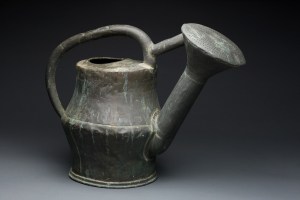
Watering Pot, made in France or England, 18th century, copper, iron.
At the center of Gardens & Groves is a fascinating 8’x 9’x 11’ model of Mount Vernon’s landscape as Washington last saw it in 1799. Developed by Mount Vernon historians, archaeologists, and curators, this state-of-the-art model has returned home from a national tour in Mount Vernon’s traveling exhibition, Discover the Real George Washington: New Views from Mount Vernon. In addition to delighting viewers with its intricate craftsmanship, the model incorporates countless scenes from daily life—laundry drying in the laundry yard, a sailing ship on the Potomac, just-planted trees along the bowling green.
Such details introduce a broad view of the landscape, revealing two separate, but intersecting landscapes that existed at Mount Vernon: the pleasure grounds of the planter and the working spaces of the enslaved community. Gardens & Groves also tells the stories of the men and women, both hired and enslaved, who created and maintained George Washington’s gardens, and visitors will see some actual artifacts that they used, including a copper watering can and archeologically-recovered flower pot fragments.
An interactive touchtable will demonstrate the evolution of the landscape at Mount Vernon over time. Visitors will be able to scroll through three topographical maps created by Mount Vernon’s preservation staff, reconstructing the appearance of the landscape when Washington inherited the property, during an early renovation, and as it finally appeared at the end of Washington’s life. On each of the maps, visitors will be able to click on individual elements to bring up more information about a particular feature.
A list of ten facts about the landscape at Mount Vernon is available here»
◊ ◊ ◊ ◊ ◊
Published this spring in connection with the exhibition:
Susan P. Schoelwer, ed., The General in the Garden: George Washington’s Landscape at Mount Vernon (Mount Vernon: Mount Vernon Ladies’ Association, 2015), 208 pages, ISBN: 978-0931917486, $35.
 The General in the Garden provides an engaging, informative, and richly illustrated introduction to George Washington’s landscape at Mount Vernon—arguably the best-documented, best-preserved complex of gardens and grounds to survive from eighteenth-century America.
The book’s three essays, by Adam T. Erby, J. Dean Norton, and Esther C. White, chronicle Washington’s transformation of the estate in the years between the American Revolution and the Constitutional Convention of 1787, the stewardship of its gardens by the Mount Vernon Ladies’ Association since 1860, and the archaeology that led to the recent restoration of Washington’s showplace upper garden. Mount Vernon assistant curator Adam Erby examines Washington’s critical role in developing Mount Vernon’s landscape, arguing that the general drew on British design sources and gardening manuals but adapted them to his own circumstances, creating a truly American garden. J. Dean Norton, Mount Vernon’s director of horticulture, traces the evolution of the estate’s landscape and recreated gardens across the two centuries since Washington’s death. And Esther White, Mount Vernon’s director of historic preservation and research, shows how groundbreaking archaeological methods facilitated the discovery of Washington-era garden beds and borders of flowers, shrubs, and vegetables in his upper garden—a remarkable find that yielded one of the most significant eighteenth-century garden recreations of our time. Also included is a lavishly illustrated guide to Mount Vernon’s landscape features, introducing Washington’s beloved estate to a modern audience.
An interview with the authors of the book is available here»
New Book | To My Dear Pieternelletje
From Brill:
Bea Brommer, To My Dear Pieternelletje: Grandfather and Granddaughter in VOC Time, 1710–1720 (Leiden: Brill, 2015), ISBN: 978-9004289666, 175€ / $227.
 To my dear Pieternelletje describes a ten-year period in the lives of Pieternella van Hoorn and her grandfather Willem van Outhoorn, former governor-general of the Dutch East Indies. Eleven years old, Pieternella left for Amsterdam and the only contact possible was by mail. Numerous letters have survived and combined with contemporaneous documents—most of them never published before—they offer a vivid and clear picture of their private life and feelings, forming a most welcome addition to official VOC-history. Van Outhoorn not only acted as Pieternella’s mentor while she tried to adjust to her new but unknown fatherland, but also sent her numerous exquisite presents, the greater part of which has been traced and described in full, thus offering new insight in the cultural history of Asia.
◊ ◊ ◊ ◊ ◊
C O N T E N T S
Preface
Introduction
Part 1: Pieternella van Hoorn and Willem van Outhoorn
1. My Long-Standing Request for my Release: The first letter
2. Sing the Watch Song
3. Flees and Hottentots: The Cape of Good Hope
4. Your Very Dear and Beloved Father: Batavia
5. What a Wonderfull Country
6. To Invest Our Pennies Securely
7. Tied with a Chinese Silken Bow: Presents for Pieternella
8. Raised in My Small Country Garden: Country Estates around Batavia
9. Some Pins, Needles, and Thread: Grandfather’s Slaves
10. Becoming Quite an Amsterdam Young Lady
11. Those Gentlemen!
12. Not Without Ailments: Medication, Dutch and Asian, The cordial stone
13. My Beloved Grandpapa: Grandfathers’s Burial and Estate
Part II: The Dramaties Personae
1. The Hair Grown Grey: The Van Outhoorn Family: Japanese Lacquer Dishes
2. My Dear Son Johannes: The Van Outhoorn Family
3. The Cold I Cannot Stand Very Well: The Van Riebeeck Family Portraits
4. Personalia
Appendices
Letters of Willem van Outhoorn
Inventory of Willem van Outhoorn, Batavia
Invenotry of Joan van Hoorn, Amsterdam
Inventory of The Van Hoorn Collection
Glossary
Sources
Index
New Book | The Courtiers’ Anatomists
From The University of Chicago Press:
Anita Guerrini, The Courtiers’ Anatomists: Animals and Humans in Louis XIV’s Paris (Chicago: The University of Chicago Press, 2015), 352 pages, ISBN: 978-0226247663, $35.
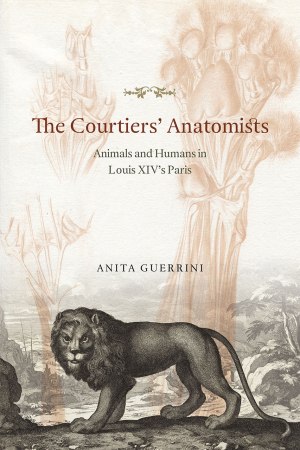 The Courtiers’ Anatomists is about dead bodies and live animals in Louis XIV’s Paris–and the surprising links between them. Examining the practice of seventeenth-century anatomy, Anita Guerrini reveals how anatomy and natural history were connected through animal dissection and vivisection. Driven by an insatiable curiosity, Parisian scientists, with the support of the king, dissected hundreds of animals from the royal menageries and the streets of Paris. Guerrini is the first to tell the story of Joseph-Guichard Duverney, who performed violent, riot-inducing dissections of both animal and human bodies before the king at Versailles and in front of hundreds of spectators at the King’s Garden in Paris. At the Paris Academy of Sciences, meanwhile, Claude Perrault, with the help of Duverney’s dissections, edited two folios in the 1670s filled with lavish illustrations by court artists of exotic royal animals.
Through the stories of Duverney and Perrault, as well as those of Marin Cureau de la Chambre, Jean Pecquet, and Louis Gayant, The Courtiers’ Anatomists explores the relationships between empiricism and theory, human and animal, as well as the origins of the natural history museum and the relationship between science and other cultural activities, including art, music, and literature.
Anita Guerrini is Horning Professor in the Humanities and professor of history in the School of History, Philosophy, and Religion at Oregon State University. She is the author of Experimenting with Humans and Animals: From Galen to Animal Rights and Obesity and Depression in the Enlightenment: The Life and Times of George Cheyne.
◊ ◊ ◊ ◊ ◊
C O N T E N T S
A Note on Names, Dates, and Other Matters
Abbreviations Used in the Notes
List of Illustrations
Introduction
1 Anatomists and Courtiers
2 The Anatomical Origins of the Paris Academy of Sciences
3 The Animal Projects of the Paris Academy of Sciences
4 The Histoire des animaux
5 Perrault, Duverney, and Animal Mechanism
6 The Courtiers’ Anatomist: Duverney at the Jardin du roi
Conclusion
Epilogue: The Afterlife of the Histoire des animaux
Acknowledgments
Notes
Bibliography
Index
Exhibition | New for Now: The Origin of Fashion Magazines
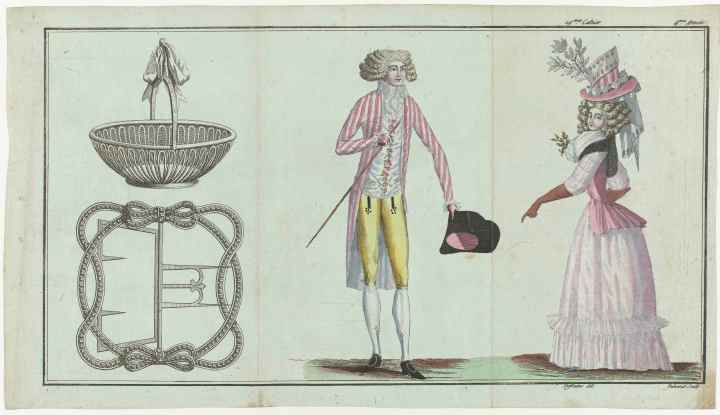
Magasin des Modes Nouvelles Françaises et Anglaises (1 Juin 1789), Pl. 1, 2 et 3
(Amsterdam: Rijksmuseum)
◊ ◊ ◊ ◊ ◊
Press release (20 May 2015) from the Rijksmuseum:
New for Now: The Origin of Fashion Magazines
Rijksmuseum, Amsterdam, 12 June — 27 September 2015
From 12 June, the Rijksmuseum presents a major retrospective of its rich collection of costume and fashion prints for the first time. The change in women’s and men’s fashion from the year 1600 up to and including the first half of the 20th century, and the development of the fashion magazine into the fashion glossies we know today, can be seen in more than 300 prints. The exhibition was designed by designer and co-curator Christian Borstlap, in collaboration with fashion illustrators Piet Paris and Quentin Jones.
The publishers of fashion prints did everything to make their product as attractive as possible. They attracted skilled illustrators for this purpose, some of whom went on to become specialists in this area: true ‘fashion illustrators’. The trick was to portray the models on the prints as skillfully as possible and with a great sense of elegance. The printmaker was responsible for transferring the design sketches onto an engraving that could reproduce the design. A so-called ‘colourist’ subsequently added colours to each individual image by hand.
New for Now shows prints by fashion designer Paul Poiret, among others. His ‘Fashion is Art’ statement marked the beginning of a new era. He presented his designs in two artfully designed series of works in bright opaque colours, which served as an inspiration for a number of artistically high-quality fashion magazines.
Many of the prints shown are from two important collections acquired by the Rijksmuseum in 2009: The Raymond Gaudriault Collection and The MA Ghering-van Ierlant Collection. All 8,000 prints from these collections can be seen online from June 2015. This is the result of a multi-year project in which the prints were catalogued, described and digitalised.
◊ ◊ ◊ ◊ ◊
The catalogue is available from the Rijksmuseum:
Georgette Koning and Els Verhaak, New For Now: The Origin of Fashion Magazines (Amsterdam: Rijksmuseum, 2015), 204 pages, 20€.
 Fashion changes constantly, but the desire to be ‘in fashion’ is eternal. For centuries people have eagerly followed the latest fashion trends. But how did one keep up in an age without internet, fashion blogs, Pinterest and glossy fashion magazines? New for Now explores how trends were spread before Vogue and Harper’s Bazaar appeared on the shelves. From the costume book in the 16th century by way of individual, hand-coloured fashion plates to the first fashion magazine to roll off the presses in 1785: Cabinet des Modes. There was no stopping after this, and one fashion magazine appeared hard on the heels of the other, reaching an absolute high point in the Gazette du Bon Ton in 1912, full of magnificent art deco illustrations.
Graham Beal Retires from the Detroit Institute of Arts
Press release (8 January 2015) from the DIA: 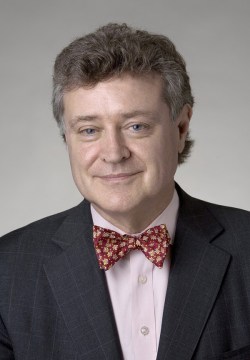 The Detroit Institute of Arts announced that Director Graham W. J. Beal will retire as of June 30, 2015, after serving as director, president and CEO for nearly 16 years. Since joining the DIA, Beal has presided over some of the most significant accomplishments in the museum’s history, including a tremendously successful reinvention of presenting art to the public; passage of a tri-county regional millage to support museum operations; and the DIA participation in the historic and unprecedented grand bargain initiative, which secured for future generations’ the DIA’s widely acclaimed art collection while also successfully facilitating resolution of the Detroit bankruptcy. Beal has overseen two major capital campaigns, has built on the museum’s outstanding reputation with regard to art acquisitions and exhibitions, has greatly increased attendance and expanded the DIA’s community outreach and awareness through programming and innovative art installations. Under Beal’s leadership, the DIA has co-organized outstanding exhibitions such as Van Gogh: Face to Face in 2000, Magnificenza! The Medici, Michelangelo and the Art of Late Renaissance Florence in 2003 and organized the highly anticipated Diego Rivera and Frida Kahlo in Detroit. . . The full press release is available here» Michael Hodges reports on the story for The Detroit News (29 June 2015), available here»










 Enfilade
leave a comment