Exhibition | Le Roi est Mort!
As reported by the AFP:
 To mark the 300th anniversary of the Sun King’s death on Tuesday, the Palace of Versailles turned to modern-day town crier Twitter to relay his slow and agonising demise from gangrene. “Breaking News. Louis XIV passed away,” the palace said from its account @CVersailles at 0615 GMT (8:15am) on Tuesday, after livetweeting the king’s illness as if it were taking place today.
The hashtag #leroiestmort (“the king is dead” in English) was rolled out to mark the anniversary of his death at 76 years old on September 1, 1715. With 72 years on the throne, king Louis XIV was the longest-reigning monarch in European history, overseeing a period of glory in France in which he built the glittering palace west of Paris. . . .
The tweets will continue up to his funeral (the schedule is available here), all as a perfect build-up to the exhibition at Versailles, which opens next month:
The King Is Dead!
Châteaux de Versailles, 27 October 2015 — 21 February 2016
Curated by Béatrix Saule, Hélène Delalex, and Gérard Sabatier
Scenography by Pier Luigi Pizzi
The death of the king, both as a man and an institution, was a key moment in the construction of the public perception of the monarchy, combining religion (the death of a Christian) and politics (the death and resurrection of the king, who never dies). From his final death throes to the burial it resembled a performance, a great Baroque show of huge significance to courtly society, which was affected more than ever by it.
 The exhibition—the first on the subject—will look back on the details of the death, autopsy and funeral of Louis XIV, which strangely are little known, and to situate them in the funeral context of European sovereigns from the Renaissance period to the Enlightenment. It also discusses the survival—often paradoxical—of this ritual from the French Revolution to the contemporary era.
The exhibition will bring together works of art and historical documents of major importance from the largest French and foreign collections, including ceremonial portraits, funeral statues and effigies, gravestones, the manuscript for the account of the autopsy of the king, coins from the Saint-Denis Treasury, gold medals, emblems and ornaments, and furniture of funeral liturgy. Some of the pieces on display have never been exhibited in public.
Exhibiting these masterpieces has required grand scenography effects. Scenographer Pier Luigi Pizzi was asked by Béatrix Saule, the exhibition’s Head Curator, to design the layout for this great Baroque show. Across the nine sections, visitors will discover a veritable funeral opera conducted by the artist.
The subject of the exhibition will not fail to surprise, and is scientifically rigorous. It is based on an international research program on royal ceremonies in European Courts, undertaken over the course of three years at the Palace of Versailles Research Centre under the leadership of Professors Gérard Sabatier and Mark Hengerer and with the participation of a team representing a range of disciplines, from coroners to liturgists, from medieval to contemporary historians.
Curated by Béatrix Saule, Director and Head Curator of the Musée National des Châteaux de Versailles et de Trianon, assisted by Hélène Delalex Conservation Officer at the Musée National des Châteaux de Versailles et de Trianon, and Gérard Sabatier, Emeritus Professor. Scenography by Pier Luigi Pizzi.
Additional information is available at the exhibition website.
Terra Foundation for American Art International Publication Grants
Terra Foundation for American Art International Publication Grants
Letters of inquiry due by 21 September 2015
In 2014, the Terra Foundation for American Art awarded the College Art Association (CAA) a major, three-year grant to administer an annual program to support book-length scholarly manuscripts in the history of American art. This program, now in its second year, makes funds available to US and non-US publishers through the Terra Foundation for American Art International Publication Grant.
Awards of up to $15,000 will be given for books that examine American art in an international context, increase awareness of American art internationally through publication outside the United States, allow wider audiences to access important texts through translation, and/or result from international collaboration. The program also will support the creation of an international network of American art scholars by providing two non-US authors whose books are funded through the grant program with travel stipends and complimentary registration to attend CAA’s annual conference.
Grant guidelines, detailed eligibility requirements, and application instructions are available on the CAA website. Letters of inquiry should be submitted to CAA by September 21, 2015. Applicants whose projects fall within the guidelines and successfully fulfill the mission of the grant program will be invited to submit full applications, due November 9, 2015. The first round of award winners will be announced in March 2016.
New Book | The Idea of the Cottage in English Architecture, 1760–1860
From Taylor & Francis:
Daniel Maudlin, The Idea of the Cottage in English Architecture, 1760–1860 (New York: Routledge, 2015), 212 pages, ISBN: 978-1138793873, $160.
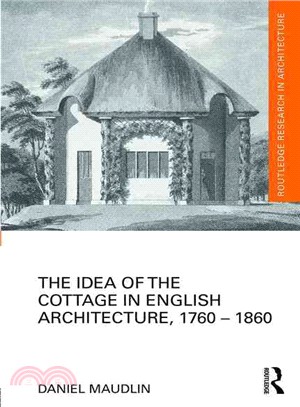 The Idea of the Cottage in English Architecture is a history of the late Georgian phenomenon of the architect-designed cottage and the architectural discourse that articulated it. It is a study of small buildings built on country estates, and not so small buildings built in picturesque rural settings, resort towns and suburban developments.
At the heart of the English idea of the cottage is the Classical notion of retreat from the city to the countryside. This idea was adopted and adapted by the Augustan-infused culture of eighteenth-century England where it gained popularity with writers, artists, architects and their wealthy patrons who from the later eighteenth century commissioned retreats, gate-lodges, estate workers’ housing and seaside villas designed to ‘appear as cottages’.
The enthusiasm for cottages within polite society did not last. By the mid-nineteenth century, cottage-related building and book publishing had slowed and the idea of the cottage itself was eventually lost beneath the Tudor barge-boards and decorative chimneystacks of the Historic Revival. And yet while both designer and consumer have changed over time, the idea of the cottage as the ideal rural retreat continues to resonate through English architecture and English culture.
Daniel Maudlin is Professor of Early Modern History at the University of Plymouth. He has previously held positions at Plymouth School of Architecture, Design and Environment, Dalhousie University, the University of Pennsylvania and the University of Glasgow. From farmhouses in Nova Scotia to aristocratic retreats on English country estates, his work focuses on the social meanings of design and the consumption of domestic architecture in the early modern British Atlantic world. He also writes on architectural theory, modern vernaculars and the everyday.
◊ ◊ ◊ ◊ ◊
C O N T E N T S
1 The Cottage, Rural Retreat and the Simple Life
2 The Cottage in English Architecture
3 The Architect-Designed Cottage
4 The Cottage in Arcadia
5 Architects, Patrons and Connoisseurs
6 Habitations of the Labourer
7 The Appreciation of Cottages
8 Re-Imagining the Vernacular
9 The Cottage Ornée
10 The Cottages of Old England
Fellowships | Bard Graduate Center Research Fellowships
From BGC:
Bard Graduate Center Research Fellowship for 2016–17
Bard Graduate Center invites scholars from university, museum, and independent backgrounds with a PhD or equivalent professional experience to apply for funded research fellowships, to be held during the 2016–2017 academic year. The fellowships are intended to fund collections-based research at Bard Graduate Center or elsewhere in New York, as well as writing or reading projects in which being part of Bard Graduate Center’s dynamic research environment is intellectually valuable. Eligible disciplines and fields of study include—but are not limited to—art history, architecture and design history, economic and cultural history, history of technology, philosophy, anthropology, and archaeology.
The stipend rate is $3,500 per month, and housing is available. Both long- and short-term fellowships are available (for example, 6, 4 and 2 months). The timing of dates will be negotiated with individual awardees. Fellows will be given a workspace in the Bard Graduate Center Research Center at 38 West 86th Street, between Columbus Avenue and Central Park West, in New York City.
Bard Graduate Center is a graduate research institute devoted to the study of the decorative arts, design history, and material culture, drawing on methodologies and approaches from art history, economic and cultural history, history of technology, philosophy, anthropology, and archaeology. It offers MA and PhD degrees, possesses a specialized library of 60,000 volumes exclusive of serials, and publishes West 86th: A Journal of Decorative Arts, Design History and Material Culture and Cultural Histories of the Material World (both with The University of Chicago Press), and the catalogues that accompany the four exhibitions it presents every year in its Gallery space (with Yale University Press). Over 50 research seminars, lectures and symposia are scheduled annually and are live-streamed around the world on Bard Graduate Center’s YouTube channel.
To apply, please submit the following materials electronically, via email to fellowships@bgc.bard.edu, in a single PDF file: (1) cover letter explaining why Bard Graduate Center is an appropriate research affiliation and indicating the preferred length and dates of the fellowship; (2) detailed project description; (3) CV; (4) publication or academic writing sample of approximately 20-30 pages. In addition, please arrange for two letters of reference to be submitted either via email (to fellowships@bgc.bard.edu) or post (to Bard Graduate Center, Research Fellowship Committee, c/o Dean Elena Pinto Simon, 38 West 86th Street, New York, NY, 10024). All materials must be received by November 15, 2015. Incomplete or late applications will not be considered. Please direct questions to the Research Fellowship Committee via email (fellowships@bgc.bard.edu).
Bard Graduate Center does not reimburse fellows for travel, relocation, or visa-related costs in connection with this fellowship award. Also, please note that the fellowship stipend and the value of the provided housing may be subject to taxes for both US citizens and non-US citizens in accordance with US tax code. Fellowships are awarded without regard to race, color, gender, religion, national origin, sexual orientation, age, or disability. Please also see our Frequently Asked Questions page.
Two Paintings Returned to the Deutsches Historisches Museum
Press release (14 August 2015) from the Gemäldegalerie:

Frans Lütgert, The Margrave of Bayreuth, Officer of the Dragoon Regiment, 1734
(Berlin: Deutsches Historiches Museum)
The Gemäldegalerie in Berlin is returning two paintings, originally from the Zeughaus (Armoury) holdings, to the Deutsches Historisches Museum. The eighteenth-century portraits had been placed in safekeeping at the Gemäldegalerie, as works of unknown provenance. The Deutsches Historiches Museum, which is now responsible for the Zeughaus collections, believed the paintings had been lost in the war.
The portrait entitled The Margrave of Bayreuth, Officer of the Dragoon Regiment was painted by the artist Frans Lütgert in 1734. It shows Friedrich III of Brandenburg-Bayreuth wearing a short powdered wig and a uniform of the period of Friedrich Wilhelm I. The second work, painted in 1770, is a portrait of Albrecht Christian von Oheimb, Lieutenant General of the Cavalry and Governor of Rinteln. He wears the Order of the Golden Lion of the House of Hesse and the Hessian Order of Military Merit ‘Pour la vertu militaire’. The identity of the artist is unknown.
Staff members of the Deutsches Historisches Museum came across entries for the two works while searching the Lost Art database of the Deutsches Zentrum Kulturgutverluste (German Lost Art Foundation). On the basis of its own catalogue of items of unknown provenance, the Stiftung Preussischer Kulturbesitz had placed the works in the keeping of the Gemäldegalerie. A comparison with the catalogue of works lost by the Berlin Zeughaus confirmed their identification and they have now been returned to the Deutsches Historisches Museum.
For both institutions, the return of the paintings is a success story for provenance research, which includes the identification of works which museums hold but do not own. The Stiftung Preussischer Kulturbesitz attempts to trace the origins of such items and restore them to their rightful owners. All works which are held by the Stiftung but which are not its legal property are being documented in a series of publications by the Staatliche Museen zu Berlin: the first catalogue, for the Gemäldegalerie, appeared in 1999, the volume for the Nationalgalerie was published in 2008, and a volume for the Antikensammlung is now in production.
The Deutsches Historisches Museum has made its digitalised collections available to the public on-line since 1992. So far, 600,000 data records can be accessed via the museum’s website and are thus available to support provenance research.
Exhibition | De Versailles à La Motte Tilly: L’abbé Terray
Press release for the exhibition now on view at the Château de La Motte Tilly:
De Versailles à La Motte Tilly: L’abbé Terray, Ministre de Louis XV
Château de La Motte Tilly, 29 May — 20 September 2015
Curated by Gwenola Firmin and Vincent Bastien
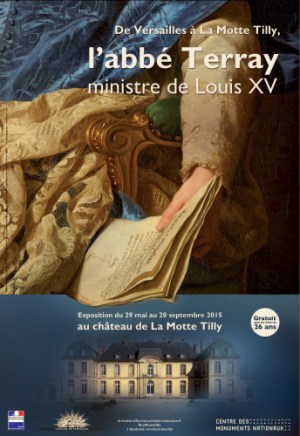 Après Sacres Royaux, de Louis XIII à Charles X au palais du Tau à Reims et Le salon de George Sand à Nohant, en 2014, la troisième exposition du partenariat entre le Centre des monuments nationaux et le château de Versailles se tiendra au château de La Motte Tilly (Aube) du 29 mai au 20 septembre 2015. Cette nouvelle exposition conjointe est consacrée à l’abbé Joseph Marie Terray (1715–1778), ministre des finances de Louis XV, à l’occasion du tricentenaire de sa naissance.
L’abbé Terray et La Motte Tilly
Joseph Marie Terray bénéficie, à ses début, de l’héritage financier de son oncle, premier médecin de la princesse Palatine, belle-sœur de Louis XIV. Nommé abbé de Notre-Dame de Molesme, au diocèse de Langres, en octobre 1764, il devient, le 23 décembre 1769, contrôleur général des Finances de Louis XV. Après le renvoi du duc de Choiseul en 1770, il est l’un des hommes forts du ministère dit du Triumvirat. Incarnation de l’ascension sociale du XVIIIe siècle, talentueux réformateur, grand homme de l’histoire économique et politique du règne de Louis XV, l’abbé Terray, malgré l’appui constant de Madame de Pompadour puis de Madame Du Barry, est très impopulaire. Il mène en effet une politique financière, certes efficace et progressiste, mais aussi brutale et autoritaire. Le ministre occupe finalement la prestigieuse charge de directeur des Bâtiments du Roi en août 1773. Mais, un an plus tard, il démissionne avec l’avènement de Louis XVI et se retire à La Motte Tilly, tout en rêvant secrètement d’être rappelé au gouvernement.
Son domaine de La Motte Tilly, parfait exemple de l’architecture du XVIIIe siècle, est sa résidence de 1748 à son décès en 1778. La demeure et son parc, comprenant aujourd’hui près de 1080 hectares, témoignent d’un certain art de vivre au Siècle des Lumières. L’actuel château, élevé à partir de 1755, est l’œuvre de l’architecte parisien François-Nicolas Lancret (1717–1789), le neveu du célèbre peintre de scènes galantes, Nicolas Lancret. L’implication de l’abbé Terray dans les différents chantiers de sa demeure de plaisance s’amplifie à mesure que sa carrière politique prend de l’importance.
L’exposition
Présentée dans les anciens appartements du ministre, l’exposition De Versailles à La Motte Tilly. L’abbé Terray, ministre de Louis XV retrace l’ascension et la vie du maître des lieux, personnage historique parmi les plus influents de la fin du règne de Louis XV mais aussi parmi les plus controversés du XVIIIe siècle. Réunis pour la première fois, des documents d’archives, des objets d’art précieux, des dessins et des tableaux contribuent également à mettre en lumière le domaine de La Motte Tilly, chef-d’œuvre architectural trop longtemps ignoré. L’exposition est enfin l’occasion unique de présenter un somptueux portrait conservé dans les collections versaillaises : l’effigie officielle du ministre tout puissant peinte par Alexandre Roslin à la demande de Terray en 1773. Ce dernier y est figuré au sommet de sa gloire.
L’exposition est rendue possible grâce au prêt d’œuvres des collections du musée national de Versailles et de Trianon, ainsi qu’aux concours généreux du musée du Louvre, de l’abbaye de Chaalis, de la Bibliothèque nationale de France, de la Bibliothèque municipale de Versailles, des Archives nationales, des Archives départementales de l’Aube et de plusieurs collections particulières.
Ce parcours historique est conçu par Gwenola Firmin, conservateur, en charge des peintures du XVIIIe siècle au château de Versailles, assistée de Vincent Bastien, docteur en Histoire de l’art, chargé de mission.
Le partenariat entre le CMN et le château de Versailles
Le partenariat établie en 2013 entre le CMN et le château de Versailles instaure un dialogue entre des collections trop souvent méconnues et des hauts lieux du patrimoine national. Des expositions temporaires conjointes permettent aux deux institutions d’unir leurs ressources afin de donner au plus grand nombre la possibilité de découvrir ou de redécouvrir quelques pages de l’Histoire de France. En 2014, les expositions Sacres royaux, de Louis XIII à Charles X au palais du Tau à Reims et Le salon de George Sand au domaine de Nohant ont attiré au total près de 76 000 visiteurs.
Gwenola Firmin and Vincent Bastien, De Versailles à la Motte Tilly: L’abbé Terray, Ministre de Louis XV (éditions du Patrimoine / Centre des Monuments Nationaux, 2015), 48 pages, ISBN: 978-2757704714, 12€.
The full dossier de presse is available as a PDF file here»
Marie-Stéphanie Delamaire Joins Winterthur as Associate Curator
As reported last week at Art Daily:
 Winterthur Museum, Garden & Library announced that Marie-Stéphanie Delamaire, Ph.D., will join the Museum July 13, 2015, as Associate Curator of Fine Art. Dr. Delamaire will be responsible for curating the Museum’s collection of nearly 5,000 prints, paintings, and sculpture from the 17th, 18th, and 19th centuries. In addition to her curatorial responsibilities, Dr. Delamaire will teach in University of Delaware’s graduate level Winterthur Program in American Material Culture.
“Stephanie joins the Winterthur curatorial department as the Associate Curator of Fine Art to oversee an important and growing part of the collection,” said Dr. David Roselle, Director of Winterthur. “We are confident that Stephanie will soon make Winterthur’s substantial collection of prints, paintings, maps, photographs, and sculpture be an added attraction for the many persons who visit our well known decorative arts collection.”
Linda Eaton, the John L. and Marjorie P. McGraw Director of Collections and Senior Curator of Textiles, said, “With a background both in the arts and the sciences, Stephanie brings a wide range of experience to Winterthur. We look forward to seeing where her fresh eye and keen mind will take her as she works with our collection, which includes iconic works of art by important artists such as Benjamin West and John Singleton Copley, among others.”
Dr. Delamaire earned her Ph.D., in Art History from Columbia University, where she also worked as a lecturer in the Department of Art History and Archaeology. She also holds a master’s degree in Egyptian Archaeology from l’Ecole du Louvre. While her studies began in France, her interests turned to American art, and her primary field of expertise is the history of American art from the Colonial era to World War I. In particular, Delamaire has investigated how translation developed in 19th-century American art with the expansion of the publishing industry and the formation of an American school of painting. Her research has been supported by the Andrew W. Mellon Foundation, the National Endowment for the Humanities, the Caroline and Erwin Swann Foundation for Caricature and Cartoon, the American Historical Print Collectors Society, the Smithsonian American Art Museum, and the Terra Foundation for American Art.
In addition to her research, Dr. Delamaire served on the advisory committee for the preparation of the exhibition New Eyes on America: the Genius of Richard Caton Woodville at The Walters Museum of Art in Baltimore, Maryland, and as the curatorial research assistant for the New-York Historical Society exhibition Group Dynamics: Family Portraits & Scenes of Everyday Life at the New-York Historical Society.
Galleries Reopen at the Bayerisches Nationalmuseum

◊ ◊ ◊ ◊ ◊
From the Bavarian National Museum:
Barock und Rokoko
Bayerisches Nationalmuseum, Munich, open from 9 July 2015
Seit dem 9. Juli 2015 ist der zum Englischen Garten gelegene Westflügel des Bayerischen Nationalmuseums nach mehrjähriger Sanierung wieder für den Besucher zugänglich. Auf rund 1500 m² werden mehr als 600 einzigartige kunst- und kulturhistorische Glanzstücke des 17. und 18. Jahrhunderts in neuem Licht präsentiert. Skulpturen, Möbel, Gemälde, Uhren, Porzellan, Goldschmiedewerke, Prunkwaffen und Tapisserien künden von Vorlieben, Alltag und Entwicklungen jener Epoche.
 Im Hauptgeschoss des Museums wird damit der kunst- und kulturhistorische Rundgang fortgesetzt, der sich in erster Linie an bayerischen Kurfürsten Maximilian I., Ferdinand Maria, Max Emanuel und Karl Albrecht und ihren Kunstvorlieben orientiert. Erstmals präsentiert sind große Teile der Kunstsammlung des Kurfürsten Johann Wilhelm von der Pfalz, dessen Kunstschätze aus Düsseldorf und Mannheim um 1800 nach München kamen. Bei den nun neu ausgestellten Werken handelt es sich um einen Großteil der Objekte, die das Haus Wittelsbach dem Museum kurz nach dessen Gründung 1855 übergeben hat.
Ein eigener Saal widmet sich Facetten des barocken Gartens und dem von der Natur inspirierten Kunsthandwerk. Ein weiterer Raum, das sogenannte Landshuter Zimmer aus dem Stadtpalais der Freiherren von Stromer in Landshut, veranschaulicht die Wohnwelt des Adels im 18. Jahrhundert. Einen weiteren Schwerpunkt der Sammlung bilden schließlich die Skulpturen des Barock und Rokoko, allen voran die Werke von Johann Baptist Straub und Ignaz Günther.
In der Vermittlung beschreitet das Museum neue Wege. Medienstationen mit Touchscreens ermöglichen den Besuchern spannende Blicke hinter verschlossene Schranktüren oder auf tickende Uhrwerke.
Additional images are available here»

◊ ◊ ◊ ◊ ◊
The catalogue, published by Sieveking Verlag, is available from Artbooks.com:
Renate Eikelmannn, Barock und Rokoko: Meisterwerke des 17. und 18. Jahrhunderts (München: Sieveking Verlag, 2015), 248 pages, ISBN: 978-3944874364, 25€ / $45.
The collections of Baroque and Rococo art at the Bayerisches Nationalmuseum are among the most important in Europe. Many of the works created by the international artists and craftsmen represented at the museum are outstanding achievements. Sculptures, furniture, paintings, clocks, porcelain objects, goldsmith work, sumptuously decorated weapons, and tapestries bear witness to the tastes and trends of the era. The succession of rulers who had a profound impact on Bavaria between the Thirty Years’ War and the French Revolution provides the chronological focus for this catalogue of selected works: Bavarian electors Maximilian I, Ferdinand Maria, Max Emanuel, and Karl Albrecht, as well as Elector Palatine Johann Wilhelm, whose art collection arrived in Munich by way of family succession. The publication also includes a look at the domestic environments of the nobility and the eighteenth-century passion for gardens. Baroque and Rococo sculptures constitute a cornerstone of the museum’s collections, especially works by Munich sculptors Johann Baptist Straub and Ignaz Günther. Their masterpieces, produced for churches and monasteries as well as for aristocratic patrons, are now considered quintessential examples of southern German Rococo.
Call for Nominations | Eldredge Book Prize
Call for Nominations: 2016 Charles C. Eldredge Prize
The Smithsonian American Art Museum is now accepting nominations for the 2016 Charles C. Eldredge Prize. The prize is awarded annually by the Museum for outstanding scholarship in the field of American art. A cash award of $3,000 is made to the author of a recent book-length publication that provides new insight into works of art, the artists who made them, or aspects of history and theory that enrich our understanding of the artistic heritage of the United States. The Eldredge Prize seeks to recognize originality and thoroughness of research, excellence of writing, clarity of method, and significance for professional or public audiences. It is especially meant to honor those authors who deepen or focus debates in the field, or who broaden the discipline by reaching beyond traditional boundaries.
Single-author books devoted to any aspect of the visual arts of the United States and published in the three previous calendar years (2013, 2014, 2015) are eligible. To nominate a book, send a one-page letter explaining the work’s significance to the field of American art history and discussing the quality of the author’s scholarship and methodology. Nominations by authors or publishers for their own books will not be considered. The deadline for nominations is December 1, 2015. Please send them to: The Charles C. Eldredge Prize, Research and Scholars Center, Smithsonian American Art Museum, P.O. Box 37012, MRC 970, Washington, D.C. 20013-7012. Nominations will also be accepted by email: eldredge@si.edu or fax: (202) 633-8373.
Further information about the prize may be found here»
New Book | Concepts of Value in European Material Culture, 1500–1900
From Ashgate:
Bert De Munck and Dries Lyna, eds., Concepts of Value in European Material Culture, 1500–1900 (Farnham: Ashgate, 2015), 304 pages, ISBN: 9781472451965, $135.
 In contemporary society it would seem self-evident that people allow the market to determine the values of products and services. For everything from a loaf of bread to a work of art to a simple haircut, value is expressed in monetary terms and seen as determined primarily by the ‘objective’ interplay between supply and demand. Yet this ‘price-mechanism’ is itself embedded in conventions and frames of reference which differed according to time, place and product type. Moreover, the dominance of the conventions of utility maximising and calculative homo economicus is a relatively new phenomenon, and one which directly correlates to the steady advent of capitalism in early modern Europe. This volume brings together scholars with expertise in a variety of related fields, including economic history, the history of consumption and material culture, art history, and the history of collecting, to explore changing concepts of value from the early modern period to the nineteenth century and present a new view on the advent of modern economic practices. Jointly, they fundamentally challenge traditional historical narratives about the rise of our contemporary market economy and consumer society.
Bert De Munck is a Professor in the Department of History at the University of Antwerp, Belgium. He is a member of the Centre for Urban History at the same university and Director of both the interdisciplinary Urban Studies Institute and the Scientific Research Community (WOG) ‘Urban Agency. Setting the Research Agenda of Urban History’. His publications include Innovation and Creativity in Late Medieval and Early Modern European Cities (2014, co-edited with Karel Davids); Gated Communities? Regulating Migration in Early Modern Cities (2012, co-edited with Anne Winter); Technologies of Learning: Apprenticeship in Antwerp from the 15th Century to the End of the Ancien Régime (2007); and Learning on the Shop Floor: Historical Perspectives on Apprenticeship (2007, co-edited with Hugo Soly and Steven L. Kaplan).
Dries Lyna is an Assistant Professor of History at the Radboud University Nijmegen, The Netherlands. His areas of interest include the history of urban economies, material culture and art markets of the Low Countries, from the late seventeenth to nineteenth centuries. He has received fellowships and awards from the Fulbright Commission, the Getty Research Institute, the International Economic History Association and the Belgian American Educational Foundation. His publications include Art Auctions and Dealers: The Dissemination of Netherlandish Art during the Ancien Régime (2009, co-edited with Filip Vermeylen and Hans Vlieghe) and Art Crossing Borders: The International Art Market in the Age of Nation States, 1760–1914 (forthcoming, co-edited with Jan Baetens).
◊ ◊ ◊ ◊ ◊
C O N T E N T S
1 Locating and Dislocating Value: A Pragmatic Approach to Early Modern and Nineteenth-Century Economic Practices, Bert de Munck and Dries Lyna
Part I Expanding Markets and Market Devices
2 Labelling with Numbers? Weavers, Merchants and the Valuation of Linen in Seventeenth-Century Münster, Christof Jeggle
3 Words of Value? Art Auctions and Semiotic Socialization in the Austrian Netherlands (1750–1794), Dries Lyna
4 From a ‘Knowledgeable’ Salesman towards a ‘Recognizable’ Product? Questioning Branding Strategies before Industrialization (Antwerp, Seventeenth to Nineteenth Centuries), Ilja Van Damme
5 Golden Touchstones? The Culture of Auctions of Paintings in Brussels, 1830–1900, Anneleen Arnout
Part II Conventions, Material Culture, and Institutions
6 The Justness of Aestimatio and the Justice of Transactions: Defining Real Estate Values in Early Modern Milan, Michela Barbot
7 Vehicles of Disinterested Pleasure: French Painting and Non-Remunerative Value in the Eighteenth Century, Tomas Macsotay
8 Usefulness, Ornamental Function, and Novelty: Debates on Quality in Button and Buckle Manufacturing in Northern Italy (Eighteenth to Nineteenth Centuries), Barbara Bettoni
Part III The Old and the New
9 Façon de Venise: Determining the Value of Glass in Early Modern Europe, Corine Maitte
10 The Veneer of Age: Valuing the Patina of Silver in Eighteenth-Century Britain, Helen Clifford
11 The Value of a Collection: Collecting Practices in Early Modern Europe, Adriana Turpin
Index










leave a comment