The Landmark Trust Turns 50
The Landmark Trust turns fifty in May:
The Landmark Trust’s Golden Weekend
50 Landmark Open Days in the UK, 16–17 May 2015
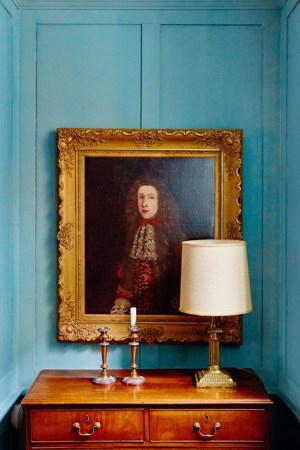
The Dining Room at 13 Princelet Street, Spitalfields, London, built ca. 1718–19. The Landmark Trust is featured in House & Garden (May 2015), pp. 134–39. Photo by Ben Quinton.
The Landmark Trust is a charity that rescues important buildings that would otherwise be lost. We take on historic places in danger and carefully and sensitively restore them. By making them available for holidays, we make sure they can be enjoyed by all, both today and for future generations. We have in our care nearly 200 buildings in Britain and several in Italy and France. Though they range from the sober to the spectacular, all our buildings are rich in history and atmosphere. They include picturesque pavilions and medieval long-houses, artillery forts and Gothick follies, clan chiefs’ castles and cotton weavers’ cottages, the homes of great writers and the creations of great architects, from Browning to Boswell, from Pugin to Palladio.
In the month we were founded, we will open 25 Landmarks for a special, celebratory open weekend across England Scotland and Wales, many never before or only rarely open to the public. The buildings have been carefully picked so that 95% of the British population will be within 50 miles of an open Landmark.
At 3pm on 16 May 2015 local groups, community choirs, bands, bell ringers and musicians of all sorts will simultaneously perform a specially commissioned Anthem for Landmark by acclaimed young composer Kerry Andrew. We hope this will unite Landmarkers and local communities across the country in a wonderful shared celebration.
More information about the weekend is available here»

Richard Samuel Coade, Belmont (Lyme Regis, Dorset), built before 1784, at which point it became the home of Eleanor Coade; appropriately the house showcases the eponymous artificial stone she pioneered.
◊ ◊ ◊ ◊ ◊
One of The Landmark Trust’s latest project, Belmont is scheduled to open later this year:
Belmont (Lyme Regis, Dorset) is a fine, early example of a maritime villa, a new building type that sprang up in the second half of the 18th century with the rising popularity of sea bathing and holidays by the seaside. Our research has shown that the house was built before 1784 by Samuel Coade. This is the date he transferred the house to his niece, Mistress Eleanor Coade (1733–1821), one of the most intriguing figures in 18th-century architecture.
Our project will rescue Belmont from decay and restore it to its late-Georgian glory, creating a Landmark which will sleep 8 people. As it was once Mrs Coade’s holiday villa, so it will be used for holidays again, with its original features repaired and reinstated.
Thanks to a hugely generous financial bequest to Landmark by the late Mrs Shelagh Preston, the fundraising appeal for Belmont has now reached its target. We are so grateful to everyone who supported Belmont, helping us to raise a total of £1.8m.
Romantic Illustration Network

◊ ◊ ◊ ◊ ◊
From RIN:
The Romantic Illustration Network (RIN) restores to view the importance of book illustration and visual culture in the Romantic period, but also across the eighteenth and nineteenth centuries. RIN brings together scholars working on poetry, prose, the printed book, visual culture, and painting from roughly 1750–1850 to share research and to develop new models for understanding the relationship between word and image in the period, between large and small scale work, and between painting, print and illustration.
We are collaborating with Tate Britain to enhance the Tate’s collection of literary prints and paintings. RIN will foreground artists who have been unduly ignored, and return attention to well-known artists in unfamiliar roles. We aim to recapture lost cultures of looking and of reading, restoring the link between word and image not only in book illustration but in the wider literary and visual culture. Our programme of events will take as starting point in turn the artist, the author, the gallery and the economics of print. We will produce an edited collection of essays and it is hoped that this network will form the basis for a longer research project.
The RIN blog is available here»
New Book | Romanticism and Caricature
From Cambridge UP:
Ian Haywood, Romanticism and Caricature (New York: Cambridge University Press, 2013), 242 pages, ISBN: 978-1107044210, £60.
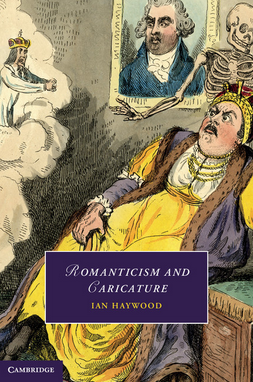 Ian Haywood explores the ‘Golden Age’ of caricature through the close reading of key, iconic prints by artists including James Gillray, George and Robert Cruikshank, and Thomas Rowlandson. This approach both illuminates the visual and ideological complexity of graphic satire and demonstrates how this art form transformed Romantic-era politics into a unique and compelling spectacle of corruption, monstrosity and resistance. New light is cast on major Romantic controversies including the ‘revolution debate’ of the 1790s, the impact of Thomas Paine’s ‘infidel’ Age of Reason, the introduction of paper money and the resulting explosion of executions for forgery, the propaganda campaign against Napoleon, the revolution in Spain, the Peterloo massacre, the Queen Caroline scandal, and the Reform Bill crisis. Overall, the volume offers important new insights into the relationship between art, satire and politics in a key period of history.
Ian Haywood is Professor of English and Co-Director of the Centre for Research in Romanticism at the University of Roehampton. He co-edited, with John Seed, The Gordon Riots: Politics, Culture and
Insurrection in Late Eighteenth-Century Britain (Cambridge University
Press, 2012).
◊ ◊ ◊ ◊ ◊
C O N T E N T S
Introduction: The Recording Angel
1 Milton’s monsters | James Gillray, Sin, Death and the Devil (1792)
2 Lethal money: forgery and the Romantic credit crisis | James Gillray, Midas (1797), George Cruikshank and William Hone, Bank Restriction Note (1819)
3 The aesthetics of conspiracy | James Gillray, Exhibition of a Democratic Transparency (1799)
4 The spectral tyrant: Napoleon and the English dance of death | Thomas Rowlandson, The Two Kings of Terror (1813)
5 The spectropolitics of Romantic infidelism | George Cruikshank, The Age of Reason (1819)
6 The British inquisition | George Cruikshank and William Hone, Damnable Association (1821)
7 The return of the repressed: Henry Hunt and the Reform Bill crisis | William Heath/Charles Jameson Grant, Matchless Eloquence (1831).
Notes
Select Bibliography
Index
Exhibition | Charles de La Fosse: The Triumph of Color
Now on view at Versailles:
Charles de La Fosse, le triomphe de la couleur
Château de Versailles, 24 February — 24 May 2015
Musée des Beaux-Arts, Nantes, 19 June — 20 September 2015
Curated by Béatrice Sarrazin, Adeline Collange-Perugi, and Clémentine Gustin-Gomez
 Although almost forgotten over the past two centuries, Charles de La Fosse (1636–1716) introduced a great many new ideas during the reign of Louis XIV, of whom he was a contempory. His work bears testimony to the artistic development of Charles Le Brun under whom he studied, and that of Antoine Watteau, a close friend. Considered to be one of the greatest painters of his time, Charles de La Fosse contributed to all the royal worksites at the Tuileries, the Palace of Versailles and the Invalides, while still devoting a large amount of time to private commissions. His body of work is equally exceptional for his numerous drawings, in particular those using the ‘trois crayons’ technique (black, red, white).
Charles de La Fosse’s work can be admired throughout the Palace, as an introduction to the monographic exhibition devoted to him in Madame de Maintenon’s Apartement. The display of major compositions in the Royal Chapel, the Diana Room and the Apollo Room—restored for the occasion—reveals La Fosse to be one of the main creators behind the decoration in Versailles.
The exhibition at the end of the tour of the State Apartments highlights the different aspects of the artist’s talent, inspired by the masters of the Académie (Poussin and Le Brun), and strongly influenced by contact with Venetian (Titian and Veronese) and Flemish (Rubens and Van Dyck) paintings to produce light seductive paintings with glowing colours. Preferring colour to lines, La Fosse’s work was extremly innovative and makes him one of the great pioneers of the 18th century.
A colloquium Charles de La Fosse et les arts en France autour de 1700 is scheduled for 18–19 May 2015 (see the website for the Centre de recherche du château de Versailles).
The full press packet for the exhibition is available as PDf file here»
◊ ◊ ◊ ◊ ◊
From Dessin Original:
Béatrice Sarrazin, Adeline Collange-Perugi et Clémentine Gustin, Charles de La Fosse (Paris: Somogy, 2015), 240 pages, ISBN: 978-2757209158, 35€.
 Publié à l’occasion de la première exposition monographique consacrée à Charles de La Fosse, l’ouvrage met en lumière les différentes facettes du talent de l’artiste qui, puisant ses racines chez les maîtres de l’Académie (Nicolas Poussin et Charles Le Brun), sait se renouveler au contact de la peinture vénitienne (Titien et Paul Véronèse) et flamande (Pierre Paul Rubens et Antoine Van Dyck) pour créer une peinture séduisante et légère, aux coloris chatoyants. Favorisant la couleur plutôt que la ligne, l’œuvre de La Fosse, extrêmement novatrice, fait de ce peintre l’un des grands précurseurs du XVIIIe siècle.
Quelque peu tombé dans l’oubli ces deux derniers siècles, Charles de La Fosse (1636–1716) est pourtant le grand introducteur des idées nouvelles sous le règne de Louis XIV dont il est l’exact contemporain. Son œuvre témoigne de l’évolution de la création artistique, de Charles Le Brun, dont il fut l’élève, à celle d’Antoine Watteau, un ami proche. Considéré comme l’un des meilleurs peintres de son temps, Charles de La Fosse participe à tous les chantiers royaux des Tuileries, du château de Versailles et des Invalides, tout en consacrant une grande part de son activité aux commandes privées. Son œuvre est aussi remarquable par ses nombreux dessins, notamment ceux à la technique des trois crayons (pierre noire, sanguine, rehauts de blanc).
◊ ◊ ◊ ◊ ◊
S O M M A I R E
Charles de La Fosse tel qu’en lui-même, ALAIN MÉROT
Charles de La Fosse: un parcours novateur, CLÉMENTINE GUSTIN-GOMEZ
Charles de La Fosse à Versailles, BÉATRICE SARRAZIN
Charles de La Fosse: de Le Brun à Louvois, NICOLAS MILOVANOVIC
Charles de La Fosse: Les amours des dieux, ADELINE COLLANGE-PERUGI
Entre ligne et couleur: Réflexions sur les dessins de Charles de La Fosse, BÉNÉDICTE GADY
Charles de La Fosse en son temps, FRÉDÉRIQUE LANOË
Un coup de tonnerre (ou plutôt un coup de foudre), PIERRE ROSENBERG
New Book | Charles-Joseph Natoire and the Académie de France in Rome
The latest volume in the Oxford University Studies in the Enlightenment (previously SVEC) book series:
Reed Benhamou, Charles-Joseph Natoire and the Académie de France in Rome: A Re-evaluation (Oxford: Voltaire Foundation, 2015), 254 pages, ISBN: 978-0729411622, £60 / €83 / $89.
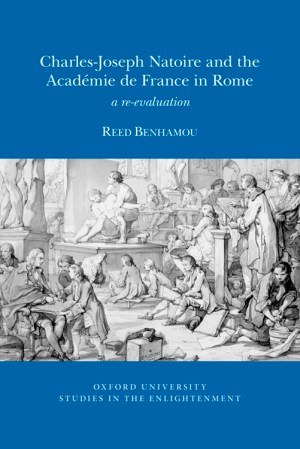 In 1752 Charles-Joseph Natoire, then a highly successful painter, assumed the directorship of the prestigious Académie de France in Rome. Twenty-three years later he was removed from office, criticised as being singularly inept. What was the basis for this condemnation that has been perpetuated by historians ever since? Reed Benhamou’s re-evaluation of Natoire’s life and work at the Académie is the first to weigh the prevailing opinion against the historical record.
The accusations made against Charles-Joseph Natoire were many and varied: that his artistic work was increasingly unworthy of serious study; that he demeaned his students; that he was a religious bigot; that he was a fraudulent book-keeper. Benhamou evaluates these and other charges in the light of contemporary correspondences, critics’ assessment of his work, legal briefs, royal accounts and the parallel experiences of his precursors and successors at the Académie. The director’s role is shown to be multifaceted and no director succeeded in every area. What is arresting is why Natoire was singled out as being uniquely weak, uniquely bigoted, uniquely incompetent. The Charles-Joseph Natoire who emerges from this book differs in nearly every respect from the unflattering portrait promulgated by historians and popular media. His increasingly iconoclastic students rebelled against the traditional qualities valued by the French artistic elite; the Académie went underfunded because of the effects of war and a profligate king, and he was caught between two competing institutional regimes. In this book Reed Benhamou not only unravels the myth and reality surrounding Natoire, but also also sheds light on the workings of the institution he served for nearly a quarter of a century.
Reed Benhamou is a Professor Emerita at Indiana University. Her research focuses on the educational programmes offered by royal, municipal and private art academies in Paris, Rome and the French provinces. Her many publications include Regulating the Académie: Art, Rules, and Power in Ancien Régime France, SVEC 2009:08.
◊ ◊ ◊ ◊ ◊
C O N T E N T S
Introduction
Part I, 1700–1751
1 In the bosom of the family (Natoire, 1751)
2 His gift for painting (d’Antin, 1723)
3 The brilliant verve of Natoire and Boucher (Locquin, 1912)
4 Natoire is the most qualified (Tournehem, 1750)
Part II, 1752–1777
5 It seems necessary to pass some time in Rome (Perrault, 1664)
6 A deep understanding of what is required (d’Antin, 1708)
7 My position requires it (Natoire, 1755)
8 Completely inadequate for a difficult time (Lecoy, 1874)
9 This strayed lamb (Natoire, 1753)
10 Never a more singular case (Mémoires secrets, 1768)
11 I’ve been advancing money to the Academy for a long time (Natoire, 1773)
12 I must obey and conform (Natoire, 1775)
Appendix 1: Natoire and art (1737–1777)
Appendix 2: Natoire and money (1752–1777)
Bibliography
Index
Call for Papers | Art, Anatomy, and Medicine since 1700
Art, Anatomy, and Medicine since 1700
Columbia Museum of Art, Columbia, South Carolina, 31 March — 1 April 2016
Proposals due by 1 July 2015
The symposium organizer seeks proposals for papers that address visual, theoretical, cultural, historical and/or contemporary connections, relationships, conflicts and/or collaborations among the visual arts, anatomy/dissection, and medicine from the eighteenth century to the present. Participants may be historians of art, medicine, science or technology, art educators, medical professionals, artists (who may propose to contextualize their own work), etc. Successful papers may also be invited for publication in an edited volume of the same theme.
Broad topics may include (but are certainly not limited to):
· The role of anatomy in artists’ training (past, present and/or future)
· Artists’ roles in the creation/dissemination of anatomical knowledge
· Artistic representation of anatomical and medical professionals
· Anatomical and medical models: from écorché figures to nano-imagery
· Anatomy as art, art as anatomy
· Anatomical displays, exhibitions (e.g. Body Worlds), and collections: from curious to educational to controversial
· Corpses, dissection and grave-robbing in art, literature and medical history
· Imaging bodily surface and anatomical depth: from sculpture to M.R.I.s and beyond
· Beyond human, superhuman, inhuman(e)?: technological ‘improvements’, additions and extensions of human anatomy from prosthetics/implants to Google glasses
· Zombies and vampires, and the creative/fantastic defiance of or resistance to anatomical, medical and worldly reality
· The evolutionary human in art and science: looking backward and looking ahead
· Parts vs. whole: the functions of specificity and generality in aesthetics and visual medical information
Please send cover letter, abstract (no more than 3 pages, double-spaced typed), and CV to:
Dr. Andrew Graciano, Associate Professor of Art History and Associate Director
School of Visual Art & Design
University of South Carolina
Columbia, SC 29208
or by email to: graciano@mailbox.sc.edu
Colloquium | Ces architectes qui ont bâti l’Europe
From H-ArtHist:
Les Européens: Ces architectes qui ont bâti l’Europe, 1450–1950
Institut national d’histoire de l’art, Paris, 23–25 April 2015
Organisé avec le soutien de LabEx EHNE : Ecrire l’Histoire Nouvelle de l’Europe (Université de Paris-Sorbonne); Centre André Chastel (CNRS, Université de Paris-Sorbonne); et Centre Jean Pépin, THETA (CNRS-ENS, Paris)
2 3 A V R I L 2 0 1 5
9.30 Ouverture du colloque par Alexandre Gady, directeur du centre André Chastel et Dany Sandron, responsable du LabEx EHNE pour le centre André Chastel
10.00 Olga Medvedkova (CNRS, centre Jean Pépin, Paris), Les « vitae» des architectes-migrants et la notion de l’Europe architecturale
10.30 L’Europe face à l’Europe à l’époque de la Renaissance
Président de séance : Alexandre Gady
• Marco Folin (Université de Gènes), Le cosmopolitisme d’un artiste de la Renaissance: Léonardo da Vinci (1442–1519) en France
• Sabine Frommel (EPHE, Paris), A la cour de France : Sebastiano Serlio (1475-1554) et Francesco Primaticcio (1504–1570)
• Agnieszka Wiatrzyk (EPHE, Paris), Le problème de la ville idéale : Bernardo Morando (1540–1600) et Zamosc
13.00 Pause déjeuner
14.30 Les architectes-migrants auprès des Cours européennes du XVIIe siècle
Président de séance : Claude Mignot
• Hélène Vérin (CNRS, centre Alexandre Koyré, Paris), De Princes en Monarques : Salomon de Caus (1576–1626) et l’art des grottes, fontaines et jardins
• Linnéa Tilly (AUSser umr 3329), De maître maçon à architecte, Simon (1590?–1642) et Jean (1624-1696) de la Vallée en Suède
• Jorge Fernández-Santos Ortiz-Iribas (E.T.S.A. Universidad San Jorge, Saragosse), Un polymathe à la recherche de l’obliquité architecturale : Juan Caramuel Lobkowitz (1606–1682)
• Raphaël Tassin (EPHE, Paris), Un Milanais, architecte du duc de Lorraine : Giovan Betto (1642–1722)
2 4 A V R I L 2 0 1 5
9.30 L’Europe élargie au Siècle des Lumières
Président de séance : Pascal Liévaux
• Alexandre Gady (Université de Paris-Sorbonne), Faire l’Europe sans bouger : Robert de Cotte (1656–1735) et l’architecture royale
• Ekaterina Orekhova (Musée de l’Ermitage, Saint-Pétersbourg), Deux Italiens parisiens à Saint-Pétersbourg dans la première moitié du XVIIIe siècle : les Rastrelli, père et fils
• Jérôme de La Gorce (CNRS, centre André Chastel, Paris), Un artiste florentin dans l’Europe des Lumières : Jean Nicolas Servandoni (1695–1766)
• Dimitri Ozerkov (Musée de l’Ermitage, Saint Pétersbourg), Les antiquités romaines sans frontières : Vincenzo Brenna (1747–1820) en Pologne et en Russie
13.00 Pause déjeuner
14.30 L’Europe face au Monde Nouveau (XVIIIe et XIXe siècles)
Président de séance : Jean-Philippe Garric
• Emilie d’Orgeix (Université de Bordeaux-III), Un ingénieur, architecte, théoricien français à travers l’Amérique et l’Europe : Amédée Frézier (1682–1773)
• Alberto Garin (Universidad Francisco Marroquín Lives, Antigua Guatemala), L’ingénieur militaire espagnol, entre l’Antigua et la Nouvelle Guatemala : Luis Díez Navarro (1699–1776)
• Philippe Malgouyres (Musée du Louvre), Un architecte néoclassique espagnol au Mexique au crépuscule de l’empire espagnol : Manuel Tolsa (1757–1816)
• Pascal Dubourg-Glatigny (CNRS, centre Alexandre Koyré, Paris-Berlin), Un architecte-ingénieur français au service des méandres politiques de la Colonie du Cape : Louis-Michel Thibault (1750–1815)
2 5 A V R I L 2 0 1 5
9.30 Les architectes émigrés et la modernité architecturale du XXe siècle
Président de séance : Pierre Caye
• Orfina Fatigato (Laboratoire ACS, ENSA Paris-Malaquais – DiARC, Università degli Studi di Napoli Federico II), Un ‘gothique’ devenu ‘latin’ : Le Corbusier (1887–1965)
• Nabila Oulebsir (Université de Poitiers, Centre Georg Simmel, CNRS-EHESS), Un architecte moderne méditerranéen : Léon Claro (1899–1991)
• Martin Pozsgai (Stiftung Bibliothek Werner Oechslin), Entre Bauhaus et exile : Fred Forbát (1897–1972), un architecte hongrois en Allemagne et en Suède
• Anat Falbel (Instituto de Filosofia e Ciencias Humanas. Universidade Estadual de Campinas. IFCH/UNICAMP), Architecture, histoire et engagement politique : Anatole Kopp
• Clôture du colloque par Pierre Caye, directeur du centre Jean Pépin, CNRS-ENS
New Book | The Cambridge Companion to the French Enlightenment
From Cambridge UP:
Daniel Brewer, ed., The Cambridge Companion to the French Enlightenment (New York: Cambridge University Press, 2014), 265 pages, hardback ISBN: 978-1107021488, $80 / paperback ISBN: 978-1107626140, $30.
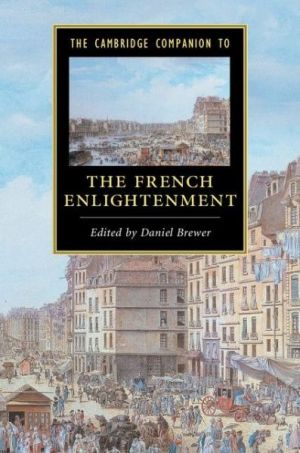 The Enlightenment has long been seen as synonymous with the beginnings of modern Western intellectual and political culture. As a set of ideas and a social movement, this historical moment, the ‘age of reason’ of the seventeenth and eighteenth century, is marked by attempts to place knowledge on new foundations.
The Cambridge Companion to the French Enlightenment brings together essays by leading scholars representing disciplines ranging from philosophy, religion and literature, to art, medicine, anthropology and architecture, to analyse the French Enlightenment. Each essay presents a concise view of an important aspect of the French Enlightenment, discussing its defining characteristics, internal dynamics and historical transformations. The Companion discusses the most influential reinterpretations of the Enlightenment that have taken place during the last two decades, reinterpretations that both reflect and have contributed to important re-evaluations of received ideas about the Enlightenment and the early modern period more generally.
Daniel Brewer, Department of French and Italian, University of Minnesota, has published widely in the area of eighteenth-century French literature and culture. He is author of The Enlightenment Past: Reconstructing Eighteenth-Century French Thought (Cambridge University Press, 2008) and co-editor of L’Esprit Créateur: The International Quarterly of French and Francophone Studies.
◊ ◊ ◊ ◊ ◊
C O N T E N T S
Chronology
1 Daniel Brewer, The Enlightenment Today?
2 Antoine Lilti, Private Lives, Public Space: A New Social History of the Enlightenment
3 Andrew Curran, Anthropology
4 Paul Cheney, Commerce
5 J. B. Shank, Science
6 Dan Edelstein, Political Thought
7 Julie Candler Hayes, Sex and Gender, Feeling and Thinking: Imagining Women as Intellectuals
8 Charly Coleman, Religion
9 Jennifer Milam, Art and Aesthetic Theory: Claiming Enlightenment as Viewers and Critics
10 Thomas DiPiero, Enlightenment Literature
11 Stéphane Van Damme, Philosophe/Philosopher
12 Downing A. Thomas, Music
13 Anthony Vidler, Architecture and the Enlightenment
14 Anne Vila, Medicine and the Body in the French Enlightenment
15 Charles W. J. Withers, Space, Geography, and the Global French Enlightenment
Further Reading
PhD Studentship | Portraiture and the British Naval Officer

Richard Livesay, Captain Richard Grindall and His Family, ca. 1800 (Greenwich: National Maritime Museum). More information about the painting is available here»
◊ ◊ ◊ ◊ ◊
From AAH:
Portraiture and the British Naval Officer, ca.1740–1805
Full-time Collaborative PhD Studentship, University of East Anglia, 2015–2018
Applications due by 11 May 2015
The University of East Anglia, in partnership with the NMM and the NPG (both part of the Collaborative Doctoral Partnership, the Thames Consortium), is seeking to appoint a suitably qualified applicant for a full-time collaborative PhD studentship undertaking the first sustained critical study of British naval officers’ portraits (paintings and prints) between the period of Britain’s emergence as a world maritime power and that power’s consolidation at Trafalgar, for three years commencing 1 October 2015. The research will address the production, reception, dissemination and significance of eighteenth-century British naval officers’ portraits whilst also contributing to related online publications, research and events within the NMM and the NPG.
The successful applicant will be based at the NMM, the NPG and the Department of Art History and World Art Studies (UEA). The studentship is funded through the AHRC Collaborative Doctoral Award programme, and includes tuition fees up to the standard Home/EU amount and an annual stipend. Funding for PhD studentships from AHRC is available to successful candidates who meet the UK Research Council eligibility criteria. Applicants should hold (or expect to achieve) a Master’s degree and either a 1st Class or Upper 2nd Class Honours degree in a relevant discipline.
More information is available here»
Australia’s NPG Acquire Portrait of William Bligh
Press release from the National Portrait Gallery in Canberra:

Attributed to John Webber, Portrait of William Bligh, in Master’s Uniform ca. 1776 (Canberra: National Portrait Gallery)
On Tuesday, 31 March 2015, the National Portrait Gallery unveiled an exciting new acquisition of irrefutable importance to all Australians. Portrait of William Bligh, in Master’s Uniform (c. 1776), attributed to John Webber, is one of the earliest portraits of the contentious, historical figure and extends the Gallery’s remarkable collection of early colonial portraits.
On the occasion of the launch of the National Portrait Gallery Foundation, President Sid Myer announced the acquisition, made possible by a most generous act of benefaction. He paid special tribute to Canberra philanthropists, Sotiria Liangis and John Liangis, for their assistance in funding the purchase of this striking and masterful work. Director, Angus Trumble, said he was overjoyed with the purchase, one which the Gallery had been contemplating for some time. “The work, purchased by the Gallery through Christie’s in London, has a very high level of indisputable national significance to Australia, and the Gallery is immensely appreciative to the Liangis family for their support,” he said.
Portrait of William Bligh, in Master’s Uniform will take its place alongside another John Webber painting: the Portrait of Captain James Cook RN (1782), acquired in 2000 by the Commonwealth Government with the generous benefaction of Robert Oatley and John Schaeffer. Webber spent three years at sea with Cook and was the artist on the Resolution.
The life of William Bligh (1754‒1817) offers up a handful of the most remarkable episodes in the history of Britain’s maritime empire. Bligh’s epic journey to Timor with his companions in a small open boat the 3,600 miles whence they were ejected from H.M.S. Bounty remains an astonishing feat of navigation by the stars. Bligh’s misfortune was not merely to have gone through the ordeal of mutiny aboard the Bounty, but to have faced insurrection in Sydney during his tenure as fourth Governor of New South Wales. The Rum Rebellion of 1808 damaged Bligh’s reputation, but he was vindicated in London and promoted to vice-admiral of the blue. He ended his enormously eventful career by mapping Dublin Bay.
Bligh has become for Australians a mythic figure. There has been a bellwether William Bligh in every phase of Australian history—the martinet versus the brilliant cartographer and genius of navigation; the deeply misunderstood versus the merely blinkered man; the blackguard versus the gentleman and officer of the Royal Navy, steeped in its sometimes brutal disciplinary code; the angry tyrant versus the lonely husband and victim of circumstance, stoutly defended again and again, as a matter of principle, by their Lordships of the Admiralty.
Trumble said, “This portrait represents a different William Bligh. Here he is represented at the age of about 25, several years before his marriage, wearing the uniform of sailing master, already skilled in navigation and seamanship, no doubt ambitious for himself, his men and his vessel, shortly before he was hand-picked by James Cook to go aboard H.M.S. Resolution, on which the artist John Webber also sailed.”










 Enfilade
leave a comment