Call for Panel Proposals | Creating Markets, Collecting Art
From AAH:
Creating Markets, Collecting Art
Christie’s King Street, London, 14–15 July 2016
Proposals due by 1 June 2015
To commemorate the traditional founding date of Christie’s auction house in 1766, a two-day conference, 14–15 July 2016, will be held at Christie’s King Street, focusing on the theme of Creating Markets and Collecting Art.
Christie’s Education is known for its collaborative and cross-disciplinary approach to the study of works of art through its Master’s programmes in the History of Art and its Markets, Art-world Practice and Art, Law and Business internationally. This conference hopes to explore this cross-disciplinary area, looking at the interrelationship of commerce, collecting and the academy.
Sessions should engage with current scholarship on any aspect of the art market, in particular on creating markets, collecting, regulation and cultural heritage, from the eighteenth century to the present day, and in all geographical regions. Session proposals may address the following:
• the role of the intermediary in the structure of art ecosystems
• the economics of taste and its relationship to value(s)
• how artefacts are transformed into works of art by the market and by enthusiasts and collectors
• the role of regulation and the law
• the auction house as cultural space
• current theoretical debates surrounding ‘aura’ and the making/meaning of authenticity
Session proposals should include a title and abstract (maximum 250 words), the contact details of the convenor(s) and a brief biography. Please submit the Session Proposal Form by e-mail to the Conference Secretary (aking@christies.com) by 1st June 2015. This will be followed by a Call for Papers in July 2015.
New Book | Académie Royale: A History in Portraits
From Ashgate:
Hannah Williams, Académie Royale: A History in Portraits (Farnham: Ashgate, 2015), 394 pages, ISBN: 978-1409457428, $110.
 From its establishment in 1648 until its disbanding in 1793 after the French Revolution, the Académie Royale de Peinture et de Sculpture was the centre of the Parisian art world. Taking the reader behind the scenes of this elite bastion of French art theory, education, and practice, this engaging study uncovers the fascinating histories—official and unofficial—of that artistic community.
Through an innovative approach to portraits—their values, functions, and lives as objects—this book explores two faces of the Académie. Official portraits grant us insider access to institutional hierarchies, ideologies, rituals, customs, and everyday experiences in the Académie’s Louvre apartments. Unofficial portraits in turn reveal hidden histories of artists’ personal relationships: family networks, intimate friendships, and bitter rivalries. Drawing on both art-historical and anthropological frames of analysis, this book offers insightful interpretations of portraits read through and against documentary evidence from the archives to create a rich story of people, places, and objects.
Theoretically informed, rigorously researched, and historically grounded, this book sheds new light on the inner workings of the Académie. Its discoveries and compelling narrative make an invaluable and accessible contribution to our understanding of this pre-eminent European institution and the social lives of artists in early modern Paris.
Hannah Williams is Junior Research Fellow in Art History at St John’s College, University of Oxford.
◊ ◊ ◊ ◊ ◊
C O N T E N T S
Introduction: Face-to-Face with the Académie Royale
Part I. The Official Face
1 An Institutional Image: Portrait of the Artist as an Academician
2 Rituals of Initiation: Becoming and Being in the Académie
3 On the Wall: Portraits, Spaces, and Everyday Encounters at the Académie
Part II. The Unofficial Face
4 Bloodlines: Portraits of Family
5 Reciprocal Acts: Portraits of Friendship
6 Facing Off: Portraits of Rivalry
Epilogue: The End of an Institution
Appendices
Bibliography
Index
Call for Papers | CIHA 2016 Session, The Other and the Foreign
Below is the general Call for Papers for the 2016 meeting in Beijing of the Comité International d’Histoire de l’Art (CIHA), along with details for the session on “The Other and the Foreign.” Many of the 21 sessions will be of interest and the full CFPs is available here.
34th CIHA World Congress of Art History: Terms
Beijing, 15–22 September 2016
Proposals due by 30 June 2015
The Chinese CIHA Committee will host the 34th CIHA World Congress of Art History in Beijing and invites art historians from all over the world to attend and discuss Terms. Scholars from a vast cross-section of disciplines and fields of professional interest are called upon to discuss together ways of seeing, describing, analyzing, and classifying art works. The topics are divided into 21 sections. The sections should enable comparisons to be made between different viewpoints and methods. Each panel will compose a program reflecting the CIHA’s commitment to the idea of diversity, which should allow talks on different genres, epochs, and countries to be brought together. Please submit the abstract of your paper directly to the chairs with a copy to info@ciha2016.org before 30 June 2015.
Session 14: The Other and the Foreign: Contact, Curiosity, and Creative Exchange
Session Chairs
Petra Chu, Seton Hall University, New Jersey (petra.chu@shu.ed)
DING Ning, Peking University, Beijing (dingning@pku.edu.cn)
LIANG Shuhan (Junior Chair), Peking Univeristy, Beijing (liangtiantian@hotmail.com)
Respondent
Jennifer Milam, Sydney University (jennifer.milam@sydney.edu.au)
This session is concerned with the representation of the ‘other’ and the ‘foreign’ in art as well as with the reception of ‘other’ and ‘foreign’ art forms. It acknowledges that, in a global world, the notion of ‘othering’ is not restricted to the geographically or ethnically distant (‘foreign’), but occurs within one’s own (geographically defined) culture between different social classes, genders, age groups, and religious affiliations. More generally, the session focuses on the phenomenon of artistic encounter and exchange. While its parameters are worldwide, papers on all topics related to the ‘other’/’foreign’ are solicited in as far as they pertain to the creation and reception of art and/or the transmission of creative ideas. Papers on the contacts between specific regions or the role and place of individual artists in the process of artistic exchange are welcomed.
Questions to be addressed may include but are not limited to the following:
• Can we distinguish universal paradigms for the ways in which ‘the other’ is represented in art, globally?
• In the global history of art, how have animals been used as devices for ‘othering’, not solely as subject matter, but as a means through which artists and their audiences engage with the nature of self—other relationships?
• How can we improve our theoretical models of the reception of foreign and, more generally, ‘other’ art?’
• Are there degrees of ‘otherness,‘ and if so, can we measure them? Can a work produced within one’s own (geographically defined) culture be just as ‘other’ as, or more so than, a work produced in a ‘foreign’ culture?
• How can we theorize ‘artistic exchange?’
• How do we define ‘hybridity’ in art? Is more than one definition possible?
• What is the relation/difference between exchanges between cultural centers and those that happen at peripheries, specifically in connection with ‘hybrid’ art forms?
• To what extent can artistic differences and sameness be accounted for through geography?
Researchers Revisit Fragonard’s ‘Young Girl Reading’
Press release (2 April 2015) from Washington’s NGA:
Researchers were able to establish that Portrait of a Woman with a Book existed as a ‘complete’ painting for at least six months before it was changed into Young Girl Reading. The composition once showed a woman with her head turned outwards, looking at the spectator. She wore a large feathered headdress dotted with colored beads, a thinner neck ruffle than in the subsequent painting, and she was illuminated by a frontal light source. An amorphous folding shape in the background behind her was suggested to be a curtain on the basis of precedents in 17th- and 18th-century French portraiture.

Details of Young Girl Reading, the near infrared hyperspectral image (HSI) and the x-ray florescence (XRF) scan for the element mercury (thought to show the presence of vermilion) are shown alongside a simulation of Portrait of a Woman with a Book, generated by cross-referencing various imaging techniques (simulated image by Becca Goodman and Denis Doorly).
One of the most beloved paintings in the National Gallery’s permanent collection, Young Girl Reading (c. 1770) by Jean-Honoré Fragonard, shows a young woman in profile, reading the book in her hand. It is now clear that a completely different face was painted underneath, that of an older woman looking out towards the viewer. Using groundbreaking imaging techniques and new art historical investigation, Yuriko Jackall, assistant curator of French paintings, John Delaney, senior imaging scientist, and Michael Swicklik, senior paintings conservator, all at the National Gallery of Art, recovered and reconstructed this first composition, a fully-realized, ‘lost’ painting newly referred to as Portrait of a Woman with a Book.
Their research was sparked by the discovery, at a June 2012 Paris auction, of a drawing by Fragonard showing the Washington picture as a woman looking out at the viewer. The drawing further indicated that the Gallery’s painting once belonged to a series of 18 so-called ‘fantasy figures’, an ensemble painted for a single commission about which many details are still unknown. Today, these works have been dispersed among distinguished private collections and public institutions such as the Musée du Louvre, the Clark Art Institute, and The Metropolitan Museum of Art.
In the 1980s, x-radiography had indicated the presence of another composition beneath Young Girl Reading, but many details including the extent to which the artist had altered his canvas remained unknown. In the last decade, innovations in imaging technologies have provided completely new ways to examine paintings. Using a diverse range of methodologies combining traditional high-resolution color imaging, digital x-radiography, and cross-sectional analysis with chemical information from Delaney’s newly developed, high sensitivity, near infrared hyperspectral imaging (HSI) camera and x-ray fluorescence (XRF) scanning sensor, Jackall, Delaney, and Swicklik investigated the process by which Fragonard changed one composition into the other. The technology was developed recently at the Gallery as part of an ongoing initiative to create new analytical imaging tools for conservation led by Delaney. Funding was provided by the Andrew W. Mellon and Samuel S. Kress Foundations and a grant from the National Science Foundation to the Gallery and George Washington University (GWU). Image-registration algorithms designed by GWU’s Murray Loew and his team aided in the reconstruction of the prior composition.
At crucial points in their work, Jackall, Delaney, and Swicklik relied upon the expertise of colleagues across the Gallery, particularly in the departments of science, conservation, and imaging and visual services. Swicklik, who had previously written a pioneering article on the use of varnish in French painting, was critical in making sense of Fragonard’s painting technique. Jackall, an expert in 18th-century French painting, brought to the project an unusually deep network of contacts in France, having studied and worked there for a decade prior to her move to Washington, DC. In addition to conducting archival research, she consulted the Paris-based Fragonard specialist, Marie-Anne Dupuy-Vachey, one of the first to discover the drawing when it appeared at the Paris auction.
Moving forward on their research on the ‘fantasy figures’ and Young Girl Reading, Jackall, Delaney, and Swicklik plan to investigate other works in Fragonard’s series, in cooperation with institutions and individuals. Young Girl Reading was a gift of Mrs. Ailsa Mellon Bruce in memory of her father, Mr. Andrew W. Mellon, in 1961. The National Gallery owns 13 paintings, 21 drawings, and 17 prints by Fragonard.
The findings of Jackall, Delaney, and Swicklik, as well as Dupuy-Vachey’s preliminary study of the place of the drawing in Fragonard’s artistic practice (translated from the French by Jackall), appear in the April 2015 issue of The Burlington Magazine.
Exhibition | Landscapes of the Mind: British Landscapes

Joseph Wright of Derby, Sir Brooke Boothby, 1781 (London: Tate)
◊ ◊ ◊ ◊ ◊
As noted at ArtDaily:
Landscapes of the Mind: British Landscapes from the Tate Collection, 1690–2007 / Paisajismo británico. Colección Tate, 1690–2007
Museo Nacional de Arte, Mexico City, 25 March — 21 June 2015
On March 25th Landscapes of the Mind: British Landscape Painting, Tate Collection, 1690–2007 was presented for the first time ever in Mexico City, an exhibition organized by Tate in association with Museo Nacional de Arte, as part of the celebrations of the Dual Year between Mexico and the United Kingdom. The exhibition presents 111 artworks by British and European artists, with a plurality of techniques (painting, drawing, printmaking, photography, sculpture/installation, etc.) which ponder the evolution of British landscape in art history. The term ‘Britain’ is understood as the geographical entity of the British Isles, i.e., the archipelago that includes England, Wales, Scotland and Ireland, before the independence of the latter in 1921.
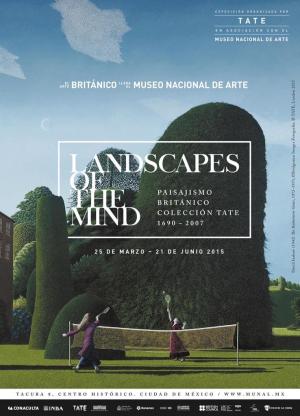 This genre was explored in Britain during the 16th century with the use of documents describing the topography, geology, history, and legends of the said land. It gained popularity throughout the 17th century, with the discoveries of explorers, naturalists, and merchants who helped expand the limits of the British nation to the four parts of the world. By the late 18th century, the landscape genre had become a dominant trend in Britain.
According to Nicholas Serota, Director of Tate, “the reasons for the predominance of landscape in British visual culture are many and varied: the extraordinary diversity of physical landscapes in such a relatively small geographic area; acute sense of loss of a pastoral and rural ideal world because of rapid industrialization during the 18th and 19th centuries; identification of the aristocracy of classical culture field; the immense impact of the natural sciences, and at the same time, the belief that close observation revealed both the moral and the hidden spiritual truth behind appearances”.
The nine topics developed by curator Richard Humphreys aim to introduce British culture through great classical painters of the 18th century such as Thomas Gainsborough; continuing with artworks of romantic and impressionist artists of the 19th century, like John Constable, J.M.W. Turner, John Martin, John Singer Sargent and James Tissot; and finally addressing modern and contemporary landscapes by artists such as David Inshaw, Sir Stanley Spencer, and Paul Nash.
Considering the importance of a current view on the history of landscape and the need for a continued dialogue between the ages; in addition to meeting the great interest of a younger generation in discovering the artistic production of its own time, Dr. Agustín Arteaga, Director of the Museo Nacional de Arte, managed the incorporation of David Hockney’s Bigger Trees Near Warter or /ou Peinture sur le Motif pour le Nouvel Age Post- Photographique. In 1984, Museo Tamayo presented the traveling exhibition Hockney Paints the Stage, an exhibit shown after the failed attempt to include a graphic series of nudes during the Cultural Olympiad in 1968, which were eventually censored. After visiting Mexico City in 1984, Hockney traveled to the state of Oaxaca, where he produced a series of paintings and graphics inspired by a hotel in Acatlán. Tate preserves in its collection some works from this series. Nearly 30 years after, Hockney returns to Mexico with his biggest artwork accomplished so far: a picture of monumental proportions, more than 4.5 by 12 meters, consisting of 50 paintings, done in six weeks in 2007 for the Summer Exhibition of the Royal Academy of London, and donated to Tate the following year, along with two digital reproductions. The image depicts a landscape of East Yorkshire, a region where the artist lived, shortly before the arrival of spring when the trees begin to sprout.
Alongside Landscapes of the Mind, a comparative exercise linking landscape tradition in Britain and Mexico is included, this latter is exhibited as a dialogue with the newly renovated galleries of the Museo Nacional de Arte in the permanent exhibit. The relationship was established through the canvas Mexico Valley (1837) of the London traveler artist Daniel Thomas Egerton. His work coexists with a selection of paintings by the Mexican artist José María Velasco.
The exhibition is accompanied by a bilingual catalog print run of 2,000 copies, consisting of 142 black/white and color images, with texts by curator Richard Humphreys and edited by Museo Nacional de Arte. As part of the show, Museo Nacional de Arte offers an Academic Program aimed at a wide audience, including a lecture every Thursday at 17:00 with varied presentations including one by the curator Richard Humphreys; a commented film series of the best of British cinematography; weekend and specialized workshops; interpretive materials downloadable via the website, as well as guided tours.
New Book | Arthur Shurcliff and the Colonial Williamsburg Landscape
Published by the University of Massachusetts Press in association with the Library of American Landscape History:
Elizabeth Hope Cushing, Arthur A. Shurcliff: Design, Preservation, and the Creation of the Colonial Williamsburg Landscape (Amherst: University of Massachusetts Press, 2014), 312 pages, ISBN: 978-1625340399, $40.
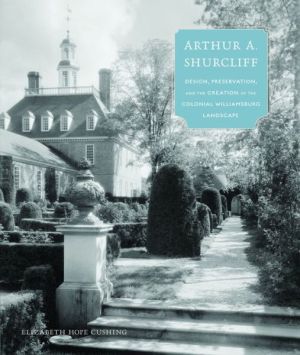 In 1928 the landscape architect Arthur A. Shurcliff (1870–1957) began what became one of the most important examples of the American Colonial Revival landscape—Colonial Williamsburg, a project that stretched into the 1940s and included town and highway planning as well as residential and institutional gardens. Shurcliff graduated from MIT with a degree in engineering in 1894 but was drawn to landscape architecture. Because no formal programs existed at the time, on the advice of Frederick Law Olmsted and with the aid of his mentor, Charles Eliot, he went on to piece together courses at Harvard College, the Lawrence Scientific School, and the Bussey Institute, earning a second B.S. two years later. He then spent eight years working in the Olmsted office, acquiring a broad and sophisticated knowledge of the profession. Opening his own practice in 1904, Shurcliff emphasized his expertise in town planning, through the years preparing plans for towns surrounding Boston and for several industrial communities. He also designed recreational spaces in and around Boston, including significant aspects of the Franklin Park Zoo and the Charles River Esplanade, one of Shurcliff’s major projects in the region. In this richly illustrated biography, Elizabeth Hope Cushing shows how Shurcliff’s early years in Boston, his training, his early design and planning work, and his experience creating an Arts and Crafts–style summer compound in Ipswich led to Colonial Williamsburg, the largest commission of his career and his most significant contribution to American landscape architecture.
Elizabeth Hope Cushing is the author of numerous cultural landscape history reports and coauthor of Community by Design: The Olmsted Firm and the Development of Brookline, Massachusetts (University of Massachusetts Press / Library of American Landscape History, 2013).
New Book | Rediscovering Architecture: Paestum
From Yale UP:
Sigrid de Jong, Rediscovering Architecture: Paestum in Eighteenth-Century Architectural Experience and Theory (New Haven: Yale University Press, 2015), 352 pages, ISBN: 978-0300195750, $85.
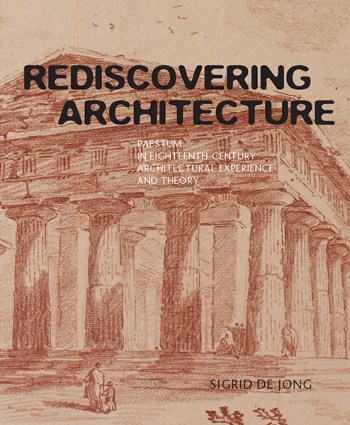 The 18th-century rediscovery of the three archaic Greek-Doric temples in Paestum in southern Italy turned existing ideas on classical architecture upside down. The porous limestone temples with rough, heavy columns were entirely unlike the classical architecture travelers to the site were familiar with. Paestum, exceptional in the completeness of its ruins, came to fascinate architects, artists, writers, and tourists alike, who documented the site in drawings and texts. In Rediscovering Architecture, Sigrid de Jong analyzes extensive original source material, including letters, diaries, drawings, paintings, engravings, and published texts, which are attractively reproduced here. The book offers new insights on the explorations of the site, the diverse reactions to it, and their dramatic and enduring effect on architectural thought, as they influenced intellectual debates in England, France, and Italy during the long 18th century. This unique study of the experience of architecture reconstructs Paestum’s key role in the discourse on classical architecture and its historiography, primitivism, the sublime and the picturesque, and the growing importance of science and history in architectural thought.
Sigrid de Jong is a postdoctoral researcher and lecturer at Leiden University.
Call for Papers | CAA 2016 Session, Eros and Enlightenment
An addition to the CAA 2016 sessions:
ASECS Panel on Eros and Enlightenment at the
104th Annual Conference of the College Art Association
Washington, D.C., 3–6 February 2016
Proposals due by 31 May 2015
Session Chairs:
Nina Dubin, University of Illinois at Chicago (dubin@uic.edu)
Hérica Valladares, University of North Carolina at Chapel Hill (herica.valladares@gmail.com)
What would it mean to consider the eighteenth century through the lens of its evolving discourse on love? The explosion of a novel-reading public; the Enlightenment’s often nervous inquiry into love’s place among the ‘moral sentiments’ and its status in relation to the equally unstable category of friendship; the expansion of epistolary culture and the attendant vogue for love letter pictures; the libertine conceptualization of love as a ‘commerce’; homoeroticism as a cultural leitmotif; the ubiquitous presence of Cupid, even in such unexpected contexts as financial literature; the fixation on ancient notions of eros, from Ovid’s persistently popular Ars Amatoria to the unearthed remains of erotic frescoes: these and other phenomena suggest that love played a central yet complicated role in period self-imaginings, in ways that iconographic accounts of the era’s visual arts have perhaps not fully registered. This ASECS-sponsored panel seeks papers on all aspects of visual and material culture that expand, challenge, and enliven our understanding of eros in the eighteenth century.
Please email a title, abstract (1–2 pages, double-spaced) and brief CV (1–2 pages) to the panel chairs by May 31.
Call for Papers | Visual Print Culture in Europe, 1500–1850
From the University of Warwick:
Visual Print Culture in Europe, 1500–1850: Techniques, Genres, Imagery, and Markets
University of Warwick at Palazzo Pesaro Papafava, Venice, 5–6 December 2015
Proposals due by 1 June 2015
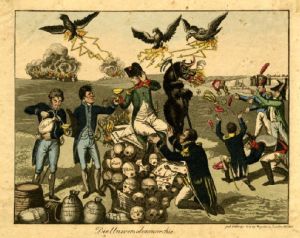 Under Napoleon’s Empire we find London acting as a hub for printing caricatures of Napoleon in a range of languages, and with a number of distinctive styles. The print Die Universalmonarchie (pictured to the right) claims, for example, to have been published by Boydell & Co. in London in 1815, but the Boydells were based at Cheapside, not—as the print states—at Pall Mall (once the location of the late Josiah Boydell’s famous Shakespeare Gallery). The publication information would seem to be spurious, and the British Museum suggests that it was likely published in Paris. Is this print, then, German, French, or even possibly English? Who exactly is its market? How far is its imagery tailored to a particular ‘national’ audience and in what ways might it be distinctively comprehensible to such an audience? Besides London, what other European hubs were important, at what moments and why?
Visual Print Culture in Europe 1500–1850 aims to draw together scholars with a range of disciplinary skills to discuss the methods, representational forms, and distribution of and audience for visual print media in Europe between 1500 and 1850. Its seeks to de-nationalize the study of visual print culture, and to explore the extent to which interactions between engravers and printers, artists and consumers in Europe, and a range of common representational practices produced a genuinely European visual print culture—with local modulations, but nonetheless with a common core.
Papers can draw on a range of disciplinary backgrounds in exploring the exchange of techniques and processes, the analysis of imagery, and the identification of markets, and in analysing the conditions under which particular generic forms crossed or failed to cross national boundaries. Although the emphasis is on European visual print culture, the impact of that culture on, and its interaction with, the wider world is also of interest. The conference language will be English. The conference may be able to provide some financial assistance to those whose home institutions are unable to support their attendance, especially postgraduate students.
The conference organisers—acting under the European History Research Centre—are Mark Philp (History, EHRC Director, Warwick mark.philp@warwick.ac.uk), Kate Astbury (French Studies, Warwick), Mark Knights (History, Warwick), and David Taylor (English, Warwick). Proposals for papers should be submitted to t.smith.2@warwick.ac.uk by June 1st 2015, but please feel free to contact Mark Philp in advance with any queries.
Display | Canaletto’s ‘Regatta on the Grand Canal’

Canaletto, A Regatta on the Grand Canal, ca. 1740
(London: National Gallery)
◊ ◊ ◊ ◊ ◊
Compton Verney press release for the display now on view at the Victoria Art Gallery:
Canaletto’s A Regatta on the Grand Canal
Victoria Art Gallery, Bath, 7 March — 3 May 2015
Compton Verney, Warwickshire, 9 May — 21 June 2015
Sunderland Museums and Winter Gardens, 11 July — 13 September 2015
Canaletto’s masterpiece A Regatta on the Grand Canal (about 1740) is on loan from the National Gallery to promote the understanding, knowledge and appreciation of Old Master paintings to as wide an audience as possible. This large-scale work depicts the annual carnival regatta in Venice. Some of the figures in the foreground wear the bauta, a costume of white mask and black cape which was typically worn during the carnival. The painting shows the one-oared light gondola race. The arms of the Doge Alvise Pisani, who ruled from 1735 to 1741, are visible on the macchina della regatta or floating pavilion on the left, from which coloured flags were presented to the winners. The painting is a companion piece to Canaletto’s Venice: The Basin of San Marco on Ascension Day of the same date.
The Masterpiece Tour is part of the National Gallery’s commitment to promote the understanding, knowledge and appreciation of Old Master paintings to as wide an audience as possible. This opportunity to bring hugely popular National Gallery paintings to the public’s doorstep is made possible by the generous support of Christie’s.
◊ ◊ ◊ ◊ ◊
This year Compton Verney and Bath’s Holburne Museum are also hosting a major exhibition addressing the Venetian artist: Canaletto: Celebrating Britain.










 Enfilade
leave a comment