Exhibition | Canaletto: Celebrating Britain

Canaletto (Giovanni Antonio Canal), London: The Thames from Somerset House Terrace towards the City
(Royal Collection Trust/© Her Majesty Queen Elizabeth II 2014)
◊ ◊ ◊ ◊ ◊
News of this exhibition appeared here at Enfilade in January, but the posting addressed only the Kendal venue (where it will have a slightly different title). Here’s the expanded version:
Press release from Compton Verney:
Canaletto: Celebrating Britain
Compton Verney, Warwickshire, 14 March — 7 June 2015
Holburne Museum, Bath, 27 June — 4 October 2015
Abbot Hall Art Gallery, Kendal, Cumbria, 22 October 2015 — 14 February 2016
This is the first time that these magnificent paintings and drawings by Canaletto have been brought together to provide an overview of Canaletto’s work created between 1746 and 1755, whilst he was visiting Britain. During his nine-year stay in Britain he documented not just traditional or established views and landmarks but also his (and his patrons’) latest achievements in architecture and engineering. The depictions of these new building works and projects, whether couched in Palladian, Baroque or Gothic styles, celebrate the new-found wealth and assurance of the British nation, reflecting contemporary developments in popular culture such as the rediscovery of Shakespeare; the success of Handel’s Messiah and the cult of King Alfred—which in turn spawned Arne’s immortal Rule Britannia.
Set into context, by 1750 the first generation of Palladian architects and patrons (Burlington, Campbell and Kent) were dead, and the nation was ready for a more liberal attitude to architectural design. Britain itself was a more stable and confident place than it had been even thirty years before. During the recent War of the Austrian Succession, the nation had held onto its new colonial gains and had succeeded in forcing Spain to open up South America to its traders. The economy was booming and the Jacobite threat had evaporated. Accordingly, a new, more confident generation, profiting from the ‘Georgian Revolution’ and increasingly assured by Britain’s status as a major world power, was prepared to be less regimented by Palladian rules and more eclectic in its architectural patronage seeking cultural inspiration not just from the Mediterranean but also from their own history.
This new found confidence signalled through the architecture of Baroque masters such as Wren (at St Paul’s and St Mary’s, Warwick), Hawksmoor (at Westminster Abbey’s west towers) and the Gothic revival marks Britain out as the new Venice, which was the real subject of Canaletto’s great canvases on display in this exhibition.
Information regarding programming at Compton Verney is included in the press release.
◊ ◊ ◊ ◊ ◊
From Paul Holberton:
Steven Parissien, Pat Hardy, Jacqueline Riding and Oliver Cox, Celebrating Britain: Canaletto, Hogarth, and Patriotism (London: Paul Holberton Publishing, 2015), 128 pages, ISBN: 978-1907372780, £25.
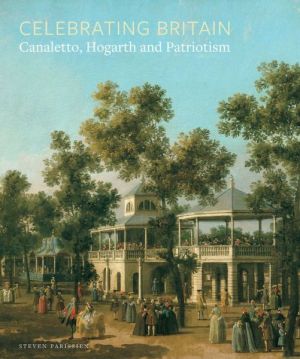 By 1750 Britain was—as Jacqueline Riding shows—at peace with her traditional enemy, France, and had finally extinguished the threat from the Catholic Jacobites. The art of William Hogarth—particularly his great canvas O The Roast Beef of Old England of 1749—duly reflected this new sense of security and pride in being British. The economy was booming. Trade was expanding. And newly-confident Britons were no longer looking to Italy or France for their cultural exemplars, particularly in the field of architectural design.
It was the ferment of activity, the eclectic building boom which underlines Britain’s wealth and optimism and which marks the nation out as the new Venice, which is the real subject of Canaletto’s great canvases. Almost all of Canaletto’s views focused on a new architectural commission or a recent urban development, and were specifically designed to celebrate the latest achievements of British architecture and engineering. The Italian master was not alone. The vigorous and infectious patriotism of his works mirrored emerging nationalistic trends in popular culture during the 1740s, a decade which witnessed the canonization of William Shakespeare as a British hero, the creation of Handel’s Messiah and Arne’s immortal Rule Britannia, and, as Oliver Cox shows, the propagation of the nationalistic cult of King Alfred—and, more bizarrely, of the ‘flying king’ Bladud in Bath.
As Pat Hardy explains, the presence of a significant group of artists working in London prior to Canaletto’s arrival, led by Samuel Scott, along with the strength of existing artistic practices and traditions and the vibrant print market for maps and surveys of London, suggests that the impact of the arrival of Canaletto was more complicated than may have previously been perceived. At the same time, Canaletto’s legacy survived throughout the eighteenth century, in the hands of native artists such as William Marlow.
◊ ◊ ◊ ◊ ◊
Press release (November 2014) from Abbot Hall:
Abbot Hall was built in the Palladian style just three years after Canaletto left England for the last time. In 1746, by then in his late 40s, he first arrived for a prolonged stay in London. He was to remain for most of the following 10 years.
Already a well established artist, his work had proved very popular with aristocratic Englishmen doing their Grand Tour of Europe. In the 1720s, having started his career as a theatrical scene painter, Canaletto started painting his distinctive views of Venice, frequently featuring the many major churches designed for it by Palladio. One of his clients was Joseph Smith, an English merchant banker who lived in Venice for 70 years, for 16 of which he was the British consul there. Smith bought many Canaletto works for himself, and also helped arrange commissions from wealthy English collectors—by the late 1720s his works were already in the collections of Goodwood, Chatsworth, Woburn and of the Prime Minister, Sir Robert Walpole. Smith himself owned by far the largest collection of works, including 52 oil paintings and over 140 drawings, which he eventually sold to George III in 1762 for £10,000—half the sum the latter paid the previous year for Buckingham Palace.

Canaletto (Giovanni Antonio Canal), Portrait of Canaletto with St Paul’s in the Background at Anglesey Abbey, Cambridgeshire (National Trust Images/Hamilton Kerr Inst/Chris Titmus)
Canaletto came to London as an indirect result of the War of the Austrian Succession, which started in 1741. This had made continental travelling difficult for his wealthy English patrons, severely reducing his income. He therefore decided to move himself to London, setting up his studio near Golden Square. He arrived a month after Culloden, the last pitched battle fought on British soil, and at the beginning of a period of unprecedented domestic peace and prosperity, which saw London turning into the world’s richest and largest city.
Although the bulk of the works with English subjects were of London scenes, with the Thames a frequent presence, he was also a regular visitor to the countryside, often at the invitation of his rich patrons, and painted several views of Warwick Castle, as well as of Alnwick, Badminton, Eton and Walton.
The rapid change of London’s architecture during his time here is also documented. In The Old Horse Guards from St James’ Park of 1749, he caught the Horse Guards Parade ground, complete with parading soldiers, as well as men peeing against the wall of Downing Street, and dozens of people promenading, showing the artist’s interest in depicting scenes of daily life. Within a couple of years, from almost exactly the same spot, he was back painting the new Horse Guards parade, the one that is still there today—it can be dated very precisely to 1752–53, as the clock tower still has scaffolding on it, while the south wing had yet to be constructed.
Canaletto is often accused of depicting London whilst using bright Venetian lighting. However, in both his pictures of the Horse Guards, the light is soft and diffused. In A View of Walton Bridge the sky is even more typically ‘English’—and un-Venetian—with the sun competing with storm clouds brewing overhead. The picture also includes a portrait of Thomas Hollis, who commissioned 5 works from Canaletto, as well as a rare self-portrait of the artist, shown painting the scene. The bridge was regarded at the time as an advanced feat of engineering. The contrasting stately bulk of Westminster Bridge and the views from it was evidently something that fascinated Canaletto, who clearly would have agreed with Wordsworth’s later opinion that “earth hath not anything to show more fair.” The bridge was under construction during his time here, and he painted and sketched it repeatedly. In one of the pictures from the Royal Collection, he frames a view of the Thames, St Paul’s and the City as if he had drawn the scene from under one of the new arches of the bridge, while others show it still under construction.
It is easy to forget that Canaletto continued to paint Venetian scenes throughout his time in London. Worked up from his sketches, or done from memory, these provided him with a significant proportion of his income whilst in London, as his more conservative patrons demanded work that they were familiar with, rather than venturing into the new views that the artist was confronting. For example, his Bucintoro at the Molo on Ascension Day, showing the state barge after the annual ‘marriage’ of Venice with the sea—which, when it sold for $20,000,000 in 2005, was briefly his most expensive painting sold at auction—was painted in London in 1754.
Ruskin had a particular down on Canaletto. It is, however, unclear quite how familiar the ascerbic critic was with genuine works by the Venetian. As a hugely popular artist, his work was widely forged and copied both during his lifetime and afterwards. It is possible that Ruskin was sometimes writing about Canaletto pupils and assistants, when he thought he was writing about Canaletto himself. In “Notes on the Louvre”, writing about a picture of the Salute and the entrance to the Grand Canal, he said that it is “cold and utterly lifeless—truth is made contemptible” and that “boats and water he could not paint at all.” The picture has since been re-attributed to Canaletto’s pupil Michele Marieschi. Similarly the “bad landscape” he saw in Turin is almost certainly a work by Bernardo Bellotto, Canaletto’s nephew. Writing about Canaletto’s “vacancy and falsehood” in Modern Painters, he refers to a painting in the Palazzo Manfrin—Augustus Hare, who visited it at about the same time, noted that the palazzo “has a picture gallery which is open daily, but contains nothing worth seeing, all the good pictures having been sold.” It is unclear which work Ruskin was referring to when he said that Canaletto’s depiction of architecture was “less to be trusted in its renderings of details than the rudest and most ignorant painter of the 13th century.” Certainly that is not the view of most modern critics of most properly authenticated works by Canaletto, but Ruskin was never one to allow the facts to affect his pet prejudices.
Exhibition | Treasured Possessions

Unidentified English maker, Trompe l’oeil folding fan, 1757
(Cambridge: The Fitzwilliam Museum)
◊ ◊ ◊ ◊ ◊
Assiduous readers of Enfilade may recall my fascination with puzzle jugs. And so in the spirit of April Foolishness, it’s the object from the exhibition I’m especially excited about—at least for today. There are more serious sorts of things from the eighteenth century also included (samples of which are available here), and the catalogue looks wonderful. -CH
From The Fitzwilliam:
Treasured Possessions from the Renaissance to the Enlightenment
The Fitzwilliam, Cambridge, 24 March — 6 September 2015
A dazzling journey through the decorative arts: from the hand-crafted luxuries of the Renaissance to the first stirrings of mass commerce in the Enlightenment. Each of the 300 beautiful and engaging objects was once a treasured possession, revealing the personal tastes and aspirations of its owner, and preserving precious memories. Witness the impact of global trade on European tastes: the lust for goods imported from the East, the revolutions caused by New World products like chocolate and sugar. European shoppers were lured by dazzling colours, intricate designs, constant technological innovation and the glamour of the exotic.
 This show is all about desire and possession. It explores how beautiful, curious and engaging objects were made, marketed, acquired, personalized and valued. Some objects shown here are undoubtedly masterpieces: works of dazzling design and innovative skill, long-prized as highlights of the Museum’s collection; others are more ordinary. The purpose of this exhibition is to move beyond conventional appraisals of artistic or monetary worth to appreciate how objects were crafted and what they were made from, and how possessions took on changing meanings for individual owners.
The Renaissance to the Enlightenment period is a long one (about 1400 to about 1800), which saw profound changes in the production and availability of goods. Over this time, we can chart the emergence of new luxuries and technological innovations, the importation and imitation of foreign artefacts such as porcelain or calico, the domestication of new world substances like chocolate or tobacco, and the first stirrings of mass production that
would transform the European home.
The objects in this new material world created new visual realities, and changed how people felt about themselves and others. Despite the rapid increase in the availability of non-essential goods, objects from this period were often charged with emotional significance and inscribed with sentimental value. Some of the things on display are named and dated so as to commemorate an important event such as a marriage or a death. Others show signs of persistent wear and tear and deliberate mending. There are home-made items, painstakingly created and handed down from one generation to the next. And there are showy pieces which flaunt the tastes, aspirations and fantasies of their past owners. Of course, we cannot always reconstruct the hidden history of an object; many of these treasures still hold their secrets tight.
I. A New World of Goods
The Renaissance witnessed an explosion of goods. Lists of household possessions, carefully recorded by scribes and preserved to this day, give a sense of the accumulated clutter in prosperous homes. Such inventories describe elaborate dinner services, glassware, furniture, linen, clothes, jewellery, ornaments and books. Equally striking is the presence of highly specialized items, such as hand-warmers or flower vases, often created to be beautiful as well as functional.
The great variety of objects in European homes testifies to new expectations of comfort, convenience, pleasure and taste. Here we find the new world of goods that Europeans discovered throughout the period: the age before industrialization and mass production, when non-essential commodities nevertheless became widely available across the social spectrum. While local craftsmen honed their skills to produce the innovative and intricate objects demanded by their clients, exotic foreign goods also entered the market. In turn, high-quality objects made at home were influenced, formally and stylistically, by global imports. The treasures displayed in this section give a taste of this astonishing period of innovation and experimentation.
II. Desiring and Acquiring Things

Trade card of James Wade, “Tea, Coffee, Chocolate and Snuff Seller”, Bristol, 1754 (Cambridge: The Fitzwilliam)
The Renaissance to Enlightenment period is often seen as an age of acquisitiveness, when Europeans tasted the pleasures of shopping for the first time. The reality of that experience was, however, a far cry from the sanitized world of today’s supermarkets and department stores. Buying and selling were activities subject to stern moral judgment and anxiety; fears of cheating and deception abound in literary accounts. Nor was it necessary to go to a shop in order to shop. Some of the treasured possessions exhibited here were commissioned directly from the maker; others were acquired from street vendors or markets.
In the eighteenth century, shopping became more than simply acquiring goods. It was a pastime and leisure activity, especially for the rising middling classes. Shops appeared in many British and continental European cities. They replaced market stalls and itinerant pedlars, offering a new experience for consumers increasingly allured by the goods displayed in their windows. At the same time, street sellers were the subjects of printed illustrations and expensive porcelain figures. Shopkeepers were also at the forefront of marketing innovation. They advertised their wares and services in newspapers and through trade cards and bill heads on customer receipts.
III. The Irresistible

Puzzle jug, English, probably London (either Lambeth Pottery or Rotherhithe Pottery), 1686. Tin-glazed earthenware, with pierced body containing a two-headed bird (Cambridge: The Fitzwilliam).
Antonio de Pereda’s painting Still Life with an Ebony Chest shows a mid-seventeenth-century Spanish vision of the irresistible: ebony from Africa, porcelain from China, chocolate and sugar from America, and lustreware from Valencia. The value of these enticing commodities lay not only with their rarity but also with their potential to generate pleasure. While ongoing anxieties about luxury and consumption did not disappear, Pereda’s image offers a meditation on the joys of living in ‘the here and now’.
The irresistible was inextricably linked to the expansion of Europe and the idea of the exotic, which changed constantly in response to the exploration of ‘new’ worlds. The Medici court in early Renaissance Florence desired the colourful and stylized designs of Iznik pottery and was, later on, the first European connoisseur of Chinese porcelain. Contact with America not only brought chocolate and sugar but also encouraged a new interest in the natural wonders of the New World. By the end of the eighteenth century, tobacco, chocolate, tea and coffee had all been ‘domesticated’ by Europeans. New objects, new behaviours and new social spaces were created for and
by the consumption of these novel stimulants.
IV. The Fashionable Body

Pair of shoes, English, c.1700–30. Yellow silk taffeta, bound with ribbon; floss silk embroidery in French knots, tied with ribbon. Design of scrolling stems with leaves and flowers (Cambridge: The Fitzwilliam)
The visual arts often dominate our sense of the Renaissance. Yet this cultural movement became visible to many through a new world of fashion. Tailoring was transformed by new materials and refined techniques of cutting and sewing, as well as by the demand for a tighter fit, particularly for men’s clothing. Enterprising merchants created larger markets for fashion innovations and ‘chic’ accessories. Artistic representations of the clothed body proliferated as never before. Mirrors enticed people to experiment with their appearance, as they caught sight of their reflections in looking-glasses on walls, or in small portable mirrors designed to be carried on the body.
This new type of consumption and aesthetic appreciation depended on the assemblage of a panoply of wearable goods from clothing and armour to accessories like hats, hair-pieces, feathers, toothpicks, rings, gloves, purses and shoes, which brought self-display to life. The tiny honestone portrait from the 1520s shows a woman at the height of fashion with a bonnet perched on her head. In turn, the earthenware male figure of 1606 sports an expensive modish slashed suit with belt, buttons and a flamboyant feathered hat. Even the style of facial hair could codify people and establish identities.
V. At Home and On Display
As Renaissance shoppers acquired more ‘stuff’, even ordinary homes became places of display, and new types of furniture evolved to store and show off the family treasures. During the period covered by this exhibition, traditional chests were replaced with front-opening cupboards, dressers and sideboards—versatile props on which ornamental items could be positioned. Meanwhile, cabinets containing small drawers allowed collectors to order their most precious objects, keep them safe under lock and key, and then draw them out to show selected visitors.
By the eighteenth century, technological changes, the expansion of global trade networks, and the growth of European markets had broadened the opportunities for buying and displaying goods in the home to a much wider group of people. Tea services were laid out and admired on sideboards, inkstands on desks, vases on mantelpieces, and scent-bottles and patch boxes on dressers. A whole range of ornamental porcelain items was available as well as equally coveted imitations in cheaper earthenware. The sub-division of interiors into specialized spaces resulted in new kinds of furniture such as the tea-table or secrétaire (‘writing desk for ladies’) used both to display fashionable objects and to hide its owner’s secrets.
◊ ◊ ◊ ◊ ◊
The catalogue is published by Philip Wilson:
Victoria Avery, Melissa Calaresu, Mary Laven, eds., Treasured Possessions from the Renaissance to the Enlightenment (London: Philip Wilson Publishers, 2015), 288 pages, hardback, ISBN: 978-1781300336, £40 / paperback £25.
This book is all about possession. It explores the significance of beautiful and engaging objects—chosen, acquired, personalised and treasured—to the people who once owned them. With over 300 works discussed, the book takes us on a dazzling visual adventure through the decorative arts, from Renaissance luxuries wrought in glass, bronze and maiolica to the elaborate tablewares and personal adornments available to shoppers in the Age of Enlightenment. En route the authors consider the impact of global trade on European habits and expectations: the glamour of the exotic, as witnessed in the lust for objects imported from the East, the ubiquity of New World products like chocolate and sugar, and the obsession with Chinoiserie decoration. They ask what decorative objects meant to their owners before the age of industrial mass production, and explore how technological innovation and the proliferation of goods from the sixteenth century onwards transformed the attitude of Europeans to their personal possessions.
Victoria Avery, FSA is Keeper of Applied Arts at The Fitzwilliam Museum, University of Cambridge. She has published extensively on Italian Renaissance sculpture, and was awarded the Premio Salimbeni 2012 for her monograph, Vulcan’s Forge in Venus’ City: The Story of Bronze in Venice, 1350–1650 (2011).
Melissa Calaresu is the Neil McKendrick Lecturer in History at Gonville and Caius College, Cambridge. She has written on the Grand Tour, autobiographical writing, urban space, political reform and, most recently the making and eating of ice cream in eighteenth-century Naples.
Mary Laven is Reader in Early Modern History at the University of Cambridge. She has written extensively about aspects of religion in Renaissance and Counter-Reformation Italy and is now working on ‘Domestic Devotions’, an interdisciplinary, collaborative project, funded by the European Research Council.
◊ ◊ ◊ ◊ ◊
From The Fitzwilliam:
Treasured Possessions Conference
St John’s College, Divinity School, Cambridge, 11 May 2015
Join scholars, curators and conservators for this day long event inspired by objects that once lay close to their owner’s hearts. Learn about the historical context of the exhibition, and the opportunity it provided for collaboration between curators, academics and makers. Key speakers include Peter Burke, Ludmilla Jordanova, Giorgio Riello and Evelyn Welch. The day closes with an early evening private view of the exhibition and drinks reception.
Monday, 11 May 2015, 9:00–17:00. Free but booking essential, tel: 01223 332904 or email: education@fitzmuseum.cam.ac.uk.
The Huntington to Open New Education and Visitor Center
Press release (5 March 2015) from The Huntington:
The new Steven S. Koblik Education and Visitor Center will open to the public on April 4, 2015, offering the 600,000 annual visitors to The Huntington Library, Art Collections, and Botanical Gardens a dramatically improved experience, replete with six and a half acres of gardens interspersed with beautiful facilities for dining, shopping, meeting, seeing a lecture or performance, or attending a class.

The Rose Hills Foundation Garden Court in the new Steven S. Koblik Education and Visitor Center at The Huntington Library, Art Collections, and Botanical Gardens. Photo: Tim Street-Porter
The front, northernmost section of the complex opened to the public in January, making available to visitors a new and substantially larger Huntington Store, a new specialty coffee shop, and a new full-service admissions and membership area. The rest of the visitor center, opening on April 4, features a 400-seat auditorium, a large café with indoor/outdoor seating and garden views, four multi-use classrooms, meeting and event spaces, and an orientation gallery—all arranged amid new, beautifully landscaped, drought-tolerant gardens.
The $68 million project broke ground in April 2013. An additional $10 million has been raised to endow the new facilities’ operations. Designed by Architectural Resources Group, the Education and Visitor Center consists of 52,000 square feet of educational facilities and visitor amenities. The design of the complex of buildings and gardens harmonizes with the original early 20th-century Beaux-Arts architecture on the property (once the estate of Gilded Age railroad magnate, real estate developer, and collector Henry E. Huntington). The landscape, designed in concert with the architecture by the Office of Cheryl Barton, reflects the local Mediterranean climate as well as both the agricultural and elegant estate history of the 207-acre Huntington grounds. Much of the new construction replaces existing facilities built in 1980 that no longer accommodated the needs of Huntington visitors, scholars, or staff. The project also includes the addition of 42,000 square feet of underground space to house The Huntington’s growing collections of original historical research materials as well as provide institutional storage.
The Steven S. Koblik Education and Visitor Center was funded entirely with private contributions, with a lead gift from Charles T. Munger.
Exhibition | Diana Thater: Life is a Time-Based Medium
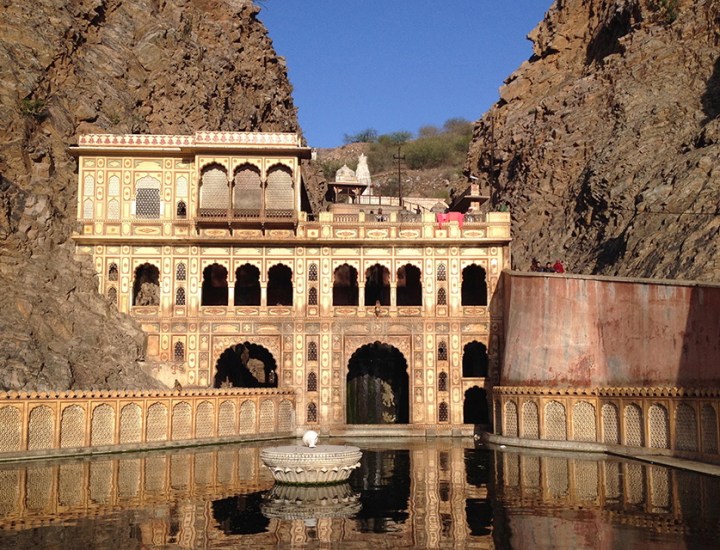
Galtaji Temple, near Jaipur, India, from the video installation Diana Thater: Life is a Time-Based Medium, 2015, 3-channel projection, 3 lenses, 1 media player, and watchout system.
◊ ◊ ◊ ◊ ◊
Press release from Hauser & Wirth:
Diana Thater | Life is a Time-Based Medium
Hauser & Wirth, London, 26 March — 16 May 2015
Hauser & Wirth is pleased to present a new video installation by Diana Thater. The work comprises footage from the Hindu pilgrimage site, the Galtaji Temple, near Jaipur in India. Thater projects images of the 18th-century pavilions and pillars onto the walls and floor of the gallery to create an immersive environment depicting the many monkeys that inhabit the temple in their architectural habitat. The installation will be included in Thater’s mid-career retrospective, opening at LACMA in Autumn 2015. This year, Thater will also present exhibitions at the Aspen Art Museum in Colorado and at San Jose Museum of Art in California.
 Thater’s experiential video installations investigate the space between documentation and abstraction, sculpture and architecture, by presenting a mediated reality. In this new work, Thater choreographs an architectural reconstruction of the Galtaji Temple. Built by Diwan Rao Kriparam in the 18th century, in pink sandstone, amidst low hills, the temple is structured to look more like a palace or ‘haveli’ than a traditional place of worship. The buildings are positioned around a natural fresh water spring and seven holy ‘kunds’—or water tanks—and waterfalls that create two tiered pools. Within the gallery, projections of the lower pool onto the floor foreground the architectural structure and evoke a tranquil setting. Appearing blurred and faded as they are diffused from the wall, the pools of water occupy a liminal state between reality and imagination. Thater works with the existing architecture of the gallery, dividing the space into two halves and employing projections to suggest the physical structure of the temple’s domed ceilings, carved pillars and painted walls. In the second space, Thater recreates an area of the temple that is inaccessible to humans, using close-up video footage to bring the viewer into greater proximity with the monkeys. As in previous works, Thater herself features in the footage in order to make manifest an encounter between humans and animals.
The ancient Galtaji Temple is still an important pilgrimage site. Thater examines the reverence with which humans approach the location, in direct contrast to the informal, rampant activity of the monkeys. Thater explores both the tame and wild aspects of the monkeys’ lives and the co- existence of animals and humans. The work is inspired by the Hindu god Hanuman, who often takes the form of a monkey and is worshipped as a symbol of physical strength, perseverance and devotion. Through Hanuman, Thater layers historical, natural and religious references to explore the potentially spiritual relationship between humans and animals.
Thater is one of the most significant contemporary artists working in new media. Drawing on issues of conservation, natural and manmade ecosystems, and socially-engineered environments, she explores tensions between mankind and the animal kingdom. Her formal interest straddles both the spatial and temporal aspects of video. She presents non-linear footage that explores animal behaviour with what she describes as a ‘neo-narrative’ approach. The exhibition’s title, Life is a Time-Based Medium, draws attention to the parallels between reality and the construction of reality that Thater’s videos present.
Diana Thater was born in 1962 in San Francisco. She studied at New York University and Art Center College of Design, Pasadena, and lives and works in Los Angeles. Thater’s work has featured in numerous significant international exhibitions. Solo shows at major institutions include: Diana Thater: Delphine, Église Saint-Philibert Church, Dijon, France (2014); Peonies, Wexner Center for the Arts, Columbus, Ohio (2011); Diana Thater: Chernobyl, Institute of Modern Art, Brisbane, Australia (2011); Diana Thater: Between Science and Magic, Santa Monica Museum of Art, Santa Monica, California (2010); gorillagorillagorilla, Kunsthaus Graz, Austria (2009); Keep the Faith: A Survey Exhibition, Museum für Gegenwartskunst Siegen, Siegen, Germany and Kunsthalle Bremen, Bremen, Germany (2004); Knots + Surfaces, DIA Center for the Arts, New York (2001); Projects 64: Diana Thater: The best animals are the flat animals, Museum of Modern Art, New York (1998); Diana Thater: Orchids in the Land of Technology at Walker Art Center, Minneapolis (1997); and China, The Renaissance Society at the University of Chicago (1995). Thater has been the recipient of a number of awards. In 2014, she was awarded a California Community Foundation Fellowship for Visual Artists. She received the Award for Artistic Innovation from the Center for Cultural Innovation, Los Angeles in 2011 and a John Simon Guggenheim Memorial Foundation Fellowship in 2005.
Symposium | The Romantic Eye, 1760–1860 and Beyond
From the YCBA:
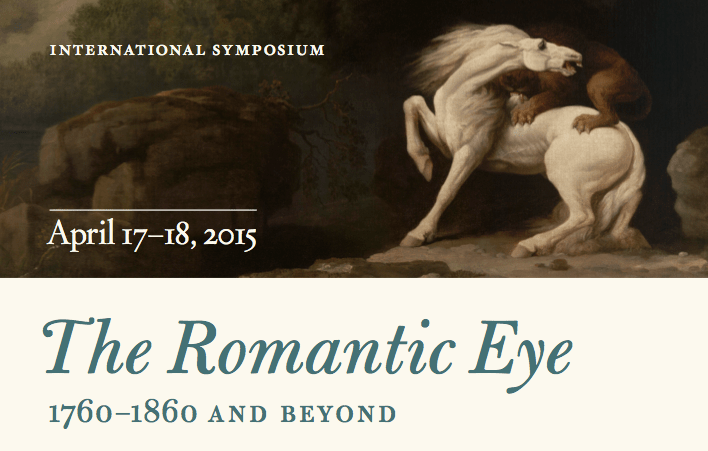
The Romantic Eye, 1760–1860 and Beyond
Yale University, New Haven, 17–18 April 2015
This two-day international symposium examines Romanticism as a shape-shifting cultural phenomenon that resists categorization. The symposium coincides with a major collaborative exhibition organized by the Yale Center for British Art and the Yale University Art Gallery, The Critique of Reason: Romantic Art, 1760–1860. Comprising more than three hundred works in a range of media, the exhibition features iconic artists including William Blake, John Constable, Honoré Daumier, Eugène Delacroix, Henry Fuseli, Théodore Géricault, Francisco de Goya, John Martin, and J. M. W. Turner.
The symposium is free and open to the public. Register online in advance (recommended) by April 15, or on-site at the event. For further information, contact ycba.research@yale.edu.
Cosponsored by the Yale Center for British Art, the Yale University Art Gallery, the Department of the History of Art at Yale University, and the Yale Student Colloquia Fund.
◊ ◊ ◊ ◊ ◊
F R I D A Y , 1 7 A P R I L 2 0 1 5
9:00 Registration and coffee
9:30 Welcome and curatorial remarks
10:00 Panel I: British Romanticism
Chair: Tim Barringer (Yale University)
• Paul Fry (Yale University), Peele Castle, Hadleigh Castle: Romantic Poetry and Painting
• Esther Chadwick (Yale University), “Copper in the Manner of Wood”: An Experimental Vignette by Thomas Bewick
• Terry Robinson (University of Toronto), Sarah Siddons and the Mediation of Spectatorship
12:00 Lunch break
1:30 Breakout Sessions
• A. Cassandra Albinson (Yale Center for British Art), The Child, the Portrait, and the Artist in the Romantic Period
• Nina Amstutz (Yale Center for British Art), Nature between Spectacle and Specimen: Robert John Thornton’s Temple of Flora and James Ward’s Two Extraordinary Oxen
• Gillian Forrester (Yale Center for British Art): “The origin of my fame”: The Visualizing “I”
in John Constable’s English Landscape Scenery and J. M. W. Turner’s Liber Studiorum Print Series c
• Scott Wilcox (Yale Center for British Art), The Rise of Watercolor Painting in Romantic Britain
2:30 Break
3:00 Panel 2: French Romanticism
Chair: A. Cassandra Albinson (Yale Center for British Art)
• Valérie Bajou (Versailles), Insolence and Insurrection in Romantic French Painting
• Mikolaj Getka-Kenig (University of Warsaw), The Fall of Napoleon and the Romantic Crisis of Heroic Representation
• Tamar Mayer (University of Chicago), Romanticizing the Neoclassical: Loss of Gravity in Jacques-Louis David’s Late Drawings and Artistic Procedures
5:00 Break
6:00 Andrew Carnduff Ritchie Keynote Lecture
• T. J. Clark (University of California, Berkeley), “Attempting Impossibles”: Hazlitt on Turner and Blake
7:00 Reception
S A T U R D A Y , 1 8 A P R I L 2 0 1 5
10:00 Panel 3: Romantic Pictorial Innovations
Chair: Nina Amstutz (Yale Center for British Art)
•Richard Maxwell and Katie Trumpener (Yale University), Romantic Panoramas: Robert Barker, Marquand Wocher, Eduard Gaertner
• Allan Doyle (Princeton University), Théodore Géricault and the Lithographic Picturesque
• Izabel Gass (Yale University), Portrait of the Artist as a Young Narcissist
12:00 Lunch break
2:00 Panel 4: Baudelaire and Romanticism
Chair: Colin Foss (Yale University)
• Tobias Kämpf (Ruhr University Bochum), Poetry as Art Criticism: Baudelaire’s Romantic Quest
• Carol Armstrong (Yale University), Baudelaire: Looking Back from 1863
3:30 Break
4:00 Panel 5: Afterlives—Modern Art and the Romantic Tradition
Chair: Harry Adams (Yale University)
• AnnMarie Perl (Princeton University), Mysticism, Striptease, Iconoclasm: Yves Klein’s Debut Performance of the Anthropometries in 1960
• Daniel Spaulding (Yale University), Death Keeps Me Awake: Joseph Beuys and the Conclusion of Romanticism
The Burlington Magazine, March 2015
The eighteenth century in The Burlington:
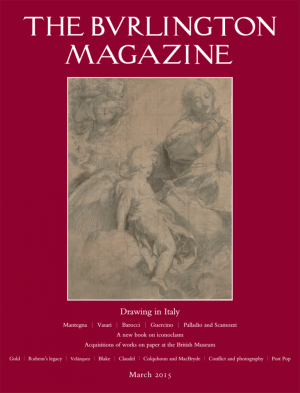
The Burlington Magazine 157 (March 2015)
 A R T I C L E S
• Veronica Maria White, “Guercino’s Beggar Holding a Broken Jug: A Drawing from the Gennari Inventory of 1719,” pp. 169–71.
• Andrew Hopkins, “Palladio and Scamozzi Drawings in England and Their Talman Marks,” pp. 172–80.
• Andrea Tomezzoli, “From Venice to Newport: A Painting by Giambettino Cignaroli Lost and Found,” pp. 181–85.
R E V I E W S
• Simon Watney, Review of Stacy Boldrick, Leslie Brubaker, and Richard Clay, eds., Striking Images: Iconoclasms Past and Present (Ashgate Publishing, 2013), pp. 186–89. Available at The Burlington website for free.
• David Scrase, Review of Laura Giles, Lia Markey, and Claire Van Cleave, eds., Italian Master Drawings from the Princeton University Art Museum (Yale University Press, 2014), pp. 197–98.
• Frances Parton, Review of the exhibition Gold (London: Queen’s Gallery, 2014–15), p. 202.
• David Scrase, Review of the exhibition William Blake: Apprentice and Master (Oxford, Ashmolean, 2014–15), pp. 206–07.
Lecture | Pannill Camp on Masonic Ritual as Philosophy
From The Newberry:
Pannill Camp, Masonic Ritual as Philosophy in Early Eighteenth-Century France
The Newberry Library, Chicago, 25 April 2015
The story of Freemasonry’s introduction into France in the early decades of the eighteenth century is also in part the story of Enlightenment philosophy’s reliance on performance activity. Radical philosophy and freethinking did not subsist only in the circulation of printed texts. Natural philosophy was demonstrated in proliferating spaces of experimental proof, and esoteric thinkers devised ceremonies meant to serve as the basis of a new moral and intellectual reality. Figures credited with promoting French interest in Freemasonry, including J. T. Desaguliers, were also intimately involved in disseminating new knowledge about the natural world.
As part of a project that examines multiple categories of performance behavior that Freemasonry instituted and inspired in France, Professor Camp will propose that Masonic ritual activity represents a broader category of philosophical performance, encompassing works like John Toland’s 1720 Pantheisticon, which Margaret C. Jacob has provocatively called a Masonic ritual text. Examining this text alongside artifacts of proper Masonic rituals, Professor Camp will also argue that treating eighteenth-century French Freemasonry as an embodied philosophical pursuit may allow us to reconcile two disjointed themes that have so far characterized historians’ approaches to the topic. In other words, the ideals that motivated early Masonic activity, when viewed through the lens of performance, may also be seen as integral to the synthetic emotional bonds and sensitive masculine solidarity cultivated in lodge activity.
Eighteenth-Century Seminar, Saturday, April 25, 2015, 2pm.
Please register by 10am Friday, April 24.
Pannill Camp is Assistant Professor of Drama at Washington University, St Louis. His research examines points of intersection between theater history and the history of philosophy, especially in eighteenth-century France. He is the author of The First Frame: Theatre Space in Enlightenment France, (Cambridge University Press, 2015).
Mellon Lectures | Thomas Crow on Restoration as Event and Idea
Press release (20 February 2015) from NGA in Washington (after the fact, audio and video recordings are available here) . . .
Thomas Crow, Restoration as Event and Idea: Art in Europe, 1814–1820
64th Annual A. W. Mellon Lectures in the Fine Arts
National Gallery of Art, Washington, D.C., 15 March — 26 April 2015
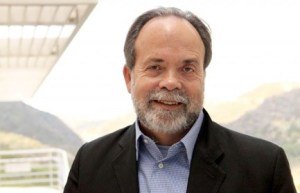 Thomas Crow, Rosalie Solow Professor of Modern Art at the Institute of Fine Arts, New York University, will give the 64th annual A. W. Mellon Lectures in the Fine Arts in a series entitled Restoration as Event and Idea: Art in Europe, 1814–1820. Crow will consider the period 1814–1820, following the fall of Napoleon. During this time, artists throughout Europe were left uncertain and adrift, with old certainties and boundaries dissolved. How did they then set new courses for themselves? Crow’s lectures will answer that question by offering both a wide view of art centers across the continent—Rome, Paris, London, Madrid, Brussels—and a close-up focus on individual actors—Francisco Goya (1746–1828), Jacques-Louis David (1748–1825), Antonio Canova (1757–1822), Sir Thomas Lawrence (1769–1830), Jean-Auguste-Dominique Ingres (1780–1867), and Théodore Géricault (1791–1824). Whether directly or indirectly, these artists were linked in a new international network with changed artistic priorities and new creative possibilities emerging from the wreckage of the old.
March 15: Moscow Burns/The Pope Comes Home, 1812–1814: David, Gros, and Ingres Test Empire’s Facade
March 22: At the Service of Kings, Madrid and Paris, 1814: Aging Goya and Upstart Géricault Face Their Restorations
March 29: Cut Loose, 1815–1817: Napoleon Returns, David Crosses Borders, and Géricault Wanders Outcast Rome
April 12: The Religion of Ancient Art from London to Paris to Rome, 1815–1819: Canova and Lawrence Replenish Papal Splendor
April 19: The Laboratory of Brussels, 1816–1819: The Apprentice Navez and the Master David Redraw the Language of Art
April 26: Redemption in Rome and Paris, 1818–1820: Ingres Revives the Chivalric while Géricault Recovers the Dispossessed
All lectures will take place on Sunday afternoons at 2:00pm and are free and open to the public. Because of the East Building renovation, the lectures will be presented in the West Building Lecture Hall, which has limited capacity. Entry passes (one per person) will be required for admission and will be distributed starting at 1:00pm on a first-come, first-served basis on the day of each lecture in the East Building Concourse. The lectures will be streamed live. At the Gallery, the live stream will be shown in the West Building Project Room and the East Building Reception Room. The live stream will also be available at the NGA website. On the Wednesday following each lecture, a video screening will be shown in the West Building Lecture Hall at noon. Audio recordings will be available each Tuesday, and video recordings with closed captioning will be available each Friday following the lecture here.
Thomas Crow is the Rosalie Solow Professor of Modern Art at the Institute of Fine Arts, New York University. He holds an MA and a PhD in art history from the University of California, Los Angeles, and a BA from Pomona College. His interests center on the entwined aesthetic and social dynamics in the production of art and the role of art in modern society.
Crow’s most recent book, The Long March of Pop: Art, Design, and Music, 1930–1995, was published by Yale University Press in January 2015. He is also the author of Emulation: Making Artists for Revolutionary France (1995, 2006); The Rise of the Sixties: American and European Art in the Era of Dissent (1996, 2005); The Intelligence of Art (1999); Modern Art in the Common Culture (1996); Painters and Public Life in Eighteenth-Century Paris (1985); and articles including “The Practice of Art History in America,” Daedalus 135 (Spring 2006) and “Marx to Sharks: The Art-Historical ’80s,” Artforum 41 (2003). He is a contributing editor of Artforum.
Crow has received numerous honors throughout his career, including the Eric Mitchell Prize for the best first book in the history of art (1986), the Charles Rufus Morey Prize of the College Art Association (1987), and a National Endowment for the Humanities Fellowship (1988–1989). He is a member of the American Academy of Arts and Sciences. He is currently the recipient of a John Simon Guggenheim Memorial Foundation fellowship (2014–2015) and spent the fall of 2014 as a Michael Holly Fellow at the Sterling and Francine Clark Art Institute.
Before his appointment at the Institute of Fine Arts, Crow was director of the Getty Research Institute, professor of art history at the University of Southern California, the Robert Lehman Professor of the History of Art at Yale University, and professor and chair in the history of art at the University of Sussex.
Call for Session Proposals | ASECS 2016, Pittsburgh
2016 American Society for Eighteenth-Century Studies Conference
Pittsburgh, 31 March — 3 April 2016
Session Proposals due by 1 June 2015
Proposals for panels at the at the 47th annual meeting of the American Society for Eighteenth-Century Studies, to take place in Pittsburgh, are now being accepted. Please complete the form (available as a Word document) and email it to asecs@wfu.edu.
ASECS Awards, 2014–15
A selection of this year’s ASECS awards that particularly relate to landscapes, images, objects, and material culture:
2014–15 Louis Gottschalk Prize
 Vittoria Di Palma, Wasteland: A History (New Haven: Yale University Press, 2014).
The American Society for Eighteenth-Century Studies awards annually the Louis Gottschalk prize to the best scholarly book on an eighteenth-century subject. The 2015 Gottschalk prize has been awarded to Vittoria Di Palma for Wasteland: A History (Yale University Press, 2014), an elegant, probing, and timely account of how the emerging discourse of modern aesthetics in Britain was inseparably intertwined with interest in certain ‘unimproved’ types of land. Di Palma’s work, which conjoins the resources of art history, landscape and garden studies, the history of science, and more disciplines still, is a scholarly tour-de-force that synthesizes disparate studies of subjects ranging from land enclosure to the sublime in order to shed new light on the prehistory of our current ecological challenges.
2014–15 James L. Clifford Prize
Paola Bertucci, “Enlightened Secrets: Silk Intelligent Travel, and Industrial Espionage in Eighteenth-Century France” published in Technology and Culture 54 (October 2013): 820–52.
Bertucci offers a critical examination of the relationship between the openness of academic knowledge and the secrecy of state affairs in the age of Enlightenment. Using the silk manufacturing industry of France and Piedmont as an example, she explores the ways in which technical intelligence was gathered under the guise of academic exchange and demonstrates that the seeming openness of academic culture was one of the resources that intelligent travelers mobilized to serve the state in secret.
2014–15 Women’s Caucus Editing and Translation Fellowship
There were five very fine submissions this year for the Women’s Caucus Editing and Translation Prize. The selection committee—which consisted of Katherine Binhammer, Katharine Kittredge, and Mary Trouille (Chair)—was especially impressed by the proposals submitted by Aileen Douglas and Catherine Sama. Since no prize was given last year, the Women’s Caucus kindly agreed to allow our committee to award a $1,000 prize to both Professors Douglas and Sama. Catherine Sama is Professor of Italian at the University of Rhode Island in Providence. She has published widely on eighteenth-century Italian women writers and artists. The title of her project is “Rosalba Carriera (1673–1757): Correspondence of a Venetian Artist.”
2014–15 Innovative Course Design Competition
Michael Gavin, “Modeling Literary History: Quantitative Approaches to the Enlightenment”
Estelle Joubert, “Music in the Global Eighteenth Century: A New Course Proposal”
Sean Silver, “The Novel and the Museum”










 Enfilade
leave a comment