Symposium | The 2015 Newport Symposium
From The Preservation Society of Newport County:
North and South: Crosscurrents in American Material Culture
23rd Annual Newport Symposium, Newport, Rhode Island, 26–29 April 2015
Despite the sometimes irreconcilable differences that culminated in the Civil War (1861–65), Newport and other Northern cities maintained close social, economic, cultural, and artistic ties with the South from the Colonial period through the Gilded Age. The 2015 Newport Symposium, North and South: Crosscurrents in American Material Culture, invites a fresh look at regional differences in American furnishings, silver, textiles, painting, architecture, and interiors to reveal the complex exchange of ideas and enduring influences.
◊ ◊ ◊ ◊ ◊
S U N D A Y , 2 6 A P R I L 2 0 1 5
4:00 Opening Lecture
“Historic House Museums, North and South: Preserving Our Past, Enhancing Our Future,” George McDaniel (Executive Director, Drayton Hall, Charleston, SC)
In both the North and South, historic house museums are too often seen as staid institutions, stuck on giving only boring ‘velvet ropes’ tours and suffering from declining revenues and morale. While such examples do exist, there are also many house museums that are using their collections, their site, and their staff in innovative and strategic ways to reach out and make a difference in their communities and beyond, and to thereby play significant roles in preserving our past and enhancing our future.
5:00 Opening Reception at Rosecliff (1902)
M O N D A Y , 2 7 A P R I L 2 0 1 5
8:00 Registration and coffee
9:00 Welcome, Donald O. Ross (Chairman of the Board, The Preservation Society of Newport County)
9:30 “Pride & Prejudice: Understanding North and South,” Tom Savage (Director of Museum Affairs, Winterthur Museum)
At the first Williamsburg Antiques Forum in 1949, Joseph Downs, then curator of the American Wing at the Metropolitan Museum of Art, announced that “little furniture of artistic merit was ever produced south of Baltimore.” A southern matron asked politely but pointedly if Mr. Downs had spoken “out of prejudice or ignorance?” The battle cry that went out from that conference spawned the landmark 1952 exhibition Furniture of the Old South, 1640–1820 at the Virginia Museum and a special issue of The Magazine Antiques dedicated to southern furniture. In 1965, The Museum of Early Southern Decorative Arts (MESDA) opened in Winston-Salem, North Carolina. This lecture will examine the historiography of southern decorative arts research and the mythological perceptions that have pervaded our understanding of American material culture, both North and South.
10:30 Break
11:00 “He Went to War a Virginian But Came Home an American: General Washington’s Revolutionary Transformation of Mount Vernon,” Susan Schoelwer (Robert H. Smith Senior Curator, George Washington’s Mount Vernon)
George Washington’s wartime travels took him to countless communities in New England and the Middle States, giving him rich opportunities to compare country estates and city houses in these regions with more familiar examples in Virginia and Maryland. After the Revolution, he drew on these experiences to purposefully redesign Mount Vernon, his beloved home and estate on the Potomac River, to suit what he called his ‘Republican stile of living’. The resulting innovations—most notably the picturesque landscape surrounding the Mansion and the grand neoclassical interior that Washington called his ‘New Room’—vividly expressed his prescient vision for the future of the new American nation.
12:00 Lunch
1:30 Concurrent lectures and tours
“Beyond the Summer Colony: Exchange Between Charleston and Newport,” Brandy Culp (Curator Historic Charleston Foundation)
Because of its favorable climate and intellectual charm, Newport was a fashionable summer destination for many Charlestonians in the eighteenth and nineteenth centuries. In addition to being what some have called “the Bath of America,” Newport was an important partner in the coastal trade, and the two cities were economically linked. We will discuss the exchange of goods between Newport and Charleston facilitated by merchants such as Rhode Island native Nathaniel Russell, as well as the cultural connections that gave rise to Newport’s popularity among the southern colony.
“Elegant Boston Interiors 1789–1830,” Jane Nylander (President Emerita) and Richard Nylander, (Curator Emeritus, Historic New England, Boston, MA)
In two consecutive afternoon sessions, the Nylanders will discuss furnishings and interiors in the homes of Boston’s elite during the New Republic. Early nineteenth-century Boston witnessed changing styles of architecture and furniture, new technologies, increasing prosperity, and an expanded circle of world trade. Interiors featured both locally made and imported goods such as textiles and wallpaper, ceramics and glass, window curtains and carpets as well as paintings and sculpture, reflecting an increased interest in the fine arts.
3:00 Concurrent lectures and tours
“Finding the Sacred in the Secular: Eighteenth-Century Synagogue Architecture in Newport and Charleston,” Daniel Kurt Ackermann (Associate Curator, Museum of Early Southern Decorative Arts, Winston-Salem, NC)
Touro Synagogue in Newport, which opened in 1763, has long been held up as a symbol of religious tolerance in America. Indeed, both Touro and KKBE’s Synagogue in Charleston, South Carolina, were important buildings in their cityscapes. These two sacred buildings constructed in secular styles reflected the status and acceptance that Jews found in early America. They also reflected the webs of kinship, commerce, and faith that linked the Jews of Newport and Charleston to each other and to the rest of the Jewish Atlantic world.
“Elegant Boston Interiors 1789–1830,” Jane Nylander (President Emerita) and Richard Nylander, (Curator Emeritus, Historic New England)
In two consecutive afternoon sessions, the Nylanders will discuss furnishings and interiors in the homes of Boston’s elite during the New Republic. Early nineteenth-century Boston witnessed changing styles of architecture and furniture, new technologies, increasing prosperity, and an expanded circle of world trade. Interiors featured both locally made and imported goods such as textiles and wallpaper, ceramics and glass, window curtains and carpets as well as paintings and sculpture, reflecting an increased interest in the fine arts.
4:00 “Elegant Taking and Talking Tea: Gentility, Patriotism and Shared Conversations in Early America,” Martha Willoughby (Senior Specialist, Christie’s, London)
This lecture will look at the American tea party and its central role in social and cultural discourse during the eighteenth century. Throughout the colonies, the ritual of tea drinking and its symbolism of British tyranny during the Revolution provided a means for establishing and affirming bonds with neighbors, visitors and compatriots. A close look at the tea party’s guest of honor—the tilt-top tea table—will illustrate the lively and fruitful conversation of ideas between North and South.
5:00 Tea and refreshments
T U E S D A Y , 2 8 A P R I L 2 0 1 5
8:00 Registration and coffee
9:00 “North and South: Town & Country,” Trudy Coxe (CEO & Executive Director) and Laurie Ossman (Director of Museum Affairs, The Preservation Society of Newport County)
9:30 “‘Send None but the Finest Quality’: Art and Patronage in Early Maryland–The Edward Lloyd Family and Beyond,” Alexandra Kirtley (The Montgomery-Garvan Associate Curator of American Decorative Arts, Philadelphia Museum of Art)
Edward Lloyd settled on Maryland’s Eastern Shore in 1659. There he established a dynasty of gentleman farmers, whose lands eventually stretched the entire length of the Delmarva peninsula. The Lloyds patronized artists of the first order, from the finest silversmiths and furniture makers to British marine painter Dominic Serres and American portraitist Charles Willson Peale. The family crafted an extraordinary landscape and built exceptional manor houses to reflect the most current architectural styles of the day. The story of the Lloyd family art patronage typifies the social experience in Early Maryland and the Upper South.
10:30 Break
11:00 “Five Desks for Virginia: New England Furniture in the South and the Caribbean during the Eighteenth Century,” Brock Jobe (Professor of American Decorative Arts, Winterthur Museum)
Throughout the 1700s, many New England woodworkers built furniture for export to distant ports in the South, the Caribbean, and beyond. Craftsmen often entered into contracts with ship captains, who carried the furniture from port to port in search of a market; when the pieces were finally sold, the proceeds were used to purchase timber, coffee, and molasses. The first provided the raw material for the furniture-making; the latter two offered a source of cash for craftsmen. We will trace the furniture export trade in four New England communities: Portsmouth, Salem, Boston, and Newport.
12:00 Lunch
1:30 Concurrent lectures and tours
“The Cosmopolitan Middletons: A Family’s History as Told Through Their Collections,” George McNeely (Vice President for Strategic and International Affairs, World Monuments Fund, New York)
The Middleton family established themselves in South Carolina in the early 18th century and have been prominent in politics, international affairs, commerce and culture ever since. Their remarkably grand Jacobean-style seat was completed in 1741 and the unusual ‘butterfly’ lakes and extensive gardens in the following decades. Trace the family through triumphs and despair, from Charleston to Philadelphia to Newport to London and back, through a wonderful selection of paintings, furniture and decorative arts in the family collections.
“In Search of Respite: Natchezians at the Northern Resorts,” Jeff Mansell, Historian, Natchez National Historical Park
In an attempt to escape the blistering Southern summers, wealthy Natchez, Mississippi planters sought refuge at popular watering holes and fashionable Northern resorts. From June to October, in a seemingly steady progression, Natchezians moved from Niagara Falls and Seneca Lake to Saratoga and Cape May. In August, they descended on Newport and by 1860, one planter’s wife observed, “it seems to me all of Natchez is here.” While most Natchezians spent only a few weeks of the season in Newport, others built cottages and became fixtures in the social and cultural life of the town.
3:00 Concurrent lectures and tours
“Victoria Mansion: The 1860 Maine Summer Home of a New Orleans Hotelier,” Arlene Palmer Schwind (Curator, Victoria Mansion, Portland, ME)
Maine native Ruggles Sylvester Morse began his hotel career in Boston and New York, but by 1843 he settled in New Orleans where he quickly made a sizable fortune. Between 1858 and 1860 he constructed a magnificent summer home in Portland, Maine. This Italian villa style mansion is largely intact, with interiors that are exceptional for their brilliant wall and ceiling paintings, marble fireplaces, and stained glass. Over ninety percent of the original furnishings remain from 1860, including an important collection of furniture by Gustave Herter, who also supervised the design of the mansion’s sumptuous interiors. Learn how Morse’s background as a hotelier and a New Orleans resident influenced the design and furnishing of this unique example of pre-Civil War grandeur, a National Historic Landmark that has been a historic house museum since 1941.
“The North in the South: Furnishings in Antebellum Natchez,” Caryne Eskridge (Project Manager and Research Curator, The Classical Institute of the South, New Orleans)
In the mid-nineteenth century, the elite ‘Natchez Nabobs’ possessed the wealth, taste, and connections that allowed them to order the most fashionable furnishings from Philadelphia, New York, and Massachusetts. As a result, many of the parlors, dining rooms, and bedrooms in Natchez resembled what was found in elite households in the Mid-Atlantic and New England. These objects challenge the distinction of ‘northern’ versus ‘southern’ and reveal significant paths within the dynamic movement of goods and people. The presentation will highlight objects that remain extant in Natchez, in some cases in a nearly complete context.
7:00 Dinner at The Breakers (1895)
W E D N E S D A Y , 2 9 A P R I L 2 0 1 5
8:30 Registration and coffee
9:30 “‘The Largest Assortment Constantly on Hand’: Furniture in New Orleans, 1840–1900,” Stephen Harrison (Curator of Decorative Art and Design, The Cleveland Museum of Art)
Recent research suggests that the story of household furnishings in the South’s most prosperous port city is far richer in its associations with Europe and the American style centers of the North both before and after the Civil War than ever imagined before. This fully illustrated lecture will discuss the many furniture emporiums that lined Royal Street and the bounty they displayed. Familiar purveyors such as Barjon, Mallard, and Siebrecht will come to life again along with the storied plantations and fashionable city residences they furnished and adorned with furniture of ‘fancy and fashion’ they kept ‘constantly on hand’.
10:30 Break
11:00 “Painting in the American South, 1730–1790,” Carolyn Weekley (Juli Grainger Curator Emerita, Colonial Williamsburg)
Portraiture dominated the activity of painters who worked in the early South. Most artists were trained in trades techniques such as signboard and coach painting. Both resident and traveling painters were the chief providers of portraits, although Southerners occasionally commissioned pictures from artists elsewhere in America and abroad, chiefly in London. Most of the painters engaged by Southerners had contact with others in the trade. Some were directly trained by fellow painters while others imitated the idiosyncratic styles of other artists.
12:00 Lunch
1:00 Optional independent touring
Symposium attendees will be admitted free of charge by presenting their symposium badges at the following properties: Redwood Library and Athenaeum (1748), Newport Art Museum, J.N.A. Griswold House (1864), The International Tennis Hall of Fame, Newport Casino (1881), The Museum of Newport History at Brick Market. Preservation Society Properties: Chateau-sur-Mer (1852), Marble House (1892), The Breakers (1895), The Elms (1901), Rosecliff (1902)
Georeferencing the British Library’s Map Collection
◊ ◊ ◊ ◊ ◊
A recent posting at at the British Library’s Maps and Views blog (25 March 2015) describes the latest phase of the project to georeference the BL’s map collection. As a crowdsourcing project, it’s fascinating. And even if you’re not interested in contributing your time, there are lots of resources already available (to search for maps previously georeferenced, use the map portal Old Maps Online, which searches across numerous online map collections, including the British Library). The video below provides an effective introduction to the basic concept of georeferencing. –CH
◊ ◊ ◊ ◊ ◊
From the BL’s Georeference Home:
Help! British Library needs 50,000+ maps georeferenced
 You can join the latest phase of our project, which features over 50,000 more maps from the British Library collections. Help us identify accurate locations for these historic maps! Bear in mind that some places have changed significantly or disappeared completely, creating a puzzle that reveals an exciting contrast.
Your name will be credited, and your efforts will significantly improve public access to these collections. Contributors can see the results of their work, as well as the progress of the pilot and other participants, and the top contributor will be publicly announced.
Sotheby’s Institute of Art | European Decorative Arts, 1600–1900

◊ ◊ ◊ ◊ ◊
From Sotheby’s Institute of Art:
Summer Study in London | European Decorative Arts: From Baroque to Art Nouveau
Sotheby’s Institute of Art, London, 26 May — 19 June 2015
Sotheby’s Institute of Art’s Summer Study programme offers intensive short courses in areas of art business, art history and finance. The programme is designed for undergraduates, career changers, study abroad participants and those interested in art and cultural history. This summer the Institute is offering a four-week intensive and immersive European Decorative Art course.
Beginning in the seventeenth century with the rise of the Baroque and culminating in Art Nouveau at the end of the nineteenth, this varied and exciting course provides a comprehensive understanding of key stylistic developments in Western European design and the decorative arts. The course focuses on furniture, ceramics, glass and metalwork, explored within the context of architecture and interiors and the broader historical and cultural forces that have influenced the production and consumption of decorative art objects. It seeks also to provide students with a basic knowledge of materials and techniques.
A diverse programme of lectures is complemented by visits to leading museums, galleries and historic houses. Students will make a private visit to Sotheby’s Warehouse, to see art objects consigned for sale and learn about the auction process, and will also have the opportunity to visit the Olympia International Art and Antiques Fair. The teaching approach is object-based and enables students to gain confidence in analyzing and identifying a wide range of art objects. Students are taught by a range of in-house tutors and visiting experts from the art world; the course is led by Jane Gardiner and Helena Pickup. For a single course, the fee is £2,650.
Suggested Reading
Gere, C. and M. Whiteway. Nineteenth-Century Design from Pugin to Mackintosh. 1993.
Riley, N. (ed.). The Elements of Design. 2003.
Snodin, M. and J. Styles (eds.). Design and the Decorative Arts: Georgian Britain, 1714–1837. 2004.
Thornton, Peter. Seventeenth-Century Interior Decoration in England, France and Holland. 1981.
Display | The Curious Neoclassical Vision of Ennemond-Alexandre Petitot
Now on at the V&A:
The Curious Neoclassical Vision of Ennemond-Alexandre Petitot
Victoria and Albert Museum, London, 25 March — 6 December 2015
Curated by Sarah Grant
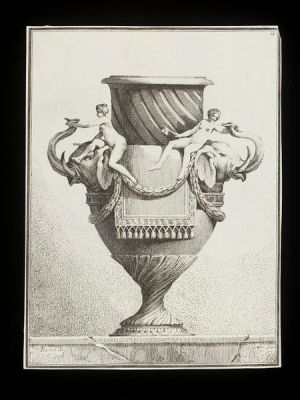
Ennemond-Alexandre Petitot, Suite de Vases (1 of 30 designs), etching by Benigno Bossi, 1770s (London: V&A)
This display showcases 24 prints and drawings by French-born architect and designer, Ennemond-Alexandre Petitot (1727–1801) who was responsible for some of the most captivating and eccentric neoclassical ornamental designs ever produced.
Petitot received a classical training in Lyons, Paris and Rome and won the prestigious post of court architect to the Duke of Parma in 1753. He executed a diverse range of commissions for the ducal palace and other important interiors, bringing a distinctly French aesthetic to the architecture and gardens of Parma. In two famous suites of ornament prints published in the 1770s Petitot gave full reign to his imagination and ensured his legacy as one of the most original exponents of Neoclassicism. These prints and a number of Petitot’s drawings and works by other influential architects and designers form the focus of this display.
Display | Blue and White: British Printed Ceramics
Now on at the V&A:
Blue and White: British Printed Ceramics
Victoria and Albert Museum, London, 31 January 2015 — 3 January 2016
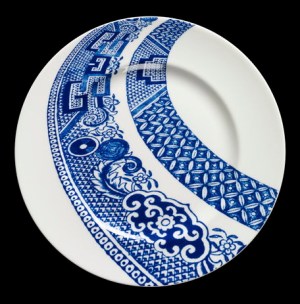
Plate, transfer-printed in enamel, ‘Border’ designed by Robert Dawson. Made by Josiah Wedgwood & Sons, Stoke-on-Trent, 2005 © Victoria and Albert Museum/WWRD United Kingdom Ltd/Robert Dawson
Blue-and-white printed ceramics are a pronounced British phenomenon with continued appeal for potters, artists and consumers. At its very best ceramic printing in blue results in a high-quality, technically precise and aesthetically pleasing decoration, enabling a rapid design response to society and culture.
This display features the wide variety of designs and decoration used in blue-and-white printed ceramics in Britain from the 1750s to present day, in both industrial and art production, demonstrating how these objects reflect British society, culture and interpret the wider world.
The display has been generously supported by The Headley Trust and includes loans from The Potteries Museum and Art Gallery, The Spode Museum Trust, The Wedgwood Museum and private collections.
Display | The Lost Art of Writing
The last weeks for this display at the V&A:
The Lost Art of Writing
Victoria and Albert Museum, London, 6 September 2013 — 4 May 2015

Inkstand, Sheffield plate, ca. 1810 (London: V&A)
“Beautiful Writing pleases everyone, it makes one sought after,” explained the French writer Père Gregoire Martin in 1761.
Having a fine writing hand was not only a useful skill but the sign of an educated and genteel person
This small display in the Metalware gallery explores some of the objects used in writing, from a medieval penner to an ingenious 18th-century globe inkstand and a pen rest designed by the architect Alfred Waterhouse. These objects, made to serve the art of writing, have been displaced by the new virtual world of icons and toolbars.
Symposium | Robert Adam and His Brothers
From the conference programme and The Georgian Group:
Robert Adam and His Brothers
Burlington House, Piccadilly, London, 23–24 September 2015
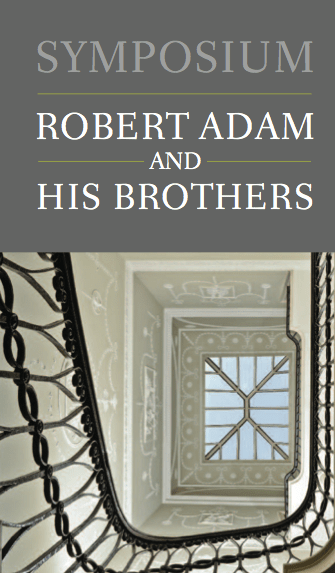
Adam Staircase Compartment of the 1770s, Mansfield Street, London, (Chris Redgrave, English Heritage)
The Adam style revolution transformed British architecture in the latter half of the eighteenth century. The brothers’ unique and inventive approach to design, based on a modern reinterpretation of the art of antiquity, found widespread popularity and was to have a lasting impact on European and American architecture. The movement and surface variety inherent in their buildings, combined with the lightness and informality of their interiors, set new standards of elegance and were widely imitated.
This two-day Georgian Group symposium, led by the architectural historians Colin Thom of UCL and Georgian Group Journal editor Dr Geoffrey Tyack, will highlight new research and findings on Robert Adam and his brothers across all aspects of their life and work, including architecture, interior decoration, the use of colour, the influence of classical sources, drawing office procedure, the art market, town-planning and building speculation. The symposium will offer interpretations by a mix of established scholars and a younger generation of historians and doctoral students, one of the main objectives being to stimulate further study on the Adams.
The Symposium papers will form the basis of a monograph to be published by Historic England in association with The Georgian Group. £100 per person for both days, or £60 for a single day. Buffet lunch included on both days. Book online or print and mail this form, with full payment, to: The Georgian Group, 6 Fitzroy Square, London W1T 5DX. Please make cheques payable to The Georgian Group. For further information, telephone 020 7529 8920.
◊ ◊ ◊ ◊ ◊
W E D N E S D A Y , 2 3 S E P T E M B E R 2 0 1 5
9.30 Registration and coffee
9.50 Opening address and welcome by Geoffrey Tyack and Colin Thom
10:00 Session 1: Scotland
• Alistair Rowan (University College, Cork), Johnie, the Eldest Adam Brother
• Simon Green (Royal Commission on the Ancient and Historical Monuments of Scotland), John, Robert and James Adam Build a House in Ayrshire
• Anthony Lewis (Curator of Scottish History, Glasgow Museums), The Adam Brothers and Their Building Tradesmen in Scotland
11:30 Tea and coffee
12:00 Session 2: Italy
• Jonathan Yarker (Lowell Libson Ltd, Art Dealers), ‘Antique Mad’: The Adam Brothers, Their Collection of Antiquities and the Roman Art Market in the Eighteenth Century
• Maria Celeste Cola (Department of Art History, Sapienza Università di Roma) Travelling to Naples: Drawings and Views by Robert Adam
1:00 Lunch
2:00 Session 3: Interior Design and the Adam Style: Antique and Etruscan
• Adriano Aymonino (Lecture in Art History, University of Buckingham), Robert Adam and the birth of the ‘true style of antique decoration’: the interiors at Kedleston Hall and their antiquarian sources
• John Wilton-Ely (Emeritus Professor in the History of Art, University of Hull) Piranesi and the Etruscan Style of Robert Adam: a Stylistic Revolution
3:15 Tea and coffee
3:45 Session 4: Interior Design and the Adam Style: Adam’s Painters and Chinoiserie
• Flaminia Conti (MA in History of Art, Sapienza Università di Roma), Reinvoking the Antique in Interior Design: The Work of Giovanni Battista Cipriani in the Houses of Robert Adam
• Katherine McHale (PhD candidate, School of Art History, University of St Andrews) Adam and the Academicians: The Contributions of Leading Italian Artists
• David Pullins (PhD candidate, Harvard University), Robert Adam’s Neoclassical Chinoiseries
T H U R S D A Y , 2 4 S E P T E M B E R 2 0 1 5
9:30 Tea and coffee
10:00 Session 5: Interior Design and the Adam Style: Light, Colour, and Theatre
• Richard Ireland (Conservator, historic paint and plaster), The Adam Brothers at Kenwood: Reconsidering
• Conor Lucey (Irish Research Council Elevate Postdoctoral Fellow, Trinity College Dublin), From Developed Surfaces to Misapprehended Plans: Robert Adam’s Interiors for Headfort House
• Miranda Hausberg (PhD candidate, University of Pennsylvania), Robert Adam’s Scenographic Interior
11:15 Tea and coffee
11:45 Session 6: Later Adam: Metropolitan Speculation, Villas, Castle Style and Picturesque
• Colin Thom (Senior Historian, Survey of London, UCL Bartlett School of Architecture), Portland Place: A Reassessment
• Sue Berry (Sussex Archaeological Society, former Associate Lecturer, Sussex University), Robert Adam’s Seaside Villa in Brighton
• Marrikka Trotter (PhD Candidate, Harvard University), Temporal Sublime: Robert Adam’s Castle Style and Picturesque Landscapes
1:00 Lunch
2:00 Session 7: Adam Drawings and Plans
• Stephen Astley (Curator of Drawings, Sir John Soane’s Museum), The Adam Office and Adam Drawings
• David King (Emeritus Professor, Economics, University of Stirling), The Ingenious Mr Adam
3:00 Session 8: The Adam Legacy
• Eileen Harris (historian and author), The Parent Style or the Original Sin? The Adam Revival in America
New Book | Four Centuries of Quilts
From Yale UP:
Linda Baumgarten and Kimberly Smith Ivey, with a foreword by Ronald Hurst, Four Centuries of Quilts: The Colonial Williamsburg Collection (New Haven: Yale University Press, 2014), 356 pages, ISBN: 978-0300207361, $75.
 Quilts are among the most utilitarian of art objects, yet the best among them possess a formal beauty that rivals anything made on canvas. This landmark book, drawn from the world-renowned collection of the Colonial Williamsburg Foundation, highlights the splendor and craft of quilts with more than 300 superb color images and details. Fascinating essays by two noted scholars trace the evolution of quilting styles and trends as they relate to the social, political, and economic issues of their time.
The collection includes quilts made by diverse religious and cultural groups over 400 years and across continents, from the Mediterranean, England, France, America, and Polynesia. The earliest quilts were made in India and the Mediterranean for export to the west and date to the late 16th century. Examples from 18th- to 20th-century America, many made by Amish and African-American quilters, reflect the multicultural nature of American society and include boldly colored and patterned worsteds and brilliant pieced and appliquéd works of art.
Grand in scope and handsomely produced, Four Centuries of Quilts: The Colonial Williamsburg Collection is sure to be one of the most useful and beloved references on quilts and quilting for years to come.
Linda Baumgarten is curator of textiles and costumes, Kimberly Smith Ivey is curator of textiles and historic interiors, and Ronald Hurst is the Carlisle H. Humelsine Chief Curator and vice president of collections, conservation, and museums, all at Colonial Williamsburg.
Call for Papers | Reconsidering the Rococo: 18th to 21st Centuries
From H-ArtHist:
Reconsidering the Rococo: 18th to 21st Centuries / Penser le Rococo (XVIIIe–XXIe Siècle)
University of Lausanne, 5–6 November 2015
Proposals due by 30 June 2015
This symposium will be held alongside Agents and Agency of Rocaille Ornament (Les acteurs de la rocaille) organised at the Institut national d’histoire de l’art in Paris from 1st to 3rd October 2015.
Despite the scepticism or irony which it provokes, the notion of the Rococo occupies a central position within the historiography of 18th-century art. It structures our understanding of this epoch and determines the way in which we see it. This symposium, planned as an answer to the stimulating research of the last twenty years on the Rococo, aims at an epistemological reflection on a protean notion which was progressively defined as a style during the 19th century.
The Rococo—which is often associated with the supposed frivolity of the 18th century—is regularly described as a capricious, sensual, anti-vitruvian artistic phenomenon without any coherent theoretical grounding. Alternately presented as progressive—even transgressive—or retrograde, profane or religious, the Rococo is always a place of contradictions. In order to avoid its moral, political and cultural connotations, some art historians attempt to define it only by its formal aspects. In the history of styles, the Rococo is often set against Neoclassicism and entertains an unclear relationship with the Baroque. Is it fundamentally different from the latter? Might it be the Baroque’s last phase, its fulfilment or its decline? Its origin is also the object of vivid debate: while it is generally agreed that the Rococo first appeared in France, some authors have stated that it only reached its full development in Germany.
This symposium therefore favours a critical approach to this notion, urging contributors to reconsider how it emerged, how it was formed and diffused. What were the first manifestations of the Rococo, on what preconceived ideas was it founded, and how did it become a formal and aesthetic canon? Which sources did it draw upon? What ideas and categories have been used to structure it? How were the boundaries of the Rococo established? The different objects which have been brought together through this classification can be linked to many discourses of their time, notably those concerning the inventio and the caprice. However, those same objects also caused many reactions: a large proportion of these, from the 18th century on, were negative, as is exemplified in famous texts by Abbé Le Blanc and Cochin. How have art historians interpreted these discourses? What simplifications, anachronisms, projections or prejudices does this attempt to describe 18th-century art reflect? How has the context in which interpreters have written about the Rococo oriented the formulation of narratives during the 19th, 20th and 21st centuries? How have the ideas upon which their work is founded inflected the production of imitations of 18th-century objects? How have these revivals, in turn, acted upon our understanding of the Rococo?
These questions—as well as many other similar ones—can be used as a framework for the presentations. As the reader will have understood by now, this symposium will not attempt to define the characteristics of a style, nor to determine an essence of the Rococo but to reflect on the manner in which a notion has been—and continues to be—perceived. Proposals of up to 300 words—to which a brief resumé and a list of publications should be joined— can be sent to carl.magnusson@unil.ch and paulinart@yahoo.fr until 30th June 2015. Travel and lodging expenses will be covered by the University of Lausanne.
Scientific Organisers
Carl Magnusson (University of Lausanne)
Marie-Pauline Martin (University of Aix-Marseille, CNRS TELEMME UMR 7303)
Scientific Committee
Jan Blanc (University of Geneva)
Frédéric Dassas (Musée du Louvre, Department of Decorative Arts)
Michaël Decrossas (Institut national d’histoire de l’art, Paris)
Peter Fuhring (Custodia Foundation, Paris)
Christian Michel (University of Lausanne)
Call for Articles | Tales from the Crypt: Museum Storage and Meaning
From H-ArtHist:
Collected Essays | Tales from the Crypt: Museum Storage and Meaning
Abstracts due by 15 May 2015 / Final papers due by 15 October 2015
Museums are about display. But are they really? In spite of recent curatorial attempts to exhibit ‘visible storage’, prevailing debates in the history of museums and collecting are mainly centred around questions of exhibiting, display and spectatorship. This kind of discourse, however, distorts the museum in many ways: it ignores the fact that museums do not just consist of exhibition halls but of vast hidden spaces; it leaves millions of objects out of our museum histories; and lastly, it presents the museum as an organized and stable space, in which only museological ‘results’ are visible not the intermediate stage of their coming into being. Display seems to be about the structured, purposeful, strategic gathering of things according to a system, the features of which are clearly defined. What remains out of sight is the fact that the majority of museum objects lie in storage. As a result, not only a vast physical but also important epistemological and semantic aspect of museums and their collections are eliminated from our discussions. The binary between ‘display’ and ‘backstage’ of museums has previously evoked the assumption that the exhibition area functions as a kind of theatre with objects ‘perform’ on stage, while in the back they are processed from their existence as a mere ‘thing’ to a proper artefact. But there is much more to say about museum storage. Backstage areas of museums are not simply areas where potential display objects are kept. They perform functions and fulfill intentions that, when studied, reveal deep purposes of the museum that go well beyond a mere history of display. A history of storage is a thus history of things that are not shown, but also not written about. The understanding of museums and the intellectual histories they encode undergoes a radical shift when we consider what a museum shows alongside the (usually much larger) range of things it stores. These issues may and will be discussed very differently in various parts of the world, which is what this volume intends to address.
Seeking a variety of historical contributions (e.g. with specific case studies), theoretical and philosophical intervention as well as reflections on practical issues, we wish to explore these ‘tales from the crypt’ along the lines of the following themes:
• Storage and canonization
• The politics of collecting
• Power and censorship
• The economic and epistemic value of museum objects
• Ethics and moral aspects of preservation
• Disposal, sale, and de-accessioning
• The (scholarly) uses, necessities and functions of storage
• Curated and un-curated storage
• Visible storage, off-side storage, deep storage, ‘non-museological’ storage
• The politics of displayability
• Storage, the archive and data mining
• Architecture, real estate and the physical spaces of storage
• Issues of access to storage
• Economic aspects of storage
• Storage and digitization
The volume will partly present the results of a workshop (Victoria & Albert Museum, October 2014), organized under the aegis of the India-Europe Advanced Research Network on Museum History that invited a small group of scholars to respond to museum storage—concept and practice—in India and Europe. It is this cross-cultural approach that we wish to take with the volume. We therefore welcome contributions addressing a broad variety of material and theories across all continents. A report of the IEARN workshop can be found here.
Abstracts (max. 300 words) for papers (max. 8000 words) should be sent to mirjam.brusius@history.ox.ac.uk and kavising@gmail.com by May 15, 2015. Authors will be notified in June. The deadline for final papers will be October 15, 2015.
Concept by Mirjam Brusius and Kavita Singh for the Research Group on Museums and History, March 2014 and 2015










 Enfilade
leave a comment