New Book | Painting 1600–1900: Art and Architecture of Ireland
Distributed by Yale UP:
Nicola Figgis, ed., Painting 1600–1900: Art and Architecture of Ireland (London: The Paul Mellon Centre for Studies in British Art, 2014), 600 pages, ISBN: 978-0300179200, $150.
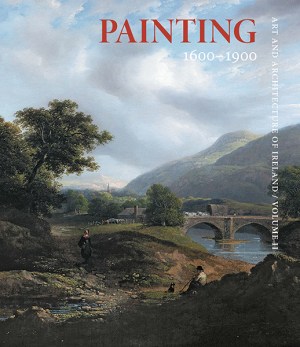 Art and Architecture of Ireland is an authoritative and fully illustrated survey that encompasses the period from the early Middle Ages to the end of the 20th century. The five volumes explore all aspects of Irish art—from high crosses to installation art, from illuminated manuscripts to Georgian houses and Modernist churches, from tapestries and sculptures to oil paintings, photographs and video art. This monumental project provides new insights into every facet of the strength, depth and variety of Ireland’s artistic and architectural heritage.
Painting 1600–1900: Art and Architecture of Ireland
The volume is divided into two sections. The first contains thematic essays, ranging widely from exhibiting practices to the social history of Irish art, revealing how pictures were produced, acquired and traded in Ireland. The varied texts reflect the decision to be inclusive in determining ‘Irishness’—the volume considers painters born in Ireland who spent their careers abroad, as well as visiting artists to Ireland. The second section is devoted to biographical entries, largely based on W.G. Strickland’s biographies of artists (Dublin and London, 1913), but updated to include extensive recent research. More than 300 entries provide information on Irish painters of the seventeenth, eighteenth and nineteenth centuries, a critical period that saw the development of easel painting, patronage, the exploration of antiquarianism and a search for the pictorial expression of national identity. The biographies offer a rich compendium of Irish experience; while some of the artists lived with worldly success and fame, others suffered disappointment and failure. All the entries are based on original research, much of it undertaken in hitherto unexplored archives. It seems appropriate given Ireland’s economic, political and social history, that the story told by this volume is one of exodus, exchange and international endeavour.
Nicola Figgis is a lecturer at the School of Art History and Cultural Policy, University College, Dublin, specialising in 17th–19th-century Irish painting and aspects of the Grand Tour. She is co-author, with Brendan Rooney, of Irish Paintings in the National Gallery of Ireland, volume i (2002).
New Book | Sculpture 1600–2000: Art and Architecture of Ireland
Distributed by Yale UP:
Paula Murphy, ed., Sculpture 1600–2000: Art and Architecture of Ireland (London: The Paul Mellon Centre for Studies in British Art, 2014), 600 pages, ISBN: 978-0300179217, $150.
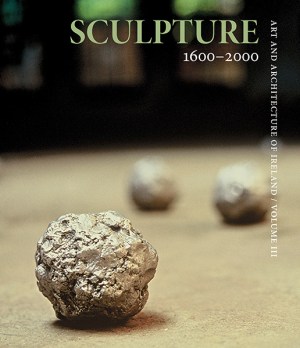 Art and Architecture of Ireland is an authoritative and fully illustrated survey that encompasses the period from the early Middle Ages to the end of the 20th century. The five volumes explore all aspects of Irish art—from high crosses to installation art, from illuminated manuscripts to Georgian houses and Modernist churches, from tapestries and sculptures to oil paintings, photographs and video art. This monumental project provides new insights into every facet of the strength, depth and variety of Ireland’s artistic and architectural heritage.
Sculpture 1600–2000: Art and Architecture of Ireland
Irish sculptors have made a significant contribution to the development of their art form both within and outside Ireland. This volume affords the unique opportunity to explore four centuries of their work. Biographies of individual artists and analytical assessments are augmented by a series of thematic
essays establishing a context for the practice of sculpture
throughout the country north and south.
Paula Murphy is associate professor at University College Dublin, where she lectures in art history, specializing in art of the modern period. She has a particular interest in sculpture and has published widely on Irish sculpture, notably Nineteenth-Century Irish Sculpture: Native Genius Reaffirmed, published by Yale University Press in 2010.
Exhibition | American Neoclassic Sculpture at the Boston Athenæum

Now on view at the Boston Athenaeum:
American Neoclassic Sculpture at the Boston Athenæum
Boston Athenæum, 26 February — 16 May 2015
Curated by David Dearinger
American Neoclassic Sculpture at the Boston Athenæum, on view at the Boston Athenæum February 26 through May 16, 2015, reveals a collection that is among the oldest and most significant of its kind in the United States, one that helped establish an ‘American taste’ in the visual arts. The exhibition includes more than thirty work: sculptures by the three ‘founders’ of American Neoclassicism—Horatio Greenough (Boston’s first professional sculptor), Thomas Crawford, and Hiram Powers—along with works by their followers, works by such European Neoclassicists as Jean-Antoine Houdon and Bertel Thovaldsen, and marble copies of ancient works including the Venus de Medici and the Apollo Belvedere.
Featured works include Horatio Greenough’s Elizabeth Perkins Cabot (1832–33), Venus Victrix (1837–40), and The Judgment of Paris (1837–40); Thomas Crawford’s Adam and Eve (1855); Bertel Thorvaldsen’s Ganymede and the Eagle (ca. 1830–50); and Jean-Antoine Houdon’s George Washington (ca. 1786). A series of sculpted portraits of Daniel Webster by John Frazee, Hiram Powers, Thomas Ball, and Shobal Vail Clevenger explores the range of treatments, from real to ideal, used in Neoclassic portraiture.
Organized by David Dearinger, the Boston Athenæum’s Susan Morse Hilles Curator of Paintings and Sculpture, American Neoclassic Sculpture is the first time these important works have been shown together. The show presents sculptures, many acquired directly from the artists themselves, that helped establish Neoclassicism as the first ‘national style’ of the young United States. Neoclassic taste, based on the work of ancient Greek and Roman artists, dominated the West starting in the 1750s, after sensational archaeological discoveries at Pompeii, Herculaneum, and elsewhere revealed the styles the ancient Romans favored in vivid detail. It was the latest in a series of classical revivals since the fifth-century fall of Rome. In the young United States, the idealized design language of the classical world seemed the perfect translation of the heady notions of the American Revolution, including the democracy of ancient Greece and the civic virtues of Republican Rome. The proliferation of ancient forms in the United States—columns, capitals, acanthus leaves, imposing pediments, togas (even on George Washington), drapery, idealized faces, and perfect torsos—infused the freshly-minted American republic with the grandeur and gloss of historic destiny.
Almost as soon as it was founded in 1807, the Boston Athenæum began to acquire art along with books and periodicals— slowly at first and then, starting in the 1820s, with increasing vigor. At the same time, the Athenæum and some of its members became major patrons and promoters of American Neoclassic sculptors. “Boston was a particular hotbed of activity,” Dr. Dearinger says of this period. “The city had patrons who were enthusiastic about classical literature and American history. So neoclassical sculpture fit right in. Boston was considered a great place for sculpture. Sculptors came up from New York and New Jersey to meet potential Boston collectors. There was nothing like it anywhere else at the time. “Leading Massachusetts politicians like Charles Sumner and Edward Everett were major patrons, not out of self-interest but as promoters of native-born sculptors and their work,” Dearinger continues. “They supported American sculptors in every way they could, for patriotic reasons, because they felt culture was important to a democratic society and because the work embodied democratic ideals.”
Meanwhile,the Boston Athenæum was commissioning pieces and buying directly from the artists, helping to get things started. Until the Museum of Fine Arts, Boston, opened in 1876, the Boston Athenæum served as the city’s only public art museum. The Athenæum featured works by American sculptors in its annual art exhibitions and, by the time of the Civil War, had established a reputation as a leading and reliable supporter of American sculpture. By 1860, the Athenæum owned one of the largest publicly-accessible collections of sculpture in the country. Among those early Athenæum acquisitions were sculptures: free-standing or in relief, made of plaster or marble. They included fine, full-size copies of approved ancient pieces such as the Venus de Medici and the Apollo Belvedere, as well as idealized figures and busts of important historical personages, modeled or carved by leading modern European neoclassicists. Special connections in Europe also helped the Athenæum acquire plaster casts of important ancient works made directly from the originals in European museums and private hands.
With the maturation of sculpture in America beginning in the 1820s, the work of native Neoclassic sculptors began to be represented in the Athenæum’s collection. Eventually, this included important works by the three ‘founders’ of American Neoclassic sculpture, Horatio Greenough (1805–1852), Thomas Crawford (1814–1857), and Hiram Powers (1805–1873), as well as examples by their followers, many of them born in or around Boston: Richard S. Greenough (1819–1904), Thomas R. Gould (1818–1881), Harriet Hosmer (1830–1908), Chauncey B. Ives (1810–1894), and William Wetmore Story (1819–1895). By then, many American sculptors had moved to Italy to live and work in Florence or Rome, where the cost of living was lower and Puritan standards of behavior did not need to be observed. The change also brought the Americans closer to their classical models and to good sources of the best white marble, which was not available in the United States. Connections to Boston, however, remained as strong as ever. “New Englanders in general were better represented on the Grand Tour than other Americans,” Dr. Dearinger says. “In the 1820s, 40s, and 50s, many of these intrepid seekers of culture were publishing travel books. Chapters in them describe visits to American studios in Italy, places which became, eventually, mandatory European tour stops.” Many works were purchased by American collectors right out of those studios. Nathaniel Hawthorne’s novel The Marble Faun, written after long sojourns in Florence and Rome, and Henry James’s Roderick Hudson, both describe the lives of American sculptors in Italy.
The installation of American Neoclassic Sculpture includes sections summarizing the ancient roots of Neoclassicism, early European interpretations of it, the rise of Neoclassicism in America, the tension between the classical and the real in portraiture and in images of children, the Neoclassicist’s preference for themes from literature and religion, and the special role that Boston—and the Boston Athenæum—played in the patronage of American sculptors during the first half of the nineteenth century. The installation design also reflects early nineteenth-century ideas of how best to display Neoclassic work. “Deep, deep red or deep, deep blue were considered the best wall colors for setting off white marble works,” Dearinger says. “Sculptors were sometimes involved in designing the settings for their own works in their patrons’ homes and they really cared about it. We know of projects where the artist worked out the light source, chose the deep red fabric rugs, even selected the color of the benches.” The dark blue gallery walls and dramatic lighting of the Athenæum’s installation is designed to suggest those early environments. “If there is an overall theme of this exhibition, it is the fine line between the real and the ideal,” Dearinger concludes. “How does artist address both? In portraiture, a bust must look something like the person portrayed, so how does the artist judge where to stop along the boundary between reality and flattery?. The exhibition also explores how conservative protestant Americans were able to straddle the gap between their Puritan backgrounds and the seductive, sensuous tastes of the ancients.”
The Architectural Drawing: From the Document to the Monument
From the press kit for the art fair:
Salon du Dessin 2015
Palais Brongniart, Paris, 25–30 March 2015 / Symposium, 25–26 March 2015
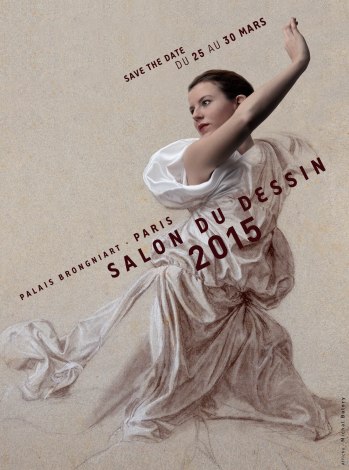 Created in 1991 by a small group of art dealers, the Salon du dessin is now a leader in its field. A frontrunner for many reasons, the fair possesses all the ingredients of a success story: the exceptional quality of the works selected by the exhibitors, its undeniable commercial dynamism, its capacity to attract the most important collectors and curators from around the world, and its ability to gather together institutions to celebrate drawings. Thanks to its unprecedented position in the art world, the Salon du dessin resolutely pursues its mission, which is to ardently promote the art of drawing. In 2014, 13,000 visitors assembled in the magnificent Palais Brongniart around their shared passion for drawings.
A Showcase for the Drawings of the Bnf
Since its creation in the 17th century the Bibliothèque nationale de france has gathered numerous drawings by renowned architects such as Mansart, Brongniart and Viollet-le-Duc. Gradually enriched throughout the centuries and then inventoried, deciphered and classified, this collection is now ready to be unveiled. The department of Prints and Photographs has selected the most significant sheets, which will be given a preview at the Salon.
The Semaine du Dessin: Uniting Drawing Enthusiasts
From 23rd until 30th March, the most important museums from Paris and its surroundings will open the doors to their graphic art departments, presenting a special display or organising, in conjunction with the Salon, an exhibition on the theme of drawing. In partnership with the City of Paris, more than twenty prestigious institutions will participate in this celebration of drawing in all its forms and from all periods. Among the shows not to be missed is: drawings by the artist Jean Gorin, a native of Nantes and a proponent of neo-plasticism, at the drawings department of the Centre Pompidou; Italian masters from the renaissance from the Städel museum in frankfurt on show at the Custodia Foundation; drawings by the discreet yet prolific painter and decorator Charles Lameire at the musée d’orsay, and the homage given at the musée Carnavalet to “monsieur Barrée, architect and speculator in Enlightenment Paris.”
◊ ◊ ◊ ◊ ◊
International Symposium
The Architectural Drawing: From the Document to the Monument
Le Dessin d’architecture: document ou monument?
Palais Brongniart, Paris, 25–26 March 2015
The Salon has more than a solely commercial dimension. On 25th and 26th March a series of twelve lectures will present the work of a wide range of academics researching the field of architectural drawing. Inaugurated last year under the auspices of Claude Mignot, professor emeritus at the University of Paris Sorbonne, this series of lectures will focus on the topic with a new light: The Architectural Drawing: From the Document to the Monument. The proceedings of the symposium, now a reference, will be published in the fall.
The lectures begin at 2:30pm and conclude at 6:00pm (in the small auditorium). It is free for those visiting the fair, though please note that seating is limited. The fair entrance fee is 15€ and includes a copy of the catalogue.
W E D N E S D A Y , 2 5 M A R C H 2 01 5
Claude Mignot (Professor Emeritus, Paris-Sorbonne University), Introduction
Tim Benton (Professor Emeritus of Art History, the Open University, Milton Keynes), On the Difficult Birth of Le Corbusier’s Project
Guido Beltramini (Director of the Centro Internazionale di Studi di Architettura Andrea Palladio), Freedberg’s Question: On the Beauty of the Drawings by Andrea Palladio
Gordon Higgott (Independent Historian, London), Documenting the Design of St Paul’s Cathedral in Drawings and Engravings: The Contribution of Simon Gribelin (1661–1733)
Olivia Horsfall Turner (Curator, Victoria & Albert Museum), Documenting Monuments: Antiquaries and Architectural Drawing in 17th-Century England.
Jérôme de La Gorce (Senior Researcher at the CNRS), A Little-known Project by Servandoni: The Décor of Fireworks for the Birth of a New Heir to the Throne (1732)
Charles Hind (Chief Curator and H. J. Heinz Curator of Drawings, RIBA British Architectural Library), A Classical or Gothic Monument: Proposals for Reconstructing the Houses of Parliament, 1735–1835
T H U R S D A Y , 2 6 M A R C H 2 0 1 5
Emmanuelle Brugerolles (Chief Curator, ENSBA Paris), From Architecture to Document: The Example of Drawings by Jean-Michel Chevotet for l’Architecture Française by Jean Mariette
Basile Baudez (Associate Professor, History of Modern and Contemporary Heritage, University Paris-Sorbonne), On the Use of Tracing Paper in Late 18th-Century Architecture: A Tool for Conception or Memory of Representations
Jean-Philippe Garric (Professor of History of Contemporary Architecture, University Paris 1 Panthéon-Sorbonne), The Monument to La Pérouse: To Document Labrouste’s Drawing
Marc Le Cœur (Art Historian, Teacher at the Ecole spéciale d’Architecture), Architects’ Drawings in the Print Department of the BnF: An Exceptional Yet Little-known Collection
Magnus Olausson (Head of Collections and Director of the Swedish National Portrait Gallery, Nationalmuseum, Stockholm), The Architect’s Practice in the Nationalmuseum of Stockholm Collections: Between Dream and Reality
Simon Texier (Professor at the Université de Picardie Jules-Verne), The Technical Drawings of the Perret Brothers: A Way towards the Monument
Call for Papers | Objects in Motion: Material Culture in Transition
From the Call for Papers:
Objects in Motion: Material Culture in Transition
CRASSH, University of Cambridge, 18–20 June 2015
Proposals due by 15 March 2015
 Proposals for papers and for visual and performing art are welcome for the three-day interdisciplinary conference Objects in Motion: Material Culture in Transition. The conference is supported by and will be held at the Centre for the Arts, Social Sciences and Humanities (CRASSH) at the University of Cambridge on 18–20 June 2015. The deadline for all proposals is 15 March 2015, and registration is expected to open in April 2015.
Objects in Motion will bring together diverse scholars, curators, writers, and artists to discuss material culture in transition. Material objects are produced within specific contexts—geographical, cultural, and temporal. This is true for things as diverse as the Great Sphinx built in Egypt at least 4500 years ago, the Lindisfarne Gospels illuminated in 8th-century Northumbria, a wooden ceremonial mask carved in 19th-century Nigeria, or a mobile phone made in 21st-century China.
What happens when objects such as these transition into other contexts? How are differences in use and meaning negotiated? Sometimes later reinterpretations and reincarnations (including ‘fakes’ and reproductions) incorporate elements of the objects’ original use and meaning, and other times they diverge entirely. This can affect not only the objects themselves but also the knowledge and experiences embedded within or produced by them—as with books, musical recordings, and technologies.
Scholars, curators, writers, and artists from all disciplines are welcome to propose relevant talks. Visual artists (including photographers) are also welcome to propose artwork on the theme to be displayed in the Alison Richard Building. Proposals for performing arts may be made as well, within the constraints of space and time stated below. The papers and art, selected by both CFP and invitation, will be complemented by events at local museums.
These diverse contributions will help to shed light on material culture dynamics which remain highly relevant even today despite the growth of multinational corporations, global communication, and increasing standardisation. They will also foster productive dialogue on different disciplinary and interdisciplinary approaches to studying and responding to these dynamics.
Guidelines for proposing a paper
Proposals for talks should be emailed to the convenor Dr. Alexi Baker (ab933@cam.ac.uk) by 15 March 2015. They should include a title, an abstract of up to 250 words, a brief biography, contact information, and any institutional affiliations. Scholars at all stages of their careers including independent scholars are encouraged to apply, as are artists and writers who would like offer talks reflecting on the conference theme.
Guidelines for proposing visual or performing arts
Proposals for visual or performing arts which reflect upon the conference theme should be emailed to the convenor Dr. Alexi Baker (ab933@cam.ac.uk) by 15 March 2015. The visual artwork will hang in the ground floor seminar rooms of the Alison Richard Building from the time of the conference until at least October 2015, and must be fitted to the available space and hanging facilities. The artist(s) must be able to transport their works to the Alison Richard Building themselves and to install them with limited assistance from staff. Each piece will need to come fitted with string or hooks on the back so that they can be attached to the hanging rails in the seminar rooms with nylon string. (The type of rails in use can be seen here. Small labels may also be affixed near the artworks using white-tack. Proposals for performing arts will be considered as well as long as they can be staged within the limited space of a seminar room, and have a running time of less than one hour. Possibilities could include for example recitations, musical performances, or self-contained dramatic performances. Proposals for visual or performing arts should consist of:
• Contact information and any institutional affiliations
• Title of the installation or performance
• Description of up to 250 words
• CV and (if available) website of the artist
• Examples of the work of the artist
• Detailed installation or staging requirements
New Book | The Nation’s First Monument
From Ashgate:
Sally Webster, The Nation’s First Monument and the Origins of the American Memorial Tradition: Liberty Enshrined (Aldersthot: Ashgate, 2015), 254 pages, ISBN: 978-1472418999, $105.
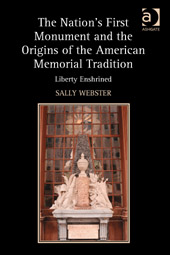 The commemorative tradition in early American art is given sustained consideration for the first time in Sally Webster’s fascinating study of public monuments and the construction of an American patronymic tradition. Until now, no attempt has been made to create a coherent early history of the carved symbolic language of American liberty and independence. Establishing as the basis of her discussion the fledgling nation’s first monument, Jean-Jacques Caffiéri’s Monument to General Richard Montgomery (commissioned in January of 1776), Webster builds on the themes of commemoration and national patrimony, ultimately positing that like its instruments of government, America drew from the Enlightenment and its reverence for the classical past. Webster’s study is grounded in the political and social worlds of New York City, moving chronologically from the 1760s to the 1790s, with a concluding chapter considering the monument, which lies just east of Ground Zero, against the backdrop of 9/11. It is an original contribution to historical scholarship in fields ranging from early American art, sculpture, New York history, and the Revolutionary era. A chapter is devoted to the exceptional role of Benjamin Franklin in the commissioning and design of the monument. Webster’s study provides a new focus on New York City as the 18th-century city in which the European tradition of public commemoration was reconstituted as monuments to liberty’s heroes.
Sally Webster is Professor of American Art, Emerita at Lehman College and the Graduate Center, CUNY.
◊ ◊ ◊ ◊ ◊
C O N T E N T S
List of Illustrations
Acknowledgments
Introduction
1 New York’s De Lancey Family and the Origins of the American Memorial Tradition
2 Celebrating the Repeal of the Stamp Act: New York Tributes to William Pitt and George III
3 A Memorial to General Richard Montgomery: Commemorating the Death of an American Hero
4 Benjamin Franklin and the Commission of America’s First Monument
5 New York, Pierre-Charles L’Enfant, and a Monument for America
Bibliography
Index
New Book | Exhibiting Outside the Academy, Salon and Biennial
From Ashgate:
Andrew Graciano, ed., Exhibiting Outside the Academy, Salon and Biennial, 1775–1999: Alternative Venues for Display (Aldershot: Ashgate Publishing, 2015), 308 pages, ISBN: 978-1472428271, $120.
 In recent years, there has been increasing scholarly interest in the history of museums, academies, and major exhibitions. There has been, however, little to no sustained interest in the histories of alternative exhibitions (single artwork, solo artist, artist-mounted, entrepreneurial, privately funded, ephemeral, etc.) with the notable exception of those publications that deal with situations involving major artists or those who would become so—for example J. L. David’s exhibition of Intervention of the Sabine Women (1799) and The First Impressionist Exhibition of 1874—despite the fact that these sorts of exhibitions and critical scholarship about them have become commonplace (and no less important) in the contemporary art world. The present volume uses and contextualizes eleven case studies to advance some overarching themes and commonalities among alternative exhibitions in the long modern period from the late-eighteenth to the late-twentieth centuries and beyond. These include the issue of control in the interrelation and elision of the roles of artist and curator, and the relationship of such alternative exhibitions to the dominant modes, structures of display and cultural ideology.
Andrew Graciano is Associate Professor of Art History at the
University of South Carolina.
◊ ◊ ◊ ◊ ◊
C O N T E N T S
List of Illustrations
Notes on Contributors
Acknowledgements
Introduction: Alternative Venues, Andrew Graciano
1 Nathaniel Hone’s 1775 Exhibition: The First Single-Artist Retrospective, Konstantinos Stefanis
2 Branding Shakespeare: Boydell’s Shakespeare Gallery and the Politics of Display, Heather McPherson
3 Fantasy and Rivalry: Jean-Baptiste Regnault’s Solo Exhibition, Paris 1800, Katie Hanson
4 Rereading ‘Court’ in the Touring Exhibition of Rembrandt Peale’s Court of Death (1820), Tanya Pohrt
5 ‘Plasmati dalle sue mani’: Canova’s Touch and the Gipsoteca of Possagno, Christina Ferando
6 Art History as Spectacle: Blockbuster Exhibitions in 1850s England, Amy M. Von Lintel
7 Merging Form and Formlessness: The 1892 Monotype Exhibition by Edgar Degas, Christine Y. Hahn
8 The Radical Work of Oskar Kokoschka and the Alternative Venues of Die Kunstschauen of 1908–1909, Vienna, Austria, Rosa J.H. Berland
9 Bringing the Boudoir into the Gallery: Florine Stettheimer’s ‘Failed’ Solo Exhibition, Karen Stock
10 Exhibiting the Museum-Function: Marcel Broodthaers and the Musée d’Art Moderne, Département des Aigles, Julian Jason Haladyn
11 Georges Adéagbo: Between Artwork and Exhibition, Kathryn M. Floyd
Epilogue: Control Issues, Andrew Graciano
Select Bibliography
Index
Lecture | Mark Rakatansky on Piranesi and Soane
From The Morgan:
Mark Rakatansky | ‘His Conduct is Mischievous’: Piranesi and Soane
The Morgan Library and Museum, New York, 19 March 2015
Sir John Soane, although an admirer of the graphic works of Piranesi, remarked that his “conduct is mischievous” in his only built work Santa Maria del Priorato. Similar sentiments have been expressed about Soane, particularly in regard to his own House-Museum. Mark Rakatansky (Graduate School of Architecture, Planning and Preservation, Columbia University) will explore the complex relationship of these two architects and the unsettling ‘mischievous’ engagements of their architecture, drawings, and writings. This lecture is cosponsored by Sir John Soane’s Museum Foundation.
The exhibition Piranesi and the Temples of Paestum: Drawings from Sir John Soane’s Museum will be open at 5:30pm for program attendees.
Thursday, March 19, 2015, 6:30pm
Tickets: $15; $10 for Morgan and Sir John Soane’s Museum Members; and free for students with valid ID.
New Book | Wearable Prints, 1760–1860
From Kent State UP:
Susan W. Greene, Wearable Prints, 1760–1860: History, Materials, and Mechanics (Kent: Kent State University Press, 2014), 600 pages, ISBN: 978-1606351246, $100.
 Wearable prints are not only a decorative art form but also the product of a range of complex industrial processes and an economically important commodity. But when did textile printing originate, and how can we identify the fabrics, inks, dyes, and printing processes used on surviving historical examples? In Wearable Prints, 1760–1860, Susan Greene surveys the history of wearable printed fabrics, which reaches back into the earliest days of the discovery of the delights of selectively patterned cloth and is firmly interwoven with the Industrial Revolution. The bulk of the book is devoted to the process of printing and dyeing. Greene brings together evidence from period publications and manuscripts, extant period garments and quilts, and scholarship on eighteenth- and nineteenth-century chemistry and technology. Greene includes some 1600 full-color images, showing an array of textile samples. Wearable Prints, 1760–1860 is a convenient encyclopedic guide, written in plain language accessible to even the most casual reader. Historians, students,
costumers, quilters, designers, curators, and collectors will find it an
essential resource.
Susan W. Greene is a collector, museum consultant, and independent scholar. Her collection of late eighteenth- and early nineteenth-century clothing now resides at the Genesee Country Village and Museum in Mumford, New York. She is the author of Textiles for Early Victorian Clothing and several entries in Valerie Steele’s Encyclopedia of Clothing and Fashion and Carol Kammen’s Encyclopedia of Local History.
Newly Formed ANZSECS
Australian and New Zealand Society for Eighteenth-Century Studies

Jean-Baptiste Joseph Pater, The Fair at Bezons, ca. 1733 (New York: Metroplitan Museum of Art)
The newly formed Australian and New Zealand Society for Eighteenth-Century Studies (ANZSECS) exists to promote the study of the culture and history of the long eighteenth century within Australia and New Zealand. The Society encourages research in eighteenth-century studies on a broad interdisciplinary basis—its members work in fields including art history, history, literature, philosophy, bibliography, and the history and philosophy of science. It is an affiliate of ISECS, the International Congress for Eighteenth-Century Studies.
Established in December 2014, the Society draws on a distinguished history of eighteenth-century scholarship in Australia and New Zealand. It advances the exchange of information and ideas among researchers engaged in eighteenth-century studies through various activities and events, including the 3–4 yearly David Nichol Smith Seminar. For more information about the Society, membership, and related events, please visit our website.










 Enfilade
leave a comment