Call for Papers | Les Acteurs de la Rocaille
From H-ArtHist:
Les Acteurs de la Rocaille
Institut national d’histoire de l’art (INHA), Paris, 1–3 October 2015
Proposals due by 29 April 2015
 L’étude des arts décoratifs fédère aujourd’hui une large communauté de chercheurs et engage, par-delà l’histoire artistique des objets et des décors, des spécialités et des compétences variées (littérature, critique, esthétique, sociologie, visual studies, gender studies). Dans la perspective des travaux d’envergure menés sur la production rocaille de certains grands ornemanistes (Jacques de Lajoüe, Juste-Aurèle Meissonnier, François Boucher), le colloque Les acteurs de la rocaille entend opérer un retour à l’objet tout en mettant à profit les récentes conclusions énoncées dans le domaine des sciences humaines.
Marquant le 300e anniversaire du début de la Régence, dont la rocaille fut l’une des expressions majeures, il explorera cet art libre et inventif dans le domaine du décor, des arts décoratifs et de l’architecture. L’objectif visé sera de mieux comprendre le rôle historique de chacun des acteurs de la rocaille tout au long du XVIIIe siècle, depuis sa conception jusqu’à sa diffusion, à Paris, en province et dans le reste de l’Europe.
Les propositions préciseront le nom de l’intervenant, ses coordonnées institutionnelles, le titre de la communication proposée, et un résumé de 500 mots maximum. Elles seront envoyées avant le 30 avril 2015 à l’adresse suivante: lesacteursdelarocaille@gmail.com. Un retour sur l’examen des candidatures sera donné à la fin du mois de mai 2015. Le colloque se tiendra à Institut national d’histoire de l’art les 1er, 2 et 3 octobre 2015.
Organisation scientifique: Michaël Decrossas (INHA), Alexia Lebeurre (Université Bordeaux Montaigne), Marie-Pauline Martin (Aix-Marseille Université, CNRS TELEMME UMR 7303), Claire Ollagnier (Labex – CAP / INHA, Ghamu).
◊ ◊ ◊ ◊ ◊
Note (added 22 March 2015) — Also see the call for papers for Reconsidering the Rococo: 18th to 21st Centuries / Penser le Rococo (XVIIIe–XXIe Siècle) at the University of Lausanne (5–6 November 2015).
New Book | The Challenge of Emulation in Art and Architecture
From Ashgate:
David Mayernik, The Challenge of Emulation in Art and Architecture: Between Imitation and Invention (Aldershot: Ashgate, 2013), 296 pages, ISBN: 978-1409457671, $110.
 Emulation is a challenging middle ground between imitation and invention. The idea of rivaling by means of imitation, as old as the Aenead and as modern as Michelangelo, fit neither the pessimistic deference of the neoclassicists nor the revolutionary spirit of the Romantics. Emulation thus disappeared along with the Renaissance humanist tradition, but it is slowly being recovered in the scholarship of Roman art. It remains to recover emulation for the Renaissance itself, and to revivify it for modern practice.
Mayernik argues that it was the absence of a coherent understanding of emulation that fostered the fissuring of artistic production in the later eighteenth century into those devoted to copying the past and those interested in continual novelty, a situation solidified over the course of the nineteenth century and mostly taken for granted today. This book is a unique contribution to our understanding of the historical phenomenon of emulation, and perhaps more importantly a timely argument for its value to contemporary practice.
David Mayernik is a practicing artist and architect, and an Associate Professor at the University of Notre Dame’s School of Architecture.
◊ ◊ ◊ ◊ ◊
C O N T E N T S
Preface
Introduction
1 On Imitation
2 On Emulation: A Part of Emulation, Or Something Else Again?
3 The Theater of Aspirations: Apprenticeship as Performance
4 An Atelier of Rivals: Constructive Competition
5 The Mosaic of History: Tesserae and Continuum
6 Metamorphosis: Found in Translation
7 On Invention
8 The End of Emulation
9 Coda: The Case for Emulation
Bibliography
Index
Call for Papers | Women in the Global Eighteenth Century
From the Call for Papers:
Women in the Global Eighteenth Century
Seton Hall University, South Orange, New Jersey, 5–6 November 2015
Proposals due by 15 May 2015
Plenary lecture by Dr. Lynn Festa, Associate Professor of English, Rutgers University

Maria Sibylla Merian, Plate 1 from Dissertation in Insect Generations and Metamorphosis in Surinam, 1719 (National Museum of Women in the Arts).
In The Global Eighteenth Century, Felicity Nussbaum and her contributors urged scholars to see the eighteenth century as ‘wide’: a period with a geographical as well as temporal sweep. Such a perspective, Nussbaum contended, would require different, more complex narratives of the people, events, systems, and discourses of the age. In the spirit of our namesake Aphra Behn, whose poetry, drama, plays, and translations reflect a complex awareness of a widening world, The Aphra Behn Society for Women in the Arts, 1660–1830 takes up the challenge posed by The Global Eighteenth Century to invite papers exploring any aspect of women and the arts in this ‘global eighteenth century’. How does a wider, potentially global, lens change the view of people, places, and things both familiar and strange, domestic and imperial, Us and Other? How does gender affect those views?
The Aphra Behn Society for Women and the Arts invites papers addressing the intersection of gender and the global eighteenth century from a wide variety of disciplines, including but not limited to Literature, History, Art History, Music History, Modern Languages, Philosophy, Religious Studies, and Women and Gender Studies. We welcome papers
on this topic from all sub-fields of these disciplines.
Papers might address the following topics:
• Investigations or representations of ‘difference’ in literature and the sister arts
• Representations of social and political authority
• The arts, women, and empire
• Women and the construction of literary, artistic, domestic, public, national, imperial, and colonial spaces
• Women and travel writing
• Women and diaspora
• Women and the metropole
• Women and indigenous knowledge
• Women, genre (textual, visual, musical, etc.), and space/place
• Notions of performance and gender
• Notions of gender and race, class, religion, or other markers, perhaps under pressure in a widening context
• Gender and encountering the Other
• Women, modernity, and post-colonial situations
• Women and the colonial or post-colonial Enlightenment
As always, we also welcome abstracts for papers not related to the conference theme. Please upload 1–2 page abstracts or panels to the conference website by May 15, 2015. Conference registration includes all conference events, including the a luncheon, the concluding banquet, a performance by Seton Hall students, and a reception with the rare books librarians and university archivists to view highlights of the university’s collection. The Aphra Behn Society also sponsors a graduate student travel award ($150) and a graduate student essay prize ($150 and the possibility of publication in ABO: Interactive Journal for Women in the Arts, 1640–1830). For more information, please see the conference website or contact the conference organizers, Dr. Kirsten Schultz at Kirsten.schultz@shu.edu or Dr. Karen Gevirtz at Karen.gevirtz@shu.edu.
Sponsored by the Aphra Behn Society for Women in the Arts, 1660–1830, the College of Arts and Sciences, and the Women and Gender Studies Program at Seton Hall University.
Call for Papers | Entering the City, 1700 to the Present
From H-ArtHist:
Entering the City: Spaces, Transports, Perceptions, and Representations
Brussels, 15–16 October 2015
Proposals due by 15 March 2015
Organized in Brussels on 15 and 16 October 2015, the international conference, Entering the City: Spaces, Transports, Perceptions, and Representations from the 18th Century to the Present, is an initiative of the MICM-arc research project (micmarc.ulb.ac.be) based at the Université libre de Bruxelles. The conference will provide a forum for exploring the ways and means of entry into the urban space and the resulting impressions and representations of that experience, one closely related to the themes of mobility, culture and metropolitan identity at the heart of the MICM-arc research project.
Enclosed by fortified walls, ancient and medieval cities were delineated by clear boundaries. Access via land routes was clearly marked by city gates. Historians have extensively studied the controlling function of such thresholds as well as their symbolic dimensions. The growth and industrialization of urban centers changed the way in which they were approached from the exterior. In the 19th century, new modes of transportation and suburban sprawl rendered old city gates obsolete and radically changed the ways in which cities were accessed. Today, roundabouts and off-ramps seem to have replaced those gates, and the infrastructure that lines the routes connecting one town to another makes it difficult if not impossible to perceive their boundaries. Moreover, an increasing part (if not the majority) of entrances into urban space are no longer the result of a gradual progression along a traditional route but often pass through the intermediate zones of train stations and airports that lead to urban zones without further transition. These changes affect travelers and the experience of travel. Beyond analyzing the entry-points to the city, it is also necessary to envisage the symbolic, subjective dimension of passing from one space to another, to study the perceptions and representations associated with entering the city.
The aim of the conference is to reflect upon the manners in which the city is entered, in terms of the evolution of peripheries, modes of transport, the urban planning of the spaces involved and the experience of entering the city itself. The organizers envisage a resolutely interdisciplinary exchange involving the participation of historians, geographers, architects and urban planners, sociologists, and art historians. Papers will permit comparisons between different historical periods and different urban centers, with special attention being given to the case of Brussels. The period in question extends from the 18th century to the present day and embraces a range of models from the pre-industrial town to the post-industrial metropolis.
1) The first focus of the conference is devoted to the spaces through which both occasional and regular travelers move to access the city, as well as the means of transport involved. The slow and steady arrival with a defined point of entry defined by the transportation and origin of the journey of the 18th and early 19th centuries was supplanted and upended by new and varied manners of entering the city: more rapid, sometimes underground or through the air, centralized through train stations, relegated to the peripheral zones in the case of airports, or allowing travelers to avoid central zones in the case of ring roads. Of particular interest in the present context are approaches that theorize the act of entering the city, the notion of city limits, questions of accessibility, the spatial forms of urban entrances, and particular means of transportation. More particular points of inquiry might include:
• Is it possible to create typology of city entrances (spaces, infrastructures, landscapes)? Can one speak of the homogenization of these paces via the existence of a particular sort of dominant architecture, or are should such entrances be understood as attempts by various municipalities to distinguish themselves from their neighbors?
• What sort of skyline has presented itself to the traveler at the city entrance at different points in history? Are there models of city planning specifically adapted to these functional and symbolic zones?
• How are the entrances to cities built, designed, and landscaped? What sort of infrastructure (hotels, museums, markets, businesses) and functions (economic, touristic, cultural, healthcare, etc.) are grouped around the urban transport infrastructure found at a city’s points of entry? What forms do these infrastructures take? What aspects are rendered visible or invisible? What symbolism is implied by architectural choices? What considerations are made in conjunction with spaces of mobility and consumer activities?
• What public and private forces model the entrances to cities? Take for example, the neighborhoods surrounding train stations dominated by hotels and hotel-related businesses in the late 19th and early 20th centuries.
2) A second area of focus of the conference will be devoted to perceptions of entering the urban space. The spaces that mark arrival in the urban space and their appearance, be it infrastructure or landscape, affect the way in which the city is first perceived, shaping experience and memory. The arrival by boat in Venice cemented the city’s reputation as a town built on water, just as architectures of iron and glass of the 19th-century train stations defined the typology of the new modern metropolis. Choices of materials and architectural gestures continue to define present day ambitions embodied in the new train stations and airports of the present day. Before arriving at a destination, the conditions in which it is approached (speed, view, sounds, smells) offers a unique impression of the city. As a result a particular panorama or a neighborhood can be disproportionately influential upon first impressions without necessarily being representative of the larger urban area which remains to be discovered. The starting point of the journey, be it a small or large town, a foreign country, perhaps a suburb, and the frequency of the route traveled (for work or tourism, as an immigrant or asylum seeker), both have an impact upon the perception of one’s first encounter with a city. In moving from one city to another, the traveler leaves one point of reference and encounters new environments and experiences through mobility that affects the vision of each city that is visited. Questions evoked by the perception of the arrival in a city might include:
• What marks the entrance into a city and how is it perceivable or staged through physical boundaries, signs, and monuments? What might the absence of evident dramatization reveal? How has the appearance of city entrances evolved with the evolution of the city itself?
• How does the time passed in entering a city and eventual stops along the way allow for perception of its age, architecture, social structures, topography, in a word, its identity?
• How do means of transportation affect the perception of one’s entrance into a city?
• How does one know one has arrived? What factors upon leaving a train, plane, parking lot constitute thresholds or symbols of arrival?
• How are our perceptions of arrival in a city influenced by the place from which we come or the frequency with which we make the journey? What characterizes the experience of a tourist compared to that of a commuter or regular resident?
3) The third area of focus deals with representations of arrival in the urban space. A mix of experience, previous knowledge (through travel guides or the description of others), personal sensations all contribute to the representation of arrivals in the urban space, which in turn can be studied from a historic, artistic or symbolic point of view. The arrival in a city often provides the starting point for fictional plots or the articulation of their form and is a literary topos in and of itself from the Bildungsroman to contemporary novels. The act of entering the urban space often represents the hopes of the traveler and is associated with the expectations they have for a city in which they will grow and develop as they perceive it for the first time. The expectations created by travel guides and the accounts of other travelers are complemented by representations in art and literature and are juxtaposed with new perceptions as the traveler enters the city. Capturing and transforming memories, filtering and accumulating perceptions, diverse forms of literature and art frequently deal with the entrance into the city. Questions related to this inquiry involving representation of urban spaces in both their anticipation and the actual experience of entering a city include:
• How do travel guides of the past and present describe the entry points of the city?
• How do new modes of communication lead travelers to forge an impression of a destination before they arrive?
• What forms has the entrance into the urban space taken in literature? How have these forms developed over the past three centuries? Is there a recurring dramaturgy that unifies their treatment?
• How have sites of modernity linked to movement inspired avant-gardes? Do they remain a pertinent field of artistic exploration?
• Are there current creative projects linked to the notion of entering a city?
• It is not unusual for municipalities to situate artworks that influence traveler’s perceptions at the entry points of their territory and other zones of mobility. Is this a contemporary trend or the conjugation of a historical practice?
The questions proposed here in connection to the three zones of inquiry are far from exhaustive and represent a few suggested starting points for further reflection. The received propositions will be selected according to their pertinence, originality and capacity to encourage exchange through complementary reflection. Please send your title and proposed abstract, in English or French (a maximum of 2500 characters), before 15 March 2015 to micmarc@ulb.ac.be. Final selection will be made at the end of March 2015 and the results will be communicated in early April. You may also direct questions regarding this call to micmarc@ulb.ac.be.
Call for Papers | AAH Student Summer Symposium: Fashion & Art
From AAH:
Fashion and Art History
University of York, 29–30 June 2015
Proposals due by 27 March 2015
The Association of Art Historians (AAH) Summer Symposium is a two-day annual conference highlighting post-graduate research. It takes place at a different university each year in early Summer.
Fashion and art often follow a shared trajectory of social, political, and historical circumstances. In collaboration with the University of York, the AAH’s annual Student Summer Symposium will explore the relationship between fashion and art, by inviting papers that engage with this subject across a wide range of chronological and theoretical perspectives.
The influence of fashionable dress on artists and patrons of art has recently become a popular and productive avenue for research in art history, while fashion designers have likewise been shown to engage continuously with historical and fine art as sources of inspiration. Fashion and Art History invites papers that build upon these conversations while also addressing questions that continue to be debated in art and fashion history circles: What evidence does art provide for how dress operates within society? Is fashion ‘art’? Should fashion history be taught alongside art history in academic curricula? When should these objects be displayed in galleries alongside each
other, and how does this change the way we understand artworks and fashionable dress? Finally, how might the tools and methodologies of these related disciplines aid the study of their respective subjects?
We welcome contributions from all periods and contexts that engage with the relationship between art and fashion within aesthetic, cultural, social, and material frameworks. Topics may include, but are not limited to:
• The engagement of artists, sitters, and patrons of works art with fashion
• Artworks and visual imagery as evidence for understandings of historical dress
• Artists as fashion designers and style setters
• The dissemination of fashionable dress through artworks
• Fashion designers as artists and the status of fashion as an art
• Historical revivals in fashion and the role of visual culture in this process
• Exhibitions devoted to fashion history, and the display of fashion in art galleries
• Developing relationships between fashion and art and its histories
Abstracts of no more than 250 words for 20-minute papers plus a 100-word biography should be submitted as a single Word document to Anna Bonewitz, Serena Dyer, Sophie Littlewood, and Sophie Frost at fashionandarthistory2015@gmail.com by 27 March 2015. The symposium is open to all, however speakers are required to be AAH members.
Travel Diaries of Crown Prince Friedrich Christian, 1738–40
I imagine many Enfilade readers will be interested to learn of Maureen Cassidy-Geiger’s transcriptions of the unpublished diaries of Crown Prince Friedrich Christian, documenting his travels in Italy from 1738 to 1740. –CH
◊ ◊ ◊ ◊ ◊
From Cassidy-Geiger’s introduction to the project:
Incognito: The ‘Comte du Lusace’ on the Grand Cure in Italy, 1738–40 — The unpublished travel accounts of Crown Prince Friedrich Christian (1722–63) of Saxony/Poland, a disabled tourist traveling in Italy in 1738–40 as ‘Comte de Lusace’, and related documentation and research by Maureen Cassidy-Geiger.
The Prince and I
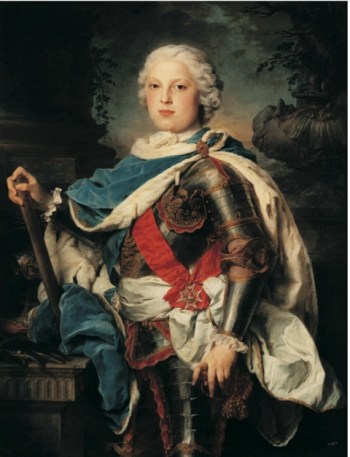
Pierre Subleyras, Portrait of Prince Friedrich Christian of Saxony, 1739 (Dresden, Gemäldegalerie)
I first met Friedrich Christian, Crown Prince of Saxony/Poland, in 2004 in the State Archives in Dresden. I was gathering material for a book and stumbled across the handwritten travel diaries of his Italian odyssey in 1738–40. Sixteen years old and crippled by scoliosis and what was termed “palsy” (probably cerebral palsy), his Grand Tour was less a gap year than an all-out effort to find a cure for his condition in medicine or religion and safeguard the succession. Crowned Elector in 1763, he died prematurely from smallpox, aged 41, after reigning for 74 days. Thus he ended up a footnote in history books instead of a legend. And in 2004, I adopted him as my subject, hero and muse. . . .
The handwritten journals of his two-year odyssey are the guidebooks for this journey of mine, of his. The prince wrote daily, in school-boy French, in the words of a dutiful and obedient child on the uncertain road to manhood. A Catholic crown prince of a Protestant state held tight by the Jesuits and buttressed by the Bohemian mysticism of the court of Vienna, he sat at the center of an able-bodied swirl, incognito as Comte
de Lusace though hardly anonymous. . . .
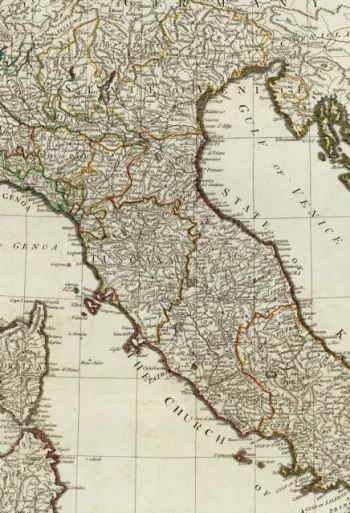
A New Map of Italy . . . from Monsr. D’Anville (London, Robert Sayer, 1790)
To date, I have twice driven the historic itinerary and have conducted research in situ in Dresden, Naples, Rome and Venice, towards an annotated publication. For the moment, however, this WordPress blog is an experimental platform for sharing the contemporary accounts with interested colleagues. The transcriptions retain the inaccuracies, idiosyncrasies and misspellings of the originals and await thorough proofreading and corrections; autocorrect has also introduced inadvertent errors, for which I apologize. . . .
The site is available here»
Exhibition | Sweet 18: Contemporary Art, Fashion, and Design
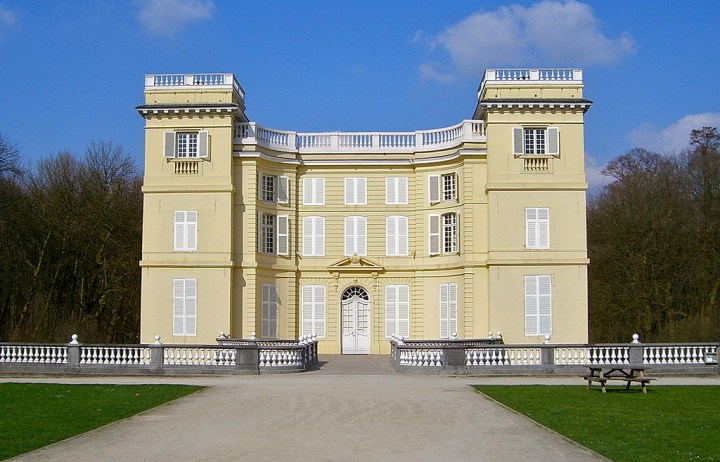
Kasteel d’Ursel at Hingene (Bornem), Belgium.
Photo from Wikimedia Commons, 4 May 2009.
◊ ◊ ◊ ◊ ◊
Press release for the exhibition:
Sweet 18: Contemporary Art, Fashion, and Design Inspired by the 18th Century
Kasteel d’Ursel, Hingene, Belgium, 1 May — 5 July 2015
Curated by Luisa Bernal, Dieter Van Den Storm, Wim Mertens, Tamara Berghmans, and Hélène Bremer
This spring the former summer residence of the aristocratic d’Ursel family will be the setting for the exhibition Sweet 18, presenting the 18th century through the eyes of fifty contemporary designers, artists, and fashion designers—from Erwin Olaf and Wim Delvoye to Walter van Beirendonck and Philippe Starck.

Jessica Harrison, Painted Lady (10), found ceramic, enamel paint, 22 x 17 x 13cm, 2014.
We all have somewhere in our minds the same images of the 18th century: wigs and hooped petticoats, towering hairstyles and elegant furniture, fine porcelain on lavishly decked tables, sensual portraits and frivolous paintings. The 18th century was the time of the Enlightenment and of the flowering of the arts and sciences. But it also created a playful, artificial world for aristocrats wanting to escape reality and immerse themselves in fantasy. A charmed world of pleasure, abundance, and voluptuousness, of pastel tints and curlicues, a world that inspires many an artist to this day. Spreading themselves over all three floors of the castle, these artists will show you the 18th century as you have never seen it before.
Sweet 18 has been brought together by the following team of curators: Luisa Bernal (art), Dieter Van Den Storm (design), Wim Mertens (fashion), Tamara Berghmans (photography) and Hélène Bremer (art).
Ode to Marie Antoinette
Whether it be for her extravagant lifestyle, influential fashion sense or her tragic death, French Queen Marie-Antoinette still speaks to our imagination. Director Sofia Coppola’s film spear- headed the revival. For pop stars like Madonna and Beyoncé, she is also a powerful icon. German illustrator Olaf Hajek gives his own take on her in the Black Antoinette series while top Dutch photographer Erwin Olaf offers up a gory portrait of the queen: beheaded.
Exuberant Fashion
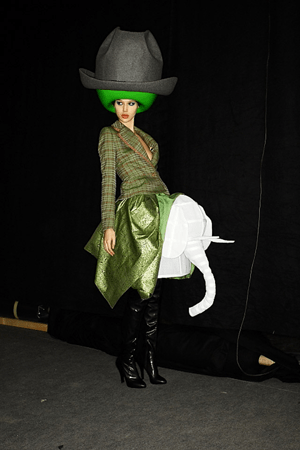
Walter Van Beirendonck. Foto: Ronald Stoops
The extravagant wardrobe of Marie-Antoinette is the springboard for many a contemporary fashion designer: from the minimalism of Japanese Yohji Yamamoto and eccentricity of German Bernhard Willhelm to French fashion houses Nina Ricci and Thierry Mugler. American artist Yasemen Hussein recreates one of her wigs in metal, and English milliner Stephen Jones is inspired by her to create his evocative hats. The outsized dresses, tight corsets, and tailored jackets of Belgian designers Walter Van Beirendonck and Olivier Theyskens also sample the 18th century.
Transparent Plastic en Burnt Wood
Dutch designer Hella Jongerius immersed herself in the archives of the German porcelain manufactory Nymphenberg to come up with plates which combine hand-painted patterns and little sculptured animals, all done in 18th-century style. Designer Maarten Baas literally set fire to a number of antique chairs before reworking them in lacquer. His Smoke Chair has become a classic. Even more famous is French star designer Philippe Starck’s Ghost Chair, which references a Louis XV chair in a pared-down, transparent design. Spanish designer Jaime Hayon’s lounge chair and an outlandish seat by British designer Nina Saunders also find a home in the exhibition. One absolute high point is L’ornement jamais by Swiss designer Philippe Cramer, an outstanding piece of pine furniture executed in 18th-century style and partially dipped in liquid gold.
Deformed Status Symbols
The fine china of Meissen, Sèvres, and Wedgwood remains to this day an inexhaustible source of inspiration. The sculptural groups of American artist Chris Antemann may look like replicas but reveal themselves on closer inspection to be rather wicked tableaux, full of forbidden fruit. British artist Jessica Harrison makes superficially sweet female figurines that are actually hideously mutilated, with their deformed heads and coloured tattoos. With War and Pieces, Dutch ceramicist Bouke de Vries offers a modern interpretation of the extravagant banquets that were thrown the night before a battle. British artist Amy Hughes’s Trésor découvert suggests treasure that has been lying buried for centuries under that same battlefield, treasure that has lost its gleam but has a story of the past and its rediscovery to tell.
Fêtes Galantes
In Stavronikita Project Austrian photographer Andreas Franke recreates 18th-century festivities. By situating them in the unusual setting of a sunken ship he emphasises the beauty that underlies decadence and decline. The tableaux of Canadian artist Ray Caesar border on the surreal, while the work of English painter Patrick Hughes plays games with the laws of perspective.
Pastoral Scenes

Richard Saja
Nothing is more typical of the 18th-century domestic interior than ‘toile de Jouy’, cotton wall- coverings depicting scenes of rural life. American artist Richard Saja pimps its little cowherds into clowns or punks, while the French Collectif Ensaders transforms them into figures of fantasy and Virginie Broquet gives them an erotic spin. Scottish design studio Timourous Beasties substitutes its idyllic villages with views of the London skyline, while French artist Joël Ducorroy reduces it to its bare essentials. American Beth Katleman brings toile de Jouy wallpaper to life in a vast 3D construction, introducing flea market finds into her installation to accentuate the strangeness of the effect.
Lavish Finery
British artist Jo Taylor translates the extravagant stucco ornament of the grand 18th-century house into three-dimensional porcelain objects. American Molly Hatch’s porcelain plates, when set together, form a landscape painting covering an entire wall. Taking as her inspiration the bizarre wigs of the French court, English artist Kathy Dalwood turns
casts of utilitarian objects into plaster portrait busts.
Made in Belgium
Belgian artists easily hold their own amongst all these international heavyweights. Isabelle Copet lays a gigantic lace collar in the pool behind the castle. In the park Michaël Aerts places an inverted statue of Louis XIV on a pedestal made of flight cases and builds a seven metre high obelisk from the same black cases. Two twisted sculptures by Wim Delvoye overlook the entrance hall. Zaza contributes a print. In the mirrored room Bart Ramakers has filmed a richly imaginative ballet on the theme of romantic love. Painter Jan Devliegher exhibits gigantic porcelain plates and Nick Ervinck has printed two stunningly designed vases in 3D. A design for a bedroom by architect Koen Deprez combines classic panelling and Fragonard paintings with Stanley Kubrick’s 2001: A Space Odyssey. Pieter Theuns (BOX) has composed music inspired by Mozart for the exhibition.
Kasteel d’Ursel
For nearly four centuries Kasteel van Hingene was the favourite summer residence of the aristocratic d’Ursel family. Every summer the Duke would travel with family and servants to his magnificent country house. Now it is the property of the Province of Antwerp, which is restoring it to its former glory. In 2014 Kasteel d’Ursel won the ‘Flemish Heritage Award’.
The exhibition begins on the first floor and leads you through the noble family’s former bedchambers. The service stairs bring you directly to the second floor where once the servants and the children of the family were accommodated. The circuit ends in the hall of mirrors and the reception rooms of the ground floor. The restored castle, with its characteristic Chinese interior decoration, is the perfect setting for this contemporary look at the 18th century.
Research Project | Marrying Cultures: Queens Consort, 1500–1800
This HERA-funded research project on queens consort will be of interest to many readers. Upcoming events are scheduled to take place throughout Europe: Wolfenbüttel, Berlin, Oxford (in conjunction with Kensington Palace), Warsaw, and Stockholm. –CH
Marrying Cultures: Queens Consort and European Identities, 1500–1800
Marrying Cultures is a three-year research project funded by HERA (Humanities in the European Research Area) focusing on the foreign consort as agent of cultural transfer. The case studies to be investigated are the Polish princesses Katarzyna Jagiellonka, Duchess of Finland and Queen of Sweden (1526–83), and Zofia Jagiellonka, Duchess of Braunschweig-Wolfenbüttel (1464–1512); Hedwig Eleonora of Schleswig-Holstein-Gottorp, Queen of Sweden (1636–1715), and Charlotte Amalie of Hessen-Kassel, Queen of Denmark (1650–1714); the Portuguese princess Catarina of Braganza, Queen of Great Britain (1638–1705); Maria Amalia of Saxony, Queen of the Two Sicilies and Queen of Spain (1724–1760); and Luise Ulrike of Prussia, Queen of Sweden (1720–82).
Working with colleagues in historic palaces, museums and libraries (including Kensington Palace, the Victoria and Albert Museum and the National Portrait Gallery, London; the Royal Armoury, Stockholm, and the Duke August Library, Wolfenbüttel), the project members will also consider how it is that certain consorts become embedded in national cultural memory and others do not.
Partners
Historic Royal Palaces (Kensington Palace, London): Dr Joanna Marschner
National Portrait Gallery, London: Dr Catharine Macleod
Victoria and Albert Museum, London: Dr Julius Bryant
Livrustkammaren (The Royal Armoury), Stockholm: Dr Malin Grundberg
The Museum of Polish History, Warsaw: Monika Matwiejczuk
Supportive Institutions
Herzog August Bibliothek, Wolfenbüttel: Professor Hellwig Schmidt-Glintzer
Hochschule für Musik, Theater und Medien, Hannover: Professor Susanne Rode-Breymann
Husgerådskammaren (The Royal Collections), Stockholm: Dr Lars Ljungström
Turku Castle and Historical Museum: Olli Immonen

Exhibition | Vivienne Westwood: Cut from the Past

◊ ◊ ◊ ◊ ◊
From Danson House:
Vivienne Westwood: Cut from the Past
Danson House, Bexleyheath, Kent, 1 April — 31 October 2015
The 18th century is the high point of art and culture. —Dame Vivienne Westwood
The impact of 18th-century art and design on the work of distinguished British fashion designer Vivienne Westwood is celebrated in a new exhibition at Danson House this spring. Vivienne Westwood: Cut from the Past brings together for the first time a number of her ground-breaking designs, and explores the collections that proved to be her turning point both critically and commercially.
Danson House, a splendidly restored Georgian villa, provides a tailor-made backdrop to the exhibition which highlights Westwood’s seminal work of the 1990s which was influenced by the 18th century. Designs and outfits on show make particular reference to the Rococo paintings of French artists Watteau and Boucher. Westwood’s passion for 18th-century design is also reflected in some earlier pieces from the ‘Cut, Slash and Pull’ and ‘Mini Crini’ collections, and the Malcom McLaren and Vivienne Westwood ‘Seditionaries’ Collection.
Caroline Worthington, Chief Executive, Bexley Heritage Trust said, “We are delighted to be working together with the Victoria & Albert Museum for the first time to bring cutting edge design back to Danson House for the 2015 season—just as the original owners, the Boyd family, did in the 18th century.”
◊ ◊ ◊ ◊ ◊
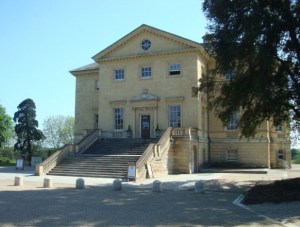 Danson House boasts a suite of rooms created for Sir John Boyd, a man besotted with his young bride. Enjoy this superb example of 18th-century architecture with its classical proportions, elegant interiors and rich symbolism celebrating love and marriage. Designed as a retreat from the hustle and bustle of central London, Danson House was completed in 1766. Sir John Boyd was a sugar merchant and vice-chairman of the British East India Company. Together with the notable architect Sir Robert Taylor, Boyd created this homage to the Golden Age of Antiquity, filling it with art and sculpture from his travels on the Continent. Today his home gives us a fascinating insight into fashionable
Georgian life.
Exhibition | Love Bites: Caricatures by James Gillray
From the Ashmolean:
Love Bites: Caricatures by James Gillray
Ashmolean Museum, Oxford, 26 March — 21 June 2015
Curated by Todd Porterfield

James Gillray, Design for a Naval Pillar, 1800
(New College, Oxford)
To mark the 200th anniversary of the death of British caricaturist James Gillray (1757– 1815), the Ashmolean presents more than 60 of Gillray’s finest caricatures from the outstanding collection of New College, Oxford.
James Gillray trained as a professional copyist at the Royal Academy and then staked his professional life on caricature, amongst the first generation of artists to do so. He produced more than a thousand prints, some the fruit of months of reflection, others banged out at lightning speed, responding to but also creating instant controversies on the very day of the event. His prints were divisive and partisan: in 1798 a Tory Lord would congratulate him for having “been of infinite service in lowering them [the Whigs] and making them look ridiculous,” while the exiled Napoleon, well aware of Gillray’s anti-French propaganda, was reported to have said that the British engraver did more than all the armies of Europe to bring him down.
Love Bites: Caricatures by James Gillray is curated by Professor Todd Porterfield of the University of Montreal. The exhibition has been generously supported by The Paul Mellon Centre for Studies in British Art and the Friends of the Ashmolean.
In connection with the exhibition, the Ashmolean Museum will host a conference, James Gillray@200: Caricaturist
without a Conscience?, on the 28th and 29th of March 2015.










 Enfilade
leave a comment