New Book | The Visual Culture of Catholic Enlightenment
From Penn State UP:
Christopher M. S. Johns, The Visual Culture of Catholic Enlightenment (University Park: Penn State University Press, 2014), 440 pages, ISBN: 978-0271062082, $90.
 Until relatively recently, most scholars considered the notion of a Catholic enlightenment either oxymoronic or even illusory, since the received wisdom was that the Catholic Church was a tireless and indefatigable enemy of modernist progress. According to Christopher Johns, however, the eighteenth-century papacy recognized the advantages of engaging with certain aspects of enlightenment thinking, and many in the ecclesiastical hierarchy, both in Italy and abroad, were sincerely interested in making the Church more relevant in the modern world and, above all, in reforming the various institutions that governed society. Johns presents the visual culture of papal Rome as a major change agent in the cause of Catholic enlightenment while assessing its continuing links to tradition. The Visual Culture of Catholic Enlightenment sheds substantial light on the relationship between eighteenth-century Roman society and visual culture and the role of religion in both.
Exhibition | Canaletto’s Architecture: Celebrating Georgian Britain

Canaletto (Giovanni Antonio Canal), London: The Thames from Somerset House Terrace towards the City
(Royal Collection Trust/© Her Majesty Queen Elizabeth II 2014)
◊ ◊ ◊ ◊ ◊
Press release (November 2014) from Abbot Hall (with a more complete posting available here) . . .
Canaletto’s Architecture: Celebrating Georgian Britain
Abbot Hall Art Gallery, Kendal, Cumbria, 22 October 2015 — 14 February 2016
Abbot Hall was built in the Palladian style just three years after Canaletto left England for the last time. In 1746, by then in his late 40s, he first arrived for a prolonged stay in London. He was to remain for most of the following 10 years.
Already a well established artist, his work had proved very popular with aristocratic Englishmen doing their Grand Tour of Europe. In the 1720s, having started his career as a theatrical scene painter, Canaletto started painting his distinctive views of Venice, frequently featuring the many major churches designed for it by Palladio. One of his clients was Joseph Smith, an English merchant banker who lived in Venice for 70 years, for 16 of which he was the British consul there. Smith bought many Canaletto works for himself, and also helped arrange commissions from wealthy English collectors—by the late 1720s his works were already in the collections of Goodwood, Chatsworth, Woburn and of the Prime Minister, Sir Robert Walpole. Smith himself owned by far the largest collection of works, including 52 oil paintings and over 140 drawings, which he eventually sold to George III in 1762 for £10,000—half the sum the latter paid the previous year for Buckingham Palace.

Canaletto (Giovanni Antonio Canal), Portrait of Canaletto with St Paul’s in the Background at Anglesey Abbey, Cambridgeshire (National Trust Images/Hamilton Kerr Inst/Chris Titmus)
Canaletto came to London as an indirect result of the War of the Austrian Succession, which started in 1741. This had made continental travelling difficult for his wealthy English patrons, severely reducing his income. He therefore decided to move himself to London, setting up his studio near Golden Square. He arrived a month after Culloden, the last pitched battle fought on British soil, and at the beginning of a period of unprecedented domestic peace and prosperity, which saw London turning into the world’s richest and largest city.
Although the bulk of the works with English subjects were of London scenes, with the Thames a frequent presence, he was also a regular visitor to the countryside, often at the invitation of his rich patrons, and painted several views of Warwick Castle, as well as of Alnwick, Badminton, Eton and Walton.
The rapid change of London’s architecture during his time here is also documented. In The Old Horse Guards from St James’ Park of 1749, he caught the Horse Guards Parade ground, complete with parading soldiers, as well as men peeing against the wall of Downing Street, and dozens of people promenading, showing the artist’s interest in depicting scenes of daily life. Within a couple of years, from almost exactly the same spot, he was back painting the new Horse Guards parade, the one that is still there today—it can be dated very precisely to 1752–53, as the clock tower still has scaffolding on it, while the south wing had yet to be constructed.
Canaletto is often accused of depicting London whilst using bright Venetian lighting. However, in both his pictures of the Horse Guards, the light is soft and diffused. In A View of Walton Bridge the sky is even more typically ‘English’—and un-Venetian—with the sun competing with storm clouds brewing overhead. The picture also includes a portrait of Thomas Hollis, who commissioned 5 works from Canaletto, as well as a rare self-portrait of the artist, shown painting the scene. The bridge was regarded at the time as an advanced feat of engineering. The contrasting stately bulk of Westminster Bridge and the views from it was evidently something that fascinated Canaletto, who clearly would have agreed with Wordsworth’s later opinion that “earth hath not anything to show more fair.” The bridge was under construction during his time here, and he painted and sketched it repeatedly. In one of the pictures from the Royal Collection, he frames a view of the Thames, St Paul’s and the City as if he had drawn the scene from under one of the new arches of the bridge, while others show it still under construction.
It is easy to forget that Canaletto continued to paint Venetian scenes throughout his time in London. Worked up from his sketches, or done from memory, these provided him with a significant proportion of his income whilst in London, as his more conservative patrons demanded work that they were familiar with, rather than venturing into the new views that the artist was confronting. For example, his Bucintoro at the Molo on Ascension Day, showing the state barge after the annual ‘marriage’ of Venice with the sea—which, when it sold for $20,000,000 in 2005, was briefly his most expensive painting sold at auction—was painted in London in 1754.
Ruskin had a particular down on Canaletto. It is, however, unclear quite how familiar the ascerbic critic was with genuine works by the Venetian. As a hugely popular artist, his work was widely forged and copied both during his lifetime and afterwards. It is possible that Ruskin was sometimes writing about Canaletto pupils and assistants, when he thought he was writing about Canaletto himself. In “Notes on the Louvre”, writing about a picture of the Salute and the entrance to the Grand Canal, he said that it is “cold and utterly lifeless—truth is made contemptible” and that “boats and water he could not paint at all.” The picture has since been re-attributed to Canaletto’s pupil Michele Marieschi. Similarly the “bad landscape” he saw in Turin is almost certainly a work by Bernardo Bellotto, Canaletto’s nephew. Writing about Canaletto’s “vacancy and falsehood” in Modern Painters, he refers to a painting in the Palazzo Manfrin—Augustus Hare, who visited it at about the same time, noted that the palazzo “has a picture gallery which is open daily, but contains nothing worth seeing, all the good pictures having been sold.” It is unclear which work Ruskin was referring to when he said that Canaletto’s depiction of architecture was “less to be trusted in its renderings of details than the rudest and most ignorant painter of the 13th century.” Certainly that is not the view of most modern critics of most properly authenticated works by Canaletto, but Ruskin was never one to allow the facts to affect his pet prejudices.
At Auction | Sotheby’s Old Master Week
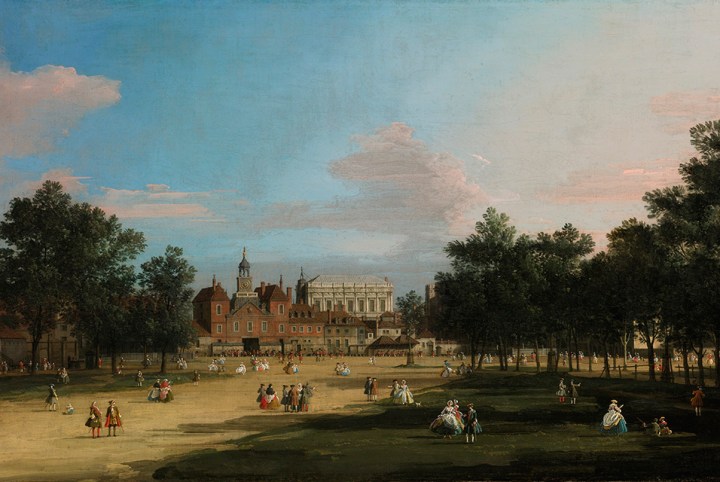
Giovanni Antonio Canal, called Canaletto, London, a View of the Old Horse Guards and Banqueting Hall, Whitehall Seen from St. James’ Park, ca. 1749. Estimate. $4–6 million. Photo: Sotheby’s.
◊ ◊ ◊ ◊ ◊
Press release (16 December 2014). . .
Sotheby’s Sale 9302 | Master Paintings: Part I
New York, 29 January 2015
Sotheby’s January 2015 Old Master Week in New York will feature a select group of highly important paintings assembled by noted collector J. E. Safra (included in Sale 9302). The choice offering of 17 paintings presents a wide range of styles and genres of the period including the Dutch Golden Age, as well as 18th-century Italian and French. The vast majority of the works have been off the market for at least 20 years and together the group is estimated to bring $22–34 million. The paintings will go on public exhibition, alongside Sotheby’s Old Master Week sales, beginning 24 January.
Leading a very strong group of Dutch works to be offered in Sotheby’s January 2015 sales is Frozen River at Sunset, painted by Aert van der Neer in or shortly after 1660, a period that was a high point for Dutch landscape painting and for the artist himself (est. $4–6 million). The work embodies the artist’s fascination with the people and the world around him and most notably the effect of light on a winter landscape and how it can transform the content and mood of a composition.
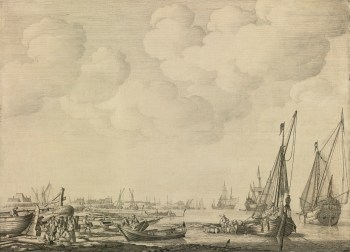
Willem van de Velde the Elder (1611–1693), Dutch Harbor in a Calm with Small Vessels. Lot 32, estimate $2–3 million.
Willem van de Velde the Elder’s Dutch Harbor in a Calm with small Vessels is one of the greatest examples of a penschilderij (pen and ink painting) remaining private hands (est. $2–3 million). Executed in a remarkable combination of pen, ink and brush over a thin layer of lead white, the use of quills of varying sizes and inks in different shades creates a remarkable sense of recession without the loss of any detail, even in the distant buildings of the town beyond.
A Roemer, an Overturned Pewter Jug, Olives and a Half- Peeled Lemon on Pewter Plates is a key work in Pieter Claesz.’s development as a painter of still-life, signaling a new approach to the genre (est. $2–3 million). In this modest ontbijtje (breakfast piece), he abandons the more luxurious displays of his early years in favor of compositions with fewer objects organized around a simple geometric structure and restricts his palette to suit this more muted style.
Among the wonderful Italian works to be offered from Mr. Safra’s collection is an exquisite example of views from Canaletto’s English period: London, A View of the Old Horse Guards and Banqueting Hall, Whitehall seen from St. James’ Park (est. $4–6 million). In May of 1746, Canaletto transferred his studio to London, perhaps in pursuit of fresh challenges. The outbreak of the War of the Austrian Succession in 1740 had discouraged English visitors from undertaking the Grand Tour, and these had made up the majority of Canaletto’s patrons. The painting is presumed to date to 1749, when the old, red brick Horse Guards had been condemned. This perhaps captured the imagination of the artist, compelling him to record the architecture in painted form for posterity.
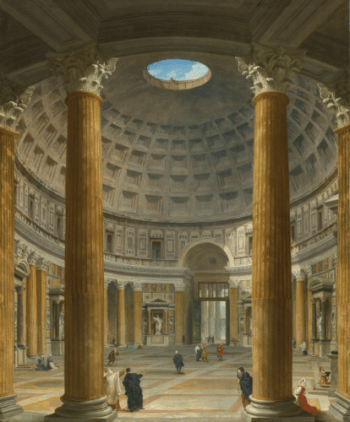
Giovanni Paolo Panini, Rome, The Pantheon, A View of the Interior towards the Piazza della Rotonda, 1732. Lot 91, estimate $3–5 million.
Giovanni Paolo Panini’s Rome, The Pantheon, A View of the Interior towards the Piazza della Rotonda is the earliest dated view of the interior of the Pantheon in Rome by the artist (est. $3–5 million). The work is in fantastic condition and a wonderful snapshot of figures marveling at the spectacular construction around them, in much the same way as they do today. Panini offers us a broad spectrum of the social tapestry of Rome in 1732; the spirited figures include soldiers, clergymen, beggars and other people at prayer, all dwarfed by the ancient Roman temple. As is typical of Panini’s great works, the meticulously observed architecture, particularly the Corinthian capitals, is bathed in the warm and inviting glow of Rome’s afternoon light
Call for Papers | Art and Science in the Early Modern Low Countries
From the call for papers:
Art and Science in the Early Modern Low Countries
Amsterdam, 17–18 September 2015
Proposals due by 15 April 2015

Anatomical studies of a human heart, attributed to Jan l’ Admiral, 1700–1750 (Amsterdam: Rijksmuseum).
Anticipating plans for a future exhibition on Art and Science in the Early Modern Low Countries (ca 1550–1730), the Rijksmuseum and the Huygens Institute for the History of the Netherlands (Royal Dutch Academy of Arts and Sciences) organize a preliminary, two-day conference. This event will take place at the Rijksmuseum (September 17th) and the Trippenhuis (September 18th) in Amsterdam.
The Low Countries were flourishing in the early Modern Period, influenced by developments in Northern Italy and Southern Germany. First Antwerp and later Amsterdam emerged as centers of artistic and scientific innovation and creativity, and as nodal points in the exchange of goods, knowledge and skills. It is certainly no coincidence that a high level of artistic productivity in the Low Countries coincided with the so-called ‘Scientific Revolution’. Seen from a contemporary point of view, ars and scientia were complementary concepts, rather than opposites.
The aim of the conference is to explore the possibilities, prospects and also the pitfalls of the conjunction of ‘art and science’, and to contribute to the developing conversation between historians of art, historians of science and everyone interested in the visual and material culture of the sixteenth- and seventeenth-century Low Countries. The organizers look forward to receiving original submissions that address the relationships between art and science on both a material and a conceptual level.
Proposals which take objects, works of art, images, or illustrated texts as their point of departure are particularly welcomed. These may include ‘borderline’ topics—cross-overs between art and science, such as decorated shells, maps, models, pop-up books or anatomical preparations. Although the focus of the conference will be the Low Countries—both the South and the North—proposals which make reference to developments elsewhere shall certainly be considered, so long as the overall relevance for the main theme is clear.
Topics for discussion may include, but are not limited to
• the fluid borders between art and nature, both in theory and in practice (e.g. life casting techniques, strategies of display),
• the influence and use of new theories and instruments of visual representation (e.g. the use of perspective, anatomical analysis, the telescope, microscope and camera obscura),
• the processes and techniques that artists used for the visual representation of the increasing body of traditional and new knowledge, such as different print media and the use of color, multi-sheet and interactive prints.
• the mediation of direct observation by visual conventions and the specific demands of illustrations concerned with the production of new knowledge (for instance with regard to previously unknown flora, fauna and peoples, and to anatomical and astronomical discoveries),
• the emergence in visual materials of new conceptions of objectivity and trustworthiness (e.g. the meaning of ‘ad vivum’ and its cognates; the character and use of illustrations in natural histories and ‘scientific’ treatises),
• spaces where scholars, craftsmen and artists cooperated, discussed and produced new knowledge, such as cabinets of curiosities, the workshop, the anatomical theatre and the botanical garden,
• the role of religion in the definition and construction of knowledge and its influence on the visualization of knowledge.
We invite proposals for 20-minute and 10-minute papers, presenting the results of new or ongoing research. A 300-word abstract (preferably including an image or reference to a work of art), together with a short curriculum vitae, should be sent to both Jan de Hond (j.de.hond@rijksmuseum.nl) and Eric Jorink (eric.jorink@huygens.knaw.nl). Proposals should be submitted no later than April 15, 2015. The selection of proposals will take place during the following month.
Historic New England’s Wallpaper Collection Now Available Digitally
◊ ◊ ◊ ◊ ◊
Press release via Art Daily (29 December 2014). . .
Thanks in part to a grant from the Institute of Museum and Library Services, Historic New England announces the completion of a digitization project that makes its extensive wallpaper collection more accessible. For the past two years, Historic New England has been cataloguing and digitizing its wallpaper collection. Now, more than 6,000 samples have been electronically catalogued and are available at WallpaperHistory.org. The collection includes rolled, flat, oversize, and three-dimensional materials, which each require unique handling and digitization methods.
The project makes accessible a collection that spans three centuries and ranges from very early imported items to William Morris designs to vinyl wallpapers from mid-1960s. The entire Waterhouse Archive of Historic Wallpapers has been newly catalogued and digitized, and there are upgrades and a redesign to 4,800 additional records that improve image quality and data content.
“Now the collection is searchable by date, location, and manufacturer, and by keywords like color and type of pattern”, says cataloguer Peggy Wishart. “You can zoom in to see every detail.”
Historic New England extensive wallpaper collection contains individual samples, historic photographs of wallpaper in situ, and ephemera dealing with the wallpaper industry. The wallpapers range from pristine examples with complete repeats to small fragments that are part of a sequence in a particular room and also includes scrapbooks, borders, bandboxes, fireboards, and scenic panels, many of which are accessible online for the first time. Historic New England is the oldest, largest, and most comprehensive regional heritage organization in the nation. We bring history to life while preserving the past for everyone interested in exploring the New England experience from the seventeenth century to today. Historic New England owns and operates thirty-six historic homes and landscapes spanning five states. We share the region’s history through vast collections, publications, programs, museum properties, archives, and family stories that document more than 400 years of life in New England.
More information is available here»
New Book | Ladies of the Grand Tour in Naples and Environs
Published by Grimaldi and available from ArtBooks.com: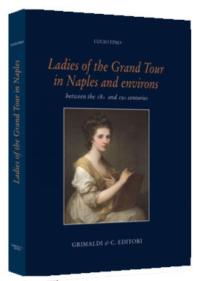
Lucio Fino, Ladies of the Grand Tour in Naples and Environs between the 18th and 19th Centuries (Naples: Grimaldi, 2014), 197 pages, ISBN: 978-8898199211, 95€ / $150.
Large volume with 145 color plates, many of which are full-paged reproductions—some previously unpublished—of prints, drawings, paintings, and watercolours from public and private collections. English text.
Call for Papers | The Enlightenment of the Senses
From the Calgary-based Enlightenment Group:
The Enlightenment of the Senses
Mount Royal University, Calgary, Alberta, 6 March 2015
Proposals due by 30 January 2015
For its third symposium, The Enlightenment Group at Mount Royal University invites paper propositions on the enlightenment of the senses. This symposium is also open to undergraduate and graduate students.
The publication of Locke’s Essay Concerning Human Understanding in 1690 rejuvenated the relationship between thought and senses by rejecting the concept of innate ideas and establishing sense experience as the basis of knowledge. While the senses were no longer seen as the cause of errors or illusions, this new empiricism was difficult to reconcile with long privileged themes such as the nature of the soul and of the real essence of things. Voltaire and others would make use of those tensions in their critiques of orthodox theology. The work of writers such as Condillac would prolong the effect of Locke’s empiricism throughout the eighteenth century.
Given the influence of this epistemological revolution in Europe across philosophy, science, literature and the arts, this symposium aims at examining the notion of sensualism in the Enlightenment through the lens of various disciplines in order to map out the similarities and the differences in the reception and application of sensualism in the Enlightenment world.
Topics may include, but are not limited to
• Empiricism and science
• Arts and senses
• Sensualism and literature
• Senses and philosophy
• Taste and sensibility
• Social dynamics of sensibility and taste
Please submit abstracts of 250 words by January 30, 2015 to Antoine Eche (aeche@mtroyal.ca)
STUDENTS: submit your abstract by February 17, 2015.
The Enlightenment Group is an interdisciplinary group of MRU scholars engaged in the study of the Eighteenth Century.
Exhibition | Eighteenth-Century Fans from the Lázaro Collection
◊ ◊ ◊ ◊ ◊
Thanks to Pierre-Henri Biger for noting this exhibition now on view at the Fundación Lázaro Galdiano:
Abanicos del Siglo XVIII en la Colección Lázaro
Museo Lázaro Galdiano, Madrid, 10 October 2014 — 26 January 2015
Curated by Carmen Espinosa
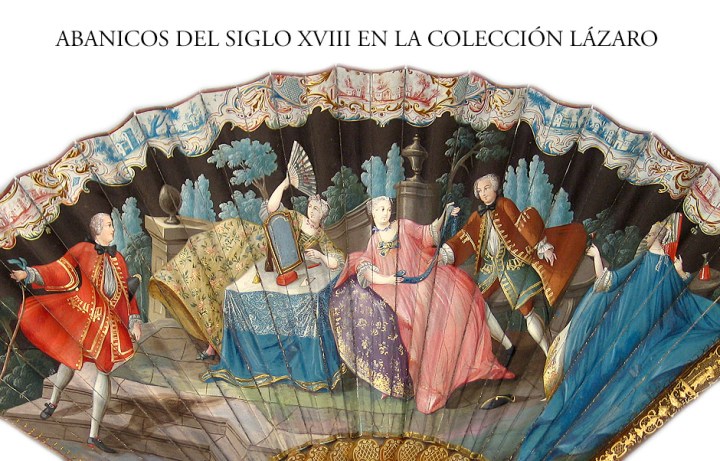
La exposición Abanicos del siglo XVIII en la Colección Lázaro, comisariada por Carmen Espinosa, conservadora jefe del Museo Lázaro Galdiano, se compone de una cuidada selección de 24 piezas correspondientes a la edad de oro del abanico, elemento fundamental del adorno personal femenino, signo de distinción y de lujo. La gran variedad de abanicos que atesoró José Lázaro es muestra de su incansable búsqueda como coleccionista, de meses e incluso años, para encontrar piezas con las que obsequiar a su esposa, Paula Florido, desde que la conoció en 1901.
Los ejemplares expuestos en Abanicos del siglo XVIII en la Colección Lázaro constituyen un excelente repertorio que permite al visitante apreciar la evolución de este complemento femenino. Se muestran obras tempranas, del primer tercio del siglo XVIII, donde las referencias al barroco clasicista son evidentes; piezas en las que vemos cómo se va fraguando el gusto rococó que dio lugar al abanico galante, fiel reflejo de la vida refinada y placentera de los nobles y burgueses europeos del segundo tercio de la centuria; y otras de estructura sencilla, pero de calidad, que nos adentran en el estilo neoclásico y la moda Imperio.
Las pinturas de los países están realizadas sobre papel o vitela -piel de vaca o ternera, adobada y pulida-, materiales que permiten el plegado, y están inspiradas en asuntos mitológicos, históricos, galantes y pastorales. Los poemas homéricos de la Iliada y la Odisea, unidos a la Eneida de Virgilio y Las Metamorfosis de Ovidio, fueron una fuente inagotable para los pintores de abanicos junto a las gestas de Alejandro Magno cuya figura encarnó los ideales de valor, poder y nobleza. La pintura de los abanicos de estilo Luis XV, identificados con el rococó, refleja la creciente hegemonía de la mujer en la vida social, protagonista indiscutible reflejada en la diosa Venus, personificación del amor, la belleza y la fertilidad; en Juno, diosa del matrimonio y protectora de la mujer; o en Onfalia que hizo que Hércules olvidará su valentía abandonándose a los placeres del amor. De la historia religiosa, habitual en abanicos del primer tercio del siglo, se escogieron relatos del Antiguo Testamento, aquellos donde la mujer desempeñó un papel fundamental como Sansón y Dalila, Salomé, Betsabé o la reina de Saba. A partir de 1750, a la literatura se unen, como fuente de inspiración para los pintores, el teatro, la ópera y el ballet.
Las pinturas de Antoine Coypel, Charles Le Brun y sobre todo las de Jean Antoine Watteau y François Boucher, creadores de la fiesta galante y de la pintura pastoral, son otro gran referente para la decoración de los abanicos dieciochescos. Esta riqueza iconográfica se muestra en los abanicos de la Colección Lázaro y queda patente en esta exposición.
Variedad y calidad están presentes en los abanicos de esta muestra, citemos como ejemplo uno francés con la representación de la Alegoría de las Artes o el italiano con una escena de toilette, que figuran entre las más ostentosas de la colección. También podemos deleitarnos con los elegantes varillajes realizados en marfil o carey con trabajo de piqué -técnica italiana adoptada en Francia e Inglaterra que consiste en la incrustación de pequeños fragmentos de oro y plata-, tallados y calados en forma de rejilla o puntos -grillé / pointillé-, a los que se añaden pequeñas láminas de madreperla, plata dorada o corlada, nácar y, en ocasiones, piedras preciosas en el adorno de las palas y en el clavillo -pasador que sujeta las varillas, las fuentes y palas, del abanico-.
La colección de abanicos, compuesta por noventa piezas, es un caso especial entre todas las que conforman la Colección Lázaro. Sus obras, nos explica Carmen Espinosa, son algo más que objetos de colección, fueron testigos mudos de una relación personal, la de los coleccionistas José Lázaro y Paula Florido: desde que se conocieron, en 1901, y hasta la muerte de Paula en 1932, Lázaro regaló a su esposa abanicos en dos fechas muy señaladas: el 15 de enero, día de su cumpleaños, y el 29 de junio, en que celebraba su onomástica. Estos abanicos responden al gusto de Lázaro que se esforzó por encontrar las piezas con las que agasajar a su esposa aunque, evidentemente, existió cierta complicidad pues conocía su preferencia por la época de Luis XV y Luis XVI. Los abanicos del XVIII estaban considerados, a comienzos del siglo XX y aún hoy, como verdaderas joyas, muy buscadas y de gran valor.
◊ ◊ ◊ ◊ ◊
From La Tienda de Los Museos Online:
Este catálogo recoge la colección completa de abanicos (casi un centenar) en la que están incluidas las 24 piezas de la exposición.
Arte, Lujo y Sociabilidad: La Colección de Abanicos de Paula Florido (Año Edición, 2009), 134 pages, ISBN: 978-8496411906, 12€.
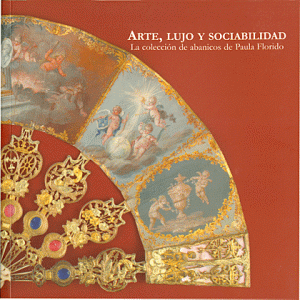 Se trata de una muestra de abanicos de elite, con materiales en su mayoría nobles de textiles, metales, brillantes, países y varillaje bien hecho y torneado, en madera de peral o de carey, con ejemplares muy selectos que abarcan los siglos XVIII y XIX.
Entre los abanicos expuestos también se encontraban cocardas (tipo paipai redondeado y recogido) o pericones, de mayor tamaño, así como abanicos de baraja. En su mayoría abanicos franceses, italianos e ingleses, con escenas bíblicas, mitológicas, heroicas, galantes, de la Comedia del arte y muy pocos con motivos políticos como el del matrimonio de doña Isabel II. En el abanico elegante se buscaban brillos y destellos de luz para impactar en sociedad.
Un bello cuadro de Luis Paret y Alcazar La Tienda (1772), perteneciente al mismo museo, ilustra sobre el modo en que un caballero y una dama adquieren ejemplares de abanico o miniaturas en aquel colmado ilustrado.
Se añaden algunos grabados de Goya que también dan cuenta del uso del abanico en Los Caprichos, objeto de indumentaria de lujo en principio, que paulatinamente se fue popularizando. El abanico era una pieza utilizada por el hombre o la mujer indistintamente, aunque era la mujer la que ofrecía con él todo un código de señales de sociabilidad.
New Book | Architectural Temperance: Spain and Rome, 1700–1759
From Taylor & Francis:
Victor Deupi, Architectural Temperance: Spain and Rome, 1700–1759 (New York: Routledge, 2014), 214 pages, ISBN: 978-0415724395, $155.
 Architectural Temperance examines relations between Bourbon Spain and papal Rome (1700–1759) through the lens of cultural politics. With a focus on key Spanish architects sent to study in Rome by the Bourbon Kings, the book also discusses the establishment of a program of architectural education at the newly founded Real Academia de Bellas Artes de San Fernando in Madrid.
Victor Deupi explores why a powerful nation like Spain would temper its own building traditions with the more cosmopolitan trends associated with Rome; often at the expense of its own national and regional traditions. Through the inclusion of previously unpublished documents and images that shed light on the theoretical debates which shaped eighteenth-century architecture in Rome and Madrid, Architectural Temperance provides readers with new insights into the cultural history of early modern Spain.
Victor Deupi teaches the history of art and architecture at the School of Architecture and Design at the New York Institute of Technology and in the Department of Visual and Performing Arts
at Fairfield University. His research focuses on cultural politics in
the early modern Ibero-American world.
◊ ◊ ◊ ◊ ◊
C O N T E N T S
Introduction: Architectural Temperance
1 Spain and Rome in the Early Eighteenth Century
2 Italian Grandeur
3 Metropoli Dell’ Universo
4 Iberian Architects in Rome
5 Santissima Trinità Degli Spagnoli in Via Condotti
6 Bourbon Patronage and Italian Influence
7 The Written Word and the Artifact
Exhibition | Giambattista Bodoni: The Invention of Simplicity

◊ ◊ ◊ ◊ ◊
From the Biblioteca Nacional de Portugal:
Giambattista Bodoni: a invenção da simplicidade
Biblioteca Nacional de Portugal, Lisbon, 29 November 2014 — 21 February 2015
Curated by José de Monterroso Teixeira
A exposição procura, numa abordagem holística, alavancar-se em três protagonistas, que estão na base da sua constituição: Francisco Vieira, o Portuense (1765–1805), Rodrigo de Sousa Coutinho (1745–1812), 1.º conde de Linhares, e Giambattista Bodoni (1740–1813). A matéria-prima centra-se no inestimável acervo saído dos prelos do célebre editor parmense que a Biblioteca Nacional de Portugal guarda e que configura um dos seus mais relevantes núcleos de livro antigo.
Giambattista Bodoni dirige a Stamperia Reale de Parma, desde 1768, dando à estampa, vinte anos depois, o marcante e aclamado Manuale Tipografico, que corresponde à codificação da arte tipográfica na sua depuração mais rigorosa. Admirava o talento de Vieira Portuense e convidou-o a colaborar em duas edições fundamentais: Pitture di Antonio Allegri detto il Correggio esistenti in Parma nel monistero di San Paolo (Parma: Nel Regal Palazzo, co’ tipi Bodoniani, 1800) e Le più insigne pitture parmense indicate agli amatori delle belle arti (Parma: Dalla Tipografia Bodoniana, 1809), projetos para os quais o pintor português realizou todos os desenhos do elenco das ilustrações.
Em 1798, já em Londres, Vieira Portuense propõe a Rodrigo de Sousa Coutinho, inspetor da Real Biblioteca Pública da Corte (e da Junta Económica, Administrativa e Literária da Impressão Régia), a aquisição da coleção de edições do amigo e impressor parmense, que entretanto reunira, participando-lhe: «ter eu toda a Colecção Bodoniana tão completa que mesmo Bodoni não haver companha e só me dizia ser como a de [2.º] Lord Spencer [1758–1834] nesta corte [inglesa]», o que vem efetivamente a acontecer, e cuja entrega simbólica, sob as arcadas do Terreiro do Paço e já com António Ribeiro dos Santos como bibliotecário-mor, ocorre em 1802.
Os anais da história da edição reservam a Giambattista Bodoni um lugar distinto como «legislatore del libro» e talentoso fautor da arquitetura gráfica neoclássica.
Bodoni ou a invenção da simplicidade realiza-se em articulação com duas outras exposições, a decorrer simultaneamente no Museu Nacional de Arte Antiga: Il celebre pittore. Vieira Portuense (Desenhos de Parma), que redescobre os trabalhos gráficos da época em que se relacionou com Bodoni; e A Coleção de Franco Maria Ricci, editor de exceção e grande colecionador, profundamente marcado pelas obras de Bodoni e de Jorge Luís Borges.










 Enfilade
leave a comment