Call for Papers | Crash and Burn: Destruction in American Art
As posted at H-ArtHist:
Crash and Burn: Destruction in American Art
The Courtauld Institute of Art, London, 5–6 June 2015
Proposals due by 15 February 2015
Destruction has long occupied a central position in the construction of an American national image. From Cotton Mather’s description of Boston as ‘the City of Destruction’ to the 9/11 attacks and Hurricane Katrina, the sheer visual force of destruction has repeatedly left an indelible mark on the collective psyche. As historians such as Richard Slotkin and Kevin Rozario have demonstrated, violent and destructive episodes have been inextricably linked with the apparently opposing forces of creation and regeneration so central to American self-imaging. This symposium will elaborate on such historical accounts to examine how the idea of destruction has shaped and been shaped by American art and visual culture.
Whether through the kind of dramatic cataclysm predicted in Thomas Cole’s The Course of Empire, or the ruined aftermath captured by the post-industrial landscapes of photographer Lewis Baltz, images of destruction in American art have often engaged with the most pressing historical questions of their time. Intensifying the paradoxes between artistic creation and destruction, American art has sometimes been directly engaged in the destructive act itself. As the recent ground-breaking exhibition Damage Control: Art and Destruction Since 1950 made clear, the efforts of conceptual artists to incorporate destruction as an artistic technique not only threatened to destroy the art object, but offered a powerful comment on contemporary social phenomena including urban renewal and ecological devastation. The capacity of artworks from earlier periods to embody such social and environmental concerns is a subject that merits increased scholarly attention.
The symposium will attempt to establish a genealogy for the destructive impulse as it was specifically activated in American art, charting its evolution from the colonial era to the present. How do American artists reconcile destruction with their own processes of creation? What motivated artists to incorporate destruction into their art, and how have these contextual meanings changed over time? The symposium will interrogate destruction as a theme addressed by artists through their work, but also consider those external forces that have seen the artwork itself subjected to the forces of destruction. Papers can consider works of art of all mediums and periods, as well as a wider range of visual and material culture.
Please submit abstracts of 150–200 words in English, along with a short biography of approximately 100 words to destructionsymposium@gmail.com by 15 February 2015. Speakers and attendees alike will be invited to submit proposals to present further work in a related workshop to be held at Tate later in 2015, as part of their Refiguring American Art initiative.
Organised by Hélène Valance, Terra Foundation for American Art Postdoctoral Fellow, The Courtauld Institute of Art, and Alex J. Taylor, Terra Foundation Research Fellow in American Art, Tate.
Exhibition | Joshua Reynolds: Experiments in Paint
From the press release for the exhibition:
Joshua Reynolds: Experiments in Paint
The Wallace Collection, London, 12 March — 7 June 2015
Curated by Lucy Davis, Mark Hallett, and Alexandra Gent
A room hung with pictures is a room hung with thoughts. –Joshua Reynolds (1784)
The Wallace Collection’s spring exhibition will offer a fresh perspective on the work of a towering figure of British painting, Joshua Reynolds. Although widely regarded as one of the most important and influential painters of the period, Reynolds’s reputation as an ‘establishment’ artist masks his unquenchable thirst for innovation and his experimental approach to the practice and materials of painting. The exhibition explores Reynolds’s painting techniques, pictorial compositions and narratives through the display of 20 paintings, archival sources and x-ray images.

Joshua Reynolds, Mrs. Abington as Miss Prue in ‘Love for Love’ by William Congreve, 1771 (New Haven Yale Center for British Art)
Joshua Reynolds: Experiments in Paint will draw upon the significant works within the Wallace Collection and major loans from the UK, other European countries and the USA, all chosen to reveal Reynolds’s compositional and narrative experimentation and his unorthodox choice of materials, admixtures of paint and complex layering techniques. The exhibition reveals discoveries made during a four-year research project into the outstanding collection of twelve Reynolds paintings at the Wallace Collection.
With support from the Paul Mellon Centre for Studies in British Art, TEFAF, the Hertford House Trust, various private donors, and Trusts and drawing on the research expertise of the National Gallery in London and the Yale Center for British Art in New Haven, the exhibition spans most of Reynolds’s career and includes portraits, ‘fancy’ pictures and history painting.
On display will be celebrated portraits such as Nelly O’Brien (c.1762–64), Mrs Abington as Miss Prue (1771) and Reynolds’s own Self Portrait Shading the Eyes (1747–49) together with experimental studies and a canvas showing how Reynolds observed the effects of different combinations of colour and media. Collectively, alongside the hidden stories behind the paintings, archive resources and x-ray-images, the exhibition demonstrates the diversity of Reynolds’s artistic production, his highly original approach to image-making, composition and narrative, and prompts us to review opinions and perceptions of this truly experimental artist.
Joshua Reynolds: Experiments in Paint has been curated by Dr Lucy Davis, Curator of Old Master Pictures at the Wallace Collection, Professor Mark Hallett, Director of Studies in British Art at the Paul Mellon Centre and Alexandra Gent, also responsible for paintings conservation for the Reynolds Research Project. Director of the Wallace Collection, Dr Christoph Martin Vogtherr initiated the Reynolds Research Project. The Wallace Collection is a leading centre for the study of Joshua Reynolds and owns twelve important paintings by the artist dating from 1759 until the end of his career, covering several important aspects of his oeuvre: bust-length, half-length and full-length portraits of male and female sitters, ‘fancy’ pictures and a rare history painting.
◊ ◊ ◊ ◊ ◊
From Paul Holberton:
Lucy Davis and Mark Hallet, eds., Joshua Reynolds: Experiments in Paint (London: Paul Holberton Publishing, 2015), 192 pages, ISBN: 978-0900785757, £30 / $50.
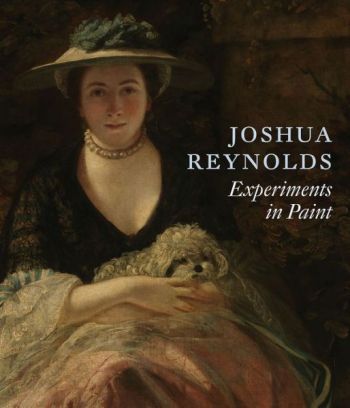 One of Britain’s most important and influential painters, Sir Joshua Reynolds (1723–1792) is justly celebrated for his dynamic portraiture, his poignant ‘fancy pictures’, his ambitious history paintings and his role as the first President of Britain’s Royal Academy.
This catalogue, published to accompany a major exhibition at the Wallace Collection, provides a fresh perspective on the artist, focusing on his innovative, often highly experimental approaches to the practice and materials of painting. Building on the many discoveries made during a four-year research project into the outstanding collection of the artist’s works at the Wallace Collection, Joshua Reynolds: Experiments in Paint investigates his radical manipulation of pigments, oils, glazes and varnishes. It traces his experiments with colour, tone and handling, reveals his continual temptation to rework and revise his pictures, and illuminates his highly creative responses to the new exhibition culture of his day. It also suggests the extent to which the artist’s work was founded upon a radical agenda of pictorial assemblage, in which he mixed anew the motifs, narratives and visual effects he drew from in the great art of the past. Finally, it demonstrates how Reynolds’s innovations as a painter were often the product of collaboration—in part, with his assistants and his students, but, more importantly, with his patrons and subjects, with whom he continually explored the possibilities of gesture, expression, performance and role-play.
The catalogue features an introduction, seven essays by leading scholars, curators and conservators, a chronology of the artist’s life and career, and detailed entries on a range of Reynolds’s pictures, at the centre of which are the Wallace Collection’s own collection of works by the artist.
Call for Papers | Joshua Reynolds and Artistic Experiment
From the call for papers:
Challenging Materials: Joshua Reynolds and Artistic Experiment in the Eighteenth Century
The Wallace Collection, London, 15 May 2015
Proposals due by 13 February 2015

Joshua Reynolds, Portrait of Mrs. Mary Robinson, 1783–84 (London: The Wallace Collection)
This conference, which accompanies the exhibition Joshua Reynolds: Experiments in Paint at the Wallace Collection, is designed to investigate and contextualise the artist’s famously experimental practice. Building upon the technical findings of the Reynolds Research Project at the Wallace Collection, and also on a range of recent conservation projects on Reynolds’s paintings, it will explore his distinctive manipulation of paint as a medium. Papers are encouraged that will offer new perspectives on Reynolds’s experimental forms of pictorial composition, narrative and allusion, and to look afresh at the dynamic interactions between the artist, his sitters and his models in the studio.
As well as focusing on Reynolds’s own art in detail, the conference seeks to place his experimental activities within the context of wider artistic, cultural and scientific practices of the eighteenth century. How did his own attitudes to the fundamental materials of his profession—to pigments, oils, varnishes and glazes—relate to those of other artists, both from his own period and before? How did his distinctive engagement with the conventions of portraiture, fancy pictures and history painting compare to the ways in which other practitioners reworked such pictorial genres? Can we contextualise his painting within a broader project of cultural experimentation and innovation in the period, one that is also visible in the spheres of literary, theatrical and musical production? And, finally, might it be helpful to understand his work in relation to the forms of scientific and technological experimentation that developed in the Georgian era, whether institutionalised or unofficial? The Challenging Materials conference is designed to address such questions, and in doing so to shed fresh light not only on Reynolds’s own work, but also on the visual culture of which it was a part.
This one-day conference is being organised by the Paul Mellon Centre for Studies in British Art and the Wallace Collection. It will take place at the Wallace Collection and includes a morning viewing of Joshua Reynolds: Experiments in Paint. Substantial time will be granted for discussion; refreshments, lunch and a drinks reception will also be provided.
Proposals of no more than 300 words for 20-minute papers should be sent to Ella Fleming at efleming@paul-mellon-centre.ac.uk by Friday 13th February 2015. Please also include a short biography of c. 150 words in your application.
Fellowship with The Phillips Collection and GWU
From H-ArtHist:
Postdoctoral Fellowship with The Phillips Collection and George Washington University
Applications due by 15 January 2015
The Phillips Collection, in partnership with the George Washington University, offers a postdoctoral fellowship to support research and teaching on topics in American, European, or non-western art, including photography, from 1780 to the present. The next fellowship term is July 2015 through June 2016.
The appointment carries a departmental affiliation with the George Washington University’s Department of Fine Arts and Art History and with The Phillips Collection. The fellow receives a stipend and generous benefits package, as well as various university/museum privileges, including access to facilities, libraries of institutions, equipment, support staff, curators, and faculty.
The fellowship is open to untenured scholars who have received their PhDs within the past five years. Applicants must have successfully defended their thesis prior to the application deadline (no later than January 15, 2015) and their doctoral degree must be conferred no later than June 30, 2015, prior to the start day of July 1, 2015. Preference will be given to applicants whose projects focus on subjects related to the museum’s areas of collecting and reinterpret the topic via innovative methodological approaches or alternative perspectives that may cross national boundaries and art historical time periods.
The next fellowship opportunity is July 2015 through June 2016. Deadline for receipt of the application is January 15, 2015. To apply, send a cover letter, CV, a one-page research proposal, a sample syllabus for a proposed undergraduate or graduate course, and two letters of reference. All application materials must be sent electronically in one PDF document to fellowships@phillipscollection.org. Letters of recommendation may be submitted together with the application materials or sent separately by the recommenders to the same e-mail address.
Hodson-Brown Fellowship, 2015–16
Hodson-Brown Fellowship, 2015–16
Applications due by 15 March 2015
The C.V. Starr Center for the Study of the American Experience and the John Carter Brown Library invite applications for the Hodson Trust-John Carter Brown Fellowship, a unique research and writing fellowship. The deadline for applications for the 2015–2016 Hodson-Brown Fellowship is March 15, 2015. The fellowship supports academics, independent scholars, writers, filmmakers, novelists, and artists working on significant projects relating to the literature, history, culture, or art of the Americas before 1830.
Fellowship award: $20,000 plus housing and university privileges.
Duration: two months of research in Providence, RI (any time between September and May) and two months of writing in Chestertown, Md. (any time between May and August).
Residence: In Providence, a private room in the John Carter Brown Library’s Fellows’ Residence; in Chestertown, exclusive occupancy of a restored circa-1735 house.
Work space: In Providence, space in the John Carter Brown Library; in Chestertown, a private office in the circa-1745 waterfront Custom House, home of the Starr Center.
Additional information is available here»
Exhibition | Opulent Art: 18th-Century Dress from the Larson Collection
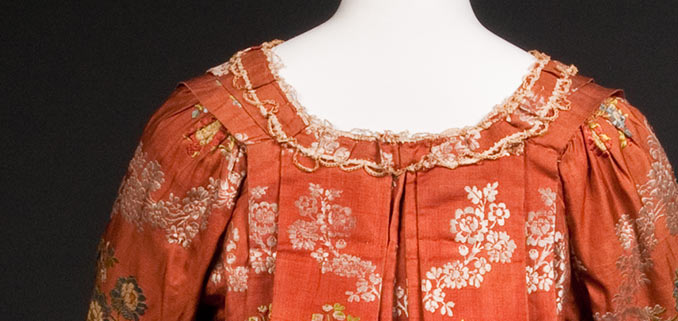
Robe Volante, France, ca. 1745, Brocaded silk, silk passementarie & linen
(Helen Larson Historic Fashion Collection FIDM Museum)
◊ ◊ ◊ ◊ ◊
From the FIDM Museum & Galleries:
Opulent Art: 18th-Century Dress from The Helen Larson Historic Fashion Collection
FIDM Museum & Galleries, Los Angeles, 10 February — 2 July 2015
Curated by Kimerly Chrisman-Campbell and Kevin Jones
Ladies and gentlemen living in 18th-century Europe dressed opulently. Luxurious silks, handmade laces and precious metal trimmings were de rigueur for those aligned with royal courts and attending state theaters. In this exhibition are displayed lavish garments and accessories spanning the century, including a rare Figaro costume worn by an actor portraying the rascal servant in Beaumarchais’s famed opera trilogy. The stories of this character’s hijinks undermining his aristocratic employer sparked revolutionary tensions with real life rulers, who tried unsuccessfully to ban the popular productions.
The exhibition is part of the programming for LA Opera’s Figaro Unbound: Culture, Power and Revolution at Play. More information is available here.
Figaro Unbound: Culture, Power, and Revolution at Play
Readers in the Los Angeles area as well as those planning to attend ASECS may find this series from LA Opera of interest. The associated programming is extensive. –CH
Figaro Unbound: Culture, Power, and Revolution at Play
Various venues in the Los Angeles area, January — April 2015

After Jean-Marc Nattier, Portrait of Pierre-Augustin Caron de Beaumarchais, ca. 1755 (Institution: Comédie-Française)
From February 7 through April 12, 2015, LA Opera will produce three operas inspired by the works of the French playwright Pierre-Augustin Caron de Beaumarchais (1732–1799). Beaumarchais was a man of many talents: a playwright, watchmaker, inventor, musician, diplomat, fugitive, spy, publisher, horticulturalist, arms dealer, satirist, financier and revolutionary (both French and American). His trilogy of Figaro plays—The Barber of Seville (1775), The Marriage of Figaro (1784) and The Guilty Mother (1792)—captured staggering changes in social attitudes of the late 18th century. These plays and their characters have been subsequently adapted into operas (some more successful than others) by Paisiello, Salieri, Massenet and Milhaud to name a few.
LA Opera’s programming of the “Figaro Trilogy”—John Corigliano’s The Ghosts of Versailles, Rossini’s The Barber of Seville and Mozart’s The Marriage of Figaro—within the 2014/15 season will immerse audiences in the world of a character who created a sensation in the years leading up to the French Revolution. The lasting legacy of the free-thinking barber will be explored in Figaro Unbound, a three-month celebration of the revolutionary spirit.
With a variety of programming for all ages, Figaro Unbound will investigate the ongoing relevance of Figaro and the Beaumarchais trilogy. There will be performances of alternate musical adaptations of Figaro’s story and opportunities to examine his lasting influence on American political and cultural life. Figaro Unbound partners include ArcLight Cinemas, the Hammer Museum, Opera UCLA, A Noise Within, LA Theatre Works, FIDM Museum, the Huntington Library, LACMA, the Norton Simon Museum, the Getty Museum, and the Opera League of Los Angeles, among others.
Call for Papers | RACAR Thematic Issue: The Nature of Naturalism
From the call for papers:
RACAR Thematic Issue—The Nature of Naturalism: A Trans-historical Examination
Edited by Sarah Guérin (Université de Montréal) and Itay Sapir (UQAM)
Proposals due by 1 February 2015; completed articles due by 1 August 2015
In spite of its inherent complexities and ambiguities, the definition of naturalism in art is often taken for granted. Indeed, the history of art continues to be schematized by dividing it into periods of greater and lesser naturalism. Thus, for instance, the remarkably life-like capital foliage of Reims cathedral is flagged as a break from a typically medieval ‘abstract’ style; and the categorization of artists such as Caravaggio as ‘naturalists’ is repeated, but seldom questioned, throughout the spectrum of art historical texts, from scholarly studies to wall texts addressing the museum-going public.
The relations and interactions between art and nature, however, are never simple. Works of art can seek to imitate one aspect of nature while ignoring, or actively discarding, others. General interest in natural phenomena does not necessarily imply a ‘naturalistic’ technique, and vice versa. The perspective shifts even more dramatically when considered within the framework of global art history. The definition of nature is in itself, of course, a fraught philosophical question, exemplified, but not exhausted, by the distinction between Natura naturans and Natura naturata.
In this special issue of RACAR (Revue d’art canadienne / Canadian Art Review), we seek to problematize further the concept of naturalism in the visual arts. What are the criteria that define a work, a corpus, or a style, as naturalistic? How do artists formulate an approach to nature through the related aspects of content, form, and function? Should one distinguish naturalism from realism and mimesis, terms frequently used as quasi-synonyms? Is the category of ‘naturalistic art’ helpful at all for art historical discourse, or should it be dispensed with altogether? A perennial question in the history of art, the nature of naturalism remains relevant to the field.
We welcome both theoretical texts and specific case studies treating questions of naturalism from any historical period, geographical region, and artistic medium. The articles (of a maximum of 8,500 words including footnotes) will be due on 1 August 2015 and will be submitted to double-blind peer review. Please email your 250-word abstract and a short CV to Sarah Guérin (s.guerin@umontreal.ca) and Itay Sapir (sapir.itay@uqam.ca) by 1 February 2015.
◊ ◊ ◊ ◊ ◊
RACAR, un numéro thématique—La nature du naturalisme: un questionnement transhistorique
Sarah Guérin, Université de Montréal Itay Sapir, UQAM
En dépit de sa complexité et de ses ambiguïtés, la définition du naturalisme dans l’art est souvent tenue pour acquise. En effet, l’histoire de l’art continue d’être schématiquement divisée en périodes selon le degré de naturalisme. Ainsi, par exemple, les chapiteaux végétaux remarquablement véridiques de la cathédrale de Reims sont décrits comme une rupture par rapport au style médiéval qui serait typiquement « abstrait » ; et des artistes comme Caravage sont régulièrement étiquetés « naturalistes » dans des textes historiographiques divers, sans que cette description soit sérieusement expliquée ni remise en question.
Il est évident, pourtant, que les relations entre l’art et la nature sont loin d’être si simples. Les œuvres d’art peuvent tenter d’imiter directement un aspect de la nature tout en ignorant ou en rejetant activement d’autres ; un intérêt général pour les phénomènes naturels ne signifie pas nécessairement une technique « naturaliste », et vice-versa. La perspective bascule de façon encore plus radicale lorsque nous prenons comme cadre une histoire de l’art mondiale. La définition de la nature est en elle-même, bien sûr, une question philosophique complexe : la distinction entre Natura naturans et Natura naturata en est un aspect crucial parmi bien d’autres.
Dans ce numéro spécial de RACAR (Revue d’art canadienne / Canadian Art Review), nous souhaitons problématiser le concept de naturalisme dans les arts visuels. Quels sont les critères qui définissent une œuvre, un corpus ou un style comme naturaliste ? Comment les artistes formulent-ils leur approche à la nature à travers le contenu, la forme et la fonction de leurs créations ? Faut-il distinguer le naturalisme des termes fréquemment utilisés comme ses synonymes, tels le réalisme et la mimesis ? La catégorie d’« art naturaliste » est- elle d’une quelconque utilité pour le discours historiographique, ou serait-il préférable de l’abandonner ? La question de la nature du naturalisme, soulevée par les artistes et les théoriciens tout au long de l’histoire, demeure d’actualité.
Nous invitons des propositions d’articles (en anglais ou en français) traitant de la question du naturalisme dans l’histoire de l’art. Les textes qui se penchent sur des questions théoriques générales ou qui se concentrent sur des études de cas sont fortement encouragés. L’appel est ouvert à des sujets provenant de toutes les périodes historiques, toutes les aires géographiques et culturelles et tous les médias artistiques. Les articles (d’un maximum de 8500 mots y compris les notes) seront exigibles le 1er août 2015 et seront soumis à un examen par les pairs en double aveugle. Veuillez soumettre vos propositions d’un maximum de 250 mots et un court CV avant le 1er février à Sarah Guérin (s.guerin@umontreal.ca) et Itay Sapir (sapir.itay@uqam.ca).
Exhibition | The King of Groningen: Jan Albert Sichterman (1692–1764)

Johann Dietrich Findorff, after Jean-Baptiste Oudry, Clara the Rhinoceros, ca. 1752
(Schwerin: Staatliches Museum)
◊ ◊ ◊ ◊ ◊
Along with the exhibition highlighting treasures from the Dresden Picture Gallery acquired in the eighteenth century, the Groninger Museum is currently presenting an exhibition addressing the collection of the Dutch merchant Jan Albert Sichterman:
De Koning van Groningen: Jan Albert Sichterman (1692–1764)
Groninger Museum, Groningen, 20 September 2014 — 1 March 2015
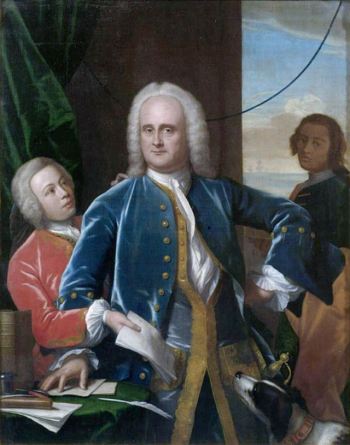
Philip van Dijk, Portrait of Jan Albert Sichterman (Groninger Museum)
The art collection of the Groningen merchant Jan Albert Sichterman—one of the most striking figures of the eighteenth century—included Asian ceramics, beautiful porcelain, splendid portraits painted by Philip van Dijk, Cornelis Troost and others, inconceivably fine pappercutting by Koster, furniture, silver, chintz, and memories of Clara the rhinoceros. After Sichterman’s death in 1764, his art collection was auctioned off and the collection largely dispersed. Fortunately, many collection pieces remained within the family and, in the course of time, the Groninger Museum has also been able to acquire several items. With this exhibition, the Groninger Museum has seized the exceptional opportunity to gather together what has been diffused since 1764. For this occasion, the Museum’s own Sichterman collection has been supplemented by hitherto unshown objects from private collections, as well as a number of works on loan. Never before has so much Chine de Commande porcelain owned a single family been exhibited in our country.
Christiaan J.A. Jörg, Egge Knol, and Denise A. Campbell, Jan Albert Sichterman (1692–1764): Een imponerende Groninger liefhebber van kunst (Groningen: Groninger Museum, 2014), 184 pages, ISBN: 978-9071691737, €39.
New Book | The Portrait Collection of Francesco Maria Niccolò Gabburri
From Artbooks.com:
Andrea Donati, Conoscere Collezionando: I ritratti della collezione Gabburri (Foligno: Etgraphiae editrice, 2014), 120 pages, ISBN: 978-8890868481, $69.
 Nella storia del collezionismo europeo e della cultura illuministica Francesco Maria Niccolò Gabburri (Firenze, 1676–1742) rappresenta un caso di straordinario interesse per l’autentica passione e lungimiranza che lo contraddistinsero a Firenze come accademico, mecenate, collezionista, conoscitore. L’interesse per i ritratti maturò in lui fin dalla giovinezza, sulla scorta delle memorie fiorentine e delle raccolte dei Granduchi di Toscana, ma divenne parte vitale di un progetto originale, quando egli capì di dover combinare la sua vocazione collezionistica con lo studio della storia dell’arte. Conoscere collezionando, questo è il senso della sua vita e della sua opera. Questo è il senso del libro che gli ho dedicato.










 Enfilade
leave a comment