Exhibition | The Jason Tapestries
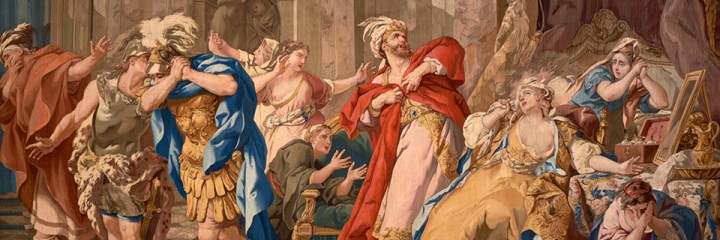
Creusa Consumed by the Poisoned Robe [detail], French, 1789. After a cartoon by Jean François de Troy, woven by Royal Gobelins Manufacture, signed “Audran 1789.” Wool, silk, and linen (Wadsworth Atheneum Museum).
◊ ◊ ◊ ◊ ◊
Press release (25 November 2014) from the Wadsworth:
The Jason Tapestries
Wadsworth Atheneum Museum of Art, Hartford, Connecticut 28 November 2014 — April 2015
The Wadsworth Atheneum Museum of Art will display rarely-exhibited tapestries from the eighteenth century in its soaring Morgan Great Hall during the final phase of the museum’s five-year, $33 million renovation. The large, intricate tapestries—which depict the saga of Greek hero Jason—will be on view through April 2015, at which point the Great Hall will be transformed in preparation for the September 19, 2015 grand reopening of the Morgan Memorial Building. The Jason Tapestries are enormous in size—ranging in height up to 14 feet, and in width up to 24 feet—presenting a challenge for curators in exhibiting them on a regular basis.
“The sheer magnitude of these stunning woven treasures, when paired with their fragility, prevents the museum from showing them as frequently as we would wish,” said Susan L. Talbott, Director and C.E.O. “The changing of the guard in our magnificent Morgan Great Hall presented us an ideal window in which to share these masterpieces with our visitors, and it is our hope that everyone will take advantage of this marvelous opportunity.”
The Jason Tapestries series was donated to the Wadsworth Atheneum in 1946. It consists of four tapestries from an original set of seven, which narrates the saga of Jason, well known to French contemporaries through the book Metamorphosis by Ovid. The tapestries depict Jason’s voyage with the Argonauts, the capture of the Golden Fleece (a symbol of kingship), and their subsequent return to Greece. Jason appears as a tragic hero—youthful, brave and clever—whose entanglement with the sorceress Medea will assure him the Fleece, but will also lead to the annihilation of his family.
From the fourteenth to the eighteenth centuries—the great period of tapestry weaving— popes, kings, and aristocrats alike competed for these luxurious pieces. Much more labor intensive and expensive to produce than paintings and sculpture, tapestries served as portable sources of wealth, and were given as precious diplomatic gifts. Manufactories used the finest materials, such as silk threads that were often combined with silver and gold. The mythological (or historical and biblical) narratives depicted were often used to glorify heroic acts of the past and present.
The story of Jason was one of the most popular tales to illustrate in tapestries of the late eighteenth century, the time of the Ancien Régime in France. In 1743, King Louis XV commissioned a seven-part Jason and Medea series for the Throne Room at Versailles, arguably the most prestigious room in France. Jean François de Troy (1679–1752) provided sketches that were later translated into life-size preparatory drawings and subsequently woven into tapestries at the Gobelins workshop. Other versions of this series were given as precious gifts by the French crown, and today belong to the Hermitage in St. Petersburg, the Royal Collections in Sweden, the Palazzo Reale in Milan and Windsor Castle in England, among others.
About Morgan Great Hall
Hartford native J. Pierpont Morgan, one of America’s richest men and greatest art collectors during the Gilded Age, donated the land and money to build the Beaux-arts Morgan Memorial. He also had a special interest in tapestries, and when the Great Hall opened in 1915, he loaned ten of them to adorn its walls. The space soon became known as ‘Tapestry Hall’. Morgan and his contemporaries saw themselves as the offspring of the old European aristocracy, who hung tapestries in the Great Halls of their country houses to demonstrate their power and influence, as well as to keep out the cold. The Wadsworth Atheneum will celebrate the centennial of the Morgan Memorial and its Great Hall in 2015; following the exhibition of The Jason Tapestries, Morgan Great Hall will be installed with masterworks from the museum’s permanent collection of European art, to open September 19, 2015, as part of the unveiling of the restored building.
Call for Essays | Equestrian Cultures, 1700–Present
From H-ArtHist:
Edited Collection of Essays: Equestrian Cultures, 1700–Present
Proposals due by 28 February 2015
Pictured in wonderfully textured shades of sepia, the horses of Roberto Dutesco’s photographic Sable Island series are beautiful, larger than life, and undeniably Other. They come alive on the walls of urban art galleries, and in doing so they both reaffirm and unsettle our conceptions of what it means to be ‘horse’. Liminally situated between rural and urban, domestic and wild, aesthetic object and independent subject, Dutesco’s Sable Island horses are both eminently real beings with their own experiences of worlding, and representations that speak to Western, hegemonic discourses of the nonhuman. What is ‘horse’? How have they been represented within literature and the arts? What is their relationship to humans, and how has their presence altered human society over time? These questions, along with the complex instability of the equine nonhuman, are the subject of this essay collection. We invite papers that explore the role and representation of horses in human culture from 1700 to the present in a wide array of geographies and contexts, and from multiple disciplinary perspectives within the humanities. Papers that explore horses in non-Anglocentric equestrian cultures are especially welcome. (more…)
Fellowships | Lichtenberg-Kolleg Early Career Fellowships
Lichtenberg-Kolleg Early Career Fellowships, 2015–17
Applications due by 2 March 2015
The Lichtenberg-Kolleg, the Göttingen Institute for Advanced Study in the Humanities and Social Sciences, invites applications for up to 12 Early Career Fellowships.
 Opening its doors in 1737 Göttingen quickly established itself as one of Europe’s leading Enlightenment universities. Named after one of the most important and versatile representatives of the Gottingen Enlightenment, the Lichtenberg-Kolleg is an interdisciplinary research institute with a strong focus not only on the Enlightenment(s), but also on ‘bridges’ between the human and natural sciences and on the study of religion. For the period October 2015 to July 2017 we are inviting early career scholars to join one of the research teams for the study of either:
• Globalising the Enlightenment: Knowledge, Culture, Travel, Exchange and Collections, or:
• Human Rights, Constitutional Politics and Religious Diversity, or:
• Primate Cognition: Philosophical, Linguistic, and Historical Perspectives.
The University of Göttingen is an equal opportunities employer and places particular emphasis on fostering career opportunities for women. Qualified women are therefore strongly encouraged to apply as they are underrepresented in this field. Disabled persons with equivalent aptitude will be favoured. All Fellowships are open to candidates who have received a doctorate within the last 6 years. The deadline for applications is 2nd March 2015.
Details are available here»
Exhibition | Tiepolo: I Colori del Disegno

Giandominico Tiepolo, The Three Angels Appearing to Abraham
(Venice: Accademia)
◊ ◊ ◊ ◊ ◊
Now on at the Capitoline Museum (with caveats concerning an English translation in this particular case) . . .
Tiepolo: The Colours of Drawings / I Colori del Disegno
The Capitoline Museum, Rome, 3 October 2014 — 18 January 2015
Curated by Giorgio Marini with Massimo Favilla and Ruggero Rugolo
For the first time in Rome, the work of one of the greatest painters and printmakers of the eighteenth-century Venice, Giambattista Tiepolo. In the history of European figurative art, the impressive quantity and variety of designs produced by Tiepolo stands out as a great monument of eighteenth-century graphic representation.
 The history of European figurative culture is remarkably marked by a huge amount and variety of drawings of the Tiepolos, which stand out as a magnificent monument of Eighteenth-century graphics. Indeed, drawing is the basic element of Giambattista Tiepolo’s genial art and is where he was the most prolific. Similarly, drawing characterized the exceptional and unique production of his family-owned original atelier, where he guided the graphical activity of his sons, Giandomenico and Lorenzo, in the last example of a very old Venitian tradition. Such an inexhaustible narrative vein, mainly intended as an independent exercise, is made of an extensive variety of registers that the artist used to adjust to the different functionalities of his production. Thus, the various typologies, techniques and themes give rise to a ‘colour of drawing’. This occasion is dedicated to this peculiar perspective on the many-sided world of Tiepolo and finds its reason in the lucky chance of gathering a selection of works coming from Italian collections, unfamiliar to the great public, with sheets that have been hardly ever exhibited before.
 The four sections of the exhibition feature drawings and a selection of etchings according to prominent thematic clusters, but still arranged according to the range of their techniques: from the project to the early sketches, from ‘memories’ to ‘amusements’ and to the replicas of Giandomenico and Lorenzo, as an emulation of their father’s works. A measured selection of paintings is also exhibited in order to introduce and somehow represent the painting outcomes of every graphical typology. Some are well known, others have re-emerged or have been recognized only by the most recent research activities—even in the preparation of this exhibition—but they all contribute to grasp the dynamics of Tiepolo’s language, whose exceptional imaginative fertility does not exclude a constant innovation in the iteration of models.
The catalogue is available from ArtBooks.com:
Giorgio Marini et al., Tiepolo: I Colori del Disegno
(Rome: Campisano Editore, 2014), 192 pages, ISBN:
978-8898229338, $78.
New Book | The Churches of Rome, 1527–1870
From Pindar:
Michael Erwee, The Churches of Rome, 1527–1870: Volume I. The Churches (Oxford: Pindar Press, 2014), 780 pages, ISBN: 978-1904597285, £150 / $300.
 The churches of Rome constitute arguably the most important manifestations of art and architecture in the Western world. This book is a detailed description of 251 churches in Rome and the Vatican City, built or decorated between 1527 and 1870, and is based on extensive research in state, church and private archives, as well as an exhaustive survey of modern and historical bibliographical sources.
Its aim is to provide a more complete picture of the construction and decoration of these churches than previously known. This entails not only providing the names of the architects who designed the churches, but also the names of the masons (muratori) and stone cutters (scalpellini), who built the churches and whose skills were essential for realising the architect’s plans. This depth of information is carried through to the interior decorations. The interior of each church is then described in depth, on a chapel-by-chapel basis, and includes stucco work, marble revetment, monuments, metal work, fresco and painted decorations and altarpieces. For each church, a brief historical introduction is given and a general bibliography supplied. Archival research has brought to light a great number of works of art whose authorship and/or dates have hitherto been unknown, including works by well-known artists but also many that are unknown to scholars. A great number of works of art whose authorship has hitherto been unknown are published in this volume for the first time.
An alphabetic index of artists (consisting of over two thousand names) is supplied, and includes the churches where their works are to be found and accurate biographical information for each artist. In addition there is an index of patrons, and a street and rione index. Also provided are the names and contact details of the archives consulted in researching this book. The book is intended to be used as a reference and resource book, as well as to be used by visitors to these churches. It is lavishly illustrated with photographs.
Michael Erwee was born in Zambia. He received his doctorate from the University of Sydney and was awarded an Alexander von Humboldt post doctorate scholarship from the German Government. At present he is an independent researcher.
Exhibition | Country House, City House
In a posting on the preservation strategy for Menokin a few days ago, I failed to note the related exhibition now on view in DC. Thanks to Pierre-Henri Biger for pointing it out! –CH
From the website Menokin: Rubble with a Cause:
Country House, City House
The Octagon House, Washington, D.C., 6 November 2014 — April 2015
 Menokin and The Octagon House are linked across the centuries through historic events, a family, and a love of architecture. Step inside their history and be immersed in the revolutionary plans for their future in the Country House, City House exhibition. The AIA Foundation (which operates The Octagon House) and The Menokin Foundation share a common mission: to encourage and educate the public and the architecture profession about the preservation of great design of the past, and the creation of great design for the future. That mission is made tangible through this
collaborative exhibition. It is comprised of three parts:
Menokin: Re-imagining A Ruin
A visual overview of the history, rehabilitation and future of Menokin.
Through Their Eyes: A Photographic Journey
Take an artistic journey through the camera lenses of two photographers—Frances Benjamin Johnston and Hullihen Williams Moore. This collection spans over eight decades of Menokin’s history, as well as the changes in technique and the advancements in photo-technology from 1930 to 2014.
Menokin Revealed
This exhibition is a curated collection of the imaginations and visions of the students of architect, Jorge Silvetti, from his 2013 studio course at the Harvard Graduate School of Design.
Additional information is available here»
Exhibition | Painting Paradise: The Art of the Garden
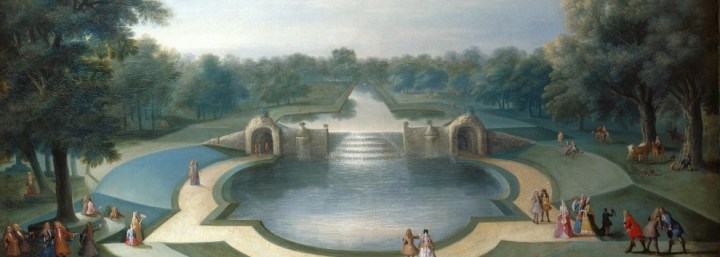
Studio of Marco Ricci, A View of the Cascade, Bushy Park Water Gardens (detail),
ca. 1715 (Royal Collection Trust)
◊ ◊ ◊ ◊ ◊
Press release (9 October 2014) from the Royal Collection Trust:
Painting Paradise: The Art of the Garden
The Queen’s Gallery, Buckingham Palace, 20 March — 11 October 2015
The Queen’s Gallery, Palace of Holyroodhouse, Edinburgh, 5 August 2016 — 26 February 2017
Curated by Vanessa Remington
Whether a sacred sanctuary, a place for scientific study, a haven for the solitary thinker or a space for pure enjoyment and delight, gardens are where mankind and nature meet. A new exhibition at The Queen’s Gallery, Buckingham Palace will explore the many ways in which the garden has been celebrated in art through over 150 paintings, drawings, books, manuscripts and decorative arts from the Royal Collection, including some of the earliest and rarest surviving records of gardens and plants. From spectacular paintings of epic royal landscapes to jewel-like manuscripts and delicate botanical studies, Painting Paradise: The Art of the Garden reveals the changing character of the garden and its enduring appeal for artists from the 16th to the early 20th century, including Leonardo da Vinci, Rembrandt van Rijn and Carl Fabergé.
The idea of an earthly paradise—an enclosed space with orchards, flowing water, shade and shelter—can be traced back to Persia in the 6th century BC. The painted miniature Seven Couples in a Garden, c.1510, from the earliest illustrated Islamic manuscript in the Royal Collection, shows a beautiful Persian garden with an octagonal pool, plane and cypress trees, and elaborately tiled pavilions laid with floral carpets.
Before the 15th century, most European images of gardens appeared in illuminated religious manuscripts. The Book of Genesis, with its references to the Tree of Life, Tree of Knowledge and Four Rivers, provided a framework for artists to create images of Eden, as in Hartmann Schedel’s woodcut of 1493. In Adam and Eve in the Garden of Eden, 1615, Jan Brueghel the Elder relegates the main protagonists and the Tree of Knowledge to the middle distance in an abundant woodland landscape rich in flora and fauna. As court painter to the Habsburg Archdukes Albert and Isabella, Breughel was able to study botanical specimens in the palace garden in Brussels.
Until the 16th century, gardens in paintings and manuscripts remained largely those of the imagination. Henry VIII’s Great Garden at Whitehall Palace, seen in the background of the painting The Family of Henry VIII, c.1545, is the first real garden recorded in British art. By the Renaissance, gardens had become status symbols to be employed in royal propaganda. The wealth of a garden’s owner could be demonstrated through elaborate horticultural features such as obelisks, pergolas, knot designs and topiary. Although in the painting Pleasure Garden with a Maze by Lodewijk Toeput (Pozzoserrato), c.1579–84, the water labyrinth is the artist’s invention, it is inspired by contemporary descriptions of 16th-century Italian formal gardens.
By the 17th century, aristocratic gardens were created on a previously unimaginable scale. The intense rivalry between the French and English kings, Louis XIV and William III, produced two of the largest and most elaborate royal gardens ever made. The exhibition includes a panoramic view by Jean-Baptiste Martin of the French king’s gardens at Versailles, c.1700, and A View of Hampton Court, by Leonard Knyff, c.1702–14, the greatest surviving Baroque painting of an English garden.
With their amphitheatres, cascades and fountains, statuary, exotic birds and aviaries, Baroque gardens offered much to engage artists. The only surviving pair of sundials by the great 17th-century horologist, Thomas Tompion, are shown in the exhibition. The fashion for parterres (ornamental flower gardens) is reflected in An Exact Prospect of Hampton Court, an etching by Sutton Nicholls, c.1700, while A View of Bushy Park Water Gardens by the studio of Marco Ricci, c.1715, shows a large cascade, a rare feature in an English landscape.
By the 18th century, gardens took on a more natural, informal style, inspired in part by the poet John Milton’s romantic description of a wild and untamed Eden in Paradise Lost, 1667. An oil painting of Kew by the Swiss artist Johan Jacob Schalch, 1759, is from a series of views of the gardens designed for Frederick, Prince of Wales by William Kent and William Chambers. The distant pagoda is the only obvious sign of human intervention among the gently sloping hills, grazing sheep and lake.
In the 19th century the garden became a symbol of wholesome and virtuous family life, and a necessary ingredient of ordered domestic harmony. In a portrait of Queen Victoria and Prince Albert by Edwin Landseer, commissioned only two months after their marriage in 1840, the royal couple are set against a view of the East Terrace garden at Windsor Castle. William Leighton Leitch’s 1855 watercolour of the Swiss Cottage, created by Prince Albert for his children in the garden of Osborne House, reflects the informal and private existence enjoyed by the family on the Isle of Wight.
The 16th and early 17th centuries saw the birth of botanical illustration, florilegia (flower books) and still-life painting. Leonardo da Vinci was the first artist to produce true botanical studies, and the exhibition includes a number of exquisite examples by the artist. The only surviving painted flower book from 17th-century England is by the English gardener and botanical artist Alexander Marshal. Produced over a period of 30 years, it includes rare specimens, such as Auriculas (Primula x pubescens), grown only in the finest gardens of the time.
Flower designs on porcelain, silver, furniture and textiles, such as the vine-covered tapestry of a pergola by Jacob Wauters, c.1650, brought the garden inside the home. In the 19th century, the ‘language of flowers’ was translated into precious luxury items, such as the brooch presented by Prince Albert to Queen Victoria in celebration of their betrothal in 1839. In the form of orange blossom, symbolising chastity, it was the first of a suite of flower jewellery given to the Queen over several years. The skill of replicating the charm and beauty of flowers in three-dimensional objects reached new heights in the workshops of Carl Fabergé, the great Russian jeweller and goldsmith. Fabergé’s Bleeding Heart, c.1900, carved in nephrite, rhodonite and quartzite, has its flowers suspended from gold stems, so that they can move gently, as if blown by the wind.
◊ ◊ ◊ ◊ ◊
Published by the Royal Collection and distributed by The University of Chicago Press:
Vanessa Remington, Painting Paradise: The Art of the Garden (London: The Royal Collection Trust, 2015), 312 pages, ISBN: 9781909741089, $75.
 The garden is of perennial interest to artists. Yet, as cultural attitudes toward the garden and how we enjoy it have changed, so too have the ways in which it has been represented in art. From a space for solitary communion with nature to the backdrop for a budding romance, and from a place for scientific study to the source of the foods we eat, Painting Paradise looks at why the garden has remained such a seductive artistic subject.
For centuries, gardens have prompted reflection on the relationship between nature and man. They have also been considered representations of the divine, as in Flemish master Jan Brueghel’s famous Adam and Eve in the Garden of Paradise. Their ability to carry messages about their creator’s status will be clear to all who have had the pleasure of walking the grounds of meticulously manicured palaces or stately homes, but they are also evocative of prevailing cultural values and a desire to better understand, classify, and collect elements of the natural world. By the sixteenth century, artists were also attempting to bring the garden indoors as a source of design elements in the decorative arts, from seventeenth-century Flemish Pergola tapestries to handcrafted flowers from the Russian House of Fabergé.
Tracing these and other themes that attracted the attention of artists from the fifteenth to the early twentieth century, Painting Paradise explores how these ideas came to be expressed in ways characteristic to a particular place and time, including works in both the Eastern and Western traditions. The curator of an accompanying exhibition opening at Buckingham Palace, Vanessa Remington has weeded through the Royal Collection to cultivate a selection of paintings, drawings, manuscripts, tapestries, and jewelry of exceptional value and extraordinary beauty. With more than three hundred color illustrations—including many treasures that have been previously unpublished—the book will be of great interest to artists, art and design historians, and all who find inspiration in the beauty of the garden.
Vanessa Remington is Senior Curator of Paintings, Royal Collection Trust, and the author of several books highlighting its collection, including Victorian Miniatures in the Collection of Her Majesty The Queen.
The Menokin Glass House: A Revolutionary Project
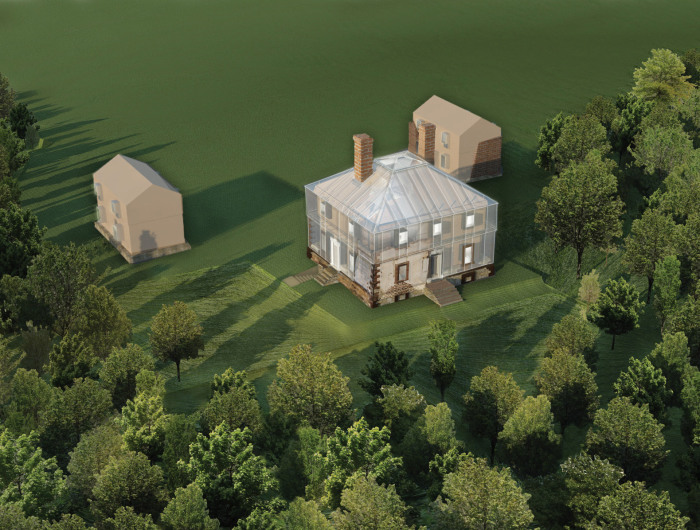
Proposed ‘Glass House’ Restoration for Menokin in Warsaw, Virginia
from the website Menokin: Rubble with a Cause
◊ ◊ ◊ ◊ ◊
From the blog of the National Trust for Historic Preservation:
Meghan O’Connor, “Eighteenth-Century House Ruin to Be Restored…With Glass,” Preservation Nation Blog (3 December 2014).
What some people see when they look at Menokin is a collapsed house, an old ruin, a testament to the perils of ignoring preservation. What the staff and Board at Menokin see, however, is a cutting-edge preservation opportunity.
The Menokin Foundation does not want to restore the house to its original condition. Instead, the Foundation believes Menokin is more valuable to the public in pieces. Menokin was home to Declaration of Independence signer, Francis Lightfoot Lee. The land was given to Lee and his wife Rebecca Tayloe by his father-in-law as a wedding gift. The house was built around 1769. . . .
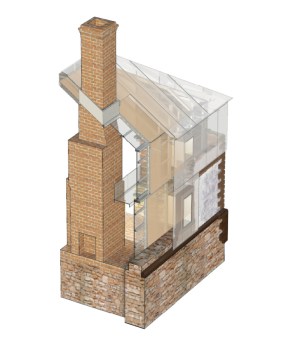
Re-imagining a Ruin: Exterior Structure Cutaway View
Dubbed the “Glass House Project,” the Foundation floated the idea around the preservation community. Pope says, “We started getting really positive responses to it. We got some raised eyebrows, believe me, but we came to [the] consensus that this was an approach worth pursuing.”
To design the Glass House Project, the Foundation hired world-renowned architecture firm Machado and Silvetti Associates in 2012. Designing projects ranging from an addition to the Bowdoin College Museum of Art to the expansion of the Getty Villa, Machado and Silvetti focus on creating contemporary and innovative designs that merge with historic contexts. . . .
The Foundation is currently developing and implementing Phase 1 of the Glass House Project — to build a glass shell around the current remaining structure.
Menokin’s innovation does not just stop at glass. The Foundation’s ultimate goal for the site is to be an internationally known learning and teaching center. In a departure from many historic house museum models, Menokin does not want to focus solely on one story or one time period. The site will not just be a colonial relic, but a place that can have modern implications for, and showcase in a revolutionary way, preservation, history, architecture, and natural resources. . .
Meghan O’Connor is the member services assistant at the National Trust. She enjoys learning, writing, and talking about museums, art, architecture, and anything historic. She worked with Menokin on the museum’s historical interpretation as part of a graduate school class.
◊ ◊ ◊ ◊ ◊
Note (added 15 December 2014) — The original version of this posting included a photo from the original concept team; the current photos comes from the Menokin blog.
Seventeenth- and Eighteenth-Century Funiture, Pegs and ’Tails
For anyone who’s ever dreamed of being able to look over the shoulder of someone who understands eighteenth-century furniture at the level of materials, design, construction, and afterlife, I’m glad to recommend Pegs and ‘Tails, the blog of Jack Plane, a retired antiques dealer and self-taught woodworker, formerly from the UK who now lives in Australia.
His reproduction pieces are fascinating, and he’s especially helpful for things at auction (the good and the bad). His blog includes a fine bibliography, and there’s a book is in the works. –CH
◊ ◊ ◊ ◊ ◊
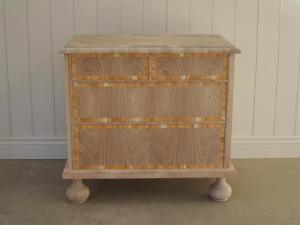
The first chest of drawers is typical of small four-drawer William and Mary chests made around 1695. The carcase is made of pine and veneered with walnut, and the drawer fronts are additionally crossbanded with yew. Jack Plane.
. . . I now believe a monograph on late seventeenth- and eighteenth-century chests of drawers would be a better introduction to those with an interest in case pieces and all manner of furniture from this period. The book’s contents may vary as I work my way through it, but the projected chapters are as follows:
• The Development of the Chest of Drawers
• A William and Mary Walnut Veneered Chest, circa 1695
• A Queen Anne Walnut Veneered Chest, circa 1705
• A George I Virginia Walnut Chest, circa 1720
• A George II Mahogany Chest, circa 1740
• A George III Mahogany Chest, circa 1765
• Reproduction finishing
◊ ◊ ◊ ◊ ◊
The blog began 14 September 2009 with this inspired posting:
It’s on a somewhat gloomy note that I begin this blog…
Q. Traditionally speaking, what are the principal differences between carpenters, joyners and cabinetmakers?
A. Nails, pegs and dovetails!
Sadly, carpenters predominantly employ air-powered ‘phittunks’ these days, joyners have largely disappeared from the vernacular and cabinetmakers assemble built-in bathroom, bedroom and kitchen units from man-made board.
Looking up ‘cabinetmakers’ in the ‘phone directory and Google reveals numerous entries for kitchen fitters and very few makers of fine furniture. It seems makers of fine furniture are now known as ‘woodworkers’—a very unhappy reflection and a far cry from the eighteenth-century heyday when cabinetmakers ranked second only to upholsterers in the furniture trades hierarchy.
This is my blog concerning pegs and dovetails.
Jack Plane.
West 86th, Fall–Winter 2014
The eighteenth century in the current issue of West 86th:
West 86th: A Journal of Decorative Arts, Design History, and Material Culture 21 (Fall–Winter 2014).
Charles Alan Watkins, “The Tea Table’s Tale: Authenticity and Colonial Williamsburg’s Early Furniture Reproduction Program,” pp. 155–91.

The CW-8 Tea Table as it appeared in Kittinger’s 1940 catalogue Colonial Williamsburg Incorporated Approved Reproductions of Furniture by Kittinger Company.
In July 1936 Tomlinson of High Point, a mid-priced North Carolina furniture manufacturer, began a franchising and marketing concept called the Williamsburg Galleries that gained broad national acceptance in stores and among consumers. Outraged by Tomlinson’s actions and unwilling to abandon the retail market to those it felt were interlopers, Colonial Williamsburg set up a subsidiary corporation, Williamsburg Craftsmen, Inc., that licensed manufacturers to create reproductions of objects owned by the Restoration. Furniture was the most important part of the plan, and Williamsburg licensed the Kittinger Company of Buffalo, New York, as the manufacturer. Selected department stores were encouraged to build sales spaces that were period replicas of Raleigh Tavern rooms, and craft shops were developed in the historic area to promote the work of the various manufacturers. Because a number of stores sold both Tomlinson and Kittinger products, Williamsburg developed the concept of ‘authenticity’ to distinguish the copies being made by Kittinger from Tomlinson’s generic eighteenth-century adaptations. Virtually handmade, said the Restoration, these Kittinger pieces were line-by-line reproductions, inside and out, of originals on display in Williamsburg, Virginia. Regardless of what Colonial Williamsburg said and believed, however, recent examination of individual pieces of Kittinger furniture made for the Restoration reveals that the New York factory relied far more on modern machine production methods than on craft methods of the eighteenth century.
Charles Alan Watkins holds a PhD in American cultural history and museum studies from the University of Delaware. Until his recent retirement from teaching, he was professor and coordinator of Salve Regina University’s Cultural and Historic Preservation Program in Newport, Rhode Island, and, prior to that, was the director of the graduate and undergraduate public history programs at Appalachian State University in Boone, North Carolina.
◊ ◊ ◊ ◊ ◊
Alain Schnapp, as translated by Martina Dervis, “The Birth of the Archaeological Vision: From Antiquaries to Archaeologists,” pp. 216–29.

Greek antiquities of Anne Claude Philippe, Comte de Caylus, Recueil d’antiquités égyptiennes, étrusques, grecques et romaines, vol. 1 (Paris: Desaint & Saillant, 1761), facing p. 85. INHA, Paris.
Focused on a series of French scholars and travelers, this article proposes that a distinct approach to history and antiquarianism developed in France during the seventeenth and eighteenth centuries emphasizing the importance of artifacts as bearers of historical evidence. Beginning with the circle around Nicolas-Claude Fabri de Peiresc, the article introduces aspects of the work of the Marquis de Nointel, Jacob Spon, Bernard de Montfaucon, Michel Fourmont, the Comte de Caylus, and the scholars who accompanied Napoleon’s expedition to Egypt in 1798. The article concludes with a discussion of Abel Blouet’s expedition to the Peloponnese (Morea) in Greece in 1829–31 that, in its scientific management of fieldwork, can be regarded as a landmark in the development of modern archaeological research.
Alain Schnapp is professor of Greek archaeology at the University of Paris 1 (Panthéon-Sorbonne). In 1999, he was the founding director of the Institut national d’histoire de l’art (INHA), the premier research center for art history in France. He has held many visiting professorships, including those at the universities of Princeton, Naples, Cambridge, and Heidelberg. The history of archaeology is one of his primary interests, on which he has published widely, including La conquête du passé: Aux origines de l’archéologie (Paris: Éditions Carré, 1993), which was translated into English as The Discovery of the Past (London: British Museum Press, 1994).










 Enfilade
leave a comment