Exhibition | Bon Boullogne
Press release for the exhibition:
Bon Boullogne (1649–1717): A Master of the Grand Siècle / Un chef d’école au Grand Siècle
Musée Magnin, Dijon, 5 December 2014 — 5 March 2015
Curated by Rémi Cariel and François Marandet
 This retrospective aims to rediscover the work of Bon Boullogne who, alongside Charles de La Fosse, Jean Jouvenet, Antoine Coypel and Louis de Boullogne, was one of the five most celebrated history painters at the end of the reign of Louis XIV. No paintings by Bon Boullogne was displayed during the exhibitions Les Peintres du Roi-Soleil (1968), Les Amours des Dieux (1990) and La Peinture française au Grand Siècle (1994). The art of Jouvenet, La Fosse and Coypel are known through many works; the Department of Prints and Drawing at the Musée du Louvre devoted an exhibition to the drawings of Louis de Boullogne in 2010. As for his brother, Bon, he has never been the subject of an in-depth investigation, undoubtedly because of the difficulty in bringing together his work. In fact, in 1745 Dézallier d’Argenville noted the multi-faceted character of Bon Boullogne’s creations. While it is true that his work tends to elude classification methods, he nevertheless adopted a relatively constant manner: after the 1690s a genuinely formal repertoire began to emerge. This has led to roughly thirty of his works being identified in French museums and private collections.
Bon Boullogne’s works are varied, in terms of both genre and technique. Sometimes he imitated the Bolognese School; sometimes he created pastiches of the lesser masters from the Dutch Golden Age. This unusual aspect will appear in the exhibition, as well as the considerable role that Boullogne played in teaching the next generation of painters. Not only did he shape the majority of French painters working at the turn of the century in his studio, but by increasing the numbers of mythological subjects populated with nudes, Boullogne established the artistic taste that would dominate the first half of the 18th century. This exhibition will enhance our perception of history of art, in whose name a break is said to have taken place from the time of the French Regency period. As the paintings of Bon Boullogne show, this transformation was already under way in the 1690s.
Organised by the Réunion des Musées Nationaux—Grand Palais and the Musée Magnin
Curators
Rémi Cariel, chief curator, director of the Musée Magnin; François Marandet, art historian, Bon Boullogne expert
The Burlington Magazine, December 2014
The eighteenth century in The Burlington:
The Burlington Magazine 156 (December 2014)
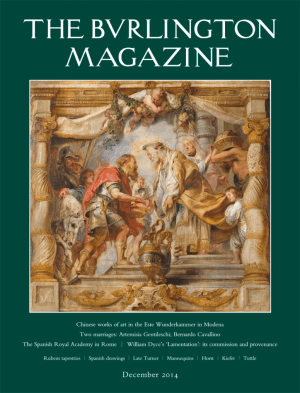 A R T I C L E S
• Pilar Dies del Corral, “The Beginnings of the Real Academia de España in Rome: Felipe de Castro and Other Eighteenth-Century Pioneers,” pp. 805–10.
R E V I E W S
• Marjorie Trusted, Review of David Bindman, Warm Flesh, Cold Marble: Canova, Thorvaldsen and their Critics (Yale University Press, 2014), pp. 824–25.
• Todd Longstaffe-Gowan, Review of Beth Fowkes Tobin, The Duchess’s Shells: Natural History Collecting in the Age of Cooke’s Voyages (The Paul Mellon Centre for Studies in British Art, 2013), pp. 827–28.
• James Ayres, Review of the exhibition Silent Partners: Artist and Mannequin from Function to Fetish (The Fitzwilliam Museum, Cambridge, 14 October 2014 — 25 January 2015; and Musée Bourdelle, Paris, 31 March — 12 July 2015), pp. 840–41.
• Xavier F. Salomon, Review of three Veronese exhibitions in the Veneto, including Veronese Inciso: Stampe da Veronese dal XVI al XIX Secolo (Museo della Stampa Remondini, Bassano del Grappa,14 September 2014 — 19 January 2015), pp. 842–43.
Exhibition | Prints after Veronese
From the Remondini Museum in Bassano:
Veronese Inciso: Stampe da Veronese dal XVI al XIX Secolo
Museo della Stampa Remondini, Bassano del Grappa, 14 September 2014 — 19 January 2015
Curated by Giuliana Ericani
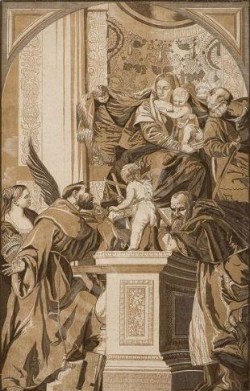 Si inserisce nell’itinerario Scopri il Veneto di Paolo Veronese con altre 5 mostre e 32 siti intitolati al grande artista del Cinquecento Veneto la mostra che i Musei civici di Bassano del Grappa dedicheranno a settembre alla fortuna di Veronese nella stampa “di traduzione.” Sarà così segnalata con larga evidenza l’enorme fama dell’artista e le capacità tecniche degli incisori di rendere con i tratti segnati sulla lastra la felicità e l’esuberanza del colore del Caliari.
La scelta di 58 fogli consente di riconoscere quasi tutti i capolavori del grande artista, alcuni irrimediabilmente perduti, opere riprodotte tra acqueforti e xilografie, tra la fine del Cinquecento fino a tutto il Settecento, a partire dalle acqueforti contemporanee di Agostino Carracci. Un paio di secoli più tardi, in pieno Neoclassicismo, la produzione più corrente dei Remondini non esita a tradurre nei segni fortemente inchiostrati la magniloquenza del disegno più che la felicità del colore, documentando per il mercato un artista la cui fama, complici il barocco e Tiepolo, non aveva mai visto flessioni.
Nella seconda metà del Settecento Giuseppe Remondini raccoglie una consistente collezione di incisioni a paragone, modello e supporto tecnico della produzione calcografica e tipografica della più grande stamperia dell’epoca, prima in Europa—è l’Encyclopédie a ricordarlo—per numero di addetti e quantità della produzione. Tale fondo, donato nel 1847 alla città dall’ultimo erede, Giambattista, è il nucleo fondante per il più recente tra gli antichi musei bassanesi—premio ICOM 2010—prezioso giacimento di questa e delle altre mostre che il Museo della stampa Remondini va via via proponendo dal 2007.
Posto d’onore in mostra per i legni xilografici incisi, con tecnica da lui inventata, dall’inglese John Baptist Jackson, tutti ceduti a Giuseppe Remondini, che saranno esposti assieme ad una selezione dei fogli da lui eseguiti sulle opere di Veronese. Una chicca che, in mezzo a stampe multiple, da sola vale il viaggio a Bassano, per gli addetti ai lavori e per chi vuole capire come le immagini si propaghino grazie alla forza espressiva delle immagini stesse.
Giuliana Ericani, ed., Veronese Inciso: Stampe da Veronese dal XVI al XIX Secolo (Naples: Arti Grafiche Zaccaria, 2014), 90 pages, ISBN: 978-8885821446, €10.
Writing for The Burlington 156 (December 2014), Xavier Salomon judges the catalogue “an essential contribution to the subject and complements Paolo Ticozzi’s catalogue of 1977” (p. 843).
Exhibitions Mark the 250th Birthday of the Hermitage

The river-god Ilissos. Marble statue from the West pediment of the Parthenon, Athens, Greece, 438–32 BCE (British Museum 1816,0610.99). Photo by Marie-Lan Nguyen, 2007, Wikimedia Commons.
◊ ◊ ◊ ◊ ◊
Founded by Catherine the Great in 1764, the Hermitage Museum celebrates its 250th anniversary this year (though it opened to the public only in 1852). In connection with events marking the occasion, The British Museum has loaned the marble Ilissos from the Parthenon—the first time a portion of the Elgin Collection has ever been loaned. The work will will be on display from 6 December until 18 January. The press release stresses the Enlightenment origins of both museums:
The British Museum opened its doors in 1759, just five years before the Hermitage. Sisters, almost twins, they are the first great museums of the European Enlightenment. But they were never just about Europe. The Trustees of the British Museum were set up by Parliament to hold their collection to benefit not only the citizens of Great Britain, but ‘all studious and curious persons’ everywhere. The Museum today is the most generous lender in the world, sending great Assyrian objects to China, Egyptian objects to India and Iranian objects to the United States—making a reality of the Enlightenment ideal that the greatest things in the world should be seen and studied, shared and enjoyed by as many people in as many countries as possible. . .
Noted (added 6 December 2014) — The AFP (Agence France-Presse) reports on Greek dissatisfaction with the loan, quoting a statement from Prime Minister Antonis Samaras: “The British Museum’s decision constitutes an affront to the Greek people.” The full article is available art Art Daily.

St Andrew Service, Germany, Meissen Manufactory, porcelain with overglaze painting, gilding, 1744–45 (The Hermitage State Museum)
◊ ◊ ◊ ◊ ◊
Also on view is this exhibition:
Gifts from East and West to the Imperial Court over 300 Years
State Hermitage Museum, St Petersburg, 3 December 2014 — 8 March 2015
The gifts from Eastern and Western countries presented at the exhibition in the General Staff Building reflect the history of Russia’s relations with the West and the East from 18th century till the fall of the Russian Empire.
The tradition of giving the diplomatic gifts had existed for centuries. They commemorated military victories, conclusions of peace, events important for the court and official visits. Presented to the Imperial court precious metal works, porcelain, arms, coins, tapestries, books, exotic objects, works of fine art are records of the history of Russia.
Exhibition | Remembering Radcliffe
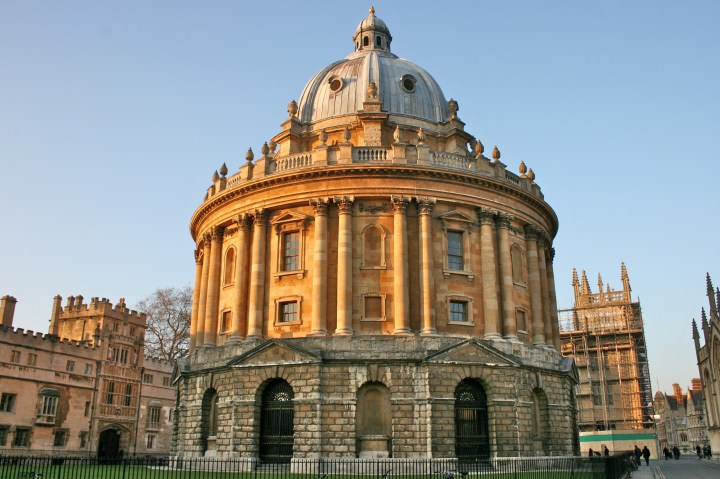
James Gibbs, Radcliffe Camera, Oxford, 1735–49
(Photo: Mike Peel, December 2007, Wikimedia Commons)
◊ ◊ ◊ ◊ ◊
From the Bodleian:
Remembering Radcliffe: 300 Years of Science and Philanthropy
Bodleian Library, Oxford, 28 November 2014 — 20 March 2015
Curated by Stephen Hebron
A new exhibition at the Bodleian Libraries explores the life and legacy of John Radcliffe, the doctor and philanthropist who gave Oxford some of its most iconic buildings. Remembering Radcliffe: 300 Years of Science and Philanthropy opens on 28 November and marks the 300th anniversary of the physician’s death.
 John Radcliffe (bap. 1650–1714) was the most successful doctor of his day and was sought after as a physician to the royal family. On his death he left the bulk of his fortune to charitable causes. With beautiful engravings, watercolours, and architectural drawings, the Bodleian’s free exhibition tells the story of the Oxford landmarks funded by Radcliffe’s legacy: the Radcliffe Camera (the first circular library in Britain), the Radcliffe Observatory, and the Radcliffe Infirmary (the precursor of the modern John Radcliffe Hospital). The exhibition also looks at Radcliffe’s ongoing legacy in the work of The Radcliffe Trust.
“This is a wonderful opportunity for people to learn more about this remarkable physician and philanthropist,” said Richard Ovenden, Bodley’s Librarian. “John Radcliffe’s legacy lives on today—not only in Oxford’s stunning buildings but through his legacy’s investment in scientific research and its support for UK heritage and crafts, and classical music performance and composition through The Radcliffe Trust.”
Exhibition Highlights
• Architectural designs by Nicholas Hawksmoor and James Gibbs for Dr Radcliffe’s Library, which later became the Radcliffe Camera, part of the Bodleian Library
• A 3D scale model of the Radcliffe Camera from 1735
• Rare and first edition books from the first collection of books housed in the Radcliffe Camera
• Early photographs and maps of Oxford including the buildings that bear Radcliffe’s name
• Watercolours, sketches, and engravings of the Radcliffe Camera, Radcliffe Observatory, and Radcliffe Infirmary
• Medical instruments, prescriptions, and records from Radcliffe’s medical career
• Letters, diary entries, and other materials related to Radcliffe’s life and death
• Silverware, stone carvings, and basket weavings produced by contemporary artists supported by The Radcliffe Trust
“The exhibition explains how an 18th-century doctor became one of Oxford’s greatest benefactors,” said curator Stephen Hebron. “Visitors can discover the story behind one of Oxford’s most famous buildings, the Radcliffe Camera, including its origins, its design, how it was built, and its role as a university library.”
On his death in 1714 Radcliffe left the bulk of this fortune to the University of Oxford, including £40,000 for the construction of the Radcliffe Camera, funds for an extension to University College and provision for two travelling fellowships in medicine. He stipulated that the residue of his estate be used for charitable purposes, forming the basis of The Radcliffe Trust. The Trust continues to this day and supports classical music performance and training as well as the UK’s heritage and crafts sector. To celebrate their tercentenary, The Radcliffe Trust has generously supported the Bodleian Libraries’ Remembering Radcliffe exhibition.
“If the amazing Dr Radcliffe had done no more than create the Radcliffe Camera as a monument to his memory this would have been an extraordinary achievement,” said Felix Warnock, Chairman of The Radcliffe Trust. “As it is, his endowment of The Radcliffe Trust was if anything even more visionary: the Trust, one of the very first grant-making charities, now stands on the threshold of a remarkable fourth century of philanthropic giving. We welcome you to the exhibition and accompanying events and hope you leave enriched and inspired by this truly original and remarkable benefactor.”
◊ ◊ ◊ ◊ ◊
Distributed by The University of Chicago Press:
Stephen Hebron, Dr Radcliffe’s Library: The Story of the Radcliffe Camera in Oxford (Oxford: Bodleian Library, 2015), 104 pages, ISBN: 978-1851244294, $25.
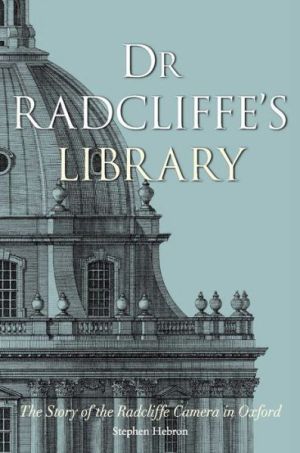 The Radcliffe Camera is one of the most celebrated buildings in Britain. Named for the physician John Radcliffe—who directed a large part of his fortune to its realization at the heart of the University of Oxford in the early eighteenth century—the circular library is instantly recognizable, its great dome rising amidst the Gothic spires of the university. Drawing on maps, plans, photographs, and drawings, Dr Radcliffe’s Library tells the fascinating story of the building’s creation over more than thirty years. Early designs for the Radcliffe Camera were drawn by the brilliant architect Nicholas Hawksmoor, who conceived the shape so recognizable today: a great rotunda topped by the University of Oxford’s only dome. From there, it would take decades to acquire and clear the site between the University Church of St Mary’s and the Bodleian. After Hawksmoor’s death, the project was taken on by the Scottish architect James Gibbs who refined the design and supervised the library’s construction. Published to accompany an exhibition opening in November at the Bodleian Library, Dr Radcliffe’s Library tells the fascinating story of the making of this architectural masterpiece.
Stephen Hebron is a curator working in the Department of Special Collections at the Bodleian Libraries. He is the author, most recently, of Marks of Genius: Masterpieces from the Collections of the Bodleian Libraries.
New Book | British Romanticism and Italian Old Masters
From Ashgate:
Maureen McCue, British Romanticism and the Reception of Italian Old Master Art, 1793–1840 (Ashgate, 2014), 204 pages, ISBN: 978-1409468325, $110.
 As a result of Napoleon’s campaigns in Italy, Old Master art flooded into Britain and its acquisition became an index of national prestige. Maureen McCue argues that their responses to these works informed the writing of Romantic period authors, enabling them to forge often surprising connections between Italian art, the imagination and the period’s political, social and commercial realities. Maureen McCue examines poetry, plays, novels, travel writing, exhibition catalogues, early guidebooks and private experiences recorded in letters and diaries by canonical and noncanonical authors, including Felicia Hemans, William Buchanan, Henry Sass, Pierce Egan, William Hazlitt, Percy Shelley, Lord Byron, Anna Jameson, Maria Graham Callcott and Samuel Rogers. Her exploration of the idea of connoisseurship shows the ways in which a knowledge of Italian art became a key marker of cultural standing that was no longer limited to artists and aristocrats, while her chapter on the literary production of post-Waterloo Britain traces the development of a critical vocabulary equally applicable to the visual arts and literature. In offering cultural, historical and literary readings of the responses to Italian art by early nineteenth-century writers, McCue illuminates the important role they played in shaping the themes that are central to our understanding of Romanticism.
Maureen McCue is a Lecturer in English Literature at Bangor University.
◊ ◊ ◊ ◊ ◊
C O N T E N T S
Introduction
1. Attempting ‘To Engraft Italian Art on English Nature’
2. Connoisseurship
3. Making Literature
4. Samuel Rogers’s Italy
Conclusion
Bibliography
Index
Call for Panels and Papers | Fashion
From the conference website:
Fashion, the 84th Anglo-American Conference of Historians
Senate House, London, 2–3 July 2015
Proposals due by 15 December 2014
In a major collaboration with the Victoria and Albert Museum, the IHR is taking Fashion as the theme for its annual conference in summer 2015. Fashion in history is a topic which has come of age in recent years, as scholars have turned to addressing what is chic and what is style over the ages and across different cultures. The history of fashion, and the role of fashion in history, is not just confined to the study of dress and costume, but encompasses design and innovation, taste and zeitgeist, treats as its subjects both people and objects, and crosses over into related disciplines such as the history of art and architecture, consumption, retailing and technology. And across the world, fashion brings together museums, graduate teaching programmes, learned societies and the fashion profession around a common set of interests and concerns. The IHR conference next year we hope will be a perfect showcase and a meeting-point for the wide spectrum of specialists in this exciting field.
Our plenary speakers include Christopher Breward (Edinburgh), Beverly Lemire (Alberta), Ulinka Rublack (Cambridge) and Valerie Steele (Fashion Institute of Technology, New York). Proposals for panels on the themes of dress, imitation and emulation, taste and style, body-art, the fashion-industry and its media, fashionability and trend-setting, catwalks, fairs and exhibitions, innovation in interior design, architecture and public space, fashion education and technology will be accepted down to the middle of December. Individual paper proposals will also be accepted. Panels should comprise three papers and a chair, and proposals must include the name and affiliation of the speakers, the title of the panel and the titles of the individual papers. Please send proposals by 15th December toIHR.Events@sas.ac.uk Decisions will be made known once the Programme Committee has met in early January 2015.
Conference | The Legacy of Carlo Fontana
As posted at H-ArtHist:
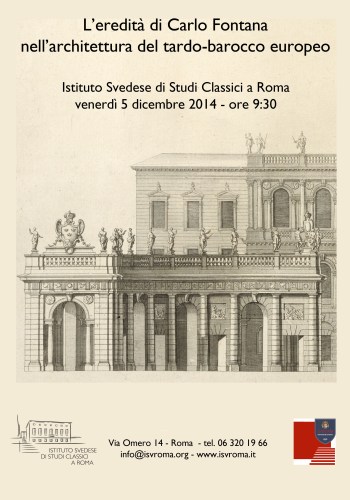
L’eredità di Carlo Fontana nell’architettura del tardo-barocco europeo
Istituto Svedese di Studi Classici, Rome, 5 December 2014
Convegno organizzato da: Istituto Svedese di Studi Classici, Roma -Svenska Institutet i Rom.
Con la collaborazione di: Università degli Studi di Camerino; Dipartimento di Ingegneria dell’Impresa, Università di Roma “Tor Vergata”
 9:30 I sessione | La famiglia Fontana e l’Europa
Coordina Elisabeth Kieven (Bibliotheca Hertziana)
• Giuseppe Bonaccorso (Università degli Studi di Camerino), I Fontana dopo Fontana. L’epilogo di una dinastia familiare: da Mauro Fontana ai numerosi “nipoti” in Europa
• Antonio Russo (La Sapienza, Università di Roma), Architettura e scenografia negli altari a tabernacolo di Carlo Fontana: persistenze, innovazione e fortuna
• Jasenka Gudelj (Università di Zagabria), Carlo Fontana e l’Adriatico orientale: il caso di Dubrovnik
• Andrzej Betlej (Jagiellonian University, Kraków), The Current State of Research on the Influence of Carlo Fontana and His Pupils on Art in the Polish-Lithuanian Commonwealth
• Francesco Amendolagine, Abdul Kader Moussalli (Università degli studi di Udine), La famiglia Fontana all’estero: architetture e decorazione in terra polacca
14:00 II sessione | Cultura e professione architettonica nel Settecento europeo
Coordina Aloisio Antinori (Università degli Studi del Molise)
• Martin Olin (Istituto Svedese di Studi Classici), Architectural Culture in Northern Europe During the Eighteenth Century
• Aloisio Antinori (Università degli Studi del Molise), Circolazione e uso delle stampe romane di architettura al tempo di Carlo Fontana e durante il XVIII secolo
• Mauro Volpiano (Politecnico di Torino), Formazione e aggiornamento degli architetti sabaudi a Roma tra Seicento e primo Settecento
• Simonetta Ciranna (Università degli Studi dell’Aquila), L’eredità di Carlo Fontana nella formazione dell’architetto-ingegnere di fine Settecento. Disegno e geometria nel lavoro di un professionista
integrale
18th- and 19th-Century American Galleries Reopen at Delaware
Press release (24 November 2014) from the Delaware Art Museum:

Raphaelle Peale, Portrait of the Reverend Absalom Jones, 1810 (Delaware Art Museum, Gift of Absalom Jones School)
The Delaware Art Museum is pleased to unveil its renovated and reinstalled 18th- and 19th-century American Art galleries—Galleries 1, 2, and 3—to the public on Friday, November 28. Just in time for the holiday season, the beautifully redesigned space will display over 50 works of art, including many permanent collection objects that have not been on view for over 10 years. As part of this reinstallation, the galleries will highlight 150 years of portraiture, sculpture, landscape painting, still life, and history painting.
“I am excited to be able to present our regional history within the context of the dynamic national art scene,” explains Heather Campbell Coyle, Curator of American Art at the Delaware Art Museum. “The product of more than two years of research and planning, the redesigned space gives us the opportunity to showcase the Museum’s outstanding collection of American art to the local community, visitors, and school groups in new and exciting ways.”
The first gallery presents portraits that span 1757 through 1856, featuring familiar favorites by Benjamin West (1738–1820), Thomas Sully (1783–1872), and Raphaelle Peale (1774–1825). Two images of Delawarean women, five-year-old Anna Walraven (1846–1927) and Sally Ann Ross Paynter (1812– 1866), will also be on view. These portraits, all produced within a 50-mile radius of the Delaware Art Museum, reflect the aspirations and accomplishments of local families.
The second gallery introduces landscape painting, which became very popular during the mid-1800. The loan of Michele Felice Cornè’s romantic overmantel painting (circa 1800), which hung in the main house at Mount Cuba Center in recent decades, provides a prelude to the meticulous landscape paintings of the Hudson River School. These evocative landscapes are joined by history paintings, sculptures, and a luscious still life by Severin Roesen (1815–1872).
In the third gallery, the story of landscape painting continues with works by George Inness (1825–1894) and John Twachtman (1853–1902), which now hang near an early painting by Robert Henri (1865–1929) and a pair of etchings by Thomas Moran (1837–1926) and local printmaker Robert Shaw (1859–1912). One wall has been hung salon-style, creating an interesting juxtaposition of 16 works of art from the Museum’s 12,500-object permanent collection and select loans.
In November 2013, the Museum underwent a major renovation and reinstallation of its gallery dedicated to contemporary American art, which nearly doubled the amount of objects on view from the permanent collection. The reinterpretation of the permanent collection galleries allows the Museum to find new ways to present its history and material culture to visitors of all ages.
About the portrait of Absalom Jones:
The Reverend Absalom Jones was the prominent minister of St. Thomas African Episcopal Church in Philadelphia. Born a slave in Sussex, Delaware, Jones eventually won his freedom, became a founding member of the Free African Society, was ordained the first African American minister of the Episcopal denomination, and helped to organize a school for African American children. His church congregation may have commissioned this painting from noted Philadelphia painter Raphaelle Peale.
Cooper Hewitt to Reopen on December 12th

With the newly renovated Cooper Hewitt opening December 12th, you’ll have to visit the museum’s website to make sense of it all, everything from a specially commissioned typeface (Cooper Hewitt, which you can download for free here) to an interactive pen. I’ve noted one exhibition below, but presumably there are lots of eighteenth-century attractions. –CH
From Cooper Hewitt:
 Caroline Baumann, director of Cooper Hewitt, Smithsonian Design Museum (formerly Cooper-Hewitt, National Design Museum), has announced plans for the opening of the renovated and restored Carnegie Mansion and the 10 exhibitions that will inaugurate the revamped and expanded gallery spaces. The nation’s only museum devoted exclusively to historic and contemporary design, Cooper Hewitt will open its doors to the public on Friday, December 12. The museum will boast 60 percent more gallery space to present its important collection and temporary exhibitions and will offer an entirely new and invigorated visitor experience, with interactive, immersive creative technologies.
Cooper Hewitt’s renovation provides the opportunity to redefine today’s museum experience and inspire each visitor to play designer before, during and after their visit. Visitors will explore the museum’s collections and exhibitions using groundbreaking technologies that inspire learning and experimentation. This new participatory experience is specifically designed to engage all audiences—students, teachers, families, young children, designers and the general public.
All visitors will be given a newly developed interactive Pen to collect and create. They will be able to digitally collect design objects on view, as well as additional objects from the ultra-high-definition interactive tables. Visitors will become designers in their own right by creating their own designs with the Pen. Symbolizing and embodying human creativity, the Pen is a key part of every visitor’s experience. With it, they will be able to record their visit, which can be viewed and shared online and supplemented during future visits. . .
The largest initiative in Cooper Hewitt’s history, the renovation and expansion of the entire campus on New York’s Museum Mile—the Carnegie Mansion, Arthur Ross Terrace and Garden and the museum’s two townhouses on East 90th Street—have been achieved through a successful $91 million capital and endowment campaign.
“With four floors of exhibition galleries that can now stay open 12 months of the year, free garden access, extended garden and café hours, an inviting new street entrance and the digitization of our collections, Cooper Hewitt will reach a broader audience and be more accessible than ever before,” said Baumann. “We have created a 21st-century museum that will bring our collections to life and make design even more relevant and exciting to today’s audiences, while continuing to respect the history of this museum and the integrity of the much-treasured Carnegie Mansion.”
In addition to Cooper Hewitt’s physical transformation, the museum now has a new name, graphic identity, website and custom typeface. Formally the “Cooper-Hewitt, National Design Museum,” the museum has been renamed “Cooper Hewitt, Smithsonian Design Museum,” emphasizing the museum’s heritage. The museum has taken on a bold new graphic identity designed by Pentagram and the typeface “Cooper Hewitt” designed by Chester Jenkins of Village [available for free download here; see Michael Silverberg’s discussion here] . . . .
◊ ◊ ◊ ◊ ◊
About The Models & Prototypes Gallery:

Staircase model, France, late 18th century; Joined, bent and carved pear, wrought brass wire; 75 x 67.3 x 67 cm (NY: Cooper Hewitt, Smithsonian Design Museum; photo by James Hart)
This new second-floor gallery will be home to rotating installations showcasing the important role of design models and prototypes. For the opening installation, the gallery will present the exceptional 18th- and 19th-century models of staircases and some significant architectural models donated to Cooper Hewitt by Eugene V. and Clare E. Thaw (16 models altogether with four accompanying drawings).
The models represent a range of design styles and techniques, but most of the staircase models were designed in the compagnonnage tradition. Compagnonnage, meaning ‘group of companions’, is a type of design practice that combined formal study with practical training from masters. Apprentices honed their skills in a workshop during the day, taking courses in the art of geometrical drawing and design in the evening, living together in a boarding house. First, concepts were taught, then the handiwork, both of which became increasingly sophisticated. Each successful member made a ‘tour de France’, working and studying under masters in major cities. At each stage of the learning process (acceptance, reception, mastership), apprentices created models, leading them to become masters of their craft and design. Most of the staircase models produced in this tradition were made by masters of woodworking—joiners, cabinetmakers, and/or carpenters.










 Enfilade
leave a comment