Study Course | Drawings in Theory and Practice
From ArtHist.net:
Drawings in Theory and Practice: Connoisseurship – Collecting – Curatorial Practice
Albertina, Vienna, 28 July — 1 August 2025
Applications due by 6 June 2025
We are pleased to announce the Albertina’s 7th annual study course on drawings. The course is designed for doctoral students and early post-doc-researchers who are working in the field of drawings and prints and are interested in exploring curatorial practices. The course offers the opportunity to discuss current research on the graphic arts and, at the same time, to gain insight into one of the most renowned collections of prints and drawings. The course is organized jointly by the Institute of Art History at the University of Vienna and the Albertina and is generously supported by the Wolfgang Ratjen Foundation.
Participants are expected to present aspects of their current research in a 30-minute paper. Together we will discuss relevant drawings in the Albertina and gain insight into different curatorial practices: conception and planning of exhibitions, publication of catalogues, conservation and marketing, collecting and provenance research. Accommodation in Vienna will be covered as well as documented travel costs (economy flight, 2nd class train ticket) up to 350 Euros. The general course language is English, while individual papers can be presented in German, Italian, and French. The course is directed by Univ.-Prof. Dr. Sebastian Schütze and Dr. Christof Metzger.
Applications—including a cv, short description of the drawing or print related research project, and a reference letter from a university professor—should be sent by 6 June 2025 to Dr. Silvia Tammaro, silvia.tammaro@univie.ac.at. Applicants will be notified by 15 June 2025.
Conference | Publics of the First Public Museums: Visual Sources
From ArtHist.net:
Publics of the First Public Museums, 18th and 19th Centuries: Visual Sources
Online and in-person, Museo Nacional del Prado, Madrid, 5–6 June 2025
Organized by Carla Mazzarelli and David García Cueto
The conference Publics of the First Public Museums, 18th and 19th Centuries: Visual Sources is an integral part of the research project Visibility Reclaimed: Experiencing Rome’s First Public Museums (1733–1870), An Analysis of Public Audiences in a Transnational Perspective (FNS 100016_212922) directed by Carla Mazzarelli. Marking the third of three encounters (following I. Institutional Sources and II. Literary Discourses), this workshop delves into the examination of visual sources, vital to understanding the forms of representation of early museums and their publics. We intend to investigate a vast range of visual sources, from views of internal and external spaces to architectural and display projects, from caricatures to illustrations published in catalogues, guidebooks, voyages pittoresques up to the (self)representation of publics, museum staff (directors, custodians, ciceroni), and artists within the museum.
Visual sources have long represented a privileged source for investigating the origins of the first public museums and the impact on their publics. However, in the light of recent studies aimed at deepening the material history of the museum and the encounter of the public with the institutions, these sources deserve a closer scrutiny in both methodological and critical terms. As museums sought to define and engage their publics, visual sources often became both a mirror and a mould; they reflect and shape institutional and societal perceptions, contributing to build up the idea of museum but also to give a depiction of practices of access to public and private collections in Europe and in the World. The Museo Nacional del Prado welcomes this initiative as it has been involved since its foundation in 1819 in the process that the conference analyzes. The well known paintings that represent the spaces of Museo Nacional del Prado, since its opening, such as those of Fernando Brambilla, are an important starting and comparison point for the theme at the center of the conference discussion. On the other hand, paintings depicting ‘quadrerie’ have been a codified genre at least since the 17th century. Such artworks have also been read as sources for the study of the evolution of the display during the early modern age, but they also represent reference models for artists on how to represent the interiors of museum spaces, their publics and staff.
Direction
Carla Mazzarelli (Università della Svizzera italiana, Accademia di Architettura, Istituto di storia e teoria dell’arte e dell’architettura)
David García Cueto (Madrid, Museo Nacional del Prado)
It is possible to attend the sessions until all seats are filled or to follow the congress on line through the link to the Zoom platform that will be provided for all those enrolled. When enrolling you must choose a type of attendance.
Contact
visibilityreclaimed@gmail.com
congreso.visibily@museodelprado.es
t h u r s d a y , 5 j u n e
10.15 Registration
10.45 Welcoming Remarks — Alfonso Palacio (Director Adjunto de Conservación e Investigación del Museo del Prado)
11.00 Session 1 | Museums and Audiences in Image: Frameworks and Methodologies
Chair: David García Cueto (Museo Nacional del Prado)
• Carla Mazzarelli (Università della Svizzera italiana) — Alle origini del pubblico “esposto”. Proposte di lettura e confronto delle fonti visive
• Daniela Mondini (Università della Svizzera italiana) — Visiting Sacred Spaces as ‘Museums’
• Luise Reitstätter (Universität Wien) — Museums Ego Documents as Visual Source: Imaging First Publics within Founding Missions
• Javier Arnaldo Alcubilla (Museo Nacional del Prado) — La bohemia en el Prado: entre fuentes visuales y literarias
12.45 Keynote Address
• Sebastian Schütze (Universität Wien) — Going Public: The Gallery Picture and its Agencies
13.30 Lunch Break
14.45 Panel 2 | Mirroring Museums: The Public in Photographic Archives and Digital Atlases
Chair: Daniela Mondini (Università della Svizzera italiana)
• Beatriz Sánchez Torija (Museo Nacional del Prado) — El Museo del Prado y el uso de la fotografía como enlace con el público en la segunda mitad del siglo XIX
• Irina Emelianova (Università della Svizzera italiana) — European Art Museums and Their Audiences through the Photographic Collection of the Academy of Fine Arts in St. Petersburg: Between the End of the 19th Century and the Beginning of the 20th Century
• Paola D’Alconzo (Università degli studi di Napoli Federico II), Donata Levi (Università degli studi di Udine), Martina Lerda (Università di Pisa) — Dall’Atlante digitale dei musei italiani (DAIM): Immagini del pubblico, immagini per il pubblico
16.15 Coffee Break
16.30 Panel 3 | Museums in Sight: Visual Records of Visit and Display
Chair: Christoph Frank (Università della Svizzera italiana)
• Barbara Lasic (Sotheby’s Institute of Art) — Visualising Museal Trajectories at the Garde-Meuble de la Couronne
• Luca Piccoli (Università della Svizzera italiana) — ‘The colours of them so chosen to carry the eye forward’: alle origini dell’esperienza di visita del Museo Pio Clementino tra rappresentazione e realtà (1770–1796)
• Julia Faiers (Independent Scholar) — Experiencing Medieval Art at Toulouse’s First Public Museums
17.50 Break
18.00 Keynote Address
Andrew McClellan (Tufts University) — Towards a Machine for Looking: Science, Psychology, and Visitor Experience at the Museum of Fine Arts, Boston, 1900
f r i d a y , 6 j u n e
10.00 Panel 4 | Strategies of Self-Presentation: Museums between Politics and Cultural Stereotypes
Chair: Chiara Piva (Sapienza Università di Roma)
• Benjamin Carcaud (École du Louvre / Ministère de la Culture) — Quelle image du visiteur les artistes ont-ils construite dans leurs œuvres? Les stéréotypes du visiteur de musée dans les salles du Louvre
• Adrián Fernández Almoguera (Universidad Nacional de Educación a Distancia, Madrid) — ¿Imágenes como estrategia? A propósito del Musée des Antiques en la cultura visual del Louvre imperial
• Cynthia Prieur (University of Victoria, British Columbia) — Shaping the Image of the Louvre Museum: Maria Cosway’s Prints of the Exhibitions of Looted Art
11.20 Coffee Break
11.35 Panel 5 | The Critical Eye: Museums and Publics Between Promotion and Satire
Chair: Stefano Cracolici (Durham University)
• Grégoire Extermann (Université de Genève) — Un caricaturista en París: el ginebrino Wolfgang Adam Töppfer y el público del Louvre imperial
• Ludovica Scalzo (Università Roma Tre) — Il pubblico dei musei nei primi periodici illustrati europei (1830–1850)
• Gaetano Cascino (Università della Svizzera italiana) — I musei di Roma e i loro visitatori in satira nella pubblicistica dopo l’Unità
13.00 Lunch Break
14.00 Panel 6 | The Public Image of the Private Museum
Chair: Carlos G. Navarro (Museo Nacional del Prado)
• Federica Giacomini (Istituto Centrale per il Restauro, Roma) — La Galleria Borghese in un’illustrazione de ‘Le Magasin Pittoresque’: per un’indagine del pubblico nell’Ottocento
• Kamila Kludwiecz (Adam Mickiewicz University, Poznań) Aldona Tolysz (the Office of the Provincial Conservator of Monuments in Warsaw) — Between Documentation and Self-Creation: The Role of Illustration in the Activities of Polish Private Museums in the 19th Century
15.00 Panel 7 | From National to Global Image: The Identity of the Museum and Its Audiences
Chair: Giovanna Capitelli (Università Roma Tre)
• Susanne Anderson-Riedel (University of New Mexico) Caecilie Weissert (Universität Kiel) Joelle Raineau-Lehuédé (Petit Palais) — A Global Public for France’s National Museum
• Elizaveta Antashyan (Sapienza Università di Roma) — Visibility Granted: The Hermitage Museum in the 19th Century and Its Representation in Contemporary Imagery
• Raffaella Fontanarossa (Indipendent Scholar) — Le muse in Oriente. I primi visitatori dei musei in Cina e Giappone attraverso le fonti visive
• Jonatan Jair López Muñoz (Univesidad Complutense de Madrid) — La imagen omnipresente. La representación regia en los museos nacionales del siglo XIX en España e Italia
16.45 Coffee Break
17.00 Panel 8 | A Museum for All? The Variety of Audiences on Display
Chair: Daniel Crespo Delgado (Universidad Complutense de Madrid)
• Gemma Cobo (Universidad Nacional de Educación a Distancia, Madrid) — La mirada de la infancia: Nuevos museos y educación artística en la Europa de entresiglos, 1750–1850
• Anna Frasca-Rath (Friedrich-Alexander University) — Through the Eye of a Child? Visual Sources of/for Museum Publics in 19th-Century Vienna
• Marie Barras (Université de Genève) — See and Be Seen: Museums and Art Exhibitions as Fashion Stages, 1870–1900
18.20 Concluding Remarks by Carla Mazzarelli
The Sainsbury Wing of London’s National Gallery Reopens
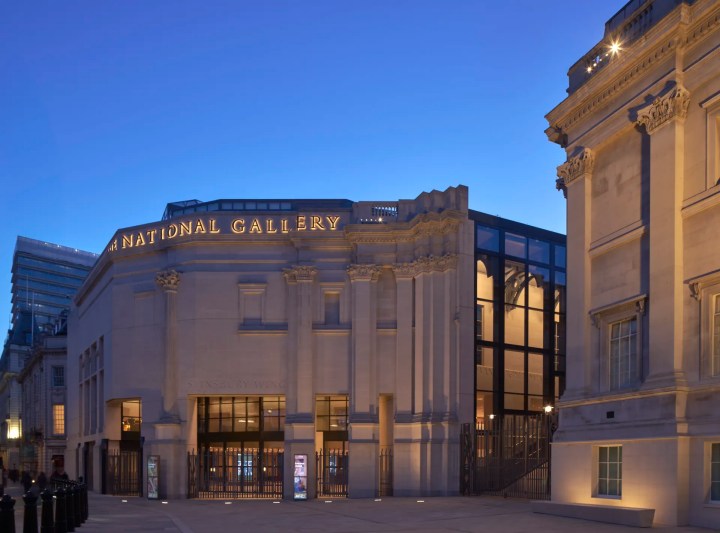
View of the National Gallery Sainsbury Wing from Trafalgar Square. After contentious early designs were scuttled in the 1980s, the Sainsbury Wing, as conceived by Robert Venturi and Denise Scott Brown, opened in 1991. The latest revisioning, an £85m project, was led by Annabelle Selldorf. (Photo by Edmund Sumner, ©The National Gallery, London).
◊ ◊ ◊ ◊ ◊
From the press release (9 May 2025) . . .
The National Gallery’s new main entrance reopened to the public on Saturday 10 May 2025, as part of the Gallery’s 200th birthday celebrations.
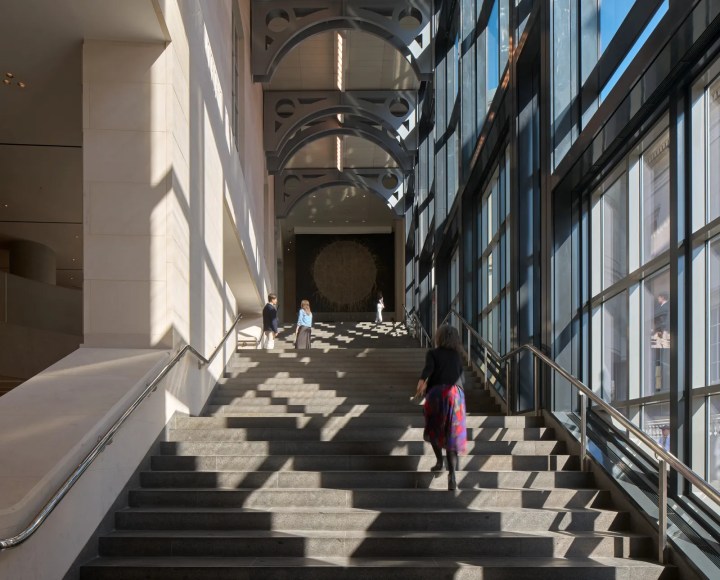
View looking up the main staircase of the Sainsbury Wing (Photo by Edmund Sumner, ©The National Gallery, London).
The Sainsbury Wing closed in February 2023 to undergo sensitive interventions to its external façade, foyer, and first floor, providing a better and more welcoming first experience to the National Gallery’s millions of visitors, in a plan designed by New York-based Selldorf Architects, working with heritage architects Purcell.
At the entrance, some of the Gallery’s footprint has been given over to public realm, creating a ‘square-within-a-square’, and leading to a more spacious entrance to the Gallery. The original dark glass of the stairs up to the gallery spaces has been replaced with clear glazing, bringing daylight across the foyer while revealing subtle views of the 1830s National Gallery building by William Wilkins (1778–1839). The glazing also allows people in Trafalgar Square to see directly into the Gallery for the first time.
This entrance opens into a new double-height foyer, which is larger, more open, and brightly lit. A 12-metre wide, 16K screen shows astounding details of National Gallery paintings. Visitors will find a new espresso bar, ‘Bar Giorgio’, by Giorgio Locatelli, on the ground floor. ‘Locatelli’, the restaurant by the same chef, will be on the mezzanine level, alongside a new bookshop and spaces for meetings and events. A bar will provide the to-date only publicly accessible space in London to enjoy a drink with views onto Trafalgar Square.
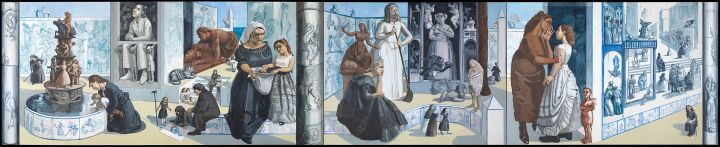
Paula Figueiroa Rego (1935–2022), Crivelli’s Garden, 1990–91, acrylic on canvas. Commissioned by the National Gallery in 1989, the painting responds to the predella of Carlo Crivelli’s Madonna of the Swallow (1491)—with an emphasis on the actions of strong women.
◊ ◊ ◊ ◊ ◊
Facing the restaurant diners will be Paula Rego’s (1935–2022) Crivelli’s Garden (1990–91). Rego was the National Gallery’s first Associate Artist and was inspired to create the work by looking at Renaissance paintings by Carlo Crivelli (about 1430/5 – about 1494) for the Sainsbury Wing Dining Room on its original opening in 1991.
Also reopening is the recently renamed Pigott Theatre, on the lower ground floor. The theatre has been fully refurbished with a new colour scheme and refitted for increased comfort and accessibility, including level access to the stage.
The palette of high-quality materials used throughout the new spaces includes the same grey Florentine limestone (pietra serena) employed in the Venturi-Scott Brown designed gallery spaces, along with Chamesson limestone from northern Burgundy, slate, oak, and black granite. Wherever possible existing materials have been re-used, recycled, or repurposed in other building projects.
The NG200 Welcome project has been made possible thanks to support from many generous donations, from both major benefactors and members of the public. In particular, The Linbury Trust and The Headley Trust which, together with The Monument Trust, funded the original establishment of the Sainsbury Wing 35 years ago, have been instrumental in helping the Gallery to realise the evolution of the building for its changing visitor needs.
Statements by Timothy Sainsbury, Gabriele Finaldi, Annabelle Selldorf, and Chris Bryant are available in the full press release.
◊ ◊ ◊ ◊ ◊
In his review of the newly unveiled spaces, Oliver Wainwright provides a useful summary of the architectural controversies that have always been part of the Sainsbury Wing’s history.
Oliver Wainwright, “‘Tranquillising Good Taste’: Can the National Gallery’s Airy New Entrance Exorcise Its Demons?” The Guardian (6 May 2025). When the Sainsbury Wing opened, it was called ‘vulgar pastiche’. Now, after an £85m revamp, it has become the famous gallery’s main entrance. But have its spiky complexities been tamed? And why all the empty space?
When the Sainsbury Wing first opened in 1991, it was not loved. It was variously slammed as “a vulgar American piece of postmodern mannerist pastiche” and “picturesque mediocre slime.” It was too traditional for modernists and too playful for traditionalists. Its dark, low-ceilinged entrance was damned as “a nasty cellar-like space” cluttered with a maze of (non-structural) columns. “It just didn’t work,” says the gallery’s deputy director, Paul Gray, adding that visitor numbers have swelled from three million back then to approaching six million now. The wing was never intended to handle such volumes. “The modern visitor expects so much more now. They want big, open, welcoming spaces, and it never felt like that.”
But time garners affection. And there is nothing like the threat of change to arouse fondness. When Selldorf’s modernising plans were first unveiled in 2022, the same critics who had pooh-poohed Venturi Scott Brown’s design leapt to its defence. . . .
The full article is available here»
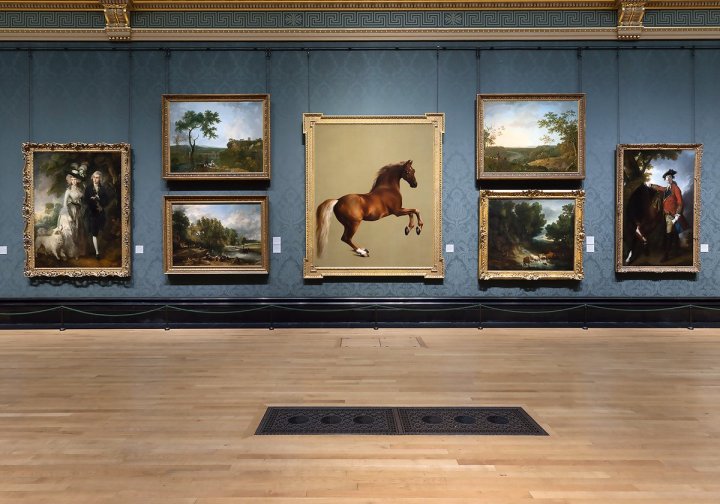
In Room 34 George Stubbs’s Whistlejacket (ca. 1762) is surrounded by a new ‘salon’ hang of British painting, 1740–1800.
◊ ◊ ◊ ◊ ◊
In addition to the reworking of the entrance and secondary spaces, galleries were rehung under the direction of Christine Riding, as described by Martin Bailey for The Art Newspaper:
Martin Bailey, “First Look: The ‘Once-in-a-Lifetime’ Rehang at London’s National Gallery,” The Art Newspaper (5 May 2025).
The Art Newspaper was given an early tour by Christine Riding, the director of collections and research, who has overseen the rehang. She describes her task as a “once-in-a-lifetime” opportunity. Now virtually completed, the rehang means that the National Gallery will show nearly 40% of its collection.
There will be 1,045 paintings hanging in the upper-floor rooms: 919 from the collection, plus 126 on loan. Nearly a third will be in the Sainsbury Wing and the rest on the main floor of the original Wilkins building. . . .
The number of works on display is slightly greater than before, thanks to a marginally denser hang, more glass cases in the centre of rooms, two walls with 34 plein-air landscape oil sketches (Room 39) and an additional space (Room 15a) with small Dutch pictures.
Riding has been particularly keen to emphasise “how artists have been influenced by their predecessors.” For instance, Elisabeth Vigée Le Brun’s Self Portrait in a Straw Hat (1782) is hung in the same octagonal space (Room 15) as the picture that inspired it, Peter Paul Rubens’s presumed Portrait of Susanna Lunden (1622–25). . . .
The Sainsbury Wing will now be the main entry point for visitors, with possibly more than 90% coming through there rather than via the portico or Getty entrances.
The full article is available here»
National Gallery Names Room 34 for the Blavatnik Family Foundation
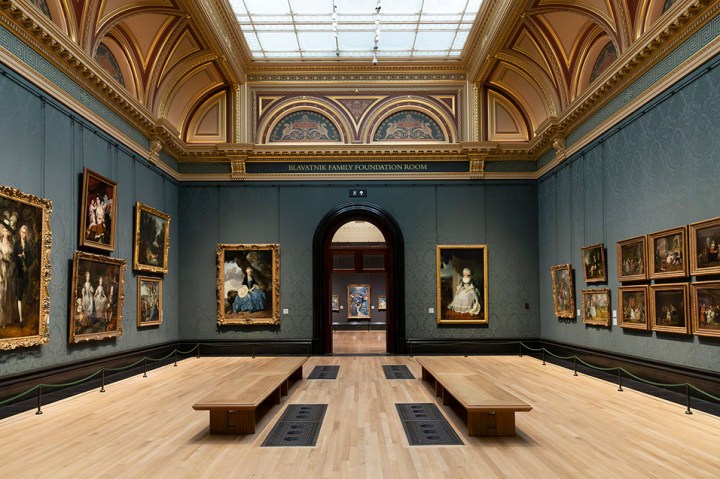
Room 34 of the National Gallery unveiled as the Blavatnik Family Foundation Room in recognition of its significant gift to the NG200 campaign.
◊ ◊ ◊ ◊ ◊
From the press release (7 May 2025) . . .
Room 34 of the National Gallery will today be unveiled as the Blavatnik Family Foundation Room in recognition of its significant gift to NG200. The generous gift marks the culmination of NG200, the National Gallery’s year-long bicentenary celebration of art, creativity, and imagination, marking two centuries of bringing people and paintings together.
Led by Sir Leonard Blavatnik, founder and chairman of Access Industries, the Blavatnik Family Foundation promotes innovation, discovery, and creativity to benefit the whole of society. Through the Foundation, the Blavatnik family has contributed over $1billion globally to advance science, education, arts and culture, and social justice. They have provided essential funding to dozens of scientists in the early stages of their careers through the Blavatnik Awards for Young Scientists, made major gifts to universities such as Harvard and Yale, and funded The Blavatnik School of Government at Oxford University. The Blavatnik Family Foundation has also supported more than 180 leading cultural organisations, including the National Portrait Gallery, Royal Academy, V&A, Courtauld, and the expansion of Tate Modern.
Room 34 of the National Gallery is a showcase of the best of British painting in the second half of the 18th century. It is home to such iconic works as the monumental horse painting Whistlejacket (about 1762) by George Stubbs (1727–1788), Mr and Mrs Andrews (about 1750) by Thomas Gainsborough (1727–1788), and William Hogarth’s (1697–1764) six painting series Marriage A-la Mode (about 1743).
Sir Leonard Blavatnik, said: “I’m delighted to support the National Gallery’s bicentenary and this magnificent room that celebrates Britain’s artistic heritage.”
Sir Gabriele Finaldi, Director of the National Gallery, said: “We are thrilled by the extraordinary and transformative philanthropy of the Blavatnik Family Foundation at this seminal moment in the National Gallery’s history and are delighted to recognise the generosity of the Blavatnik Family in one of our most beautiful and important rooms.”
New Book | The National Gallery: A History
Distributed by Yale UP:
Jonathan Conlin, The National Gallery: A History (London: National Gallery Global, 2025), 384 pages, ISBN: 978-1857097191, £35 / $45.
 Published in the National Gallery’s bicentenary year, this is the story of how one of the world’s finest collections of paintings was formed by (and for) the people of Britain.
For two hundred years the National Gallery has been at the heart of the nation’s life. Established in 1824 and situated in the centre of London with a commitment to free admission, it was conceived as a gallery to be enjoyed by all, while also serving as a place of refuge in times of war and crisis. The National Gallery: A History tells the story of an institution that holds education, social cohesion, and national heritage at its core, and whose outstanding collection has shaped the art historical canon over two centuries. Special focus on fifteen highlight paintings affords an opportunity to explore changes in taste over the decades, as well as the reactions of visitors to the Gallery’s great works of art.
Jonathan Conlin is professor of modern history at the University of Southampton. His books include The Met: A History of a Museum and Its People (2024) and a cultural history of the 1969 BBC2 television series Civilisation (2009).
New Book | Rethinking the Republic of Letters
Previously, Scholten has spent considerable time addressing the 970-page travel journal of the Utrecht-born Joannes Kool (1672–1712). From Amsterdam UP:
Koen Scholten, Rethinking the Republic of Letters: Memory and Identity in Early Modern Learned Communities (Amsterdam: Amsterdam University Press, 2025), 442 pages, ISBN: 978-9048559855, €159.
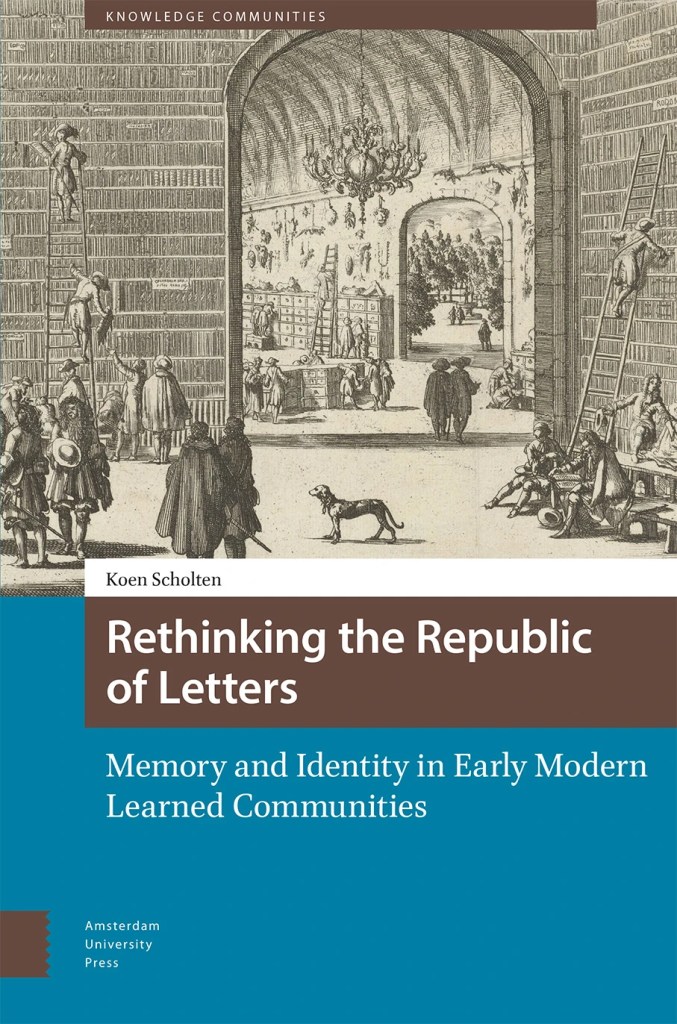 This book offers a revisionist look at the historiography of the Republic of Letters and the community of learning in early modern Europe. It suggests a new approach, conceptualising the learned world as a web of imagined communities in which the members do not know all their peers. These communities formed through distinct memory cultures and the representation of and identification with collective identities. Rethinking the Republic of Letters looks at early modern biographical dictionaries (vitae), eulogies, letters, travelogues, and funerary monuments of early modern learned men to trace the (re)formation of these communities. It thereby offers a novel perspective on early modern learned communities—the many Republics of Letters.
Koen Scholten is a historian of science and published on memory and identity in scholarly and scientific communities. He edited Memory and Identity in the Learned World (Brill, 2022) and received his PhD from Utrecht University on a thesis on the formation of early modern communities in the world of learning in 2023.
c o n t e n t s
Introduction: The Republic of Letters as an Imagined Community
1 An Inventory of Scholarly Values and Virtues
2 Collective History and Geographical Inclusion in Vitae and Elogia
3 Collective Memory and Identity in Hugo Grotius’s Correspondence
4 The Peregrinatio Literaria: Experiencing, Representing, and Forming Learned Communities
5 The Basilica di Santa Croce: The Florentine Site of Learned Memory
6 The Pieterskerk: Representing the Learned Community of Leiden University
Conclusion
Bibliography
List of Abbreviations
Manuscript Sources
Printed Sources, Before 1800
Printed Sources, Modern
Secondary Literature
Appendix 1
Corpus and Keyword Analysis
Main Corpus
Reference Corpus
Acknowledgements
Celebration of the York Georgian Society’s 2024 Nuttgens Award Winners
From the York Georgian Society:
Celebration of the York Georgian Society’s 2024 Nuttgens Award Winners:
Charlotte Goodge and Constance Halstead
York Medical Society, 18 June 2025, 6pm
Organised by Jemima Hubberstey, Charles Martindale, and Moira Fulton
York Georgian Society is delighted to host two talks given by our 2024 Nuttgens Award Winners: Constance Halstead and Charlotte Goodge. The event will start with a drinks reception in the garden of York Medical Society (weather permitting). Then in the Lecture Room, Professor Mary Fairclough (University of York) will give an introduction, followed by our award winners who will deliver two short talks. It will be a wonderful opportunity to network with other members of the Society and hear exciting new research in eighteenth-century studies. Current students at the University of York also have the chance to learn more about the Nuttgens Award and how the York Georgian Society supports early-career research. Ticket are £15 for members, £25 non-members, and free for students who book in advance. Booking is available here; please note that ticket purchase and free ticket registration must be done separately. In case of any questions, please email jemimahubberstey@hotmail.co.uk.
Charlotte Goodge | Colonial Strategies for Disempowerment and the ‘Deformed’ Mammae of Khoekhoe Mothers
Dr Charlotte Goodge submitted and successfully defended her AHRC-funded PhD thesis in December 2024. Her interdisciplinary doctoral research broadly examines the cultural constructedness of female fatness in the period, demonstrating that both the real-life and the fictional fat female figure was variously used as a vehicle through which ideologies of femininity, class hierarchy, and civilisation were reinforced. Charlotte has held fellowships at the Huntington Library (2023) and Chawton House (2021) and was recently awarded the ASECS Race & Empire Caucus’s Graduate Student Essay Prize (2024). Her work has been published in The Journal for Eighteenth-Century Studies (2023), Eighteenth-Century Life (2025), and in Studies in Eighteenth-Century Culture (2025). This talk will explore the way in which eighteenth-century European commentators and travel writers depicted Khoekhoe mothers and their breastfeeding practices in South Africa.
Constance Halstead | ‘Surely It Was Not Platonic’: Anne Lister’s Queer Account of the Ladies of Llangollen
Constance Halstead is a second year PhD student at the University of York’s Centre for Eighteenth Century Studies, where her research is funded by the Sally Wainwright Scholarship for the Study of Anne Lister. Her thesis, titled “Telling ‘All as It Really Is’: Form and Formation in Anne Lister’s Manuscript and Digitised Journal,” offers a literary study of Lister’s journal. It focuses on Lister’s generic, material, and textual negotiation of eighteenth-century traditions of diary writing. Constance completed her BA at the University of Oxford and MLitt at the University of St Andrews.
◊ ◊ ◊ ◊ ◊
The Nuttgens Award is named in honour of Patrick Nuttgens (1930–2004). A well-known and warmly remembered figure, both locally and nationally, Nuttgens was founding director of the Institute of Advanced Architectural Studies within the University of York and successively served as secretary, chairman, and president of the York Georgian Society. The Nuttgens Award was first offered in 2008, the result of a fruitful collaboration between York Georgian Society and the University of York. It provides a grant of £500 to be awarded annually to two PhD students researching any aspect of the Georgian period.
New Book | Fragmentary Forms: A New History of Collage
From Princeton UP (with most books now 50% off, until May 31 with code BLOOM50) . . .
Freya Gowrley, Fragmentary Forms: A New History of Collage (Princeton: Princeton University Press, 2024), 400 pages, ISBN: 978-0691253749, £50 / $60.
 A beautifully illustrated global history of collage from the origins of paper to today
While the emergence of collage is frequently placed in the twentieth century when it was a favored medium of modern artists, its earliest beginnings are tied to the invention of paper in China around 200 BCE. Subsequent forms occurred in twelfth-century Japan with illuminated manuscripts that combined calligraphic poetry with torn colored papers. In early modern Europe, collage was used to document and organize herbaria, plant specimens, and other systems of knowledge. In the eighteenth and nineteenth centuries, collage became firmly associated with the expression of intimate relations and familial affections. Fragmentary Forms offers a new, global perspective on one of the world’s oldest and most enduring means of cultural expression, tracing the rich history of collage from its ancient origins to its uses today as a powerful tool for storytelling and explorations of identity.
Presenting an expansive approach to collage and the history of art, Freya Gowrley explores what happens when overlapping fragmentary forms are in conversation with one another. She looks at everything from volumes of pilgrims’ religious relics and Victorian seaweed albums to modernist papiers collés by Pablo Picasso and Georges Braque and quilts by Faith Ringgold exploring African-American identity. Gowrley examines the work of anonymous and unknown artists whose names have been lost to history, either by accident or through exclusion. Featuring hundreds of beautiful images, Fragmentary Forms demonstrates how the use of found objects is an important characteristic of this unique art form and shows how collage is an inclusive medium that has given voice to marginalized communities and artists across centuries and cultures.
Freya Gowrley is a leading scholar of the cultural lives of images and objects. She is based at the University of Bristol, where she writes about the relationship between art and identity from the early modern period to the present day. She is the author of Domestic Space in Britain, 1750–1840: Materiality, Sociability, and Emotion.
c o n t e n t s
Introduction
1 New Material Possibilities
2 Divine Collections
3 Knowledge and Owning the World
4 Material Proliferations
5 Desire and Devotion
6 Craft into Canon
7 Objects of Modernity
8 Radical Possibilities
Conclusion
Bibliography
Index
Acknowledgments
Credits
Penn Dry Goods Market Textile Lecture Series
From the Schwenkfelder Library & Heritage Center, as noted by The Decorative Arts Trust:
Penn Dry Goods Market Textile Lecture Series
Schwenkfelder Library & Heritage Center, Pennsburg, Pennsylvania, 16–17 May 2025
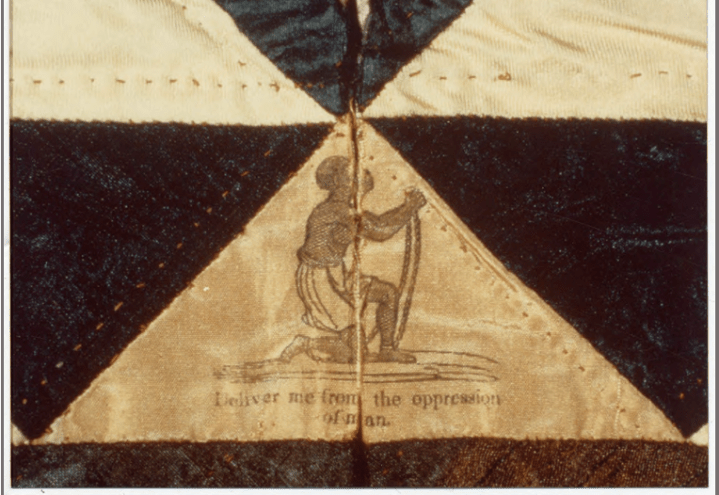
Image: Deborah Simmons Coates quilt detail, 1840s–1850s, Lancaster History — to be discussed in Mariah Kupfner’s talk.
The Penn Dry Goods Market Textile Lecture Series offers a chance to hear nationally recognized authorities in textile history on a broad range of topics—from embroidered hand towels to Appalachian weaving, from quilts to samplers, and from Scandinavian American and African American traditions. All lectures require a ticket ($25/lecture prepaid or $30 at door). Each ticket also provides access to the Penn Dry Goods Market antique show.
f r i d a y , 1 6 m a y
8.45am ‘This is the Way I Pass My Time’: Mennonite Hand Towels from Eastern Pennsylvania — Joel Alderfer (Collections Manager, Mennonite Heritage Center)
10.00 Colonialism, Power, and Identity: Fashion in American Portraits, 1670–1840 — Lynne Bassett (Independent scholar, curator, and author)
12.45 Heritage Craft, Community, and Continuity among Scandinavian Americans — Josh Brown (Skwierczynski University Fellow, University of Wisconsin-Eau Claire, and folk weaver)
2.00 Pennsylvania German Quilt Turning: 40 Examples from Both Sides of the Susquehanna — Debby Cooney (Independent quilt scholar)
3.15 Hidden in Plain Sight: Uncovering the Samplers of Black Girls — Lynne Anderson (President of the Sampler Consortium and Director of the Sampler Archive Project)
s a t u r d a y , 1 7 m a y
8.45am A Usable Past: American Hand-Weaving Revival in Appalachia, 1892–1940 — Matthew Monk (Linda Eaton Associate Curator of Textiles, Winterthur)
10.00 Pennsylvania German Quilt Turning: 40 Examples from Both Sides of the Susquehanna — Debby Cooney (Independent quilt scholar)
11.15 ‘So Intimately Are We Connected’: Antislavery Textiles and the Weight of Cotton — Mariah Kupfner (Assistant Professor of American Studies and Public Heritage, School of Humanities, Penn State Harrisburg)
12.45 The Joys of Tape Weaving as Viewed through the Eleanor Bittle Collection — Johannes Zinzendorf and Zephram de Colebi (The Mahantongo Heritage Center at the Hermitage)
2.00 A Legacy in Thread: Schoolgirl Needlework and Female Education in Dutchess County, New York — Stacy Whittaker (Independent needlework scholar)
3.15 The Quilt That Never Was: Solving the Mystery of the Inscribed Great Valley Quilt Blocks — Charlene Bongiorno Stephens and William Stephens (Independent quilt scholars)
Exhibition | Mama: From Mary to Merkel
From the press release for the exhibition:
Mama: From Mary to Merkel
Kunstpalast, Düsseldorf, 12 March — 3 August 2025
Curated by Linda Conze, Westrey Page, and Anna Christina Schütz

Marie-Victoire Lemoine, Portrait of Madame de Lucqui with Her Daughter Anne-Aglaé Deluchi, 1800, oil on canvas, 100 × 81 cm (Arp Museum Bahnhof Rolandseck, Rau Collection for UNICEF).
The exhibition Mama: From Mary to Merkel explores the many different aspects of motherhood over eight chapters. The focus is on the societal expectations that have always influenced motherhood and are reflected in art, culture, and everyday life. The approximately 120 works on display from the fourteenth century to the present day create a panorama that involves everyone, including fathers and those without children of their own. From the concept of the ‘good mother’ to care work and family configurations, the show illustrates how the role of mother quickly breaks down into different, highly individual perspectives that are nevertheless deeply intertwined in cultural history. A polyphonic sound installation uses pre-recorded voice messages to give space to personal experiences, memories, and visions.
“Everyone has a mother. By placing motherhood at the centre of an exhibition, the Kunstpalast is once again addressing a topic that directly touches the lives of our visitors and that everyone can relate to with their own experiences and opinions. The show combines seriousness with humour and art with everyday life and pop culture— thus tying in with the Kunstpalast’s mission statement on several levels,” says Felix Krämer, general director of the Kunstpalast.
Popular culture and art both emphasise societal expectations of mothers and the role of the GOOD MOTHER. We begin with figures of the Virgin Mary from the fourteenth to the eighteenth centuries. The image of Mary—probably the most prominent mother in Christian culture—remains a symbol of total maternal devotion today. The stereotype of the ‘good’ mother was established in the eighteenth century and is still widespread: contemporary artists in the exhibition explore the efforts involved in attaining this ideal. For a portrait of his mother, Aldo Giannotti (b. 1977) pressed a sign into her hands. The word ‘MOM’ on it only becomes an admiring exclamation of ‘WOW’ when she subjects herself to the strain of hanging upside down from the ceiling. Motherhood is a yardstick by which a woman’s achievement is measured—even if she is not a mother. A well-known example is Angela Merkel (b. 1954): nicknamed ‘Mutti’ (Mum) when she was German Chancellor, she can also be seen as Mother Theresa on the cover of Der Spiegel magazine.
The historical changeability of notions of ‘good’ motherhood is demonstrated by advice books from various decades of the twentieth and twenty-first centuries, whose recommendations to mothers are often fundamentally contradictory. ADVICE OR REGULATION—from the Weimar Republic to National Socialism, the early Federal Republic and the GDR to the present-day reunified Germany, this genre is characterised by both consistencies and inconsistencies. A bookshelf in the exhibition gathers advice literature from recent decades and invites visitors to pause and read.
“Ideals and role models, advice, expectations and emotions—the aim of this exhibition is to make the subject of motherhood tangible in all its artistic, cultural historical, social and, of course, highly personal dimensions,” agree the three curators of the show. Linda Conze, Westrey Page and Anna Christina Schütz have approached the topic from different angles, finding mothers and non-mothers in the Kunstpalast collection, supplementing these artists with important, sometimes international loans and bringing everything together to create a narrative. “Connections between the collectively selected works reveal continuities, but also the mutability of images of mothers, which are constantly being reappropriated, reinterpreted, contested and celebrated. We see the show as an invitation to open up a dialogue about care and motherliness and look forward to hearing the audience’s perspectives,” explains the curatorial team.
Looking after children is work. Nevertheless, CARE WORK remains mostly unpaid and has traditionally been automatically assigned to women. With a critical eye, artists have drawn attention to the fact that care is influenced by social norms and class affiliations. For a long time, only poor mothers breastfed their babies themselves, while wealthier women hired wet nurses. Around 1800, the idea that all women should take care of their babies themselves became prevalent; the presence of the biological mother became more important. In the present day, working mothers who focus “too much” on their careers are judged just as much as those who devote themselves entirely to their children and the household. The balancing of care and paid work as well as the role of caregiver and other identities is a recurring theme among the women artists in the exhibition. Several paintings in the exhibition are by Paula Modersohn-Becker (1876–1907), who was always fascinated by motifs of the bond between mother and child. However, she was also apprehensive about the effects of her own motherhood on her artistic work. In her sculpture of a body dissolving in the mechanics of a breast pump, Camille Henrot (b. 1978) focuses on the fine line between providing nourishment and self-sacrifice.
The exhibition delves deeper into the subject of the PLACES OF MOTHERHOOD: historical doll’s house kitchens are brought into dialogue with the video work Semiotics of the Kitchen by Martha Rosler (b. 1943), which examines the distance of the housewife’s domain from intellectual settings. Scottish artist Caroline Walker (b. 1982) portrays mothers with their newborns in the intimate yet isolating domestic sphere. Finnish artist Katharina Bosse (b. 1968) photographs herself in erotically charged poses with her toddler crawling beside her in natural landscapes. In this way, she disrupts the seemingly natural idyll that surrounds motherhood in art and cultural history.
Several women artists use their work to address the fact that the decision to (NOT) HAVE CHILDREN often could not and still cannot be made freely, despite all the progress that has been made. For centuries, female ‘nature’ was defined in a wide variety of societies by a woman’s ability to conceive and bear children. The Virgin Mary, whose life is depicted in Dürer’s Life of the Virgin, is both a female role model and a special case. Her actions are always centred on her son, whom she conceived by divine intervention.
The medical achievements and societal developments of the twentieth century allowed women to emancipate themselves from their socially prescribed destiny for the first time by taking the contraceptive pill or asserting their hard-fought right to terminate a pregnancy. Hannah Höch (1889–1978) paints her struggle with the decision to not have a child by Raoul Hausmann. Nina Hagen’s (b. 1955) protest against the expectations of fulfilling her duty as a mother in the song “Unbeschreiblich Weiblich” (Indescribably Feminine) is juxtaposed with Elina Brotherus’s (b. 1972) confrontation with her own involuntary childlessness.
For a long time, the physical bond between mother and child was unquestioningly viewed as a prerequisite for a motherly love that was regarded as intrinsic. The exhibition also shows that the often positively connoted intimate relationship between mother and child at all ages can also have a potentially traumatic side. In a series of photographs, Leigh Ledare (b. 1976) explores his CLOSENESS to his mother, who confronts her adult son with uncompromising desire. In a video work by performance artist Lerato Shadi (b. 1979), she and her mother lick sugar and salt off each other’s tongues and explore the space between repulsion and affection. The armchair by Italian designer Gaetano Pesce (1939–2024) promises a return to the mother’s womb, with the foot section connected to the main body of the furniture via an ‘umbilical cord’.
In German, the word MUTTERSEELENALLEIN describes the utmost loneliness. Mary, Our Lady of Sorrows, mourning her dead son Jesus Christ, is one of the central motifs in Western art history. Artists have repeatedly made reference to the so-called Pietà, appropriating and reinterpreting it as a motif. The loss of the child is juxtaposed with the loss of the mother, which artists of different generations have sometimes made an autobiographical theme and thus given expression and form to their personal grief. Finally, mutterseelenallein can also refer to anyone who has been denied motherhood, whether due to social norms, physical conditions or decisions that were not made voluntarily.
 The exhibition chapter FAMILY CONFIGURATIONS asks what influence family images have on motherhood. In the eighteenth century, the nuclear family rose to become the ideal of the Western world. In this model, the mother is the centre of care, while the father is responsible for financial support. Through processing their own personal or observed experiences, artists have questioned the dominance of this father-mother-child constellation. Alice Neel, who lived apart from her daughter, captures psychological subtleties in her family portraits that resist simple narratives. Oliviero Toscani’s photos for a campaign for the Benetton fashion brand around 1990 challenged conservative notions of family by placing homosexual parents at the centre. Queer lifestyles can inspire ways of thinking in which the burden of care is placed on several shoulders instead of being the sole responsibility of the biological mother. The circle of people who can be mothered also extends beyond biological relatives: foster, step-, adopted children and those in care are also looked after. In the complexity of modern living arrangements, the bond with a pet can be just as important as other relationships. Art reflects the shift from the question ‘Who is the mother?’ to ‘Who is mothering?’
The exhibition is an invitation to continue the dialogue about care and motherhood—for example in the diverse accompanying programme, which ranges from a midwife consultation in the exhibition to workshops with various collectives and organisations such as Düsseldorf family centres. One of Germany‘s most prominent mother figures has recorded the audio guide for the exhibition: Marie-Luise Marjan, aka ‘Mutter Beimer’ from the popular TV series Lindenstraße.
Mama: From Mary to Merkel is curated by Linda Conze, Head of Department of Photographs; Westrey Page, Curator Special Projects; and Anna Christina Schütz, Department of Prints and Drawings, Research Associate.
Linda Conze, Westrey Page, and Anna Christina Schütz, ed., Mama: Von Maria bis Merkel (Munich: Hirmer Verlag, 2025), 200 pages, ISBN: 978-3777444888, €45.










 Enfilade
leave a comment