Pure Judgment
After five years, I hope you’ll indulge me as I ask a small favor that has nothing to do with HECAA or the eighteenth century. A former student and now friend of mine has recently launched a blog, and I would be grateful if you have a look. Pure Judgment—related to the eighteenth century only in owing its title to Kant—reports on juried awards in a variety of cultural fields, with an emphasis on the arts. The site’s editor, Anna Hanchett, was good enough to put up with me in a handful of classes, including January term trips to Venice and London. She’s currently working as an assistant to a particularly fine bookbinder (and in this capacity does handle an enviable share of eighteenth-century material culture). –CH
Here’s the link and more information:
 In contrast to the thousands of blogs built around highlighting an individual’s tastes, preferences, and recommendations, Pure Judgment reports on juried standards of excellence. Covering a wide range of cultural production—including literature, the visual arts, music, fashion, film and food—the site aims to inform readers of people whose work has been recognized by experts within a given field as outstanding. Among the award-winners recently highlighted are David Titlow (Taylor Wessing Prize), Uxua Casa Hotel (Smith Hotel Award), Richard Flanagan (Man Booker Prize), Paper Airplanes (CinefestOz Film Award), and Iris Van Herpen (Andam Prize).
While other sites report on particular areas of cultural production, Pure Judgment is exceptional for its expansive scope . . . because you shouldn’t have to know about a particular award to care about the category or the winner. Pure Judgment aims to broaden the horizon for all of us.
Exhibition | Marks of Genius: Drawings from the MIA
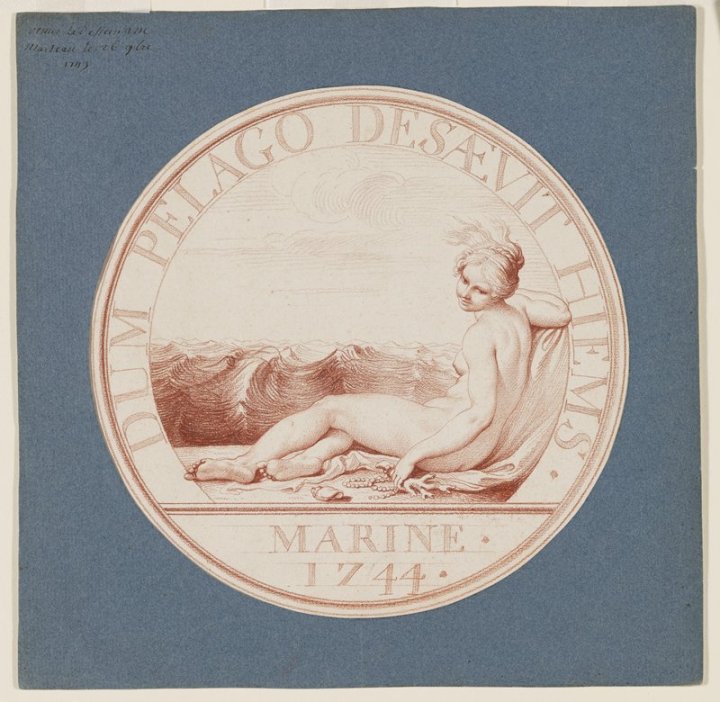
Edme Bouchardon, Design for a Token: Marine, 1744,
ca. 1743, red chalk (Minneapolis Institute of Arts)
◊ ◊ ◊ ◊ ◊
Press release (7 May 2014) from the MIA:
Marks of Genius: 100 Extraordinary Drawings from the Minneapolis Institute of Arts
Minneapolis Institute of Arts, 13 July — 21 September 2014
Grand Rapids Art Museum, 26 October 2014 — 18 January 2015
North Carolina Museum of Art, Raleigh, TBA
Joslyn Art Museum, Omaha, Nebraska, TBA
Curated by Rachel McGarry
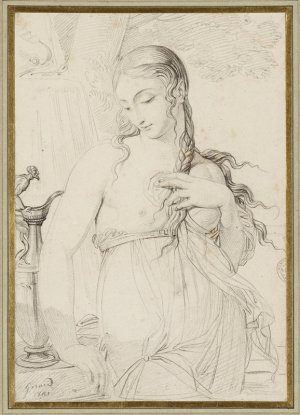
Louis Lafitte, Young Woman in Classical Dress, Study for the Month of Thermidor, ca. 1804–05, black chalk, partially incised (Minneapolis Institute of Arts).
This summer, the Minneapolis Institute of Arts (MIA) showcases an exemplary selection of its rarely seen, superb drawings collection in Marks of Genius: 100 Extraordinary Drawings from the Minneapolis institute of Arts. This special exhibition marks the first time this selection of drawings, which spans over 500 years, will be seen together by the public. Featured artist include celebrated masters such as Ludovico Carracci, Guercino, Thomas Gainsborough, Eugène Delacroix, Edgar Degas, Gustav Klimt, Egon Schiele, René Magritte, and Georgia O’Keeffe. Marks of Genius opens at the MIA and will then travel to the Grand Rapids Art Museum in Michigan, the North Carolina Museum of Art, Raleigh, and the Joslyn Art Museum in Omaha, Nebraska. A fully illustrated catalogue.
“Due to their sensitivity to light, drawings are exhibited for only short periods of time and are otherwise kept in dark storage,” says exhibition curator Rachel McGarry. While works from the museum’s large paper collection—over 40,000 prints and drawings—can be seen by appointment in the Herschel V. Jones Print Study, Marks of Genius is a rare opportunity for the public to see the cream of this collection.

Nicolas-Bernard Lépicié, Standing Male Nude, 1760s–80s, red chalk (Minneapolis Institute of Arts)
Marks of Genius is exhibited at an apropos time. The MIA’s ‘treasury’ of drawings, which includes over 2,600 works, has increased by 20 percent since 2009. Several of these recent additions will be on view for the first time in this show. The exhibition brings to life the immediacy of drawings and explores its multiple roles as a means of study, observation, problem solving, a record of the artist’s imagination, and a medium for creating finished works of art.
The thematic display highlights these different aspects of drawing:
• Spark of Creation features ‘first draft’ sketches and inventions. This portion of the exhibition, showcasing the immediacy of the artistic process, features works such as Giuseppe Bazzani’s Pan and Syrinx, c. 1760, and George Romney’s Study for ‘The Lapland Witch,’ completed c. 1775–77.
• From Life is a section which features various observational studies drawn from nature throughout history. Notable works include Käthe Kollwitz’s c. 1903 Two Studies of a Woman’s Head and Pierre-Joseph Redouté’s Amaryllis lutea. c. 1800-06.
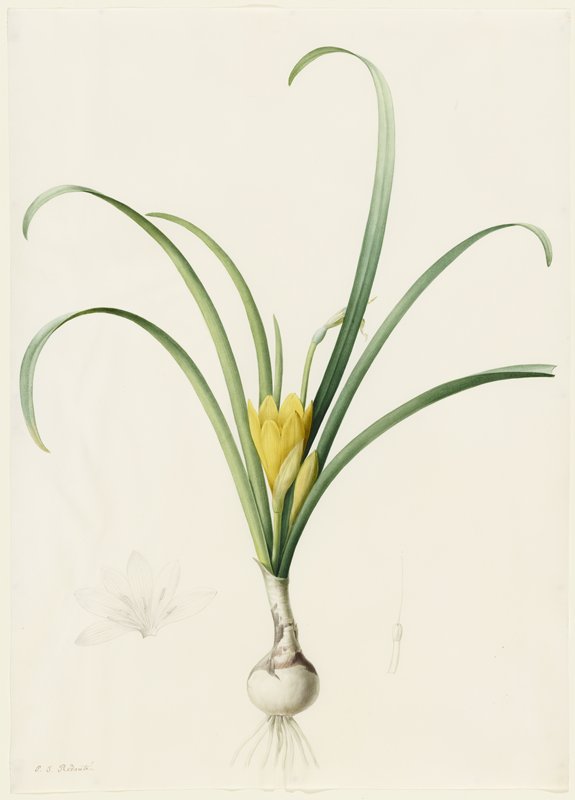
Pierre-Joseph Redouté, Amaryllis lutea, ca. 1800–06, watercolor and graphite on vellum (Minneapolis Institute of Arts)
• Portrait Drawings presents works such as Lovis Corinth’s Self-Portrait completed in 1908 and Egon Schiele’s Standing Girl, c. 1910.
• Figural Abstraction a section which documents artists’ studies of human forms and expression. Works featured in this section include Guercino’s Hercules, (1641–42) and Ernst Kircher’s Seated Woman in the Studio, completed in 1909.
• Storytelling presents drawings with a narrative theme, such as Arthur Rackham’s Little Red Riding Hood, 1909, and Ludovico Carracci’s Judith Beheading Holoferenes, c. 1581–85.
• Other themes include Sense of Place with Emil Nolde’s Heavy Seas at Sunset, c. 1930–35, and Appropriation with Roy Lichtenstein’s 1962 Bratatat!
◊ ◊ ◊ ◊ ◊
From the MIA@Artbook:
Rachel McGarry and Thomas Rassieur, Master Drawings from the Minneapolis Institute of Arts (Minneapolis: Minneapolis Institute of Arts, 2014), 300 pages, ISBN: 978-0989371841, $60.
 This lavishly illustrated book presents one hundred significant drawings from the 15th to the 21st century, including new discoveries and works by both celebrated masters and others who deserve to be better known. Among the artists represented are Annibale and Ludovico Carracci, Guido Reni, Giovanni Domenico Tiepolo, Antoine Watteau, Jean-Honoré Fragonard, Pierre-Paul Prud hon, Thomas Gainsborough, George Romney, Edgar Degas, Henri Matisse, Lovis Corinth, Ernst Ludwig Kirchner, Käthe Kollwitz, Otto Mueller, Emil Nolde, Egon Schiele, Edward Hopper, John Marin, Grant Wood, Roy Lichtenstein, Jasper Johns, Andy Warhol, and Edward Ruscha.
Catalogue entries for each drawing include complete documentation, provenance, and bibliography. The text provides important new scholarship and attributions; examines a variety of themes, such as connoisseurship, patronage, materials and techniques, watermarks, and collectors’ stamps; and discusses how a work fits into the artist’s oeuvre or represents larger developments in artistic movements or trends in artistic production
New Book | Mariette and the Science of the Connoisseur
From Ashgate:
Kristel Smentek, Mariette and the Science of the Connoisseur in Eighteenth-Century Europe (Aldershot: Asghate, 2014), 342 pages, ISBN: 978-1472438027, £70 / $120.
 Celebrated connoisseur, drawings collector, print dealer, book publisher, and authority on the art of antiquity, Pierre-Jean Mariette (1694–1774) was a pivotal figure in the eighteenth-century European art world. Focusing on the trajectory of Mariette’s career, this book examines the material practices and social networks through which connoisseurs forged the idea of art as an object of empirical and historical analysis. Drawing on significant unpublished archival material as well as on histories of science, publishing, collecting, and display, this book shows how Mariette and his colleagues’ practices of classification and interpretation of the graphic arts gave rise to new conceptions of artistic authorship and to a history of art that transcended the biographies of individual artists. To follow Mariette’s career through the eighteenth century is to see that art was consolidated as a specialized category of intellectual inquiry—and that style emerged as its structuring analytic device—in the overlapping spaces of the collector’s cabinet, the connoisseur’s portfolio, and the dealer’s shop.
Kristel Smentek is Associate Professor of Art History in the Department of Architecture at MIT.
◊ ◊ ◊ ◊ ◊
C O N T E N T S
Introduction: Art History and the 18th-Century Connoisseur
Knowledge Economies of the Print Trade
The Making of a Drawings Connoisseur
The Collector’s Cut
Origins: Of Antiquarianism, Aesthetics, and History
Conclusion: The Mariette Sales
Select Bibliography
Index
At Auction | Un Moment de Perfection: Furniture & Paintings

One of a pair of Italian walnut commodes, ca. 1784–85, designed and mounted by Luigi Valadier. Estimate: £600,000–1 million (Lot 30; click here for additional images and audio description).
◊ ◊ ◊ ◊ ◊
Press release (26 November 2014) from Christie’s:
Un Moment de Perfection: An Important Private Collection of French
18th-Century Furniture and Old Master Paintings, Sale 10199
Christie’s, London, 3 December 2014
 Christie’s will present a superb collection of French paintings and decorative arts in Un Moment de Perfection: An Important Private Collection of French 18th-Century Furniture and Old Master Paintings on 3 December 2014 [Sale 10199]. Formed by an erudite and sophisticated collector of both French and Spanish origins, the quality and breadth of this collection demonstrate the distinguished gentleman’s deep understanding of art and history, which developed and matured through endless curiosity, extensive travels and friendships formed in the art world. Comprising 83 lots, the wide array of important treasures include a pair of Italian walnut commodes designed and mounted by Luigi Valadier (estimate: £600,000–1 million); a pair of impressive ormolu candelabra attributed to the ciseleur-doreur Pierre Gouthière (estimate: £350,000–500,000); and a pair of capricci of Rome by Hubert Robert depicting the Forum with the Temple of Antoninus and Faustina and the Temple of Saturn (estimate: £200,000–400,000). The sale offers new and established collectors the opportunity to acquire works of exceptional quality from this magnificent group. The collection will be available to view from Friday 28 November at Christie’s King Street.
European Furniture
The sale is led by an elegant pair of Italian walnut commodes, circa 1784–85, designed and mounted by Luigi Valadier (estimate: £600,000–1 million) which corresponds almost exactly to a pair of commodes in a drawing from the workshop of Luigi Valadier which, along with other papers, is now in the Pinacoteca Civica. Other notable pieces of European furniture include a late Louis XV ormolu-mounted tulipwood, amaranth and fruitwood marquetry commode by Pierre-Antoine Foullet, circa 1770–75, which belongs to a group of case furniture stamped or attributed to Pierre-Antoine Foullet, all of which share the distinctive neo-classical oval frame mounts and Transitional form of this commode (estimate: £70,000–100,000); a French pale-grey painted and parcel-gilt cast-iron centre table from the second quarter of the 19th century (estimate: £15,000–25,000); and a French ormolu and gilt-varnished metal gueridon, attributed to Maison Jansen, late 19th century, in the manner of Adam Weisweiler (estimate: £6,000–9,000). Regarded as one of the most prominent interior decorating companies of the 20th century, Maison Jansen, founded in 1880 also designed and made furnishings for the interiors they conceived, the designs for which ranged from a revival of Louis XV, XVI and Empire styles to modern taste, creating a dialogue between the historical and the contemporary. Some of the firm’s most important commissions were for the Duke and Duchess of Windsor’s residence in Paris, the White House for Jacqueline and John F. Kennedy and the March family residences in Spain.
European Objects
Formerly in the collection of Archibald Philip Primrose, 5th Earl of Rosebery (1847–1929) at Mentmore Towers, a magnificent pair of candelabra attributed to the celebrated ciseleur-doreur Pierre Gouthière, may be regarded as one of the most accomplished models executed in the ‘goût à l’Etrusque’ (estimate: £350,000–500,000). They are thought to be after a design by Jean-Demosthène Dugourc, made by Gouthière and supplied by the celebrated marchand-mercier Dominique Daguerre who collaborated closely with Gouthière on various important commissions. Further highlights range from a pair of Louis XVI ormolu-mounted Sèvres ‘beau bleu’ porcelain vases, the mounts attributed to Pierre-Philippe Thomire, circa 1785, which were also almost certainly supplied by Dominique Daguerre (estimate: £200,000–300,000); to a pair of restoration ormolu-mounted porphyry and blued-steel brûle parfums, circa 1820-30, after the model by Mathew Boulton (estimate: £30,000–50,000); a Louis XVI oval marble bas-relief of a vestal virgin, attributed to Louis-Simon Boizot, circa 1777, which is almost certainly the marble bas-relief depicting Une Vestale that Boizot exhibited in the Paris Salon of 1777 (estimate: £8,000–12,000).

Old Master Paintings
Leading the offering of Old Master paintings is one of the top lots of the sale, a pair of capricci of Rome by Hubert Robert depicting the Forum with the Temple of Antoninus and Faustina and the Temple of Saturn (estimate: £200,000–400,000, Lot 36). In the collection of HRH The Duchess of Kent at Derby House between 1940 and 1947, this pair of views are a vibrant demonstration of Robert’s fascination with the ancient world and of the palpable influence of Giovanni Paolo Panini. Other key works include a striking portrait of Don Lourenço José Xavier de Lima, 1st Count of Mafra by Louis Gauffier’s a beautifully preserved example of the artist’s small full-length portraiture, the genre that dominated his oeuvre until his death in 1801 and for which he would ultimately be most celebrated (estimate: £150,000–250,000).
19th-Century Paintings
A three-quarter length Portrait of Empress Alexandra Feodorovna of Russia, née Princess Charlotte of Prussia by Scottish born Christina Robertson is likely to be of particular Russian interest (estimate: £ 30,000–50,000). Robertson travelled to St Petersburg in 1839 to paint the Empress and the Imperial Court, and became her favoured court artist, painting a number of portraits of her. She returned again in 1849 where she remained until her death in 1854. The largest concentration of her work is in the collection of the Hermitage Museum. Amongst her distinguished patrons were the Duke and Duchess of Northumberland, Lord Powerscourt, and influential European families including the Rothschilds and Pototskis. Lady with a fan by Roberto Bompiani was exhibited at the Esposizione di Belle Arti in Turin in 1880 where it was highly praised (estimate: £30,000–50,000). Nicknamed ‘the Italian Bouguereau’, for his pictures of religious and mythological subjects which were evocative of the great French Academic artist, Bompiani was also known as a history and portrait painter who frequently represented members of the Italian aristocracy, such as the Borghese family.
Display | Visions of Rome: Lusieri and Labruzzi
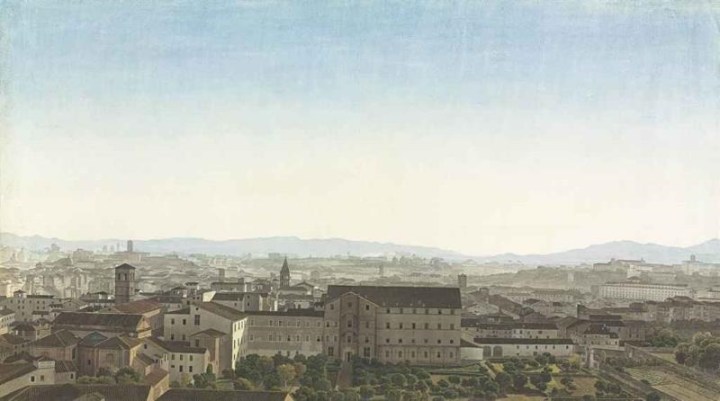
Giovanni Battista Lusieri, Panoramic View of Rome: Capitoline Hill to the Aventine Hill, ca. 1778–1779, watercolour, 55.2 x 97.8 cm. (22 x 39 inches) (London: The British Museum).
◊ ◊ ◊ ◊ ◊
Press release from The British Museum:
Recent Acquisitions | Visions of Rome: Lusieri and Labruzzi
The British Museum, London, 12 December 2014 — 15 February 2015
The British Museum has acquired a rare early surviving work by one of the eighteenth century’s most innovative and technically gifted landscape artists, with the support of the Art Fund, the Ottley Group, the Oppenheimer Fund, Jean-Luc Baroni, the Society of Dilettanti Charitable Trust, and individual contributions.
Giovanni Battista Lusieri’s watercolour Panoramic View of Rome: Capitoline Hill to the Aventine Hill (ca. 1778–79) shows a panoramic view of his native city Rome from Piazza San Pietro in Montorio on the Janiculum, stretching from the Capitoline Hill on the left to the Aventine Hill on the right. It is one of three surviving views from a four-sheet 180 degree watercolour panorama of Rome from the Janiculum at different times of day from morning to evening. These were bought or commissioned by Philip Yorke (1757–1834), who became 3rd Earl of Hardwicke in 1790, during his time in the city in 1778–79. Panoramic View of Rome: Capitoline Hill to the Aventine Hill shows the panorama in the late afternoon with shadows lengthening in the now built over garden of the convent of San Callisto and San Michele in Trastevere in the foreground. (more…)
Display | Connecting Continents: Indian Ocean Trade and Exchange

Front and back of a pendant from Yemen made from a 1780 silver Maria Theresa thaler, 1950s. These coins were originally minted in the Hapsburg Empire but from the late 18th century onwards were used across the Indian Ocean (London: The British Museum). Click here for a high-resolution image.
◊ ◊ ◊ ◊ ◊
Press release from The British Museum
Connecting Continents: Indian Ocean Trade and Exchange
The British Museum, London, 27 November 2014 — 31 May 2015
Objects connected to the long history of trade in the Indian Ocean can be found throughout the British Museum. The new exhibition, Connecting Continents: Indian Ocean Trade and Exchange, is the first time a selection of these have been exhibited together to tell the story of how this vast oceanic space has connected people and cultures from Asia, East Africa, the Middle East and beyond. This intimate yet far-reaching exhibition features objects dating from around 4500 years ago to the present.
Connecting Continents: Indian Ocean Trade and Exchange explores trade from several perspectives. The exhibition features the commodities traded, such as textiles, precious stones and ceramics, which might have been found thousands of miles from their point of origin or production. Other objects on display indicate the use of foreign commodities, such as Roman jewellery made of South Asian sapphires and garnets. The exhibition also demonstrates how objects and their meanings change through these journeys. Coins, for example, were used in many ways—as money, bullion or incorporated into jewellery.

Model Boat Made of Threaded Cloves. Probably from Indonesia, 18th–20th century (London: The British Museum). Click here for a high-resolution image.
◊ ◊ ◊ ◊ ◊
A model boat, made entirely of dried cloves threaded together and displayed for the first time, is the centrepiece that embodies many of the themes in the exhibition. The clove tree is indigenous to Indonesia, from where this boat is likely to originate. The maker used this intricate technique to create a model of a traditional trading ship. These types of model were popular in the 18th and 19th centuries with Europeans, many of whom worked in the East India companies involved in the highly lucrative spice trade. Cloves, as well as cinnamon, pepper, ginger and other spices, have been central to Indian Ocean commerce for millennia. This single object, only half a metre long, illustrates the significance of spices within the Indian Ocean commercial world, the ships used to transport them and how this trade led to the interaction of different cultures.
The written records of merchants and travellers offer further insights into the nature of this trading system. The 14th-century Muslim pilgrim, Ibn Battuta, travelled to East Africa as well as to the Far East, describing in detail the commercial world and the cosmopolitan towns he encountered. Objects found in places Ibn Battuta visited form one section of this display.
The long duration of trade in the Indian Ocean is also demonstrated with beautiful jewellery incorporating carnelian beads from the Indus valley dating from around 2500BC found in the Royal Cemetery at Ur in Mesopotamia.
Pottery from India and East Africa from the 7th to 10th centuries AD found in Siraf on the Gulf coastline of southern Iran illustrates the global movement of people. At this time Siraf was one of the major trading posts on the Ocean rim and these everyday items were likely to have been used for cooking by foreign merchants who sailed long distances to engage in trade.
By thinking about history from the perspective of the ocean, areas which appear small on the map such as the Maldives, become highly significant when we realise they were vital points of refreshment for ocean-going vessels and acted as trading posts. Islands such as these, which are often only associated today with luxury tourism, were central to this early globalised economic system.
The compelling object histories in this display represent a huge geographical spread and tell this long and significant history. Every object in this small space contains myriad stories of interaction, movement, exchange and connection which has characterised the Indian Ocean for thousands of years.
Phase II of the Conservation of Thornhill’s Painted Hall Announced

Restoration of the West Wall of the Painted Hall at Greenwich, included in Phase I of the conservation project, was completed in the spring of 2013. Phase II is expected to begin in the summer of 2016.
◊ ◊ ◊ ◊ ◊
Press release, via Art Daily (29 November 2014). . .
The Heritage Lottery Fund today announced that it has earmarked funding of £2.77 million, including a development grant of £98,800, to The Greenwich Foundation towards its £7m scheme to complete the conservation of the Painted Hall at the Old Royal Naval College (ORNC). This first round pass will enable the Foundation to proceed with it plans for the conservation of the remaining 3,700 square metres of paintings: one of the most ambitious painting conservation projects ever undertaken within a historic interior. It will also support improved interpretation and accessibility, the delivery of conservation skills training, and a programme of associated community, learning and public events including scaffolding tours which proved immensely popular during Phase I of the conservation.
Created in the early 18th century by Sir James Thornhill for Sir Christopher Wren’s Royal Hospital for Seamen, the spectacular, Grade 1 Listed, Painted Hall is one of Europe’s most important architectural interiors and is considered to be the greatest achievement of English Baroque art. Phase I of the conservation, which was also supported by a grant from the Heritage Lottery Foundation, saw the west wall and upper hall ceiling restored to their former glory [opened in May 2013]. Phase II will see the lower hall, with its spectacular ceiling, the entrance vestibule and cupola similarly restored.
Sue Bowers, Head of the Heritage Lottery Fund for London, said, “This Baroque masterpiece is one of the lesser-known treasures at the heart of the Greenwich World Heritage Site. HLF funded the first stage of restoration works and we are now delighted to support plans to complete the project.”
“This is absolutely wonderful news,” adds Brendan McCarthy, Chief Executive of the Greenwich Foundation. “Ever since the first phase of conservation was completed, we’ve been looking forward to restoring the rest of the Painted Hall and the HLF stage 1 pass has taken us a long way towards that—although much fundraising remains to be done. The next few months will be very interesting and great fun. There will be changing exhibitions, information, exciting talks and hands-on workshops as part of our overall approach to involving the public as the project develops. Phase II of the Painted Hall conservation will transform the experience of visiting and viewing this remarkable painted interior, and people can also be part of the exciting project by helping us to reach our £7m target.”
The Foundation will submit detailed project proposals, based on a feasibility study by Martin Ashley Architects, to HLF at the end of 2015 with a view to starting work on the project in the summer of 2016. The Painted Hall will be under scaffolding for around two years after the start of works, however the public will have access to the Hall, including on the scaffolding itself. Visitors—including wheelchair users—will be able to get close up to the painted surfaces and watch conservators at work—an exciting element of project.
Key elements of the Phase II programme include
• Cleaning and conservation of the remaining 3,700 square metres of painted wall surface, including the great ceiling in the Lower Hall, executed by James Thornhill between 1708 and 1712. This will remove layers of dirt and varnish, unlocking the colour and vibrancy of these great paintings. The work will be undertaken by Paine & Stewart, leading specialists in the conservation of historic wall paintings who also undertook the conservation work in Phase I.
• Re-presentation of the interior with improved lighting, new seating and interpretation.
• Introduction of environmental improvements to ensure the best possible conditions for the painted surfaces.
• Creation of a new, fully accessible visitor reception in the King William Undercroft with improved facilities, innovative interpretation, dedicated retail, and a new café.
• Improved visibility of the Painted Hall within the Discover Greenwich visitor centre, including a new audio-visual exhibit.
The conservation work is expected to be completed by the summer 2018 with the overall project completed the following year.
A masterpiece that was almost 20 years in the making
With over 4,250 square metres of painted surfaces, the Painted Hall was Thornhill’s most extensive commission, taking the artist almost 20 years to complete. In the dining hall proposed for the Royal Hospital for Seamen the artist was asked to create an homage to Britain’s maritime power and royal family. The astonishing ceiling of the lower hall shows the contribution the British navy made to the prosperity of the nation at the time of William III and Mary II, under during whose reign the Hospital was commissioned, and the Upper Hall ceiling features the last of the Stuart monarchs, Queen Anne, during whose reign the Lower Hall paintings were made. The allegorical theme of the huge and exuberant Lower Hall ceiling is the Triumph of Peace and Liberty over Tyranny, and pays due tribute to Stuart monarchs William and Mary and British maritime power. Within the oval frame are the four seasons and other references to the passing of time including the signs of the zodiac. Beyond the arch in the Upper Hall Queen Anne surveys the continents of the world, while on the west wall her Hanoverian successors, George I and his family, are shown in sober glory. Elsewhere much use is made of trompe l’oeil painting, on the columns, windowsills and in the vestibule. During the period when he working on the painting Thornhill became court Painter to the new King, George I, and was subsequently knighted. After completion in 1727, the Greenwich pensioners moved their dining room to the undercrofts below, and the Hall became a popular visitor attraction with an admission price of 6d. In the early 19th century the Painted Hall became the home of the National Gallery of Naval Art—one of Britain’s first public art galleries. It was not used again as a dining room until 1936, when the paintings were moved to the newly-established National Maritime Museum.
Sir James Thornhill (1675–1734)
Born in Dorset in 1675, artist James Thornhill was to rise to become a court painter and sergeant painter to George I and George II, a master of the Painters’ Company and a fellow of the Royal Society. He was the first English painter to be knighted for his work, in 1720, and sat as a Member of Parliament for 12 years from 1722 until his death in 1734. The eight scenes in the dome of St. Paul’s Cathedral (1715–19) and the allegories in the Painted Hall, Royal Hospital for Seamen (1708–27), are his two most considerable commissions with the majority of his paintings largely executed on the ceilings and stairs of country houses and palaces such as Hampton Court, Blenheim, and Chatsworth. Among Thornhill’s few canvases are the altarpiece for St. Mary’s Parish Church, Weymouth, and a group portrait of the members of the House of Commons in which he was assisted by William Hogarth (who eloped with Thornhill’s daughter in 1729). Thornhill also made a number of portraits (his sitters including Sir Isaac Newton and co-founder of The Spectator Magazine, Richard Steele), book illustrations, theatre scenery, and the rose window of the north transept of Westminster Abbey. Thornhill’s works can be seen in collections across the globe including The Louvre, Paris; Metropolitan Museum, New York; and National Portrait Gallery, Tate, Royal Academy and Courtauld Institute, London.
Exhibition | Treasures from India: Jewels from the Al-Thani Collection
Press release (21 October 2014) from The Met:
Treasures from India: Jewels from the Al-Thani Collection
The Metropolitan Museum of Art, New York, 28 October 2014 — 25 January 2015
Curated by Navina Haidar

Flask, 1650–1700, North India, Rock crystal, inlaid with gold wire, rubies, and emeralds, with gold collar, stopper, and foot, 9.2 x 5.5 cm (The Al-Thani Collection).
Some 60 jeweled objects from the private collection formed by Sheikh Hamad bin Abdullah Al-Thani will be presented at The Metropolitan Museum of Art in the exhibition Treasures from India: Jewels from the Al-Thani Collection, opening October 28. The presentation will provide a glimpse into the evolving styles of the jeweled arts in India from the Mughal period until the early 20th century, with emphasis on later exchanges with the West. The exhibition will be shown within the Metropolitan Museum’s Islamic art galleries, adjacent to the Museum’s own collection of Mughal-period art.
“It is with great delight that we present to the public this selection of works representing several centuries of tradition and craftsmanship in the jeweled arts—from India’s Mughal workshops to the ateliers of Paris,” Thomas P. Campbell , Director and CEO of the Metropolitan Museum, said when announcing the exhibition.
Sheikh Hamad stated: “The jeweled arts of India have fascinated me from an early age and I have been fortunate to be able to assemble a meaningful collection that spans from the Mughal period to the present day. I am delighted that The Metropolitan Museum of Art will be exhibiting highlights from the collection, making the subject known to a wider audience.”

Box (dibbi), 1740–80, North India; Jade, inlaid with gold wire, rubies, emeralds, and crystal, 4.2 x 10.8 x 10.2 cm (The Al-Thani Collection)
The display will include historical works from the Mughal period in the 17th century and from various courts and centers of the 18th and 19th centuries, including Hyderabad; a group of late 19th- and 20th-century jewels made for India’s Maharajas by Cartier and other Western firms; and contemporary commissions inspired by traditional Indian forms. On view will be several antique gems that were incorporated into modern settings by Maison Cartier, jewelry designer Paul Iribe, and others. Contextual information will be provided through historical photographs and portraits of Indian royalty wearing works similar to those on view.
India has been a vibrant center for the jeweled arts for many centuries, with its own mines yielding gold, diamonds, and many other precious and semiprecious stones. India’s Mughal rulers and their successors appreciated ceremonial and functional objects made of luxury materials. Among the Mughal works will be an elegant jade dagger originally owned by two emperors—the hilt was made for Jahangir and it was re-bladed for his son Shah Jahan, builder of the Taj Mahal. In the 19th century, the dagger was in the collection Samuel F. B. Morse, inventor of the Morse code. The hilt features a miniature sculpture—a European-style head.
Historically, the gem form favored throughout India has been the cabochon. In the traditional kundan technique, a gem is set within a bed of gold, and often backed in foil to enhance its color. Another highlight of the exhibition will be a gem-set tiger head finial originally from the throne of Tipu Sultan (1750–1799), which incorporated numerous cabochon diamonds, rubies, and emeralds in a kundan setting.

Huqqa Mouthpiece, 1750–1800, North India, Jade, inlaid with gold, rubies, and emeralds; 7.1 x 1.9 cm (The Al-Thani Collection)
Also on view will be several examples of North Indian sarpesh and jigha (turban ornaments) from 1875–1900, brought together in a display that traces their evolution from traditional plume-inspired forms and techniques toward more Western shapes and construction. Silver foil backing was used; however, the diamonds were set using a Western-style claw or coronet, rather than the kundan setting. And a work designed by the artist Paul Iribe and made by goldsmith Robert Linzeler in 1910 in Paris recalls the kind of aigrette (decorative pin) that would have ornamented the turban of a Maharaja or Nizam. At the center is a large emerald, carved in India between 1850 and 1900.
The exhibition is organized by Navina Haidar, Curator, Islamic Art Department. Exhibition design is by Michael Batista, Exhibition Design Manager; graphics are by Sophia Geronimus, Graphic Design Manager; and lighting is by Clint Ross Coller and Richard Lichte, Graphic Design Managers, all of the Museum’s Design Department. The exhibition is made possible by Cartier.
The exhibition will be accompanied by a catalogue published by the Metropolitan Museum and distributed by Yale University Press. Written by Navina Haidar, with a foreword by Sheila Canby, the Patti Cadby Birch Curator in Charge of the Department of Islamic Art, and contributions from Courtney Stewart, Senior Research Assistant, it draws on a study of the collection called Beyond Extravagance, edited by Amin Jaffer, that was printed by Assouline Publishing in 2013.
◊ ◊ ◊ ◊ ◊
From Yale UP:
Navina Najat Haidar and Courtney Ann Stewart, Treasures from India: Jewels from the Al-Thani Collection (New York: The Metropolitan Museum of Art, 2014), 144 pages, ISBN: 978-0300208870, $40.
 India’s rich tradition of jeweled arts has produced extravagant and opulent creations that range from ornaments for every part of the body to ceremonial court objects such as boxes, daggers, and thrones. Starting with the Mughal rulers of India (1526–1858) and continuing to the present day, this artistic practice is characterized by an abundance of costly materials such as gold, ivory, jade, and precious stones of astounding size and quality, which artists have used to create unique and valuable works.
Treasures from India presents 60 iconic works from the world-renowned Al-Thani collection, accompanied by a text that introduces readers to their significance within the history of Indian jeweled arts. Included are some of the earliest pieces created for the imperial Mughals in the 16th century, others made for Maharajahs of the 18th through 20th centuries, and later Indian-inspired works created by Cartier in the 20th century. These examples represent the range and scope of the finest expression of the jeweled arts in India, and stand among the highest expressions of Indian culture and artistry.
Navina Najat Haidar is curator and administrator, and Courtney Ann Stewart is senior research assistant, both in the Department of Islamic Art at The Metropolitan Museum of Art.
New Book | James Barry’s Murals at the Royal Society of Arts
James Barry’s Murals at the Royal Society of Arts: Envisioning a New Public Art will be launched at the Royal Society of Arts in London on December 9th and at the Crawford Art Gallery in Cork on December 3rd. From Cork UP:
William L. Pressly, James Barry’s Murals at the Royal Society of Arts: Envisioning a New Public Art (Cork: Cork University Press, 2014), 384 pages, ISBN: 978-1782051084, €49 / $66.
 Between 1777 and 1784, the Irish artist James Barry (1741–1806) executed six murals for the Great Room of the Society of Arts in London. Although his works form the most impressive series of history paintings in Great Britain, they remain one of the British art world’s best kept secrets, having attracted little attention from critics or the general public. James Barry’s Murals at the Royal Society of Arts is the first to offer an in-depth analysis of these remarkable paintings and the first to demonstrate that the artist was pioneering a new approach to public art in terms of the novelty of the patronage and the highly personal nature of his content. Barry insisted on, and received, complete control over his subject matter, the first time in the history of Western art that the patron of a large, impressive interior agreed to such a demand. The artist required autonomy in order to present his personal vision, which encompasses a complex surface narrative as well as a hidden meaning that has gone unperceived for 230 years. The artist disguised his deeper message due to its inflammatory nature. Were his meaning readily apparent, the Society would have thrown out him and his murals.
Ultimately, as this book seeks to show, the artist intended his paintings to engage the public in a dialogue that would utterly transform British society in terms of its culture, politics, and religion. In making this case, the book brings this neglected series into the mainstream of discussions of British art of the Romantic period, revealing the intellectual profundity invested in the genre of history painting and re-evaluating the role Christianity played in Enlightenment thought.
William L Pressly is Emeritus Professor of Eighteenth- and Nineteenth-Century European Art at the University of Maryland. He is the author of James Barry: The Life and Art of James Barry (Yale University Press, 1981) and James Barry: the Artist as Hero (Tate Gallery, 1983).
Thankful for Saved Collections: Wedgwood and the DIA
Announced 3 October 2014, from Save the Wedgwood Collection:
The Wedgwood Collection—one of the most important industrial archives in the world and a unique record of 250 years of British art—has been saved for future generations. The Art Fund raised £15.75m in total, including £2.74m through a public appeal that reached its target within a month of launching. Donations were matched pound-for-pound by a private charitable trust. Thank you to everyone who donated to and supported the appeal!
◊ ◊ ◊ ◊ ◊
From the Detroit Free Press:
Mark Stryker, “With Its Art Collection Saved, DIA Looks to the Future,” Detroit Free Press (9 November 2014)
Museum leaders spent the past year and a half fighting to prevent the sale of any of its irreplaceable treasures to satisfy city creditors—an epic battle for its life that ended with Friday’s [November 7’s] court approval of the bankruptcy restructuring plan that preserved the DIA collection. . . . The grand bargain granted the DIA its freedom from city ownership for the first time in nearly a century. The move, which will take effect in the coming weeks, ensures that its collection will never again be held hostage to municipal debt or the vagaries of city government. . .










 Enfilade

leave a comment