Film | National Gallery
◊ ◊ ◊ ◊ ◊
Frederick Wiseman’s new documentary from Zipporah Films has its US premier in New York this month at Film Forum (November 5–18), with the director himself appearing at several of the early screenings (November 5, 7, and 8). The DVD release is scheduled for early 2015.
Frederick Wiseman, National Gallery (Zipporah Films, 2014), 181 minutes.
London’s National Gallery, one of the world’s foremost art institutions, is itself portrayed as a brilliant work of art in this, Frederick Wiseman’s 39th documentary and counting. Wiseman listens raptly as a panoply of docents decode the great canvases of Da Vinci, Rembrandt, and Turner; he visits with the museum’s restorers as they use magnifying glasses, tiny eye-droppers, scalpels, and Q-tips to repair an infinitesimal chip; he attends administrative meetings in which senior executives do (polite) battle with younger ones who want the museum to become less stodgy and more welcoming to a larger cross-section of the public. But most of all, we experience the joy of spending time with the aforementioned masters as well as Vermeer and Caravaggio, Titian and Velázquez, Pissarro, and Rubens and listen to the connoisseurs who discourse upon the aesthetic, historical, religious, and psychological underpinnings of these masterpieces.
More information is available from the Toronto International Film Festival (TIFF).
Exhibition | The Diligent Needle
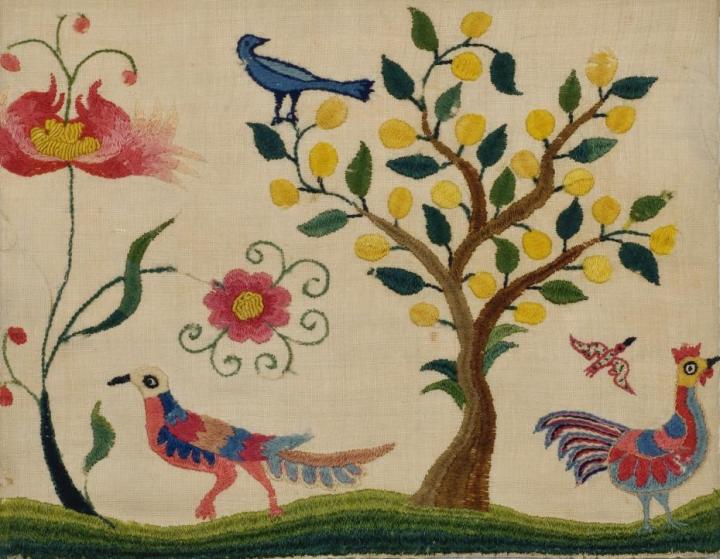
Needlework picture, 1750–1800
(Winterthur: Gift of Henry Francis du Pont 1961.1697)
◊ ◊ ◊ ◊ ◊
Now on view at Winterthur:
The Diligent Needle: Instrument of Profit, Pleasure, and Ornament
Winterthur, Wilmington, Delaware, 23 August 2014 — 5 July 2015
For centuries, instruction in needlework was an important part of women’s education. Both plain sewing and fancy embroidery are skills that take considerable time and effort to acquire, and as a result, many women took great pride in their work. Women might use their skill to earn a living through teaching or sewing, to create objects of beauty for themselves and for others, or to embellish clothing and household furnishings. This exhibition showcases the evolution of needlework and the prominent role it played in women’s lives during the 17th through 19th centuries. It opens with the diligence and skill required to learn and excel at needlework and delves into the various applications of the skill with sections on diligence, profit, pleasure, and ornament, featuring stunning visual examples:
Diligence
Samplers diligently worked on in day and boarding schools are the best documented examples of a girl’s education, but needlework skills were also learned at home, where women of all ages too part in the needlework activities of the household.
Profit
Women could use their skill with a needle to generate extra income or support themselves and their families. Some women, known as mantua makers, milliners or tailoresses, created fine dresses and other clothing, others taught embroidery or offered their skill in decorating clothing and furnishings, while others used the skill for plain sewing, mending and hemming.
Pleasure
Not everyone loved embroidery, but those who did would continue to develop their skill and artistry throughout their life.
Ornament
Those skillful with a needle often used their talent to embellish their own clothing, accessories, and textile furnishings.
Call for Papers | Entre l’œil et le monde, 1740–1840
From H-ArtHist:
Entre l’œil et le monde: dispositifs et expédients d’une nouvelle
épistémologie visuelle dans les sciences de la nature entre 1740 et 1840
Université de Neuchâtel, 4–7 November 2015
Proposals due by 5 January 2014
I. Contexte de l’événement
Du 6 au 7 novembre 2014 aura lieu à Neuchâtel un colloque intitulé “‘La bêtise des yeux’. Illusions des sens et épistémologie visuelle au XVIIIe siècle” (“‘Der Augen Blödigkeit’. Trugwahrnehmungen und visuelle Epistemologie im 18. Jahrhundert”). Il s’agit de se pencher sur les dimensions physiologique, individuelle et sociale du processus de perception visuelle, tel que le mettent en scène la littérature, les beaux-arts et la philosophie du XVIIIe siècle. Nous avons placé au centre de cette rencontre les expériences visuelles problématiques, qu’elles relèvent de l’illusion ou soulignent la faiblesse des sens, voire le caractère trompeur des informations prodiguées par ceux-ci, relativisant ainsi la valeur d’une connaissance essentiellement fondée sur une ‘idéologie de la lumière et de l’œil’. En novembre 2015, un second volet de cette réflexion sera organisé autour de questions plus spécifiquement liées aux sciences naturelles et expérimentales des années 1740 à 1840. (more…)
Two More Waddesdon Manor Treasures Now Online
Le Ballet Royal de La Nuit and Jean de La Fontaine’s Fables choisies, two treasures of Waddesdon Manor’s library collected by Ferdinand de Rothschild (1848–1898) are now accessible via the online collection catalogue.

Jean de La Fontaine, Fables choisies, (Paris, 1755–59); Waddesdon, The Rothschild Collection (The National Trust) Bequest of James de Rothschild, 1957; acc. 3681.1-4. Photo by Mike Fear © The National Trust, Waddesdon Manor.
Le Ballet Royal de La Nuit at Waddesdon was probably produced as a gift for Louis Hesselin (1602–1662) as a reward for the successful staging of the ballet, first performed at the French court on 23 February 1653. It contains material from three distinct sources: the booklet of the ballet printed by Robert Ballard in 1653, a poem called Le Docteur Muët, and 129 original designs depicting costumes and scenes from the ballet now attributed to Henry Gissey (c. 1621–1673). Reproductions of the bindings; inscriptions by a previous owner, Baron Jérome Pichon (1812–1896); as well as the designs are available online, accompanied by commentaries based on the publication: Michael Burden and Jennifer Thorp (eds), Ballet de la Nuit: Rothschild B1/16/6 (Hillsdale; Pendragon Press; 2009).
Also now online are entries for four volumes of Jean de La Fontaine’s (1621–1695) Fables choisies, published in Paris between 1755 and 1759 by Desaint and Saillant. This edition is considered to be the most magnificent illustrated book made before the advent of modern printing. The binding of the Waddesdon example, by Louis Douceur (d. 1769), is decorated with specially-cut tools also illustrating the fables. The dolphin which occurs on the spine panels of the Waddesdon volumes may indicate that these were bound especially for the Dauphin Louis (1729–1765), son of Louis XV. Details of the location and sizes of the illustrations in all four volumes, along with a transcription of the title and names of the designer and engraver of each print, are included in the online entries.
Both books can also be explored further in the newly published catalogue by the late Giles Barber, The James A. de Rothschild Bequest: Printed Books and Bookbindings (The Rothschild Foundation, 2013). The Waddesdon collection is one of the finest of its kind in the world, and the published catalogue along with the online entries allows for many of these treasures to be revealed to the public for the first time. For more information about the printed catalogue, please visit the website.
Exhibition | Out of the Ordinary: Living with Chinese Export Porcelain
From Jorge Welsh:
Out of the Ordinary: Living with Chinese Export Porcelain
Jorge Welsh, London, 1–8 November 2014
Jorge Welsh, Lisbon, 14 November — 6 December 2014
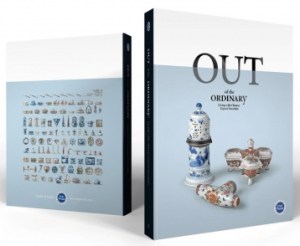 The exhibition Out of the Ordinary: Living with Chinese Export Porcelain will take place at the newly refurbished London gallery from the 1st of November, coinciding with the late night opening of Asian Art in London. The exhibition then travels to our Lisbon gallery, where it will be on view from the 14th of November until the 6th of December.
The exhibition and catalogue will focus on the most unusual forms of Chinese export porcelain produced in the late 17th and 18th centuries. Truly out of the ordinary, most of these items were copied from Western prototypes made in metal, wood, ceramics or glass. Jorge Welsh will present more than 100 objects including egg cups, strainers, cutlery handles, pudding moulds, custard pots, ladles, funnels, bulb pots, snuff boxes, cane handles, barber’s bowls and chamber pots, amongst others. Commissioned according to the latest fashions, they provide an insight into the scope of the European orders and the sophistication of contemporary consumer society in Europe at this time.
Out of the Ordinary: Living with Chinese Export Porcelain (London: Jorge Welsh Books, 2014), 344 pages, ISBN 978-0957354715, £100.
New Book | Bertrand’s Toyshop in Bath: Luxury Retailing, 1685–1765
From the flyer (via Oblong Creative) . . .
Vanessa Brett, Bertrand’s Toyshop in Bath: Luxury Retailing, 1685–1765 (Wetherby: Oblong Creative, 2014), 364 pages, ISBN: 978-0957599246, £48 / $89 / €69.
 Toys were expensive luxuries such as gold snuffboxes, buckles, watches, canes, and porcelain. Toyshops also sold children’s playthings, theatre tickets, elixirs and scientific instruments—and much more. Paul Bertrand was born in America of Huguenot parents. He worked in London as a goldsmith until his second marriage linked him to the family of England’s most successful toyshop owners, and took him to Bath.
With over 230 illustrations and 364 pages, this hardback book takes a fresh approach to the history of retailing and of Bath. Through the topography and society of Bath and London in the early eighteenth century, and through Bertrand’s newly-discovered bank account, it reveals how shopkeepers, craftsmen and merchants rubbed shoulders with actors and lawyers, courtiers and soldiers. Bertrand’s customers included royalty, the ‘middling sort’, country dwellers and townsfolk. The book is about commerce, about people, about the objects that were part of their daily lives, and the development of a fashionable resort.
Whereas many books on retailing, and books on Bath, focus on the last decades of the eighteenth century due to the availability of material, this book is about the first half of the century. The newly discovered bank account of this luxury shopkeeper is an important addition to the handful of known business archives relating to retailers of the period. It reveals the names of nearly 900 people of all social levels and over 100 trades and occupations. Paul Bertrand was at the centre of Bath life, not only because of his toyshop but also through the assembly rooms and carrier’s business of his partners. Illustrations include portraits, landscapes, maps, the paperwork on which banking and businesses depended, and the stock of a toyshop. The book will appeal to all those with an interest in the eighteenth century and the central role of trade and luxury goods.
Vanessa Brett was brought up in the City of London and now lives near Bath. She is a former editor of The Journal of the Silver Society.
Exhibition | In Plain Sight: Discovering the Furniture of Nathaniel Gould
Press release (15 September 2014) from PEM:
In Plain Sight: Discovering the Furniture of Nathaniel Gould
Peabody Essex Museum, Salem, MA, 15 November 2014 — 29 March 2015
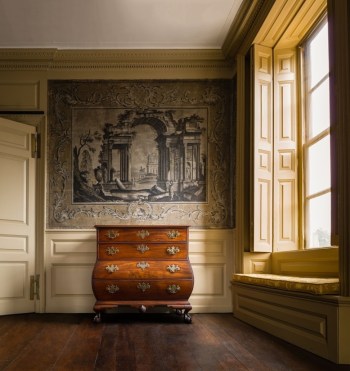
Chest of Drawers, 1758–66, attributed to Nathaniel Gould. Marblehead Historical Society and Museum. Photographed in the Jeremiah Lee Mansion (ca. 1766–68), 170 Washington Street, Marblehead. © 2014 Peabody Essex Museum. Photo by Dennis Helmar Photography.
At the dawn of the American Revolution in a city bustling with trade, politics and commerce, a craftsman of unusual ability was working tirelessly to create fine furniture for his wealthy patrons. Nathaniel Gould (1734–1781) established one of the region’s most sought-after workshops, producing thousands of technically sophisticated and aesthetically refined works for clients at home and for export. With an astute business sense, Gould thrived in one of the most tumultuous political and economic eras in American history. Despite all of this, until recently, Gould’s life and legacy was largely unknown. Masterworks sat in anonymity in the halls of major museum collections, unsigned by their maker and identified only vaguely by their geographic origin. In 2006, everything changed.
In the vaults of the Massachusetts Historical Society, among the records of Gould’s estate lawyer, researchers discovered documents that cast fresh light on—and forever enhance our understanding of—American furniture history. Three of Gould’s bound ledgers kept between 1758 and 1783 document in detail the production of almost 3,000 pieces of furniture in his Salem workshop. Painstaking analysis has revealed the identity, preferences, and transactions of more than 500 of Gould’s patrons as well as the names of his journeymen and probable apprentices. This veritable data dump of information has led museums, antique collectors, and the general public to examine their collections with fresh eyes and piqued interest. Works whose significance was obfuscated by the passage of time and lack of provenance are now being reconsidered and reappraised.
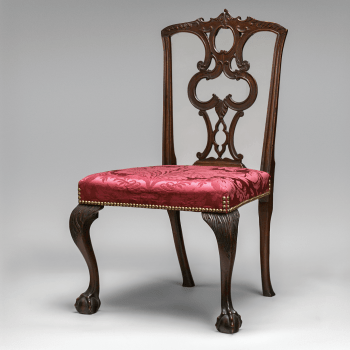
Attributed to the shop of Nathaniel Gould, Side Chair, 1770. Mahogany, maple, birch, and pine, 39 x 21 x 21 inches (NY: The Metropolitan Museum of Art: Gift of Mrs. Paul Moore, 39.88.2)
In Plain Sight: Discovering the Furniture of Nathaniel Gould—on view at PEM from November 15, 2014, through March 1, 2015—is the first exhibition to definitively unpack this discovery and describe the signature characteristics of Gould’s work. In Plain Sight also invites exploration into the life, times and social mores of early America through the lens of one of the country’s earliest and most successful woodworkers. Stately desks, bombé chests, and scalloped-top tea tables made of the finest imported mahogany are presented alongside paintings, archival materials, decorative arts, and an interactive workbench and desk provide insight into the makers and consumers of 18th-century American design and culture. The exhibition is accompanied by an exquisite publication of photographs and detailed essays from PEM curators and principal researchers Kemble Widmer, Joyce King, and Betsy Widmer.
“Possessing extraordinary woodworking skills and a refined sense of design, Gould created works that rank among the finest produced in 18th-century New England,” says Dean Lahikainen, PEM’s Carolyn and Peter Lynch Curator of American Decorative Art. “This jewel-like exhibition celebrates the best of Gould’s furniture in a format that invites contextual exploration and rewards close looking.”
Gould’s work is distinguished by its careful attention to graining, distinctive carved ball-and-claw feet, extended knee returns, and superbly carved pinwheels and scallop seashells. Clients could choose from a range of design forms, including desks and chests of drawers, tables, chairs, beds, and miscellaneous pieces, such as cradles, coffins, and fire screens. Gould built his career on his ability to translate London’s latest designs—sometimes gleaned from British pattern books, including Thomas Chippendale’s The Gentleman and Cabinet-Makers Director—into a more conservative style that pleased the tastes of the region’s wealthy elite.
The Gould ledgers reveal a high percentage of domestic furniture produced to fill wedding orders, mostly from members of the merchant class. Within a highly competitive social environment, newlywed couples aspired (as they do today) to own status symbols that communicated the family’s wealth and social position.
At the time, Salem was the hub of coastal trade and, as the ever-wise businessman, Gould saw opportunity. His ledgers reveal 616 pieces of furniture that were sold in the Caribbean and of this inventory, 62 percent were desks, half of which were made of cedar—an aromatic wood prized for its ability to deter insects in the semitropical regions. Gould’s participation in the export business also allowed him to become Salem’s principal importer of cedar and mahogany logs and allowed him to reserve the best pieces for his own magnificent workshop.
◊ ◊ ◊ ◊ ◊
From Giles:
Kemble Widmer and Joyce King with essays by Dean Lahikainen, Glenn Adamson, Daniel Finamore, and Elisabeth Garrett Widmer, In Plain Sight: Discovering the Furniture of Nathaniel Gould (London: Giles, 2014), 284 pages, ISBN: 978-1907804335, £45 / $70.
 In Plain Sight: Discovering the Furniture of Nathaniel Gould is the stunning result of happy accident and indefatigable, dedicated research. In the field of early American furniture made in Massachusetts, Nathaniel Gould has loomed as something of a mystery—believed to have been prolific, handsomely skilled, and exceptionally enterprising, yet considered elusive because of a scarcity of known works, lack of documentation, and difficulties of attribution. Accident—the unexpected discovery of Gould’s day books and account book in the collection of the Massachusetts Historical Society—and analysis—painstaking and inductive—have produced an invaluable, multifaceted case study.
This book establishes Gould unquestionably as Salem’s leading cabinetmaker before and during the period of the American Revolution. He made substantial and often expensive furniture, including case pieces of bombé form embellished with carving. The number of works that can be attributed to Gould remains small, but the foundation for increasingly assured connoisseurship lies within these pages and Gould’s archival records. The scale of his workshop, his impressively large, diverse clientele, and his successes in Salem’s furniture export trade attest to his achievements as an entrepreneur.
This book illuminates not only a particular individual, but the Salem/Boston/New England spheres in which Gould operated during a tumultuous time in American history. The scrupulously recorded notations in his ledgers are precious clues to emerging concepts of style and taste, cultural mores, business practices, socio-economic circumstances, and familial histories with local, regional, and national relevance. In Plain Sight presents a choice array of forms confidently assigned to Gould’s shop and makes accessible the ledgers themselves, meticulously analyzed and interpreted to facilitate present and ongoing scholarship regarding Nathaniel Gould, Salem, early New England furniture, and colonial America.
Kemble Widmer has applied his training and career as an industrial engineer to his examination of early furniture in Boston and Essex County, Massachusetts. Over twenty-five years, by rigorously documenting and comparing like forms, he has determined places of origin and even individual craftsmen. His research on Nathaniel Gould has disclosed an unparalleled amount of information about cabinetmaking, customers, and colonial life. Joyce King, an eleventh generation inhabitant of Salem, Massachusetts, is an expert in genealogical research. She has collaborated closely with her co-author on numerous issues of provenance that have enabled attributions of furniture to Nathaniel Gould. Glenn Adamson, formerly Head of Research, Victoria and Albert Museum, London, is The Nanette L. Laitman Director of the Museum of Arts and Design, New York. He is the founding co-editor of The Journal of Modern Craft and the author of Inventing Modern Craft. Daniel Finamore is The Russell W. Knight Curator of Maritime Art and History at the Peabody Essex Museum, Salem, Massachusetts. Dean Lahikainen is The Carolyn and Peter Lynch Curator of American Decorative Art at the Peabody Essex Museum, Salem, Massachusetts. His publications include Samuel McIntire: Carving an American Style and In the American Spirit: Folk Art from the Collections of the Peabody Essex Museum. Elisabeth Garrett Widmer, formerly director of Sotheby’s American Arts course and a Senior Vice President at Christie’s, New York, and director of Classes in Connoisseurship, is an authority on American eighteenth- and nineteenth-century decorative arts and social history. Her publications include At Home: The American Family, 1750–1870.
Exhibition | Tables from the Great Gallery of The Wallace Collection
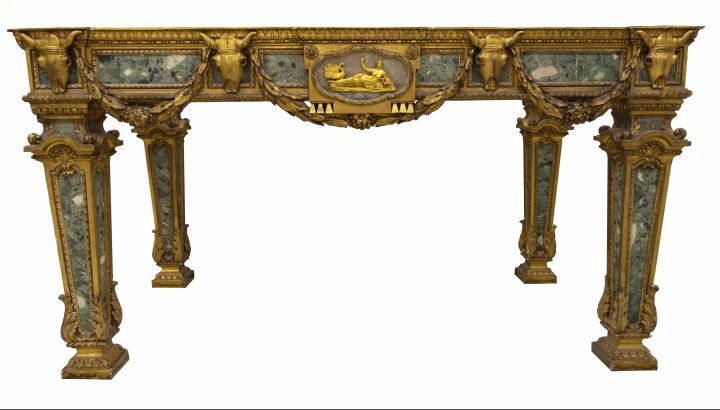
Pier table, Italy, ca. 1770 (London: The Wallace Collection)
A high resolution image is available here»
◊ ◊ ◊ ◊ ◊
Now on at The Wallace:
Collaboration, Conservation and Research: Furniture from the Great Gallery
The Wallace Collection, London, 19 September 2014 — 27 September 2015
Two pairs of monumental tables have been on display in the Great Gallery for more than a century. The recent Great Gallery refurbishment project provided the perfect opportunity for all four tables to undergo full cleaning and conservation treatment. To address the treatment needs of the tables, the Wallace Collection teamed up with Buckingham New University, City and Guilds of London Art School and West Dean College and several students undertook the work as an integral part of their degree course. Now, some two years later, the tables have returned from treatment and look stunning in their former locations, much as they would have looked in Sir Richard Wallace’s day.
During the course of their treatment conservators and curators were able to analyse the tables forensically, discovering, for example, that the two in the centre of the gallery (F510-511) are not in fact a pair, instead one is a later copy of the other. To learn more about our new findings, as well as the techniques which the students used in their conservation work on these and the pair of pier tables (F514-515), come and visit the display from 19 September in the Conservation Gallery at the Wallace Collection.
T A L K S
All talks start at 1pm in the Conservation Gallery.
Monday, 22 September: John Slight, a former student from Bucks New University, will discuss the treatment of a grand nineteenth-century Italian table.
Monday, 20 October: Hans Thompson, a former student from City and Guilds of London Art School, will discuss the treatment of the Italian eighteenth-century Pier table.
Thursday, 20 November: Kate Aughey, a former student from West Dean College, will discuss the treatment of the Italian eighteenth-century Pier table.
Monday, 8 December: Dr. Marina Sokhan, Head of Conservation at City and Guilds of London Art School, will discuss the treatment of the Italian eighteenth-century Pier table as well as the conservation course at City and Guilds of London Art School.
Exhibition | Birth of Design, Furniture Masterpieces, 1650–1789
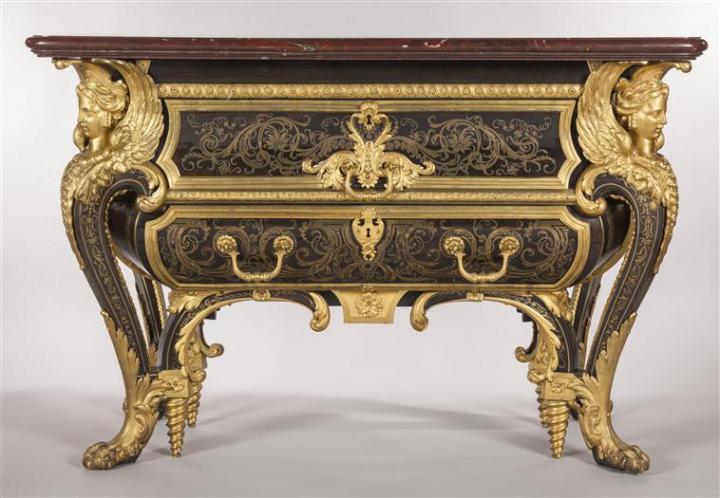
André-Charles Boulle, Louis XIV’s commode; made of resinous wood, ebony veneer, tortoiseshell and bronze inlay, gilt bronze, griotte marble; Paris, 1708, H. 88 x 131 x 65 cm (Versailles, National Museum of the Palaces of Versailles and Trianon; Inv. VMB 14279.1)
◊ ◊ ◊ ◊ ◊
From the Château de Versailles:
Eighteenth Century, Birth of Design, Furniture Masterpieces, 1650–1789
18e, aux sources du design, chefs-d’œuvre du mobilier 1650 à 1790
Château de Versailles, 28 October 2014 — 22 February 2015
From 28 October 2014 to 22 February 2015, the Palace of Versailles is hosting the exhibition 18th Century, Birth of Design, Furniture Masterpieces from 1650 to 1790 in the Africa and Crimea Rooms. The exhibition offers a glimpse of the ingenuity of a bygone era viewed from a present-day perspective and showcases the innovative and avant-garde nature of the shapes, techniques, decorations, and materials used in 18th-century furniture. The exhibition includes around 100 major works from collections at the Palace of Versailles, the Louvre Museum, the Musée des Arts Décoratifs, the Palace of Fontainbleau, and the Getty Museum, alongside works from private collections which will be on show to the public for the first time. Cabinets, desks, writing tables, commodes, and console tables, but also sofas, armchairs, folding chairs, and seating chairs will testify to the revolution that the 18th century brought about in the history of furniture, a reflection of the evolving tastes of a society enamoured by modernity and wanting to live in comfort and luxury.
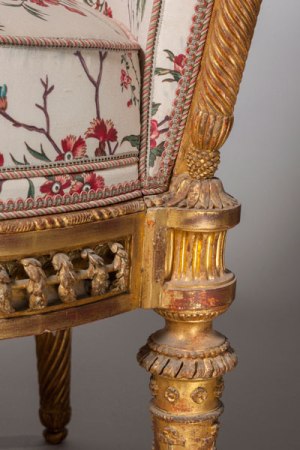
Jacques Gondoin and François II Foliot, Chair from the Pavillon du Rocher at the Petit Trianon; carved, gilded beech; 1781, 89 x 56 x 56 cm (Versailles, National Museum of the Palaces of Versailles and Trianon, Inv. V 5358)
Concept of Design
In 1712, Shaftesbury introduced the term and concept of design to art theory. It contains the dual meaning of ‘plan’ and ‘intention’ and unifies the processes of conceiving and shaping a work. For the first time, furniture was planned with forethought, created with specific intention and shaped for both functionality and comfort. 18th-century furniture was produced according to design sources, both in its overall conception and its quest for harmony between form and function.
The Transformation of Furniture
The quest for the ideal shape and form hit its peak in the 18th century, when the shape of furniture began to change. Inventiveness and creativity abounded and new outlines began to take shape, from console tables to commodes to secretary and armoire desks. Rigid outlines began to soften, then morphed into rounded curves, subsequently giving way to curved legs—sometimes four, six or even eight of them. Furniture became multi-purpose and featured mechanisms that allowed it to transform into something else.
Boldness of Materials and Colours
The same quest characterised the use of materials: furniture was covered with exotic woods, lacquers, varnishes, tortoiseshell, mother-of-pearl, bronze, brass, lead, porcelain, straw, steel and stone marquetry. Cloth, bulrush and copper began to be used in chairs. Long before the garish colours afforded by plastic in the 20th and 21st centuries, the 18th century saw the birth of furniture in red, daffodil yellow, turquoise blue, apple green, partially gilded or silvered, etc. At the same time, other colour palettes were limited to the black and gold of lacquer and bronze, and patterns were reduced to natural ones made out of quality materials such as mahogany.
◊ ◊ ◊ ◊ ◊
The catalogue is available in both French and English:
18th Century, Birth of Design, Furniture Masterpieces, 1650–1790 (Dijon: Éditions Faton, 2014), 280 pages, ISBN 978-2878441949 (English) / 978-2878441901 (French), 42€.
 The sole purpose of this book, published to tie in with the magnificent exhibition at the Palace of Versailles, is to lay bare the incredible inventiveness of the century of Enlightenment, a century in which, for the first time, furniture became an art. Architects, artists and dealers as well as ordinary craftsmen set about organising furniture and elaborating it as never before.
The eighteenth century was to turn three everyday acts—sitting, sitting at table, storing things—into an art. Furniture changed its skin and shape. For the first time, it explored new materials, sought out new forms. It broke free of architecture, but went on playing with some of its styles. It became movable and occasional, and the notion of comfort came into being. Furniture found its identity in everyday actions to which it was closely linked. The connection between the individual and furniture became obvious. From its disposition to its ingenuity, and through the matchless quality of its incomparable workmanship, furniture in the eighteenth century came to be an integral part of daily life and fashion, quick to respond to changing moods and styles. Having thus secured both a new status and recognition, it became for ever a distinct element in the intellectual process of creation.
Daniel Alcoufe, conservateur général honoraire
Gérard Mabille, conservateur général honoraire
Yves Carlier, conservateur en chef au Musée national des châteaux de Versailles et de Trianon
Patrik Hourcade, photographe et designer
Patrick Lemasson, conservateur en chef au Musée du Petit Palais
Call for Papers | Charles de La Fosse and the Arts in France, ca. 1700
As noted at Le Blog de L’ApAhAu:
Charles de La Fosse et les arts en France autour de 1700
Château de Versailles, 18–19 May 2015
Proposals due by 15 December 2014

Charles de la Fosse, Clitia Changed into a Sunflower, 1688, 128 x 156 cm (Versailles: Châteaux de Versailles et de Trianon)
En complément de l’exposition Charles de La Fosse qui se tiendra au Château de Versailles du 23 février au 24 mai 2015, l’établissement public du château, du musée et du domaine national de Versailles et le centre recherche du Château de Versailles organisent un colloque sur l’artiste, les lundi 18 et mardi 19 mai 2015.
L’exposition, organisée en cinq grandes sections (les commandes pour les maisons royales ; La Fosse dessinateur ; la tradition académique ; le triomphe du coloris ; un précurseur du XVIIIe siècle) sera en effet de l’occasion de faire le point sur un artiste majeur de la seconde moitié du règne de Louis XIV.
Le colloque voudrait être à la fois un approfondissement et un élargissement du propos de l’exposition et permettre de mieux situer La Fosse dans les enjeux de la pratique artistique autour de 1700. Il s’articulera donc en quatre grandes sections, chacune avec plusieurs thématiques possibles (indiquées ici à titre d’exemple), qui pourront accueillir entre trois et cinq communications d’environ 20/25 minutes:
• L’art de La Fosse (la question du dessin; les artistes contemporains élèves ou collaborateurs de La Fosse)
• Le grand décor au temps de La Fosse (quadratura et plafond; le grand décor religieux)
• La mythologie vue par La Fosse et ses contemporains (Apollon- Soleil; Clytie et les fleurs; les amours des dieux)
• La Fosse et le rayonnement des capitales artistiques (Venise à Paris; le séjour Londres; le cercle Crozat)
Toute personne qui souhaiterait présenter une communication doit envoyer un synopsis de celle-ci en 300–500 mots pourvu d’un titre, avec un curriculum vitae d’une page avant le 15 décembre 2015 à
beatrice.sarrazin@chateauversailles.fr et olivier.bonfait@u-bourgogne.fr. Les réponses seront données autour du 10 janvier. Le colloque devrait pouvoir être publié.
Direction scientifique
Béatrice Sarrazin (Conservateur général au Château de Versailles et de Trianon) et Olivier Bonfait (professeur à l’Université de Bourgogne)
Comité scientifique
Olivier Bonfait (professeur à l’Université de Bourgogne), Adeline Collange-Perugi (conservateur au musée des beaux-arts de Nantes), Clémentine Gustin-Gomez (historienne de l’art), Béatrice Sarrazin (Conservateur général au Château de Versailles et de Trianon).










 Enfilade
leave a comment