Exhibition | J. M. W. Turner: Romance and Reality
 .
.
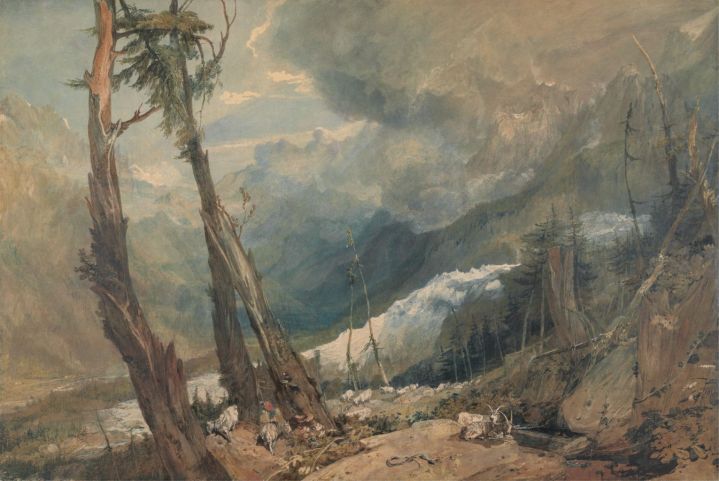
J.M.W. Turner, Mer de Glace, in the Valley of Chamonix, 1803, watercolor, graphite, gum, scraping out and stopping out on moderately thick, slightly textured, cream wove paper mounted on thick, smooth wove paper (New Haven: Yale Center for British Art, B1977.14.4650)
◊ ◊ ◊ ◊ ◊
Opening next month at the YCBA, which itself reopens after a two-year conservation project:
J. M. W. Turner: Romance and Reality
Yale Center for British Art, New Haven, 29 March — 27 July 2025
Dordrechts Museum, Spring 2026
The year 2025 marks the 250th anniversary of the birth of Joseph Mallord William Turner (1775–1851), possibly the most widely admired and influential British artist of all time.
Though Turner was trained within the English topographical tradition, his practice was deeply rooted in a wider European heritage of landscape painting. Turner pushed this inheritance to its limits in pursuit of his own expressive ends, astounding contemporaries with his bold and highly original compositions. His unique approach paved the way for a new form of landscape art, one that combined virtuoso brushwork with brilliant color, dazzling light effects, and an almost abstract sensibility. As a result, Turner came to be recognized as the most radical and innovative painter of his time and has continued to be so ever since.
This exhibition, the first show focused on Turner to be held at the Yale Center for British Art in more than thirty years, will showcase the museum’s rich holdings of the artist’s work. Unequaled in North America, this collection includes some of Turner’s most acclaimed oil paintings, notably his masterpiece Dort or Dordrecht: The Dort Packet-Boat from Rotterdam Becalmed (1818) and his celebrated later painting Staffa, Fingal’s Cave (1831–32). Alongside these major works, the exhibition will also feature outstanding watercolors and prints from the YCBA’s collection, including the artist’s only complete sketchbook outside of the British Isles.
Turner’s works are akin to painted poems, filled with incident, anecdote, and symbolism. Conveying both the beauty and cruelty of nature and human life, they shed fascinating light on the artist’s world and reveal an aesthetic—and moral—complexity that is at once discomforting and strangely modern.
The exhibition is generously supported by the Dr. Lee MacCormick Edwards Charitable Foundation.
From Yale UP:
Ian Warrell, with contributions by Gillian Forrester, Turner (New Haven: Yale University Press, 2025), 144 pages, ISBN: 978-0300279719, $40.
 This book, the inaugural installment in the Yale Center for British Art’s Collection Series, explores the museum’s astonishing Turner holdings—the largest outside the United Kingdom—in a manner that will engage the general reader and expert alike. Six sections of plates provide a comprehensive overview of the artist’s career, place the works within their historical and cultural context, and include new discoveries regarding the identification of locations, landscapes, and dates. Gillian Forrester’s supplementary essay offers a novel account of Turner’s innovative printmaking practice, illuminating his fraught collaborations with other printmakers. Complementing an exhibition at the YCBA and a satellite exhibition at the Dordrechts Museum (The Netherlands), both planned for the 250th year of Turner’s birth, this publication celebrates the artist’s unparalleled vision as exemplified in the YCBA’s world-class collection of his work.
Ian Warrell is an independent curator specializing in British art of the nineteenth century. Gillian Forrester is an independent curator specializing in British art from the eighteenth century to the present and former senior curator of prints and drawings at the Yale Center for British Art.
Turner 250

.
J.M.W. Turner, The Battle of Trafalgar, 21 October 1805, 1822–24, about 10 × 14 feet framed
(Greenwich: National Maritime Museum, BHC0565)
◊ ◊ ◊ ◊ ◊
Press release (21 January 2025) from Tate:
This morning, cultural institutions across Britain announced Turner 250, a year-long festival of special exhibitions and events. Taking place throughout 2025, the programme celebrates 250 years since the birth of renowned painter JMW Turner. Whether visiting museums and galleries or tuning in on TV and online, everyone will have the chance to enjoy Turner’s greatest works, learn about his incredible life and career, and discover the many ways he continues to inspire creativity today.
Born on 23 April 1775, Joseph Mallord William Turner is widely considered to be the greatest and most influential British artist of all time. From humble beginnings, he travelled the length and breadth of the country to capture its dramatic scenery, redefining landscape painting in the process. Today he remains a touchstone of British cultural life—the face on the £20 note—and the painter behind some of the most iconic images of the natural world ever created.

J.M.W. Turner, Self-Portrait, ca.1799, oil on canvas, 74 × 58 cm (London: Tate, Turner Bequest 1856, N00458).
This announcement includes over 30 projects taking place this year, organised by venues large and small as well as by national organisations such as Tate, the BBC, and Art UK. Turner exhibitions will be held in London, Edinburgh, Leeds, Manchester, Liverpool, Norwich, Bath, and Sussex, highlighting key themes in his life and work and exploring his connections to other renowned historic figures like Jane Austen and John Constable. Turner’s legacy in modern and contemporary art will be celebrated with displays, commissions, and events in London and Margate, while the Turner Prize will be staged in Bradford as a highlight of the UK City of Culture programme. Books, films, and digital content will be released through the year, including a complete catalogue of Turner’s 37,500 sketches and watercolours on Tate’s website, a major new BBC documentary bringing the man and his art to life, and a screening of Mike Leigh’s award-winning film Mr. Turner at BFI Southbank. Talks and workshops will showcase new scholarship and ideas inspired by Turner, including an international conference at Tate Britain, a summit exploring art’s connection to the natural world at Turner Contemporary, and the Turner Society’s annual Kurt Pantzer memorial lecture. A keen international traveller, Turner will also have his 250th anniversary commemorated far beyond the UK, with celebratory shows being staged in Connecticut, Cincinnati, and Shanghai, as well as a special exhibition closer to home in Dublin.
Turner’s birthday on 23 April 2025 will be a particular highlight: the artists shortlisted for the Turner Prize will be announced that morning ahead of their show in Bradford in the autumn, an exhibition of Turner’s rarely-seen images of wildlife will open at Turner’s House in Twickenham, and a newly refreshed room will open in Tate Britain’s Clore Gallery, home to a permanent free display of 100 works by the artist.
Arts Minister Sir Chris Bryant said: “Turner was one of this country’s greatest artists. An innovator who created some of our best known canvasses, he reshaped British art. A talent of Turner’s stature requires a year of celebration, from the prize in his name to the back of the £20 note, his immense legacy continues to permeate through the arts and public life in Britain. The 250th anniversary of his birth will be an opportunity for the public to immerse themselves in our outstanding artistic heritage. I encourage everyone to take the time to find an event from the upcoming year to enjoy some of Britain’s finest artists from the past and present.”
Maria Balshaw, Director of Tate, said: “Turner is a standout figure in the story of British creativity. It is Tate’s privilege to care for the world’s biggest collection of his art and showcase it to the widest possible public. Over the course of this year, I’m delighted that we will be showing over 150 of his stunning works at Tate Britain as well as lending over 100 more to venues right across this country and beyond.”
Suzy Klein, Head of BBC Arts & Classical Music TV, said: “We’re thrilled to be working with Tate to celebrate Britain’s most celebrated artist and be granted unprecedented access to Turner’s vast collection of rarely seen sketches. I can’t wait to share this treasure trove with audiences, not only illuminating the workings of Turner’s unique creative mind but also offering an unprecedented view into the extraordinary era of change during his lifetime.”
Exhibition | A Lively Mind: Jane Austen at 250
There’s no shortage of stimulating events marking this year’s 250th anniversary of Jane Austen’s birth, and readers will know this terrain much better than I. But for anyone tring to keep up, the following sites offer a useful starting place. –CH
• Ben Jureidini, “Is 2025 the Year of Jane Austen? From Society Balls to Blockbuster TV Shows, the 250th Anniversary of ‘Britain’s Greatest Author’ Is Set to Break Records,” The Tatler (6 January 2025). Miss Austen and The Other Bennet Sister on the BBC, a Dolly Alderton adaptation of Pride and Prejudice heading for Netflix, and a tourism boom for real-life regency balls, there’s something truly Austentatious about 2025. Link»
• “Worldwide Guide to Jane Austen 250th Events,” from the Jane Austen Centre in Bath, which focuses on the life and works of Jane Austen, as well as the Regency period in which she lived. Link»
• The Jane Austen Society, founded in 1940 by Dorothy Darnell with the purpose of raising funds to preserve the Cottage in the village of Chawton, Hampshire, where Jane Austen lived with her mother and sister Cassandra from 1809 to 1817. Link»
• The Jane Austen Society of North America, a non-profit organization staffed by volunteers and dedicated to the enjoyment and appreciation of Jane Austen and her writing. Link»
◊ ◊ ◊ ◊ ◊
Opening at The Morgan in June:
A Lively Mind: Jane Austen at 250
The Morgan Library and Museum, New York, 6 June — 14 September 2025
Organized by Dale Stinchcomb and Juliette Wells
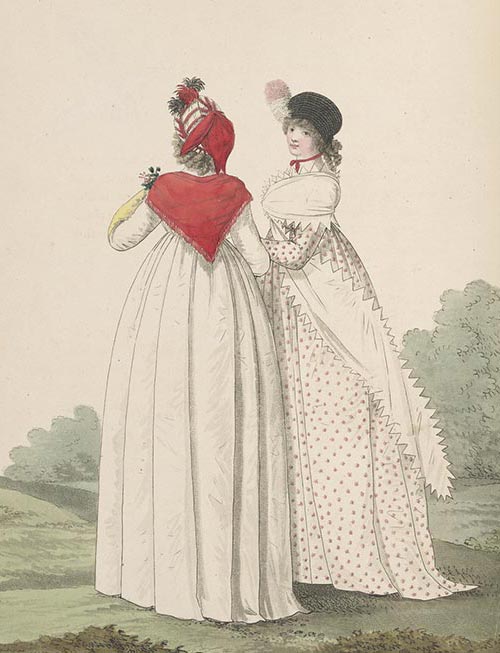
Morning Dresses from Gallery of Fashion (London: N. Heideloff, 1798), figs. 198, 199 (New York: The Morgan Library & Museum; PML 5680).
A Lively Mind immerses viewers in the inspiring story of Jane Austen’s authorship and her gradual rise to international fame. Iconic artifacts from Jane Austen’s House in Chawton, England join manuscripts, books, and artworks from the Morgan, as well as from a dozen institutional and private collections, to present compelling new perspectives on Austen’s literary achievement, her personal style, and her global legacy.
Beginning as a teenager, Austen cultivated her imaginative powers and her ambition to publish. Encouraged by her family, especially her father and her sister Cassandra, she persevered through years of uncertainty. Her creativity found expression in a range of artistic pursuits, from music-making to a delight in fashion. The story of how Americans first encountered and responded to Austen’s novels, unbeknownst to her, emerges from four surviving copies of an unauthorized edition of Emma published during her lifetime. Following Austen’s death, family members preserved their memories of her, while carefully guarding what was publicly revealed. Austen’s audience continued to grow as those who loved her novels helped new generations of readers to appreciate them. In addition to celebrating Austen, A Lively Mind commemorates the landmark gift of Austen manuscripts to the Morgan in 1975 by Alberta H. Burke and draws extensively on the extraordinary collection she bequeathed to Goucher College in Baltimore.
A Lively Mind: Jane Austen at 250 is organized by Dale Stinchcomb, Drue Heinz Curator of Literary and Historical Manuscripts, and Juliette Wells, Professor of Literary Studies at Goucher College. It is made possible by generous support from the Drue Heinz Exhibitions and Programs Fund, Cynthia H. Polsky, Martha J. Fleischman, the Caroline Morgan Macomber Fund, the Lucy Ricciardi Family Exhibition Fund, and Alyce Williams Toonk.
Exhibition | Better on Paper

.
John Pike, Fan: Land of Matrimony and Land of Celibacy, London, late 18th century, paper and wood
(Wellesley College Special Collections)
◊ ◊ ◊ ◊ ◊
From the press release for the exhibition:
Better on Paper: Recent Acquisitions of Prints, Drawings, Photographs, and Books
Davis Museum, Wellesley College, Massachusetts, 7 February — 1 June 2025
Curated by Amanda Gilvin and Ruth Rogers
Better on Paper is a new exhibition that spotlights and celebrates some of the thousands of newly acquired and previously unseen works of art on paper, including prints, drawings, photographs, books, and other objects, acquired by the Davis Museum and the Wellesley College Library Special Collections over the last decade. The exhibition emphasizes contemporary art, while also showcasing many new acquisitions of art from past centuries. More than 100 recent gifts and purchases will be on view in Better on Paper, along with two other new exhibitions at the Davis Museum all highlighting new acquisitions.
“Better on Paper presents a stunning array of visionary works of art from Wellesley’s collections in this collaboration between the College Library’s Special Collections and the Davis,” said Amanda Gilvin, the exhibition’s co-curator and Interim Co-Director, Sonja Novak Koerner ’51 Senior Curator of Collections, and Associate Director of Curatorial Affairs.
The exhibition calls attention to Wellesley’s decades-long leadership in the field of the study of photography, Gilvin said. She notes works that will be on view and are now part of the Davis collection include Nigerian artist Taiye Idahor’s Ekundayo; prominent African American photographer in the 1970s and 1980s Ming Smith’s Self Portrait, Harlem, NY; work by locally-based multimedia artist Jo Sandman; Chitra Ganesh’s Architects of the Future, City Inside Her; and Magdelena van de Passe after Crispijn de Passe the Elder’s Spring. Special Collections will present 18th-century publisher John Pike’s satirical fan The Land of Matrimony [and] Land of Celibacy and Swiss graphic designer Romano Hänni’s artist book It is Bitter to Leave Your Home: A True Story Depicted in Typographic Images.

.
Motonori Taki, Kōkei Saikyūhō [Emergency Remedies for the Benefit of People], Kyōto: Izumoji Bunjirō; Edo: Hanabusa Daisuke han, ca. 1790
(Wellesley College Special Collections)
◊ ◊ ◊ ◊ ◊
The Davis and the Wellesley College Library Special Collections have joined together to mount Better on Paper to pay homage to these new acquisitions that represent Wellesley’s commitment to inclusive excellence. Often collaborating with Wellesley faculty, staff, and students, curators have acquired the objects in the exhibition to support and expand the Wellesley College curriculum. The prints, drawings, photographs, books, and other objects in Better on Paper originate from around the globe, spanning diverse makers and approaches, and dating to many periods.
“It is a tremendous opportunity for the College Library’s Special Collections to be off the shelves and on view to a wider audience,” said Ruth R. Rogers, Curator of Special Collections and Visiting Lecturer, Art Department. “Better on Paper allows us to share a selection from the range of international, rare books, contemporary artists’ books, and other evidence of material communication that are the basis of teaching and research on campus.
Building these collections supports today’s Wellesley Method: object-based and human-centered learning across disciplines. “We invite you to study, learn, and teach in this exhibition—and to find out more about the many other works on paper in the Davis Museum and Special Collections,” Gilvin said.
Better on Paper was co-curated by Amanda Gilvin and Ruth Rogers with contributions from Nicole Berlin, Associate Curator of Collections, Alicia Bruce, Friends of Art Curatorial Project Manager and Researcher, Yuhua Ding, Kemper Assistant Curator of Collections and Academic Affairs, L. Goins ‘26, 2024 Summer Curatorial Intern, James Oles, Adjunct Curator of Latin American Art and Senior Lecturer, Art Department, Mariana S. Oller, Associate Curator of Special Collections, and Semente, Curator of Education and Public Programs. The exhibition is presented with generous support from the Anonymous ’70 Endowed Museum Program Fund, Marjorie Schechter Bronfman ’38 and Gerald Bronfman Endowment for Works on Paper, and Wellesley College Friends of Art at the Davis.
Exhibition | Nevers in the World
From the press release for the exhibition:
Nevers in the World
Davis Museum, Wellesley College, Massachusetts, 7 February — 1 June 2025
Curated by Nicole Berlin, with Alicia Bruce and Yuhua Ding
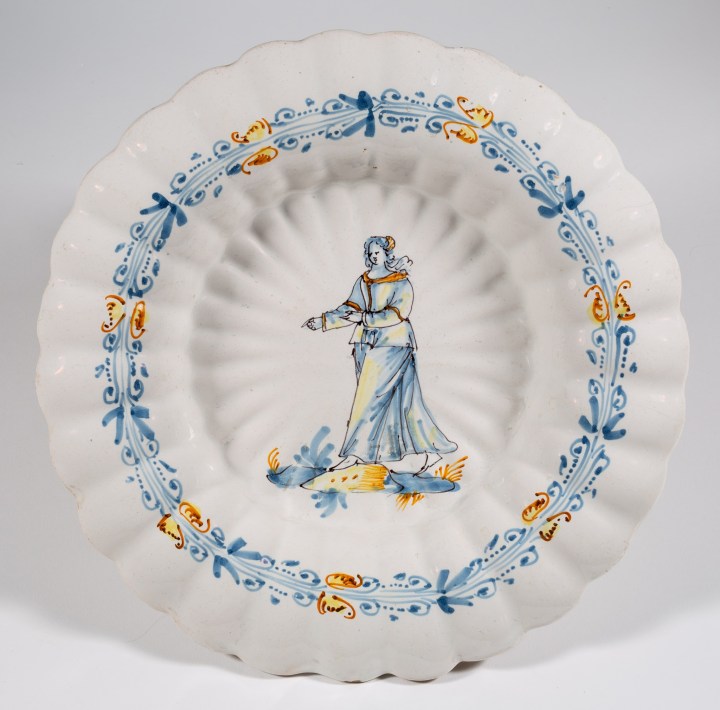
Gadrooned Dish, ca. 1700, Faience, made in Nevers (Davis Museum, Wellesley College, 2023.3.24).
Nevers in the World is an intimate exhibition of 11 newly-acquired seventeenth- to nineteenth-century French ceramics that were recently donated to the Davis Museum at Wellesley College. The French faience vessels are highly stylized glazed ceramics, created using a tin-glaze technique that originated in the Middle East, likely around Iraq, as a response to the vibrant white porcelain of China. Over time, this technique spread to Egypt, Spain, Italy, and eventually France, where it evolved into a distinctive art form.
The exhibition spotlights these beautifully glazed vessels, used mostly for dining tables, and illustrate a cross-cultural migration from their early origins in Iraq to the early iterations of Italian pieces and expanded color palettes and shapes by the French.
“When the generous gift of French faience arrived and our Curatorial team first saw it in storage, we were immediately excited by the many ways we could integrate it into both the permanent collection and a temporary exhibition,” said Nicole Berlin, Associate Curator of Collections at the Davis Museum and the Nevers show curator. “The vibrant colors, whimsical shapes, and the centuries-old ceramic glazing technique open up a wealth of creative possibilities for showcasing this remarkable collection.”
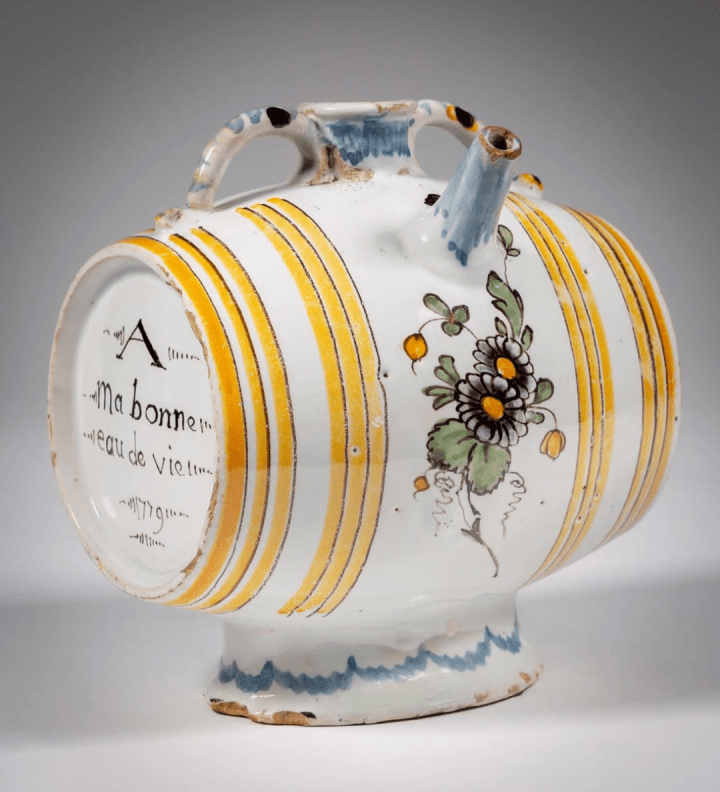
Spirit Cask, 1779, Faience, made in Nevers (Davis Museum, Wellesley College, 2023.3.26).
Nevers in the World is a selection of artworks from the generous bequest of the late Wellesley Trustee Emeritus Sidney R. Knafel, who spent decades assembling a world renowned collection of French ceramics. These objects demonstrate how artistic innovation can flourish through cross-cultural exchange. During the seventeenth and eighteenth centuries, a group of artisans in Nevers, France created extraordinary ceramic vessels using the faience technique. Invented nearly a millennium earlier, faience describes a glaze for ceramics that includes tin. In eighth-century Iraq, craftspeople discovered that adding tin to ceramic glaze produced an opaque, white surface suitable for colorful decoration. As the method spread across Asia and Europe, Italians called it maiolica. In France, it became known as faience, after the Italian city of Faenza.
In 1565, French aristocrat Henriette of Cleves married Italian politician Louis of Gonzaga, Duke of Nevers. The couple brought artisans from Italian maiolica centers to Nevers, where they introduced a style of storytelling through images in addition to tin-glaze. By 1600, European demand for Chinese porcelain spurred workshops in Nevers to attempt imitations in faience. Nevers artisans quickly developed a distinctive style that reached its zenith in popularity under King of France Louis XIV (1638–1715), when it featured in his elaborate dinner parties at Versailles. Today, these objects continue to tell stories about the people who made and used them.
Nevers in the World was curated by Nicole Berlin, Associate Curator of Collections with Alicia Bruce, Friends of Art Curatorial Project Manager and Researcher, and Yuhua Ding, Kemper Curator of Collections and Academic Affairs. This exhibition is supported by the Sandra Cohen Bakalar ‘55 Fund, the Judith Blough Wentz ’57 Museum Programs Fund, and Wellesley College Friends of Art at the Davis.
New Book | Art and Artifice in Visual Culture
From Routledge:
Sonia Coman, Vasile-Ovidiu Prejmerean, and Michael Yonan, eds., Art and Artifice in Visual Culture, Eighteenth Century to the Present (New York: Routledge, 2025), 210 pages, ISBN (hardback): 978-1032756783, $180 / ISBN (ebook): 978-1003478898, $50.
 This edited volume explores the notion of ‘artifice’ in modern visual culture, ranging from the eighteenth century to the present, in countries around the globe.
Artifice has been regarded as a primarily Western phenomenon, playing as it does a central role in European art theory since the Renaissance. This volume proposes that artifice is better understood as a transcultural artistic phenomenon and requires far broader conceptualization across international contexts. It acquaints readers with works of art, visual modes of communication, and concepts originating in France, Germany, the United States, Japan, and China, and includes painting, sculpture, drawings, prints, photographs, film, and virtual reality/augmented reality (VR/AR) objects. Contributors demonstrate how practices of artifice function as both symbol and form, in parallel and divergent ways, in multiple cultural settings.
Sonia Coman, PhD is a Contributor and Consultant at Smarthistory and Director of Digital Engagement at Washington National Cathedral. Vasile-Ovidiu Prejmerean is a PhD candidate at Université de Fribourg, Switzerland. Michael Yonan, PhD is a Professor of Art History and Alan Templeton Endowed Chair in the History of European Art, 1600–1830, at the University of California, Davis.
c o n t e n t s
List of Illustrations
List of Contributors
Introduction: Art and Artifice in a Transcultural Perspective — Sonia Coman, Vasile-Ovidiu Prejmerean, Michael Yonan
Part 1 | Artifice and Spectatorship
1 Fractured Perception: Drawings, Prints, and Verres Casses — J. Cabelle Ahn
2 Rococo Aesthetics and the Problem of Trompe l’Oeil — Michael Yonan
3 Degas’s ‘Histories’ and the Foreshadowing Artifice of Self-Candaulism — Vasile-Ovidiu Prejmerean
Part 2 | Haptic Illusions
4 Suggestive Surfaces: The Self-Referential Texture of Woodgrain in Japanese Woodblock Prints — Kit Brooks
5 Reconsidering the Origins of Yongzheng Guwantu: From the Aniconic Period to Vimalakīrtinirdeśa Sūtra — Chih-En Chen
6 Fooling Art History: John F. Peto and William Harnett — Yinshi Lerman-Tan
Part 3 | Alternative Realities
7 First Nations’ Wampum Belts: A Colonial Vision of Artifice in Eighteenth-Century New France — Clémence Fort
8 ‘An Opportunity to Grapple with the Picture Plane…’: The Stereo-Illusion’s History of Frustration — Eszter Polonyi
9 Self-Reference and Medium-Reference in Virtual Reality and Trompe l’Oeil — Sonia Coman
Index
Morgan Library & Museum Seminar | Drawing Nature, 1500–1900
The Morgan presents this day-long seminar for graduate students:
Drawing Nature, 1500–1900
The Morgan Library & Museum, New York, Friday, 4 April 2025
Proposals due by 21 February 2025
Led by Sarah Mallory, Assistant Curator of Drawings and Prints at the Morgan; Olivia Dill, Moore Curatorial Fellow at the Morgan; and Roberta J. M. Olson, Curator of Drawings Emerita at The New York Historical
European and North American Natural History drawings made before 1900 are historically understood as either works of fine art or as scientific records. The Morgan Library & Museum’s significant collection of natural history drawings, however, provides an opportunity to rethink longstanding divisions between the arts and sciences. This seminar will focus on collection holdings made by artists working in The Netherlands, Germany, England, France, and the Americas, from ca. 1450 to ca. 1850. Participants will have the opportunity to closely examine a large selection of works by Maria Sibylla Merian, Mark Catesby, Madeleine Françoise Basseporte, Georg Dionysius Ehret, John James Audubon, and many others. Lively discussions will address the production and subsequent uses of natural history drawings, including the ways in which techniques of observation and scientific developments informed drawing praxis. Key too will be instances in which artistic practice conditioned the production of empirical knowledge. We will also consider how gender, patronage, collecting practices, and colonial expansion inform natural history drawings.
This seminar is open to graduate students of the history of art, the history of science, and related fields, and also to graduate students interested in the conservation of works on paper. Applicants are kindly invited to submit a one paragraph statement which should include the following:
• Name and email
• Academic institution
• Class year
• Field of study
• Interest in natural history drawings and relevance of the seminar to your research
Applications should be submitted electronically with the subject header ‘Drawing Nature Seminar’ to drawinginstitute@themorgan.org by 21 February 2025. Participants will be notified by March 4.
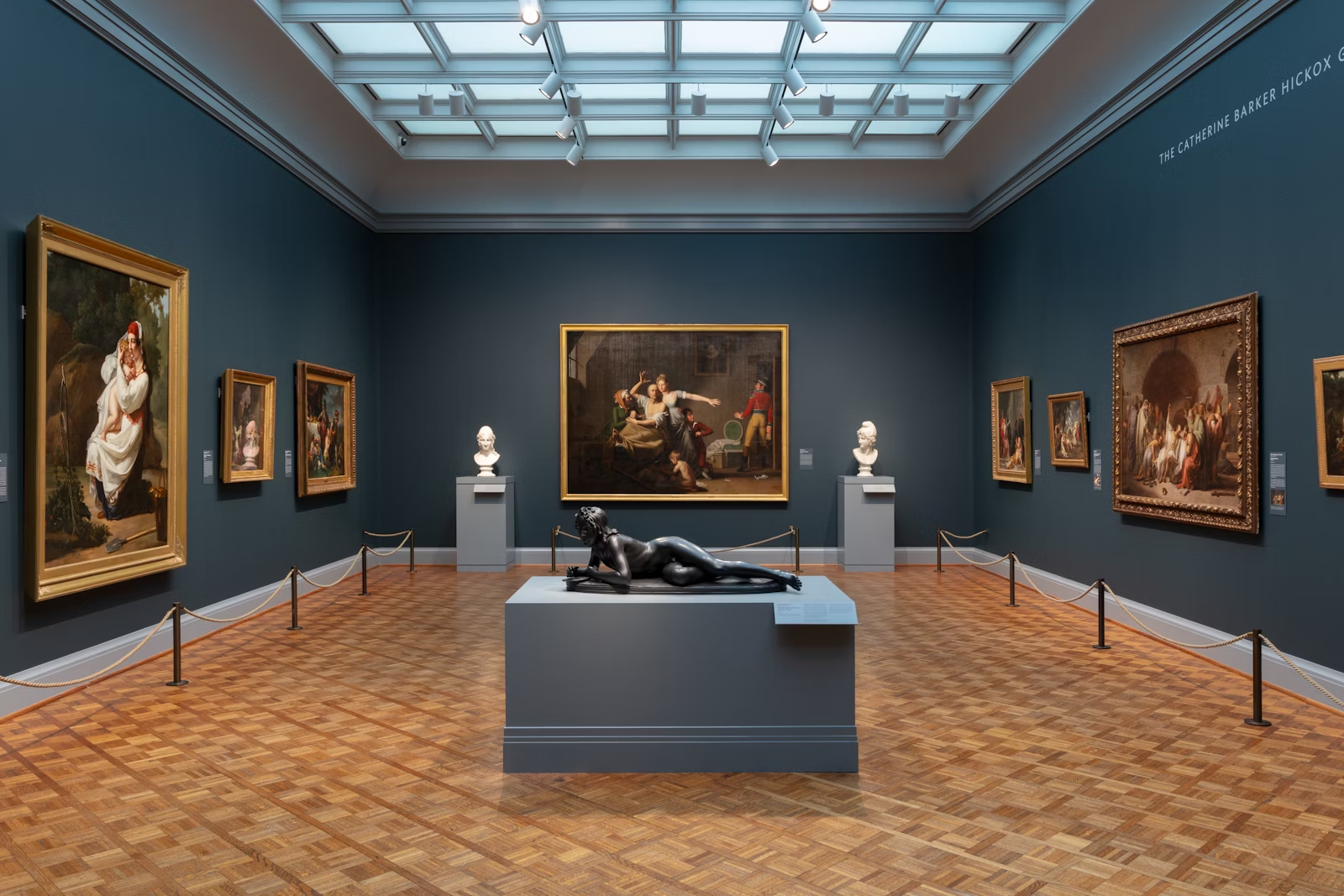
AIC Receives Horvitz Collection of over 2200 Works of French Art
.
Installation view of French Neoclassical Paintings from The Horvitz Collection at the Art Institute of Chicago, 2024.
◊ ◊ ◊ ◊ ◊
From the AIC press release (11 February 2025) . . .
The Art Institute of Chicago is honored to announce a transformative gift of 16th- to 19th-century French art from Jeffrey and Carol Horvitz. The Horvitz Collection is the preeminent collection of French Old Master paintings, drawings, and sculptures in the United States, and while the Art Institute is already renowned for one of the most comprehensive collections of 19th-century French art worldwide, this unparalleled gift will allow the museum to provide its visitors with a 300-year panorama of French art that is wholly unique outside of France.
This gift is made up of nearly 2,000 drawings, 200 paintings, and 50 sculptures, and includes works by well-known artists Charles Le Brun, François Boucher, Jean-Honoré Fragonard, Jacques-Louis David, and Théodore Géricault; numerous works by women artists, including Anne Vallayer Coster, Élisabeth Vigée Lebrun, Marie-Gabrielle Capet, and Adélaïde Labille-Guiard; and rare works of art where few or none otherwise exist in America, such as artworks by Jacques Bellange, Reynaud Levieux, and Nicolas Prevost.

Jean-Charles-Niçaise Perrin, Death of Seneca, ca. 1788 (Chicago: AIC, Horvitz Collection).
The collection has been built over four decades and continues to grow and evolve. For the last three decades, it has been widely featured in thematic exhibitions in museums across the United States and Europe. More recently, two spectacular exhibitions in late 2024 at the Art Institute—French Neoclassical Paintings from The Horvitz Collection and Revolution to Restoration: French Drawings from The Horvitz Collection—featured just a small portion of the paintings and drawings in this vast collection.
To ensure the care, stewardship, accessibility, and long-term sustainability of the collection and programming for French art, phased financial gifts will accompany the collection and are expected to become one of the largest financial gifts in the history of the Art Institute. These funds will be dedicated to supporting French art across the permanent collection—conserving and caring for works, creating special exhibitions, supporting museum staff, and conducting groundbreaking research.
Jeffrey Horvitz explains, “We have always envisioned this collection remaining as a whole in order to be more than the sum of its parts, and for it to go to a major American museum where the most visitors can experience these artistic treasures, where scholars and curators can avail of the resources and advance this important research, and where our enthusiasm will resonate long after we are gone. We spent years thinking about where the collection should ultimately go—there was no more perfect choice than the Art Institute.”
This ongoing collaboration is the result of significant partnership between Jeffrey and Carol Horvitz; Alvin Clark, the Horvitzes’ curator of French drawings, paintings, and sculpture; and the Art Institute. Carol is an active member of the museum’s Board of Trustees and works closely with the museum regarding other aspects of the Horvitz’s collection, including superb Chinese cinnabar lacquer and the most significant collection of contemporary Japanese ceramics outside of Japan. Many of these works were loaned to the recent acclaimed Art Institute exhibition Radical Clay: Contemporary Women Artists from Japan, which was seen by more than 100,000 visitors.
“We are so grateful to Jeffrey and Carol for this impactful gift,” James Rondeau, President and Eloise W. Martin Director of the Art Institute of Chicago said. “Their continued support and passion for the museum is truly special, not only because it will allow millions of visitors to experience a fuller story of French art, but also because their generous financial support of the ongoing care and research of this collection will allow us to continue advancing our broader mission.”
Conference | CAA 2025, New York
Very warm wishes to everyone attending this week’s conference! –CH
113th Annual Conference of the College Art Association
New York Hilton Midtown, 12–15 February 2025
The CAA 113th Annual Conference will take place at the New York Hilton Midtown, New York City, 12–15 February 2025. Noted below is just a small selection of this year’s offerings, with a full schedule available here.
◊ ◊ ◊ ◊ ◊
Women Artists and the Politics of Neoclassicism
Wednesday, 12 February, 2.30–4.00, Hilton Midtown, 2nd floor, Nassau East
Chairs: Andrea Morgan (The Art Institute of Chicago) and Megan True (The Art Institute of Chicago)
• Marie-Thérèse Reboul Vien and the Emergence of Neoclassicism — Tori Champion (University of St Andrews)
• Marie-Guillemine Benoist (1768–1826): A Neoclassicism of Her Own — Jennifer Germann (Independent Scholar)
• La Créatrice in Flux: Women’s Artmaking and Ambition in Revolutionary France — Maura Gleeson (Valencia College)
• The Genre Anecdotique and Feminine Historical Consciousness in Early 19th-Century France — Marina Kliger (Harvard Art Museums)
◊ ◊ ◊ ◊ ◊
Gender, Class, and Empire: Women and the Representation of Animals in 18th- and 19th-C. Art
Thursday, 13 February 13, 11.00–12.30, Hilton Midtown, 3rd floor, Mercury Ballroom
• The Shepherdess in the Colonies: Young Women in the Pastoral Mode — Patricia Johnston (College of The Holy Cross)
• Bridging Relationships: Pet Animals as Connectors in Eighteenth-Century British Portraiture — Luba Stephania Kozak (University of Regina)
• Vincent van Gogh, Jules Michelet, and Working-Class Women — Christa Rose DiMarco (New College of Florida)
◊ ◊ ◊ ◊ ◊
The Art of Collaboration in the Long 18th Century (HECAA)
Friday, 14 February, 2.30–4.00, Hilton Midtown, 2nd floor, Nassau East
Chairs: Yasemin Diba Altun and Tori Champion
• Layers of Collaboration: The Making of Toiles de Jouy, — Melissa Percival (University of Exeter)
• Beyond the Inner Chamber?: The Making of Female ‘Elegant Gathering’ Paintings in Late 18th-Century China — Michelle Tian (Princeton University)
• Materials as Collaboration in 18th- and 19th-Century Philadelphia — Cambra Sklarz (Harvard Art Museums)
◊ ◊ ◊ ◊ ◊
Unboxing the Long 18th Century (American Society for Eighteenth-Century Studies)
Friday, 14 February, 4.30–6.00, Hilton Midtown, 2nd floor, Nassau East
Chairs: Dani Ezor and Jennifer Germann
• Machines for Naturalization: The Cajones of the Spanish Botanical Expeditions — Rebecca Yuste (Columbia University)
• Unveiling the Trans-regional Journey of Red Ginseng: Joseon Korea’s Commercial Expansion in the 18th Century — Jeffrey C. Youn (College of Charleston)
• ’Wat men veerst haelt, dat smaeket soetst’: The Pomander as a Miniature Cabinet of Curiosities — Jasper Martens (University of California Santa Barbara)
◊ ◊ ◊ ◊ ◊
HECAA@CAA Lunch
Friday, 14 February, 12.45
Join HECAA members for lunch on Friday, before the “Art of Collaboration” panel. Catch up with other HECAA members over a buy-your-own lunch at a nearby food hall. The group will meet at the lobby of the conference Hilton hotel between 12.45 and 1.00 and then head to Urban Hawker; please be in touch with Tori Champion (tc217@st-andrews.ac.uk) so we can know how many people to expect!
◊ ◊ ◊ ◊ ◊
On Prints: From Fragonard to the Legacy of the Harlem Renaissance
Hauser & Wirth, Thursday, 13 February, 6.30–8pm
Registration Required
HECAA members attending CAA are invited to attend an off-site gathering On Prints: From Fragonard to the Legacy of the Harlem Renaissance at Hauser & Wirth (443 W 18th Street). The event is organized by Michelle Foa, Tulane University, for the Association of Historians of Nineteenth-Century Art (AHNCA), who have generously extended the invitation to HECAA members to join. Speakers will include Ewa Lajer-Burcharth, Rachael DeLue, Ashley Dunn, Michelle Foa, Rena Hoisington, Meredith Martin, and Britany Salsbury. HECAA members can register and find more information here.
Call for Papers | Trade and Its Representations, 17th & 18th Centuries

.
Gerrit Adriaensz Berckheyde, The ‘Dam’ in Amsterdam, 1668, oil on canvas
(Antwerp, Royal Museum of Fine Arts)
◊ ◊ ◊ ◊ ◊
From the Call for Papers and ArtHist.net, which includes the French version:
Trade and Its Representations: Commercial Activity in Art and Architecture in the 17th and 18th Centuries
Le commerce et ses representations: L’activite marchande dans ses arts t l’architecture aux XVIIe et XVIIIe siècles
Institut national d’histoire de l’art (INHA), Paris, 12–13 June 2025
Proposals due by 31 March 2025
During the seventeenth and eighteenth centuries, the many transformations and significant expansion of commercial activities led to the diversification of consumption and the expansion of commercial areas. These phenomena reflected improvements in transport conditions, better organisation of trade networks and the resources of capitalism. The images and literature related to the world of commerce diversified and transformed society’s perception of this practice and its players (pedlars, itinerant merchants, manufacturers, wholesalers, entrepreneurs, etc.). While the ideal of the mercator sapiens (Caspar van Baerle, Athenaeum illustre, 1632) gradually came to fruition, culminating in the eighteenth century, the opposition between otium and negotium continued to change, with the nobility becoming increasingly interested in the lucrative activities of commerce and industry. How did artists perceive these sociological transformations, which thrust into the spotlight characters who had hitherto often been ignored?
The development of trade in all its forms also calls for the renewal of existing types, their multiplication and the introduction of new programmes. From the shop counter to the square, from the market and the bazaar to the annual fair, from the Atlantic ports to the great Dutch and Hanseatic exchanges, to the han of the Islamic world, the places of exchange are multiple, polymorphous and hybrid. In their turn, specialised trading spaces transformed the city (major routes, storage areas, etc.), whose urban growth could no longer be confined to guild houses and market squares.
Anchored in the city, the corporate system was shaken by the transformation of trade. Although they had helped to defend and protect the interests of each profession since the Middle Ages, the arts and crafts associations in Europe were increasingly seen as restrictive. Conflicts between these different players and institutions changed the way trade was conducted in the city. How do the representations of these places of professional sociability reflect these societal changes?
The rise of commercial capitalism was accompanied by an improvement in communication routes: river navigation benefited from the expansion of canals and road links were developed and paved, supporting the development of both domestic and foreign trade. Founded in the seventeenth century, the European colonial companies underwent unbridled expansion in the eighteenth century, as trade shifted into triangular. How did artists reflect this attraction to international trade? What emblematic projects did architects undertake to establish the reputation of companies involved in transatlantic trade?
The conference is organised around the following three main themes:
• Axis 1 | Merchants’ strategies of representation
• Axis 2 | Ways in which commerce is represented ‘in action’ and places where it is practised
• Axis 3 | Commercial activity as a vector of forms, ideas and images on a European and extra-European scale
Proposals may fit into one or more of these areas, but the axes remain indicative. It should be noted that the selection committee will favour contributions that break out of the paradigm of the art dealer and the marchand mercier. The first axis looks at the merchants’ strategies of representation. In addition to the varied images of these actors—often positive, sometimes picturesque—this section will look at the artistic practices and representations they have used to develop an image of themselves, their role or their place in society. These practices include patronage, collecting, speculation and socially valued techniques such as learning and drawing. The different types of portraits, whether individual or group, can also be explored. Similarly, we could look at architectural formulas that were codified or designed to be practical in terms of the status and activity of the client. These various approaches will also provide an opportunity to question the existence of a distinctive ‘merchant taste’, whether it was voluntarily established by the merchants themselves or formed on the basis of criticism from other classes in society and disseminated through printmaking, among other means. However, the aim will not be to essentialise the bourgeois merchants, but to identify in greater detail common representations or specific features.
The second axis will explore the ways in which commerce is represented ‘in action’ and the places where it is practised. How did the visual arts and architecture reflect, accompany, frame or guide the practice of commerce? The economic upheavals of pre-industrial societies and the expansion of the field of the representable by artistic modernity have challenged the iconography of commercial practices. This focus will encourage formal and iconographic analysis of trades that are poorly represented in the arts; studies questioning the iconographic domination of certain commercial scenes; and examinations exploring the gap between the reality of practices and their representation. Alongside the study of the shop, its decorations and the art of “window-dressing”, the aim will also be to open up perspectives to European and nonEuropean ommercial architecture. How do architects design these commercial buildings? This type of architecture will be understood in its broadest sense: all buildings with a commercial purpose as well as buildings and public spaces linked to the commercialisation of pleasure and leisure.
This corpus of graphic, pictorial, sculptural and architectural works will be enriched by all the images which, without representing a specific commercial practice or location, convey a commercial discourse with political or religious connotations. What representations and iconography do artists use to evoke the idea of commerce in their work? Drawing on allegory, fable, philosophy or books of words, these discourses, often disseminated through engraving, were also displayed on façades or asserted through major building programmes. The third axis will aim to open up the subject to the various forms of commercial activity, understood as a vector of forms, images and ideas, as well as the circulation of people and materials, on a global scale. Trade between cities and nations encouraged the development of trade routes (roads, bridges, lighthouses, ports, etc.) and the production of facilities (trading posts, stock exchanges, new cities, etc.). Here we examine the impact of the development of internal and external trade on the territory, in terms of architectural and visual production.
Proposals for papers, individual or collaborative, in French or English, of approximately 300 words, may take the form of general statements or case studies. Please send proposals and a curriculum vitae, along with any questions, to asso.grham@gmail.com by 31 March 2025.
Organising Committee
Élisa Bérard (doctoral student, Sorbonne Université), Maxime Bray (doctoral student, Sorbonne Université), Justine Cardoletti (doctoral student, Université Paris 1 Panthéon-Sorbonne), Florence Fesneau (PhD, Université Paris 1 Panthéon-Sorbonne), Barbara Jouves-Hann (PhD, Université Paris 1 Panthéon-Sorbonne), Maxime-Georges Métraux (expert, Galerie H. Duchemin), Alice Ottazzi (post-doctoral fellow, Kunsthistorisches Institut in Florenz), Maël Tauziède-Espariat (lecturer, Université Paris-Nanterre), members of the board of the Groupe de Recherche en Histoire de l’art moderne (GRHAM). Clémence Pau (Phd, Sorbonne Université), Jean Potel (doctoral student, Sorbonne Université), members of the Board of Directors of the Groupe Histoire Architecture Mentalités Urbaines (GHAMU).
s e l e c t e d b i b l i o g r a p h y
ABAD Reynald, Le grand marché. L’approvisionnement alimentaire de Paris sous l’Ancien Régime, Paris, Fayard, 2002.
AGUILAR Anne-Sophie, « L’enseigne, histoires et représentations », dans Anne-Sophie Aguilar et Eléonore Challine (dir.), L’Enseigne. Une histoire visuelle et matérielles (XIXe– XXe siècles), Paris, Citadelles & Mazenod, 2020, p. 18–33.
ANGIOLINI Franco et ROCHE Daniel (dir.), Cultures et formations négociantes dans l’Europe moderne, Paris, EHESS, 1995.
BAKER Emma (dir.), Art, Commerce, and Colonialism 1600–1800, Manchester, Manchester University Press, 2017.
BENTLEY Tamara H. (éd.), Picturing Commerce in and from the East Asian Maritime Circuits, 1550–1800, Amsterdam, Amsterdam University Press, 2020.
BOUCHERON Patrick, « Espace public et lieux publics : approches en histoire urbaine », dans Patrick Boucheron et Nicolas Offenstadt (dir.), L’espace public au Moyen âge. Débats autour de Jürgen Habermas, Paris, Presses universitaires de France, 2011, p. 99–117.
BRAUDEL Fernand, Civilisation, économie et capitalisme, Paris, Librairie générale française, 1993, 3 vol.
CABESTAN Jean-François, La conquête du plain-pied. L’immeuble à Paris au XVIIIe siècle, Paris, Picard, 2004.
CASTELLUCCIO Stéphane, Le prince et le marchand. Le commerce de luxe chez les marchands merciers parisiens pendant le règne de Louis XIV, Paris, SPM, 2014.
CHRISTENSEN Stephen Turk et NOLDUS Badeloch, Cultural Traffic and Cultural Transformation around the Baltic Sea, 1450–1720, numéro thématique du Scandinavian Journal of History, n° 28, 2003, 3/4.
COQUERY Natacha (dir.), La Boutique et la ville. Commerces, commerçants, espaces et clientèles. XVIe–XXe siècles, Tours, Centre d’histoire de la ville moderne et contemporaine / Publications de l’université François Rabelais, 2000.
COQUERY Natacha, Tenir boutique à Paris au XVIIIe siècle. Luxe et demi-luxe, Paris, Éd. du CTHS, 2011.
COQUERY Natacha et VARLET Caroline, « Urbanité, rationalité, fonctionnalité : la ville des Lumières et ses boutiques (Paris, XVIIIe siècle) », Annuaire de l’EHESS, 2002.
CROUZET François et DAUDIN Guillaume, Commerce et prospérité : la France au XVIIIe siècle, Paris, Presses de l’Université Paris-Sorbonne, 2005.
CUVELIER Laurent, « Les codes de l’enseigne dans l’espace public parisien, XVIIe–XXe siècles », dans Anne-Sophie Aguilar et Eléonore Challine (dir.), L’Enseigne. Une histoire visuelle et matérielle (XIXe–XXe siècles), Paris, Citadelles & Mazenod, 2020, p. 34-37.
DAVIS Dorothy, Fairs, Shops, and Supermarkets. A History of English Shopping, Londres, Routledge & K. Paul, 1966.
DENNISON Patricia, EYDMANN Stuart, LYELL Annie et al., Painting the Town. Scottish Urban History in Art, Edimbourg, Society of Antiquaries of Scotland, 2013.
DESCAT Sophie, « La boutique magnifiée : commerce de détail et embellissement à Paris et à Londres dans la seconde moitié du XVIIIe siècles », Histoire urbaine, n°6, 2002, p. 69–86.
DESSERT Daniel, Argent, pouvoir et société au Grand Siècle, Paris, Fayard, 1984.
FINDLEN Paula et SMITH Pamela (dir.), Merchants and Marvels. Commerce, Science, and Art in Early Modern Europe, Londres, Routledge, 2002.
FOURNIER Guenièvre, « La mise en image du port méditerranéen à travers les vues et les plans de Marseille, Gênes et Barcelone », dans Lionel Dumond, Stéphane Durand et Jérôme Thomas (dir.), Les ports dans l’Europe méditerranéenne. Trafics et circulation, images et représentations, XVIe–XXIe siècles, Montpellier, Presses Universitaires de la Méditerranée, 2007, p. 359–386.
FROMONT Cécile, « The Taste of Others. Finery, the Slave Trade, and Africa’s Place in the Traffic in Early Modern Things », dans Paula Findlen (éd.), Early Modern Things: Objects and Their Histories, 1500–1800, 2e édition, Abingdon, Routledge, 2021, p. 273–292.
GARRIOCH David, « House Names, Shop Signs, and Social Organization in Western European Cities, 1500–1900 », Urban History, 1994, n°21, p. 20–48.
GAUVIN Alexander Bailey, Architecture and Urbanism in the French Atlantic Empire. State, Church and Society, 1604–1830, Montréal / Londres / Chicago, McGill-Queen’s University Press, 2018.
GOMEZ Y CACERES Georges et PIERREDON Marie-Ange de (dir.), Le Décor des boutiques parisiennes, Paris, Délégation à l’Action Artistique de la Ville de Paris, 1987.
GRANDJEAN Gilles, « Les Marchands Levantins, un décor inspiré par Claude-Joseph Vernet », dans Autour de Claude-Joseph Vernet. La marine à voile de 1650 à 1890 (cat. exp.), Rouen, Musée des Beaux-Arts, 1999, p. 69–75.
HAMON Philippe, L’or des peintres. L’image de l’argent du XVe au XVIIe siècle, Rennes, Presses universitaires de Rennes, 2010.
JACOB Margaret C. et SECRETAN Catherine (éd.), The Self-Perception of Early Modern ‘Capitalists’, New York, Palgrave Macmillan, 2008.
JEANNIN Pierre, Marchands d’Europe. Pratiques et savoirs à l’époque moderne, Paris, Éd. rue d’Ulm/Presses ENS, 2002.
LAND Jeremy, Colonial Ports, Global Trade, and the Roots of the American Revolution, 1700–1776, Leyde, Brill, 2023.
LYON-CAEN Nicolas, « Les marchands du temple. Les boutiques du Palais de justice de Paris aux XVIe‑XVIIIe siècles », Revue historique, 2015/2, n°674, p. 323–352.
LYON-CAEN Nicolas, « L’immobilier parisien au XVIIIe siècle. Un marché locatif », Histoire & mesure, 2015/43, n°2, p. 55–70.
MARGAIRAZ Dominique, Foires et marchés dans la France préindustrielle, Paris, Éd. de l’École des hautes études en sciences sociales, 1988.
MARRAUD Mathieu, Le pouvoir marchand. Corps et corporatisme à Paris sous l’Ancien Régime, Seyssel, Champ Vallon, 2021.
MILLIOT Vincent, Les Cris de Paris ou le Peuple travesti. Les représentations des petits métiers parisiens (XVIe–XVIIIe siècles), Paris, Éditions de la Sorbonne, 2014.
NÈGRE Valérie (dir.), L’Art du chantier. Construire et démolir du XVIe au XXIe siècle, Paris, Snoeck/Cité de l’architecture, 2018.
NÈGRE Valérie et VICTOR Sandrine (dir.), « L’Entrepreneur de bâtiment : nouvelles perspectives (Moyen Âge-XXe siècle) », Aedificare. Revue internationale d’histoire de la construction, no 5, février 2020, p. 23–39.
NÈGRE Valérie, « Remarques sur les entrepreneurs-architectes parisiens du siècle des Lumières », dans Thomas Kirchner et Sophie Raux (dir.), L’Art de l’Ancien régime. Sortir du rang, Paris, Heidelberg University Library / Centre Allemand d’histoire de l’art, 2022, p. 37–55.
NOLDUS Badeloch, Trade in Good Taste. Relations in Architecture and Culture between the Dutch Republic and the Baltic World in the Seventeenth Century, Turnhout, Brepols, 2005.
NOTTER Annick et METREAUX Maxime Georges (dir.), Chic et emprise : culture, usages et sociabilités du tabac du XVIe au XVIIIe siècle (cat. exp.), La Crèche, La Geste, 2019.
OTTENHEYM Koen E., CHATENET Monique et DE JONGE Krista, Public Buildings in Early Modern Europe, Turnhout, Brepols, 2006.
OTTENHEYM Koen E. et DE JONGE Krista, The Low Countries at the Crossroads. Netherlandish Architecture as an Export Product in Early Modern Europe, 1480–1680, Turnhout, Brepols, 2013.
PICON Antoine, Architectes et ingénieurs au siècle des Lumières, Marseille, Éditions Parenthèses, 1988.
PINON Pierre, « Lotissements spéculatifs, formes urbaines et architectes à la fin de l’Ancien Régime », dans Soufflot et l’architecture des Lumières, Paris, Ministère de l’environnement et du cadre de vie, Direction de l’architecture, C.N.R.S, 1980, p. 178–191.
RABREAU Daniel, « Royale ou commerciale, la place à l’époque des Lumières », Revue des monuments historiques, n°120, 1982, p. 31–37.
RABREAU Daniel, Apollon dans la ville. Essai sur le théâtre et l’urbanisme à l’époque des Lumières, Paris, Éditions du Patrimoine, 2008.
ROCHE Daniel, « Négoce et culture dans la France du XVIIIe siècle », Revue d’histoire moderne et contemporaine, t. XXV, n°3, juillet-septembre 1978, p. 375–395.
ROCHE Daniel, Histoire des choses banales. Naissance de la consommation dans les sociétés traditionnelles (XVIIe–XIXe siècles), Paris, Fayard, 1997.
SARGENTSON Carolyn, Merchants and Luxury Market. The Marchands Merciers of Eighteenth‑Century Paris, Londres, Victoria and Albert Museum Ed., 1996.
SECRETAN Catherine, Le « Marchand philosophe » de Caspar Barlaeus. Un éloge du commerce dans la Hollande du Siècle d’Or. Étude, texte et traduction du Mercator Sapiens, Paris, Champion, 2002.
STROSETZKI Christoph (dir.), El poder de la economía : la imagen de los mercaderes y el comercio en el mundo hispánico de la Edad Moderna, Madrid, Iberoamericana-Vervuert, 2018.
YAMEY Basil, Art & Accounting, New Haven, Yale University Press, 1989.










 Enfilade
leave a comment