Call for Papers | James Gillray@200: Caricaturist without a Conscience?
From New College, Oxford:
James Gillray@200: Caricaturist without a Conscience?
Ashmolean Museum, Oxford, 28 March 2015
Proposals due by 15 November 2014
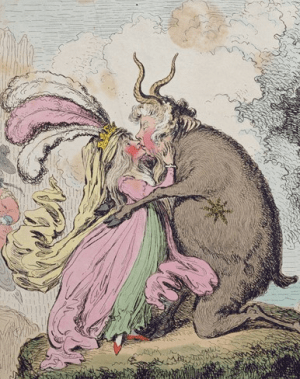 James Gillray’s reputation in the two centuries since his death has been as varied and layered as his prints. Trained at the Royal Academy, he failed at reproductive printmaking, yet became, according to the late-eighteenth-century Weimar journal London und Paris, one of the greatest European artists of the era. Napoleon, from his exile on St Helena, allegedly remarked that Gillray’s prints did more to run him out of power than all the armies of Europe. In England, patriots had hired him to propagandize against the French and touted him as a great national voice, but he was an unreliable gun-for-hire. At a large public banquet, during the heat of anti-Revolutionary war fever, he even raised a toast to his fellow artist, the regicide, Jacques-Louis David. Gillray produced a highly individual, highly schooled, and often outlandish body of work with no clear moral compass that undermines the legend of the caricaturist as the voice and heart of the people, so that the late Richard Godfrey described him as a caricaturist without a conscience. Following 2001 and 2004 retrospectives in London and New York, and fuelled by scholarship of a new generation of thinkers, our era’s Gillray is just now coming into focus.
To commemorate the 200th anniversary of Gillray’s death, and in conjunction with the Ashmolean Museum’s exhibition, Love Bites: Caricatures of James Gillray (26 March – 21 June 2015), based on New College’s outstanding collection, we are organizing a one-day symposium at the Ashmolean Museum to hear and see the latest Gillray scholarship.
We seek proposals papers that address any aspect of Gillray’s work or that consider artistic duty or purposeful negligence of duty in the period around 1800. Comparative, formal, contextual, and theoretical approaches to Gillray and our theme are all welcome. Proposals should be a maximum of 200 words and be accompanied by a short bibliographical statement.
Organised by Todd Porterfield (Université de Montréal), Martin Myrone (Tate Britain), and Michael Burden (New College, Oxford), with Ersy Contogouris (Université de Montréal)
All enquiries should be addressed initially to the New College Dean’s Secretary, Jacqui Julier, jacqui.julier@new.ox.ac.uk, to whom all abstracts should be submitted by 15 November 2014. The programme will be announced on 21 November 2014.
Call for Papers | L’image Railleuse
From INHA:
L’image Railleuse: La satire dans l’art et la culture visuelle, du 18e siècle à nos jours
Institut national d’histoire de l’art, Paris, 25–27 June 2015
Proposals due by 30 October 2014
 Colloque international organisé par l’Institut national d’histoire de l’art, l’Université du Québec à Montréal et le LARHRA UMR 5190 de Lyon
La satire, soit l’attaque moqueuse, contestataire ou réformatrice d’un individu, d’un groupe, d’une époque, voire de toute une culture, constitue l’une des armes privilégiées de la fonction critique des images et, au-delà, de l’ensemble des artefacts visuels. Se constituant en genre littéraire dès l’Antiquité, la satire a gagné les beaux-arts et les arts graphiques à l’âge classique, seule ou en conjonction avec l’écrit. Ce sont toutefois les médias modernes—édition, presse, expositions, télévision, internet—qui, en élargissant progressivement sa sphère d’influence, ont renouvelé ses formes et ses objectifs, et augmenté leur efficacité. Autorisant une diffusion planétaire et presque instantanée des images satiriques, internet et les technologies numériques n’ont pas seulement transformé la matérialité et les moyens d’action de cette imagerie et leurs effets socio-politiques, ils ont aussi affecté les formes de la recherche sur le satirique en donnant accès de plus en plus rapidement à des corpus extrêmement vastes. La satire est ainsi partout, et aucun acteur ni canal de diffusion ne peut prétendre désormais en contrôler ses usages généralisés.
Ce colloque porte sur la satire visuelle du 18e siècle à nos jours, entendue comme genre aussi bien que comme registre, selon que l’on s’intéresse à un type de représentations (caricaturale, en particulier) ou à une veine (le satirique) traversant de multiples champs, parmi lesquels celui de l’art contemporain. Envisagée dans sa visualité même, elle recouvre des objets, particuliers ou partagés, des mécanismes et des effets spécifiques que nous souhaitons interroger à partir des études visuelles.
Les propositions d’intervention de 30 minutes seront adressées avant le 30 octobre 2014 à frederique.desbuissons@inha.fr afin d’être examinées par le comité scientifique. Elles comprendront 500 mots maximum et seront accompagnées d’une courte bio-bibliographie.
Pour lire l’intégralité de l’appel à contributions, cliquez ici.
◊ ◊ ◊ ◊ ◊
Note (added 2 October 2014) — Here’s the English version:
Satire—which can be understood as the mocking, contesting or reforming prosecution of an individual, a group, an era, or an entire culture—is one of the main weapons of the critical function of images and, more broadly, of visual artefacts. Emerging as a literary genre in Antiquity, satire joined the fine arts, and particularly the graphic arts, in the early modern era, either on its own or in connection with the written word. Modern media—publishing, the press, exhibitions, television and the Internet—have progressively widened its sphere of influence, renewing its forms and objectives and increasing its efficacy. Enabling the worldwide and nearly instantaneous dissemination of satiric images, the Internet and digital media have not only transformed the materiality and means of this imagery and its socio-political effects, they have also had an impact on the forms that research can take with respect to the satiric, by giving ever swifter access to an ever-wider range of bodies of work. Satire is thus everywhere, and no actor nor platform of dissemination can now claim to control its generalized usages.
The subject of this conference is visual satire from the eighteenth century to today. Visual satire is understood not only as genre but also as a register, depending on whether one is interested in a type of representation (caricatural, in particular) or as a vein (the satiric) that crosses several fields, among which that of contemporary art. Satire, envisaged in its visuality, ranges across individual or shared objects, specific mechanisms and effects that we hope to question from the perspective of visual studies.
We welcome proposals for papers that address, but that need not necessarily be limited to, the following thematic strands :
1. Historiographical perspectives
How can we think about and construct a history of visual satire within the history of art and visual studies? Studies in caricature and graphic satire have been delineated by a number of (?) researchers and approaches, the limits of which are fairly precise and have contributed to the establishment of a pluridisciplinary set of tools that have tended to become normative. Following the first large inventory projects (Champfleury, Wright, Stephens and George) and studies centred on perception and psychoanalysis (as just one example, Gombrich and Kris), international research, based around the university, the museum, among collectors and archives, has given us results that typically align with a certain range of objectives: the publication of monographs and studies that focus on artistic procedure, on iconology, on political discourse or on the sociology of artists. It might be important to identify the characteristics of this wide range of approaches in order to understand the disciplinary impact they have had. In this international framework, do linguistic, territorial and ideological borders play a role? Beyond this, we might reflect on the impact of this work on our critical and historical consideration of the satiric as it manifests itself in contemporary art. In short: what does satire do, what has satire done to art history—and vice-versa?
2. Norms and inventivity : the creativity of the satirical
While it is possible to understand how the satirical and the caricatural have been used throughout the history of art, the integration of this artistic undertaking—or should we speak of process, mode, genre?—nevertheless sets up certain challenges for research. These challenges arise when we think through artists’ manipulation of cognitive and narrative elements (in the articulation of figural representation with the possibilities of narrative structure, for example). It might be useful, then, to think of visual satire as a form of inventivity that connects to a wider form of social behaviour, one that might index a satiric field in which a number of expressive forms, among them those of the visual arts, have their place. If satire can be linked to the parameters of normativity in a given society or period (parameters that might in turn be malleable according to shifting social contexts), might it be possible to consider the satiric or caricatural endeavour as the site of meta-representational undertakings? Can we connect the satiric endeavour to precise historical conditions?
3. Parody of art and autonomy of the satiric genre
Satire and caricature were part of artists’ graphic practices since well before the eighteenth century. Whether created as exercises or for private recreation, they often represent the personal sphere or the artistic community. Starting in the mid-nineteenth century, the satire of art becomes a genre in its own right and conquers a public that is all the more far-reaching(?) as access to contemporary art becomes democratized. At the same time, it becomes a set of recurring themes and processes, notably at the end of the century and even more so among certain avant-gardes of the twentieth century, modern or post-modern. What is the importance of this phenomenon? What does satire do to art, notably in the eighteenth and nineteenth centuries, and what does art do to satire, especially in the twentieth and twenty-first? What are satire’s objectives, its publics, and to what aims?
4. The satiric body and violence
Satire cannot be reduced to a figure of rhetoric and to visual objects. Because it is a form of social and political action, its efficacy (whether rhetorical, effective or fantasized) makes it a weapon directed towards whatever it mocks. Its violence is deployed on three levels: it is made thematic in its motifs, instrumentalized so that its targets can be attacked, and shared with those who see it. Satire used against real persons, or against targets that are more collective and abstract (institutions, political ideas, social events, etc.) and that are almost always represented by characters or types, affects its spectators before it reaches those it targets. The corporeal dimension thus plays an important role in the workings of satire. It is sometimes put into play by caricature’s expressive deformation, thus leading to a somatism and a materialism of critical laughter. The modalities of this satirical violence will be the starting point for studies that can explore any of the paths it takes, or that can focus on the relationship between the strategies used and their resulting effects, as much for satire’s victim as for its spectator.
5. Materials and dissemination of satire
The efflorescence of the satiric genre is closely linked to the emergence of new means of reproduction and dissemination: engraving in the sixteenth century, the trade in prints, the introduction of lithography and the renewal of wood-engraving at the turn of the nineteenth century, photo-montage, etc. It seems nonetheless useful to develop a critique of the reality of such a deterministic account, both with respect to the periods just mentioned as well as in the case of more recent developments. More importantly, it seems important to measure the effects of dissemination on the modalities of reception. Several contemporary examples have shown the extent to which the Internet platform is itself a component of such a reception. In what terms is it necessary to consider this phenomenon? Does it have an impact on artists working today?
6. The configurations of the visual
Visual satire, as opposed to its literary counterpart, has elicited only too few historical and theoretical studies. What accounts for this contrasted situation? Is it because the reading of an image can be assimilated to that of a text? Is it because its elucidation is often determined by accompanying texts (dialogues, legends and other paratexts)? If so, how can we explain the ambiguity of satiric images, their semantic instability that means that the same figure can lead to highly divergent interpretations? Is this because the phenomenon is of the order of the visual, or is it due to something that might be fundamental to the satiric genre as a whole? These questions could be addressed through the study of visual and discursive configurations that are set in play in the field of satire.
On June 25th, a joint “Bande dessinée and satire” session will be presented in collaboration with the International Bande Dessinée Society and the International Comics and Graphic Novel Society. Proposals for papers, not to exceed 30 minutes, should be sent by October 30, 2014, to frederique.desbuissons@inha.fr in order to be sent to the Conference review board for evaluation. Proposals should be a maximum of 500 words in length and accompanied by a short bio-bibliography.
New Book | Mr Kilburn’s Calicos
From WoI:
Ros Byam Shaw, “Mr Kilburn’s Calicos,” The World of Interiors (October 2014): 112–18.
A scuffed little album discovered by Gabriel Sempill among her late mother’s possessions contains exquisite watercolour patterns by the esteemed 18th-century textile designer William Kilburn. Now, a facsimile of this rare find, complete with a variety of juvenilia added by a later hand, plus modern takes on Kilburn’s repeats, is published.
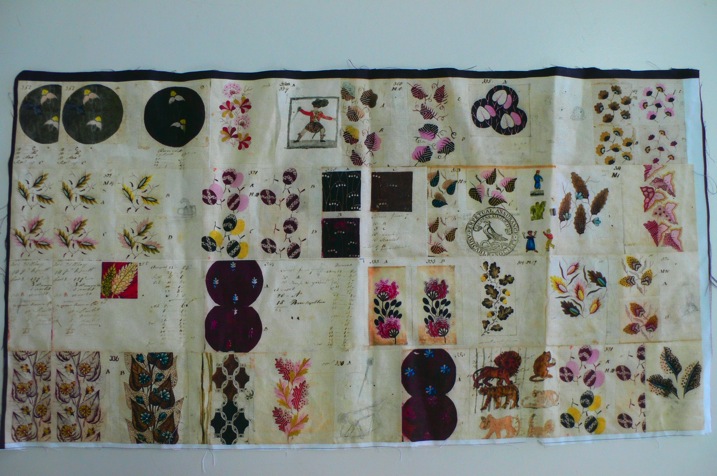
Detailed pattern units from William Kilburn’s
album, as a composite image.
◊ ◊ ◊ ◊ ◊
From Fleece Press:
Gabriel Sempill and Simon Lawrence, Mr Kilburn’s Calicos: William Kilburn’s Fabric Printing Patterns from the Year 1800 (London: Fleece Press, 2014), ISBN: 978-0992741051, £175.
Printed, bound and published at breakneck speed to coincide with The World of Interiors’ extensive feature on this book (October 2014 issue, with five pages reproduced), this is the full reproduction of a very important pocket book once owned by the great fabric designer and printer, William Kilburn (1745–1818). Hitherto known only for his highly elaborate and sumptuous chintz designs which are in the Victoria and Albert Museum, this pocket book includes 62 basic units for patterns which could be built up and repeated on a larger scale for dress material. It is a most exciting find, and Kilburn included notes of variant colourways and orders; the notebook’s subsequent use by a great grandson as a child’s scrapbook ensured its survival.
The book comprises a letterpress introduction, with the entire notebook being reproduced in the second half. There is a separate booklet of 16 patterns printed full-page, made up from Kilburn’s original units by Sholto Drumlanrig, and both the book and booklet are housed in a solander box. There are three variant bindings of quarter cloth with one of three different Kilburn patterned papers over boards.
Fellowships | Newberry Library, 2015–2016
The Newberry Library Fellowships in the Humanities, 2015–2016
Applications due by 1 December 2014 (Long-Term) and 15 January 2015 (Short-Term)
Newberry Library, Chicago (Photo: Wikimedia Commons)
The Newberry’s fellowships support humanities research in our collections. Our collections are wide-ranging, rich, and sometimes a little eccentric. If you study the humanities, chances are good we have something for you. We promise you remarkable collections; a lively interdisciplinary community of researchers; individual consultations on your research with staff curators, librarians, and scholars; and an array of scholarly and public programs. Applicants may apply for both Long- and Short-Term fellowships within one academic year. All applicants are strongly encouraged to consult the Newberry’s online catalog and collection guides before applying.
Long-Term Fellowships
Long-Term Fellowships are intended to support individual scholarly research and promote serious intellectual exchange through active participation in the Newberry’s scholarly activities. Applicants must hold a PhD at the time of application in order to eligible. Applicants may apply for 4 to 12 months of support, with a stipend of $4,200 per month.
Short-Term Fellowships
Short-Term Fellowships are available to postdoctoral scholars, PhD candidates, and those who hold other terminal degrees. Most fellowships are restricted to scholars who live and work outside the Chicago Metro area. Short-Term Fellowships are generally awarded for one continuous month in residence at the Newberry, with stipends of $2,500 per month. Applicants must demonstrate a specific need for the Newberry’s collection.
Symposium | Portuguese and Italian Relations
Programme from the Centro de História d’Aquém e d’Além-Mar:
Portugal e os territórios italianos (séculos XVI–XVIII)
The Centre for Overseas History (CHAM), Lisbon, 22 September 2014
 Este Workshop tem como objectivo propor- cionar uma visão global das relações políticas, económicas, sociais, artísticas e culturais do relacionamento entre Portugal e a península italiana na Idade Moderna. As linhas de força do encontro são sinteti- zadas pela imagem do coche, escolhida como “símbolo dinâmico” do conjunto de abordagens transnacionais desenvolvidas e apresentadas neste workshop.
P R O G R A M A
9:00 Boas-vindas
9:15 Mario Spedicato (Facoltá di Lettere e Filosofia, Università del Salento), Napoli e la Penisola Iberica nei recenti studi di Storia Sociale e Religiosa
10:00 A Comunidade Portuguesa em Roma
• Antonio J. Díaz Rodríguez, (CIDEHUS-UÉ), Os agentes de Portugal em Roma durante a dinastia filipina
• James Nelson Novoa (CESAB/CLEPUL, UL), A nação na Cidade Eterna: cristãos-novos portugueses em Roma, 1542–1590
10:40 Pausa-café
11:00 A Monarquia Portuguesa e os Estados Italianos: Entre o Comércio e a Política
• Francisco Zamora Rodríguez (CHAM, FCSH/ NOVA-UAc), Pedro de Silva Enriques, a Companhia Geral do Comércio do Brasil e a posição de Portugal em Itália
• David Martín Marcos (Universidad Nacional de Educación a Distancia), Estratégias matrimoniais e diplomacia entre Portugal e os estados italianos: o caso de D. Isabel Luísa Josefa, Princesa da Beira (1669–1690)
• Sara Pereira (ISCTE/IUL), A Partilha de Informação Política e Cultural entre Nápoles e Lisboa na segunda metade de Setecentos: dinâmica diplomática
12:00 Arte e Cultura entre Itália e Portugal
• Pilar Diez del Corral Corredoira (IHA, FCSH/ NOVA), La política artística de João V (1689–1750) en el marco de las relaciones diplomáticas con la Santa Sede
• Paola Nestola (CHSC-UC), Linhas de Erudição ou Itinerários do Olhar? Listas dominicanas barrocas entre Lisboa e Península Itálica
◊ ◊ ◊ ◊ ◊
About the Centro de História d’Aquém e d’Além-Mar:
The Centre for Overseas History (CHAM) is an inter-universitary research unit of the Faculty of Social and Human Sciences, of the New University of Lisbon and of Azores University, financed by Portuguese Foundation for Science and Technology. CHAM develops research related to the History of the Discoveries and the Portuguese Expansion, as well as the Portuguese presence around the world, with a special focus in the period between the origins of the Overseas Expansion and the Independence of Brazil (1822), with an interdisciplinary perspective and incorporating comparative history, paying particular attention to the history of the regions with which Portugal maintained contacts.
Study Day | Rome, Naples, Paris, Lisbon: Musical Practices
From the conference programme:
Roma, Nápoles, Paris, Lisboa: artistas, estilos e repertórios em trânsito ao longo do século XVIII
Casa-Museu Dr. Anastácio Gonçalves, Lisbon, 7 October 2014
 Grupo de Investigação ESTUDOS HISTÓRICOS E CULTURAIS EM MÚSICA do INET-MD/FCSH-UNL
P R O G R A M A
10:00 ROMA COMO MODELO
(Moderador: Rui Vieira Nery)
• Pilar Diez del Corral: “Para nos ter Roma inveja”: artistas ibéricos e o paradigma romano em confronto
• Cristina Fernandes: Lázaro Leitão Aranha (1678–1767), secretário régio da Embaixada do Marquês de Fontes e Principal da Patriarcal: um agente na circulação de modelos culturais e musicais entre Roma e Lisboa
11:00 Coffee Break
11:30 PERCURSOS ARTÍSTICOS E PROFISSIONAIS
(Moderadora: Cristina Fernandes)
• Vanda de Sá: Irmandade da Gloriosa Virgem e Mártir Santa Cecília dos Professores da Arte da Música da Corte de Lisboa – Implementação local na segunda metade do século XVIII: os casos de Évora e Porto
• Fernando Miguel Jalôto: ‘D. Antonio Tedeschi, Virtuoso della Cappella Reale’: 37 anos ao serviço de Sua Majestade Fidelíssima
• Diana Vinagre: João Baptista André Avondano/Jean-Pierre Duport: a ligação improvável à escola francesa de violoncello
13:00 Almoço
14:30 REPERTÓRIOS E PRÁTICAS MUSICAIS
(Moderadora: Vanda de Sá)
• Rui Vieira Nery: Do “som tremendo” aos “minuetes saltitantes”: o órgão litúrgico português na visão dos viajantes estrangeiros
• Cristiana Spadaro: A realização do baixo contínuo nos Motetes de Giovanni Giorgi destinados à Patriarcal de Lisboa
• Pedro Castro: A problemática de classificação das serenatas no tempo de D. Maria I: exemplos ibéricos e italianos
• Maria João Albuquerque: A circulação de edições de música parisienses em Lisboa nos finais do séc. XVIII
16:30 Coffee Break
17:00 MOMENTO MUSICAL
(precedido de breve apresentação da Linha Temática do INET-MD “Abordagens Históricas à Performance Musical”, a funcionar a partir de 2015)
• Anónimo Português? (século XVIII)
Obras para instrumento melódico e baixo contínuo em Sol menor / Sonata: [Adagio] & [Allegro] – Minuet
Biblioteca Geral da Universidade de Coimbra, MM63
• José António Carlos de Seixas (1704–1742)
Sonata para cravo nº 19-7 em Lá Maior / Allegretto – Adagio – Allegro
Biblioteca Nacional de Portugal, MM338
• Jean-Pierre Duport (1741–1818)
Sonata para violoncelo e baixo op.2 n.º1 em Fá Maior / Allegro – Andante – Allegretto
Paris, 1772
• Juan Bautista Plà (fl. 1747–73) ou José Plà (1728–1762)
Sonata para oboe e baixo contínuo em Dó menor / Allegretto – Andante – Allegro assai
Kungliga Musikaliska Akademiens Bibliotek – Estocolmo
Pedro Castro, oboé barroco; Diana Vinagre, violoncelo barroco; Fernando Miguel Jalôto, cravo
Exhibition | Embroidery Inspired by the Garden
As noted at the website of the Chelsea Physic Garden:
Inspired by the Garden
Royal School of Needlework, London, 8 September 2014 — 20 March 2015
Curated by Susan Kay-Williams
The Royal School of Needlework will exhibit a display of embroideries with a garden theme at its home at Hampton Court Palace.

Silk shading 18th-century floral display
Almost since the start of embroidery, capturing flowers and the natural world has been an irresistible subject for stitch. Embroidery lends itself perfectly to capturing the textures, colours, shapes and movement of nature and on show will be beautiful pieces of work including traditional floral interpretations and a host of more unusual embroidery subjects from vegetables and fruit to fungi.
The exhibition will feature historic work from the RSN Collection together with current embroideries by RSN students and tutors—all inspired by the natural world using a variety of stitched techniques. Historical pieces date from the 18th century and the exhibition will come right up-to-date with pieces submitted in Summer 2014 for the RSN Degree, Certificate and Diploma courses. Techniques will include silk shading (also known as ‘painting with a needle’) as well as canvaswork, blackwork, metal thread embroidery, crewelwork and raised embroidery.
Dr Susan Kay-Williams, Chief Executive of the RSN and curator of the exhibition says, “Embroidery is such a versatile medium that it can transform a humble vegetable into a work of art; it can reveal new elements of a flower and maximise the sense of colourful riot that is a garden in full bloom. This exhibition which takes us through the autumn and winter months will give food for thought for the gardener, the embroiderer and the lover of colour, right through to spring.”
Individuals and groups are welcome, though pre-booking is essential. Tours are on set dates and times each month: £16 per person for 1.5hr tour or £22 per person for 2hr curator’s tour. All places must be pre-booked.
◊ ◊ ◊ ◊ ◊
As described by Wikipedia:

1903 home of the School of Art Needlework; the building was demolished in 1962 (photo from the website of Brisbane-based architect Michael Heath-Caldwell).
The Royal School of Needlework (RSN) is a hand embroidery school in the United Kingdom, founded in 1872 and now based at Hampton Court Palace.
It has an archive of over 30,000 images covering every period of British history. There are also over 5,000 textile pieces, including lace, silkwork, whitework, Jacobean embroidery and many other forms of embroidery and needlework.
The Royal School of Needlework is a registered charity and has always been under royal patronage. The current patron is Her Majesty Queen Elizabeth II.
The RSN began as the School of Art Needlework in 1872 founded by Lady Victoria Welby. The first President was Princess Christian of Schleswig-Holstein, Queen Victoria’s third daughter, known to the RSN as Princess Helena. She received help from William Morris and many of his friends in the Arts and Crafts movement. It received its royal prefix in March 1875 when Queen Victoria consented to become its first patron. The word ‘Art’ was dropped from the title in 1922.
Its initial space was in a small apartment on Sloane Street, employing 20 women. The school had grown to 150 students, moving in 1903 to Exhibition Road, near to the Victoria and Albert Museum. The purposed-built building was designed by group of architects, including prominent British ‘Arts and Crafts’ architect James Leonard Williams (d.1926), who designed All Saints church in Oxted (1914–28) and St George’s in Sudbury, Middlesex (1926–27). The school moved from Princes Gate in Kensington to Hampton Court Palace in 1987 . . .
More information about the RSN’s 1903 home is available in volume 38 of the Survey of London, South Kensington Museums Area (1975), pp. 231–32, available online here.
Call for Essays | Terra Foundation for American Art Essay Prize
Terra Foundation for American Art International Essay Prize
Submissions due by 15 January 2015
The Terra Foundation for American Art International Essay Prize recognizes excellent scholarship by a non-U.S. scholar in the field of historical American art. Manuscripts should advance the understanding of American art, demonstrating new findings and original perspectives. The prize winner will be given the opportunity to work toward publication in American Art, the Smithsonian American Art Museum’s scholarly journal. He or she will also receive a $1,000 cash award and a travel stipend of up to $3,000 to give a presentation in Washington, D.C., and meet with museum staff and fellows. This annual prize is supported by funding from the Terra Foundation for American Art.
Ph.D. candidates and above who have not published in American Art previously are eligible to participate in the competition. Essays may focus on any aspect of historical (pre-1980) American art and visual culture; however, architecture and film studies are not eligible. Preference will be given to submissions that address American art within a cross-cultural context and offer new ways of thinking about the material. A strong emphasis on visual analysis is encouraged.
Submissions for the 2015 prize must be sent to TerraEssayPrize@si.edu by January 15, 2015. For more information about eligibility and the format for submissions, please visit www.americanart.si.edu/research/awards/terra.
Exhibition | First Sight: Recent Acquisitions of Prints and Drawings
Press release (13 June 2014) from the Scottish National Gallery:
First Sight: Recent Acquisitions of Prints and Drawings
Scottish National Gallery, Edinburgh, 14 June — 12 October 2014
 A group of around 30 outstanding drawings, watercolours, and prints will go on display at the Scottish National Gallery this summer in an exhibition which highlights some of the superb recent additions to the permanent collection. The aptly named First Sight exhibition will provide the general public with the chance to see many of these fabulous acquisitions for the first time following careful conservation treatment. It also offers an incredibly diverse experience, with pieces ranging from large-scale exhibition watercolours to small working sketches, from Rembrandt in the 17th century to Paul Cézanne in the late 19th century.
Acquisitions on show for the first time include an evocative watercolour by James Skene of Rubislaw which was inspired by The Heart of Midlothian, the celebrated novel by his close friend Sir Walter Scott; a delicate watercolour of Glasgow Cathedral by painted by David Roberts in 1829; and a colourful Neapolitan costume study by Giovanni Battista Lusieri from the late 18th century. J. M. W. Turner’s spectacular watercolour of Rome from Monte Mario, 1820, will once again be on show after it was briefly included in the Turner in January exhibition in 2013, along with a delicate red chalk drawing from about 1710 by Jean-Antoine Watteau. Both these pieces were allocated to the Galleries by the Government’s Acceptance in Lieu scheme.

Giovanni Battista Lusieri, A Young Woman (Rosalina Scala) with her Daughter, in Traditional Neapolitan Dress, probably 1780s
(Scottish National Gallery)
There are also landscapes by artists new to the collection, such as the Italian watercolourist Carlo Labruzzi and British artists Thomas Miles Richardson Junior and Francis Nicholson, as well as prints from the magnificent bequest made by celebrated art collectors Henry and Sula Walton in 2012, which includes etchings by Goya, Jean-Franҫois Millet, and Edouard Manet.
The Scottish National Gallery’s collection of prints and drawings has been built up through purchase, donation and bequest over many years. The generosity of supporters, donors, funding bodies and organisations has together helped to make the continued growth of this much treasured collection possible.
Works of art on paper make up the largest area of the Gallery’s permanent collection, comprising around 30,000 prints, drawings, watercolours, sketchbooks, and antiquarian volumes. When not on display, this vast resource is made available to the general public in the Prints and Drawings Study Room at the Scottish National Gallery.
Pamela Long among the 2014 MacArthur Fellows
I take inordinate pleasure each fall in seeing who’s included among the year’s MacArthur Fellows. It is inevitably a stimulating assortment of individuals producing intriguing work across wide-ranging scholarly, artistic, and cultural fields. I was especially happy to find Pamela Long among the 2014 recipients. I know only her work (particularly Openness, Secrecy, Authorship), but it’s encouraging to see this kind of recognition and substantive financial support go to an independent scholar. To the extent that the MacArthur ‘Genius Awards’ receive mainstream press coverage, one might at least hope that it gives the public a glimpse of another model of what it means to be a scholar (including the challenges). While Long’s current project focuses on the infrastructure of Renaissance Rome, it will, I imagine, be of interest to scholars addressing the Eternal City in the eighteenth-century, too. –CH
From the MacArthur Foundation:
Pamela O. Long is an independent historian of science and technology who is rewriting the history of science, demonstrating how technologies and crafts are deeply enmeshed in the broader cultural fabric. Through meticulous analysis of textual, visual, antiquarian, and archival materials from across Europe, Long investigates how literacy, language, authorship, trade secrecy, and patronage regulated the interactions of scholars, artisans, architects, and engineers of the early modern period.
Her prize-winning book, Openness, Secrecy, Authorship: Technical Arts and the Culture of Knowledge from Antiquity to the Renaissance (2001), presents groundbreaking analysis of the co-evolution of artisans as writers and technological openness as an ideal in scientific inquiry. Long illustrates the complex relationship between authorship and the ownership of intellectual property; the act of authorship simultaneously makes information public—at least to those with access to the text—and asserts the author’s ownership of that information. Her second sole-authored book, Artisan/Practitioners and the Rise of the New Sciences, 1400–1600 (2011), revisits a central issue in the history of science: the influence of artisans, craftsmen, and engineers on the introduction of empirical methodologies into science. Long discards the historical framing of dichotomies—artist or scholar, practice or theory—by identifying arenas of communication and collaboration among individuals arrayed across a continuum from artisan to scholar.
Her work in progress is a cultural history of engineering in Rome between 1557 and 1590. Long connects the humanistic study of ancient texts and artifacts by sixteenth-century Romans to their development of innovative approaches to engineering problems like flood control—a linkage not commonly recognized among historians and philosophers. In works ranging from academic treatises to booklets for a general audience, Long has changed our understanding of the artisanal and intellectual heritage of modern science.
Pamela O. Long received a B.A. (1965), M.A. (1969), and Ph.D. (1979) from the University of Maryland, College Park, and an M.S.W. (1971) from Catholic University of America. She has held a series of fellowships and visiting positions at prestigious institutions, including Princeton University, the Getty Research Institute, the American Academy in Rome, the Folger Shakespeare Library in Washington, D.C., and the National Humanities Center.










 Enfilade
leave a comment