Exhibition | Pehr Hilleström: The 18th Century Observed

Pehr Hilleström, Three Women Telling Fortune in Coffee, 1780s, 80 x 110cm
(Stockholms universitets konstsamling, J. A. Berg Collection #158)
◊ ◊ ◊ ◊ ◊
From The Sinebrychoff Art Museum:
Pehr Hilleström: The 18th Century Observed / Välähdyksiä 1700-luvun elämästä
The Sinebrychoff Art Museum, Helsinki, 4 September 2014 — 11 January 2015
Curated by Mikael Ahlund
The life of the bourgeoisie in Stockholm in the Age of Enlightenment will be on display in the Sinebrychoff Art Museum. The paintings of the Swedish artist Pehr Hilleström (1732−1816) give us a unique view directly of ordinary life in the 18th century, of how the bourgeoisie lived in Stockholm. Hilleström portrayed the whole strata of life in the Gustavian period: the life and ceremonies of the court, idle young ladies in elegant drawing rooms, servant girls carrying on with their domestic tasks, theatre, peasant culture, foundries and mines. Fifty paintings representing his most important topics will be on display. Pehr Hilleström’s work has never been exhibited this widely in Finland. The exhibition has been created in cooperation with the Nationalmuseum of Stockholm.
Exhibition publication: Mikael Ahlund, Pehr Hilleström – Välähdyksiä 1700-luvun elämästä | 1700-talet i blickpunkten (editors Kirsi Eskelinen, Reetta Kuojärvi-Närhi).
A selection of high-resolution images are available here»
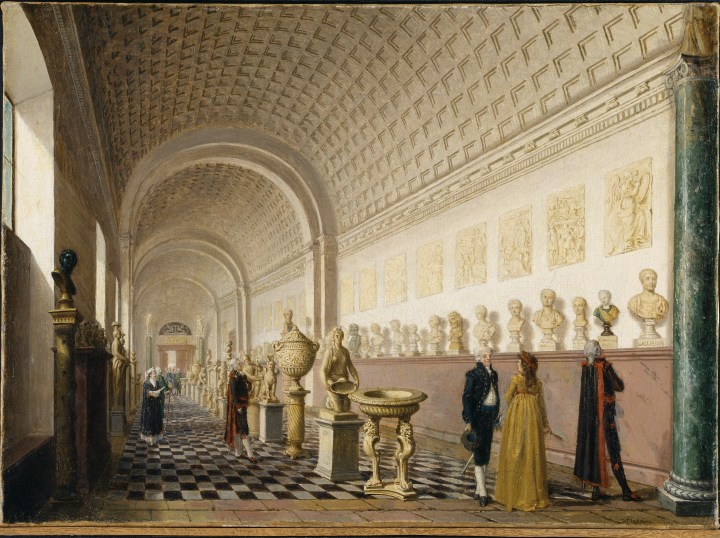
Pehr Hilleström, The Inner Gallery of the Royal Museum at the
Royal Palace, Stockholm, 1796 (Nationalmuseum, Stockholm)
◊ ◊ ◊ ◊ ◊
Press release (1 September 2014) from Stockholm’s Nationalmuseum:
Nationalmuseum has made a major loan of works to the Pehr Hilleström exhibition at the Sinebrychoff Art Museum in Helsinki. The loan comprises some twenty works by this artist best known for his documentary paintings of 18th-century Stockholm.

Pehr Hilleström, Self-Portrait, 1771 (Stockholm: Nationalmuseum; photo by Erik Cornelius)
This is the first time that a Finnish gallery has mounted a comprehensive exhibition of works by the Swedish artist Pehr Hilleström (1732–1816). Nationalmuseum in Stockholm has contributed some twenty paintings by Hillestrom, one of Sweden’s most highly regarded artists of the 18th century. The works on loan include Testing Eggs, Kitchen Scene, Card Game at the Home of Elis Schröderheim, Public Banquet at Stockholm Castle New Year’s Eve 1779, plus two self-portraits and an enigmatic portrait of Carl Michael Bellman. In all, fifty of Hilleström’s best-known paintings are on display. The exhibition was planned by Nationalmuseum’s Mikael Ahlund, who also wrote the commentary for the accompanying book.
Pehr Hilleström portrayed the entire spectrum of life in the Gustavian era, from idle young ladies in elegant drawing rooms to industrious working-class wives going about their domestic chores. He is famous for his almost documentary depictions of city fires and official ceremonies in 18th-century Stockholm. His wide range of motifs includes industry, landscapes and scenes from the theatre. In his later years, he
also turned to historical and religious motifs.
Sweden’s Nationalmuseum Launches Free Online Journal, Volume 20
Press release (3 September 2014) from the Nationalmuseum:
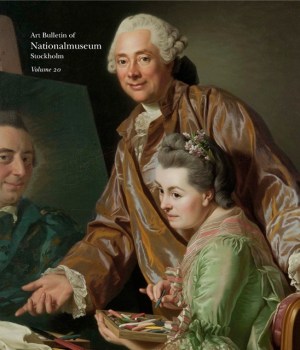 Stockholm’s Nationalmuseum has launched its first digital journal, available online to download and read free of charge. The Art Bulletin of Nationalmuseum Stockholm contains academic articles on art history relating to Nationalmuseum’s collections. The journal is moving to digital-only format and will be available through the DiVA portal (a Swedish publishing system for academic research and student theses) and the museum’s own website. The Art Bulletin of Nationalmuseum Stockholm is an annual publication containing academic articles on art history relating to Nationalmuseum’s collections. The journal has existed in print form since 1996, but is now switching to digital-only format, starting with volume 20. The journal’s established graphic design will be enhanced through the addition of digital media features such as metadata, live links to chapter headings and page references, and high-resolution images.
“For an art institution like Nationalmuseum, it’s important to offer our readers high-quality images that do full justice to the works,” said Janna Herder, editor of the Art Bulletin of Nationalmuseum Stockholm. “Readers therefore have the option of downloading the entire journal in low-resolution format or individual articles in high-resolution format.”
Nationalmuseum expects to attract a larger and wider readership now that the journal and its articles are freely available and searchable via Google and other search engines. As a member of the DiVA portal, the museum is able to distribute the publication more effectively in the academic community. “This is a further step in the digital evolution of Nationalmuseum and a key initiative in fulfilling our mandate to improve access to and awareness of our collections,” said Magdalena Gram, the museum’s head of research, library and archives and the journal’s editor-in-chief. “Another aspect of our mandate involves collaboration with other institutions such as universities and colleges. Offering an established publication like the Art Bulletin of Nationalmuseum Stockholm in digital format through the DiVA portal marks a breakthrough in terms of our ability to make specialized knowledge and information freely available.”
◊ ◊ ◊ ◊ ◊
Articles related to the eighteenth century (visit the Nationalmuseum website for the full contents) . . .
Art Bulletin of Nationalmuseum Stockholm 20 (2013).
A C Q U I S I T I O N S
Carina Fryklund, “Three 17th-Century Paintings from the Collection of Gustaf Adolf Sparre (1746–94),” pp. 11–16.
Magnus Olausson, “Roslin’s Self-Portrait with his Wife Marie Suzanne Giroust Painting a Portrait of Henrik Wilhelm Peill (1767),” pp. 17–18.
Magnus Olausson, “Wertmüller’s Portrait of Henri Bertholet-Campan with the Dog Aline (1786),” pp. 19–20.
Guilhem Scherf, “Une Statuette en Terre Cuite de Jean-Baptiste Stouf au Nationalmuseum,” pp. 27–36.
Magnus Olausson, “Madame Lefranc Painting a Portrait of her Husband Charles Lefranc (1779): A Miniature by Adélaïde Labille-Guiard,” pp. 37–8.
Anders Bengtsson, “A Unique Plate Warmer,” pp. 39–40.
Anders Bengtsson, “A Chair Fit for a Prince,” pp. 41–2.
Acquisitions 2013: Exposé, pp. 61–96.
A R T I C L E S O N T H E H I S T O R Y A N D T H E O R Y O F A R T
Martin Olin, “An Italian Architecture Library under the Polar Star: Nicodemus Tessin the Younger’s Collection of Books and Prints,” pp. 109–18.
Magnus Olausson, “Louis Gauffier’s Portrait of Gustaf Mauritz Armfelt (1793): A Political or a Conspiratorial Painting?,” pp. 119–22.
Ulf Cederlöf, “An Exceptionally Protracted Affair: The Nationalmuseum’s Acquisition of Sergel’s Collections of Drawings and Prints, 1875–76,” pp. 123–34.
S H O R T E R N O T I C E S
Görel Cavalli-Björkman and Margaretha Rossholm-Lagerlöf, “A Source-Critical Comment on Roger de Robelin’s “On the Provenance of Rembrandt’s The Conspiracy of the Batavians under Claudius Civilis,” 135–36.
Roger de Robelin, “Response to “A Source-Critical Comment etc.,” pp. 137–38.
R E P O R T
Helen Evans and Helena Kåberg, “The Nationalmuseum Lighting Lab,” pp. 139–46.
Call for Papers | Streitsache: Architecture as Matter of Contention
From Candide: Journal for Architectural Knowledge:
Streitsache: Architecture as Matter of Contention
Aachen University, 29–31 January 2015
Proposals due by 20 September 2014
From January 29 to 31, 2015 the second Candide Conference will take place at RWTH Aachen University. The peer-reviewed Candide: Journal for Architectural Knowledge was founded in 2009 and publishes contributions on the knowledge of architecture. The best papers presented in the conference will be published in a forthcoming issue.
The interdisciplinary conference Streitsache: Architecture as Matter of Contention intends to probe the complex relation between architecture and conflict. There are numerous instances in which architectural objects become objects of conflict, ‘bones of contention, a Streitsache. Conceiving of architecture as a Streitsache generates new architectural knowledge, including knowledge on the interactions that emerge from and through the objects of contention. Architectural things, whether in the form of architectural details, buildings or entire cities, are actors whose agency becomes manifest in conflictual processes. The field of politics and the negotiation of law is constituted through and by them. As thresholds Streitsachen are politically operative because they render conflicts visible and negotiable. The debates surrounding the Stuttgart 21 project, the Elbphilharmonie in Hamburg, or Les Halles in Paris could serve as recent examples.
The aim of the conference is to expand the scope of thinking about architecture, its function and character, into fields of the theory of law and political philosophy. As agents of the political, ’things of contention render plurality and heterogeneous interests visible and negotiable. Architecture’s dissension opens up a new space for collective thinking and action. The conference is interdisciplinary and addresses scholars and practitioners from the fields of architecture, art, political sciences, legal studies, cultural studies, anthropology, science and technology studies, cultural technology studies, and media philosophy.
The structure of the conference follows the phases of architectural processes in which matters of contention become visible and negotiable: a) design, planning, and implementation b) judgment and critique c) negotiation and settlement.
a) Conflicts arise because of sketches, plans, models, construction site protocols, budgets, legal rules, and press releases. How and through which circumstances does architecture turn into a matter of contention? What precisely is the disputed subject? How can we frame the design process as a sequence and as a negotiation of difference between agencies, both human and non-human? What kind of architectural knowledge becomes manifest in a concrete dispute?
b) Matters of contention generate their own social spaces. They are the sites where a contending community—and therewith the precondition for the political—emerges. How do disputing actors appropriate architecture? What modifications do contested things undergo during the conflictual relation? How do values become comprehensible and negotiable during a conflict? How do processes of selection function and how are verdicts reached? How do architectural objects become instruments that trigger or resolve conflicts?
c) Architectural matters of contention not only promote bellicose polemics but also social knowledge, which is implemented in processes of negotiation and arbitration. How does architecture function as a repository of or evidence of past conflicts? How can knowledge gained from past conflicts be used to create strategies to prevent future conflicts? Does it make sense to think the culture of architecture as a culture of contention?
We welcome submissions of case studies, historical and theoretical reflections dealing with particular projects, built architectures and specific disputes. The working languages at the conference will be German and English. Please send an abstract (max. 500 words) and a short CV before September 20, 2014 to: candide@theorie.arch.rwth-aachen.de.
Exhibition | The Generous Georgian: Dr Richard Mead
From The Foundling Museum:
The Generous Georgian: Dr Richard Mead
The Foundling Museum, London, 26 September 2014 — 4 January 2015
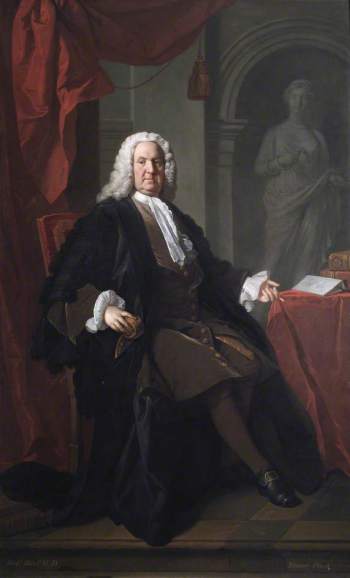
Allan Ramsay, Dr Richard Mead, 1747
(London: The Foundling Museum)
Dr Richard Mead (1673–1754) was one of the most eminent physicians, patrons, collectors, and philanthropists of his day, as well as a significant figure in the early history of the Foundling Hospital. A leading expert on poisons, scurvy, smallpox, and public health, Mead counted among his patients Queen Anne, King George II, Sir Isaac Newton, and the painter Antoine Watteau. A man of action, Mead explored poisons by drinking snake venom and is said to have defended his theory on smallpox treatment to the point of fighting a duel.
His home on Great Ormond Street backed onto the Foundling Hospital grounds and housed a magnificent collection of paintings, sculptures, antiquities, coins, and a library of over 10,000 volumes. Painters and scholars were given access to Mead’s renowned collection, which in a time before public galleries offered visitors a rare chance to view masterpieces from around the world. Examining its significance in London’s cultural landscape, this exhibition reunites key objects from his life and collection, such as the ancient bronze Arundel Head (2nd century BC) and Allan Ramsay’s half-length portrait of Mead.
Exploring Mead ‘in the round’, as a collector, philanthropist and physician, this exhibition will bring to light the Foundling Hospital’s relationship with a truly remarkable individual who, according to his contemporary the writer Samuel Johnson, “lived more in the broad sunshine of life than almost any man.”
The Generous Georgian: Dr Richard Mead is supported by the Wellcome Trust, the City of London Corporation and Verita.
◊ ◊ ◊ ◊ ◊
Conference programme from The Foundling:
Dr Richard Mead: Physician, Philanthropist, Collector
The Foundling Museum, London, 20 October 2014
To accompany the Museum’s autumn exhibition, The Generous Georgian: Dr Richard Mead, this one-day interdisciplinary conference considers the life, work, and collections of Mead. Adults £20, Concessions £15. To book, download a booking form or book online (subject to an 8% booking fee). Please send completed booking forms to: Stephanie Chapman, 40 Brunswick Square, London, WC1N 1AZ. For enquiries please contact exhibitions@foundlingmuseum.org.uk.
P R O G R A M M E
8:30 Optional early morning tour of the Royal College of Physicians (11 St Andrews Place, Regent’s Park) with curator Emma Shepley, addressing Richard Mead and his role in the institution.
9:15 Travel to the Foundling Museum. You will need to make your own way by public transport from RCP to the Foundling Museum, but staff will be able to recommend routes. The journey time is approximately 30 minutes.
9:30 Coffee and registration
10:00 Welcome
10:15 Ludmilla Jordanova, ‘The Problem of Richard Mead’
11:00 Break
11:30 Karen Howell, ‘The Curious Prescriptions of Dr Mead’
12:00 Janette Bright, ‘Dr Mead and the Curious Herbal’
12:30 Kevin Brown, ‘Richard Mead, George Anson’s Circumnavigation of the Globe, and the Health of the Seaman’
13:00 Lunch
14:00 Stephanie Chapman, ‘Richard Mead and the Foundling Hospital’
14:30 Tour of the exhibition, The Generous Georgian: Dr Richard Mead
15:00 Charles Avery, ‘The Large Brass Medallions Cast by Soldani, Selvi, and Pozzi in the Musaeum Meadianum’
15:30 Craig Hanson, ‘Debating Dissent in Leiden’
16:00 Refreshments
Exhibition | In Miniature
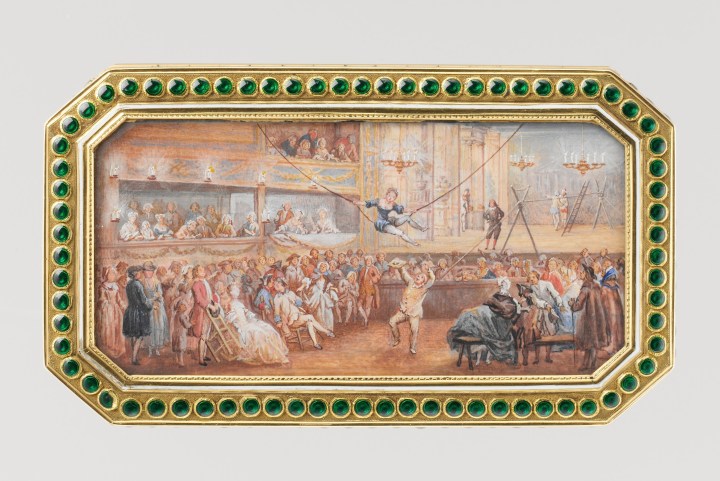
Joseph Étienne Blerzy, Snuffbox with theatrical scenes of a rope dancer and a puppet show by by Louis Nicolas van Blarenberghe and Henri Joseph van Blarenberghe, 1778–79 (New York: The Metropolitan Museum of Art. Gift of J. Pierpont Morgan, 1917; 17.190.1130). A high resolution image is available here»
◊ ◊ ◊ ◊ ◊
Now on at The Met (as noted at Bendor Grosvenor’s Art History News). . .
In Miniature
The Metropolitan Museum of Art, New York, 29 August 29 — 31 December 2014
This exhibition will comprise two groups of portrait miniatures: British, from the sixteenth and early seventeenth centuries, and French, from the revolutionary period to the Empire. Also included are several eighteenth-century French gold boxes decorated with narratives or scenes in grisaille. All are from the Museum’s permanent collection and, because of their sensitivity to light, are infrequently exhibited. Six larger paintings will be exhibited in order to consider what they may share with the miniatures and to show how they differ. Gallery 624.
◊ ◊ ◊ ◊ ◊
In conjunction with the exhibition, The Met has a Pinterest Board dedicated to “Met Miniatures”. There are lots of things there not included in the exhibition (nor particularly relevant to the exhibition), but notes indicate items that are part of the display. Serving basically as an illustrated checklist with links to the full online catalogue entries, it seems like a fairly obvious use of Pinterest by museums. –CH
New Book | The Arts of Living: Europe, 1600–1815
Among the V&A’s New Books for the fall:
Elizabeth Miller and Hilary Young, eds., The Arts of Living: Europe, 1600–1815 (London: V&A Publishing, 2014), 208 pages, ISBN: 978-1851778072, £25 / $40.
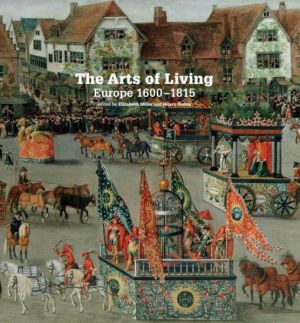 Published to accompany the landmark opening of the V&A’s new Europe 1600–1800 galleries, The Arts of Living explores the breadth, depth and beauty of the V&A’s seventeenth- and eighteenth-century collections. Written by a team of experts, this book provides an overview of more than two centuries of cultural development and artistic endeavour. Masterpieces such as the Serilly Cabinet and Gian Lorenzo Bernini’s terracotta for his funeral monument the Blessed Ludovica Albertoni are contextualized alongside discussions of Louis XIV’s patronage and the seventeenth-century Dutch interior. Many works are shown for the first time, including Count Brühl’s Meissen fountain and actor David Garrick’s tea service.
Elizabeth Miller is senior curator of prints, and Hilary Young is senior curator of ceramics at the V&A.
A preview of the book is available here»
Exhibition | Constable: The Making of a Master

◊ ◊ ◊ ◊ ◊
Press release for the upcoming exhibition:
Constable: The Making of a Master
Victoria & Albert Museum, London, 20 September 2014 — 11 January 2015
Curated by Mark Evans
“We see nothing till we truly understand it.” Constable, 1821
The V&A’s major autumn exhibition will re-examine the work of John Constable (1776–1837), Britain’s best-loved artist. It will explore his sources, techniques and legacy and reveal the hidden stories behind the creation of some of his most well-known paintings. Constable: The Making of a Master will juxtapose Constable’s work for the first time with the art of 17th-century masters of classical landscape such as Ruisdael, Rubens and Claude, whose compositional ideas and formal values Constable revered. On display will be such celebrated works as The Hay Wain (1821), The Cornfield (1826) and Salisbury Cathedral from the Meadows (1831), together with oil sketches Constable painted outdoors directly from nature, which are unequalled at capturing transient effects of light and atmosphere. The exhibition will bring together over 150 works of art including oil sketches, drawings, watercolours and engravings.
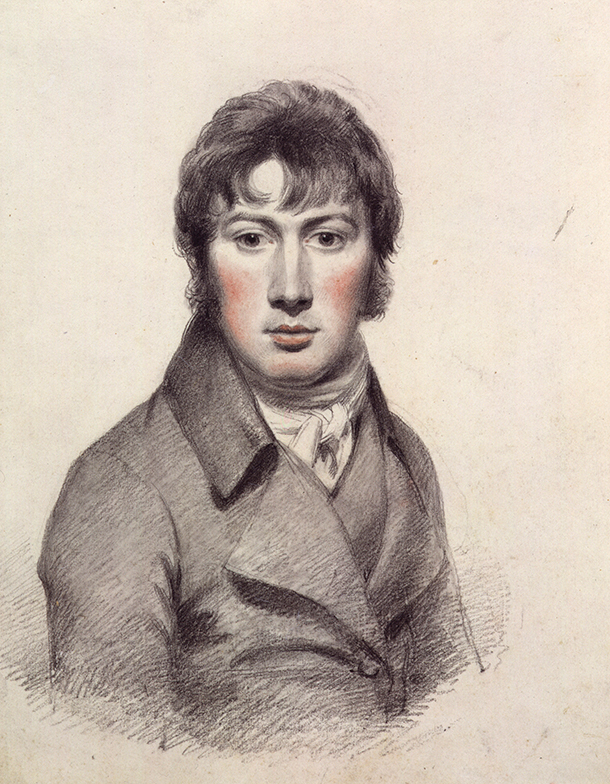
John Constable, Self-Portrait, ca. 1799-1804, pencil and black chalk heightened with white and red chalk (London: National Portrait Gallery)
Martin Roth, V&A Director, said: “The V&A has been one of the leading centres for Constable research since the 19th century, following a significant gift of paintings, oil sketches and drawings from Constable’s daughter Isabel in 1888. This exhibition refreshes our understanding of his work and creative influence. It shows that Constable’s art, so well-loved and familiar to many of us, still delivers surprises.”
Born in East Bergholt, Suffolk on 11 June 1776, John Constable was the second son of a gentleman farmer and mill owner. Whilst working in the family business he became intimately familiar with the countryside around the River Stour and sketched observations of nature and the scenery and motifs of the Suffolk countryside. Given permission by his father to pursue art, he travelled to London in 1799 where he studied at the Royal Academy of Arts. He was schooled in the old masters, meticulously copying their work and reflecting on their compositions in his individual style. On display will be paintings including Moonlight Landscape (1635–1640) by Rubens and Landscape with a Pool (1746–47) by Gainsborough, which inspired Constable’s early practice.
Constable made a number of close copies of the old masters which he referred to as a “facsimile…a more lasting remembrance.” Paintings including Claude’s Landscape with a Goatherd and Goats (c.1636–37) and Ruisdael’s Windmills near Haarlem (c.1650–52), as well as etchings and drawings by Herman van Swanevelt and Alexander Cozens, will be displayed alongside Constable’s own direct copies, many of which will be brought together for the first time since they were produced almost 200 years ago. Constable also owned an extensive art collection that included 5000 etchings principally by 17th-century Dutch, Flemish, and French landscape painters, which became a vital resource for his own image making.
Outdoor sketching was central to Constable’s working method. The 1810s saw the beginning of a series of expressive oil sketches and drawings in the open air, capturing the changes of weather and light in his native countryside. His naturalistic representation of the landscape and use of broad brushstrokes and impasto technique challenged conventions and brought the genre of outdoor oil sketching to a new level of refinement. Examples of his cloud studies, including sketches of Hampstead Heath and Brighton Beach will demonstrate Constable’s innovative and poetic evocations of land, sea and sky.
The exhibition will also investigate Constable’s methods for transferring the freshness of his sketches into his exhibition paintings. From 1818–19 Constable produced full-scale oil sketches to resolve the compositions, colours, and light values of his ‘six-footers’ such as The Hay Wain (1821) and The Leaping Horse (1825) which are amongst the best-known images in British art.
In the last decade of his life Constable and the engraver David Lucas collaborated on a series of mezzotints after the artist’s paintings. The final section of the exhibition will present a major group of these prints together with the exemplary original oil sketches on which they were based. Through these prints Constable sought to secure his artistic legacy and ensure the continued study of his groundbreaking paintings, which remain hugely influential to the present day.
◊ ◊ ◊ ◊ ◊
Constable: The Making of a Master Study Day
Victoria & Albert Museum, London, 4 October 2014
This study day will bring together scholars from a range of disciplines to explore the man, the artist, his ambitions, interests and techniques. Speakers will include Mark Evans, Annie Lyles, Sarah Cove, John Thornes, and Jonathan Clarkson. Saturday, 4 October, 10.30–17.15, Seminar Room Three. £45, £35 concessions, £15 students.
◊ ◊ ◊ ◊ ◊
Mark Evans, with Susan Owens and Stephen Calloway, John Constable: The Making of a Master (London: V&A Publishing, 2014), 192 pages, ISBN: 978-1851778003, £30.
 The remarkable naturalism of John Constable’s paintings has always been acknowledged, and his ‘vivid and timeless’ (as he called them) oil sketches have been celebrated since the 1890s as precursors of Impressionism, modernism and photographic composition. He remains a powerful influence on contemporary artists, and was famously Lucian Freud’s favourite painter. He was also hailed in 1866 as the first painter whose ‘art is purely and thoroughly English’, and his studio oil paintings have helped to define our idea of the English countryside. Published to accompany a major V&A exhibition, this book evaluates these aspects of Constable’s work, placing the artist’s naturalism and studio work in the context of his wider practice—in particular his talent for copying, and extensive print collection. A companion volume to John Constable: Oil Sketches from the Victoria and Albert Museum (V&A Publishing, 2011), this book shows how the artist’s reverence for the Old Masters is not incompatible with his revolutionary handling of paint: where others competed with the Masters, Constable assimilated their ideas and values to imbue his own naturalistic vision with dynamism..
Mark Evans is senior curator of Paintings at the V&A.
◊ ◊ ◊ ◊ ◊
Map: Constable’s England
 In conjunction with the exhibition, the V&A has created a Pinterest map to help visitors explore Constable’s England. As is usually the case with Pinterest, there are drawbacks, but I found the map useful for visualizing big points and connecting pictures to places. Given how technologically easy it is to produce this sort of page, it could work well as a teaching assignment. It also provides an excuse for me to remind readers that Enfilade maintains a handful of Pinterest boards, too. –CH
Internet Archive Book Images Now Available via Flickr Commons
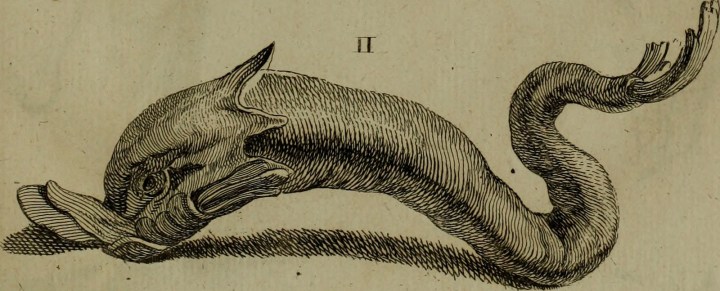
Image from page 274 of Comte de Caylus, Recueil d’antiquités égyptiennes, étrusques, greques et romaines (Paris : Desaint & Saillant, 1752). More information is available here»
◊ ◊ ◊ ◊ ◊
As noted here at Enfilade in December, the British Library made available over a million images from the pages of seventeenth-, eighteenth- and nineteenth-century books via Flickr Commons. The BBC now reports that Georgetown University Fellow in Residence Kalev Leetaru has uploaded 2.6 million pictures sourced from books digitized by the Internet Archive. Publication dates range from 1500 to 1922. All images are tagged and available for free download. A quick search for Caylus turned up the image shown above. Search options are limited, and it took me a few moments just to work out how to search only within the Internet Archive Book Images, as opposed to all of Flickr (proof only of my own clumsiness; once you start typing in the main search box in the upper right hand corner, you should see a photostream option appear just below). How useful this resource is will depend upon what sort of search you’re attempting, but the possibilities seem extraordinary. In addition to the news story excerpted below, the Flickr Blog provides further information. –CH
◊ ◊ ◊ ◊ ◊
Leo Kelion, “Millions of Historic Images Posted to Flickr,” BBC News (29 August 2014).
An American academic is creating a searchable database of 12 million historic copyright-free images.
Kalev Leetaru has already uploaded 2.6 million pictures to Flickr, which are searchable thanks to tags that have been automatically added. The photos and drawings are sourced from more than 600 million library book pages scanned in by the Internet Archive organisation. The images have been difficult to access until now. Mr Leetaru said digitisation projects had so far focused on words and ignored pictures.
“For all these years all the libraries have been digitising their books, but they have been putting them up as PDFs or text searchable works,” he told the BBC. “They have been focusing on the books as a collection of words. This inverts that. . . .”
The full BBC story is available here»

◊ ◊ ◊ ◊ ◊
More about the Internet Archive, from the Wikipedia entry on the organization:
 The Internet Archive is a non-profit digital library with the stated mission of “universal access to all knowledge.”[2][3] It provides permanent storage of and free public access to collections of digitized materials, including websites, music, moving images, and nearly three million public-domain books. As of October 2012, its collection topped 10 petabytes.[4][5] In addition to its archiving function, the Archive is an activist organization, advocating for a free and open Internet. . .
N O T E S
2. “Internet Archive Frequently Asked Questions.” Internet Archive. Retrieved April 13, 2013.
3. “Internet Archive: Universal Access to all Knowledge.” Internet Archive. Retrieved April 13, 2013.
4. “10,000,000,000,000,000 bytes archived!” Internet Archive Blogs. October 26, 2012. “On Thursday, 25 October, hundreds of Internet Archive supporters, volunteers, and staff celebrated addition of the 10,000,000,000,000,000th byte to the Archive’s massive collections.”
5. Brown, A. (2006). Archiving Websites: A Practical Guide for Information Management Professionals. London: Facet Publishing. p. 9.
New Book | Geometrical Objects
From Susan Klaiber’s blog (14 August 2014) . . .
What began as a small session at the Society of Architectural Historians 2005 Annual Meeting in Vancouver, and then developed into a very collegial two-day conference in Oxford in 2007, has now been published by Springer in both hardcover and e-book formats.
Anthony Gerbino, ed., Geometrical Objects: Architecture and the Mathematical Sciences, 1400–1800 Archimedes 38 (Cham: Springer, 2014), 318 pages, ISBN: 978-3319059976, $180.
 This volume explores the mathematical character of architectural practice in diverse pre- and early modern contexts. It takes an explicitly interdisciplinary approach, which unites scholarship in early modern architecture with recent work in the history of science, in particular, on the role of practice in the scientific revolution. As a contribution to architectural history, the volume contextualizes design and construction in terms of contemporary mathematical knowledge, attendant forms of mathematical practice, and relevant social distinctions between the mathematical professions. As a contribution to the history of science, the volume presents a series of micro-historical studies that highlight issues of process, materiality, and knowledge production in specific, situated, practical contexts. Our approach sees the designer’s studio, the stone-yard, the drawing floor, and construction site not merely as places where the architectural object takes shape, but where mathematical knowledge itself is deployed, exchanged, and amplified among various participants in the building process.
◊ ◊ ◊ ◊ ◊
C O N T E N T S
Introduction by Anthony Gerbino
Part I: Foundations
Bernard Cache, ‘Proportion and Continuous Variation in Vitruvius’s De Architectura’
Part II: Mathematics and Material Culture in Italian Renaissance Architecture
Francesco Benelli, ‘The Palazzo Del Podestà in Bologna: Precision and Tolerance in a Building all’Antica‘
Ann C. Huppert, ‘Practical Mathematics in the Drawings of Baldassarre Peruzzi and Antonio da Sangallo the Younger’
David Friedman, ‘Geometric Survey and Urban Design: A Project for the Rome of Paul IV (1555–1559)’
Part III: The Baroque Institutional Context
Susan Klaiber, ‘Architecture and Mathematics in Early Modern Religious Orders’
Kirsti Andersen, ‘The Master of Painted Architecture: Andrea Pozzo, S. J. and His Treatise on Perspective’
Part IV: Narratives for the Birth of Structural Mechanics
Jacques Heyman, ‘Geometry, Mechanics, and Analysis in Architecture’
Pascal Dubourg Glatigny, ‘Epistemological Obstacles to the Analysis of Structures: Giovanni Bottari’s Aversion to a Mathematical Assessment of Saint-Peter’s Dome (1743)’
Filippo Camerota, ‘Scientific Concepts of Beauty in Architecture: Vitruvius Meets Descartes, Galileo, and Newton’
Part V: Architecture and Mathematical Practice in the Enlightenment
Jeanne Kisacky, ‘Breathing Room: Calculating an Architecture of Air’
David Yeomans, Jason M. Kelly, and Frank Salmon, ‘James “Athenian” Stuart and the Geometry of Setting Out’
Index
Exhibition | Of Heaven and Earth: 500 Years of Italian Painting

Andrea Casali, Triumph of Galatea, ca. 1740–65, oil on canvas,
28 x 34 inches, 71.5 x 87.2 cm (Glasgow Museums Collection)
◊ ◊ ◊ ◊ ◊
Nearing the end of its run in Allentown and opening soon in Milwaukee:
Of Heaven and Earth: 500 Years of Italian Painting from Glasgow Museums
Oklahoma City Museum of Art, 24 August — 17 November 2013
Art Gallery of Alberta, Edmonton, 14 December 2013 — 9 March 2014
Allentown Art Museum of the Lehigh Valley, Allentown, Pennsylvania, 8 June — 7 September 2014
Milwaukee Art Museum, 2 October 2014 — 4 January 2015
Santa Barbara Museum of Art, 6 February — 3 May 2015
Curated by Peter Humfrey
Starting in October, the Milwaukee Art Museum welcomes some of the biggest names in European art in its fall exhibition Of Heaven and Earth: 500 Years of Italian Painting from Glasgow Museums, organized by the American Federation of Arts and Glasgow Museums. Displayed in five chronological sections, Of Heaven and Earth will include paintings originating from the principal artistic centers of Italy—Rome, Milan, Bologna, Florence, Siena, Naples, and Venice—and will present the works of artists such as Giovanni Bellini, Sandro Botticelli, Domenichino, Francesco Guardi, Salvator Rosa, and Titian alongside those of lesser-known masters.
“With works by some of the most significant European masters like Giovanni Bellini, Sandro Botticelli, and Titian, Of Heaven and Earth: 500 Years of Italian Painting from Glasgow Museums will examine the thematic and stylistic developments in Italian art—from the religious paintings of the late Middle Ages and Renaissance to the secular neoclassical and genre paintings of the nineteenth century,” said Daniel Keegan, director of the Milwaukee Art Museum. “The remarkable regional and historical breadth of the exhibition will also showcase the outstanding quality of Glasgow Museums’ collection.”
“This sumptuous exhibition presents the works of famous artists that even some art historians wait a lifetime to see,” said Tanya Paul, the Isabel and Alfred Bader Curator of European Art at the Milwaukee Art Museum. “Most of the paintings have never traveled to America before, and many have been conserved specifically for this presentation.”
Of Heaven and Earth: 500 Years of Italian Painting from Glasgow Museums is organized by the American Federation of Arts and Glasgow Museums and is supported by an indemnity from the Federal Council on the Arts and Humanities. The exhibition tour is generously supported by the JFM Foundation and the Donald and Maria Cox Charitable Fund. In-kind support is provided by Barbara and Richard S. Lane and Christie’s.
◊ ◊ ◊ ◊ ◊
Peter Humfrey, Of Heaven and Earth: 500 Years of Italian Painting from Glasgow Museums (Glasgow, 2013), 192 pages, ISBN: 978-1908638021, £16.
 This catalogue looks at 41 of the key works from the Glasgow Museums’ collection of Italian Art, with insightful commentary on each piece. Also included are short introductions to the art history of the periods during which the works were made. Glasgow Museums owns one of the finest collections of Italian art in Northern Europe. Its richness derives from the great industrial and mercantile wealth that Glasgow enjoyed in the nineteenth century as the Second City of the British Empire and the fourth richest city in Europe, as well as from the generosity and civic pride of her citizens. The collection is remarkable for both the quality and interest of individual works and for its chronological range.
An internationally renowned specialist in Italian art history, Peter Humfrey teaches at the University of St. Andrews.










 Enfilade
leave a comment