Call for Papers | Lost Museums Colloquium
From The Jenks Society:
Lost Museums Colloquium
Brown University, Providence, Rhode Island, 7–8 May 2015
Proposals due by 15 September 2014
In conjunction with the year-long exhibition project examining Brown University’s lost Jenks Museum, the John Nicholas Brown Center for Public Humanities and Cultural Heritage, the Haffenreffer Museum of Anthropology, and the John Carter Brown Library invite paper proposals for a colloquium on lost artifacts, collections and museums. (Other formats—conceptual, poetic, and artistic—are also invited.)
Museums, perhaps more than any other institutions, think in the very long term: collections are forever. But the history of museums is more complicated than that. Museums disappear for many reasons, from changing ideas about what’s worth saving to the devastation of war. Museum collections disappear: deaccessioned, traded away, repatriated, lost to changing interests and the ravages of time.
We are interested in this process of decline and decay, the taphonomy of institutions and collections, as a way of shedding light not only on the history of museums and libraries, but also on the ways in which material things reflect and shape the practices of science and the humanities, and also to help museums think about current and future practices of collections and collections use. We invite presentations from historians, curators, registrars, and collections managers, as well as from artists and activists, on topics including:
• Histories of museums and types of museums: We welcome case studies of museums and categories of museums that are no more. What can we learn from museums that are no more? Cast museums, commercial museums, and dime museums have mostly disappeared. Cabinets of curiosity went out of and back into fashion. Why? What is their legacy?
• Artifacts: How do specimens degrade? How have museums come to think of permanence and ephemerality? How do museums use, and ‘use up’ collections, either for research (e.g., destructive sampling), or for education and display; how have they thought about the balance of preservation and use? How can they collect the ephemeral?
• Museum collection history: How long does art and artifact really remain in the museum? Might the analysis of museum databases cast new light on the long-term history and use of collections?
• ‘Lost and found’ in the museum: How are art and artifacts ‘rediscovered’ in museums? How do old collections regain their importance, both in artistic revivals and in new practices of ‘mining’ the museum as artists finding new uses for old objects?
• Museum collections policy: How have ideas about deaccessioning changed? How should they change? How do new laws, policies, and ethics about the repatriation of collections shape ideas about collections?
• Museums going out of business: When a museum needs to close for financial or other reasons, what’s the best way to do that? Are there good case studies and legal and financial models?
• The future of museum collections: How might museums think about collecting the ephemeral, or collecting for ‘impermanent’ collections. What new strategies should museums consider for short-term collecting? How might digitization and scanning shape ideas about the permanence of collections?
Papers from the Colloquium may be published as a special issue of the Museum History Journal. If you’d like to present at the conference, please send an abstract of about 250 words and a brief CV to Steven Lubar, lubar@brown.edu. Deadline for submission of paper proposals is September 15, 2014.
Steven Lubar
Department of American Studies
John Nicholas Brown Center for Public Humanities and Cultural Heritage
lubar@brown.edu
Exhibition | The Spanish Gesture: Drawings from Murillo to Goya

Francisco de Goya y Lucientes, Two Groups of Picadors Overrun Consecutively by a Single Bull, 1814–16. Red chalk and red-ink wash on laid paper
(Hamburger Kunsthalle, Kupferstichkabinett 38541; photo by Christoph Irrgang)
◊ ◊ ◊ ◊ ◊
From the Meadows Museum:
The Spanish Gesture: Drawings from Murillo to Goya in the Hamburger Kunsthalle
Dibujos españoles en la Hamburger Kunsthalle: Cano, Murillo y Goya
Meadows Museum, Dallas, 25 May — 31 August 2014
Museo Nacional del Prado, Madrid, 30 October 2014 — 8 February 2015
Curated by Jens Hoffmann-Samland
The Kupferstichkabinett (collection of prints and drawings) at the Kunsthalle of Hamburg holds, alongside Florence, Paris and London, one of the most significant collections of Spanish drawings to be found outside of Spain. This is perhaps surprising at first, given that the Hanseatic city of Hamburg has historically not been a stronghold of Catholicism. Indeed, the reason for this lies in a single, rather chance purchase by the first director of the Kunsthalle, Alfred Lichtwark (1852–1914); the motivation for this acquisition was as spontaneous as it was personal.

Francisco de Goya y Lucientes, Prince Balthasar Carlos as Hunter (after Velázquez), 1778–79. Red crayon over preliminary drawing in pencil. (Hamburger Kunsthalle, Kupferstichkabinett 38540; photo by Christoph Irrgang)
In 1891, the London art and antiques dealer Bernard Quaritch (1819–1899) offered for sale a mixed lot of Spanish and Italian drawings to the Berlin Museum. There, however, the budget had already been depleted by the purchase of a different collection. Lichtwark viewed the drawings in Berlin and, since they “pleased him greatly,” he immediately and successfully went about securing the necessary £180, thus acquiring them for Hamburg.
A few years later, however, the quality of the extraordinary collection, which today comprises over 200 drawings, had already faded from memory. When August L. Mayer (1885–1944) inquired as to whether there were any Spanish drawings in the Hamburg collection that he could include in his planned publication of 150 drawings by Spanish masters to be published by The Hispanic Society of America in 1915, he was told that “it contains almost nothing of significance.” As a result, the drawings went unheeded for a considerable length of time. There followed—at intervals of about thirty-five to forty years—a small in-house exhibition in 1931, a slightly larger exhibition in 1966 with additional items from the Museo Nacional del Prado and the Biblioteca Nacional in Madrid, and another smaller presentation in 2005 comprising forty-five works of art. To be certain, some important and, by now, famous works from the Hamburg collection have often traveled to different venues. The Spanish Gesture: Drawings from Murillo to Goya in the Kunsthalle, Hamburg is the first exhibition to present this exquisite collection on a larger scale, 123 years after it was first bought by the Kunsthalle of Hamburg.
A great part of the core of today’s Hamburg collection was assembled by Bartolomé Esteban Murillo (1617-1682) and was produced in and around the Academia de Murillo he established in Seville in 1660 with Francisco Herrera the Younger (1622-1685), Juan de Valdés Leal (1622–1690), Cornelis Schut (1629–1685) and others. Highlights from this period include Murillo’s Assumption of the Virgin (c. 1665); a pen-and-ink drawing, Nobleman in a Landscape (c. 1660), attributed to Herrera the Younger; Head of St. John the Baptist (1654–55) by Valdés Leal; and Alonso Cano’s (1601–1667) Sketch for the Altar of St. Catherine. The Hamburg Kupferstichkabinett holds the largest group of half-length holy figures, understood to represent the twelve apostles, by Francisco Herrera the Elder (c. 1590–1656), created around 1640–50, and this exhibition will display all twelve works together for the first time.
Representing the later end of the collection is a number of drawings by Francisco Goya (1746–1828). Together with his Tauromaquia prints and drawings from Goya’s “Album B,” the collection holds the majority of Goya’s drawings after Diego Velázquez (1599–1660) that he subsequently used (or intended to use) for his etchings. Among these are the two Greek literary figures Aesop and Moenippus. The collection also comprises full-length portraits of members of the royal family, dwarves and court jesters, Los Borrachos, Las Meninas, and one of Velázquez’s most important early works that leads us back to Seville, the Waterseller of Seville.
As part of the continued collaboration between the Meadows Museum and the Museo Nacional del Prado, the exhibition has been researched by Dr. Jens Hoffmann-Samland, an independent art historian. Approximately eighty drawings from the Kunsthalle of Hamburg will be on view in Dallas, and will be published in the accompanying catalogue, which is being collaboratively published by the Meadows Museum, the Museo Nacional del Prado, the Kunsthalle of Hamburg, and the Centro de Estudios Europa Hispánica (CEEH). The exhibition will travel to Madrid for display at the Museo Nacional del Prado October 2014–February 2015.
This exhibition has been organized by the Meadows Museum, SMU; the Museo Nacional del Prado; the Hamburger Kunsthalle; Centro de Estudios Europa Hispánica; Center for Spain in America; and is funded by a generous gift from The Meadows Foundation. Promotional support provided by The Dallas Morning News.
◊ ◊ ◊ ◊ ◊
◊ ◊ ◊ ◊ ◊
From the Centro de Estudios Europa Hispánica:
Jens Hoffmann-Samland, et al, The Spanish Gesture: Drawings from Murillo to Goya in the Hamburger Kunsthalle (Dallas: Meadows Museum, 2014), 294 pages, ISBN: 978-0692207864.
 Este catálogo publica por primera vez toda la colección de dibujos españoles de la Hamburger Kunsthalle. Algunas de sus obras eran ya conocidas por su singular importancia, habiéndose expuesto en varias ocasiones; faltaba un estudio completo del conjunto, su historia y los problemas atributivos que suscita. El fondo de este museo alemán contiene obras de los más destacados maestros españoles de los siglos XVI al XVIII, desde Juan de Juanes hasta Francisco de Goya pasando por los máximos representantes del Siglo de Oro, entre ellos Carducho, Francisco de Herrera el Viejo, Alonso Cano, Antonio del Castillo o Murillo.
La versión inglesa del libro acompaña la exposición de una selección de piezas en el Meadows Museum de Dallas (mayo–agosto 2014); la versión española corresponde a la segunda sede de esta muestra en el Museo Nacional del Prado (septiembre 2014–enero 2015).
Su autor principal, Jens Hoffmann-Samland, es historiador del arte independiente especializado en el arte español del Siglo de Oro.
Salacious Gossip Tours of Hampton Court Palace
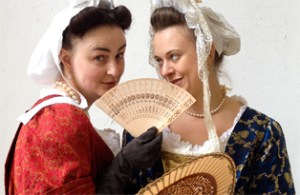 As the summer of the Georgians winds down, I thought I would mention this bit of programming. In connection with The Glorious Georges exhibition, Hampton Court Palace is featuring ‘Salacious Gossip Tours’ to highlight the “racy stories” they “dare not tell during the day!”
Historic Royal Palaces has done these in the past for The Wild, the Beautiful and the Damned exhibition (2012), and I would speculate—though it is only speculation—that the racy bits are comparable to what many of us present in class to keep students’ attention. I mention it here, in part, because as I was thinking about what readers might want from a newsletter like this one several years ago, someone perceptively replied ‘gossip!’. Ever since then, I’ve been trying (unsuccessfully) to pull that off. As with other things, suggestions are most welcome. As for the tours, participants must be at least 18 years old, tickets are £25, and the tours begins at 7:15. My hunch is that it probably adds up to a fine way to avoid the crowds, and walking out of Hampton Court Palace at 9:00 or so isn’t a bad evening. A champagne reception at the beginning couldn’t hurt either. –CH
J & A Beare and Amati Release Books on 18th-Century Violins
“With the closure of Sotheby’s and Christie’s music departments, Amati is leaping into the gap in the market with gusto and is changing the shape of the industry. Amati not only provides owners with a valuation service but allows dealers and makers around the world to upload their instruments, with full provenance and documentation for the valuable instruments.” More usefully for most of us, Amati’s online magazine includes reviews of concerts and recordings. –CH
From Art Daily (24 August 2014). . .

Antonio Stradivari ‘La Pucelle’ Violin, 1709
The Monograph Collection is a collaboration between J & A Beare and Amati, who will be releasing a series of books each dedicated to a single masterwork of the classical school of violin making. The Monograph Collection books are sold as an annual subscription and are available to pre-order, with the first three books due out in September and the fourth in December. Each volume includes a detailed history as well as descriptive text on the technical and aesthetic features of each instrument, alongside professional photos and measurements. Written by strings specialist John Dilworth, it is hoped that the books will become treasured collector’s items.
Extract from I – Antonio Stradivari ‘La Pucelle’ Violin 1709: “The soundholes are wonderfully elegant and beautifully finished, as one would expect. They sit with great poise and balance on the front, the edges still looking sharp enough to cut paper. Comparing these virtually perfect soundholes with those on other celebrated instruments by Stradivari brings home the great variation observable in position, inclination, widths, and even symmetry in the work as a whole. These particular soundholes on ‘La Pucelle’ are cut with a quite generous width in the arm, a feature going back to the 1680s. Amongst these and later examples there are soundhole pairs that lean inwardly at the upper hole, and later there appear soundholes cut with a slender arm, set sometimes very upright and parallel. Then, in the Golden Period and beyond, there appear mixtures of all these traits in pairs of soundholes on the same instrument. The explanations for all this apparently random treatment lie in the techniques Stradivari used to draw out the soundholes and the obvious fact that there were more than one pair of hands at work in the atelier.”
Amati, the marketplace for stringed instruments, was set up to offer free evaluations and to provide transparency in the sale and purchase of violins, cellos, violas and bows—from a child’s violin to mid-range instruments for young professionals and antique violins of the highest calibre. By taking the market online, it empowers buyers and sellers to become better informed about an industry often shrouded in mystique. For those with a violin gathering dust in an attic, Amati is the first port of call for finding out the value of an instrument and sourcing comparisons, to enable those with little knowledge to access accurate information in the public domain. Amati will also be providing access to illustrated, hardbound monographs written by John Dilworth on some of the most famous Stradivarius violins and cellos in existence. With the closure of Sotheby’s and Christie’s music departments, Amati is leaping into the gap in the market with gusto and is changing the shape of the industry. Amati not only provides owners with a valuation service but allows dealers and makers around the world to upload their instruments, with full provenance and documentation for the valuable instruments.
Amati was co-founded by husband and wife team James and Sarah Buchanan in July 2013. Sarah is the company Director, while James offers specialist expertise in valuations. He has gained expert knowledge of the industry, having co-founded a specialist auction house in 2006, after running the Music Department at Christie’s Auctioneers in London.
Call for Papers | Artists’ Homes before 1800
As noted at Le Blog de l’ApAhAu (24 August 2014) . . .
‘Visual Artists Must Live like Kings or Gods’
Artists’ Homes in the Middle Ages and the Early Modern Era
Nuremberg, 11–14 June 2015
Proposals due by 31 August 2014
“Plastic artists should dwell like kings and gods: how else are they to build for kings and gods?”(Goethe, Wilhelm Meister’s Journeyman Years II, 8). What pertained to Goethe in a figurative sense is our question from varying perspectives in respect to the real visual artist in Europe up to 1800. Exceptional artists such as Goethe but also Mantegna, Dürer, Michelangelo, Rubens, Rembrandt or the Asam Brothers sometimes lived almost princely. But does this apply in general to the European artist of the pre-modern era?
The conference will take a look at the artist’s home and initially examine his status from the perspective of social topography. What factors influenced this status? To be considered are, for example, the neighbourhood, the proximity to possible clients or to prestigious places for sales such as centrally located squares, prominent streets or significant churches. The conference will investigate architecture and furnishings, the iconography and iconology of an iconographical program of artists’ homes from the perspective of art history and cultural history. Finally, the conference will also examine an early nascent conservation of the artist’s home or the dwelling as a place of remembrance in the period before 1800 and thus explore questions of the history of discourse or perception.
But we also expressly request papers deviating from the idea of the artist’s home à la Goethe, rather talks considering those visual artists who rented or who frequently moved and therefore acquired no property, also talks on artists who found accommodations with their clients. What do we know about these artists’ flats or their homes? Where and in what cities did artists’ quarters, artists’ streets or blocks of flats evolve, places where artists lived over a longer period? Who lived with the artist? How were the studios situated? Were there sales rooms in the house, in the flat? Were they also used for art instruction, to hold ‘academies’ (Joachim von Sandrart)? Is there a difference between the artists bound to guilds and those who worked at court?
The conference will examine text and picture sources to determine the image of artistic self-portrayal at the time via the medium ‘artist’s house’. The latter is primarily to be viewed from the standpoint of the visual artist’s strategies to rise to a higher stratum in a hierarchical society where he was relegated to the status of craftsman. What was the role of the sometimes extensive art collections for which rooms were often exclusively built or reserved? Using case studies, overview representations and comparative examinations, the conference will approach the topic from the perspective of different disciplines, primarily, however, from the perspective of art history, cultural history, and social history.
Abstracts for as yet unpublished articles (a maximum of 2,000 characters, including spaces) with a brief CV and a possible selection of relevant publications may be submitted in German or English by 31 August 2014 to Danica Brenner M.A., brenner@uni-trier.de. Publication of the articles is planned for 2016 in the series Artifex: Sources and Studies on the Social History of the Artist [Artifex: Quellen und Studien zur Künstlersozialgeschichte] (Michael Imhof Verlag, Petersberg).
The conference is held in cooperation with the Albrecht-Dürer-Haus, curated by Dr. Thomas Schauerte (the Nuremberg Museums) and the Social History of the Artist Research Centre (SHARC), principally the EU project « artifex », directed by Dr. Andreas Tacke, Professor (University of Trier, Chair, Art History).
Le colloque international « Visual artists must live like kings or gods ». Artists’ homes in the Middle Ages and the Early Modern Era se tiendra à Nuremberg du 11 au 14 juin 2015 ; les communications seront dispensées en allemand ou en anglais.
Organisateurs : Dr. Thomas Schauerte, Dr. Andreas Tacke, University Professor.
Call for Papers | Le Paysage Spectacle: La Suisse et Tourisme
As noted at Le Blog de l’ApAhAu (18 August 2014) . . .
Le Paysage Spectacle: La Suisse au Regard du Tourisme, 1750–2015
Université de Lausanne, 23–25 April 2015
Proposals due by 15 September 2014
Le paysage construit le « pays », ce territoire naturel, urbain, rural et social. Ce dernier est le produit d’un processus d’artialisation, notamment par le truchement du regard que les artistes portent sur leur environnement biophysique et humain, et qui obéit à des codes esthétiques, culturels ou idéologiques. L’attrait du naturel et de l’artifice forge des visions utopiques ou des anticipations dystopiques. Le paysage est un lieu renvoyant le spectateur à son propre « lieu » géographique et culturel. Dans ce cadre, les points de vue des touristes ont joué un rôle primordial, du Grand Tour au voyage virtuel sur Google Maps. Le « regard touristique » opère ainsi une esthétisation de sites conventionnels ou inhabituels.
Depuis les écrits de Albrecht von Haller, la Confédération helvétique, et les Alpes en particulier, ont occupé une place centrale dans les pratiques et les théories paysagères. Ces dernières se développèrent notamment par le tourisme européen et ses projections. Les Alpes constituent à cette époque un lieu d’expérimentation que s’approprient les écrivains, artistes, philosophes, géographes, ingénieurs, biologistes, etc., construisant un ensemble de représentations historiques et culturelles. L’essor des moyens de transport et le développement de la production industrielle a favorisé de nouvelles pratiques artistiques et littéraires telles que la gravure coloriée, le panorama, l’affiche, le récit de voyage, la photographie de montagne et diverses formes de décor dans l’espace public (expositions nationales, « peintures de gares », etc.).
Ce colloque interroge les sources et les modèles qui ont contribué à l’image de la Suisse moderne et contemporaine, entre regards exogènes et indigènes. L’accent sera mis sur les approches du touriste spectateur, sur ses représentations et ses discours, sur son interaction avec les paysages et sur les approches des sciences, de l’histoire de l’art, de l’histoire, de la littérature, de la sociologie, de la philosophie, des sciences des cultures ou des sciences naturelles.
Nous nous réjouissons de recevoir des propositions de contribution (max. 300 mots) adressées à Valentine von Fellenberg : valentine.vonfellenberg@unil.ch avant le 15 septembre 2014.
Comité scientifique
Valentine von Fellenberg (UNIL)
Philippe Kaenel (UNLI)
Mathis Stock (IUKB)
Exhibition | Mind’s Eye: Masterworks on Paper from David to Cézanne
From the DMA’s exhibition press release (26 June 2014). . .
Mind’s Eye: Masterworks on Paper from David to Cézanne
Dallas Museum of Art, 29 June — 26 October 2014
Curated by Olivier Meslay and William Jordan
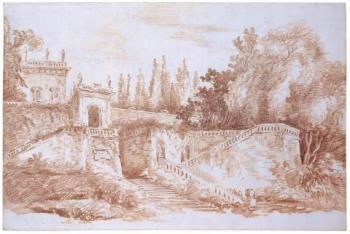
Hubert Robert, View of the Gardens at the Villa Mattei, 14 x 21 inches (34.93 x 52.39 cm), red chalk on paper, 1761 (Dallas Museum of Art, fractional gift of Charlene and Tom Marsh, 2006.17). The drawing sold in Paris at Christies (Lot 512, Sale 5075) in December 2003 for €17,625.
From quick sketches to watercolors and finished masterpieces, works by artists such as Eugène Delacroix, Jacques-Louis David, Edgar Degas, Edouard Manet, Paul Cézanne, Vincent van Gogh, Egon Schiele, Piet Mondrian and Pablo Picasso are brought together in Mind’s Eye: Masterworks on Paper from David to Cézanne. Organized by the Dallas Museum of Art, the exhibition features more than 120 works on paper—many of which have never been exhibited publicly—by 70 artists. Drawn in part from the DMA’s collection, but with significant loans from private collections in North Texas, Mind’s Eye, offers insights into the working methods of these artists, providing an intimate view of their approach to art making while also presenting the drawings and watercolors as finished works of art in their own right.
“One of the goals of the Dallas Museum of Art is to encourage collecting within the community. There is no better example of how to do this than to highlight the Museum’s graphic holdings together with those that have been assembled in private homes throughout our area,” said Maxwell L. Anderson, The Eugene McDermott Director of the DMA. “Mind’s Eye: Masterworks on Paper from David to Cézanne presents a rich and fascinating array of works in various media by artists from the Austro-Hungarian, Belgian, British, Dutch, French, German, Spanish and Swiss schools, spanning nearly 150 years—from the French Revolution to the dawn of modernism.”
The collecting and appreciation of drawings were for centuries activities associated with the privileged, the educated, or artists themselves, and the skills derived from these actions ultimately formed the basis of modern art history. Through museums, a wider audience has come to enjoy and value these most intimate of artists’ expressions. Collecting in this area has gone on throughout the DMA’s 111-year history, yet Mind’s Eye is the first exhibition to consider what has been achieved, while also serving as a tribute to the generations of collectors who have brought these drawings to Texas.
The works on view in Mind’s Eye focus on European art from the French Revolution in the late 18th century to the birth of modernism in the early 20th century. The Museum’s European works on paper collection, which has a strong holding of French art from the 19th and early 20th centuries, with an emphasis on impressionist and post-impressionist works, is complemented by loans from private collections that broaden the scope of the exhibition. Because of the different kinds of works on view, the varied roles that drawing plays for artists—as a learning exercise, as a form of note taking, as a tool for planning and development of larger works, and as an end in itself—are showcased, and the artistic process of the various artists revealed.
“Mind’s Eye is about the pleasures of collecting, but it is also about the rich history and diversity found in drawings created by artists throughout art history,” said Olivier Meslay, Associate Director of Curatorial Affairs and The Barbara Thomas Lemmon Curator of European Art. “The exhibition highlights many recognizable names along with lesser-known artists, examining overlooked works and reexamining those produced by famous artists to reveal the full effect of their contributions from a fresh, modern perspective.” Meslay is co-curator of the exhibition with Dr. William B. Jordan, formerly Director of the Meadows Museum and Deputy Director of the Kimbell Art Museum. Both are lifelong students of drawings. “This works on paper exhibition brings to light a part of the collection that is not often highlighted, despite its quality,” added Jordan.
In the exhibition, visitors will be able to learn about the care and conservation of works on paper, and how to properly frame a drawing through a video demonstration, as well as view a display of various materials represented in the works on view with examples of the different kinds of lines produced by these tools. The educational displays were created by DMA Chief Conservator Mark Leonard. In the late summer, visitors will be able to explore the exhibition with a smartphone tour featuring commentary by the exhibition co-curators, Olivier Meslay and William B. Jordan. DMA Friends will be able to earn the Mind’s Eye Special Exhibition Badge while the show is on view. For more information on the DMA Friends program, visit DMA.org/friends.
The exhibition is accompanied by a 240-page full-color publication, edited by Olivier Meslay and William B. Jordan, with contributions by Esther Bell, Richard R. Brettell, Alessandra Comini, Dakin Hart, William B. Jordan, Felix Krämer, Laurence Lhinares, Heather MacDonald, Olivier Meslay, Jed Morse, Steven Nash, Sylvie Patry, Louis-Antoine Prat, Richard Rand, George T. M. Shackelford, Richard Shiff, Kevin W. Tucker and Charles Wylie. The catalogue is distributed by Yale University Press.
◊ ◊ ◊ ◊ ◊
Distributed by Yale UP:
Olivier Meslay and William B. Jordan, eds., Mind’s Eye: Masterworks on Paper from David to Cézanne (Dallas: Dallas Museum of Art, 2014), 240 pages, ISBN: 978-0300207217, $60.
 An overview of European art from the French Revolution to the First World War, Mind’s Eye encompasses 116 works on paper in various media by seventy artists. These works range from quick sketches and working drawings to cartoons for large murals and highly finished masterpieces. Among the featured artists are such recognizable names as Pierre Bonnard, Paul Cézanne, Jacques-Louis David, Edgar Degas, Eugène Delacroix, Théodore Géricault, Fernand Léger, Pablo Picasso, Pierre-Auguste Renoir, and Georges Seurat. Also included are never-before-published works by accomplished yet lesser-known artists, such as Albert Anker, Henri Gaudier-Brzeska, Adolf Hirémy-Hirschl, Fernand Khnopff, František Kupka, and Simeon Solomon. Noted international specialists in the field address the working methods of these artists and the aesthetic beauty of their drawings and watercolors, and offer focused studies on artists, regions, schools, and themes. By simultaneously drawing attention to overlooked works and reexamining those produced by famous artists, this catalogue examines the overall effect of their cumulative contributions from a fresh, modern perspective.
Olivier Meslay is associate director of curatorial affairs at the Dallas Museum of Art, and William B. Jordan is an art historian and a trustee at the Dallas Museum of Art.
Call for Papers | Posterity in France, 1650–1800
From the Voltaire Foundation’s Facebook page, via Early Modern Architecture:
Posterity in France, 1650–1800
University of Cambridge, 19 March 2015
Proposals due by 6 October 2014
Organised by Jessica Goodman (Cambridge) and Russell Goulbourne (King’s College London)
‘La postérité pour le philosophe, c’est l’autre monde de l’homme religieux’.
So writes Diderot to the sculptor Etienne Falconet in early 1766. Their long correspondence on the subject of posterity is just one response to a topic that pervades cultural production in eighteenth-century France: from the Encyclopédie’s aim to convey to the future not only human knowledge but also the names of its creators, through Rousseau’s desire to control his posthumous image in his Confessions, to the celebration of the first literary centenaries, which gave contemporary writers cause to think on their own legacies.
The desire to be remembered was nothing new in the period: as far back as Horace’s claim in 23BC that ‘I shall not wholly die’, writers and artists had been imagining the afterlife that would be available to them through their works. This one-day conference, though, sets out to investigate the specificity of the idea of future glory for French cultural producers in the period 1650–1800, when there seems to be a suggestive confluence of social and intellectual changes: the growth of the public sphere, a new concept of an exemplary ‘grand homme’ focusing on moral and intellectual achievement rather than high birth or military might, a context of declining patronage and de-institutionalisation, and an increasing secularism, with the attendant questions about the afterlife of the soul.
Topics to be addressed could include:
• The specific features of the concept of posterity developed in the period
• How a consciousness of posterity affects how and what people write—both as individuals and in terms of broader cultural trends
• How the lure of posterity relates to an individual’s social self-positioning in life
• Whether writers and artists hold a particularly privileged position in the quest to be remembered
• The extent to which new cultures of mourning and commemoration influence or are influenced by contemporary writings on posterity
• The relationship between posterity and the religious afterlife in the thought of the period
Papers may be given in English or French and should last 20 minutes. Abstracts of 200–300 words should be sent to earlymodernposterity@gmail.com by Monday 6 October 2014. Questions may also be addressed to the organisers at this address. Contributions from early-career scholars and postgraduates are particularly welcome.
Display | An Impossible Bouquet
Press release for the display at Dulwich:
An Impossible Bouquet: Four Masterpieces by Jan van Huysum
Dulwich Picture Gallery, London, 1 July — 28 September 2014
Curated by Henrietta Ward

Jan van Huysum, Vase with Flowers, ca. 1715 (Dulwich Picture Gallery)
A special collection of works by the 18th-century Dutch artist Jan van Huysum will be on display at Dulwich Picture Gallery from 1 July until 28 September 2014. An Impossible Bouquet, Four Masterpieces by Jan van Huysum will bring together beautiful works from private collections alongside Dulwich’s own painting that together showcase the artist’s ingenuity and astonishing ability to paint flowers, fruit and insects with minute attention to detail.
Included within the display are two paintings that have remained together since they left Van Huysum’s studio around 1732: Flowers in a Vase with Crown Imperial and Fruit and Flowers in front of a Garden Vase. Their complementary compositions suggest he conceived them as pendants (painted as a pair)—a rarity amongst his oeuvre of 241 paintings. His impressive arrangements could depict over 35 different types of flowers, which, before modern cultivation techniques, would never have been seen together at the same time of year. To overcome this Van Huysum worked from sketches and painted some of his arrangements over two years, explaining why he signed his paintings with two dates.
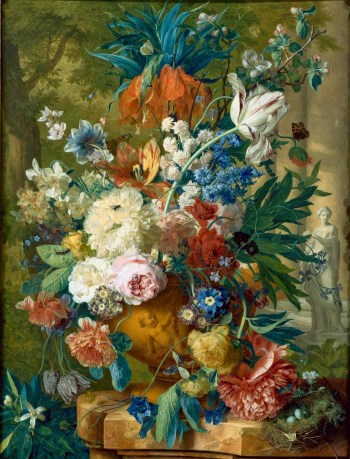
Jan van Huysum, Flowers in a Vase with Crown Imperial and Apple Blossom at the Top and a Statue of Flora, 1731–32 (Private Collection)
Van Huysum is widely regarded as the greatest still-life painter of his time. His ambitious compositions demonstrate his ability to combine a huge variety of species into beautiful, coherent still lifes that made him popular with collectors both during and beyond his lifetime. The paintings included within this display were once owned by prominent 18th-century collectors, including the Gallery’s founders, Sir Francis Bourgeois and Noël Desenfans, as well as the Swiss painter and dealer Jean-Étienne Liotard.
An Impossible Bouquet, Four Masterpieces by Jan van Huysum has been curated by Dulwich’s Curatorial Fellow Henrietta Ward. The Gallery’s forthcoming Dutch and Flemish schools catalogue, to be published by 2016, will feature Vase with Flowers along with detailed entries for masterpieces by Rembrandt, Rubens, Van Dyck, and Teniers. The catalogue is part of the Gallery’s strategy for the Curatorial Centre of Excellence, a major long-term commitment towards scholarship, learning and training of future curators.
About the Artist
Jan van Huysum (1682–1749) was based in Amsterdam, where he painted flower and fruit still lifes, as well as landscapes. He was taught by his artist-father Justus and worked in his studio until around 1701 when he decided to set up as an independent painter. His depictions of luxuriant flowers in classical vases were soon admired by collectors, particularly the way flowers, fruit and insects were rendered with astonishing accuracy and detail. He achieved this precision with fine brushes—some might have only had a single hair—which were ideal for depicting the vein structure of a leaf, the delicate hairs on a raspberry or the translucency of a water droplet. His skills earned him great acclaim and in 1750 the Dutch writer Jan van Gool (1685–1763) wrote Van Huysum’s first biography which reaffirmed the painter’s unwavering popularity amongst the wealthiest European collectors of the day; his floral paintings could be found in the aristocratic estates of the Duke of Orleans in France, Sir Robert Walpole in England, Prince William of Hesse-Kassel and the King of Poland.
Around 1720, Van Huysum turned from painting on a dark to a light background, believing the flowers and fruit wouldbe seen to better effect. He then placed his vases in architectural gardens which hinted at a grand, classical landscape beyond. The splendour of his new approach substantially increased the demand for his work, so much so that they sold for unprecedented prices, a luxury he experienced during his lifetime. Fully aware of the value of his unique skills, Van Huysum disliked anyone entering his studio, and supposedly taught only one student, for fear they might learn the secrets of his meticulous—and highly lucrative—painting techniques.
Dulwich Picture Gallery
Dulwich Picture Gallery is England’s first purpose-built public art gallery, founded in 1811 and designed by Regency architect Sir John Soane. It houses one of the finest collections of Old Masters in the country, especially rich in French, Italian and Spanish Baroque paintings and in British portraits from the Tudor period to the 19th century. The Gallery’s permanent collection is complemented by its diverse and critically acclaimed year round temporary exhibitions.
Getty Thesaurus of Geographic Names Released as Linked Open Data
Posted by James Cuno at Iris: The Online Magazine of the Getty (21 August 2014) . . .
 We’re delighted to announce that the Getty Research Institute has released the Getty Thesaurus of Geographic Names (TGN)® as Linked Open Data. This represents an important step in the Getty’s ongoing work to make our knowledge resources freely available to all. Following the release of the Art & Architecture Thesaurus (AAT)® in February, TGN is now the second of the four Getty vocabularies to be made entirely free to download, share, and modify. Both data sets are available for download at vocab.getty.edu under an Open Data Commons Attribution License (ODC BY 1.0).
What Is TGN?
The Getty Thesaurus of Geographic Names is a resource of over 2,000,000 names of current and historical places, including cities, archaeological sites, nations, and physical features. It focuses mainly on places relevant to art, architecture, archaeology, art conservation, and related fields.
TGN is powerful for humanities research because of its linkages to the three other Getty vocabularies—the Union List of Artist Names, the Art & Architecture Thesaurus, and the Cultural Objects Name Authority. Together the vocabularies provide a suite of research resources covering a vast range of places, makers, objects, and artistic concepts. The work of three decades, the Getty vocabularies are living resources that continue to grow and improve.
Because they serve as standard references for cataloguing, the Getty vocabularies are also the conduits through which data published by museums, archives, libraries, and other cultural institutions can find and connect to each other. . . .
All four Getty vocabularies will be released as Linked Open Data by late 2015. To follow the progress of the project at the Getty Research Institute, see our Linked Open Data page.
The full announcement with lots of links is available here»










 Enfilade
leave a comment