Conference | A Head for Fashion: Hair, Wigs, Cosmetics, Jewelry
From The Colonial Williamsburg Foundation:
A Head for Fashion: Hair, Wigs, Cosmetics, and Jewelry, 1600–1900
Colonial Williamsburg, 14–16 November 2014
 Colonial Williamsburg is celebrating the 75th anniversary of the opening of the Kings Arms Barber and Wig Shop by hosting a conference on wigs, hair, makeup, and accessories of the seventeenth, eighteenth, and nineteenth centuries. The program will examine how ‘fashion from the neck up’ changed over time, reflecting changes in taste, the personal images people wished to present, affluence and class, and sheer practicality. Colonial Williamsburg wigmakers and other tradespeople, historians and interpreters, will be joined by noted guest speakers to present talks on wigs, hairstyles, cosmetics, jewelry, and related topics. These presentations will be interspersed with demonstrations and panel discussions.
As we put this program together, we realized that there is little published information specifically about these topics, and it is difficult to find anything that brings them all together. This conference will help to fill that gap, for scholars, curators, museum interpreters, reenactors, theatre costumers, and anyone who is just plain interested. We are looking forward to a diverse and enthusiastic audience who will bring their perspectives to the conversation. And we plan to have fun!
Conference | 400 Years of Chocolate: Aztec to Artisanal
From The Colonial Williamsburg Foundation:
400 Years of Chocolate: Aztec to Artisanal
Colonial Williamsburg, 2–4 November 2014
 Come join us on a journey with one of the world’s favorite plants: cacao. We will discover the amazing paths through time and space that this plant and its products have traveled. From early uses as a ceremonial beverage and important crop in Mesoamerica, to its transformation to one of the most popular foodstuffs in the world, chocolate has crossed oceans, been carried up mountains, and even flown into outer space. How did the seeds of this humble plant become so popular?
Join Colonial Williamsburg’s Historic Foodways staff, curators, and distinguished guest scholars as they explore how this plant is grown and processed and how the seeds are transformed into a product that conquers the food world. Learn how people of the past used and altered chocolate from a beverage into a candy and beyond.
Guest speakers will include Dr. Howard-Yana Shapiro, one of the world’s top cacao scientists. He is Global Director of Plant Science and External Research, Mars Incorporated, and Adjunct Professor in the College of Agriculture and Environmental Sciences, The University of California at Davis. Dr. Shapiro also helped map the cacao gene and is one of the foremost scholars in the field of cacao propagation. Dr. Michael Coe, Professor Emeritus, Department of Anthropology, Yale University, will present the place of chocolate in early Mesoamerica. Ruby Fougère, Curator of Furnishings, Collections and Conservation Supervisor, Parks Canada, will complement a Foodway’s staff presentation on chocolate in seventeenth- and eighteenth-century Europe and North America, with a look at chocolate in French Canada. Dr. Deanna Pucciarelli, Program Director, Hospitality and Food Management Program, Ball State University, will explore how chocolate production methods evolved during the nineteenth century, and John and Tracy Anderson of Woodhouse Chocolate in St. Helena, California, will delve into modern artisanal chocolate making.
And, of course, no program on chocolate would be complete without a chance to eat some! Chef Rhys Lewis and the Colonial Williamsburg Lodge culinary team will present us with delicious chocolate concoctions of the past, present, and future. So, come learn, smell, taste, and follow chocolate on its journey through history.
Exhibition | A Royal Collecting Passion: Wilhelm I of Württemberg
From the Staatsgalerie Stuttgart:
A Royal Collecting Passion: Wilhelm I of Württemberg
Staatsgalerie Stuttgart, 18 July — 26 October 2014

Gottlieb Schick, Apollo among the Shepherds, 1806–08, (Staatsgalerie Stuttgart)
As a regent, Wilhelm Friedrich Karl von Württemberg (1781–1864) gave the young kingdom of Württemberg a historical identity; his multifarious initiatives as a collector and patron, however, have all but sunk into oblivion. The holdings of the Staatsgalerie, which opened in 1843, were expanded by artworks in royal ownership as well as by personal gifts. Wilhelm I moreover initiated the acquisition of the Barbini-Breganze collection, which today forms the core of the Staatsgalerie Stuttgart’s holdings in the area of Italian Baroque painting. The royal gifts, still present in our museum’s collection in their near entirety, are now to be presented to the public for the first time in many decades. Numerous furnishings from Wilhelm I’s private residences as well as masterpieces from his private painting collection—disbanded after 1918—will be on view. On the basis of the records at the Staatsarchiv Baden-Württemberg, which have been preserved almost in full, light will also be shed on the history of the royal purchases. The exhibition is being realized in cooperation with the Staatliche Schlösser und Gärten Baden-Württemberg.
More information (in German) is available here»
◊ ◊ ◊ ◊ ◊
The catalogue, published by Nicolai Verlag, is available from ArtBooks.com:
Königliche Sammellust: Wilhelm I. von Württemberg als Sammler und Förderer der Künste (Berlin: Nicolai, 2014), 208 pages, ISBN: 978-3894798727, 35€ / $68.
Call for Papers | Stitching Together a National Identity
From Colonial Williamsburg:
Stitching Together a National Identity
Colonial Williamsburg, 15–17 March 2015
Proposals due by 1 August 2014
 American home furnishings, quilts, needlework, and clothing reflect great diversity and regional variations that occurred as a result of the ethnic origins of the makers, trade patterns, influential teachers, even climate and geography. This symposium will explore these regional variations in American textiles of the seventeenth, eighteenth, nineteenth, and twentieth centuries through a series of formal lectures and juried papers. Participants are invited to submit 300-word abstract proposals for illustrated oral lectures 25 minutes in length. Paper proposals are due to Colonial Williamsburg for peer review by August 1, 2014; acceptances will be announced by November 1, 2014. Submit abstracts to Textile Symposium Abstracts, attention Kim Ivey, Colonial Williamsburg Foundation, 309 First Street, Williamsburg, VA 23185 or via e-mail at kivey@cwf.org. For general information about the symposium, contact Deb Chapman at dchapman@cwf.org. Those whose papers are accepted will have free registration for the symposium.
We will not be doing the hands-on workshops as part of this upcoming symposium. We hope to get papers on quilts and needlework, as well as clothing, to attract a broad audience.
Exhibitions | The Hanoverians on Britain’s Throne, 1714–1837
Exhibitions observing the Hanoverian tercentennial just keep coming (and forgive the use of an image used to mark materials appropriate for kids twelve and older; it’s simply the best high-resolution version I could find of a logo that appears in various guises throughout the marketing of the exhibitions). Comparing the exhibitions in Britain with those in Germany would seem interesting; for anyone interested in George II’s illegitimate son, Reichsgraf Johann Ludwig von Wallmoden-Gimborn, I think you’ll do much better in Hanover. –CH
From the exhibition website:
Als die Royals aus Hannover kamen
Hanover, 17 May — 5 October 2014
For 123 years, the Electorate of Hanover and the Kingdom of Great Britain were linked by a single monarch. This important historical period is the theme of the Lower Saxony State Exhibition 2014. From 17th May to 5th October 2014 five exhibitions in palaces and museums in Hanover and Celle will be dedicated to the numerous facets and interactions that characterised the personal union. We invite you to discover the time when the royals came from Hanover.
◊ ◊ ◊ ◊ ◊
The Hanoverians on Britain’s Throne, 1714–1837
Lower Saxony State Museum Hanover, 17 May — 5 October 2014

State Crown of George I, 1715 (Royal Collection Trust / © Her Majesty Queen Elizabeth II, 2014)
The major central exhibition in the Lower Saxony State Museum Hanover provides an overview of the whole period of the personal union. Based on the biographies of George I, George II, George III, George IV, and William IV, the life and works of the five rulers, as well as important historical events from this time, such as the Seven Years’ War, the battle for independence of the American colonies, and the Napoleonic Age, are explored. Visitors also learn what effect the connection between the two unequal empires had on the fields of art, culture, science and society.
The pomp and ceremony of the court in London is addressed, as is the founding of the University of Göttingen, the significance of George Friedrich Handel and the influence of English fashion in Hanover. Topics such as travel, horses, tea or language and portraits of important characters from this time, including Gottfried Wilhelm Leibniz, Jonathan Swift and Jane Austen, paint a multi-faceted picture of the time when the royals came from Hanover. Visitors can view some 450 outstanding exhibits from German, British and international museums, including the State Crown of George I and numerous other precious items on loan from the Royal Collection of Her Majesty Queen Elizabeth II. They are attractively displayed and supplemented by audio and multimedia exhibits.
◊ ◊ ◊ ◊ ◊
The Hanoverians on Britain’s Throne, 1714–1837
Museum Herrenhausen Palace, Hanover, 17 May — 5 October 2014
To be staged in the wings of the rebuilt Herrenhausen Palace that house the museum, the exhibition recounts the story of the new Electorate of Hanover on the eve of the personal union and during its early years. The show not only reveals the essential elements of representative court life around the turn of the 18th century but also brings together a fascinating selection of fine exhibits ranging from Baroque pomp to the simple everyday court life of the Guelphs of Hanover.
In the west wing of the former Guelph summer residence, the visitor encounters the unique collection of Reichsgraf Johann Ludwig von Wallmoden-Gimborn (1736–1811). As the illegitimate son of George II, he was born and grew up in England, brought his passion for art from the island to Hanover, and established an important collection of antiques and paintings here. Dispersed by auction in 1818, now over 200 years later, some highlights of the large number of treasures from international museums are on show in Hanover for the first time again.
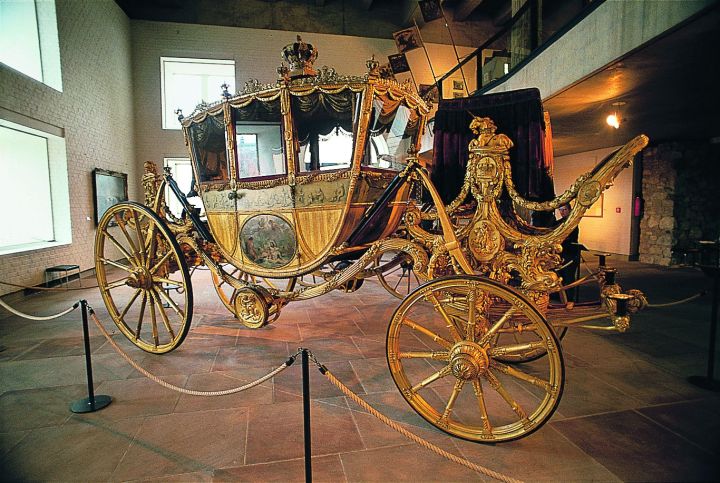
State Carriage of Prince of Wales Georg IV, built in 1782
and since 1814 state carriage no. 1 for the kings in Hannoverc
(Loan SKH Prinz Ernst August von Hannover)
◊ ◊ ◊ ◊ ◊
One Coach and Two Kingdoms: Hanover and Great Britain, 1814–1837
Historisches Museum Hannover, 17 May — 5 October 2014
The Royal State Coach is the centrepiece of this exhibition. This impressive coach was built in 1782 for the Opening of Parliament ceremony in London. In 1814, following victory over the Napoleonic troops and the elevation of Hanover to a Kingdom, the coach was brought over to the mainland. The coach was used in 1821 on the occasion of King George IV’s long awaited trip to Hanover. The exhibition tells the story of the Royal State Coach, which serves as a unique illustration of the personal connection between Great Britain and Hanover. In addition, the exhibition portrays the young Kingdom of Hanover against the background of British world power: the Guelph rulers and their local representatives, the political debates about the Constitution and land reforms, the extensive traditional economy, as well as Hanover as a royal seat, which was given a grandiose new face by Georg Ludwig Friedrich Laves, master builder to the court.

John Hamilton Mortimer, A Caricature Group, ca. 1766
(New Haven: Yale Center for British Art, Paul Mellon Collection)
◊ ◊ ◊ ◊ ◊
Royal Theatre: British Caricatures from the Time of the Personal Union and the Present Day
Wilhelm Busch – Deutsches Museum für Karikatur und Zeichenkunst, Hannover, 17 May — 5 October 2014
In the thematic exhibition in the Wallmoden Palace, the era of the Personal Union is scrutinized in detail: with some 250 high quality exhibits, the exhibition presents a lively picture of the English monarchy and society at the time of the Personal Union, while also making the connection between the single sheet caricatures of 300 years ago and caricatures in the press today. Then, just as they do now, caricatures criticised parliamentary policies, commentated with glee on court scandals and intrigues, and entertained the public with society gossip. Even the Kings of the House of Hanover had to put up with the mockery of the caricaturists, just as Queen Elizabeth II has to today. Items on loan from international, predominantly British, museums and collections as well as from contemporary cartoonists supplement the already impressive collection of the museum Wilhelm Busch – Deutsches Museum für Karikatur und Zeichenkunst.
◊ ◊ ◊ ◊ ◊
Ready for the Island: The House of Brunswick-Lüneburg on the Path to London
Residenzmuseum in Celle Castle, 17 May — 5 October 2014

Attributed to Jacques Vaillant, Sophie Dorothea with Her Children Georg August (the future George II) and Sophie Dorothea, ca. 1690 (Residenzmuseum im Celler Schloss / Bomann-Museum Celle)
How does one get ‘Ready for the Island’? Glorious wars and magnificent festivals present the power and glory of the Guelphs to the world. Even today, the works of art from this period are greeted with wonder. However, behind the gleaming facade, family intrigues and tragedies were played out. Daughters toppled their fathers from the throne; sons were imprisoned by their own father. In the historic setting of the original locations in the Residenzmuseum in the Celle Palace we take a look not only at the attractive outward image, but also at the reality behind the facade. It quickly becomes clear that the Guelphs systematically engineered their rise to power through marriage, wars and festivals. Unique exhibits from home and abroad bring this exciting history back to life once more.
Additional images are available here»
Call for Papers | ASECS 2015 in Los Angeles
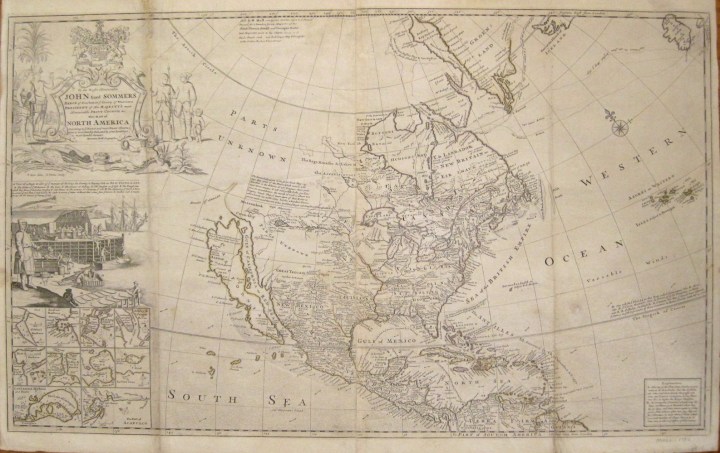
Herman Moll, To the Right Honourable John Lord Sommers…This Map of North America according to ye Newest and most Exact observations, 23 x 38 inches (London: H. Moll, ca. 1715). “California was depicted on maps as an island. . . even after Father Kino established its penisularity about 1705,” The Philadelphia Print Shop. The official date for the founding of the city of Los Angeles is September 4, 1781.
◊ ◊ ◊ ◊ ◊
2015 American Society for Eighteenth-Century Studies Conference
Los Angeles, 19–22 March 2015
Proposals due by 15 September 2014
Finished in 1976, the 35-story Westin Bonaventure Hotel is the largest hotel in the city, the work of John Portman, one of the world’s most influential hotel architects.
The 2015 ASECS conference takes place in Los Angeles, 19–22 March, at the Westin Bonaventure Hotel. Along with our annual luncheon and business meeting, HECAA will be represented by two panels chaired by Meredith Martin and Noémie Etienne and Amy Freund. In addition to these, a selection of sessions that might be relevant for HECAA members are included below. Editing the selection seems more difficult each year, but this year was especially so as there are lots of options that will be of interest to members, though specific topics may not be geared exclusively or primarily toward art historical materials. A full list
of panels is available as a PDF file here»
Those attending the conference may also find useful Ben Loeterman’s film John Portman: A Life of Building, which documents the work of the conference hotel’s architect. A less adulatory assessment comes from Edward Soja’s 1989 book, Postmodern Geographies: The Reassertion of Space in Critical Social Theory, quoted in the Wikipedia entry for the Westin Bonaventure.
◊ ◊ ◊ ◊ ◊
Anne Schroder New Scholars’ Session (HECAA)
Amy Freund, Southern Methodist University, Dallas; aefreund@gmail.com
Named in honor of the late Anne Schroder, this seminar will feature outstanding new research by emerging scholars.
◊ ◊ ◊ ◊ ◊
Pilgrim Arts of the Eighteenth Century (HECAA)
Meredith Martin, Dept. of Art History, New York University, 303 Silver Center, 100 Washington Square East, New York, New York 10003; msm240@nyu.edu and Noémie Etienne, Institute of Fine Arts.
Inspired by Robert Finlay’s description of porcelain as the “pilgrim art,” this session aims to track the movement and changing materiality of artworks across time, space, and culture during the long eighteenth century. Materiality, along with an interest in displacements, manipulations, and artisanal practices, plays an essential role in art history today. Examining the way art objects were treated, transported, and transformed helps us to understand how they were perceived and reimagined in new physical and cultural environments. Paying attention to gestures, materials, and techniques—as well as to individuals, such as restorers, who mediated between artworks, artists, and the public, is an efficient way to “repeupler les mondes de l’art,” (“repopulate the worlds of art”), according to Bruno Latour. It also enables us to go further with some traditional art historical questions—such as authorship, expertise, or authenticity—while opening onto new methodological perspectives. Topics may explore any of these issues or introduce new ones related to materiality and mobility. Interdisciplinary and cross-cultural investigations are especially encouraged.
◊ ◊ ◊ ◊ ◊
Defoe and Architecture (Daniel Defoe Society)
Rivka Swenson, Dept. of English, Virginia Commonwealth University, 900 Park Ave., P.O. Box 842005, Richmond, Virginia 23284-2005; rswenson@vcu.edu
An Act of Union like a mighty arch. A three-sided school for women. A basketwork beehive house for multiple families to live in. A house made entirely from china. A history like a maze. Defoe’s ideas and characters and things rarely exist in empty space but are instead articulated within discrete physical (or metaphorically physicalized), indeed architectural, contexts. This Defoe Society panel is devoted to thinking about the ways in which architecture, as both reality and metaphor, figures prominently across Daniel Defoe’s writings; Defoe was as interested in finding the right architectural metaphors to describe a given idea or character or thing as he was in describing how the real world (both material and immaterial) is expressed within specific formal-spatial-architectural contexts. Please send (via email) 500-word abstracts for 20-minute papers.
◊ ◊ ◊ ◊ ◊
Digging Italy (Italian Studies Caucus)
Wendy Wassyng Roworth, Dept. Art and Art History, University of Rhode Island, 112 Slater Avenue, Providence, Rhode Island 02906; wroworth@uri.edu
Digging and documenting the remains of Italy’s past were activities pursued as both scientific and profit-making ventures during the eighteenth century, and ancient sculptures and artifacts were sold and sent abroad by foreigners and Italian dealers. Other aspects of Italian culture were appropriated by foreigners in Italy as well as at home in England, Germany, France, Russia, and elsewhere—Italian opera, music, art, science, and literature—and Italian artists, musicians, and writers traveled to perform or work abroad. Italian culture was enjoyed and appreciated (‘digging it’) yet Italians themselves were often criticized (‘taking a dig’) for their customs, habits, food, etc. This session will explore all aspects of these cultural exchanges and attitudes in the visual arts, literature, criticism, travel accounts and other historical records.
◊ ◊ ◊ ◊ ◊
American Latium: American Artists in and around Rome in the Age of the Grand Tour (Italian Studies Caucus)
Karin Elizabeth Wolfe, Via Alberico II 33, Rome 00193, Italy; karinewolfe@tiscali.it
The Italian Grand Tour of American artists, including painters, architects and sculptors, is generally considered a typically nineteenth-century phenomenon. American Latium intends to analyze the origins and progression of this phenomenon in Rome and Lazio beginning in the 1760s. Specifically, it is hoped to examine the evolution of the figure of the American artist in the cultural context of Grand Tour travelers, ranging from the painters Benjamin West and John Singleton Copley, both still deeply rooted in the system of the British Grand Tour, through personalities such as the architect Charles Bulfinch—in Rome in 1786—up to the landscapist and poet Washington Allston and his contemporaries, who contributed to the creation of an autonomous American Grand Tour identity, later ideally embodied by the émigré American painter and essayist Thomas Cole. Cole’s critical affirmations regarding the profound aesthetic differences between the historicizing landscapes depicting Rome and Lazio and the romantic naturalism inspired by New World landscapes are representative of the culmination and implications of a cultural process of fertile poetic and literary exchange that constitute the thematic threads of this session. Contributors are invited to address not only the fruition of the aesthetic perception of Rome and Lazio on the part of American artists, but moreover to explore the reception of a distinct American national cultural identity on the international society that constituted the Italian Grand Tour.
◊ ◊ ◊ ◊ ◊
Storms: Robust, Turbulent, and Extreme Weather in Art, Science, Literature, Music, and Philosophy (South Central Society for Eighteenth-Century Studies)
Kevin L. Cope, Dept. of English, Louisiana State University, Baton Rouge, Louisiana 70803; jovialintelligence@cox.net or encope@lsu.edu
Favorite riffs, phrases, and motifs such as the ‘light of reason’, ‘the sun king’, and ‘the Enlightenment’ give the impression that the long eighteenth century abounded in fair weather. Had it not been for inclement episodes, however, our world would not have benefited from Ben Franklin’s electrifying kite-and-key experiment, nor would we have given the time of day to Defoe’s and Falconer’s charming stories of tempest-induced shipwrecks. This panel will look at the full range of rough weather, from paintings that reveal the ferocity of the heavens and the seas to the first efforts in meteorology to tympani solos resounding of thunder and on to philosophical speculations on the utility of the acrimonious action of the air. For this topic, the sky’s the limit!
◊ ◊ ◊ ◊ ◊
The Circuit of Apollo: Women’s Tributes to Women in the Long Eighteenth Century (Roundtable) (Women’s Caucus Scholarly Panel)
Laura L. Runge, Dept. of English, CPR107, 4202 E. Fowler Ave., University of South Florida, Tampa, Florida 33620; runge@usf.edu
In honor of the Women’s Caucus 40th anniversary, and the planned celebration honoring the work of our female academic pioneers, the scholarly panel for the Women’s Caucus focuses on eighteenth-century examples of female commemorations. Turning away from the patriarchal, heterosexual paradigm of sexual chastity, this panel puts a twist on eighteenth-century notions of ‘female honor’ and foregrounds memorable or remembered female relationships among women. From the Anne Finch poem of our title, to the Duchess of Portland’s gold and enameled friendship box of miniature portraits, to Austen’s famous commendation of Radcliffe, Edgeworth and Burney in Northanger Abbey, eighteenth-century women participated in a femino-centric discourse of praise and collegiality that bears further scrutiny. Though these examples are from England, the panel is open to commemorations from other national contexts as well. Such tributes include dedications, inscriptions, personal letters, gifts, portraits, poems, songs, and any notable artistic (or otherwise) expression of gratitude, friendship or respect. What forms did female tributes take and how might formal and gender analysis intersect? How might these examples inform our understanding of sociability, sexuality, gender, friendship, professionalism, education, materiality, embodiment or emotion? What does it mean to historicize female tribute and how do we reanimate the objectified emotional bond of the past? This panel seeks to place up to six presenters on the subject of women’s tributes to women. We ask for proposals for 10-minute presentations on the tribute, preferably with some form of representation (visual image, auditory performance, reading, etc.). The organizer requests that presenters distribute their papers in advance of ASECS so she can prepare some framing questions for a lively discussion period.
◊ ◊ ◊ ◊ ◊
Innovative Course Design
ASECS, PO Box 7867, Wake Forest University, Winston-Salem, North Carolina 27109; ASECS@wfu.edu
Proposals should be for a new approach to teaching a unit within a course on the eighteenth century, covering perhaps one to four weeks of instruction, or for an entire new course. For example, participants may offer a new approach to a specific work or theme, a comparison of two related works from different fields (music and history, art and theology), an interdisciplinary approach to a particular social or historical event, new uses of instructional technology (e.g., web sites, internet resources and activities), or a new course that has never been taught or has been taught only very recently for the first time. Participants are encourage to include why books and topics were selected and how they worked. Applicants should submit five (5) copies of a 3- to 5-page proposal (double-spaced) and should focus sharply on the leading ideas distinguishing the unit to be developed. Where relevant, a syllabus draft of the course should also be provided. Only submissions by ASECS members will be accepted. A $500 award will be presented to each of the participants, and they will be invited to submit a twelve-page account of the unit or course, with a syllabus or other supplementary materials for publication on the website.
◊ ◊ ◊ ◊ ◊
Alta and Baja: California in the Eighteenth Century (ASECS Executive Board Sponsored Session)
Karen Stolley, Dept. Of Spanish and Portuguese, Callaway 501N Emory University, Atlanta, Georgia 30322; kstolle@emory.edu
California has a rich and colorful history in the eighteenth century—one whose global dimensions are sometimes overlooked as the focus narrows in the nineteenth century to US national and state histories. This session proposes an exploration of eighteenth-century California (understood to include Alta California and Baja California) that will take advantage of the geographical location of ASECS 2015. Possible topics include negotiations between the region’s various communities—indigenous, Spanish, Anglo; military and political (mis)government; the Camino Real; the establishment of Jesuit and Franciscan missions by Junípero Serra and others; exploration of the California coast; pueblos and presidios; California as an eighteenth-century frontier that symbolized both wealth and privation; the visual arts and ethnomusicology. We encourage proposals that cross disciplines, and we plan to circulate the CFP to local historical societies, colleges and universities in California as well.
◊ ◊ ◊ ◊ ◊
Flipping the Grand Tour: The Italian Response
Blair Davis and Carole Paul, 228 Cantor, Irvine, CA 92620; Dept. of History of Art and Architecture, University of California, Santa Barbara, California 93106-7080; bhixsondavis@gmail.com and paul@arthistory.ucsb.edu
Scholarly literature on the Grand Tour has focused largely on the manifold influence of journeys to Italy on travelers. Less well explored are the numerous ways that Italians actively responded to the growing influx of foreigners in their land during the eighteenth century, forging the beginnings of the modern tourist industry. This session seeks papers that address the Italian side of the experience. Possible topics include, but are not limited to subjects such as the professionalization of tour guides, the creation of public museums, the development of the souvenir industry, and the characterization—and caricaturing—of northern Europeans.
◊ ◊ ◊ ◊ ◊
The Gendering of Space and Architecture
Leah Thomas, 4605 Hanover Avenue, Richmond, Virginia 23226; thomaslm9@vcu.edu
Literature of the long eighteenth century explores frontiers, landscapes, seascapes, gardens, spaces of confinement, such as ships and carriages, and more whether in seduction novels, captivity narratives, or satire. This panel examines the gendering of these spaces especially through, but not limited to, language, imagery, and architectural renderings but also considers larger and more nuanced perspectives on this gendering through blurred boundaries of spaces understood to be gendered and how these spaces are ‘sexed’.
◊ ◊ ◊ ◊ ◊
Scientists, Artists, and Artisans in the Eighteenth Century
Dena Goodman, Women’s Studies Dept., 1122 Lane Hall, University of Michigan, 2014 So. State Street, Ann Arbor, Michigan 48109; goodmand@umich.edu
In the eighteenth century, scientists, artists, and artisans, worked, lived, and interacted together in a variety of ways and spaces. This seminar aims to explore the spaces, practices, products, and implications of those interactions. We are inspired by a symposium held at the Wallace Collection (London) in 2013 on the “Louvre before the Louvre,” in which historians of art and architecture explored the Louvre as space of family, work, and sociability in the two centuries before it became a museum. We propose to expand their inquiry to include two other groups, artisans and scientists, who also lived and worked in the Louvre, and to ask what other spaces in Europe (and the Americas) fostered interactions among them. We encourage papers that focus on the interactions among two of these groups (artists and scientists, scientists and artisans, artisans and artists) rather than on one or the other of them. We recognize also that the lines among these professional classifications and identities were in the process of being drawn in the eighteenth century and hope to stimulate discussion about the changing meanings of art, science, artisanship, technique, and labor and how they were achieved through interaction and in practice through this seminar.
◊ ◊ ◊ ◊ ◊
Educating Women in France, 1780–1814
Melissa Hyde; 1326 NW 12th RD Gainesville, Florida 32605; mlhyde@ymail.com
This session invites papers that deal with any aspect of women’s education during the ‘long eighteenth century’—particularly the years leading up to the French Revolution and the first Empire. Topics of special relevance to this session might include: the establishment of new schools for girls (public and private) and their importance; the role of women as governesses or founders of schools (the examples of Mme Genlis and Mme Campan come to mind); women as teachers or students of art and music; representations of women as teachers or students. Also very welcome will be papers that consider questions about what was at stake philosophically and politically in the education of women for the Republic and then the Empire? In what ways did elite education differ from popular or public education? How did education shape the lives of individual women?
◊ ◊ ◊ ◊ ◊
The Habsburgs, 1740–1792
Rebecca Messbarger, Washington University, 7401 Cromwell Drive, Saint Louis, Missouri 63105; rmessbar@gmail.com
This session is dedicated to an exploration of Habsburg influence on eighteenth-century Europe. From Austria, Hungary, and Bohemia to Spain, France, Portugal and dominant regions of Italy, the Habsburg dynasty has served to define crucial aspects of enlightened absolutism. Papers are invited on any aspect of Habsburg sway in the realms of administrative, social, legal, agricultural, economic, and political reforms as well as the patronage of the arts and modern science.
◊ ◊ ◊ ◊ ◊
Beyond Orientalism: Consumer Agency and Producer Adaptation in Asia-Europe Exchanges
Emily Kugler and Samara Cahill, Kugler: 230 South Main Street, Unit 2, Providence, Rhode Island 02903; and Cahill: 14 Nanyang Drive, HSS-03-73, Singapore 637332; emnkugler@gmail.com and sacahill@ntu.edu.sg
Due to early modern globalization, Chinoiserie, curry, Persian poetry, calicoes, and other ‘exotic’ imports entered European markets, where they were adapted and imitated. In the eighteenth-century world of goods, how did the importation and/or representation of foreign goods reflect cultural exchanges that complicate our ideas of European-Asian relations? As Prasannan Parthasarathi and Brijraj Singh have recently observed (independently), much more research is needed on the reception of European imports in Asia: Europeans were not the only consumers. How were European imports (textile designs, music, painting, fashion) adapted within Asian contexts to suit local tastes? How did Asian technologies advance European industries? This panel is particularly interested in papers and projects that complicate conflations of a colonized East with passivity and imitation.
◊ ◊ ◊ ◊ ◊
Textiles in the Long Eighteenth Century
Heidi Strobel, Associate Professor of Art History, University of Evansville, 1800 Lincoln Ave., Evansville, IN, 47722; hs40@evansville.edu
As material culture has become a more integral part of art history, textiles have increasingly been the focus of scholarly and popular attention. Significant museum exhibitions that have contributed to this change include The Met’s The Worldwide Textile Trade, 1500–1800 (2013–14) and Threads of Feeling: The London Foundling’s Hospitals Textile Tokens 1740–1770, a featured exhibition at the 2014 ASECS conference in Williamsburg, Virginia. This session will focus on textiles in eighteenth-century art or literature. Papers could address textiles and their production, particularly in relation to global trade networks, textiles as an artistic medium, and/or for furniture, interior decoration, or clothing. In particular, papers are encouraged that relate to appropriation through embroidered copies of other media or ones that consider the relationship(s) between textiles and gender. Power point presentations will be the standard format, but the physical presentation of textiles as part of the session will be also welcome.
◊ ◊ ◊ ◊ ◊
A Sum of Its Parts: Symmetry in the Eighteenth Century
Daniella Berman and Charles Kang; daniella.berman@nyu.edu and cdk2118@columbia.edu.
The Encyclopédie defines symmetry as “le rapport, la proportion & la régularité des parties nécessaires pour composer un beau tout.” Although not extensively articulated outside architectural discourses, the notion of symmetry remained integral to a wide variety of eighteenth-century cultural productions. From interior decoration to literary construction, from the arrangement of artworks to the design of parterres, symmetry permeated aesthetics conceptually and practically—as essential to individual objects as to the composition of an overall environment, “un beau tout.” The duality of symmetry as a principle to observe and as a value to contradict resulted in its persistence across media and contexts. This panel invites papers that explore affirmations or negations of symmetry throughout the long eighteenth century. Rather than considering symmetry and asymmetry as binaries, we posit that they are rhetorical byproducts of each other (consider, for example, the self-reflexivity of such decorative elements as the arabesque). Possible topics may include—but are certainly not limited to: axis and composition in painting theory and practice, gender binaries in portraiture, sets and series, architectural distribution and movement through the interior, symmetry and variation in poetry, asymmetry and rococo object/architectural design, arrangement of objects, display of collections, symmetry as mirrored in reproduction/repetition. We welcome papers addressing the notions of symmetry and asymmetry in art historical, architectural, literary, decorative, design, and display contexts across the long eighteenth century.
◊ ◊ ◊ ◊ ◊
Note (added 4 September 2014) — The original version of this posting omitted Heidi Strobel’s session on ‘Textiles in the Long Eighteenth Century’, as well as the panel on symmetry planned by Daniella Berman and Charles Kang. My apologies! -CH
Exhibition | Masks, Masquerades, and Mascarons

Claude Gillot , The Two Coaches, 1712–16
(Paris: Musée du Louvre)
From the Louvre:
Masques, Mascarades, Mascarons
Musée du Louvre, Paris, 19 June — 22 September 2014
Organized by Françoise Viatte, Dominique Cordellier, and Violaine Jeammet
The exhibition presents approximately one hundred artworks showing the paradoxical function of the mask, an emblem of illusion that consists of “disguising and producing a double.” Masked men have existed in the West since ancient times. The mask hides the face in favor of its double, concealing one to reveal the other, in an act that gives shape to mystery. It belongs to the sacred and the profane, truth and vanity, reality and fiction. It horrifies and seduces, imitates and misleads.
Drawings, sculptures, paintings, and engravings demonstrate its religious role in Greek theater, its playful and rather diabolical force of expression in feasts, balls, and Italian comedies, its funereal presence on the deathbed, and its lasting and protective force on the tombstone. The duplicity of the mask in the world of allegory will also be explored, along with its presence in decoration through the mascaron which appears to be simply an avatar of Medusa’s head cut off by Perseus and placed on Athena’s shield to retain its astonishing power.
◊ ◊ ◊ ◊ ◊
The catalogue is published by Officina Libraria:
Françoise Viatte, Dominique Cordellier, and Violaine Jeammet, Masques, Mascarades, Mascarons (Milan: Officina Libraria, 2014), 272 pages, ISBN: 978-8897737377, 32€.
 L’exposition évoque, à travers une centaine d’oeuvres, la fonction paradoxale du masque, emblème de l’illusion, qui consiste à « dérober et produire un double ».Dessins, sculptures, peintures, gravures montreront son rôle religieux dans le théâtre grec, sa force expressive, ludique et quelque peu diabolique dans la fête, le bal ou la comédie italienne, son empreinte funèbre au lit de mort et sa force pérenne et protectrice au tombeau. Seront aussi abordées la duplicité du masque dans le monde de l’allégorie, sa présence dans l’ornement sous la forme du mascaron qui ne semble rien d’autre qu’un avatar de la tête de la Gorgone coupée par Persée et placée sur les armes d’Athéna pour y conserver son pouvoir sidérant.
Colloque | Conservation and Restoration of Historic Theaters
From the Centre de recherche du château de Versailles:
Conserver et Restaurer les Théâtres Historiques (XVIIIe – XIXe siècles) : Pour qui, pour quoi ?
Institut National du Patrimoine, Paris, 23–24 October 2014
Colloque organisé par l’Institut national du patrimoine et le Centre de recherche du château de Versailles dans le cadre du cycle « Rencontres européennes du patrimoine ».

Vue de la scène de l’Opéra royal de Versailles, après les travaux de 2009. © Château de Versailles / Jean-Marc Manaï
La conservation et la restauration des théâtres anciens dans leur état d’origine est un défi. Ces lieux vivants ne sont pas de simples ensembles architecturaux, l’entretien et l’usage de la scène, des décors, des installations techniques et de la machinerie impliquent des connaissances précises dont la préservation est un enjeu.
Outre l’intérêt historique et artistique de ces témoins de la vie cutlurelle d’une époque, se pose la question de leur usage actuel. Comment maintenir le caractère vivant de ces lieux sans transiger sur les nécessités de la conservation ? Quels projets peuvent être envisagés pour faire vivre ou revivre ces anciens lieux de spectacle ? La réflexion sera conduite à partir d’exemples français et internationaux et portera sur les théâtres de cour et les théâtres de ville.
Le colloque aura lieu à l’Institut national du patrimoine, auditorium de la Galerie Colbert, 2 rue Vivienne, 75002 Paris.
Charles Eldredge Prize for 2014 (Lecture) and 2015 (Nominations)
Wendy Bellion, ‘Here Trust Your Eyes’: Visual Illusion and the Early American Theater
2014 Charles C. Eldredge Prize Lecture
Smithsonian American Art Museum, Washington, D.C., 18 September 2014
The Smithsonian American Art Museum invites you to join Wendy Bellion (associate professor of American art and material culture at the University of Delaware and winner of the museum’s 2014 Charles C. Eldredge Prize for Citizen Spectator: Art, Illusion, and Visual Perception in Early National America) for a discussion entitled ‘Here Trust Your Eyes’: Visual Illusion and the Early American Theater on September 18th, 2014, at 4:00pm at the museum. Bellion’s talk will explore how Philadelphia’s Chestnut Street Theater was also a space of visual display and illusion akin to and in conversation with exhibition sites like Charles Willson Peale’s museum.
◊ ◊ ◊ ◊ ◊
2015 Charles C. Eldredge Prize for a Single-Author Book
Smithsonian American Art Museum, Washington, D.C.
Nominations due by 1 December 2014
The Smithsonian American Art Museum invites nominations for the 2015 Charles C. Eldredge Prize, an annual award for outstanding scholarship in American art history. Single-author books devoted to any aspect of the visual arts of the United States and published in the three previous calendar years are eligible. To nominate a book, send a one-page letter explaining the work’s significance to the field of American art history and discussing the quality of the author’s scholarship and methodology. Self-nominations and nominations by publishers are not permitted. The deadline for nominations is December 1, 2014. Please send them to: The Charles C. Eldredge Prize, Research and Scholars Center, Smithsonian American Art Museum, P.O. Box 37012, MRC 970, Washington, D.C. 20013-7012. Nominations will also be accepted by email: eldredge@si.edu or fax: (202) 633-8373. For more information about the prize, please visit americanart.si.edu/research/awards/eldredge.
◊ ◊ ◊ ◊ ◊
Note (added 26 October 2014) — A slightly different version of the announcement for the 2015 Eldredge Prize originally appeared in this posting; the new wording reflects the most recent description from the Smithsonian American Art Museum.
The Burlington Magazine, July 2014
The eighteenth century in The Burlington:
The Burlington Magazine 156 (July 2014)
 A R T I C L E S
• Conor Lucey, “Bas-reliefs after Angelica Kauffman,” pp. 440–44.
Plaster reliefs for interiors in Ireland based on designs of the 1770s by Angelica Kaufmann.
• Paul Hetherington and Jane Bradney, “The Architect and the Philhellene: Newly Discovered Designs by John Nash for Frederick North’s London House,” pp. 445–52.
John Nash’s designs (c.1813) for Frederick North’s unrealised house on what is now Waterloo Place, London, are published here for the first time.
R E V I E W S
• Todd Longstaffe-Gowan, Review of Elizabeth McKellar, Landscapes of London: The City, the Country, and the Suburbs, 1660–1840 (Paul Mellon Centre for Studies in British Art, 2013), pp. 467–68.
• Xavier F. Salomon, Review of Denis Tod, Giambattista Crosato: Pittore del Rococò Europeo (Scripta Edizioni, 2013), pp. 468–69.
• Philippe Malgouyres, Review of Anne-Lise Desmas, Le Ciseau et la Tiare: Les Sculpteurs dans la Rome des Papes, 1724–1758 (Collection de l’Ecole Française de Rome, 2012), p. 469.
• Richard Edgcumbe, Review of Charles Truman, The Wallace Collection: Catalogue of Gold Boxes (Wallace Collection, 2013), p. 470.










 Enfilade
leave a comment