Exhibition | Ai Weiwei in the Chapel
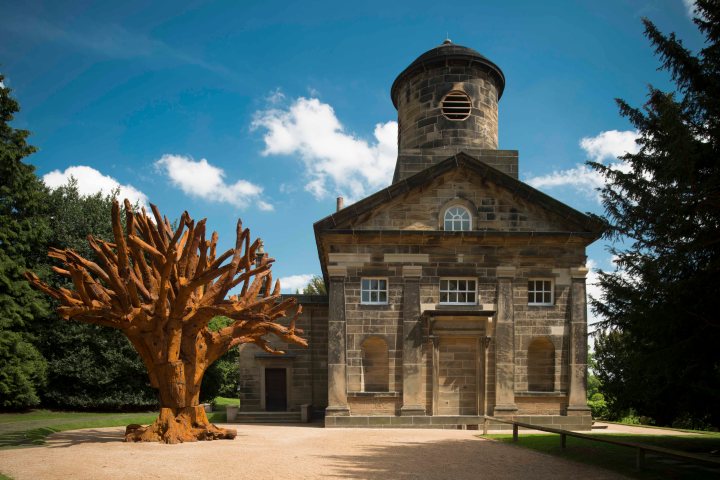
Ai Weiwei, Iron Tree, 2013, click here to enlarge.
Photo by Jonty Wilde, courtesy of Yorkshire Sculpture Park
◊ ◊ ◊ ◊ ◊
Press release (17 April 2014) from Yorkshire Sculpture Park:
Ai Weiwei in the Chapel
Yorkshire Sculpture Park, West Bretton, West Yorkshire, 24 May — 2 November 2014
Yorkshire Sculpture Park (YSP) is proud to announce an exhibition by Ai Weiwei, opening in the Park’s newly refurbished 18th-century chapel following a £500,000 restoration. The project, the first by Ai Weiwei in a British public gallery since Sunflower Seeds at Tate Modern in 2010, will be accompanied by poetry readings from the works of celebrated poet Ai Qing, Ai Weiwei’s father. Ai Weiwei in the Chapel opens to the public on Saturday 24 May 2014.
Iron Tree, 2013, a majestic six-metre high sculpture is presented in the chapel courtyard, while the installation Fairytale-1001 Chairs, 2007–14, is presented inside the chapel with three other works: the porcelain Ruyi, 2012; the marble Lantern 2014; and Map of China, 2009. The sculptures shown within the chapel relate to ideas about freedom and to the individual within society, whilst also connecting with the history and character of the building.
Iron Tree is the largest and most complex sculpture to date in the artist’s tree series, which he began in 2009. Inspired by the wood sold by street vendors in Jingdezhen, southern China, Ai’s trees are constructed from branches, roots and trunks from different trees. Although like a living tree in form, the sculptures are obviously pieced and joined together, being all the more poignant for their lack of life. Iron Tree comprises 99 elements cast in iron from parts of trees, and interlocked using a classic—and here exaggerated—Chinese method of joining, with prominent nuts and screws. Combining both the natural and crafted, the sculpture will rust over time and its installation in the secluded chapel garden makes a meditative space that gives pause for thought and is a powerful reminder of the cycles of nature.

Ai Weiwei, Fairytale-1001 Chairs, 2007, click here to enlarge.
Photo by Jonty Wilde.
◊ ◊ ◊ ◊ ◊
The second part of the exhibition, Fairytale-1001 Chairs, extends Ai’s major project for Documenta 12 in Kassel in 2007, for which he brought 1,001 Chinese citizens to Kassel for 20 days, representing each person with an antique chair. This transformational experience highlighted the complications of travel for ordinary Chinese citizens. Since his arrest in 2011, Ai’s own travel has been strictly limited and his passport is currently confiscated.
Unable to travel to Yorkshire, and working from plans and photographs of YSP’s chapel, Ai has selected 45 Fairytale-1001 Chairs and has conceived an installation of nine rows of five chairs in the nave. Spaced so that each chair is solitary, they give heightened awareness of the collective and the individual. The chairs date from the Qing Dynasty (1644–1912) and in this context challenge the class and ritual functions of such furniture, which originally was the preserve of privilege. In the stillness of the chapel, visitors are invited to take a seat and consider freedom, refuge, sanctuary and their antonyms, and to reflect on who may have sat before them, both on the chairs in China and within the 270-year-old Bretton Estate chapel. Through this simple act of participation, histories and cultures meet in a contemplative environment. As the artist has said, “those chairs are part of the fairytale—a symbolic gesture about memory and our past.”
Ai has selected two other works for the chapel. Ruyi translates to “as one wishes” and so alludes to wish-fulfilment. Sitting somewhere between fungal organic form and human internal organs, this lividly-coloured porcelain sculpture is one of a number of Ruyi made by Ai Weiwei that take the traditional Chinese sceptre of the same name, used by nobles, monks and scholars for around 2,000 years. Like talking sticks in other cultures, ruyi denoted authority and granted individuals the right to speak and be heard, so enabling orderly and democratic discourse.
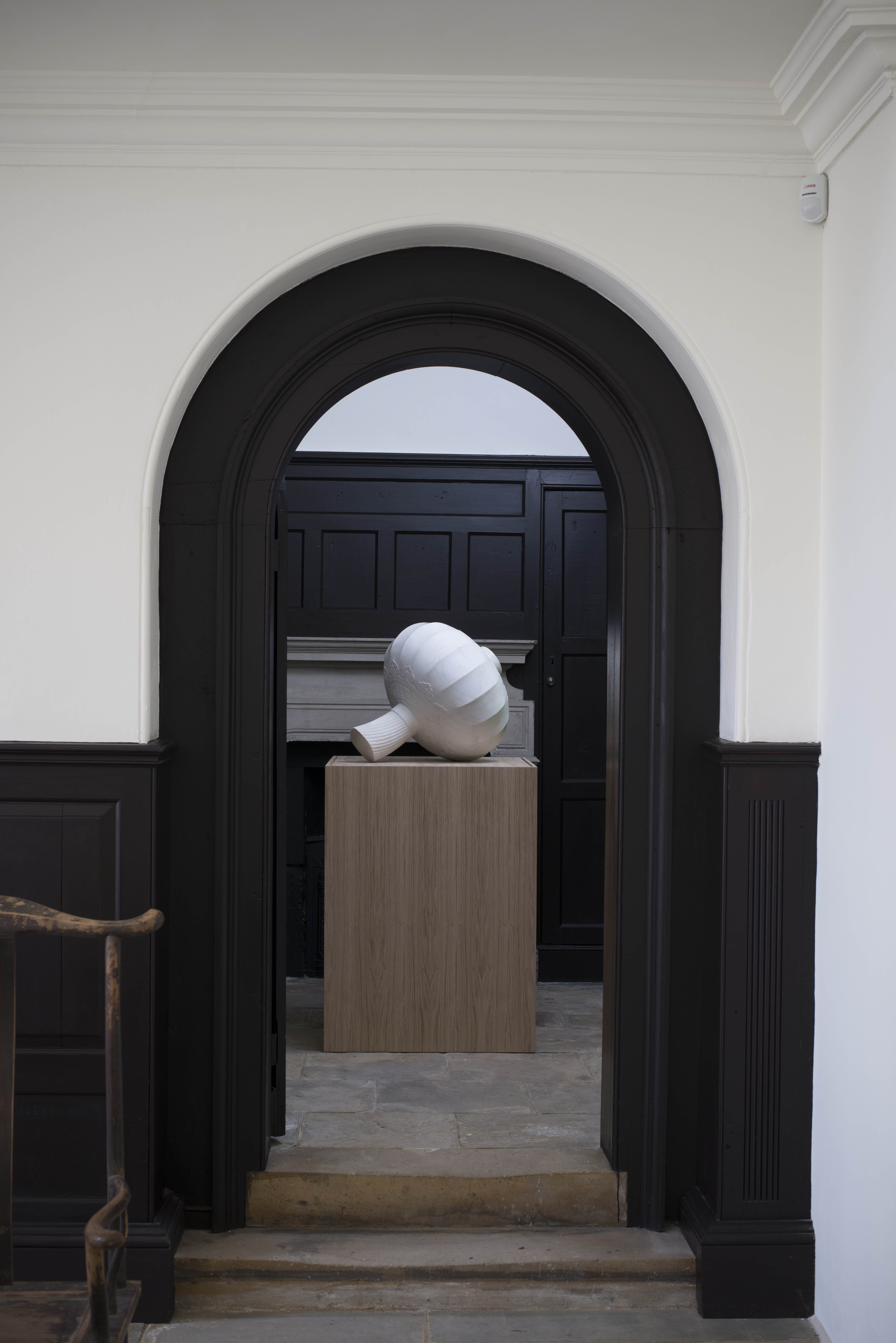
Ai Weiwei, Lantern, 2014. Photo by Jonty Wilde, courtesy Yorkshire Sculpture Park.
For some years the Chinese authorities have surrounded Ai’s home with surveillance cameras and every step he takes outside is recorded and monitored, resulting in 2010 with the series of works, Marble Surveillance Cameras. At around the same time, in a humorous gesture of mockery and defiance, he decorated the real CCTV cameras with red Chinese lanterns. For the chapel, Ai builds on this series and premieres the marble Lantern, carved in stone from the same quarries used by emperors to build the Forbidden City, and more recent rulers to build Mao’s tomb. Map of China, formed from iron wood reclaimed from Qing dynasty temples, shows China as an isolated land.
With the artist’s consent, we also present readings of works by Ai’s father, Ai Qing (1910–1996). Considered one of the most important 20th century Chinese poets, Ai Qing initially supported Mao Sedong. However, in 1958, he was found guilty of ‘rightism’ and with his family, including the baby Ai Weiwei, was sent to a labour camp and then exiled until Mao’s death, after which the family was able to return to Beijing. Readings will be made from across Ai Qing’s oeuvre, starting in 1932, and including important poems such as Snow Falls on China’s Land, My Wet-Nurse, and Wall. They demonstrate Ai Qing’s extraordinary ability to convey the strength of nature and the human spirit, even in adversity, and so connect with Ai Weiwei’s own life and this exhibition in particular.
About the Chapel
Built in 1744 by Sir William Wentworth, the Georgian sandstone chapel is historically important within YSP’s Bretton Estate. Nestled within the deer park, the Grade II* listed building was a part of the life on the estate during the 18th and 19th centuries, although it wasn’t until its acquisition by YSP in 2001 that it became more generally accessible. Artists shown here prior to restoration include James Lee Byars, Shirin Neshat and Jem Finer.
Restoration work carried out over the last nine months has transformed the gallery into a unique and versatile gallery space. Outside the building, work has included the renewal of the roof, repairs to eliminate water ingress and damp, and the renovation of external stonework. Inside the chapel, repairs have been made to the floor and internal timbers, while climactic conditions have been enhanced with the introduction of new lighting, heating and ventilation systems, and an environmentally friendly air source heat pump. Visitors to the Park will now enjoy improved access to the chapel with a new pathway from the visitor centre, wheelchair access into the building and an accessible toilet.
The £500,000 restoration of the chapel was supported by: English Heritage, Country Houses Foundation, The Wolfson Foundation, The Headley Trust, The Pilgrim Trust, the Holbeck Charitable Trust, The Leche Trust, The John S Cohen Foundation, Sir George Martin Trust, Kenneth Hargreaves Charitable Trust, Linden Charitable Trust, Jill Franklin Trust, and generous visitor donations. The lead professional advisor on the project was W. R. Dunn & Co Architects (RICS Conservation accredited building surveyor) and the appointed main contractor was William Anelay.
Call for Papers | Domestic Space and the Arts in Britain, 1753–1900
While the main deadline for submitting paper proposals for consideration for CAA 2015 passed earlier this month, here’s a late due date for a 90-minute session sponsored by the Historians of British Art:
CAA 2015 Session | Home Subjects: Domestic Space and the Arts in Britain, 1753–1900
College Art Association Conference, New York, 11–14 February 2015
Proposals due by 15 August 2014
Session chairs:
Dr. Melinda McCurdy (Associate Curator of British Art, Huntington Art Collections), mmccurdy@huntington.org
Dr. Morna O’Neill (Wake Forest University), morna.oneill@gmail.com
Dr. Anne Nellis Richter (independent scholar and adjunct instructor, American University), anne.nellis@gmail.com
Home Subjects is a new research working group which aims to illuminate the domestic display of art in Britain. Our goal is to examine the home as a place to view and exhibit works of art within the historical context of the long nineteenth century. Recent scholarship has emphasized the importance of the house itself and notions of ‘domesticity’ as important touchstones in British culture. At the same time, art historians have tended to focus on a history of British art premised on the display of art in public; according to this important narrative, British art developed in relationship to the public sphere in the eighteenth century. Art institutions and exhibitions asserted the importance of the display of art in forming audiences into publics in cultural and political terms. Such efforts continued in the ‘exhibition age’ of the nineteenth century, when display of artwork in museums, galleries, and special exhibitions solidified the important role given to art in articulating a public sphere. This narrative overlooks the continuation of older paradigms of display, especially those premised on the private and domestic audience for works of art. Within this context, the country house takes it place alongside the townhouse as an important venue for the display of art. We aim to explore this ‘counter-narrative’ of the home as the ideal place to view works of art, a view which permeated all areas of art and design and which persisted throughout the nineteenth century, despite the prevailing narrative of the development of public museums.
Also at stake in this project is a reconsideration of domesticity and its relationship to modernity. Important recent scholarship has illuminated some of the ways in which entrenched narratives of modernity and artistic modernism were defined in opposition to the domestic sphere. In a typical avant-garde gambit, artists distinguished works of art from objects of interior decoration by rejecting the private and the domestic. This session aims to bring together scholars whose work addresses this topic in order to posit a new trajectory for modernity, one that can be traced through the private, domestic sphere.
Topics of interest include but are not limited to:
• the display of easel painting and its relationship to the domestic interior
• decorative arts, their status as works of art and relationship to interior decoration
• domestic architecture and museum/gallery architecture, both public and private
• collecting and taste
• the interrelationship between private and public modes of display and decoration
Proposal abstracts should be no more than 500 words, and should be accompanied by a current 2-page c.v. and must be received by email to homesubjects@gmail.com by August 15, 2014. Please also include a mailing address, telephone number, and email.
Call for Articles | The Material Culture of Magic
As posted at H-ArtHist:
The Material Culture of Magic
Book Project Edited by Antje Bosselmann-Ruickbie and Leo Ruickbie
Proposals due by 1 August 2014
Magic is a wide field of research comprising what we might call the occult, paranormal events, anomalous experience, spirituality and other phenomena throughout human history. However, research has often been focused more narrowly on the historical analysis of written sources, or the anthropology and occasionally sociology of practitioners and their communities, for example. What is often overlooked are the physical artefacts of magic themselves.
In all areas of research, ‘material culture’ is becoming increasingly important—the ‘material turn’ as it has been labelled. This is particularly the case for disciplines that traditionally have not focused on object studies but on theory such as historical or social sciences. However, it is self-evident that the objects emerging from a culture provide valuable information on societies and their history. This is also and particularly the case for magic and related phenomena. Magic, especially, became divorced from its concrete expressions as academic study focused on problems of rationality and functionalist explanation. (more…)
Exhibition | ‘Of Green Leaf, Bird, and Flower’: Artists’ Books
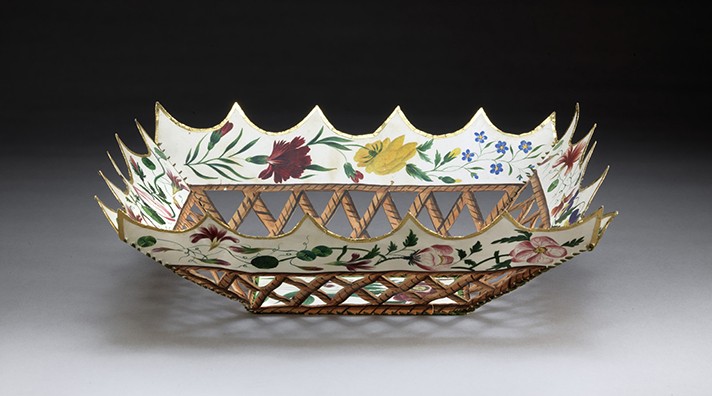
Unknown maker, Basket, ca. 1820, silk thread, cut paper, and watercolor,
(Yale Center for British Art, Paul Mellon Fund)
◊ ◊ ◊ ◊ ◊
From the exhibition press release:
‘Of Green Leaf, Bird, and Flower’: Artists’ Books and the Natural World
Yale Center for British Art, New Haven, 15 May — 10 August 2014
Curated by Elisabeth Fairman
This spring, the Yale Center for British Art presents ‘Of Green Leaf, Bird, and Flower’: Artists’ Books and the Natural World, an exhibition examining the intersections of artistic and scientific interest in the natural world from the sixteenth century to the present. On view from May 15 through August 10, 2014, the exhibition explores depictions of Britain’s countryside and its native plant and animal life through more than two hundred objects drawn primarily from the Center’s collections, ranging from centuries-old manuscripts to contemporary artists’ books.
 The exhibition highlights the scientific pursuits in the eighteenth and nineteenth centuries that resulted in the collecting and cataloging of the natural world. Also explored are the aesthetically oriented activities of self-taught naturalists during the Victorian era, particularly those of women who collected and drew specimens of butterflies, ferns, grasses, feathers, seaweed, and shells, and assembled them into albums and commonplace books. Examples of twentieth- and twenty-first-century artists’ books, including those of Eileen Hogan, Mandy Bonnell, Tracey Bush, John Dilnot, Sarah Morpeth, and Helen Douglas, broaden the vision of the natural world to incorporate its interaction with consumer culture and with modern technologies. Work by contemporary artists in the exhibition reveal a shared inspiration to record, interpret, and celebrate nature as in the work of their predecessors.
‘Of Green Leaf, Bird, and Flower’ features traditional bound books, drawings, and prints, as well as a range of more experimental media incorporating cut paper, wood, stone, natural specimens, sound, video, and interactive multimedia. Historical works are also on loan from the Beinecke Rare Book and Manuscript Library and the Lentz Collection at the Yale Peabody Museum of Natural History, including examples of early microscopes used by natural historians.
◊ ◊ ◊ ◊ ◊
From Yale UP:
Elisabeth Fairman, ed., with essays by David Burnett, Molly Duggins, Elisabeth Fairman, and Robert McCracken Peck, Of Green Leaf, Bird, and Flower: Artists’ Books and the Natural World (New Haven: Yale University Press, 2014), 248 pages, ISBN: 978-0300204247, $70.
Highlighting an enduring interest in natural history from the 16th century to the present, this gorgeous book explores depictions of the natural world, from centuries-old manuscripts to contemporary artists’ books. It examines the scientific pursuits in the 18th and 19th centuries that resulted in the collecting and cataloguing of the natural world. It also investigates the aesthetically oriented activities of self-taught naturalists in the 19th century, who gathered flowers, ferns, seaweed, feathers, and other naturalia into albums. Examples of 20th- and 21st-century artists’ books, including those of Eileen Hogan, Mandy Bonnell, and Tracey Bush, broaden the vision of the natural world to incorporate its interaction with consumer culture and with modern technologies. Featuring dazzling illustrations, the book itself is designed by Miko McGinty to evoke a fieldwork notebook, and features a collection pocket and ribbon markers.
Elisabeth Fairman is senior curator of rare books and manuscripts at the Yale Center for British Art.
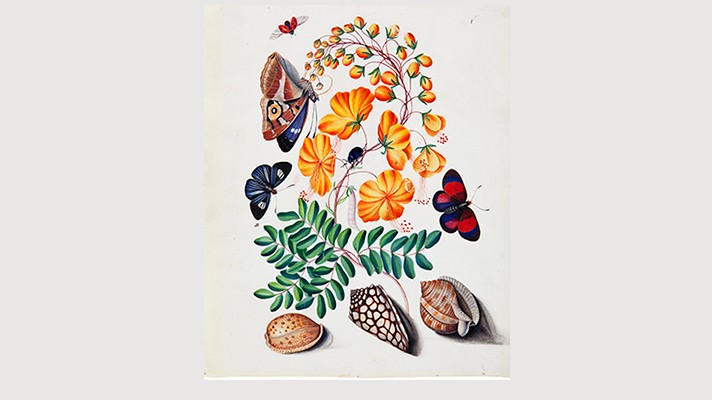
James Bolton, one of twenty drawings depicting specimens from the natural history cabinet of Anna Blackburne, ca. 1768, Yale Center for British Art, Paul Mellon Fund, in honor of Jane and Richard C. Levin, President of Yale University (1993–2013).
Call for Papers | The Ends of American Art
As posted at H-ArtHist:
The Ends of American Art
Stanford University, 7–8 November 2014
Proposals due by 9 June 2014
The Art & Art History Department at Stanford University invites submissions from advanced graduate students for a unique opportunity to share your work in a collaborative setting with leading scholars of American art and visual culture. The Ends of American Art International Conference is designed to explore new possibilities for
thinking about, performing, producing, and writing the history of American art. It will meditate on the ‘ends of American Art’ by questioning whether certain longstanding tropes within the field may now be outmoded (e.g. nationalism, American art as a history of painting and sculpture). Looking forward, we will also ponder what the new goals (or ‘ends’) of the field should be in the 21st century.
The two-day event will feature papers by senior scholars as well as two ‘workshop’ panels in which selected graduate students will present a 5-minute presentation of their project using only 1 slide. These workshops are designed to both gain a sense of the current landscape of the field and to offer participating students feedback from a diverse interdisciplinary audience in a workshop context.
Conference Features for Selected Participants
• Round-trip airfare to SFO International Airport, lodging while in Palo Alto, and ground transportation during the conference
• Opportunity to workshop your project in a collaborative setting with leading scholars from multiple fields
• Opportunity to witness the current shape of scholarship in American Art and Visual Culture as animated in the work of other advanced graduate students in the U.S. and abroad
• Be among the first scholars to view the Anderson Collection of American Art soon to be installed in a new building next to Stanford’s Cantor Arts Center
•Participate in the live webcast of the conference, which will feature real-time forums online in addition to the discussions taking place at Stanford
Eligibility
• Dissertation project must address issues in American art and visual culture, broadly defined in terms of historical period and interpretive approach (projects from all disciplines are welcome and encouraged)
• Students must be in the writing stage of the dissertation (ABD status or equivalent)
Requirement for Submission
1. CV (including university affiliation, contact information for Dissertation Committee Chair, and expected date of completion)
2. 250-word abstract of your project
3. 1 image that will be the subject of your 5-minute presentation
Please send all documents to ebennet@stanford.edu by 9 June 2014.
New Book | Chinoiserie in Eighteenth-Century Britain
From Manchester University Press:
Stacey Sloboda, Chinoiserie: Commerce and Critical Ornament in Eighteenth-Century Britain (Manchester: Manchester University Press, 2014), 272 pages, ISBN: 978-0719089459, £70 / $105.
 In a critical reassessment of chinoiserie, a style both praised and derided for its triviality, prettiness and ornamental excesses, Stacey Sloboda argues that chinoiserie was no mute participant in eighteenth-century global consumer culture, but was instead a critical commentator on that culture. Analysing ceramics, wallpaper, furniture, garden architecture and other significant examples of British and Chinese design, this book takes an object-focused approach to studying the cultural phenomenon of the ‘Chinese taste’ in eighteenth-century Britain. It is essential reading for anyone interested in the critical history of design and the decorative arts in the period, and students and scholars of art history, material culture, eighteenth-century studies and British history will find a novel approach to studying the decorative arts and a forceful argument for their critical capacities.
Stacey Sloboda is Associate Professor of Art History at Southern Illinois University.
C O N T E N T S
Introduction: Reassessing Chinoiserie
1. Making China: Circulation, Imitation and Innovation
2. Buying China: Commerce, Taste and Materialism
3. Commerce in the Bedroom: Sex, Gender and Social Status
4. Commerce in the Garden: Nature, Art and Authority
Conclusion: Style and the Global Marketplace
Bibliography
Index
Lecture | Melissa Hyde, Painted Women
From the Sydney Intellectual History Network:
Melissa Hyde, Painted Women in the Age of Madame de Pompadour
Art Gallery of New South Wales, Sydney, 10 June 2014
Co-presented with the Art Gallery Society New South Wales

François Boucher A young lady holding a pug dog (presumed portrait of Madame Boucher) mid 1740s
Professor Melissa Hyde considers the role cosmetics played in the court politics and social identities of women at the court of Versailles. For artists like François-Hubert Drouais and Elisabeth Vigée-Lebrun, who portrayed Pompadour, Du Barry (and Marie-Antoinette after them), the problem of depicting an unpainted, natural face through inherently artificial painterly means presented something of a paradox. This lecture will also look at how artists grappled with that paradox and will demonstrate how the painterly performance of the natural was a perfect vehicle for portraying Du Barry’s own performance as a natural woman.
10.00am Coffee
10.30–11.30 Lecture
More information is available here»
Lecture | Richard Taws, The Dauphin and his Doubles
From the Sydney Intellectual History Network:
Richard Taws, The Dauphin and his Doubles:
Visualizing Royal Imposture after the French Revolution
The University of Sydney, 10 June 2014
Co-presented with the Sydney Intellectual History Network (SIHN)
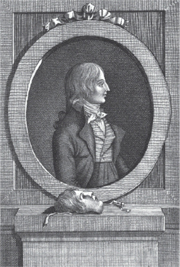
Portrait of Jean-Marie Hervagault, from Le Faux Dauphin actuellement en France, ou histoire d’un imposteur, se disant le dernier fils de Louis XVI (Paris: Lerouge, 1803)
This lecture considers the authenticating agency attributed to images of the dauphin Louis-Charles, the son and heir of Louis XVI and Marie-Antoinette, as they circulated globally in the late eighteenth and nineteenth centuries. Louis-Charles died at the age of ten in the Temple prison in 1795; yet, rumours soon spread that he had been freed in a secret royalist escape plot and continued to live somewhere, most probably in the French colonies or North America. During the course of the nineteenth century the numerous images of Louis-Charles produced before, during and after the French Revolution were invoked regularly as the primary standard of proof against which to judge the many imposters who subsequently came forward from around the world, accompanied by lurid tales of adventure, to announce themselves the ‘lost’ dauphin.
The appropriation of eighteenth-century images of Louis-Charles by these pretenders, as well as the paintings, prints and photographs they had made of themselves, were, in a rapidly transforming media ecology, closely connected to competing claims about the utility of different media in the production of the French past.
Richard Taws teaches eighteenth- and nineteenth-century European art, with a particular interest in the visual culture of the French Revolution and its aftermath. He taught previously at McGill University, Canada, and has been a Getty Postdoctoral Fellow (2006–07) and a Member of the School of Historical Studies at the Institute for Advanced Study, Princeton (2010). He is a member of the editorial board of Art History and the current recipient of a Philip Leverhulme Prize (2013–15). Richard’s recent research focuses on everyday, ephemeral and obsolete forms of visual culture and related issues to do with time, materiality and value in the late eighteenth and early nineteenth centuries. His first book, The Politics of the Provisional: Art and Ephemera in Revolutionary France (2013), examines how provisional images and objects made in 1790s France mediated both the Revolution’s memory and its future, with important implications for how citizens became constructed as political subjects.
Wednesday, 10 June 2014, 6.00–7.30pm
Law School LT 106
Level 1, Sydney Law School Annex
Eastern Avenue
The University of Sydney
Registration information for this free event is available here»
Conference | Enlightenment Cosmopolitanisms and Sensibilities
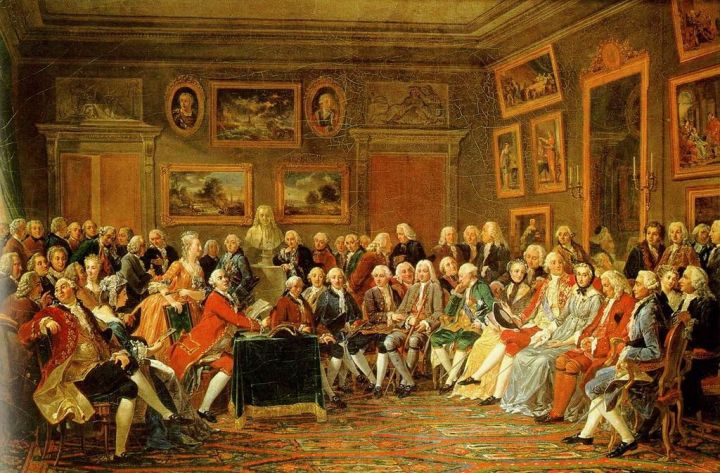
Anicet Charles Gabriel Lemonnier, Salon de Madame Geoffrin,
1812 (Château de Malmaison)
◊ ◊ ◊ ◊ ◊
From the Sydney Intellectual History Network, with the workshop programme:
Enlightenment Cosmopolitanisms and Sensibilities
Sancta Sophia College, The University of Sydney, 11–12 June 2014
The character of practiced cosmopolitanism during the Enlightenment often appears to amount to little more than an extension of early modern courtly internationalism infused with a new language of ideas. Further investigation reveals the desire on the part of Enlightenment cosmopolites to open borders in the name of economic, political, intellectual and artistic progress. This workshop explores cosmopolitanism in practice during the long eighteenth century in Europe and, through circulation, beyond its borders. It seeks out lived experiences of cosmopolitanism in the evidence of visual, social and textual expressions, and then asks how to interrogate this evidence. What were the opportunities through which border crossings became fixed in the minds of participants and observers? How was Enlightenment cosmopolitanism in practice inflected with different forms of sensibility?
W E D N E S D A Y , 1 1 J U N E 2 0 1 4
9:30 Welcome
9:45 Session 1: Languages of Cosmopolitanism
• David Garrioch (History, Monash University), Cosmopolites and their Critics: the Eighteenth-Century Language of Cosmopolitanism
• Jennifer Milam (Art History, University of Sydney), Visual Cosmopolitanism
11:15 Morning Tea
11:30 Session 2: Rome and Cosmopolitan Aesthetics
• David Marshall (Art History, University of Melbourne), Cosmopolitanism and Non- Antiquarian Taste in Early Eighteenth-Century Rome
• Mark Ledbury (Art History, University of Sydney), Cosmopolitanism and Anti- Cosmopolitanism in Rome
1:00 Lunch
2:00 Session 3: Rousseau and Cosmopolitanism
• Anik Waldow (Philosophy, University of Sydney), Rousseau, Theatre and Civic Identity
• Ian Coller (History, LaTrobe University), Rousseau’s Turban
3:30 Afternoon Tea
3:45 Session 4: Cosmopolitan Circulations
• Alexandra Cook (Philosophy, University of Hong Kong), Eighteenth-Century Botanical Cosmopolitanism: Books, Seeds and Herbaria
• Peter McNeil (Design History, University of Technology, Sydney), ‘Beauty in Search of Knowledge’: Eighteenth-Century Fashion and the Uses of Print
• Melissa Hyde (Art History, University of Florida), Wertmüller, National Identity and the Cosmopolitan Circulation of the Artist
T H U R S D A Y , 1 2 J U N E 2 0 1 4
9:30 Session 5: Open Borders: Europe and Beyond
• Simon Burrows (History, University of Western Sydney), Books Crossing Borders: Material Traces and Enlightenment Cosmopolitanism
• Jennifer Ferng (Architecture, University of Sydney), Maritime Voyages: Siege and Sovereignty at Galle Fort, Ceylon, 1729–1796
11:00 Morning Tea
11:15 Session 6: Revolutionary Exchanges
• Peter McPhee (History, University of Melbourne), Cosmopolitanism, Robespierre and the French Revolution
• Richard Taws (Art History, University College London), Chains of Command: Telegraphing Liberty in Lemonnier’s Le Commerce
12:45 Lunch
Cosmopolitan Moments: Instances of Exchange
in the Long Eighteenth Century, Emerging Scholar Sessions
In these sessions, emerging scholars explore discrete instances of cultural interaction in the long eighteenth century (visual, textual, political, philosophical, social). How do we define the nature of the exchange? Is it cosmopolitan? Areas of analysis include roles of actors and agents, bi-lateral or unilateral action, acceptance, rejection and the medium of transmission.
1:45 Session 7
• Garritt Van Dyk (History, University of Sydney), Before the Parisian Café: Cosmopolitanism and the Franco-Ottoman Alliance
• Mark Shepheard (Art History, University of Melbourne), The Cosmopolitan Castrato: Farinelli and the Visual Arts
• Warren Andrews (Art History, University of Sydney), An Ambush in Print
3:15 Afternoon Tea
3:30 Session 8
• Emma Gleadhill (History, Monash University), Lady Holland’s House: ‘The House of all Europe’
• Katja Abramova (Art History, The University of Sydney), Botany as a Cosmopolitan Pursuit for Women: The Case of the Maria Feodorvna
• Laura Jocic (History, University of Melbourne), Anna King’s Dress: Trade and Consumption in the Early Years of Settlement in Australia
• Janet Healy (Music, Monash University), Mozart in a Revolutionary Context
Bill Griswold Named Director of the Cleveland Museum of Art
Press release from The Cleveland Museum of Art:
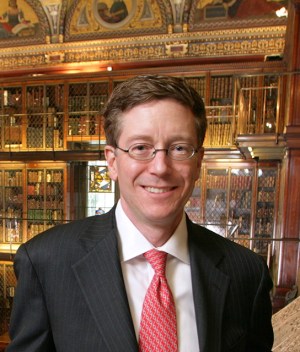 In May 2014, Dr. William M. Griswold became the 10th director of the Cleveland Museum of Art since its founding in 1916. Dr. Griswold enters the life of the museum at a dynamic moment—with a newly completed expansion project increasing its capacity and significance, and a centennial anniversary approaching. His ambition is to build the museum’s strong relevance throughout the region, the nation and the world, capitalize on its long-standing community engagement legacy and enhance the quality and breadth of its well-known collection.
Dr. Griswold’s tenure at the Cleveland Museum of Art follows his term as the fifth Director of The Morgan Library & Museum since the institution’s founding in 1924. During his seven years of leadership there, Dr. Griswold spearheaded the growth of the Morgan’s collections, exhibition program and curatorial departments, most recently adding Photography as a focus. He oversaw a number of important exhibitions and scholarly exchanges with leading international museums, including the Louvre, London’s Courtauld Institute, Munich’s Graphische Sammlung and Turin’s Biblioteca Reale.
In 2010, Dr. Griswold initiated the first interior restoration of the Morgan’s historic McKim building since its construction as Pierpont Morgan’s private study and library more than a century ago. He also oversaw a project to digitize the Morgan’s renowned collections, beginning with its holdings of drawings and music manuscripts, two of its most important. In 2011, he supervised the establishment of the innovative Morgan Drawing Institute to advance the study of drawings of all periods and schools. As a result of these initiatives, and many more, the Morgan over the last several years has seen some of the most robust donor support and attendance in its history.
Dr. Griswold had previously served as Director and President of the Minneapolis Institute of Arts, from 2005 to 2007; Acting Director and Chief Curator of the J. Paul Getty Museum, 2004 to 2005; and Associate Director for Collections at the Getty, beginning in 2001. Prior to joining the Getty, Dr. Griswold had been Charles W. Engelhard Curator and Head of the Department of Drawings and Prints at the Morgan Library since 1995. From 1988 to 1995, he was on the staff of the Metropolitan Museum of Art, first as Assistant and then as Associate Curator in the Department of Drawings and Prints.
Dr. Griswold was the co-author with Jacob Bean of 18th-Century Italian Drawings in the Metropolitan Museum of Art and has written extensively on Florentine drawings of the early Renaissance. He oversaw the design and creation of the Morgan’s Drawing Study Center, and in 1998 curated a historically significant exchange of exhibitions between the Morgan and The State Hermitage Museum, St. Petersburg, and the Pushkin State Museum of Fine Arts, Moscow. In 1999 he co-curated New York Collects, the Morgan’s first major exhibition devoted to twentieth-century art, and in 2002 he was co-author with Jennifer Tonkovich of Pierre Matisse and His Artists.
Formerly a member of the board of directors of The Courtauld Institute of Art, Dr. Griswold currently serves on the boards of the American Federation of Arts, American Friends of the Shanghai Museum, and American Trust for the British Library. He is a member of the Association of Art Museum Directors and President of Master Drawings Association, which publishes the scholarly journal Master Drawings. In 2008, he was awarded the insignia of Chevalier of the French Order of Arts and Letters.
Dr. Griswold earned his bachelor’s degree at Trinity College, Hartford, Connecticut, and his Ph.D. at The Courtauld Institute of Art, London.
Carol Vogel reports on Griswold’s appointment for The New York Times (20 May 2014), here»










 Enfilade
leave a comment