Call for Papers | SAH in Chicago, 2015

From the SAH 2015 Call for Papers:
2015 Society of Architectural Historians Annual Conference
Chicago, 15–19 April 2015
Proposals due by 6 June 2014
The Society of Architectural Historians is now accepting abstracts for its 68th Annual Conference in Chicago, April 15–19, 2015. Please submit abstracts no later than June 6, 2014, for one of the 32 thematic sessions or for an open session. Sessions have been selected to cover topics across all time periods and architectural styles. SAH encourages submissions from architectural, landscape, and urban historians; museum curators; preservationists; independent scholars; architects; and members of partner organizations.
Thematic sessions are listed below. Open sessions are available for those whose research does not match any of the themed sessions. Instructions and deadlines for submitting to themed sessions and open sessions are the same. Only one abstract per author or co-author may be submitted.
SAH is using an online abstract submission process—please do not send your abstract to the session chair’s email address as this will delay the review of your abstract or possibly void your submission.
Abstract submissions must follow these guidelines:
• Abstracts must be under 300 words
• The title cannot exceed 65 characters, including spaces and punctuation
• Abstracts must follow the Chicago Manual of Style
If submitting to a thematic session, send your CV to the appropriate session chair and the SAH office at info@sah.org. If submitting to the open session, send your CV to the SAH office only, at info@sah.org. Abstracts should define the subject and summarize the argument to be presented in the proposed paper. The content of that paper should be the product of well-documented original research that is primarily analytical and interpretative rather than descriptive in nature. Papers cannot have been previously published or presented in public except to a small, local audience. All abstracts will be held in confidence during the review and selection process, and only the session chair and General Chair will have access to them. All session chairs have the prerogative to recommend changes to the abstract in order to ensure it addresses the session theme, and to suggest editorial revisions to a paper in order to make it satisfy session guidelines. It is the responsibility of the session chairs to inform speakers of those guidelines, as well as of the general expectations for participation in the session and the Annual Conference. Session chairs reserve the right to withhold a paper from the program if the author has not complied with those guidelines.
Please note: each speaker is expected to fund his or her own travel and expenses to Chicago. SAH has a limited number of partialfellowships for which Annual Conference speakers may apply. However, SAH’s funding is not sufficient to support the expenses of all speakers. Each speaker and session chair must register and establish membership in SAH for 2015 by August 30, 2014, to show their commitment for the 2015 conference and are required to pay a non-refundable fee equal to that of the conference registration fee.
◊ ◊ ◊ ◊ ◊
A selection of panels that might be relevant for eighteenth-century scholars:
ANCIENTS AND MODERNS: THE UNRAVELING OF ANTIQUITY
The Quarrel of the Ancients and Moderns erupted in late seventeenth-century France. Although ostensibly concerned with the relative merits of the literary and cultural achievements of modernity and antiquity, the quarrel was predicated upon more ideologically charged issues, and as such what initially began as a literary quarrel quickly developed into a broader debate that impinged upon an array of subjects including architecture. Indeed, the Quarrel of the Ancients and Moderns unleashed a discourse pitting the sanctity of antiquity against the exigencies of modernity that would shape views of the architecture of both the past and present throughout the long eighteenth century.
As they grappled with questions of imitation and invention, authority and novelty, progress and perfection, and rules and genius, architects turned to the ruins of antiquity to redefine the architecture of the present. The interpretive space that existed between the ruin and its reconstruction, the fragment and the whole, gave rise to differing and vigorously contested visions of antiquity and its relevance for the modern world. The resulting expansion of knowledge led architects to question the prevailing holistic view of antiquity and the assumptions upon which it was based.
This session seeks to explore how the quarrel’s unraveling of the past influenced architectural theory and practice in the present and to understand it as a pan-European phenomenon. We invite papers that reconsider the quarrel and its architectural legacy over the course of the long eighteenth century (1670–1815) throughout Europe. Papers may address architecture as it relates to a range of issues, including the nature of authority, the possibility of progress, the status of the architect, the role of genius, and the relationship between socio-cultural change and the built environment.
Session chairs: John Pinto, Princeton University pinto@princeton.edu; Daniel McReynolds, Princeton University, dmcreyno@princeton.edu
◊ ◊ ◊ ◊ ◊
ARCHITECTURAL HISTORIES OF DATA
In the so-called digital age, ‘data’ is repeatedly presented as the primary unit of knowledge. Yet we know almost nothing of this epistemic unit’s history. How did we come to imagine data as untethered, immaterial bits of information? Historians of the early modern period have written compelling histories of the modern ‘fact’ by exposing its unexpected ties to preternatural monsters and double-entry bookkeeping. What would equivalent histories of data look like? Architectural historians may be particularly well positioned to excavate histories of data since space is a central paradox in our understanding of this unit: while data needs to be infinitely addressable, we assume that it does not occupy an address in space. The sixteenth- century scholar who decided to record his bibliographies not in bound volumes but on slips of paper so as to be able to rearrange them understood this as well as the contemporary data analyst. Over against the assumption that data is dematerialized information flowing in an imaginary frictionless space, then, this session proposes that data has always had architecture. We invite papers that explore the material infrastructures that gather, store, index, aggregate, and dissimulate data: from cabinets that file paperwork to buildings that house bureaucracies and from graphs and tables that make data visible to data centers and satellites in orbit that push it out of sight. How can these spatial and material histories start sketching an historical ontology of data? What concepts, artifacts, techniques, and institutions have been playing roles in these histories? And, finally, how might historical accounts of data challenge the technological master- narratives on which histories of architectural modernity have been based?
Session chairs: Zeynep Çelik Alexander, University of Toronto, zeynep.celik@utoronto.ca and Lucia Allais, Princeton University, allais@princeton.edu
◊ ◊ ◊ ◊ ◊
EMOTIONAL HISTORIES OF ARCHITECTURE
Louis Sullivan defied his profession’s orthodoxies in a 1894 AIA convention address titled “Emotional Architecture as Compared with Classical.” Deploring the state of contemporary design pedagogy, he argued “how deeply necessary it is that a technical or intellectual training be supplemented by a full, a rich, a chaste development of the emotions.” Sullivan’s unfamiliar antinomies of “emotional” versus “classical” architecture confound us, indeed instructively. An architectural historiography grounded solely in formal, technical and intellectual constructs is poorly equipped to evaluate emotions as evidence. Our discipline’s limitations render Sullivan’s discourse odd and inscrutable.
That situation is changing, thanks to methodological innovations in the burgeoning field of the history of emotions. Reassessing interior states conventionally assumed to be “hardwired” and universal, the field’s pioneers insist upon the historical specificity, contingency, and transience of emotional expressions. Analyzing emotive terms embedded in primary documents, they produce nuanced readings of affect as a social and cultural construct. Concepts including “emotional navigation,” “emotional regimes,” “emotional communities” (characterized by particular “systems of feeling” and “emotional styles”) and “emotional labor” bear close scrutiny by architectural historians. Familiar buildings, newly contextualized by emotive evidence discovered in their corresponding texts, bear unforeseen witness to architectural enterprises and the societies that initiate them.
This session invites papers that serve as case studies in how research methods developed in the field of the history of emotions can inform and broaden architectural history, and which suggest, conversely, how architectural history might offer unique contributions to the history of emotions. Abandoning impressionistic readings of architectural affect, papers in this session will explicitly evaluate methodologies that embed built objects within their emotional context(s). Proposals from scholars of all periods and geographies are welcome.
Session chair: Greg Castillo, University of California, Berkeley; gregcastillo@berkeley.edu
◊ ◊ ◊ ◊ ◊
FROM DRAWING TO BUILDING: REWORKING ARCHITECTURAL DRAWING
It is understood that drawing leads to building. However, the movement from one to the other is neither direct nor determined in advance. It is the presence of this ‘indeterminacy’ that creates a specific locus of research. There is, as Robin Evans (1997) has argued, a constitutive ‘gap’ between drawing and building that demands a revision of architectural history. This ‘gap’ constitutes a site in which the project of the history of architecture can be rethought and the appropriate theoretical dimensions to that rethinking incorporated. For Evans the gap is the general condition of architectural drawing. In sum this session—From Drawing to Building: Reworking Architectural Drawing—will allow for a productive rethinking of the relationship between drawing and building; a relationship that has implications as much in history and theory as it does to architectural pedagogy and contemporary practices of design.
This session will concentrate on those architectural drawings that occur apart from the ones created for what can be described as the legal documentation of the construction processes. In other words, emphasis will be given to those drawings that are used to communicate concepts and meanings central to the discipline of architecture. Furthermore, the session will emphasize interest in the specific techniques and conventions of the perspective and the axonometric as techniques used to convey spatial strategies. Even though tied to specific periods and individual practices, drawings using these techniques represent distinctive disciplinary propositions.
Through these conventions and techniques, image-based representations provide transactional visual environments that are instrumental in the development of architectural knowledge. Such provocations for the discipline are beyond any authorial desire for architecture’s substantiation in building. This session will invite papers from a range of historical periods to open discussion on the functionality of the ‘gap’ between drawings and buildings.
Session chairs: Desley Luscombe, University of Technology Sydney, Desley.luscombe@uts.edu.au and Andrew Benjamin, Monash University Melbourne, andrew.benjamin@monash.edu
◊ ◊ ◊ ◊ ◊
REPLICAS: CONTENTIOUS RECONSTRUCTIONS OF THE PAST
‘Replica’ architectures employ selective ideas of the past to construct the self-image of states, cultures, organizations or powerful individuals in the present, often operating in service of radically conservative ideologies. Frequently promoted through the rhetoric of ‘reconstruction’, these projects are seldom ‘literal’ reconstructions. Rather, they involve the tendentious reclamation of historic architectural or urban forms to reinforce identity narratives, however tenuous or counterfactual their historical veracity. Such projects advance certain political, religious or socio-cultural worldviews or reinforce certain structures of power, preserving distinctions. While architecture has always conveyed ideologies or legitimized a particular social or political order, ‘reconstruction’ projects imagined to embody authority, or which transmit counterfactual histories, sit on the margins of our discipline. Yet they are profoundly interesting as material artifacts. The stories of their life in use are just as interesting as the stories of their procurement and construction. Striking in their own contexts, such “replicas” are often stranger when examined from another cultural, temporal or political vantage point.
The study of replicas is interdisciplinary, implicating architecture as well as philosophy, cultural studies, memory studies and cultural geography. We are interested in papers that examine:
• the intentions and anxieties of their patrons and makers
• the significance of retelling or reorienting stories and myths in the service of dominant or distinctive ideologies
• the shifting relations, incipient contradictions, or unwitting ironies that emerge between originals and replicas, as the latter respond to new programs, contemporary materialities, regulations and techniques of construction
• questions of collective memory, official history and the politics of preservation
Theoretically informed proposals that ground these questions in actual sites and practices from a broad range of geographies and time periods are welcome.
Session chairs: Adam Sharr, Newcastle University, adam.sharr@ncl.ac.uk Zeynep Kezer, Newcastle University, Zeynep.Kezer@ncl.ac.uk
◊ ◊ ◊ ◊ ◊
THE TENT: ONE OF ARCHITECTURE’S MANY GUISES
From the palace and pleasure garden to the military campaign and refugee camp, the tent exemplifies a realm that is ephemeral (although not evanescent), mediatory between the natural and built environments, and, as architecture ‘built’ out of textiles, insistently foregrounding a foundation in craftsmanship. Transformed into icons, tents have also been fixed in palatial and domestic interiors as ‘tent-rooms’ in places as geographically and historically diverse as, for example, the Norman palace in Palermo, Malmaison, and Graceland. Be it as structure, site, or icon, the tent offers a critical lens for investigating architecture’s fluid and yet (often) uneasy co-existence with nature, craft, and ephemerality. To date, the most comprehensive study of tent architecture (indeed, of tents as architecture) has been Peter A. Andrews’ Felt Tents and Pavilions: the Nomadic Tradition and its Interaction with Princely Tentage (1999). Andrews’ volumes not only offer a useful catalog of medieval and early modern tents, but they also draw attention to the ways in which tents instantiate a crucial meeting-point between East and West. This panel seeks to highlight the possibilities of rethinking architectural theory and practice afforded through a careful study of tents. Our session will take a wide angle view of the phenomenon of the tent, both geographically and chronologically, and so papers are invited that treat any place or period. Plausible topics include, but are not limited to, tents as gifts, engineers of alternate realities, markers of hybrid temporalities, textiles, sites of war, and symbols of an irrepressible pre-modernity.
Session chairs: Zirwat Chowdhury, Reed College, zirwat@reed.edu; William Tronzo, University of California, San Diego, wtronzo@yahoo.com
◊ ◊ ◊ ◊ ◊
WATERY NETWORKS
If architecture and cities have long been characterized by fixity, groundedness, and a formative relationship to land, how might a maritime perspective shift our understanding? Following the pioneering work of Fernand Braudel on the Mediterranean, Kurti Chaudhuri on the Indian Ocean, and Paul Lovejoy on the Black Atlantic, historians have not only reinvigorated Mediterranean studies and encouraged the growth of trans- Atlantic studies, they have also begun to identify transnational geographies as similarly fruitful sites for exploration, including the Black Sea, the Swahili Coast, and the Red Sea. This session considers how historic connections across the sea—created through networks of trade, imperial expansion, systems of communication, and/or migrations of people—have facilitated the transmission of ideas about architecture and have shaped buildings and cities across these watery terrains.
We seek papers that explore, either in case studies or more broadly analytic investigations, the possibilities, challenges, and potential pitfalls of thinking architecture from the mid-fifteenth century to the present through an oceanic lens. Although the age of European exploration put many regions into commercial and cultural dialogue, we seek work that opens onto less familiar routes, such as the swansong of Ming exploration or Arab trade across the Indian Ocean. Papers engaging the urban scale are especially encouraged. Our aim is to bring together architectural historians who work on geographically disparate places to consider the methodological ties that bind them. What lessons might be learned about how buildings and cities are shaped by transnational networks built across systems of water and transformed by the movements and complex cultural affiliations of individuals and groups? How do we negotiate the desire for a global outlook with the localized dynamics of particular sites?
Session chairs: Sheila Crane, University of Virginia, scrane@virginia.edu; and Mark Hinchman, Taylors University, Malaysia, MarkAlan.Hinchman@taylors.edu.my
◊ ◊ ◊ ◊ ◊
WHAT CANON? QUESTIONS OF LANDSCAPE HISTORY
A canon of landscape architectural history has emerged just as art and architectural historians have questioned the value and limits of the idea of any canon. Landscape history has expanded in the context of Marxist, feminist, and race-based critiques of established canons in art and architectural history. This critical condition has produced a landscape architectural canon both more inclusive and less defined, one at once more porous and thicker. Crossing disciplinary boundaries, scholars have investigated the complex connections between the fields of landscape architecture and architecture, ecology and environment, resiliency and sustainability, cities and urbanism. A canon of sorts has emerged, though by no means static or clearly grounded in any one approach. This session seeks to explore what the canon defines and what are the manifestations, limits, and potential areas of exposure. The session seeks to consider the role of critique in historical narratives and the development of the canon- where and what is the appropriate critical role? How has critique become an historical tool? Papers that consider landscapes in non-Western cultures would be appropriate, as would alternative views of canonic places. We encourage papers addressing the relationship of architecture and landscape architecture, urban design and planning, environmental design and analysis. Papers might present completed research projects or those still being theorized. We seek papers that suggest alternative views and challenging perspectives that will contribute to the growing body of scholarship in landscape architectural history.
Session chair: Thaisa Way, University of Washington, tway@uw.edu
Exhibition | Pierre-Antoine Demachy (1723–1807)
Adapted from the Office of Tourism of Versailles:
Le Témoin Méconnu: Pierre-Antoine Demachy (1723–1807)
Musée Lambinet, Versailles, 15 February — 18 May 2014
 The Musée Lambinet in Versailles dedicates a unique exhibition to Pierre Antoine Demachy. This little-known artist of the eighteenth century, whose work has never before been showcased in a single exhibition, is a fabulous witness of his time. Strongly influenced by Italian art, Demachy applied to Paris cityscape types practiced by Canaletto and Guardi. He was among the artists whom the Empress Catherine II of Russia in 1768 placed an order through its ambassador to France, and the Count of Angivillers purchased for Louis XVI a view of the Seine at the Salon of 1783.
The work of Demachy will be presented through the following seven themes:
• Architectural whims and fantasy views
• Views related to the Louvre
• Demolition of churches and fire the Foire Saint-Germain
• Church interiors
• Other views in and around Paris
• Historic Events
• Views of the Seine and cityscapes
The press release, which includes a checklist of the major works exhibited, is available here»
◊ ◊ ◊ ◊ ◊
The catalogue is available from Artbooks.com:
Françoise Roussel-Leriche and Marie Petkowska Le Roux, Le Témoin Méconnu: Pierre-Antoine Demachy, 1723–1807 (Paris: Magellan, 2014), 216 pages, ISBN: 978-2350742809, $55.
New Book | The Architectural Capriccio
From Ashgate:
Lucien Steil, ed., The Architectural Capriccio: Memory, Fantasy and Invention (Aldershot: Ashgate, 2014), 548 pages, ISBN: 978-1409431916, £90 / $125.
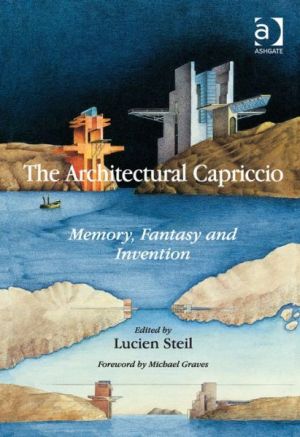 Bringing together leading writers and practicing architects including Jean Dethier, David Mayernik, Massimo Scolari, Robert Adam, David Watkin and Leon Krier, this volume provides a kaleidoscopic, multilayered exploration of the architectural capriccio. It not only explains the phenomena within a historical context, but moreover, demonstrates its contemporary validity and appropriateness as a holistic design methodology, an inspiring pictorial strategy, an efficient rendering technique and an optimal didactic tool. The book shows and comments on a wide range of historic masterworks and highlights contemporary artists and architects excelling in a modern updated, refreshed and original tradition of the capriccio. The capacity of the capriccio to create an imaginary, imagined or ‘analogue’ reality by combining and relocating existing or invented buildings and places in uniquely suggestive drawings and paintings offers unprecedented insights in the ‘Architectural Mind’.
Unlike what the word capriccio might suggest, it is not ‘capricious’ but indeed follows complex rules of realism and figuration, as well as coherent narratives and semantics. It is a playful reflection of the dialectics of the real and the ideal. The capriccio does not challenge the mechanism of reality, but questions the mechanic and linear reading of the real, of life and of art and offers a large palette of threads, figures, tones and nuances to illustrate and contribute creatively to the complexity of a sustainable built and living architectural environment.
Lucien Steil is an Associate Professor in Architecture at the University of Notre Dame, Indiana and Rome.
◊ ◊ ◊ ◊ ◊
C O N T E N T S
• Foreword: Capriccio: The efficacy of spatial narrative, Michael Graves
• Preface: The Architectual Capriccio: Memory, fantasy, invention, Lucien Steil
• Introduction, Alireza Sagharchi
• ‘Il Capriccio’, Definition of the capriccio (caprice) in the French Larousse Dictionary, trans. Julie Kleinman
• Meaning and purpose of the Capriccio, David Mayernik
• The poietic image, Samir Younés
• The Capricci of Giovanni Paolo Panini, David Mayernik
• Patronage in the golden age of the Capriccio, Selena Anders
• The grand tour, Lucien Steil
• Capriccio: The leap of the goat or the unexpected, Jose Cornelio da Silva
• Metaphors for a political urban landscape: Schinkel’s Capricci of a ‘new Athens-on-the-Spree’, Jean-François Lejeune
• J.M. Gandy’s composite views for John Soane, William Palin
• American Capriccio: Imaginary architecture in nineteenth-century painting, Gail Leggio
• The Capricci of Carl Laubin, David Watkin
• Symmetria and ethics: The didactic Capriccio, David Ligare
• Settings: Emily Allchurch and the old masters, Xavier Bray and Minna Moore Ede
• Massimo Scolari, Leon Krier
• Drawing, Leon Krier
• Capriccio, Leon Krier
• ‘Imago Luxemburgi’, Leon Krier
• The Capriccio and poetical realism, Lucien Steil
• Urban chiaroscuro (after Piranesi): Behind the scenes, Emily Allchurch
• Sublime architecture: Capricci in sketchbook and paintings, Lucien Steil
• Le Corbusier’s eye and the vanishing point of modernity, David Brain
• The architectural project: An homage to Rob Krier, Lucien Steil
• ‘La citta analoga’: Thoughts on the urban Capriccio for the design of real cities, Pier Carlo Bontempi
• Magical realism in Miami, Javier Cenicaceleya
• A very British Capriccio, Alireza Sagharchi
• Building the Capriccio, Robert Adam
• Capricci capricciosi, Ettore Maria Mazzola
• The double nature of the architectural Capriccio: From pictorial fiction to urban reality, Jean Dethier
• Postface: ‘techne’ and technology, Lucien Steil
• The aura of the computer generated image: Or virtuosity and the cult of the artifact, Dialog between Alireza Sagharchi and Gil Gorski
• Index
Exhibition | Things We Do in Bed
From the exhibition description at Art Daily:
Things We Do in Bed
Danson House, Bexleyheath, Kent, 1 April — 31 October 2014
Curated by Tracy Chevalier
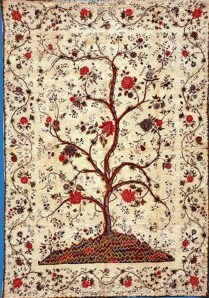
Tree of Life Quilt cropped, detail, c.1810 (Jen Jones Welsh Quilt Centre)
Things We Do in Bed celebrates quilts and their continuing links to what goes on behind the bedroom door. Featuring quilts and quilt works dating from the 18th and 19th centuries, alongside contemporary work, the exhibition is displayed through the five bedrooms in Danson House, with each room focusing on a different bed activity: Birth, Sleep, Sex, Illness, Death.
The exhibition features a lively mix of antique and contemporary quilts including:
• intricate 18th- and 19th-century cot quilts with quilted feathers and flowers and colourful patchwork designs
• a new ‘sleep quilt’ from Fine Cell Work, a charity that teaches prisoners to sew; prisoners all over the UK were asked to make squares exploring their feelings about sleep, and join them together in this quilt
• Karina Thompson’s quilt which captures an echocardiogram examining the maker’s heartbeats
• Grayson Perry’s Right to Life quilt, made as a provocative response to the abortion debate in the USA
 • Sue Watters’ hand stitched quilt, Unchained Melody which she made sitting by her husband’s side while he was in the final stages of Alzheimer’s, with sewing and music as her solace
Tracy Chevalier is an internationally bestselling author of seven novels. In her most recent book, The Last Runaway, her heroine is a quilter. As well as learning a lot about quilts, Tracy learned to quilt by hand. As she says: “Since researching quilts for my last novel, I have fallen hard for the varied and miraculous artistry of quilting. With this show I explore how quilting relates to bedroom activities, in both practical and abstract ways. For traditionalists, there are jaw-dropping examples of antique quilt-making. For contemporary art lovers, there are works that push boundaries and emotions.”
◊ ◊ ◊ ◊ ◊
Hannah Duguid writes about the exhibition for The Independent (8 April 2014).
Call for Papers | Facing the Unknown: Anonymity in the History of Art
From the symposium website:
Student Symposium | Facing the Unknown: Anonymity in the History of Art
The Cleveland Museum of Art, 24 October 2014
Proposals due by 15 June 2014
The Case Western Reserve University/Cleveland Museum of Art Joint Graduate Program in Art History & Museum Studies invites submissions from all areas of art history for the 40th Annual Cleveland Symposium. Facing the Unknown: Anonymity in the History of Art seeks papers which address the theme of anonymity or the unknown in the visual arts. The obscurity of an artist, subject, function, or context may be a byproduct of the passage of time, of traditional cultural practices, or a conscious decision on the part of the maker. This symposium aims to explore the ways in which an anonymous aspect of a work may influence its interpretation, function, classification, or perceived value throughout the object’s history.
Potential topics include, but are not limited to:
• Anonymous artists or makers
• Images of unknown subjects or for unknown patrons
• Objects with undetermined function or context
• Works of questionable authenticity, attribution, dating, or provenance
• Objects with elements that have been deliberately effaced, obscured, or omitted
• Lost works of art
• Previously unknown, unstudied, or unpublished artists or artworks
• Intentional use of anonymity, including works that mask or conceal identity
Doctoral and master’s degree students in art history and related disciplines are invited to submit a 250-word abstract and C.V. to clevelandsymposium@gmail.com by June 15, 2014. Applicants will receive notification of their status via email by August 1, 2014.
The 40th Annual Cleveland Symposium will be held in conjunction with the Symposium in Honor of Ellen G. Landau, Andrew W. Mellon Professor Emerita in the Humanities, to take place on Saturday, October 25, 2014 at the MOCA Cleveland. The keynote speaker for both events is Dr. Joan Marter, Board of Governors Professor of Contemporary Painting and Sculpture, Rutgers University, who will speak after the conclusion of the program on Friday October 24.
Newly Conserved and Renovated Salon Doré Unveiled

◊ ◊ ◊ ◊ ◊
The newly restored Salon Doré has just opened at the Legion of Honor Museum in San Francisco:
The Salon Doré from the Hôtel de La Trémoille is one of the finest examples of French Neoclassical interior architecture in the United States. Richly carved and ornately gilded, it was designed during the reign of Louis XVI as the main salon de compagnie—a receiving room for guests—of the Hôtel de La Trémoille on the rue Saint-Dominique in Paris.
After being moved not less than seven times between 1877 and today, its appearance and presentation was greatly changed from its original aspect. For a period of 18 months from 2012 to 2014, the Fine Arts Museums of San Francisco closed the Salon Doré and the adjacent British art gallery at the Legion of Honor to allow for the comprehensive conservation and renovation of this important 18th-century period room.
Over the course of the conservation and renovation project, curators, conservators, and architects reinstated the room’s original floor plan, restored the gilding and paint, repaired and replaced key carved elements, and installed an 18th-century parquet floor, a coved ceiling, windows, and new lighting.
In its new installation, a new program of period furnishings bring renewed focus to the room’s character and original purpose by demonstrating the social function of the room as a salon de compagnie, a formal room for receiving guests and conversation. The renovated Salon Doré at the Legion of Honor is a truly groundbreaking museum display that sets a new standard for American period rooms.
◊ ◊ ◊ ◊ ◊
The museum’s website includes several instructive videos explaining the project.
The Style Saloniste, the blog of Diane Dorrans Saeks, includes a report (31 March 2014) by Philip Bewley, who spoke with both the museum curator Martin Chapman and project architect Andrew Skurman.
New Book | Globes: 400 Years of Exploration, Navigation, and Power
From The University of Chicago Press:
Sylvia Sumira, Globes: 400 Years of Exploration, Navigation, and Power (Chicago: The University of Chicago Press, 2014), 224 pages, ISBN: 978-0226139005, $45.
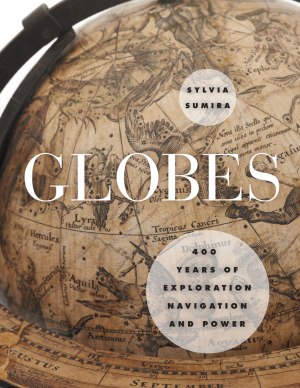 The concept of the earth as a sphere has been around for centuries, emerging around the time of Pythagoras in the sixth century BC, and eventually becoming dominant as other thinkers of the ancient world, including Plato and Aristotle, accepted the idea. The first record of an actual globe being made is found in verse, written by the poet Aratus of Soli, who describes a celestial sphere of the stars by Greek astronomer Eudoxus of Cnidus (ca. 408–355 BC). The oldest surviving globe—a celestial globe held up by Atlas’s shoulders—dates back to 150 AD, but in the West, globes were not made again for about a thousand years. It was not until the fifteenth century that terrestrial globes gained importance, culminating when German geographer Martin Behaim created what is thought to be the oldest surviving terrestrial globe. In Globes: 400 Years of Exploration, Navigation, and Power, Sylvia Sumira, beginning with Behaim’s globe, offers a authoritative and striking illustrated history of the subsequent four hundred years of globe making.
Showcasing the impressive collection of globes held by the British Library, Sumira traces the inception and progression of globes during the period in which they were most widely used—from the late fifteenth century to the late nineteenth century—shedding light on their purpose, function, influence, and manufacture, as well as the cartographers, printers, and instrument makers who created them. She takes readers on a chronological journey around the world to examine a wide variety of globes, from those of the Renaissance that demonstrated a renewed interest in classical thinkers; to those of James Wilson, the first successful commercial globe maker in America; to those mass-produced in Boston and New York beginning in the 1800s. Along the way, Sumira not only details the historical significance of each globe, but also pays special attention to their materials and methods of manufacture and how these evolved over the centuries.
Sylvia Sumira is a leading authority on historic globes and one of few conservators in the world to specialize in printed globes. She worked at the National Maritime Museum, Greenwich before setting up her own studio, where she carries out conservation work for museums, libraries, and other institutions, as well as for private owners. She lives in London.
Exhibition | The Three Graces of Antonio Canova

From the Canova Museum:
Le Grazie di Antonio Canova
Museo e Gipsoteca Antonio Canova, Possagno, 6 December 2013 — 4 May 2014
Canova le ha interpretate in due esemplari, molto simili. Il primo, ora all’Ermitage di San Pietroburgo, glielo commissionò Josephine de Beauharnais, all’epoca moglie di Napoleone; il secondo al Duca di Bedford che, visto il gesso che lo scultore teneva nel suo atelier romano, lo supplicò di creargli un ulteriore esemplare in marmo. Canova riprese il modello, apportando piccoli cambiamenti e, quasi per allontanare il momento di distacco dall’opera, l’accompagnò personalmente sino alla nuova dimora inglese. Oggi quel magnifico marmo è equamente suddiviso, sette anni ciascuno, dalla National Gallery of Scotland di Edimburgo e dal Victoria & Albert Museum di Londra.
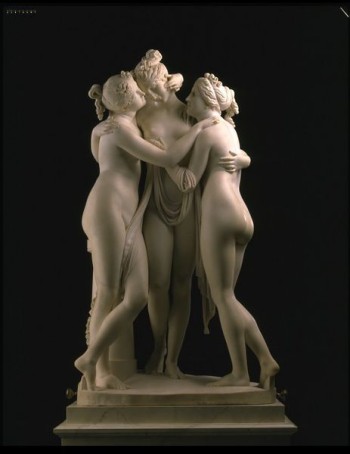
Antonio Canova, The Three Graces (London: V&A)
Dall’inizio di quelle vicende sono passati esattamente due secoli: il modello originale in gesso delle Grazie è infatti datato 1813. In questi due secoli la fama delle tre bellezze canoviane è diventata universale. La sinuosità delle forme femminili, la delicatezza e la morbidezza nonché la ricercata levigatezza del marmo determinano un gioco di luci ed ombre che affascinano chiunque le ammiri.
Nella sua Casa-Museo, nella natia Possagno, Canova lasciò il gesso originale della prima versione delle Grazie, quel gesso su cui aveva lavorato per creare il suo capolavoro. La levigatezza del marmo finale era qui ricreata da una patina in cera d’api. A Possagno giunse anche il gesso tratto dalle Grazie inglesi, quale documento da conservare a perenne memoria dell’arte del grande scultore.
Grazia e violenza non vanno d’accordo. Lo conferma, se ce ne fosse bisogno, il destino dei due capolavori del Canova. I gessi, con altre opere conservate nella Gipsoteca vennero investiti dalla nuvola di calcinacci causata dai cannoneggiamenti austroungarici durante la Prima Grande Guerra, quando Possagno, ai piedi del Grappa, era zona di battaglia. Particolarmente gravi i danni subiti dal gruppo “inglese” che vide le Grazie ritrovarsi con volti e busti drammaticamente lesionati. All’indomani del conflitto, Stefano e Siro Serafin, custodi e abilissimi restauratori, sanarono molti dei danni. Non agirono invece sulle Grazie di Bedfod che, deturpate trovarono sede nella sala del consiglio comunale di Possagno, a stridente ricordo di un guerra terribile per il paese. Il secondo gruppo di Grazie, restaurato è esposto nell’Ala Scarpiana della Gipsoteca.
A cent’anni dallo scoppio della Grande Guerra, mentre l’Europa si appresta a ricordare quel centenario, anche le Grazie “inglesi” risorgono, ritrovando tutte le loro parti. Quello che i Serafin non si sentirono di fare lo consente ora la tecnologia.
Grazie alla collaborazione delle National Galleries of Scotland, di Edinburgo, proprietari del prezioso marmo, è stato possibile fotografare e scansionare l’opera e grazie all’elettronica si è riusciti a ricomporre le parti mancanti al gesso di Possagno.
“Se Canova avesse lasciato sul marmo una sola impronta digitale, la ritroveremmo sul gesso restaurato”. Ad affermarlo è Mario Guderzo Direttore del Museo e Gipsoteca Antonio Canova di Possagno che, con Ugo Soragni, Direttore Regione per i Beni Culturali, Giuseppe Pavanello, dell’Università di Trieste e Direttore del Centro Studi Canoviani di Possagno, Marica Mercalli, Soprintendente per i Beni Storici e Artistici ed Etnoantropologici per le Province di Venezia, Padova, Belluno e Treviso e Aidan Weston Lewis, dello Scottish National Gallery di Edinburgo, Guancarlo Cunial della Gipsoteca di Possagno, componenti dell Comitato Scientifico della mostra. A dire dell’incredibile grado di perfezione raggiunto da questa tecnica, che aveva già dato prova di sé per un altro gesso di Canova, la Danzatrice, anch’essa deturpata dalla guerra, che ha ritrovato braccia e cembali.
In mostra, dal 7 dicembre al 4 maggio, si potranno ammirare entrambi gruppi delle Grazie, quello “russo”, e quello “inglese” così recuperato. Con i gessi, i due bozzetti, l’uno proveniente dal Museo di Lione, il secondo oggi di proprietà del Museo di Bassano. Poi tempere, disegni, incisioni, sempre intono al tema delle Grazie.
Mostra nella mostra è l’esposizione delle crude immagini della Gipstoteca e dei Gessi di Canova all’indomani dei bombardamenti: immagini concesse da due archivi pubblici, drammatiche nella volontà di costituire una precisa documentazione di un orrore.
“Questa mostra, afferma il Presidente della Fondazione Canova, Giancarlo Galan, sarà un’ulteriore conferma della centralità del patrimonio canoviano conservato gelosamente a Possagno e ne sottolineerà l’impegno espresso in termini di tutela e valorizzazione delle opere. Rimane fondamentale per la Storia dell’arte quanto Canova ha voluto lasciare alla sua terra facendola, così, diventare il centro mondiale dell’arte del grande Scultore.
New Book | Mimesis Across Empires
From Duke UP:
Natasha Eaton, Mimesis across Empires: Artworks and Networks in India, 1765–1860 (Durham: Duke University Press, 2013), 352 pages, ISBN: 978-0822354802, $30.
 In Mimesis Across Empires, Natasha Eaton examines the interactions, attachments, and crossings between the visual cultures of the Mughal and British Empires during the formative period of British imperial rule in India. Eaton explores how the aesthetics of Mughal ‘vernacular’ art and British ‘realist’ art mutually informed one another to create a hybrid visual economy. By tracing the exchange of objects and ideas—between Mughal artists and British collectors, British artists and Indian subjects, and Indian elites and British artists—she shows how Mughal artists influenced British conceptions of their art, their empire, and themselves, even as European art gave Indian painters a new visual vocabulary with which to critique colonial politics and aesthetics. By placing her analysis of visual culture in relation to other cultural encounters—ethnographic, legislative, diplomatic—Eaton uncovers deeper intimacies and hostilities between
the colonizer and the colonized, linking artistic mimesis to the larger colonial
project in India.
Natasha Eaton is a Lecturer in the History of Art at University College London.
◊ ◊ ◊ ◊ ◊
C O N T E N T S
List of Illustrations
Acknowledgments
Introduction
1. Colonizing the Exotic: Indian and Colonial Art in London
2. The Mirroring of Mirrors: Nostalgia, Sovereignty, and Unhomely Images in Calcutta
3. Mimicking Kingship: Sovereign Genealogies, Vernacular Landscape, and the Work of William Hodges
4. Art and Gift in India: Mimesis and Inalienability
5. Sacrifice and the Double: Physiognomy, Divination, and Ethnographic Art in India
Conclusion
Notes
Works Cited
Index
New Book | Colour, Art, and Empire
From Macmillan:
Natasha Eaton, Colour, Art, and Empire: Visual Culture and the Nomadism of Representation (London: I. B. Tauris, 2013), 416 pages, ISBN: 978-1780765198, $105.
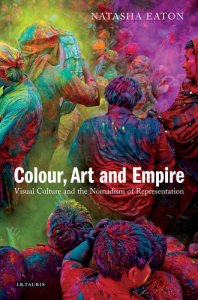 Colour, Art and Empire explores the entanglements of visual culture, enchanted technologies, waste, revolution, resistance and otherness. The materiality of color offers a critical and timely force-field for approaching afresh debates on colonialism. Located at the thresholds of nomenclature, imitation, mimesis and affect, this book analyses the formation of color and politics as qualitative overspill. Here color can be viewed both as central and supplemental to early photography, the totem, alchemy, tantra and mysticism. From the 18th-century Austrian empress Maria Theresa, to Rabindranath Tagore and Gandhi, to 1970s Bollywood, color makes us adjust our take on the politics of the human sensorium as defamiliarizing and disorienting.
Color wreaks havoc with western expectations of biological determinism, objectivity and eugenics. Beyond the cracks of such discursive practice, color becomes a sentient and nomadic retort to be pitted against a perceived colonial hegemony. Its alter materiality’s and ideological reinvention as a resource for independence struggles, makes color fundamental to multivalent genealogies of artistic and political action and their relevance to the present.
Natasha Eaton is a Lecturer in the History of Art at University College London.
◊ ◊ ◊ ◊ ◊
C O N T E N T S
1. Introduction: Chromo Zones and the Nomadism of Colour
2. Alchemy, Painting and Revolution in India, 1750–1860
3. Supplement, Subaltern Art, Design and Dyeing in Britain and South Asia, 1851–1905
4. Part 1: Still Dreaming of the Blue Flower? Race, Anthropology and the Colour Sense
5. Part 2: Creole Laboratory: Anthropology and Affect in the Torres Strait
6. Swadeshi Colour Throughout the Philtre/Filter of Indian Nationalism, 1905–1947










 Enfilade
leave a comment